




Most eCommerce sellers obsess over traffic and conversion rate while their fulfillment operation silently drains margin and destroys repeat purchase rates. Understanding what is order fulfillment means recognizing that every step between a confirmed order and a delivered package is a direct touchpoint with your customer's loyalty. This article breaks down how fulfillment actually works, what a scalable model looks like, and where most brands leave money and customers behind.
Key Takeaways
- Order fulfillment is the complete operational process that bridges a customer purchase to a delivered product, encompassing inventory, picking, packing, shipping, and returns.
- Fulfillment speed and cost transparency are the two most decisive factors in whether a first-time buyer becomes a repeat customer.
- Amazon FBA sellers have a structural fulfillment advantage, but unlocking maximum margin requires pairing it with Amazon Attribution and the Amazon Brand Referral Bonus.
- DTC brands can compete on fulfillment without Amazon's network by investing in the right third-party logistics partner and setting consistent delivery promises.
- Measuring fulfillment performance requires a named metric model, not just tracking shipped-on-time rates in isolation.
Why Order Fulfillment Defines the Entire Customer Experience
Most brand teams treat fulfillment as a back-end cost center owned by operations. The reality is that every moment between checkout and doorstep is a brand experience that either reinforces or erodes customer trust. Fulfillment is the physical embodiment of your brand promise. Sellers who understand this shift their thinking from "how cheaply can we ship?" to "how consistently can we deliver?"
According to Grand View Research's e-commerce fulfillment market analysis, the global e-commerce fulfillment services market was estimated at $123.68 billion in 2024 and is projected to reach $272.14 billion by 2030, growing at a CAGR of 14.2%. That rate of investment reflects how seriously the entire supply chain industry is taking fulfillment as a strategic asset. Opensend's order fulfillment time research shows that average U.S. delivery expectations have dropped from 5.7 days five years ago to 2.5 days in 2024, with projections reaching 1.5 days by 2029. The window for "acceptable" fulfillment is closing every year.
Here is what this means for eCommerce sellers in practical terms:
- Speed is a hygiene factor, not a differentiator: Delivering in two days no longer earns loyalty points; it just avoids losing customers.
- Transparency is the real competitive lever: Accurate estimated delivery dates outperform fast-but-opaque shipping in customer satisfaction surveys.
- Fulfillment failure is invisible until it is not: A single bad delivery experience is more likely to trigger a negative review than five average experiences are to trigger a positive one.
- Cost absorption is a strategic choice: Whether you absorb shipping costs or pass them through signals brand positioning to your customer.
The micro-influencer marketing strategies that drive traffic to your storefront only pay off when your fulfillment operation can support the demand spike they create. Sending 500 micro-influencer visits to a product listing that ships in seven days is a direct path to a wave of one-star reviews.
What Is Order Fulfillment?
Order fulfillment is the end-to-end operational process by which an eCommerce business receives, processes, and delivers a customer's order, including any returns or exchanges that follow. It begins the moment a purchase is confirmed and ends when the customer either accepts the delivery or completes a return. For most eCommerce businesses, it encompasses inventory management, order receipt and processing, picking and packing, carrier handoff, shipment tracking, and reverse logistics.
Data from Capital One Shopping's ecommerce delivery research shows that 63% of consumers choose a different retailer for later purchases if shipping takes longer than two days. That single statistic explains why fulfillment is a revenue decision, not just an operations decision. The model a seller chooses, whether in-house, outsourced to a third-party logistics provider (3PL), or delegated to Amazon FBA, directly determines which customers they keep.
The three primary fulfillment models every eCommerce seller should understand are:
- In-house fulfillment: The brand manages its own warehouse, staff, and shipping, giving maximum control but requiring capital investment that rarely pencils out below a few hundred orders per day.
- Third-party logistics (3PL): An outsourced warehouse partner handles storage, picking, packing, and shipping, allowing the brand to scale without owning infrastructure.
- Amazon FBA (Fulfillment by Amazon): Sellers send inventory to Amazon's fulfillment centers, and Amazon handles picking, packing, shipping, customer service, and returns for orders placed on the Amazon storefront.
For Amazon sellers, FBA is the dominant model because it unlocks Prime eligibility, which directly affects conversion rate and search ranking. For DTC brands selling across Shopify and other channels, a 3PL that integrates with multiple storefronts is often the more practical path to multi-channel order management.
The Fulfillment Flow Map: A 5-Stage Operational Framework
The Fulfillment Flow Map is a strategic framework for understanding order fulfillment as a continuous, customer-facing sequence rather than a collection of disconnected warehouse tasks. Rather than thinking in departmental silos, the Fulfillment Flow Map traces the customer's experience through five named stages, each with a distinct success metric and failure mode. Sellers who apply this framework consistently reduce both operational waste and customer churn at the same time.
According to Analyzify's cart abandonment research, 48% of online shoppers abandon their carts due to extra costs such as shipping fees. This means fulfillment economics must be resolved before checkout, not after. Stage one of the Fulfillment Flow Map is where that cost decision happens.
The five stages of the Fulfillment Flow Map are:
- Stage 1 -- Inventory Positioning: Stocking the right SKUs in the right quantities at the right fulfillment locations before demand arrives. Failure mode is stockout during a traffic spike.
- Stage 2 -- Order Receipt and Processing: Capturing the order from the storefront, validating payment, and releasing the pick ticket. Failure mode is processing delays that inflate fulfillment time without any carrier involvement.
- Stage 3 -- Pick and Pack: Physically pulling the correct items and packaging them to specification, including inserts, kits, and branded unboxing elements. Failure mode is incorrect or damaged items shipped.
- Stage 4 -- Carrier Handoff and Transit: Handing the package to the carrier and managing in-transit exceptions, including rerouting, delays, and lost parcels. Failure mode is poor carrier selection that creates a systematic delay pattern.
- Stage 5 -- Delivery and Post-Purchase: Confirmed delivery, customer notification, and the window for returns or exchanges. Failure mode is a missing or unclear return policy that converts a neutral experience into a negative one.
Return the Fulfillment Flow Map to your team as a diagnostic lens, not a one-time exercise. Running through all five stages monthly reveals which stage is generating the most customer complaints before those complaints become public reviews.
Stack Influence has observed that eCommerce brands running product seeding campaigns typically see the highest volume of new-to-brand orders in the 72 hours immediately following a creator post. Brands that have Stage 2 and Stage 3 of the Fulfillment Flow Map optimized for burst capacity consistently report stronger creator campaign ROI because the post-click experience matches the discovery-phase excitement.
The Fulfillment Fitness Audit: A Pre-Scale Checklist

Before any eCommerce seller invests in paid traffic, influencer campaigns, or marketplace expansion, their fulfillment infrastructure should pass a readiness check. The Fulfillment Fitness Audit is a six-item checklist designed to surface the operational gaps most likely to create customer-experience failures under volume. Think of the Fulfillment Fitness Audit as the pre-flight check that runs before any growth initiative launches.
As reported by Supply Chain Dive, Amazon increased its FBA fulfillment fees for third-party sellers by an average of $0.08 per unit starting January 15, 2026. While that increment appears small per unit, it compounds quickly across high-volume SKUs and changes the break-even calculus for sellers running thin margins. Running the Fulfillment Fitness Audit before scaling volume ensures that fee structure changes do not become a surprise margin event.
The six items in the Fulfillment Fitness Audit are:
- Audit Item 1 -- Inventory Forecasting Accuracy: Do you have at least 30 days of forward inventory visibility for your top 20% of SKUs by revenue? If not, you are one traffic spike away from a stockout.
- Audit Item 2 -- Fulfillment SLA Documentation: Is your promised ship-by time documented and enforced at the warehouse or fulfillment partner level? Undocumented SLAs produce inconsistent customer experiences.
- Audit Item 3 -- Carrier Diversification: Are you relying on a single carrier for more than 80% of shipments? Single-carrier dependency is a systemic risk during peak seasons and regional disruptions.
- Audit Item 4 -- Return Rate by SKU: Do you track return rates at the SKU level? A 15% return rate on one product signals a quality, packaging, or listing-accuracy problem, not a logistics problem.
- Audit Item 5 -- Fee Modeling Under Volume: Have you modeled your Amazon FBA fees, referral fees, and storage fees at 2x and 3x current order volume? Fee compression is the most common cause of margin erosion as Amazon sellers scale.
- Audit Item 6 -- Multi-Channel Inventory Sync: If you sell on both an Amazon storefront and a DTC site, is inventory updated in real time across both? Overselling a single unit on two channels simultaneously creates the fulfillment failure customers remember.
The Fulfillment Fitness Audit is not a one-time gate. Revisit it every quarter, and especially before Q4 inventory deadlines and before launching any influencer seeding campaign designed to drive significant order volume.
From Stack Influence's experience running product seeding campaigns for eCommerce brands, sellers who pre-qualify their fulfillment infrastructure using a structured checklist before campaign launch see measurably lower post-campaign return rates and negative review incidence. Brands that skip the pre-launch audit tend to absorb the cost of fulfillment failures in their creator campaign attribution data, making the campaign appear less effective than the traffic quality actually warrants.
What Most Guides Get Wrong About Fulfillment
The standard advice for eCommerce sellers on fulfillment is to prioritize speed above everything else. Get inventory into an Amazon FBA warehouse, turn on two-day shipping, and the customer experience problem is solved. That framing is incomplete, and for many DTC brands, it actively misdirects budget and attention.
A 2025 ShipStation Ecommerce Delivery Benchmark Report surveying over 8,000 consumers found that 60% expect free two-day shipping, yet only 35% of retailers can deliver on that promise. The insight buried in that gap is not that brands need to invest more in speed infrastructure. It is that delivery transparency, knowing exactly when a package will arrive, consistently outperforms raw delivery speed as a driver of customer satisfaction. Speed that cannot be communicated reliably is worth less than a slightly slower delivery that arrives when promised.
Here is what this reframe means for sellers applying the Fulfillment Flow Map:
- Most sellers optimize Stage 4 (carrier handoff and transit speed) when Stage 5 (delivery notification and communication) drives more repeat purchase intent.
- An accurate estimated delivery date at checkout converts better than a fast-but-vague timeline, per consumer preference data across multiple 2025 surveys.
- Brands running external traffic campaigns through influencer seeding benefit more from delivery accuracy than from delivery speed because discovery-phase buyers have lower urgency expectations than intent-based searchers.
Stack Influence's internal campaign data shows that eCommerce brands that set accurate delivery expectations in post-purchase email sequences, particularly within the first 24 hours of order placement, report higher UGC submission rates from seeded product recipients. When creators receive products on time and as expected, the resulting content quality and posting rate both improve. The fulfillment experience is also a creative brief.
For Amazon sellers, this means that the Amazon Attribution tagging on your off-Amazon traffic campaigns should be paired with delivery promise analysis, not just conversion tracking. When a campaign drives traffic to a Prime-eligible listing, the two-day delivery badge is doing critical conversion work that your ad creative does not need to replicate.
How Amazon Sellers Turn Fulfillment Into a Margin Strategy
Amazon FBA is the dominant fulfillment model for Amazon sellers for reasons that go beyond convenience. FBA inventory is Prime-eligible by default, which directly increases listing conversion rate and search ranking position. But the financial upside of Amazon's fulfillment infrastructure extends well beyond the operational layer when sellers activate the full Amazon Attribution and Amazon Brand Referral Bonus stack.
Amazon Attribution is a free measurement tool that allows brand-registered Amazon sellers to track off-Amazon marketing campaigns, including influencer content, social ads, and email, through unique attribution tags that link external clicks to Amazon purchases. The Amazon Brand Referral Bonus is a credits program that pays enrolled sellers back an average of 10% of qualifying sales generated by those external traffic campaigns. The two tools function as a closed-loop system: Attribution measures the traffic source, and the Brand Referral Bonus converts that measurement into a direct margin benefit.
Here is how the external traffic loop works for Amazon sellers using both tools:
- Step 1: Create Amazon Attribution tags for each external traffic source, whether influencer posts, email campaigns, or paid social ads.
- Step 2: Distribute those tagged links through your external marketing channels, including through micro-influencer promotions that drive qualified traffic to your product listing or Amazon storefront.
- Step 3: When a shopper clicks the tagged link and purchases within the 14-day attribution window, Amazon records the sale as attributed external traffic.
- Step 4: Amazon credits your account with the Brand Referral Bonus on those sales, which automatically offsets future referral fees.
- Step 5: Use Attribution reporting to identify which traffic sources generate the highest-converting visits, then reallocate campaign spend accordingly.
For DTC brands selling on Shopify who are not yet on Amazon, the same framework logic applies at the 3PL level. Track which marketing channels drive the highest average order values, and use that data to make inventory positioning decisions that reduce both fulfillment time and storage cost.
Across campaigns managed on the Stack Influence platform, Amazon sellers who activated Amazon Attribution tagging before launching micro-influencer product seeding campaigns were able to identify which creator traffic sources generated Brand Referral Bonus-eligible conversions. Those brands saw an average 10 to 12 percentage point improvement in the measurable ROI of their influencer campaigns compared to sellers who drove external traffic without attribution tags. The bonus effectively subsidizes the external marketing cost, making influencer-driven traffic more margin-efficient than it appears on a gross basis.
How Do You Measure Whether Fulfillment Is Actually Working?
Measuring fulfillment performance with a single metric like "on-time shipping rate" is like measuring a store's health by counting how many customers walk through the front door. It tells you one thing without context. The Fulfillment Revenue Stack is a four-component named metric model designed to give eCommerce sellers a complete picture of whether their fulfillment operation is supporting or suppressing revenue growth.
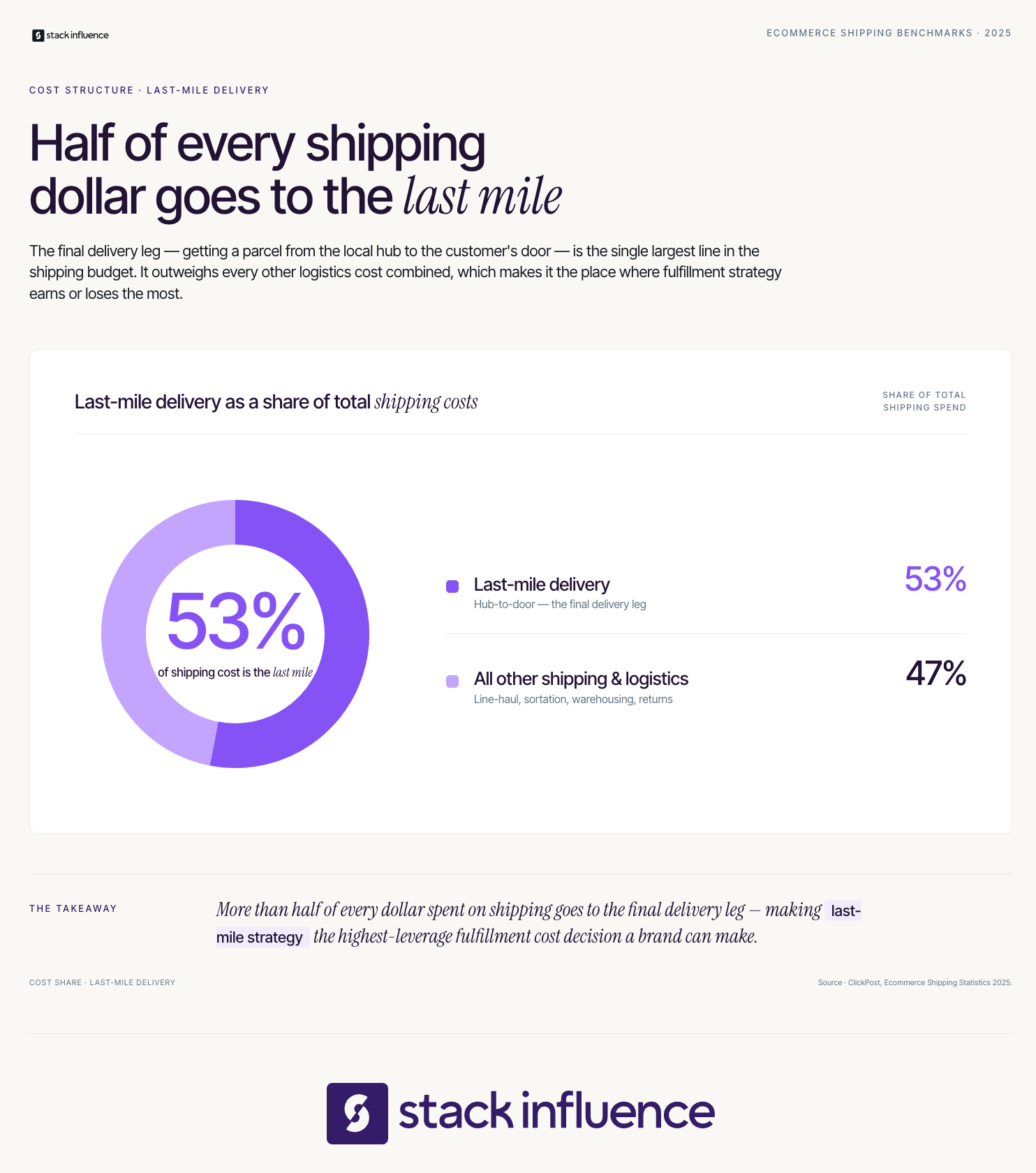
According to ClickPost's ecommerce shipping statistics, last-mile delivery accounts for over 53% of total shipping costs, making it the most expensive component of the entire logistics chain. That cost concentration means the measurement model must capture both cost-side and revenue-side outputs, not just speed metrics.
The four components of the Fulfillment Revenue Stack are:
- Component 1 -- Fulfillment Cost Per Order (FCPO): Total fulfillment spend divided by total orders shipped. FCPO includes pick, pack, shipping, and any 3PL handling fees. This is the cost-side anchor for all other calculations.
- Component 2 -- Delivery Promise Accuracy Rate (DPAR): The percentage of orders that arrive within the delivery window communicated at checkout. DPAR is more predictive of repeat purchase rate than raw transit time.
- Component 3 -- Post-Fulfillment Revenue Rate (PFRR): Revenue captured within 30 days of a customer's first fulfilled order, including repeat purchases and upsells triggered by post-purchase flows. This reveals whether your fulfillment experience converts first-time buyers into second-purchase customers.
- Component 4 -- Attribution-Adjusted Return on Ad Spend (AA-ROAS): For Amazon sellers using Amazon Attribution, this measures ROAS after accounting for Brand Referral Bonus credits earned on attributed sales. AA-ROAS is frequently 15 to 20% higher than surface-level ROAS because the bonus reduces the effective cost of the external traffic.
Reference the Fulfillment Revenue Stack in your monthly performance reviews alongside the Fulfillment Flow Map. Together they give you a diagnostic for where the operational process breaks down and a financial measure of what that breakdown costs you.
Should DTC Brands Worry About Amazon's Fulfillment Advantage?
The common concern among DTC brands is that they cannot compete with Amazon sellers on fulfillment speed because they lack access to Amazon's nationwide fulfillment center network. That concern is real but narrower than most guides suggest. The fulfillment gap between a well-run 3PL and Amazon FBA is measured in hours in most major markets, not days. The practical gap is in Prime badge conversion lift, not in transit time.
DTC sellers on Shopify and other platforms who invest in a regional 3PL network with two-coast warehouse coverage can match Amazon FBA transit times on 70 to 80% of their order volume. The remaining gap is best addressed not by infrastructure investment but by delivery transparency, meaning a clear, accurate estimated delivery date displayed before and at checkout. What DTC brands lose in the Prime badge, they can recover in brand ownership, customer data access, and the ability to control the post-purchase experience in ways Amazon sellers cannot.
The most effective DTC fulfillment strategy is built around the Fulfillment Flow Map's Stage 5, which is delivery and post-purchase experience, rather than Stage 4, which is carrier speed. Building ambassador and affiliate programs that reward repeat buyers and engaging UGC creators to document the unboxing experience are both fulfillment-adjacent tactics that compound brand equity in ways that transit speed alone cannot.
Conclusion
Understanding what is order fulfillment means accepting that logistics and marketing are not separate functions. Every fulfillment decision, from which 3PL you choose to whether you activate Amazon Attribution, has a direct bearing on customer acquisition cost, repeat purchase rate, and margin. The Fulfillment Flow Map gives sellers the operational language to diagnose where the process breaks down. The Fulfillment Fitness Audit ensures the infrastructure is ready before volume arrives. The Fulfillment Revenue Stack translates operational performance into financial outcomes that connect directly to growth decisions. For eCommerce sellers who want to compete in 2026 and beyond, fulfillment is not the last mile. It is the whole race.