




Most creators spend years building an audience without ever understanding the system brands use to evaluate them. Influencer tiers, the follower-based categories that define how brands price, select, and approach creators, directly shape your earning power, the types of partnerships available to you, and how platforms categorize your reach. This guide breaks down every tier in plain language, introduces two practical frameworks for knowing where you stand and where to go next, and gives you the data to negotiate smarter at every stage of your career.
Key Takeaways
- Influencer tiers range from nano (1K–10K followers) to mega (1M+), and each tier carries distinct engagement benchmarks, pricing norms, and brand partnership expectations.
- Smaller tiers consistently outperform larger tiers in engagement rate, but brands use different tiers for different campaign goals.
- Knowing your tier helps you pitch brands more strategically, set fair rates, and identify which creator economy tools are built for your audience size.
- UGC creation opportunities exist at every tier but are fastest-growing at the nano and micro level.
- Transitioning between tiers requires intentional audience and content strategy, not just time.
What Are Influencer Tiers, and Why Do They Matter to You?
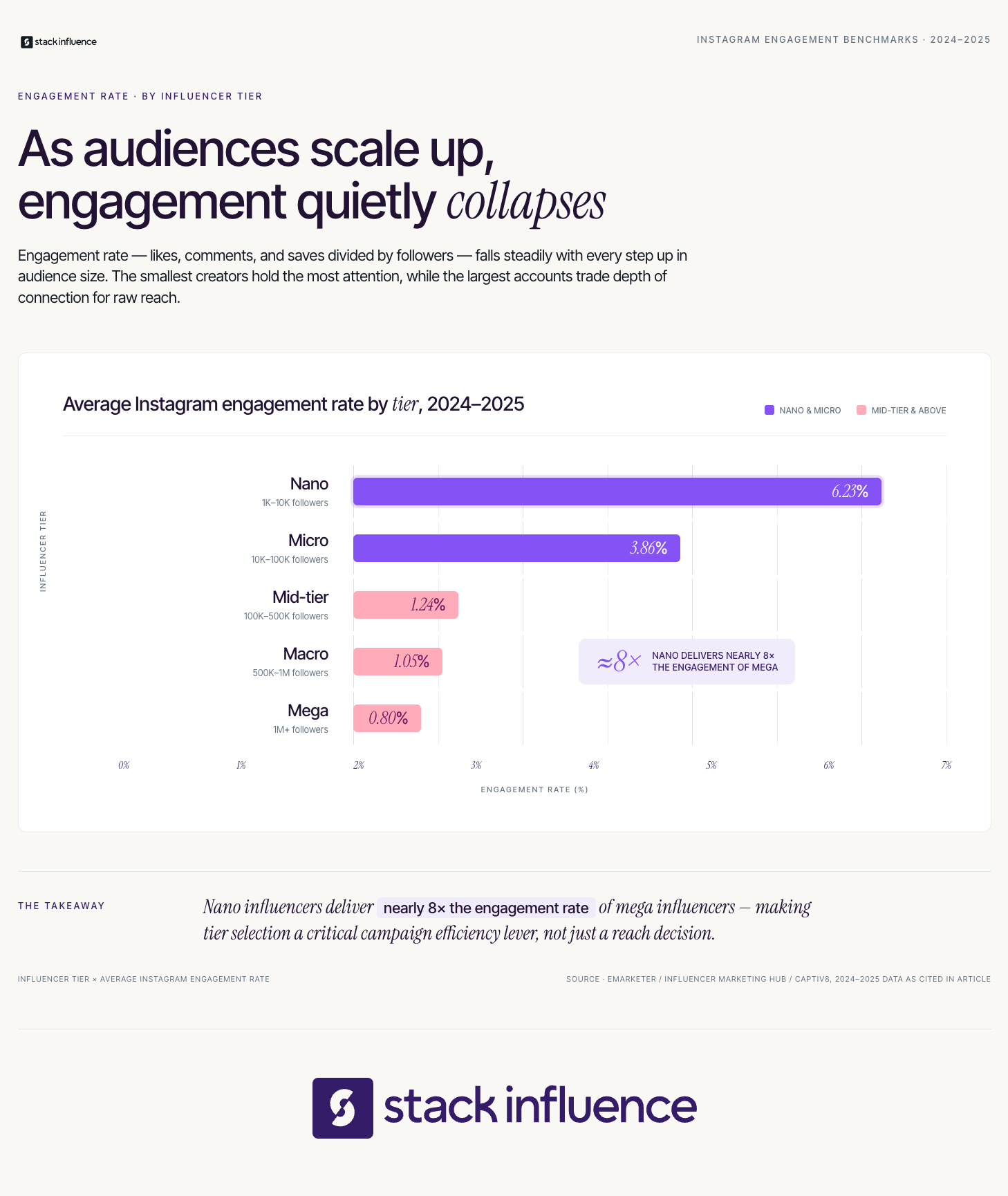
Influencer tiers are a classification system used across the influencer marketing industry to group creators by follower count, engagement benchmarks, and perceived audience reach. Brands, influencer marketing platforms, and agencies all use some version of this system to filter creator searches, set budgets, and structure brand partnerships. Understanding your tier is not just academic; it is the first step to knowing what you can charge, which brands are realistically looking for you right now, and how to position your pitch.
The five most widely used tiers are:
- Nano influencers: 1,000 to 10,000 followers. Highest engagement rates, peer-level trust, and lowest cost per post.
- Micro influencers: 10,000 to 100,000 followers. Strong niche authority, measurable conversion results, fast-growing preferred tier for ecommerce.
- Mid-tier influencers: 100,000 to 500,000 followers. Balanced reach and engagement, suited for awareness-plus-conversion campaigns.
- Macro influencers: 500,000 to 1 million followers. Broad visibility, established content operations, meaningful CPM for brand awareness.
- Mega influencers: 1 million or more followers. Celebrity-adjacent reach, premium pricing, best for mass market launches and prestige positioning.
Brands are increasingly engaging with nano, micro, and mid-tier influencers and shifting away from macro and mega influencers with larger followings. According to data from eMarketer, nano-influencers maintain the highest engagement rate across influencer categories on Instagram at 6.23%, with a notable trend of engagement rates decreasing as follower count increases.
The engagement gap between tiers is one of the most studied patterns in creator marketing. TikTok generally outperforms other platforms in terms of engagement rates across influencer sizes, but nano, micro, and mid-tier influencers maintain the highest engagement. Per a study from Influencer Marketing Hub, nano-influencers had a 10.3% engagement rate on TikTok in 2024, while micro-influencers came in at 8.7% and mid-tier landed at 7.5%.
Tier definitions vary slightly depending on which source, agency, or influencer marketing platform you consult. The ranges above represent the most widely cited consensus across industry research. When pitching a brand or filling out an application on a creator platform, use the range that matches the platform's own glossary, since even small definition differences can affect whether your profile surfaces in a campaign search.
How the Creator Tier Progression Model Works
The single most useful framework for thinking about your career trajectory is what this guide calls the Creator Tier Progression Model. It treats each tier not as a static label but as a stage in a progression, each with its own dominant activities, income sources, and strategic priorities. The model has five stages that mirror the five main influencer tiers, and it is referenced throughout this article to anchor every section to where you are right now.
The five stages of the Creator Tier Progression Model are:
- Stage 1 (Nano): Community builder. Focus is on audience depth, niche clarity, and producing content that earns trust. Income is primarily through product seeding and gifted partnerships. Key metric: engagement rate.
- Stage 2 (Micro): Conversion specialist. Audience has proven purchasing behavior, and brands pay for measurable results. Income includes paid posts, brand ambassador programs, and performance-based commissions. Key metric: click-through and conversion rate.
- Stage 3 (Mid-tier): Reach amplifier. Content operations are more professional. Brands use this stage for campaigns that need both reach and credibility. Income diversifies into licensing, UGC rights, and multi-post deals. Key metric: impressions plus conversion blend.
- Stage 4 (Macro): Brand partner. Campaigns involve negotiated media plans, content usage rights, and sometimes exclusivity. Income includes retainer deals and sponsored series. Key metric: CPM and brand lift.
- Stage 5 (Mega): Platform-level presence. Revenue includes equity, licensing, and enterprise-level brand sponsorship deals. Content strategy may involve a full team. Key metric: cultural reach and earned media value.
The Creator Tier Progression Model matters because it prevents creators from using the wrong success signals at the wrong stage. A nano creator chasing reach metrics is optimizing for the wrong thing entirely. A mid-tier creator who still prices like a micro creator is leaving significant money behind.
Stack Influence has observed that nano and micro creators who define clear niche positioning before reaching 10,000 followers tend to attract more repeat brand partnerships than those who grow broadly, because repeat brands signal authentic audience alignment rather than random spike traffic.
Understanding where you sit in the Creator Tier Progression Model also helps you identify the right influencer campaigns and platforms to apply for, since many brands filter their searches using the exact five-stage breakdown described here.
How Does Each Tier Affect Brand Deals and Rates?
Brand deals are structured very differently depending on which tier you occupy. Rates, deliverable expectations, approval cycles, and content rights terms all shift meaningfully as you move up the Creator Tier Progression Model. Understanding this helps you avoid undercharging, which is the most common mistake creators make in early negotiations.
Creator participation in brand deals dropped from 94% in 2024 to 78% in 2025, not because the tactic is declining, but as more creators diversify their income streams. According to Later's 2025 Influencer Marketing Report, nano creators can command a median CPM of up to $211, driven by standout engagement rates between 6.15% and 6.76%.
Here is how brand deal structure differs across each tier:
- Nano tier: Deals are often product-for-content exchanges or low flat fees ($100–$500 per post). Brands prioritize authenticity over reach. These are ideal entry-level brand partnerships for building a portfolio.
- Micro tier: Flat fee deals become standard ($500–$5,000 per post depending on platform and niche). Brands expect measurable performance data and often provide campaign briefs.
- Mid-tier: Multi-deliverable deals emerge. Brands may negotiate usage rights for paid ads, extending the value of your content beyond the organic post.
- Macro tier: Deals include detailed contracts, content approval rounds, and legal review. Rates run $25,000 and above per post. Exclusivity clauses become standard.
- Mega tier: Deals are fully negotiated through talent management, often bundled into multi-quarter brand ambassador agreements.
According to Captiv8's 2025 Affiliate Influencer Marketing report, micro-influencers with 50,000 to 100,000 followers saw conversion rates rise 46% year-over-year to 1.3%, while nano-influencer revenue per click jumped 74%, more than any other tier, with average order value reaching $193.
These conversion numbers matter for your pitch. If you are a nano or micro creator, showing a brand your engagement rate and purchase intent from your audience will often be more persuasive than citing your follower count. Brands that are serious about ROI already understand the tier math. Your job is to give them the data that confirms you are the right fit within your tier.
From Stack Influence's experience running micro influencer campaigns for ecommerce brands, creators who include audience demographic screenshots and a prior campaign conversion metric in their pitch emails generate substantially higher acceptance rates than those who share only a media kit with follower and engagement summary stats.
Should You Be Thinking About UGC Differently Based on Your Tier?
UGC, or user-generated content, refers to brand-relevant content created by creators and consumers rather than by the brand's own production team. UGC creators produce content specifically for brand use in paid ads, product pages, and social feeds, separate from traditional influencer posts that live on the creator's own channel. The distinction matters because UGC opportunities are structured differently from influencer post deals, and your tier affects how brands approach you for each.
Edelman's 2025 Trust Barometer found that 80% of consumers now look to peers rather than brand experts as the gold standard for accurate brand information, while Forrester research shows 68% of consumers identify UGC as the most authentic content format, up from 60% the previous year.
UGC video in particular has become one of the highest-demand content types across UGC platforms and ecommerce brands. Here is how UGC opportunities map to each tier:
- Nano tier: Brands actively recruit nano creators for product seeding campaigns where the creator generates UGC in exchange for the product. This is one of the fastest ways to build a brand relationship portfolio at Stage 1 of the Creator Tier Progression Model.
- Micro tier: Brands pay separately for UGC licensing rights, meaning your content gets used in their ads. This is a second revenue stream that sits alongside your organic post fee.
- Mid-tier: UGC becomes a negotiable line item in larger media deals. Brands want usage rights across multiple channels and time windows.
- Macro and mega tiers: UGC licensing is bundled into brand ambassador contracts, often with territory and exclusivity terms.
Up to 79% of consumers say UGC impacts purchasing decisions more than influencer posts, highlighting a growing preference for authentic, consumer-created content. This means that even creators with large audiences benefit from producing content that feels native and unpolished rather than heavily produced. Across campaigns managed on the Stack Influence platform, micro influencers in the beauty and wellness categories consistently deliver UGC reuse rates above 60%, meaning brands actively repurpose that content in paid ad creative, compared to approximately 40% reuse rates in general lifestyle categories.
Understanding the UGC layer of your tier also helps you look for content syndication opportunities where your existing organic posts can be licensed and distributed through brand channels, turning one piece of content into multiple revenue events.
The Tier Transition Checklist: When Are You Ready to Move Up?
Knowing your current tier is only half the equation. The more valuable skill is knowing when you are genuinely ready to move to the next stage of the Creator Tier Progression Model, and what steps to take before pitching at a higher level. This section introduces the Tier Transition Checklist, a secondary framework that gives creators five concrete signals to look for before repositioning their pitch to brands at a higher tier.
The Tier Transition Checklist has five items:
- Consistent engagement floor. Your last 30 posts average at or above the engagement benchmark for your current tier. Erratic engagement signals audience health issues that brands will notice.
- Niche alignment clarity. You can describe your audience in one sentence that includes a demographic, an interest, and a behavior. Vague positioning stalls brand interest at every tier.
- Portfolio proof at current tier. You have completed at least two paid or gifted campaigns that resulted in measurable outcomes you can screenshot or report on.
- Content format expansion. You have tested at least one new content format relevant to brands in the next tier up. Mid-tier brands expect Reels and short-form video. Macro brands often want multi-platform presence.
- Rate card documented. You have a written rate card that reflects current tier benchmarks, including a per-post rate, a UGC-only rate, and a usage rights addendum rate.
Captiv8's 2025 data confirms that micro-influencers established themselves as a sweet spot for brands, with conversion rates rising 46% year-over-year to 1.3%, while nano-influencer revenue per click jumped 74%. These performance metrics are exactly the type of signals the Tier Transition Checklist asks you to document before moving up, because brands at higher tiers are buying proven conversion behavior, not just follower growth.
Completing the Tier Transition Checklist before pitching at a higher tier prevents the most common mistake creators make: showing up with a larger follower count but weaker performance signals. A creator at 95,000 followers with strong conversion data often attracts better brand deals than a creator at 110,000 followers with flat engagement, even though the latter technically sits in a higher tier by follower count.
Look at how niche micro influencers perform across categories to understand which niches allow creators to transition upward faster. Beauty, wellness, food, and personal finance tend to have the highest demand from brands at the micro-to-mid-tier transition point.
What the Numbers Miss: A Contrarian Take on Follower Count

Here is the belief most new creators hold right now: the higher your follower count, the more brands will want to work with you and the more you will earn. It sounds logical. It is also increasingly wrong as a primary strategy signal. The data now tells a different story, and understanding it changes how you should be managing your content and career decisions.
The global influencer marketing platform market size reached roughly $32.55 billion in 2025, up from $24 billion in 2024. Yet within that surge of investment, according to Influencer Marketing Hub, 43% of brands shifted their budgets in 2024, focusing on smaller influencers like micro and nano-influencers due to their cost-effectiveness, authentic audience engagement, targeted reach, and better ROI.
The specific belief to challenge: "I need to reach the next tier's follower threshold to land better deals." The data says otherwise. A creator at 45,000 followers with a documented 4.5% engagement rate and two successful ecommerce conversion campaigns will consistently outperform a creator at 120,000 followers with 1.2% engagement in terms of actual brand deal value, because ecommerce brands now measure cost-per-conversion, not cost-per-impression.
Sprout Social reports that 86% of U.S. marketers are expected to partner with influencers in 2025, while its 2025 influencer report says 59% of marketers plan to partner with more influencers in 2025 than in 2024. That expansion is being driven almost entirely at the nano and micro tier, not at the mega tier. More volume at the bottom of the influencer tiers means more competition, but also more entry points and more budget being distributed to smaller creators than ever before.
The actionable alternative is the Performance Signal Stack, a set of three metrics you should lead with in every brand pitch, regardless of tier:
- Engagement rate benchmarked to your tier: Show that your rate beats the average for your follower range using published industry data.
- Audience-to-action ratio: A screenshot of a specific post where audience comments included purchase intent language or direct product questions.
- Past campaign conversion metric: One data point, even approximate, showing that a prior campaign generated clicks, codes used, or direct sales.
Brands looking for influencers at every tier are optimizing for these three signals above follower count. Creators who lead with them close partnerships faster and renegotiate upward sooner. Explore the 2026 influencer marketing predictions to see how this performance-first selection trend is expected to accelerate.
How Do You Actually Measure Your Tier Performance?
Tracking performance across influencer tiers requires a consistent measurement model, not just a collection of platform analytics screenshots. This section introduces the Creator Tier Metric Stack, a four-part measurement framework that gives you a repeatable way to evaluate your performance at any stage of the Creator Tier Progression Model and present it to brands in a professional format.
The Creator Tier Metric Stack has four labeled components:
- Engagement Rate (Tier-Adjusted): Your average likes, comments, saves, and shares divided by follower count, then benchmarked against the published average for your specific tier. A number without context is just a number; a number that beats the tier average is a negotiation asset.
- Audience-to-Action Rate: The percentage of your audience that takes a specific prompted action per campaign, such as clicking a link in bio, using a promo code, or completing a survey. This metric directly addresses what brands care about most: did the content create behavior change.
- Content Reuse Rate: How often a brand uses your content in their own paid advertising or product pages after an organic campaign. A high reuse rate signals that your UGC quality justifies licensing fees, which is a separate revenue stream from your posting fee.
- Repeat Partnership Rate: The percentage of past brand partners that have returned for a second campaign. Repeat bookings are the single strongest proof of campaign performance and are worth prominently featuring in your media kit.
On average, 73.2% of brands now work with at least ten influencers per campaign, and brands are getting $5.78 in revenue for every $1 spent on influencer marketing. Creators who can demonstrate that their campaigns contributed to that ROI number, even with a single data point, move from interchangeable to indispensable in a brand's roster.
The Creator Tier Metric Stack is most useful when you apply it to your last three campaigns and build a one-page performance summary. That summary becomes the backbone of your media kit update each quarter. Pair it with the Tier Transition Checklist to know when the performance data justifies repositioning your pitch at the next tier. You can explore how influencer seeding works for ecommerce brands to understand which metrics brands prioritize when evaluating creators for product-seeding-based campaigns specifically.
Data from Stack Influence's micro influencer campaigns suggests that creators who track their Content Reuse Rate across campaigns are more likely to proactively negotiate UGC licensing addendums, typically adding 25 to 40% to their total deal value compared to creators who only charge per post.
Building a Long-Term Strategy Across the Influencer Tiers
The creator economy rewards creators who treat tier progression as a career strategy rather than a passive byproduct of posting consistently. Reports show that 86% of consumers make at least one influencer-inspired purchase each year, while 69% say they trust influencer recommendations for product advice. That consumer behavior creates sustained demand across all influencer tiers, not just the top.
Your long-term strategy should involve three parallel tracks:
- Audience growth track: Focused on content formats and publishing cadence that grow your follower count within your niche.
- Performance track: Focused on deepening engagement and producing content that drives the behavior metrics in your Creator Tier Metric Stack.
- Brand relationship track: Focused on nurturing repeat partnerships, building a track record at your current tier, and completing the Tier Transition Checklist before moving up.
The brands that are most valuable to creators over time are not necessarily the ones paying the highest single-post rate. They are the ones offering brand ambassador programs with recurring revenue, long-term content licensing, and referral structures that turn a one-time post into an ongoing income stream. These opportunities exist at every tier but become most structured and financially significant at the mid-tier and above.
Creators who understand how influencer tiers work, and who manage their progression intentionally using frameworks like the Creator Tier Progression Model and the Tier Transition Checklist, consistently earn more per follower and attract better brand deals at every stage of their career. Whether you are building your first nano-tier portfolio or pitching your first macro-tier brand ambassador deal, the system is learnable and the metrics are on your side.