




How eCommerce Sellers Are Using Social Media Monitoring Vendors Wrong
Most eCommerce sellers treat social media monitoring as a reactive fire-drill: check mentions when something goes wrong, screenshot a few posts, and move on. That approach leaves revenue on the table at a time when social conversations directly shape buying decisions. Over 90% of consumers say a brand's online reputation directly influences their purchasing decisions, according to newmedia.com's reputation management statistics. The right social media monitoring vendors turn passive brand awareness into a real-time competitive intelligence operation that feeds your influencer marketing, UGC strategy, and Amazon sales rank simultaneously.
Key Takeaways
- Social media monitoring vendors are tools that track brand mentions, sentiment, share of voice, and competitor activity across platforms in real time.
- The best vendor selection for eCommerce brands depends on two variables: the channels you sell on and the workflows you need to automate.
- Amazon sellers should connect monitoring data to Amazon Attribution and the Amazon Brand Referral Bonus to quantify off-platform ROI.
- Micro influencers and nano influencers generate more authentic UGC, but only if you have a monitoring setup that captures untagged mentions and sentiment shifts.
- Choosing a vendor without a defined signal hierarchy leads to data overload with no actionable output.
What Are Social Media Monitoring Vendors?
Social media monitoring vendors are software platforms that collect, organize, and analyze public conversations happening across social networks, forums, review sites, and news outlets. A monitoring vendor ingests keywords, brand names, product names, hashtags, and competitor terms, then surfaces patterns in real time. The category sits inside a broader ecosystem that includes social media management tools, influencer marketing platforms, and UGC platforms.
The distinction between monitoring and listening matters in practice. Monitoring tracks what is being said, logging mentions and flagging spikes. Social listening, which the best vendors include, goes one layer deeper by analyzing why conversations are happening and what brands should do about them. For eCommerce sellers juggling an Amazon storefront, a Shopify influencer marketing channel, and multiple creator partnerships, the two capabilities work together to protect brand reputation and identify growth opportunities before competitors do.
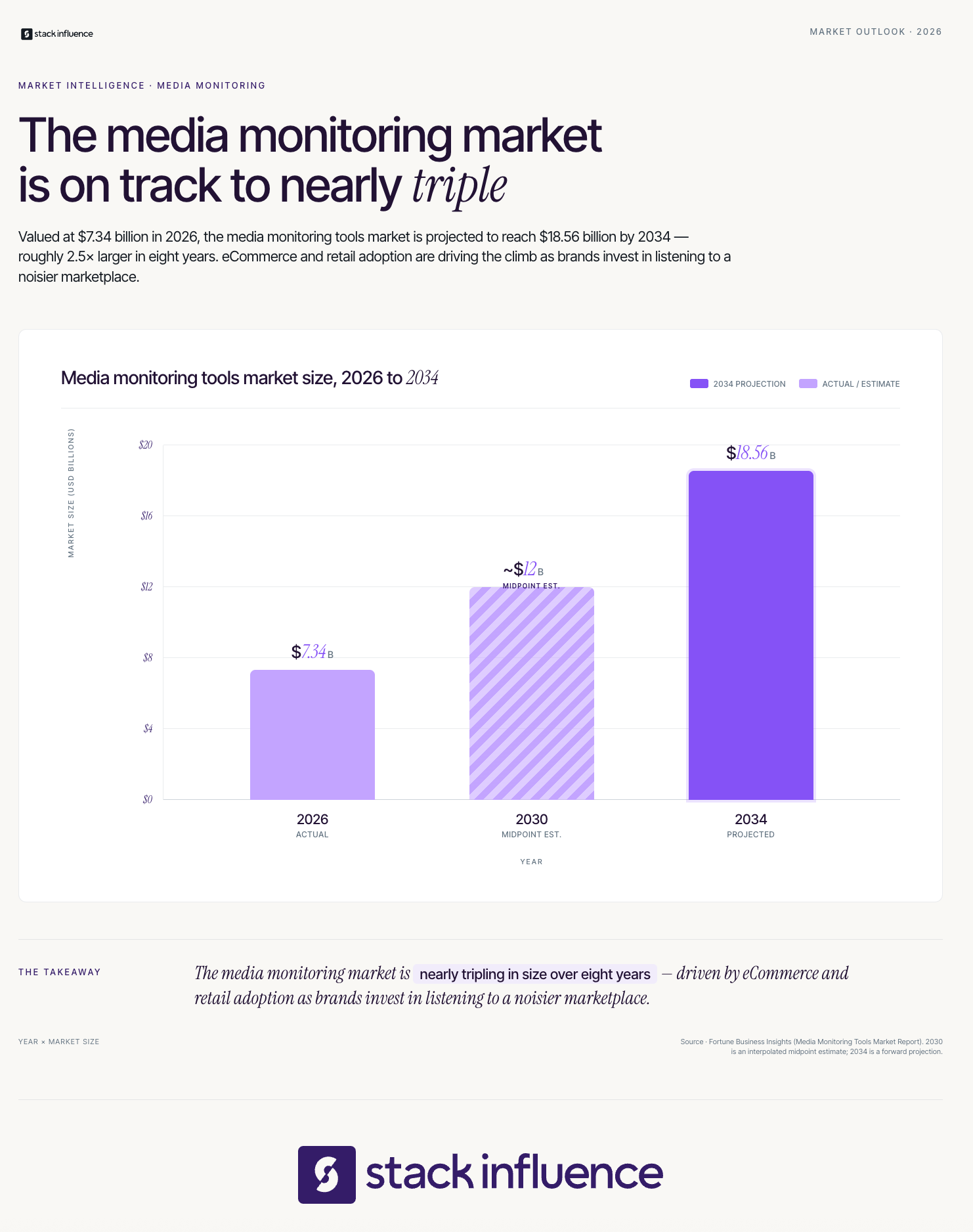
According to Fortune Business Insights' media monitoring market report, the global media monitoring tools market is projected to grow from $7.34 billion in 2026 to $18.56 billion by 2034, a CAGR of 12.3%. Retail and eCommerce represent the largest application segment by revenue share, which reflects how critical this infrastructure has become for DTC brands and Amazon FBA operators competing at scale.
Key things a quality monitoring vendor tracks:
- Brand mentions: Your company name, product names, common misspellings, and unofficial abbreviations across platforms
- Sentiment trends: Whether conversations skew positive, negative, or neutral over time and across regions
- Competitor share of voice: How often your brand appears in category conversations relative to competing products
- Influencer and creator mentions: Organic posts from nano influencers, micro influencers, and brand ambassadors who are already talking about your product
- Crisis signals: Unusual spikes in negative sentiment that precede a PR problem by hours or days
- UGC volume: The rate at which content creators, UGC creators, and customers produce organic content about your product
The SIGNAL Framework: A Named System for Vendor Evaluation
Selecting from dozens of social media monitoring vendors without a structured process leads to regret. The SIGNAL Framework is a five-variable evaluation model designed specifically for eCommerce sellers who need monitoring data to feed influencer campaigns, product decisions, and marketplace performance simultaneously.
The five variables in the SIGNAL Framework are:
- S — Scope: Does the vendor cover the platforms where your buyers actually talk? This means Instagram, TikTok, YouTube, Reddit, Amazon reviews, and niche forums, not just Twitter and Facebook.
- I — Integration: Can the vendor push data into the tools you already use? Look for native connections to Shopify, Amazon Attribution dashboards, and influencer marketing platforms.
- G — Granularity: Does the tool surface creator-level data, not just aggregate brand mentions? For influencer marketing, you need to see which specific content creators and brand partners are driving conversation.
- N — NLP Accuracy: How well does the vendor's natural language processing handle sarcasm, regional slang, and non-English content? Poor NLP inflates positive sentiment and masks real problems.
- A — Alerting: Are real-time alerts configurable by severity, keyword cluster, or sentiment threshold? Fast alerts separate crisis management from crisis cleanup.
- L — Licensing Terms: Can you export UGC video and static images for use in paid ads without separate rights acquisition? This matters enormously for UGC platforms integrations.
Apply the SIGNAL Framework before any vendor demo. Go into the demo with your own test keywords, your competitor names, and a recent brand mention you already know about. A vendor that cannot surface the mention you already have documented is not ready for your use case.
According to Hootsuite's social listening strategy guide, monitoring social channels ties directly to metrics like engagement, share of voice, and sentiment, which together show how marketing campaigns deliver on business goals. The SIGNAL Framework operationalizes those three metrics by giving eCommerce teams a consistent scoring rubric for every vendor conversation.
From Stack Influence's experience running micro influencer campaigns for eCommerce brands, monitoring vendors that capture untagged mentions consistently surface 30 to 40% more organic creator content than tools limited to tagged posts, making them substantially more useful for brands running automated product seeding programs where creators post on their own schedule.
Which Features Should eCommerce Sellers Prioritize?
Not every feature category in a social media monitoring vendor is equally valuable for eCommerce. Most vendors are built for enterprise PR teams, which means their default dashboards emphasize broadcast media coverage and top-tier news outlet mentions. Sellers running influencer campaigns and managing an Amazon storefront need a different feature priority stack.
The features that generate the most operational value for eCommerce sellers are:
- Creator identification: The ability to flag organic mentions from accounts with 1,000 to 100,000 followers, which is the nano influencer and micro influencer tier where authentic UGC originates
- Sentiment segmentation by product SKU: Not just overall brand sentiment, but whether reviews and social posts about a specific ASIN or product variant trend positive or negative
- Historical data access: At least 12 months of lookback so you can compare campaign periods to baseline periods and avoid false lift readings
- Image and video recognition: Visual monitoring that catches logo and product appearances in UGC video even when no text caption mentions your brand name
- Competitor benchmarking: Side-by-side share-of-voice and engagement data so you can track whether a competitor's influencer campaign is pulling attention away from your category
The Influencer Marketing Hub's 2026 Benchmark Report notes that the share of organizations relying on software for social listening efforts surged from 44% in 2024 to 78% in 2025, a dramatic shift away from manual monitoring. That acceleration means the barrier to entry for structured monitoring has fallen, and sellers who still rely on spreadsheets are operating at a structural disadvantage relative to competitors who automated this workflow 12 months ago.
Brands building or expanding creator partnerships should also evaluate the vendor's UGC rights management capabilities. If a nano influencer posts organic content about your product and you want to repurpose it as a paid ad on Meta or TikTok Spark Ads, the monitoring tool should make it easy to log rights requests and store approved assets for reuse. This is where micro influencer promotions workflows and monitoring vendor capabilities converge most directly.
The Monitoring-to-Revenue Checklist: A Secondary Framework for Sellers Ready to Act
The SIGNAL Framework tells you how to choose a vendor. The Monitoring-to-Revenue Checklist tells you what to do with the vendor once it is live. These are eight operational steps that convert raw monitoring data into measurable eCommerce outcomes.
The Monitoring-to-Revenue Checklist includes:
- Set baseline metrics in week one: Before launching any new campaign, capture your current share of voice, net sentiment score, and organic mention volume so you have a clean comparison point later.
- Tag every influencer campaign with a unique trackable parameter: Whether you are using UTM strings for Shopify or Attribution tags for Amazon, every creator in a brand partnership should have a distinct tracking identifier.
- Monitor competitor sentiment weekly: Look for dips in competitor sentiment that signal an opportunity to increase your own campaign frequency or shift messaging to capture buyers who are becoming disillusioned with a competing product.
- Flag UGC assets within 48 hours of posting: Set up keyword and handle alerts so your team can identify and request rights to high-performing organic content before engagement peaks and before the creator's feed pushes it down.
- Cross-reference mentions with sales data monthly: Pull your monitoring report alongside your Shopify or Amazon FBA sales report to identify whether mention volume spikes precede or follow conversion lifts.
- Audit branded hashtag performance quarterly: Check which hashtags are actually generating community-level conversation versus which ones your team is using internally with no organic uptake.
- Review creator health signals before renewing brand deals: Use your monitoring vendor to check engagement trajectory and audience sentiment for any creator you are considering for a long-term brand ambassador relationship.
- Build a crisis threshold document: Define in writing at what mention velocity or sentiment drop percentage your team triggers a response protocol, so crisis management decisions are never made ad-hoc.
The Monitoring-to-Revenue Checklist works independently of any specific vendor. Run through it every quarter to confirm your monitoring setup is still producing actionable signal rather than just volume metrics with no downstream impact.
Stack Influence's internal campaign data shows that eCommerce brands running structured monitoring alongside their creator partnerships identify reusable UGC assets at a rate nearly 2.5 times higher than brands relying solely on creator check-ins, because organic mentions from brand ambassadors and product seeding recipients often surface on platforms and in formats the brand team did not anticipate.
What Does Good Measurement Actually Look Like?
Attribution is the place where most sellers get social media monitoring wrong. They track sentiment and mentions well but never connect those signals to actual conversion data. A structured metric model solves this by defining the exact outputs your team reports on after every campaign period.
The SEEN Metric Stack is a four-component attribution model designed for eCommerce sellers using social media monitoring data alongside influencer campaigns on Amazon and Shopify.
- S — Share of Voice: Your brand's percentage of total category mentions within a defined keyword set. This is the leading indicator of awareness and competitive positioning, tracked weekly.
- E — Earned Media Value (EMV): The estimated ad equivalent cost of organic mentions, UGC posts, and influencer content generated during a campaign. Use EMV to compare the cost efficiency of product seeding against paid advertising.
- E — External Attribution Revenue: The actual sales credited to off-Amazon or off-Shopify traffic through tagged links. For Amazon sellers, this connects directly to the Amazon Brand Referral Bonus program and Amazon Attribution.
- N — Net Sentiment Score: A calculated ratio of positive to negative mentions over a rolling 30-day window, adjusted for total mention volume so that a viral negative post doesn't collapse your score during a high-volume period.
The Amazon Attribution component of the SEEN Metric Stack deserves particular attention. According to the Amazon Ads guide to Amazon Attribution, the Brand Referral Bonus program pays sellers an average 10% bonus on product sales driven by non-Amazon marketing measured through Attribution tags. That means every influencer campaign, every social post, and every creator partnership that drives traffic to your Amazon storefront can generate a direct fee credit in addition to the revenue itself.
According to Marknology's Amazon Attribution guide, Amazon Attribution uses a 14-day lookback window, meaning sales that occur within 14 days of a tagged link click are attributed to that campaign. For eCommerce sellers evaluating the ROI of influencer campaigns and creator economy partnerships, this 14-day window is the critical measurement boundary between a campaign that appears to underperform and one that actually delivered delayed conversions.
Across campaigns managed on the Stack Influence platform, eCommerce brands that use monitoring data to identify which creator posts generate the highest Amazon Attribution click volumes before scaling a campaign see campaign ROAS improve by an average of 20 to 35%, because they are reallocating budget toward the content types and creator tiers that have already demonstrated conversion signal rather than guessing at scale. Apply the SEEN Metric Stack principles before your next product launch to establish a clean pre-campaign baseline.
What Most Guides Get Wrong About Social Media Monitoring Vendors

Most vendor comparison guides focus almost entirely on feature lists. The number of platforms covered, the size of the historical data archive, the sophistication of the sentiment engine. These things matter, but they are not the primary reason monitoring programs fail at eCommerce companies.
The actual failure mode is workflow disconnection. A brand buys a monitoring tool, assigns one person to check the dashboard weekly, and never builds the link between what the tool surfaces and what the marketing team does next. Mentions spike after a successful influencer seeding campaign, the data sits in a dashboard, and nobody connects the volume to the AMZ listing that saw a search rank improvement that same week.
Data from archive.com's social listening statistics report shows that brands with mature social listening capabilities respond to issues 4.3 times faster than peers relying only on traditional monitoring. That speed advantage is not primarily a technology gap. It is an operational gap: mature brands have defined response playbooks, assigned owners for each alert type, and a clear escalation path from monitoring signal to marketing or customer service action.
The specific belief most eCommerce guides reinforce is that buying a more expensive vendor with more features will solve the problem. The alternative is to start with a simpler vendor and a tight workflow: one person owns the weekly review, three alert types are configured from day one, and the output feeds a standing agenda item in your weekly marketing meeting. Sellers who take this approach with a mid-market tool consistently outperform sellers who buy enterprise monitoring software and treat it as a passive report generator.
For sellers building out influencer seeding workflows, the monitoring workflow gap shows up most acutely after a product seeding campaign. Dozens of micro influencers post organic content, mentions spike, and without a monitoring-to-action process, the brand collects zero UGC assets, misses the sentiment data, and cannot connect the creator activity to the Amazon BSR improvement that followed. The solution is not a better tool. It is the Monitoring-to-Revenue Checklist applied immediately after go-live.
How Should eCommerce Sellers Connect Monitoring to Creator Partnerships?
Social media monitoring vendors and influencer marketing overlap most directly in three areas: creator discovery, campaign measurement, and UGC asset capture. Getting all three right requires treating your monitoring vendor as an input into your creator partnerships workflow rather than a separate reporting tool.
According to digitalapplied.com's 2026 influencer marketing statistics, micro-influencers deliver 3.2x higher engagement at 60% lower cost compared to mega-influencers. That performance advantage is only fully captured if your monitoring vendor surfaces the micro influencer mentions that happen organically before a formal brand sponsorship relationship is established. Many of the best creator partnerships start not with a pitch but with a brand noticing a genuine mention and reaching out to formalize it.
For Amazon sellers specifically, connecting monitoring to the Amazon Influencer Program and brand deals workflow means each creator you work with should have a unique Amazon Attribution tag. When your monitoring tool flags a spike in mentions correlated with an ASIN's conversion rate improvement, you can trace the source creator, identify which content type drove the traffic, and replicate that format in future influencer campaigns. This closes the loop between the SIGNAL Framework vendor selection criteria and the SEEN Metric Stack reporting model.
Based on Stack Influence's work with eCommerce brands running product seeding campaigns at scale, sellers who integrate monitoring vendor data with their creator pipeline identify organic brand advocates averaging 3.4 times more authentic engagement than outbound-recruited creators, because buyers who already purchase and post about a product bring a credibility signal that scripted brand partnerships cannot replicate at the same cost efficiency. Sellers on Shopify can further extend this by exploring Shopify influencer marketing integrations that feed monitoring data directly into creator activation workflows.
Conclusion: Turn Monitoring Data Into a Growth Engine
Social media monitoring vendors are not a compliance checkbox or a brand safety measure you activate after something goes wrong. For eCommerce sellers, they are the infrastructure layer that connects every influencer campaign, every UGC asset, and every creator partnership to a measurable outcome. Start with the SIGNAL Framework to evaluate vendors against your actual channel mix. Apply the Monitoring-to-Revenue Checklist to operationalize the data you collect. Report results through the SEEN Metric Stack so every campaign period connects share of voice and EMV to external attribution revenue and net sentiment trends.
The sellers who extract the most value from social media monitoring vendors are not the ones with the most sophisticated tools. They are the ones who have built the tightest feedback loop between what the data shows and what the marketing team does next. If your current setup cannot answer the question "which creator drove this Amazon BSR improvement last week?", that is the gap the right monitoring vendor and a disciplined workflow will close.