




Becoming an Amazon influencer is not simply a matter of creating an account and adding popular products to a page. Amazon evaluates your existing social presence, while shoppers decide whether your recommendations are specific, useful, and credible enough to influence a purchase.
For content creators, the opportunity extends beyond earning affiliate commissions. An effective Amazon storefront can demonstrate product knowledge, strengthen your portfolio, support UGC and brand deals, and show ecommerce brands that you understand purchase-focused content. This guide explains how to become an Amazon influencer, prepare your profile, apply, build a useful storefront, publish stronger content, and measure whether the work is producing meaningful results.
Key Takeaways
- Amazon considers audience size and engagement, but it does not publish one universal follower requirement that guarantees Influencer Program approval.
- Program acceptance provides a storefront, while product-page exposure through Amazon’s onsite placements requires additional content qualification and remains subject to Amazon’s selection.
- The strongest storefronts organize products around buyer problems, routines, and use cases rather than displaying an unstructured product catalog.
- Commission rates vary by product category, so content relevance, conversion, order value, and category economics all affect earnings.
- Amazon storefront content can also support product seeding, UGC projects, creator partnerships, and other brand opportunities outside the affiliate program.
What Is an Amazon Influencer?
An Amazon influencer is a social media creator accepted into the Amazon Influencer Program, an extension of Amazon Associates. Accepted creators receive a customizable Amazon storefront and vanity URL for recommending products. Creators can earn commissions from qualifying purchases, while Amazon separately determines whether eligible content receives onsite placement.
The Amazon Influencer Program is different from a seller’s Amazon Brand Store. Influencers curate third-party products for their audiences, while Amazon sellers use Brand Stores to present products belonging to their own registered brands.
It also differs from the standard Associates workflow. Both programs use affiliate tracking, but qualifying influencers receive a storefront designed to centralize recommendations and shoppable content. The distinctions are covered in more detail in this Amazon affiliate and influencer program comparison, while this Amazon storefront creation guide explains the seller and creator storefront models.
An Amazon influencer may use the storefront to publish:
- Curated product lists
- Product photos
- Demonstration videos
- Livestream content
- Recommendations grouped by niche or use case
- Links shared through social posts, profiles, websites, or email content
The storefront is the destination, not the entire business. Creators still need a reliable distribution channel and content that gives people a reason to visit.
How Do Amazon Influencers Make Money?
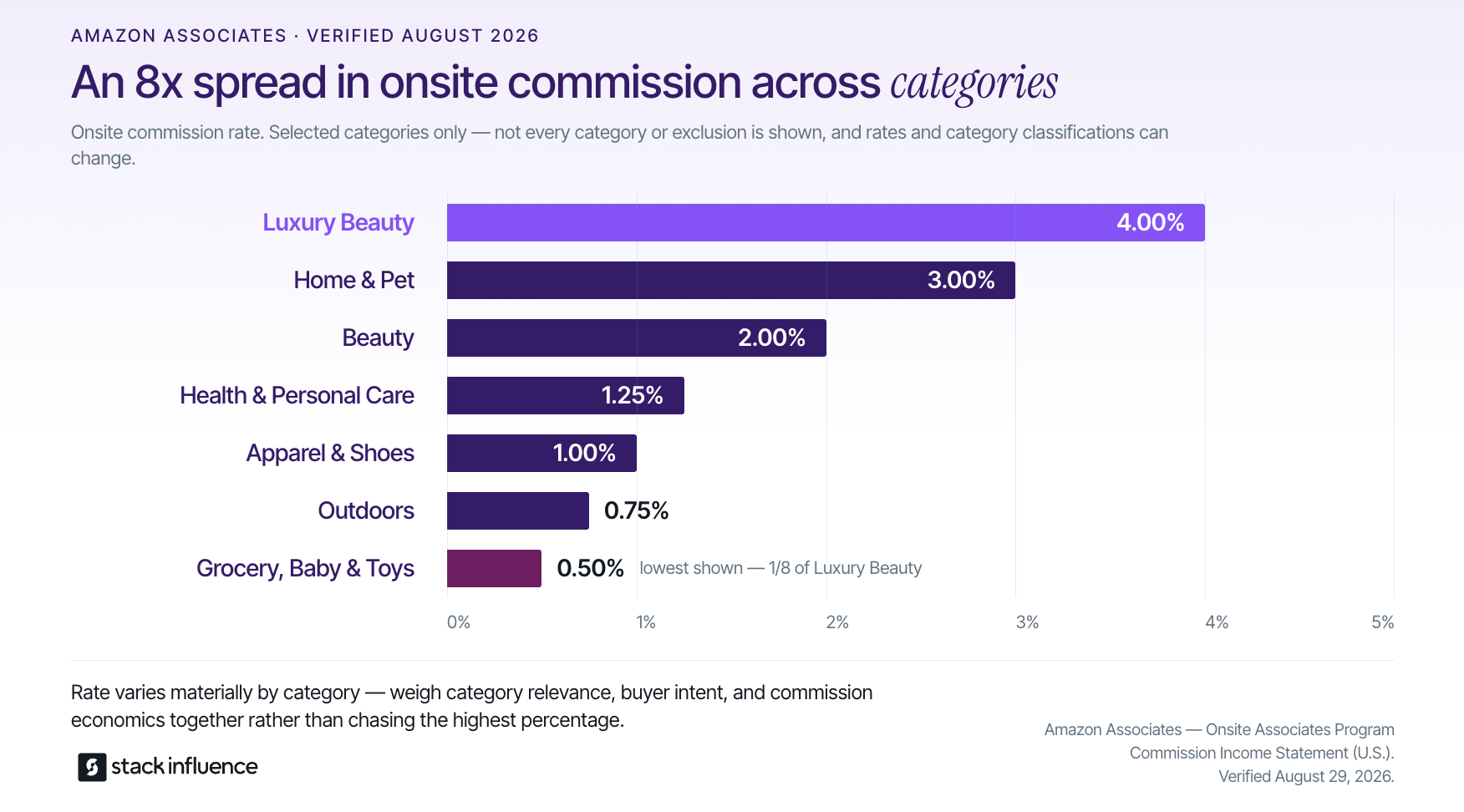
Amazon influencers can earn through two related channels: purchases generated by links they distribute outside Amazon and onsite commissions from eligible content Amazon selects for placement within its marketplace. The storefront supports both channels, but acceptance into the Influencer Program does not guarantee onsite exposure, sales, or a particular income level.
The two earning paths work differently:
- Off-Amazon traffic: A creator shares a storefront or product link through social media, a website, a newsletter, or another permitted channel.
- Onsite content: Amazon may select qualifying creator photos, videos, or livestream content for discovery within Amazon, including relevant product environments.
Amazon assigns a separate Store ID for onsite earnings, which helps creators distinguish traffic they generated from commissions associated with Amazon’s own placement of their content. Amazon’s onsite earnings guidance also makes clear that Amazon decides which content receives placement.
Commission percentages depend on the product category and applicable commission statement. Selected rates from Amazon’s current U.S. onsite commission rate card include:
- Luxury Beauty: 4%
- Home and Pet categories: 3%
- Beauty: 2%
- Health and Personal Care: 1.25%
- Apparel and Shoes: 1%
- Outdoors: 0.75%
- Grocery, Baby, and Toys: 0.5%
These are selected onsite categories, not a complete rate list. Rates, exclusions, and category classifications can change, so creators should verify the current statement before estimating revenue.
For standard affiliate links, Amazon generally applies a 24-hour shopping session. An eligible item added to the shopper’s cart during that session may still qualify when purchased later within Amazon’s stated cart period. Amazon explains the details in its standard affiliate tracking-window guidance.
Commission income is therefore shaped by several variables:
- The number of qualified people who see the content
- The percentage who click
- The percentage who purchase
- The average value of shipped products
- The product category’s commission rate
- Returns, cancellations, and excluded products
- Whether Amazon selects the content for onsite distribution
A creator with a smaller but purchase-ready audience can sometimes produce more revenue than a larger account whose followers rarely act on product recommendations. Audience intent matters alongside reach.
Who Qualifies for the Amazon Influencer Program?
Amazon accepts applications from creators using eligible YouTube, Instagram, Facebook, or TikTok accounts. Amazon says its review considers follower count and engagement metrics, but it does not disclose a universal minimum, a fixed engagement-rate threshold, or the precise weighting used to make every acceptance decision.
Separate Amazon guidance for social-network applications says an established page should contain substantive original content and, in most cases, at least 500 organic followers or likes. That language is general Associates review guidance, not a guaranteed Amazon Influencer Program cutoff.
Micro influencers and nano influencers should therefore avoid treating one follower number as the entire qualification strategy. A creator account is better prepared when it shows:
- A public profile: Amazon must be able to evaluate the account and its content.
- Original publishing history: The account should contain substantive creator-made posts rather than reposted or thin material.
- A recognizable niche: Recent content should make the creator’s audience and subject matter easy to understand.
- Visible audience response: Comments, saves, shares, and conversations provide context beyond raw follower totals.
- Consistent activity: A long-abandoned profile gives Amazon less current evidence to evaluate.
- Commercial relevance: Tutorials, reviews, comparisons, demonstrations, and routines show an ability to discuss products usefully.
Amazon retains discretion over program acceptance and continued eligibility under its Influencer Program Policy. Creators should review the policy for their marketplace rather than assuming U.S. rules, commission rates, or features apply everywhere.
The Proof-to-Purchase Build Sequence
The most reliable way to prepare is to build evidence in the same order a shopper experiences it. The Proof-to-Purchase Build Sequence moves from a focused public identity to useful content, a credible application, an organized storefront, and measurable purchase behavior.
1. Establish One Buying Niche
Choose a niche narrow enough that a new visitor can understand your value within several seconds. “Lifestyle” is usually too broad by itself, while “small-space cooking,” “beginner home fitness,” or “sensitive-skin beauty routines” creates a clearer connection between audience needs and product recommendations.
A niche should satisfy three conditions:
- You can publish about it repeatedly.
- People within the niche buy products to solve recurring problems.
- You can demonstrate genuine use rather than merely naming products.
Creators still defining their subject can use this guide to find a niche as an influencer. The goal is not to trap yourself in one category forever. It is to give Amazon, shoppers, and potential brand partners enough context to understand why your recommendations matter.
2. Publish Proof Before Applying
Create a recent body of public content that demonstrates your niche and communication style. A practical editorial target is 10 to 15 strong posts before applying, although this is a preparation recommendation, not an official Amazon requirement.
Build those posts around different forms of purchase assistance:
- A product demonstration
- A comparison between two options
- A routine containing several complementary products
- A setup or installation tutorial
- A “who this is for” explanation
- An honest limitation or tradeoff
- A frequently asked buyer question
This content should help someone make a decision even when no affiliate link is present. That standard produces a stronger public profile and prevents the account from looking like it exists only to distribute links.
3. Apply With Your Strongest Account
Use the eligible social account that gives Amazon the clearest evidence of audience relevance, original content, current activity, and genuine engagement. The account with the most followers is not automatically the account with the strongest application.
Before applying, review:
- Whether the profile is public
- Whether your bio defines the niche
- Whether recent posts are original
- Whether engagement appears organic
- Whether product-related content is easy to find
- Whether outdated or off-topic posts dominate the profile
Avoid changing your identity immediately before applying merely to imitate a successful Amazon influencer. A coherent publishing history is more credible than a sudden collection of product posts with no connection to your established audience.
4. Turn the Storefront Into a Buyer Tool
Once accepted, organize recommendations around decisions instead of creating one large list called “My Favorites.” A useful storefront shortens the distance between a shopper’s problem and the right group of products.
Strong list concepts include:
- Small-Apartment Kitchen Essentials
- Carry-On Products for Long Flights
- Beginner Home Workout Setup
- Fragrance-Free Skincare Routine
- Desk Accessories for Remote Work
- Budget Video-Creation Equipment
Start with four to seven tightly defined collections. Expand only when you have enough knowledge and content to make the next collection useful.
5. Build a Revenue and Partnership Feedback Loop
Use performance data to decide what to publish next. If a demonstration attracts clicks but few orders, the product, audience fit, price, or explanation may need work. If a comparison repeatedly produces purchases, create additional content around the same decision.
The same feedback can strengthen a creator portfolio. A storefront that shows consistent niche alignment, useful product education, and reliable publishing gives Amazon sellers and DTC brands more evidence than a media kit containing only follower totals.
How to Become an Amazon Influencer: The Application Steps

To become an Amazon influencer, prepare an established public account, apply through Amazon’s official program page, connect an eligible social profile, complete the requested account information, and wait for Amazon’s decision. After acceptance, finish payment and tax setup, create the storefront, and treat onsite content eligibility as a separate milestone.
Follow this sequence:
- Visit the official Amazon Influencer Program application.
- Sign in with an existing Amazon account or create one for the creator business.
- Connect an eligible YouTube, Instagram, Facebook, or TikTok account.
- Give Amazon the information and permissions needed to evaluate the account.
- Complete the requested creator, storefront, and contact details.
- Review the operating agreement and applicable policies before submitting.
- After acceptance, complete the required payment and tax information.
- Customize the storefront profile, categories, product lists, and creator content.
Existing Amazon Associates can generally use their current Associates account when joining the Influencer Program, although Amazon may create additional Store IDs for different forms of activity.
Amazon does not publish one dependable approval timeline for every creator. Avoid making campaign promises or announcing your storefront until access is confirmed and the account is operational.
Approval Is Only the First Distribution Gate
Influencer Program acceptance gives a creator access to storefront tools, but it does not guarantee that every uploaded video will appear on product detail pages. Content must meet Amazon’s moderation standards, and Amazon retains control over onsite eligibility, selection, placement, and continued display.
Think of post-acceptance progress as four separate gates:
- Storefront gate: The creator receives and configures the storefront.
- Moderation gate: Uploaded content must comply with Amazon’s content requirements.
- Onsite gate: The creator completes any required onsite enrollment and eligibility steps.
- Distribution gate: Amazon decides whether and where qualifying content appears.
As of August 2026, Amazon’s official video upload guidance says approved videos appear on the creator’s storefront. Once 10 videos pass moderation and onsite commission signup is complete, videos may also become discoverable on relevant product detail pages. The wording is “may,” not “will,” so creators should not treat 10 uploads as guaranteed distribution.
Build product videos to reduce a specific uncertainty. Useful subjects include:
- What the product looks like at normal viewing distance
- How long setup takes
- Which features require explanation
- How two similar options differ
- Who should consider the product
- Which use cases expose a limitation
- What is included in the package
- How the product fits into a real routine
The goal is not to make every product sound perfect. Honest context improves usefulness and can protect long-term audience trust. The creator-focused Amazon storefront guide provides additional organization ideas, while this Amazon product tester guide explains how legitimate product testing differs from misleading “free product” offers.
Measure the Creator Business, Not Just Views
Amazon influencers should measure content as a connected system: production creates attention, attention creates qualified traffic, traffic may produce orders, and repeated performance creates portfolio value. A viral view count is a leading indicator, not proof of commission income or commercial influence.
Use a five-layer measurement stack:
- Production metrics: Publish frequency, moderated uploads, active product collections, and content coverage.
- Attention metrics: Views, watch time, completion, saves, comments, and shares.
- Traffic metrics: Storefront visits and permitted affiliate-link clicks.
- Outcome metrics: Ordered items, shipped items, order value, returns, and commission income.
- Portfolio metrics: Brand inquiries, repeat partnerships, UGC requests, and content-licensing conversations.
The IAB creator measurement landscape describes creator measurement as fragmented across platforms, transactions, and brand reporting. Creators should preserve source-level records rather than trying to reduce every outcome to one social metric.
Consider an illustrative scenario, not an Amazon benchmark. Suppose a product video receives 10,000 views and 3% of viewers click, creating 300 clicks. Assume a $60 average shipped order value and a 3% commission rate.
Commission sensitivity would look like this:
- At 2% purchase conversion: 6 orders, $360 in shipped order value, and $10.80 in commission income
- At 5% purchase conversion: 15 orders, $900 in shipped order value, and $27 in commission income
- At 8% purchase conversion: 24 orders, $1,440 in shipped order value, and $43.20 in commission income
- At 12% purchase conversion: 36 orders, $2,160 in shipped order value, and $64.80 in commission income
This calculation shows why views alone are insufficient. Under the same traffic assumptions, movement from 2% to 12% purchase conversion produces six times as many orders and six times as much commission income.
Attribution also has limits. A viewer may discover a product through one video, research it elsewhere, and purchase through another route. Conversely, an attributed sale does not prove one post independently caused the order, because price, reviews, availability, competing listings, and prior exposure may all affect the decision.
Review performance over consistent 30-day and 90-day windows. Short windows are useful for testing hooks and formats, while longer windows are better for identifying repeatable product categories, seasonal patterns, and partnership value.
Turn Storefront Proof Into Brand Partnerships
An Amazon storefront can become evidence for opportunities beyond affiliate commissions. Creators can use well-produced demonstrations, comparisons, and routines when pursuing product seeding, UGC video assignments, brand ambassador work, sponsorships, and longer creator partnerships.
The strongest signal is not simply “I have an Amazon storefront.” It is “I can explain a product, reach a relevant audience, complete deliverables, and produce content that helps people make decisions.”
Creators evaluating commercial opportunities should compare expected commission income with other forms of compensation and value. The guides to how much micro-influencers make and micro-influencer platforms for creators explain several common partnership models.
Stack Influence connects ecommerce brands with roughly 600,000 vetted creators through a gifted-first product-seeding model. Its campaign workflow is built around creator activation, UGC generation, coordination, and completed-post accountability.
That workflow is separate from Amazon’s affiliate program, but it can help creators develop product experience and campaign discipline. Creators can review current creator opportunities and see how gifted campaigns work for creators before deciding whether product seeding supports their content goals.
Which Rules Do Amazon Influencers Need to Follow?
Amazon influencers must follow Amazon’s operating agreement, content standards, linking rules, and disclosure requirements, along with applicable advertising laws. Creators must clearly identify affiliate and brand relationships, avoid misleading claims, and keep disclosures close enough to the recommendation that viewers are unlikely to miss them.
Amazon’s affiliate disclosure guidance requires clear and conspicuous disclosure near affiliate links. Amazon also requires the statement, “As an Amazon Associate I earn from qualifying purchases,” to be associated with the creator’s account or site.
The FTC’s disclosure guide for social media influencers explains that a material connection includes payment, free products, discounted products, employment, family relationships, and other benefits. A free item received through product seeding still requires disclosure when the creator discusses it.
Use these compliance habits:
- Put the disclosure where people will notice it before or with the recommendation.
- Include a spoken or visible disclosure inside video content when the endorsement appears in the video.
- Do not rely on a profile bio when the material connection applies to one specific post.
- Describe personal experience honestly and avoid unsupported performance claims.
- Do not encourage relatives, friends, or followers to manipulate purchasing or engagement signals.
- Recheck Amazon and FTC guidance periodically because platform requirements can change.
Build a Storefront People Use
Learning how to become an Amazon influencer is not a one-time approval project. It is the process of developing a clear niche, publishing credible product content, organizing recommendations around buying decisions, and using performance evidence to improve both affiliate content and creator partnerships.
Start by choosing one purchase-focused niche and publishing 10 to 15 useful posts that demonstrate it. Apply with your strongest eligible account, build several tightly organized storefront collections, and measure outcomes beyond views. A storefront that repeatedly helps people make decisions can become a durable creator asset, even as individual products, commission rates, and platform features change.