



Creators who post consistently earn brand deals at a higher rate than those who don't, yet the majority of nano and micro-influencers still rely on manual posting as their default strategy. The gap between knowing you need a system and actually building one is where most creator careers stall. Whether you're managing three platforms or ten, your content scheduler decision shapes not just your output cadence but your perceived professionalism to the brands looking for influencers who can deliver reliably. This guide breaks down exactly what each approach costs you in time, visibility, and partnership opportunity, so you can make the right call for your stage of growth.
Key Takeaways
- A content scheduler automates post timing, freeing creators to focus on production and pitch quality instead of manual uploads.
- Manual posting preserves spontaneity and real-time engagement but collapses under any content volume above one or two posts per week.
- According to Sprout Social's 2024 Content Benchmarks, consistent posting frequency is a stronger predictor of audience growth than posting at "peak" times alone.
- The Creator Dispatch Sequence (introduced below) gives you a repeatable five-step system for scheduling campaigns without sacrificing authentic UGC quality.
- Brands and influencer marketing platforms assess posting consistency as a proxy for creator reliability, which directly affects campaign eligibility.
The State of Creator Posting in 2026
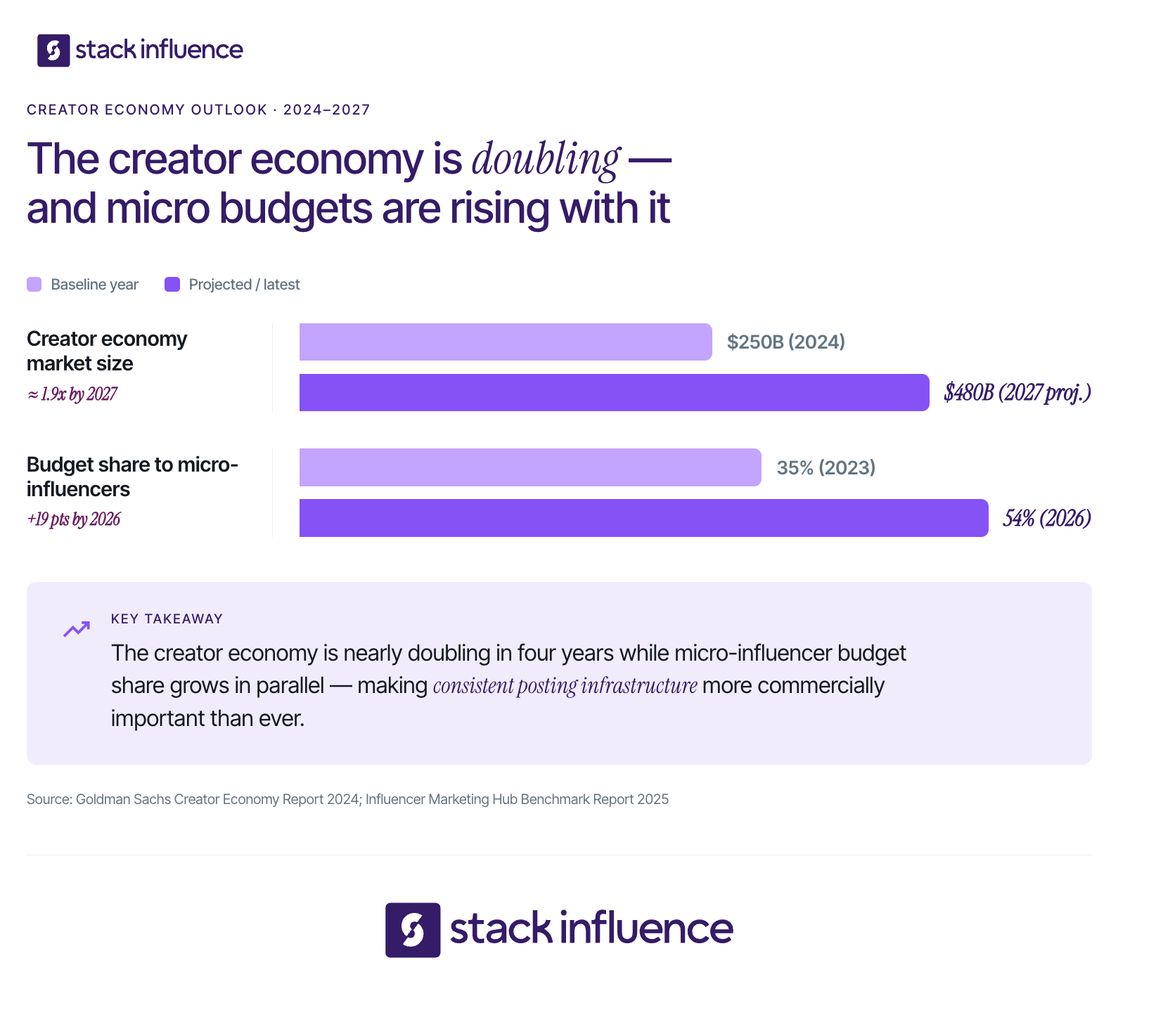
The creator economy has matured past "passion project" territory. According to Goldman Sachs' Creator Economy report, the global creator economy is projected to approach half a trillion dollars by 2027, and brands are allocating larger portions of their influencer budgets to micro-influencers and nano-influencers specifically because of their higher engagement-to-follower ratios. The pressure this creates for individual creators is real: the bar for brand partnerships has risen from "do you post?" to "do you post on a schedule that fits our campaign window?"
Platform algorithms have shifted the stakes further. Instagram's 2026 algorithm guidance now explicitly rewards publishing cadence and watch-time consistency over raw follower count, which means sporadic manual posting has a measurable negative effect on organic reach, not just on brand perception. This algorithmic reality is the single biggest reason creators at every level are reconsidering what manual posting actually costs them.
The debate is no longer philosophical. It's operational. Creators who treat content scheduling as a production tool, not a shortcut, are consistently landing more brand deals, building stronger UGC portfolios, and maintaining the audience engagement metrics that platforms like Stack Influence evaluate when vetting creators for product-seeding campaigns.
What Is a Content Scheduler?
A content scheduler is a software tool that allows creators to write, design, queue, and automatically publish content across one or more social platforms at a pre-set time, without requiring the creator to be present when the post goes live. Most schedulers also include features like analytics dashboards, hashtag suggestions, link-in-bio management, and multi-platform cross-posting. The distinction matters: a content scheduler is a publishing automation layer, not a content creation tool.
Modern schedulers range from free-tier products like Later and Buffer to more robust platforms such as Hootsuite, Sprout Social, and Metricool. The most important functional difference between them is whether the tool supports native posting (where the post publishes automatically without a push notification reminder) or reminder posting (where it notifies you to publish manually at the right time). Native posting is the only option that fully removes the manual step.
Manual Posting: Where It Wins and Where It Breaks Down
Manual posting means logging into each platform and publishing content in real time or in the moment. It's the default workflow for most creators starting out, and for very low-volume publishing (one to three times per week, single platform), it's genuinely adequate. The perceived advantage is control: you can react to trending audio, adjust captions based on what's happening in your niche, and engage in the comment section immediately after posting to boost the early engagement signal.
The breakdown happens at volume. As soon as a creator manages two or more platforms, launches a brand partnership campaign, or targets optimal posting times across multiple time zones, manual posting becomes a cognitive drain that bleeds into content quality. HubSpot's 2025 Social Media Trends Report found that creators who batch-create and schedule content report significantly higher output consistency than those who post manually, even when both groups are producing the same weekly volume. The friction of manual posting isn't just inconvenient, it's a compounding tax on creative output.
Consider what manual posting actually requires at the campaign level:
- Remembering optimal posting windows for each platform without a queue.
- Manually uploading assets to each platform separately.
- Writing and proofreading captions under time pressure.
- Monitoring engagement in real time immediately after posting.
- Repeating this process across every campaign deliverable for every brand deal.
None of this is impossible, but every step adds cognitive load that could be redirected toward shooting better content, writing stronger pitches, or developing your UGC strategy for the next campaign.
The Creator Dispatch Sequence: A 5-Step Scheduling System for Influencers
The central framework for building a scalable creator workflow is what we call the Creator Dispatch Sequence, a five-step process that takes content from idea to scheduled queue without sacrificing the authentic voice that brands want from micro-influencers and UGC creators. Reference this sequence whenever you're evaluating whether your current system can support campaign-level deliverables.
Step 1: Batch Your Content in 90-Minute Blocks
Rather than creating one post at a time, dedicate a single 90-minute session to producing a full week of content. This protects your creative energy and ensures visual consistency across posts. The Creator Dispatch Sequence starts here because batching removes the daily decision fatigue that derails manual posting schedules.
Step 2: Upload Assets to a Single Central Queue
Move all finished content into your scheduling tool's media library in one upload session. Keeping everything in one queue prevents the asset-hunting that wastes time on manual posting days. For creators managing brand-deal deliverables, this also creates a shared library that's easy to hand off or reference for campaign reporting.
Step 3: Write and Review Captions Off-Platform
Draft captions in a separate document before pasting them into your scheduler. Writing off-platform removes the distraction of live feeds, allows proper proofing, and makes it easier to hit FTC disclosure requirements (FTC's 2023 endorsement guidelines require clear and conspicuous disclosure for sponsored content, and scheduling in advance gives you time to double-check compliance before the post goes live).
Step 4: Assign Optimal Timing Using Platform Data
Use your scheduler's analytics tab to assign each post to its recommended time slot. This is where native scheduling outperforms reminder-based tools: the post fires automatically without requiring you to stop whatever you're doing at 7:14 AM on a Tuesday. The Creator Dispatch Sequence treats timing as a variable to optimize, not a constraint to work around manually.
Step 5: Build a 48-Hour Engagement Window Into Your Calendar
Schedule 15-minute check-ins at 30 minutes, 4 hours, and 24 hours after each post goes live to respond to comments and engage with early reactions. This step keeps automated scheduling from creating a "post and ghost" dynamic that lowers engagement rates and reduces algorithmic reach. Brands and micro-influencer platforms evaluate engagement rates alongside post frequency, so protecting this window matters.
The Creator Dispatch Sequence is designed for creators at the nano-influencer and micro-influencer level who are beginning to take on brand partnerships. Reference the sequence when auditing your current posting workflow or when onboarding a new brand deal that requires consistent deliverable scheduling.
How Should Creators Choose Between Tools?

Choosing between content scheduler tools depends on three primary variables: the number of platforms you manage, the volume of brand-deal deliverables you're producing, and whether you need native auto-publishing or can tolerate reminder-based posting. For creators running one or two platforms with fewer than five posts per week, a free-tier tool like Buffer or Later covers the basic queue and timing functions without added cost. Creators managing three or more platforms or producing UGC content at campaign volume need native multi-platform posting, analytics reporting, and ideally a media library.
The Creator Dispatch Sequence works inside any scheduler that supports native publishing. The tool choice matters less than the workflow discipline.
Here's a practical breakdown by creator stage:
- Nano-influencers (under 10K followers): Later's free tier or Buffer Essentials for single-platform native posting and basic analytics.
- Micro-influencers (10K to 100K followers): Metricool or Hootsuite for multi-platform support, campaign scheduling, and engagement tracking.
- Multi-platform UGC creators: Sprout Social or Planable for team collaboration, asset approval workflows, and campaign reporting that satisfies brand-deal documentation needs.
- Creators running active brand ambassador programs: Tools with link tracking and UTM parameter support, such as Sprout Social or Later's paid tiers, so campaign performance data flows directly into reporting deliverables.
For creators working within structured influencer campaigns, the scheduling layer integrates with the broader campaign workflow. Stack Influence, for example, coordinates product-seeding campaigns across its network of roughly 600,000 vetted creators, and the completed-post accountability model it uses means creators who arrive with a reliable scheduling system are better positioned to execute deliverables on time and at the posting frequency campaigns require. The Creator Dispatch Sequence maps directly to how vetted micro-influencer campaigns are executed in practice.
What Changed About Content Scheduling in 2026
Two shifts make 2026 materially different from prior years for creators evaluating their scheduling approach. First, short-form video native scheduling has finally matured. Until late 2024, platforms including TikTok and Instagram Reels required third-party workarounds or only supported reminder-based scheduling rather than true auto-publishing. Multiple major schedulers now support native Reels and TikTok auto-publishing, which removes the last significant friction point that drove creators toward manual posting for video content.
Second, AI-assisted caption generation has moved from gimmick to genuine workflow accelerator. Buffer's 2025 State of Social Media report noted that creators using AI-assisted draft features in scheduling tools cut caption writing time by a meaningful margin without a measurable drop in engagement quality, as long as they edited the output rather than posting AI drafts verbatim. This matters for UGC creators specifically: the expectation for authentic, brand-specific voice means AI-assisted drafting works best as a first-pass tool within the Creator Dispatch Sequence's Step 3, not as a replacement for human editing.
A third shift worth flagging is the rise of cross-platform scheduling penalties. Some platforms now suppress content that is detected as being posted with identical captions and hashtags simultaneously across multiple channels. This penalizes lazy batch scheduling but does not affect well-executed scheduling, where captions are platform-adapted before publishing. The Creator Dispatch Sequence's off-platform caption writing step addresses this directly.
How Do You Measure Whether Your Scheduling System Is Working?
Measuring the effectiveness of your content scheduling system requires tracking outputs at two levels: publishing performance and business impact. Publishing performance tells you whether the system is working mechanically. Business impact tells you whether it's working commercially. A good scheduling system should improve both.
Use the following three-tier metric stack, which we call the Creator Posting ROI Stack:
Tier 1: Publishing Consistency
- Post frequency vs. target (did you hit your planned cadence this week?)
- On-time delivery rate for brand-deal deliverables (percentage of campaign posts published within the agreed window)
- Platform distribution (are you maintaining activity across all platforms in your brand partnership agreements?)
Tier 2: Algorithmic Performance
- Reach per post relative to follower count (engagement rate benchmarks vary by platform; Influencer Marketing Hub's 2025 benchmarks show micro-influencer Instagram engagement rates averaging 1% to 5%)
- Watch time and completion rate for video content
- Saves and shares as a proxy for content quality beyond vanity metrics
Tier 3: Commercial Impact
- Brand deal inquiry rate month over month (does consistent posting generate more inbound brand interest?)
- Campaign deliverable approval rate (what percentage of your submitted posts are approved first-pass by brand partners?)
- UGC content reuse rate (how often do brands request rights to repurpose your content, which indicates the quality level your scheduling system is enabling?)
Attribution in influencer marketing is genuinely complex, and creators shouldn't assume a scheduler alone drives commercial outcomes. But a creator who tracks Tier 1 consistently, reviews Tier 2 weekly, and monitors Tier 3 across campaign cycles has the data to make a credible case to brand partners that their content operation is reliable and performance-oriented. That data readiness is part of what a product-seeding platform evaluates when matching creators to campaigns.
The Hidden Metric Most Scheduling Guides Skip
Most scheduling guides focus on when to post and how often. The metric they consistently omit is deliverable consistency rate, which measures what percentage of your brand-deal posts go live on time, on platform, and with the correct disclosures within the agreed campaign window. This figure is invisible to public analytics tools, but it's exactly what brands track internally when deciding whether to re-engage a creator.
For micro-influencers and nano-influencers building toward repeat brand partnerships, deliverable consistency rate is arguably more important than follower count or engagement rate in isolation. A creator with 15,000 followers and a perfect deliverable record is a lower-risk investment than one with 80,000 followers and a history of late or missing posts. Forrester's B2B influencer marketing research consistently highlights creator reliability and campaign execution quality as top factors brands cite when selecting long-term partners.
To track your own deliverable consistency rate: log the agreed posting date for every brand campaign deliverable, log the actual posting date, and calculate the percentage that were on time. This is a single column in a spreadsheet, takes two minutes per campaign, and produces the one data point brands wish more creators could cite in a pitch meeting.
A verified Stack Influence case study for Blueland, a plastic-free home essentials brand, illustrates what campaign execution at scale can produce: during a 3-month campaign, average monthly unit sales increased 4.7x from 542 to 2,562, and the brand started ranking for 927 new keywords. Those results required 211 creator promotions to execute reliably, which is the kind of campaign volume that collapses without creator-side scheduling systems in place.
Building Your Content Scheduling Foundation
Once you've committed to a scheduling workflow, the setup decisions you make in the first week shape whether the system compounds or decays over time. Here is a practical implementation checklist for creators who are new to scheduled posting or who are upgrading from a reminder-based tool to native auto-publishing.
Start by auditing your current posting performance before switching tools. Pull the last 30 days of data from each platform's native analytics and note your actual posting frequency versus your intended frequency. This gap number is your baseline problem, and it tells you how much structure your new system needs to provide.
Connect all active platforms to your scheduler in a single onboarding session. Avoid the common mistake of connecting platforms one at a time over several weeks, which creates inconsistent data in your analytics dashboard and makes the Creator Dispatch Sequence harder to execute cleanly. Most tools offer a guided connection flow that takes 10 to 15 minutes per platform.
Set a weekly batching appointment in your calendar for 90 minutes, then protect it the way you would protect a brand-deal meeting. Hootsuite's 2025 Social Trends Report found that creators who schedule content creation time as a calendar block publish 40% more consistently than those who create ad-hoc, even when both groups report the same weekly intention. The scheduling habit is the result, but the calendar block is the cause.
Creators managing active brand partnerships can learn more about how product seeding campaigns are structured at the campaign level, and how a reliable posting workflow plugs into that execution model. If you're building toward UGC creator work specifically, the UGC creator resources on Stack Influence offer a useful reference for the deliverable expectations brands set when working with creators at the micro and nano level.
The final setup step is to define your posting calendar format before the first batch session. Whether you use a shared Google Sheet, your scheduler's built-in calendar view, or a dedicated project management tool is less important than committing to one format and using it consistently. Creators who can show a brand partner a documented content calendar during a pitch conversation signal operational maturity that most of their competitors cannot.
Should You Ever Go Back to Manual Posting?
Manual posting still has a legitimate place in the creator toolkit for specific scenarios. Breaking news and trending moments require real-time publishing that a scheduled queue cannot anticipate. Live event coverage, same-day product launches, and reaction content are all situations where the value of immediacy outweighs the efficiency of a pre-set queue. The answer for most creators is not manual versus scheduled but rather when to use each within the same workflow.
A practical rule of thumb: schedule your core content calendar using the Creator Dispatch Sequence, then reserve 20% of your posting slots as open windows for reactive or real-time content. This hybrid model captures the consistency benefits of scheduling without making your feed feel robotic or disconnected from what's happening in your niche right now.
The creator workflows that perform best in 2026 treat a content scheduler not as a replacement for creative judgment but as the operational infrastructure that frees creative judgment to work at its best. Brands looking for influencers who can be trusted with product launches, gifted campaigns, and brand ambassador programs are not looking for creators who post whenever the mood strikes. They're looking for creators who post reliably, measure their own performance, and bring a deliverable history that makes a campaign manager's job easier. Your content scheduler is the most direct investment you can make in becoming that creator.
If you're building toward brand partnerships or creator partnerships that go beyond one-off posts, explore how micro-influencer campaigns are structured to support creators at every stage, from first brand deal to repeat campaign partner.