




B2B influencer marketing fails when brands treat expert credibility like rented ad inventory. A creator may reach thousands of people, but the campaign has little commercial value if those people are not involved in the buying decision or the content does not help them evaluate the offer.
For ecommerce sellers and content creators, the opportunity is broader than software promotion. B2B creator partnerships can support wholesale growth, agency relationships, professional-use products, Amazon seller tools, Shopify apps, logistics services, and other offers sold to businesses. This guide explains how to select credible creators, design useful content, manage product seeding, and connect influence to pipeline and revenue.
Key Takeaways
- Buyer relevance beats reach: The strongest B2B influencer is trusted by the people involved in the purchase, even when the audience is relatively small.
- Content needs a decision job: Every asset should help buyers discover a problem, compare options, reduce risk, or justify a choice.
- UGC and distribution are separate assets: A creator can produce valuable content without bringing a large audience, while an influencer partnership includes both content and reach.
- Attribution must start before outreach: Creator-specific links, CRM fields, marketplace tags, and reporting windows should be set before publication.
- Long-term systems outperform isolated posts: Consistent creator relationships generate more learning, reusable proof, and measurable demand than one-off sponsorships.
What Is B2B Influencer Marketing?
B2B influencer marketing is the practice of partnering with credible experts, practitioners, customers, or creators to influence a business purchase. The creator’s role is to educate, reduce perceived risk, and help a buying group evaluate a product or service. The intended buyer, not the fact that a brand pays a creator, makes the campaign B2B.
That distinction matters for ecommerce. An Amazon seller sending a skincare product to an Instagram creator to reach consumers is running B2C influencer marketing. A packaging supplier partnering with an Amazon FBA educator to reach sellers is running B2B influencer marketing. A hybrid brand may run both programs at the same time.
B2B influencers may be consultants, founders, analysts, customer champions, newsletter writers, podcasters, community leaders, employees, or niche content creators. Their authority usually comes from demonstrated experience and audience trust rather than celebrity status. Stack Influence’s guide to B2B influencer marketing for ecommerce sellers and creators explores this trust-transfer model in more detail.
For content creators, the commercial opportunity is to own a specific business problem. “Ecommerce creator” is broad. “Amazon catalog specialist who explains variation strategy to beauty brands” gives brands a clearer reason to sponsor, brief, and measure the partnership.
Why Does B2B Influencer Marketing Work Differently From B2C?
B2B influencer marketing works differently because business purchases usually involve more stakeholders, more risk, and a longer evaluation process than consumer purchases. Reach still matters, but audience relevance, expertise, evidence quality, and the creator’s ability to answer objections matter more. The strongest content helps buyers justify a decision internally.
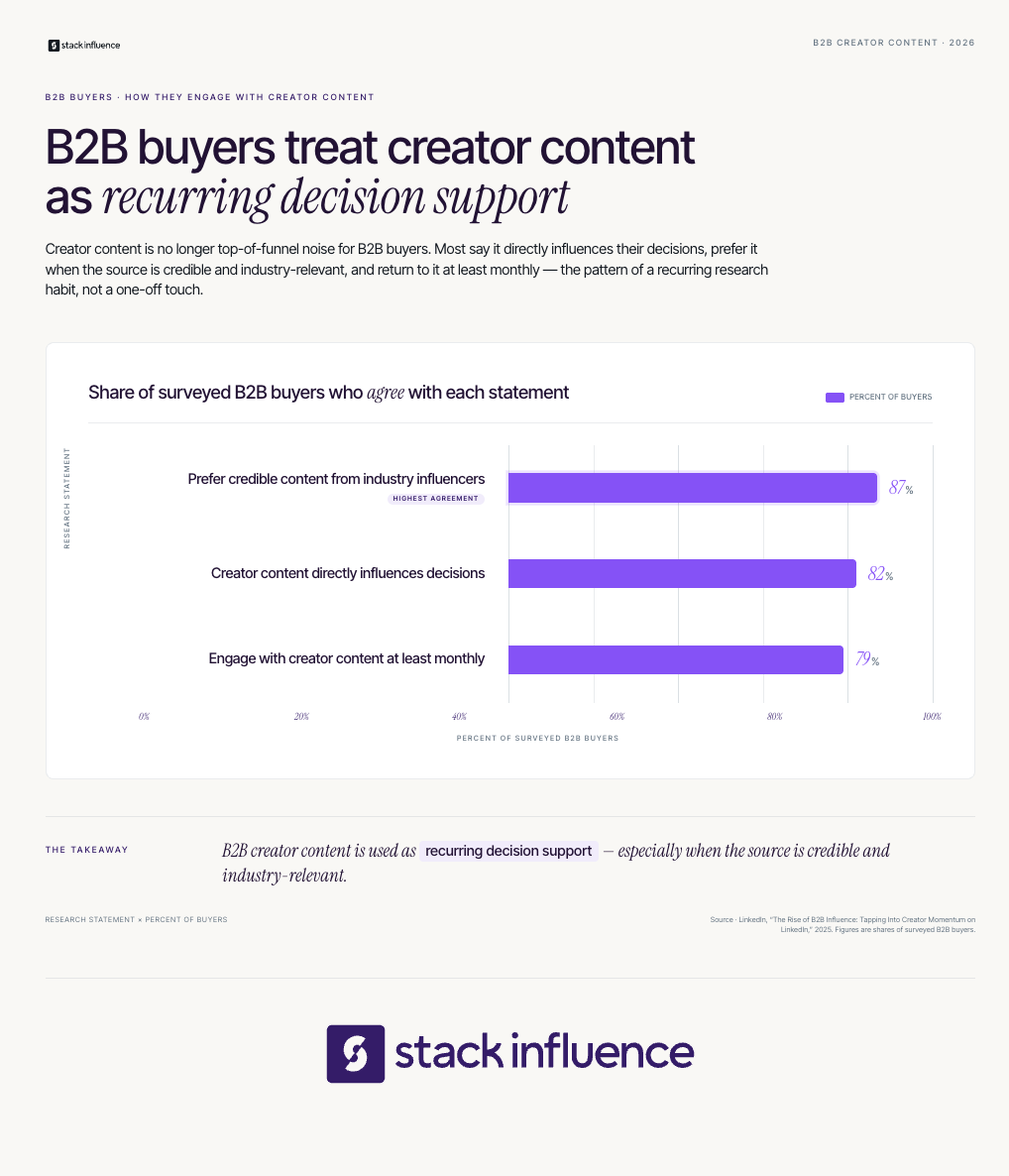
LinkedIn’s 2025 B2B creator research found that 82% of surveyed buyers said creator content directly influenced decisions, 87% preferred credible content from industry influencers, and 79% engaged with creator content at least monthly. The findings support a practical conclusion: B2B buyers use creator content as decision support, not merely entertainment.
The creator economy is also becoming a formal media category. The IAB’s 2025 creator economy report projected U.S. creator ad spend at $37 billion in 2025 and $44 billion in 2026. Those figures cover the broader creator market, not B2B alone, but they explain why brands increasingly expect professional selection, rights management, and measurement.
The practical differences are clear:
- B2B audiences are often smaller, but each qualified viewer may carry more decision value.
- The purchase may require agreement from users, managers, finance, legal, operations, or procurement.
- Educational proof usually matters more than lifestyle association.
- A useful campaign may influence a shortlist or sales conversation without producing an immediate click.
- Content often has a longer shelf life because sales teams, partners, and buyers can reuse it during evaluation.
The Decision-Path Framework for B2B Influencer Marketing
The Decision-Path Framework starts with the purchase decision and works backward to the creator, content, distribution, and measurement plan. This prevents a common mistake: choosing a popular creator first and inventing a campaign afterward.
1. Define the Buying Decision
Name the exact action the campaign should support. “Build awareness” is too vague. Better decisions include joining a wholesale program, requesting a demo, trialing a fulfillment service, switching ecommerce software, approving a professional-use product, or visiting an Amazon storefront.
Then identify the people involved and the objections each person may raise. A founder may care about growth, an operations lead about implementation, and finance about payback. One campaign can address several roles, but each asset should have one primary audience and one primary question.
2. Map the Trust Source
Find the people the buyer already consults. Search LinkedIn discussions, YouTube channels, newsletters, podcasts, communities, webinars, conference agendas, and customer conversations. Stack Influence’s guide to LinkedIn micro influencers is useful when professional context matters more than broad consumer reach.
Do not limit the search to people who call themselves influencers. A practitioner with 3,000 relevant followers can be more valuable than a general-business creator with 100,000 followers. In B2B, audience-role density often matters more than total audience size.
3. Give Every Content Asset a Decision Job
Assign each piece of content to one stage of evaluation:
- Problem discovery: Reveal a costly or overlooked issue.
- Category education: Explain how the solution works.
- Comparison: Clarify tradeoffs and selection criteria.
- Risk reduction: Show implementation, evidence, or customer experience.
- Internal justification: Give a champion material that can be shared with other stakeholders.
A repeatable influencer marketing strategy should specify the content job before the brief is written. This protects the creator’s voice while preventing vague posts that generate attention without helping a buyer act.
4. Design the Activation Path
Decide how buyers will move from content to the next useful step. The path may lead to a guide, webinar, product page, demo, affiliate offer, Amazon listing, or sales conversation. Use one clear call to action per asset and give each creator a trackable destination.
Organic distribution can be extended through email, sales enablement, partner channels, and paid amplification. On LinkedIn, Thought Leader Ads allow advertisers to promote eligible member posts with the author’s permission for supported campaign objectives.
5. Build for Continuity
Treat the first activation as a test of fit, not the entire relationship. Capture what the creator learned, which objections appeared in comments, which formats held attention, and which audience segments responded. Then turn strong one-off collaborators into recurring experts, affiliates, brand ambassadors, or co-creators.
TopRank Marketing’s 2025 B2B influencer research found that 43% of respondents reported outstanding results, rising to 79% among marketers with mature programs. The study does not prove that duration alone causes better outcomes, but it reinforces the value of operational maturity and ongoing relationships.
How Should Brands Choose B2B Influencers?
Brands should choose B2B influencers by measuring buyer relevance and credibility before audience size. A useful creator has meaningful access to the roles involved in the purchase, demonstrated expertise, a clear content style, and dependable execution. Follower count is a screening signal, not a substitute for fit.
Use a 100-point Creator Fit Score:
- ICP concentration, 30 points: How much of the audience matches the target industry, role, company size, geography, or business model?
- Subject-matter credibility, 25 points: Has the creator done the work, advised the audience, or produced original analysis?
- Evidence quality, 20 points: Can the creator explain products with examples, demonstrations, data, or clear reasoning?
- Content execution, 15 points: Does the creator communicate well in the required format, such as video, webinar, newsletter, or tutorial?
- Partnership reliability, 10 points: Does the creator respond professionally, meet deadlines, disclose relationships, and follow agreed requirements?
A score of 75 or higher is a strong pilot candidate. A score from 60 to 74 may justify a smaller test or relationship-building period. Below 60, the brand should usually keep researching rather than forcing a partnership.
Brands can source manually, use influencer marketing platforms for discovery, engage an influencer marketing agency for strategy, or use a managed workflow for execution. Choose according to the bottleneck: research, influencer outreach, product fulfillment, creator coordination, content rights, or reporting.
The review should include comment quality, not just engagement rate. Look for questions from target buyers, peer discussion, saves, reposts, and evidence that the creator changes how people think. Then use a concise influencer outreach process that explains the audience, decision problem, deliverable, compensation, timeline, rights, and measurement plan.
For creators, the same scorecard works in reverse. Show brands who follows you, which business problem you own, what content you can produce, and how previous work affected qualified conversations or buyer behavior. That evidence is more persuasive than describing yourself as a general content creator.
Campaign Formats That Create Business Evidence
The best format is the one that helps a buyer evaluate the offer and gives the brand a reusable asset. B2B influencer campaigns do not need to look like polished endorsements.
- Expert explainers and product demos: Show the workflow, implementation, or professional use case.
- Co-created research and guides: Combine the brand’s data with the creator’s interpretation and audience questions.
- Webinars, podcasts, and live sessions: Let buyers hear nuanced answers and objections in real time.
- Customer champion stories: Turn real experience into credible proof for similar businesses.
- Affiliate and ambassador programs: Reward sustained referrals and give strong partners a reason to keep educating the market.
- Product seeding for professional use: Place a physical product with practitioners who can demonstrate it in context.
Separate content creation from distribution. A UGC creator may produce a strong tutorial for the brand’s product page, sales deck, or ads without posting it to a large personal audience. An influencer supplies both content and access to an audience. Stack Influence’s overview of UGC for ecommerce explains how creator assets can support owned and paid channels after the original collaboration.
For Shopify brands, Shopify Collabs can support direct creator invitations, gifts, discount codes, affiliate tracking, and payments. It is one example of how creator partnerships can combine content with performance-based economics.
Every paid, gifted, affiliate, employment, or other material relationship needs appropriate disclosure. The FTC’s endorsement guidance tells brands and creators to make the relationship clear, and free or discounted products can count as a material connection. Disclosure requirements belong in the brief, but creators should also understand their own responsibilities.
The Hidden-Buyer Problem Most Campaigns Miss
A B2B campaign can reach the visible user and still lose the deal because an unseen stakeholder remains unconvinced. The creator brief should therefore address both the champion who wants the product and the hidden buyer who can slow or reject the purchase.
The 2025 Edelman-LinkedIn B2B Thought Leadership Impact Report found that 64% of target decision-makers and 63% of hidden decision-makers in its U.S. survey spent more than an hour per week consuming thought leadership. It also found that 91% of hidden decision-makers associated quality thought leadership with uncovering needs they had not recognized, compared with 81% of target decision-makers.
The operational response is simple: create one asset for product enthusiasm and another for internal confidence. A demo may win the user, while an implementation checklist, risk breakdown, or business case helps the user persuade finance, operations, or leadership.
How Do You Measure B2B Influencer Marketing?
Measure B2B influencer marketing as a chain of contribution from content delivery to revenue, not as a single last-click event. Track qualified attention, intent signals, influenced accounts, pipeline movement, closed revenue, and reusable content value. Use a reporting window at least as long as the normal sales cycle.
Use the B2B Influence Contribution Stack:
- Delivery: Completed assets, publication dates, disclosure compliance, and usage rights.
- Qualified attention: Views, watch time, saves, comments, and engagement from target roles or accounts.
- Intent: Branded search, landing-page visits, guide downloads, webinar registrations, product-page views, and demo requests.
- Pipeline: Influenced accounts, sales-accepted leads, opportunities, buying-group engagement, and stage progression.
- Revenue: Closed-won revenue, tracked ecommerce sales, contribution margin, retention, and expansion.
- Asset value: Reuse across ads, product pages, email, sales materials, and partner campaigns.
Set up creator-specific links before launch. Google Analytics campaign parameters can identify referral source, medium, campaign, and creative in acquisition reporting. Pair those links with CRM campaign IDs, a consistent “How did you hear about us?” field, and sales notes that identify creator-assisted conversations.
Amazon sellers can use Amazon Attribution to measure eligible non-Amazon channels, including social, video, and affiliate or influencer campaigns. Amazon’s current documentation lists engagement and conversion metrics such as clicks, detail-page views, add-to-carts, purchases, units sold, and product sales, with a 14-day attribution window.
Interpret results in three windows. Review delivery and content quality during the first 7 to 30 days, intent during the next 30 to 90 days, and pipeline or revenue across at least one normal sales cycle. These are operating guidelines, not universal benchmarks.
Do not equate influenced pipeline with caused revenue. Creator content can contribute to a decision without receiving last-click credit, while broad “influence” reporting can also claim deals the campaign barely touched. Use multiple signals and explain the attribution method in every report.
Managing Product Seeding and UGC at Scale

Ecommerce brands often combine a B2B trust program with a consumer-facing micro influencer campaign. The B2B layer reaches retailers, agencies, professional users, or ecosystem partners. The consumer layer generates product demonstrations, social proof, UGC video, and marketplace traffic.
Stack Influence is built around gifted-first product seeding, vetted micro influencer activation, creator coordination, UGC generation, and completed-post accountability. Supplied company data describes a network of roughly 600,000 vetted creators and a completions-only model, sometimes called “influencer insurance,” in which platform spend is tied to completed creator posts.
This workflow is especially practical when a team wants to move from creator sourcing to shipped products, verified posts, and reusable content without managing every follow-up manually. Brands can review Stack Influence’s influencer seeding workflow, managed micro influencer campaign process, and content syndication options when planning that execution layer.
A verified Stack Influence example shows the difference between evidence and overclaiming. During a three-month Targus product campaign, 120 creator promotions generated 275,560 social impressions and 4,323 engagements, while average monthly unit sales increased from 56 to 221 during the measured period. The campaign was an ecommerce activation, not a pure B2B demand-generation benchmark, so it demonstrates execution scale rather than a guaranteed B2B outcome.
Common Mistakes That Weaken B2B Influencer Campaigns
Most failures begin before the post is published.
- Confusing a brand-to-creator payment with B2B marketing: The intended buyer must be a business.
- Choosing audience size over buyer density: Large reach cannot compensate for the wrong roles.
- Briefing the creator like a spokesperson: Give creators a clear claim, evidence, and guardrails, then preserve their natural voice.
- Ignoring content rights: Define organic use, paid use, editing, channels, duration, and exclusivity before production.
- Waiting to plan attribution: Tracking added after publication cannot recover missing links, CRM fields, or baselines.
- Stopping after one post: A single activation provides little learning and rarely builds durable trust.
- Treating UGC and influence as identical: Content quality and audience distribution should be priced, briefed, and measured separately.
Build a System, Not a Sponsored Post
B2B influencer marketing works when credible people help business buyers make a difficult decision with greater confidence. For ecommerce sellers, that can mean reaching wholesale partners, professional buyers, agencies, or the software and service ecosystem around commerce. For creators, it means turning expertise into useful evidence rather than chasing broad attention.
Start with one buying decision, one creator cluster, one content job, and one attribution path. Then use the first campaign to build a repeatable system for stronger creator partnerships, reusable content, and better-informed buyers. A managed product-seeding workflow can support that next step when campaign volume and follow-up become too complex to coordinate manually.