




Most explanations of B2B influence stop at awareness. That misses what eCommerce sellers and creators actually need from the channel: lower buyer friction, reusable proof, and cleaner revenue math. If you sell to brands, Amazon sellers, Shopify merchants, agencies, or the software teams that serve them, that difference changes how you choose creators, briefs, and KPIs.
This guide answers what is b2b influencer marketing through five practical ideas. You will see how B2B creator programs differ from B2C campaigns, when micro influencers and nano influencers outperform bigger names, how to measure impact with Amazon Attribution, and why the smartest programs treat UGC as a business asset instead of a one-time post.
Key Takeaways
- B2B influencer marketing works best when it transfers trust from a credible niche voice to a business buyer, not when it simply rents attention from the largest audience available.
- Mature, always-on creator programs outperform one-off influencer campaigns because trust compounds over time and the content becomes easier to reuse and measure.
- For eCommerce teams, the highest-value output is often reusable UGC, not just a single sponsored mention, because those assets can support PDPs, ads, email, and marketplace content.
- Amazon sellers should measure creator work with Amazon Attribution, Amazon Brand Referral Bonus, and asset-level economics instead of relying on soft awareness metrics alone.
- Micro influencers and nano influencers can win in B2B when they are trusted practitioners, educators, or operators with a precise audience fit.
Why Does B2B Influencer Marketing Behave More Like Trust Infrastructure Than Ad Inventory?

B2B creator programs work because buyers borrow judgment from people they already trust. TopRank Marketing's 2025 research says 85% of B2B marketers already use influencer marketing, while LinkedIn's 2025 buyer research found that 82% of buyers say creator content influences decisions, 87% prefer credible content from industry influencers, and 79% engage with it at least monthly.
In eCommerce, B2B influence is broader than SaaS. It includes creator partnerships for Amazon tools, logistics providers, agencies, analytics software, UGC platforms, influencer marketing platforms, and service brands that sell to merchants rather than end consumers. The common denominator is risk reduction: the buyer wants proof that a solution works in the real operating environment.
A useful way to frame the difference is this:
- B2B buyers usually buy with multiple stakeholders, so one trusted creator can help sales, operations, and finance align around the same narrative.
- The best B2B influencers are often practitioners, operators, consultants, or educators, not entertainment-first celebrities.
- In commerce categories, the content itself often matters as much as the post because clips, demos, and testimonials can be reused across landing pages, ads, and Amazon listings.
- Trust compounds over repeated exposure, which is why relationship quality matters more than a one-off spike in reach.
That is also why program maturity matters more than novelty. TopRank reports that 43% of marketers overall say their influencer programs deliver outstanding results, but that jumps to 79% for mature programs, and 99% of teams with always-on programs rate them as effective. In other words, B2B influence starts to pay off when it becomes operating muscle, not campaign garnish.
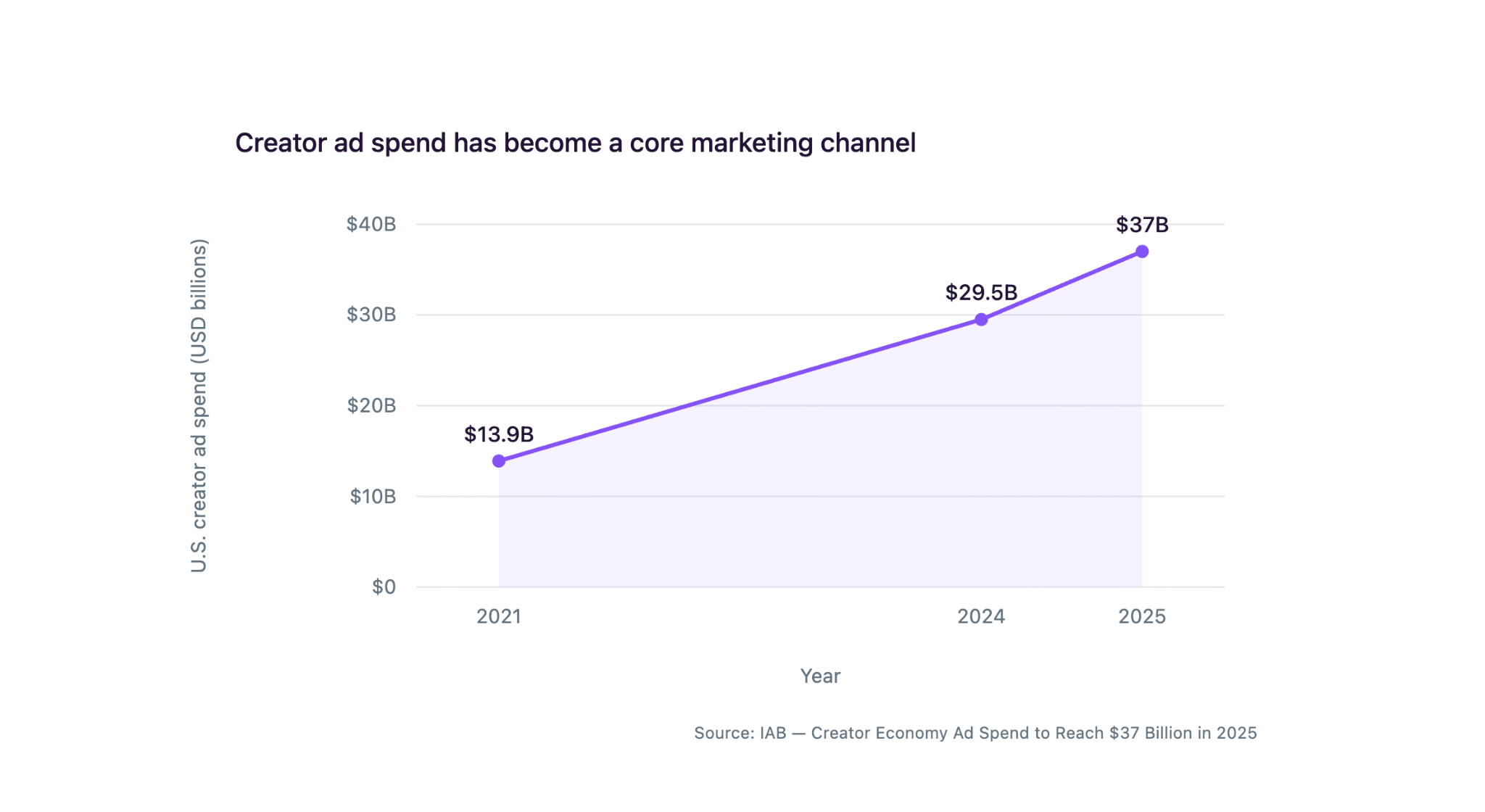
The spend side confirms the shift. IAB's 2025 creator economy report says U.S. creator ad spend is projected to reach $37 billion in 2025 after rising from $13.9 billion in 2021 to $29.5 billion in 2024, and 32% of brands already use creator campaigns to drive online sales or conversions. That is why B2B influencer marketing should be treated as a commercial channel with trust advantages, not as a soft awareness line item.
What Is B2B Influencer Marketing for eCommerce Sellers and Influencers?
What is b2b influencer marketing? It is the practice of partnering with credible niche voices to influence business buyers through education, proof, and trust transfer rather than mass consumer persuasion. In practical terms, the creator is helping another business decide, shortlist, validate, or buy.
For eCommerce sellers and influencers, that influence can come from an operator who reviews software, a consultant who teaches retention, an Amazon educator who walks through catalog strategy, or a creator who earns through the Amazon Influencer Program by curating a storefront and vanity URL. The audience is smaller than B2C, but the decision value per viewer is often much higher.
In this market, most B2B creators fall into a few repeatable buckets:
- Practitioners who show real workflows and explain tradeoffs
- Experts who compare tools, tactics, or service models
- Customer advocates who provide testimonial-style proof
- Employee creators who turn inside knowledge into thought leadership
- Commerce-focused content creators who mix education, UGC video, and product seeding experience
That also explains why influencer marketing, UGC creator, and Amazon influencers are related but not identical ideas. Influencer marketing is the partnership system, UGC is the asset, and Amazon influencers sit closer to commerce because they can connect content directly to an Amazon storefront. For DTC brands and Amazon sellers, strong B2B programs usually blend all three.
Creators themselves should think about this as a B2B sale. Visa's 2025 creator report says 68% of creators consider themselves small business owners and 88% expect their business to grow, which is a useful reminder that brand deals, brand sponsorship, and creator partnerships are not side hobbies anymore. They are part of a professional services economy inside the broader creator economy.
The Credibility-to-Conversion Flywheel
The Credibility-to-Conversion Flywheel is a simple way to evaluate whether a B2B influencer program will compound or stall. Unlike a straight funnel, the flywheel assumes one strong creator asset can keep paying back through trust, content reuse, and attributed demand long after the first post is published.
It has four moving parts:
- Authority signal: the creator must have earned trust in a specific category.
- Buyer relevance: the topic, audience, and pain point must match a real commercial need.
- Reusable proof: the output should create assets such as UGC video, screenshots, explainers, testimonials, or demo clips.
- Attributed demand: the campaign needs a measurable path to pipeline, Amazon sales, or assisted revenue.
Authority Signals
The first job in the Credibility-to-Conversion Flywheel is selecting a voice people already use as a filter. LinkedIn data shows 59% of B2B buyers discover new brands through creator content, 67% say it helps them assess solutions, 47% visit a vendor site after engaging with it, and 38% say it prompts contact with sales. Those numbers only work when the creator is trusted for the topic at hand.
Buyer Relevance
Relevance beats celebrity in B2B because the audience needs precision. A nano influencer explaining Amazon FBA prep for private-label brands, or a micro influencer known for Shopify CRO audits, can outperform a larger creator whose audience is broad but commercially mismatched. This is why many brands that work with micro influencers in B2B care more about problem fit than pure follower count.
Reusable Proof
The third stage is where eCommerce teams often unlock the most value. Based on Stack Influence's work with eCommerce brands, creator economics look far better when one delivered asset can live on social, on a PDP, inside email, and inside paid media. That logic is built into the Stack Influence pricing page, which frames campaigns around about $30 per completed creator post, and the Stack Influence Amazon influencer seeding workflow, which is designed to turn product seeding into repeatable UGC output.
Attributed Demand
The fourth stage is measurement. If the campaign cannot connect to attributed traffic, assisted conversions, or sales conversations, the flywheel still spins creatively but not commercially. That is why mature teams increasingly pair creator output with a repeatable operating model, whether they manage it internally or through a workflow like how to create an influencer marketing strategy in 2026.
When the flywheel breaks, it usually breaks at stage two or four. TopRank found that identifying the right influencers and measuring results remain two of the biggest challenges in B2B influencer marketing, which is exactly why the Credibility-to-Conversion Flywheel should be used before you approve a brief or a budget.
How Should You Measure B2B Influencer Marketing on Shopify and Amazon?
Measurement is where many B2B influencer campaigns lose credibility internally. TopRank reports that 47% of B2B marketers struggle to measure and report results, and 93% say pressure to prove marketing ROI has increased. A useful response is to build one metric system that covers trust signals, traffic quality, and commercial outcome.
Use a four-layer Proof Stack:
- Attention layer: track qualified impressions, watch time, saves, comments from target roles, and content completion rate.
- Visit layer: for website and marketplace traffic, track sessions, detailed page views, add-to-cart behavior, and landing-page engagement.
- Revenue layer: for Amazon sellers, Amazon Attribution is free, uses a 14-day attribution window, and reports clicks, detailed page views, add-to-carts, purchases, units sold, product sales, and new-to-brand metrics.
- Recovery layer: if you qualify, Brand Referral Bonus can add an average credit worth about 10% of qualifying sales measured through Amazon Attribution, which changes true CAC on off-Amazon traffic.
- Asset layer: track cost per usable photo or UGC video, paid media reuse rate, and time saved versus manual creator management.
Off-platform conversion tracking is still imperfect, especially when creators influence branded search, repeat visits, or a later Amazon purchase. That is why Shopify influencer marketing and Amazon programs should both reconcile direct attribution with softer signals like branded search lift, reply quality, content reuse, and sales-team feedback. Amazon sellers need that wider view because a creator often changes purchase confidence before the tracked click arrives.
Data from Stack Influence's micro influencer campaigns suggests that campaigns tagged before product ships produce cleaner reporting than campaigns that add tracking after content is already live. If your team needs a practical template for that setup, the Stack Influence budgeting guide for Amazon brands is a useful example of how to connect creator cost, traffic data, and Amazon Brand Referral Bonus into one P&L view.
Stop Chasing Reach, Start Building Sales Assets
The biggest mistake in B2B influencer marketing is treating the creator like rented media. Reach matters, but it rarely explains the full return in eCommerce, where the buyer may watch a demo, read peer comments, visit an Amazon listing later, and convert only after seeing proof placed in the right commerce environment. Reach fills the first quarter of the Credibility-to-Conversion Flywheel. Assets and trust finish the job.
Bazaarvoice's trust data says 47% of consumers trust customer testimonials and peer reviews when shopping on social media, and its broader Bazaarvoice shopper research shows one in three shoppers buy from creator recommendations. That should change how B2B sellers think about creator output. The best deliverable is often not a one-off mention. It is a reusable tutorial, testimonial, product comparison, or founder explanation that keeps converting after distribution ends.
If you want more durable ROI, build for these outcomes:
- A UGC library that can support paid social, landing pages, Amazon listing media, and sales enablement
- A creator roster that can evolve into brand ambassadors, affiliates, or repeat educational partners
- A briefing system that requests proof points, objections, and use-case clarity rather than generic praise
- A reuse-rights process that treats content creators as ongoing partners in content operations, not just campaign inventory
Stack Influence has observed that creator content becomes more valuable after the original placement when it is reused in ads and marketplace creative. Its public Stack Influence Amazon influencer platform page highlights up to 4x ad conversions in Amazon-focused workflows, which is why a micro influencer agency or influencer marketing platform serving DTC brands should be evaluated partly on content syndication and reuse, not just creator discovery.
This is also why a pure influencer marketing agency model is not always enough for lean teams. If your workflow includes product seeding, approvals, Amazon Attribution tags, and UGC rights, you may need a system that behaves more like creator operations infrastructure than just a campaign broker. For many eCommerce teams, that is the difference between a nice creator post and a repeatable creator engine.
Where Does B2B Influencer Marketing Work Best for DTC Brands, Amazon Sellers, and Creators?
B2B influencer marketing works best where the purchase is complex, the audience is niche, and the content can educate. That makes it a strong fit for Amazon sellers, Amazon FBA service businesses, Shopify app partners, DTC brands selling to retailers, agencies, analytics tools, UGC platforms, and service brands whose buyers want a working example before they buy. It is weaker when the offer is purely commoditized and the creator has nothing meaningful to explain.
Use the Partner-Fit Screen before you launch:
- Problem clarity: can the creator explain a real business pain in plain language?
- Audience specificity: does the audience look like merchants, operators, marketers, or procurement stakeholders you actually sell to?
- Proof format: will the creator produce demos, walkthroughs, UGC video, screenshots, or testimonial assets you can reuse?
- Attribution route: can you connect the program to Shopify sessions, demo requests, or Amazon Attribution tags?
- Relationship runway: does this look like a one-off brand deal or the start of long-term creator partnerships and brand ambassadors?
For marketplace-heavy teams, the implementation often looks different by channel. Shopify influencer marketing usually prioritizes sessions, conversion rate, and content reuse on site, while Amazon programs lean harder on PDP quality, external traffic, and attribution recovery. That is why Amazon sellers often combine influencer campaigns with product seeding, Amazon storefront traffic, and listing asset refreshes instead of treating creators as a separate channel.
For influencers, the best B2B opportunities are often quieter but stickier than consumer brand sponsorship. Software brands, service providers, and brands looking for influencers often need explainers, tutorials, case-style posts, or partner education rather than a flashy one-time endorsement. That gives micro influencers, nano influencers, and UGC creators more room to win recurring brand partnerships if they can teach, demonstrate, and stay reliable.
Turning What Is B2B Influencer Marketing Into Revenue
What is b2b influencer marketing in 2026? For eCommerce sellers and influencers, it is a trust-transfer system that turns the right creator relationship into education, proof, reusable assets, and attributed demand. The brands that win are not the ones buying the biggest voice. They are the ones designing a repeatable way to turn credible creator output into business evidence.
If you want the channel to pay back faster, start here:
- Pick one narrow buyer problem and one creator type who can explain it credibly.
- Define the asset you want before the campaign starts.
- Set attribution and reuse rules before the first product ships or the first brief goes out.
Do that, and B2B influencer marketing stops feeling abstract. It becomes a practical growth lever for Amazon sellers, Shopify merchants, DTC brands, and creators who want smarter brand deals instead of noisier ones.