




Changing your Amazon strategy because someone says “A10 replaced A9” creates a practical problem: what, exactly, are you responding to?
The Amazon A9 vs A10 algorithm debate often mixes legitimate search developments with unsupported claims about advertising, external traffic, and seller authority. As of September 10, 2026, the official Amazon sources reviewed for this guide did not provide an A10 launch announcement, replacement date, or published comparison of ranking weights.
For ecommerce sellers, the useful comparison is therefore not an invented formula for two versions. It is the difference between what Amazon documents, what your own results demonstrate, and what remains speculation.
Key Takeaways
- Treat “A10” as an unverified upgrade label, not a documented Amazon release with published ranking weights.
- Amazon has published real developments in search relevance and listing requirements, but these do not establish an A9-to-A10 replacement.
- Creator campaigns should be evaluated through completed content, qualified traffic, and business results, not promises of an algorithm bonus.
- Track organic position, query-level performance, and category sales rank separately because they answer different questions.
Amazon A9 vs A10 Algorithm: What Is Actually Confirmed?
There is no verified public A9-versus-A10 ranking formula to compare in the official sources reviewed for this article. A9 has a documented historical identity within Amazon, while the claimed A10 replacement lacks the equivalent release evidence in those sources.
Amazon’s 2004 A9.com announcement identifies A9.com as an Amazon subsidiary launching a search service. That historical name should not be mistaken for a public specification of every system involved in Amazon product discovery today.
For seller planning, use “A9” as familiar shorthand for the product-search discussion. Treat an “A10 update” claim as something that needs evidence before it changes your budget.
Compare the Claims, Not Imaginary Ranking Weights
Four distinctions help turn the debate into useful decisions:
- Keyword relevance: Amazon’s SEO guidance still recommends relevant product information, search terms, images, and clear descriptions. A claim about newer search technology is not a reason to abandon accurate keywords.
- Paid advertising: Amazon describes Sponsored Products as cost-per-click advertising. Buying an ad placement and earning an unpaid search position are different outcomes.
- External traffic: A campaign can generate measurable visits and purchases without establishing that Amazon applies a special ranking multiplier to off-Amazon orders.
- Seller authority: Do not treat seller age, catalog size, or account history as a published “A10 authority score.” Ask for the exact Amazon source before accepting a numerical weighting.
The distinction is not “old tactics versus new tactics.” It is documented functionality versus an explanation that sounds plausible but has not been demonstrated.
Sales Rank Is Not an Algorithm Version Detector
Best Sellers Rank, or BSR, measures sales performance relative to other products in a category. Amazon’s BSR explanation says it considers recent and historical sales, with recent sales receiving greater weight; it also distinguishes BSR from organic search ranking.
A product can improve its category sales rank without showing the same improvement for a particular search query.
During Stack Influence’s three-month Snow product-launch campaign, average monthly unit sales increased from 34 to 215, while BSR moved from #177,297 to #57,682. Those figures document sales and category-rank movement during the campaign, not a measured change in the ranking formula or proof that creator activity alone caused the results.
For implementation after identifying a specific visibility problem, Stack Influence’s guide to improving Amazon rankings provides a separate diagnostic workflow. The important starting point is to name the outcome you are trying to improve.
What Has Amazon Actually Changed?
Amazon has documented developments in intent-aware search research and seller-facing listing requirements. These provide concrete information to work with, but neither should be relabeled as proof of an A10 release.
Intent-Aware Relevance Has Published Research Behind It
Amazon’s COSMO research paper describes using common-sense knowledge to connect customer intentions with products. Its search-relevance experiment evaluated whether a product was an exact match, substitute, complement, or irrelevant result for a query.
In the paper’s public English-language benchmark, the trainable cross-encoder baseline achieved a Macro F1 score of 57.49. Adding intent knowledge produced 73.48, an increase of 15.99 points on the reported 0–100 scale.
These are experimental relevance-classification scores. They are not percentages of additional seller revenue, keyword-ranking improvements, or weights in a public Amazon ranking formula.
The practical inference is to describe what a product does and the circumstances in which it is useful, rather than merely repeating a popular keyword.
For an under-sink organizer, that means accurate dimensions, shelf adjustment, pipe clearance, and intended storage use. “Premium organization solution” provides less concrete information than an explanation of which cabinets the organizer fits and what prevents it from fitting.
Do not invent attributes to cover more search intentions. Better interpretation cannot make an inaccurate product claim useful to the buyer.
A Real Listing Update Has a Date and Defined Fields
Amazon’s July 27, 2026 title announcement specifies a 75-character title limit, including spaces, for categories other than media, alongside a 125-character Item Highlights field.
Amazon’s follow-up clarification says both fields are search inputs and neither is prioritized over the other. It also describes recommendations rolling out during 2026, with listings remaining active, editable, and searchable during the transition.
For U.S. sellers, this is a concrete reason to review older listing instructions. Keep product identity clear in Item Name and use Item Highlights for additional distinguishing information.
Notice the difference in evidence: the announcement identifies the fields, character limits, timing, and rollout behavior. A generic assertion that “A10 now values relevance more” does not give you the same decision-quality information.
Apply the Algorithm Claim Test Before Changing Strategy
The Algorithm Claim Test is a four-part decision filter for deciding whether an alleged search update deserves action. Record the evidence and proposed response before changing listings, advertising budgets, or creator campaigns.
1. What Is the Original Evidence?
Start with the original announcement, documentation, or research, not a secondhand summary. Record whether it describes a policy requirement, a deployed feature, an experiment, or a seller’s observation.
A research paper can support an explanation of a tested method without documenting a universal seller-facing rollout. A campaign case study can demonstrate an observed outcome without revealing the ranking mechanism.
For a claim such as “external orders are worth more under A10,” request a source that establishes both the claimed weighting and its scope. Without that evidence, do not put the multiplier into a forecast.
2. Which Outcome Is Supposed to Change?
Name the result precisely: organic position for a query, paid impressions, product-page conversion, category BSR, or attributed purchases.
A screenshot of higher revenue does not establish improved organic position. A screenshot of page-one advertising does not establish page-one unpaid placement.
Likewise, a campaign commissioned to produce reusable UGC should first be assessed against its content requirements. Content production and search visibility require different evidence.
3. What Else Changed During the Same Period?
Check price, coupons, inventory, delivery promises, advertising, listing edits, and campaign activity before attributing a result to an algorithm update.
Write these changes beside the performance timeline. Otherwise, an account-level improvement can become a story about a platform-wide update simply because both happened around the same time.
A useful observation might be: “Purchases increased after the coupon and creator campaign launched.” It is not yet: “A10 rewarded the campaign.”
4. What Decision Survives Even Without the Algorithm Claim?
Prefer actions that remain commercially sensible without an unverified ranking explanation.
Correcting dimensions, restoring inventory, clarifying a product demonstration, or testing a relevant audience can each have a defined purpose. Paying for unqualified traffic because it supposedly carries a ranking bonus does not offer the same defensible rationale.
Use the Algorithm Claim Test to separate “worth testing” from “proven to work.” Those are different decision categories, and your budget should reflect the difference.

Build Creator Demand Without Selling an Algorithm Story
Creator partnerships can be planned around useful product demonstrations, audience discovery, and measurable shopping activity without promising that a particular algorithm will reward them.
Start with the buying question the content should answer. For the under-sink organizer, a demonstration of clearance around plumbing may be more useful than an attractive photograph that hides the installation constraints.
When evaluating micro influencers and nano influencers, prioritize evidence that they can explain the use case to an appropriate audience. Stack Influence’s guide to finding Amazon influencers develops this evaluation beyond follower counts and storefront appearances.
Separate the content assignment from distribution. A UGC creator might produce a useful product demonstration, while another creator partnership is primarily intended to introduce the product to potential customers.
Contract for Deliverables You Can Verify
Stack Influence’s automated product-seeding workflow combines gifted-first creator participation with campaign coordination and completed-post accountability. Its completions-only model concerns completed creator posts, not guaranteed purchases or search positions.
That distinction should carry through the brief and reporting. Specify the required content, disclosure, destination, approval criteria, and usage rights before activation.
Separate creator participation and product costs from independent customer demand in the results. A reimbursed participant’s order should not be presented as evidence that an unrelated shopper chose the product without an incentive.
When considering Amazon-focused creator campaigns, ask how the workflow connects content delivery to tracking and commercial evaluation. “We manage completed creator content” is a verifiable service description; “we trigger A10” is not a useful measurement commitment.
Keep Reviews and Ranking Manipulation Out of the Brief
Amazon’s customer-review policy explanation prohibits incentives such as free products, refunds, or other compensation in exchange for reviews. A compensated social post and an Amazon customer review are different deliverables.
Do not use coordinated purchases, refunds, or search-and-buy instructions as ranking tactics. Plan the campaign around truthful content and genuine audience interest instead.
The FTC’s influencer disclosure guidance also requires clear disclosure of material relationships, including free products or payment. Build disclosure into the original assignment rather than treating it as a correction after publication.
Measure Search Share, Not Just a Bigger Number
Evaluate search progress using consistent query-level observations and commercial outcomes. More impressions, more purchases, and better organic position can be related, but one does not automatically prove the others.
For eligible brands, Amazon’s Brand Analytics guide explains how Search Query Performance reports impressions, clicks, cart additions, and purchases for particular queries, including the brand’s share of overall query performance.
Keep branded and non-branded queries separate. Also keep direct organic-position observations separate from aggregate performance reports, checking each report’s placement coverage before interpreting it as organic-only evidence.
More Impressions Can Coincide With a Smaller Share
Amazon’s Search Query Performance report schema distinguishes total query impressions, ASIN impressions, and ASIN impression share. The share compares the product’s impressions with the total impressions for that query.
Consider an illustrative scenario for the same ASIN, query, U.S. marketplace, and reporting definition across two hypothetical four-week periods:
- Period A: The ASIN receives 10,000 impressions out of 100,000 total query impressions, giving it a 10% impression share.
- Period B: The ASIN receives 12,000 impressions out of 150,000 total query impressions, giving it an 8% impression share.
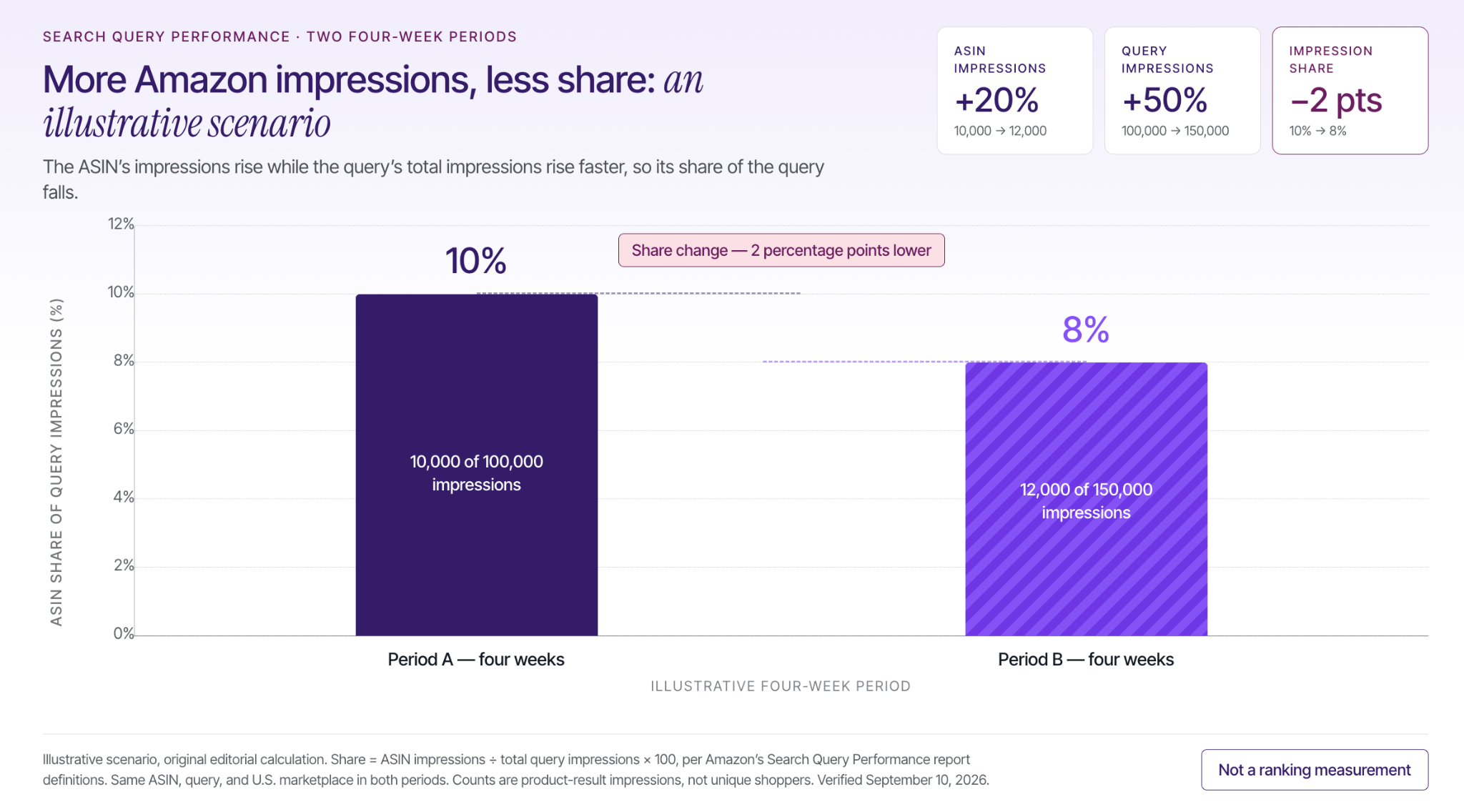
The product’s impressions increased 20%, but the total query-impression pool increased 50%. Impression share therefore fell by two percentage points.
These counts represent product-result impressions, not unique shoppers or the number of searches. The example is an invented calculation for explanation, not an Amazon benchmark or Stack Influence campaign result.
It also does not prove that organic position declined. It shows why a larger numerator is insufficient: you need the denominator and a measurement that matches the claim.
This is the Algorithm Claim Test in practice. The observation supports “more impressions but a smaller share,” not “A10 rewarded the listing” or “A10 penalized the listing.”
Attribute External Purchases Without Calling Them Incremental
Set up tracking before content goes live. Amazon’s Attribution guide describes a 14-day, last-touch model: a qualifying conversion must occur within 14 days of a click, and the most recent click receives credit.
Use distinct tags for the sources or creative groups you need to evaluate. Maintain consistent campaign names and ASIN records in your Amazon Attribution reporting workflow so content delivery and shopping activity can be connected.
Attribution describes a credited customer path. It does not establish that every credited purchase was additional, capture every untagged journey, or prove the campaign changed organic ranking.
An audience member who sees a video and later searches for the product without using its tagged link illustrates the limitation. That journey cannot simply be assigned to the video through click-based evidence that was never recorded.
Make the Commercial Decision Separately
Use leading indicators to diagnose execution: content completion, functioning links, and relevant traffic. Use outcome measures to judge the business case: customer purchases, contribution after costs, and consistently measured search performance.
Amazon’s Brand Referral Bonus explanation describes credits averaging 10% of qualifying sales, with the amount affected by factors such as product category and sales price. That is a financial program, not documentation of an organic-ranking bonus.
Include confirmed credits in the economics without counting them twice. Stack Influence’s profit-first external traffic playbook provides a broader framework for evaluating acquisition costs and contribution.
For an initial operating review, compare two equal four-week windows and annotate important changes. This is a suggested review cadence, not an Amazon ranking deadline; low-volume products may need longer, and recent attribution results need time to mature.
Keep, revise, or stop the activity according to its defined objective. A campaign can be commercially worthwhile without proving a ranking effect, while a visible ranking improvement can still be unprofitable.
Replace Algorithm Speculation With a Measurable Decision
The useful lesson from the Amazon A9 vs A10 algorithm debate is not that Amazon search stands still. It is that a version label is a poor substitute for evidence.
Follow documented listing requirements, explain the product accurately, and test acquisition strategies against outcomes you can measure. Keep campaign delivery, attributed demand, category sales rank, and organic keyword position distinct.
Start with one ASIN and one claim you need to evaluate. When creator content is part of that plan, assess a Stack Influence product-seeding workflow around completed deliverables and measurable customer demand, rather than an unverified algorithm promise.