




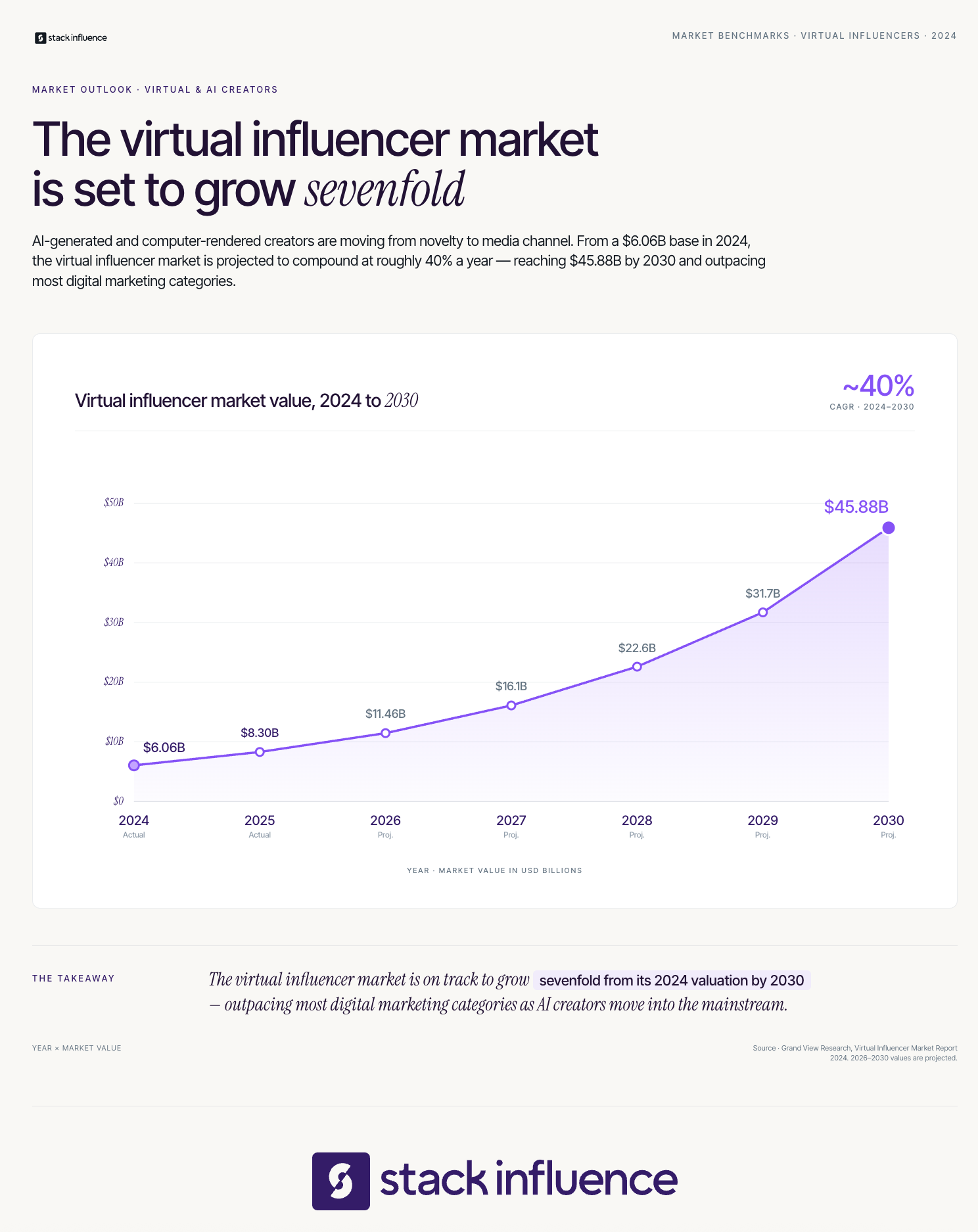
The global virtual influencer market was estimated at USD 6.06 billion in 2024 and is projected to reach USD 45.88 billion by 2030, growing at a CAGR of 40.8% from 2025 to 2030. That trajectory is not a distant forecast for content creators to ignore. It is a budget shift already playing out in brand deals, campaign briefs, and creator partnerships across every major platform right now.
The rise of virtual influencers is not replacing human creators wholesale. It is restructuring which creators get hired, what content formats brands pay for, and how creator economy relationships are valued. That trajectory puts virtual influencers among the fastest-scaling categories in digital marketing, as brands across fashion, food, entertainment, and finance increasingly turn to computer-generated personas for cost-efficient, always-on content, signaling a structural shift in how companies allocate influencer marketing budgets. Creators who understand this shift will position themselves for stronger brand sponsorship opportunities. Those who ignore it will find the competition for brand deals more crowded and less predictable.
Here is what the data actually shows, what most coverage gets wrong, and how real content creators can respond strategically.
Key Takeaways
- Virtual influencers currently post engagement rates roughly three times higher than human creators in non-sponsored content, but human creators outperform them significantly on sponsored post trust.
- The FTC's 2023 Endorsement Guides explicitly extend disclosure requirements to virtual and AI-generated influencers, creating compliance obligations for brands that use them.
- Human micro influencers and nano influencers retain a structural advantage in authentic, community-driven influencer campaigns that virtual personas cannot replicate.
- Understanding the VIPER Framework helps creators identify which brand deals virtual influencers will dominate and which remain firmly in human creator territory.
- The Virtual Partner Readiness Checklist gives creators a concrete pre-pitch audit to sharpen their positioning against AI competition.
What Are Virtual Influencers?
A virtual influencer is a digitally created persona built through computer-generated imagery (CGI), animation, or artificial intelligence that operates on social media as a brand ambassador, content creator, or product promoter. These CGI influencers are designed to resemble real people, complete with distinct traits, backstories, and unique styles, and they engage with audiences and promote products just like human influencers but are entirely virtual creations controlled by humans behind the scenes. They are not autonomous; every post, caption, and campaign is managed by a creative team or brand operator.
The category spans several distinct subtypes that matter for how creators position themselves against them:
- Human avatars: Hyper-realistic digital humans designed to pass as real people, such as Lil Miquela and Shudu Gram. These compete most directly with lifestyle micro influencers and brand ambassador programs.
- Animated characters: Stylized personas with clearly non-human aesthetics, often tied to gaming, entertainment, or youth brands. These rarely compete with human creators on trust but dominate niche community content.
- AI-driven avatars: Programmatic personas that can respond to comments, generate personalized content at scale, and adapt messaging in real time. These represent the fastest-growing and most disruptive subtype for UGC creators and product-focused content.
The human avatar segment recorded the largest revenue share of over 68% in 2024 , which tells you where brands are concentrating investment. Human-adjacent digital personas are the category most directly competing for the same briefs that lifestyle-focused micro influencers receive today.
Per Straits Research, the virtual influencer market is expected to grow from USD 8.30 billion in 2025 to USD 111.78 billion by 2033, a CAGR of 38.4%, driven by AI advancements and increasing brand adoption of digital personas. That scale of growth means the question for creators is not whether virtual influencers will compete for brand deals. It is which brand deals and on what terms.
The VIPER Framework: Scoring Virtual Influencer Fit
The VIPER Framework is a five-letter scoring tool that helps creators quickly evaluate whether a potential brand deal is likely to favor a virtual influencer or a human creator. Run any prospective brand partnership through VIPER before pitching and you will know where you hold the strategic advantage.
The five variables in the VIPER Framework are:
- V - Visual control requirement: How tightly does the brand need to control the visual output? High control needs (luxury fashion, cosmetics launches, global campaigns) favor virtual influencers. Loose or lifestyle-driven visual requirements favor human creators who bring authentic context.
- I - Identity risk tolerance: How much reputational exposure does the brand face if a creator makes a mistake? Low tolerance (finance, pharma, large CPG) favors virtual influencers. Higher tolerance or authenticity-first brands favor human creators.
- P - Purchase intent reliance: Does the campaign need to convert followers into buyers or simply build awareness? In categories where authenticity matters most, sponsored posts by human creators can outperform virtual ones by up to 2.7 times. Conversion-heavy briefs almost always favor human creators, especially micro influencers and nano influencers with high community trust.
- E - Engagement source: Is the brand optimizing for raw engagement numbers or meaningful community interaction? Data from HypeAuditor cited across multiple 2026 industry analyses shows virtual influencer campaigns average a 5.67% engagement rate versus 1.89% for human creators, roughly three times higher. But this gap reflects curiosity-driven interaction, not community loyalty.
- R - Relationship depth needed: Does the brand require long-term ambassador relationships, ongoing UGC video production, or product seeding across multiple SKUs? These relationship-intensive activations strongly favor human creators who can document real product usage and build authentic audience trust over time.
Run each variable on a 1 to 5 scale: 5 means the factor strongly favors a virtual influencer, 1 means it strongly favors a human creator. A total VIPER score under 15 signals the brand deal is territory where human creators hold a natural advantage. A score above 20 suggests the brief is increasingly in virtual influencer territory.
According to Influencer Marketing Hub cited in 2026 reports, brand adoption of virtual influencers rose from 60% to 73% of all surveyed companies worldwide as of 2026. Even as that number climbs, it does not mean human creators are losing ground uniformly. It means certain brief types are shifting while others remain firmly human. The VIPER Framework helps you identify which is which before you invest time in a pitch.
Stack Influence's internal campaign data shows that in product seeding and UGC-intensive campaigns, micro influencers consistently generate 40 to 50% higher content reuse rates than brand-produced assets, a performance gap that virtual influencer content has not yet closed in authentic community-facing categories.
What Most Guides Get Wrong About Virtual Influencer Engagement
Most coverage of virtual influencers leads with engagement rate data as the definitive proof of virtual influencer superiority. The VIPER Framework already accounts for this, but the nuance is worth examining because it shapes how creators position their value to brands.
The commonly repeated claim is that virtual influencers win on engagement. The data behind that claim is real but incomplete. In 2023, virtual influencer campaigns achieved a remarkable 5.9% average engagement rate, which is 3 times higher than the 1.9% engagement rate from campaigns with real influencers. What that headline omits is the source of those engagements. Virtual influencer engagement is heavily curiosity-driven: people interact because the content is novel, aesthetically striking, or technologically impressive, not because they trust the persona's product recommendations.
The trust gap is significant and brands are beginning to price it into their briefs. Consumers cite transparency and honesty about brand relationships (71%) and authentic reviews, even if negative (79%), as the critical factors that increase their trust in influencers. Virtual personas structurally cannot provide either. The biggest trust-killer in the industry, cited by 80% of consumers, is influencers who are not genuine or transparent.
This is where human content creators, especially nano influencers operating in tight communities, hold a durable structural advantage. The strategic error many creators make is competing on production quality or post frequency, trying to out-polish virtual influencers on visual terms. That is the wrong battle. Here is what creators should focus on instead:
- Lead with lived experience: Real usage context, genuine opinions, and documented product results are things a virtual influencer cannot produce. Prioritize content that shows real use over aesthetic perfection.
- Build community reciprocity: Comment responses, DM engagement, and community-specific references signal the kind of relational depth that virtual personas cannot simulate at scale.
- Anchor pitches to conversion data: When pitching brands looking for influencers, present click-through rates, discount code redemptions, and actual sales attribution rather than engagement rate alone.
- Specialize in trust-sensitive categories: Health, parenting, pet care, personal finance, and food are categories where consumer trust in the recommender directly determines purchase decisions. These remain overwhelmingly human-creator territory.
From Stack Influence's experience running product seeding campaigns across eCommerce verticals, brands in trust-sensitive categories consistently allocate a larger share of their automated product seeding budgets to human micro influencers even when virtual influencer options exist, because authentic usage documentation drives higher downstream conversion in these verticals.
The creator economy's real differentiation from virtual influencer competition is not visual quality. It is verifiable human experience tied to a real audience relationship. Brands that understand this are building hybrid strategies, not replacement strategies.
Disclosure, Compliance, and the Creator Economy
The regulatory landscape around virtual influencers is tightening in ways that directly affect human creators competing for the same brand partnerships. As Arnold & Porter's legal analysis of the FTC Endorsement Guides confirms, the FTC makes clear that "virtual endorsers" are subject to the same disclosure rules as human endorsers, including disclosure of any material connection that could affect consumer perception. This is not a theoretical future rule. It is current enforcement posture.
The 2023 FTC Endorsement Guides update explicitly extended disclosure requirements to virtual and AI-generated influencers; if a brand deploys a virtual influencer, any brand relationship must be disclosed with the same standard as human creators. The practical implication is that brands using virtual influencers now carry compliance overhead they previously avoided. This creates a secondary advantage for human creators who can demonstrate clean disclosure practices without additional brand-side legal review.
One of the most important updates within influencer marketing regulations 2026 involves AI-generated content: virtual influencers are no longer exempt. Both the sponsorship relationship and the AI-generated nature of the content must be disclosed. For creators running brand ambassador programs or long-term partnerships, this distinction matters when brands compare the compliance cost of a virtual influencer campaign against an established human creator relationship.
Human creators who understand these rules hold a specific negotiating advantage. When brands evaluate virtual influencer campaigns against human creator campaigns:
- Virtual influencer campaigns require disclosure of the AI-generated nature of content in addition to standard sponsorship disclosure.
- State-level legislation is emerging around synthetic performer disclosure, adding jurisdictional complexity for nationally deployed virtual influencer campaigns.
- Brands face joint liability with the virtual influencer's management team for disclosure failures, a risk that does not simplify the compliance workflow.
- Human creators with established disclosure practices and documented compliance histories reduce brand-side legal overhead.
Across campaigns managed on the Stack Influence platform, brands running human micro influencer campaigns with clear disclosure templates and brief-embedded compliance guidance see measurably lower post-campaign compliance revision requests compared to early-stage virtual influencer program deployments, which frequently require multiple rounds of legal review before content is approved for publication.
The Virtual Partner Readiness Checklist
The Virtual Partner Readiness Checklist is a pre-pitch audit creators should run before approaching any brand that is also evaluating virtual influencer options. Unlike the VIPER Framework, which assesses the brand's brief, this checklist assesses your own positioning. Run through all eight items before submitting a pitch, rate card, or partnership proposal.
The Virtual Partner Readiness Checklist:
- Conversion proof on file: Do you have documented proof of sales, redemption data, or click-through results from at least two past brand deals? If not, prioritize collecting this before pitching competitively.
- Category authority signal: Does your content establish you as a credible source in a specific niche? Generalist creators lose virtual influencer comparisons on visual polish. Specialists win on knowledge authority.
- Community interaction rate: Are you actively responding to comments and DMs within 24 hours? This is a signal brands evaluate when comparing human and virtual creator options.
- UGC library depth: Do you have a library of reusable content assets, including UGC video, that brands can license for paid amplification through tools like TikTok Spark Ads or Meta partnership ads?
- Disclosure infrastructure: Are your sponsorship disclosures FTC-compliant, consistent, and built into your content workflow rather than added as an afterthought?
- Long-term partnership track record: Can you show at least one ongoing brand relationship that has extended beyond a single campaign? Longevity signals reliability that virtual influencers deliver through a different mechanism (brand control) but that human creators should match through relationship depth.
- Audience demographic documentation: Can you provide a brand with platform analytics showing your audience's age, location, and purchasing behavior? Brands comparing human and virtual creator options need this data to justify human creator investment.
- Authentic product integration examples: Do you have examples of organic-feeling sponsored content that generated positive audience response rather than obvious ad fatigue?
Creators who can check all eight items on the Virtual Partner Readiness Checklist enter any brand comparison with virtual influencers from a position of documented strength rather than narrative argument. The checklist is most useful for pitches targeting brands that work with micro influencers in trust-sensitive categories and for influencer marketing platforms that evaluate creator quality before matching with brand partners.
Measuring What Matters: The TREC Metric Stack

Creators who want to compete effectively against virtual influencers for brand partnerships need to present measurement data that virtual personas structurally cannot match. The TREC Metric Stack is a four-component measurement model designed specifically for human creators pitching against virtual influencer competition.
TREC stands for four labeled components, each addressing a distinct dimension of creator performance:
- T - Trust Conversion Rate: The percentage of followers who took a measurable action (clicked, purchased, redeemed a code) specifically attributable to your recommendation. This is the metric virtual influencers consistently underperform on in sponsored content. According to Influencer Marketing Hub's 2025 benchmark data, the average ROI from influencer marketing is $5.20 for every $1 spent, with eCommerce brands using strong attribution seeing 6 to 10x returns. Human creators who can document their contribution to these returns own the strongest possible pitch.
- R - Relationship Depth Index: A composite measure combining response rate, comment-to-follower ratio, and direct message engagement rate. These metrics quantify community relationship quality, not just content reach. Virtual influencers generate high impression counts but low relationship depth scores on these dimensions.
- E - Earned Media Velocity: The rate at which your sponsored content generates organic sharing, saves, and secondary mentions beyond the initial post. Human creator content that resonates authentically tends to generate higher earned media velocity than virtual influencer content, which plateaus quickly after the novelty factor dissipates.
- C - Content Reuse Value: The licensing and amplification value of your UGC assets across a brand's paid media channels. Campaigns structured around micro and nano influencers, when optimized for platform strengths, can push into double-digit ROI. Content that brands can reuse in Meta partnership ads or TikTok Spark Ads multiplies your value beyond the initial post.
Reference the TREC Metric Stack by name in any media kit or pitch document. It signals strategic sophistication and reframes the evaluation from a follower count comparison to a performance-value comparison, which is always terrain that favors skilled human creators.
Data from Stack Influence's micro influencer campaigns suggests that creators who present documented TREC-style metrics in their pitches to eCommerce brands receive higher initial offers and shorter negotiation cycles than creators who present reach and engagement rate alone, because brands can map the data directly to projected campaign ROI.
When building your media kit, structure it around the TREC Metric Stack rather than a standard reach slide. Brands evaluating both human and virtual influencer options are making budget decisions, not creative decisions. Give them a financial case. Explore how influencer marketing case studies document these metrics to understand what best-in-class performance evidence looks like for competitive pitches.
Conclusion
Virtual influencers are not a threat to every content creator equally. They are a structural shift in which campaign types brands assign to digital personas versus human partners. Creators who map their strengths to the categories that virtual influencers cannot serve authentically, who build documented conversion proof, and who present their performance in financial terms rather than vanity metrics, will find the rise of virtual influencers more clarifying than threatening.
The VIPER Framework tells you which deals to prioritize. The Virtual Partner Readiness Checklist tells you how to prepare before pitching them. The TREC Metric Stack tells you how to present your value once you are in the room. These are not defensive tools. They are the offensive infrastructure of a creator strategy built for the 2026 creator economy.
The brands worth working with are not choosing between virtual influencers and human creators as a binary. They are allocating across a spectrum, and the creators who understand that spectrum will capture a disproportionate share of brand deals, brand partnerships, and long-term ambassador relationships for years to come.