




Most eCommerce sellers spend the majority of their budget trying to reach strangers with paid ads, while consistently underinvesting in the channel that closes the deal. According to McKinsey research, word of mouth marketing is the primary factor behind 20% to 50% of all purchasing decisions. That stat should reorder your priorities. This guide breaks down a structured system for engineering word of mouth at scale, why creator partnerships are the most efficient lever available to eCommerce brands today, and how to measure the impact before and after your next campaign.
Key Takeaways
- Word of mouth marketing drives between 20% and 50% of all purchases, making it the single most influential channel in any eCommerce growth stack.
- Micro influencers and nano influencers generate trust-based recommendations that function as digital word of mouth, with engagement rates that outperform macro-influencer content by a significant margin.
- UGC placed on product pages and in paid amplification campaigns can lift conversion rates by over 100% compared to brand-only content.
- Amazon sellers can stack word of mouth campaigns with Amazon Attribution and the Amazon Brand Referral Bonus to reduce net referral fees and measure off-platform ROI precisely.
- A named framework, the WORD Signal System, gives eCommerce brands a repeatable structure for activating, capturing, and scaling peer-driven recommendations.
What Is Word of Mouth Marketing for eCommerce?
Word of mouth marketing (WOMM) is the practice of intentionally creating conditions that cause customers, creators, and community members to recommend your product to others. It is distinct from paid advertising because the message is delivered by a third party, not the brand itself. That distinction is what makes it work.
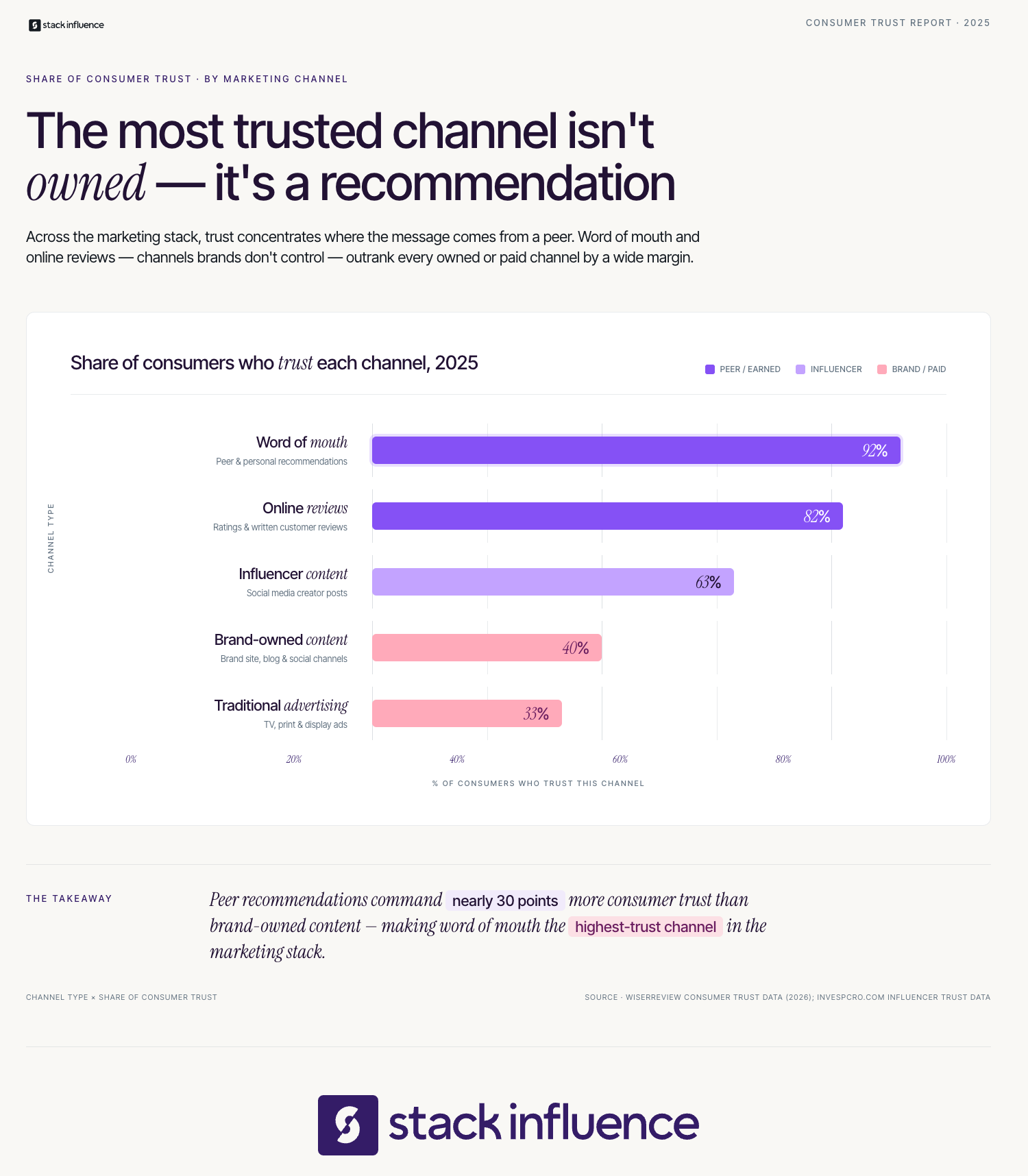
WiserReview's analysis of consumer trust data shows that 92% of people trust word of mouth referrals more than any other form of advertising. No amount of creative budget can replicate the credibility that comes from someone with no financial reason to lie telling another person that a product changed their life. For eCommerce sellers, where customers cannot touch or test a product before buying, this trust transfer is the mechanism behind conversion.
In the digital era, WOMM takes several distinct forms that eCommerce sellers need to manage as a system:
- Organic peer recommendations: Conversations on social media, in messaging apps, and in private communities that happen without direct brand involvement.
- Creator-led advocacy: Micro influencers and nano influencers sharing genuine product experiences with niche, high-trust audiences.
- User-generated content (UGC): Photos, videos, and reviews created by customers and UGC creators that live on product pages, social feeds, and paid ads.
- Referral programs: Structured incentive systems that reward existing customers for bringing in new buyers.
- Review ecosystems: Verified ratings on Amazon storefronts, Shopify product pages, and Google that function as asynchronous word of mouth at scale.
RevenueMemo's 2026 analysis confirms that word of mouth drives $6 trillion in annual global consumer spending, accounting for roughly 13% of all purchases worldwide. The opportunity is enormous, and most eCommerce brands are still treating it as a secondary channel rather than a primary growth driver.
The WORD Signal System: A Framework for Scaling Word of Mouth
The most common failure mode in eCommerce word of mouth strategy is treating it as a single tactic. Brands either run one influencer campaign and call it done, or they wait passively for organic reviews to accumulate. Neither approach compounds. The WORD Signal System is a four-stage framework for engineering sustained peer advocacy.
The WORD Signal System stages work in sequence, but each stage also reinforces the others when operating simultaneously. Brands that operate all four stages at once generate the compounding effect that separates breakout DTC brands from those stuck in paid-ad dependency cycles. You can explore how product seeding workflows fuel word of mouth for eCommerce brands as a practical entry point for Stage 2.
The four stages are:
- W (Win the Experience): Product quality and the unboxing moment must be strong enough to generate unsolicited praise. If the product cannot surprise a customer, no amount of activation will overcome it.
- O (Orchestrate Creator Activation): Work with micro influencers, nano influencers, and brand ambassadors through product seeding and brand deals to generate authentic first-person endorsements at scale.
- R (Recycle into Assets): Capture UGC, influencer content, and customer reviews and deploy them across paid ads, product pages, and organic social to extend the reach of peer recommendations.
- D (Drive Measurable Distribution): Use attribution tools, referral codes, and tracking infrastructure to measure which signals are converting and double down on the highest-performing channels.
Data from Stack Influence's micro influencer campaigns suggests that eCommerce brands running structured product seeding programs across 50 or more creators per month see content output that is 3 to 4 times greater per dollar spent than brands running a small number of high-fee macro-influencer partnerships, with reuse rates on the resulting UGC video consistently above 55%.
The WORD Signal System is not a one-time campaign architecture. It is an ongoing operating model. Each stage feeds the next, and the output of Stage R directly funds the efficiency of Stage D.
Why Do Micro Influencers Power Word of Mouth Better Than Celebrities?
The intuitive assumption is that a bigger audience creates more word of mouth. The data inverts that assumption entirely. Reach and resonance are not the same variable, and for eCommerce sellers trying to drive purchase decisions, resonance is what closes the sale.
According to Later's 2025 Influencer Marketing Report cited by Dataslayer, 73% of brands now prefer micro and mid-tier influencers who offer stronger engagement-to-cost ratios. That preference is backed by numbers. Micro-influencers deliver engagement rates of 6.15% to 6.76%, compared to 1% to 2% for larger accounts, and the median cost-per-thousand for micro-influencer content is less than half that of macro-level campaigns. This is why niche micro influencer partnerships have become the preferred strategy for brands that want peer-level trust without celebrity-level pricing.
The Glossier playbook offers a real-world proof point. According to Roe Magazine's case study, Glossier was valued at $1.8 billion by 2019, built largely on a micro-influencer strategy and community word of mouth. They activated small creators, everyday fans, and niche bloggers rather than investing in celebrity endorsements. The result was trust at scale, not just reach.
For eCommerce sellers, the WORD Signal System's Stage O benefits specifically from nano influencers for the following reasons:
- Proximity to purchase: Nano influencer followers are often in the same demographic and lifestyle context as the creator, making recommendations feel like advice from a peer, not a pitch from a personality.
- Cost efficiency: Nano influencers frequently participate in automated product seeding campaigns in exchange for product value alone, eliminating cash outlay while generating authentic UGC.
- Engagement compounding: High engagement rates mean more comments, shares, and saves, which extend organic reach beyond the initial post window.
- Niche authority: A nano creator in the supplements, outdoor gear, or pet care space speaks with category credibility that a general lifestyle mega-influencer cannot replicate.
Across campaigns managed on the Stack Influence platform, brands in competitive categories like beauty and personal care see micro influencer UGC reuse rates above 60% when content briefs are kept conversational and product demonstrations are unscripted, compared to roughly 35% for campaigns that over-brief creators with rigid talking points.
UGC as Scalable Word of Mouth: The Recycling Engine

Stage R of the WORD Signal System depends on a healthy pipeline of UGC to function. The logic is straightforward. Creator content and customer reviews are peer voices captured in reusable format. When deployed on product pages, in paid ads, or in email flows, they extend word of mouth beyond the original audience and into every touchpoint in the purchase journey.
The conversion data on UGC is difficult to argue with. Yotpo's analysis of 200,000 stores found that shoppers who interact with UGC on a product page convert at a rate 161% higher than those who do not see any peer content. That lift is not marginal. It represents a fundamental change in purchase likelihood driven entirely by social proof. Brands looking for a practical entry point into this ecosystem can explore UGC platform options for eCommerce to understand the infrastructure required to capture and syndicate creator content at scale.
The most valuable formats within Stage R include:
- UGC video on product pages: Short creator videos showing real usage, honest reactions, and before-and-after moments convert better than studio photography because they answer the question "does this work for someone like me?"
- Repurposed influencer content in Meta and TikTok ads: Emplifi's Q3 2025 research found that UGC-focused social posts drove 10.38 times higher conversion rates compared to non-UGC posts, making creator content the single most efficient paid media asset a brand can own.
- Review carousels on Shopify and Amazon storefronts: Authentic text reviews function as asynchronous word of mouth. They are available 24 hours a day on every product page, building trust without ongoing budget.
- Email testimonial sequences: Customer quotes and creator clips embedded in post-purchase and abandoned-cart flows increase click-through and re-purchase intent.
Bazaarvoice's research on UGC behavior shows that UGC-based ads generate 4 times higher click-through rates than average, and 84% of consumers are more likely to trust a brand's marketing campaign when it features user-generated content. The implication for eCommerce sellers is clear: the most cost-efficient ad creative is content your customers and creators already made.
How Should eCommerce Sellers Measure Word of Mouth Impact?
The most persistent myth about word of mouth marketing is that it cannot be measured. It can, and for eCommerce sellers with the right tracking infrastructure, it can be measured with more precision than most brand-awareness campaigns. The WORD Attribution Model covers the four measurement layers that matter.
The WORD Attribution Model layers are:
- W (Within-Platform Metrics): Engagement rate, saves, shares, and comments on creator posts, tracked per campaign and per creator tier to identify which voice types generate the most signal amplification.
- O (Off-Platform Conversion Tracking): Unique discount codes, UTM parameters, and affiliate links attached to every creator post, enabling direct revenue attribution from individual pieces of content.
- R (Revenue Per Creator): Total attributed sales divided by total creator cost (including product seeding value) to establish a per-creator ROI benchmark that informs future campaign investment.
- D (Downstream Loyalty Metrics): Customer retention rate, repeat purchase rate, and lifetime value for customers acquired through word of mouth channels versus paid advertising channels.
For Amazon sellers, the measurement infrastructure has a built-in financial bonus. According to PartnerBoost's analysis of the program, when a shopper clicks through an Amazon Attribution link and purchases a branded SKU, the seller earns a bonus credit averaging around 10% that offsets future referral fees. That means every creator-driven sale tracked through Amazon Attribution becomes incrementally cheaper to fulfill at the marketplace level.
The operational sequence for Amazon sellers combining the WORD Signal System with Amazon's tracking tools is:
- Create unique Amazon Attribution tags for each influencer or creator campaign before any content goes live.
- Assign each creator their personal attribution link or embedded URL to share in bio, stories, or shoppable posts.
- Allow the 14-day attribution window to capture conversions from followers who see the content but do not click immediately.
- Review the Brand Referral Bonus dashboard in Seller Central to confirm credited bonuses and calculate net campaign cost after fee offsets.
- Compare attributed revenue across creator tiers to identify which segment of the creator economy delivers the highest revenue per seeding dollar.
According to Advertise Purple's Brand Referral Bonus breakdown, rates vary significantly from 5% in Electronics to 45% for Amazon Device Accessories, meaning Amazon sellers should prioritize product seeding in high-bonus categories to maximize the financial return from influencer-driven traffic. For Shopify sellers running parallel campaigns, the same UTM and discount code infrastructure feeds directly into Google Analytics, enabling cross-platform attribution across the full WORD Signal System. Explore Shopify influencer marketing options to understand how to connect creator campaigns directly to storefront conversion data.
What Most Brands Get Wrong About Word of Mouth Strategy
The conventional approach to word of mouth marketing starts from the wrong end of the funnel. Most guides tell brands to "identify brand advocates" and "encourage reviews." That framing treats word of mouth as a passive harvest rather than an active infrastructure problem. The result is a strategy that depends entirely on already-satisfied customers doing the work for free.
There are three structural errors that make most word of mouth programs underperform:
- Relying on organic advocacy without activation: Satisfied customers rarely advocate spontaneously at scale. Structured creator partnerships, referral programs, and product seeding systematize the trigger that organic WOMM depends on.
- Treating UGC as a content library, not a conversion asset: Most brands collect creator content but fail to deploy it where purchase intent is highest, which is the product page, the cart email, and the retargeting ad. This is the gap that costs the most conversion lift.
- Measuring word of mouth with vanity metrics: Impressions and follower counts are reach metrics, not advocacy metrics. The right signal is attributed revenue, UGC reuse rate, and customer retention rate for peer-referred cohorts versus paid-ad cohorts.
BigCommerce's 2025 survey data found that 63% of small and medium-sized businesses credit WOMM for increasing their customer base, but most of those businesses were taking a passive approach. The upside for brands that move from passive to active is substantial: forms.app's analysis citing Forbes shows that word of mouth inspired purchases generate over twice as much revenue as paid advertising, with a 37% higher customer retention rate.
The strategic implication is that word of mouth marketing should be treated as infrastructure, not as a campaign. The brands winning on this channel are not running occasional influencer activations. They are running persistent, scalable micro influencer promotions with documented activation playbooks, structured UGC pipelines, and attribution systems that close the loop between creator content and converted revenue. Brands looking for context on how this works in practice can review influencer marketing case studies that document how peer advocacy translates into measurable eCommerce outcomes.
Conclusion
Word of mouth marketing is not a soft channel reserved for brands with viral products and lucky moments. It is an engineered system that compounds when structured correctly and deteriorates when treated as an afterthought. For eCommerce sellers competing in crowded categories, the WORD Signal System provides the operational architecture to move from passive advocacy to active, measurable, compounding peer influence. Activate the right creators, recycle their content into every conversion touchpoint, measure attribution down to the SKU level, and let peer trust do what paid ads cannot. The brands that build this infrastructure in 2026 will own the acquisition economics that define the next phase of eCommerce growth.