




Every eCommerce seller obsesses over traffic, conversion rate, and ad spend. But one variable quietly determines whether that revenue sticks or evaporates before it hits your margin: the fulfillment experience your customer actually receives. What is order fulfillment at its core? It is the operational spine of your business, the process that converts a purchase decision into a delivered product and a delivered product into a loyal customer. This article breaks down the full fulfillment process, the most common strategic errors sellers make, and a practical framework for turning your logistics operation into a competitive advantage rather than a cost center.
Key Takeaways
- Order fulfillment covers every step from inventory receiving through delivery and returns, and each step directly affects customer trust and repeat purchase rate.
- Amazon FBA sellers have access to fulfillment infrastructure that reduces logistics complexity but introduces margin trade-offs that require active management.
- Fulfillment speed matters less than fulfillment reliability: most consumers prioritize an accurate estimated delivery date over the fastest possible shipping window.
- The Fulfillment Leverage Loop framework gives sellers a repeatable model for compounding gains across all five fulfillment stages.
- DTC brands and Amazon sellers can use the Amazon Brand Referral Bonus alongside Amazon Attribution to recover margin on every sale driven by external traffic.
- Tracking the right performance metrics, rather than the most visible ones, is the difference between reactive firefighting and proactive fulfillment management.
Why Fulfillment Is a Revenue Variable, Not an Operational Detail
Most eCommerce operators treat order fulfillment as a cost to minimize rather than a lever to pull. That framing is expensive. The global ecommerce fulfillment services market was valued at $123.68 billion in 2024 and is projected to reach $272.14 billion by 2030, growing at a CAGR of 14.2% from 2025 to 2030. That capital is not flowing toward logistics because brands love warehousing. It is flowing because fulfillment has become a direct determinant of customer lifetime value.
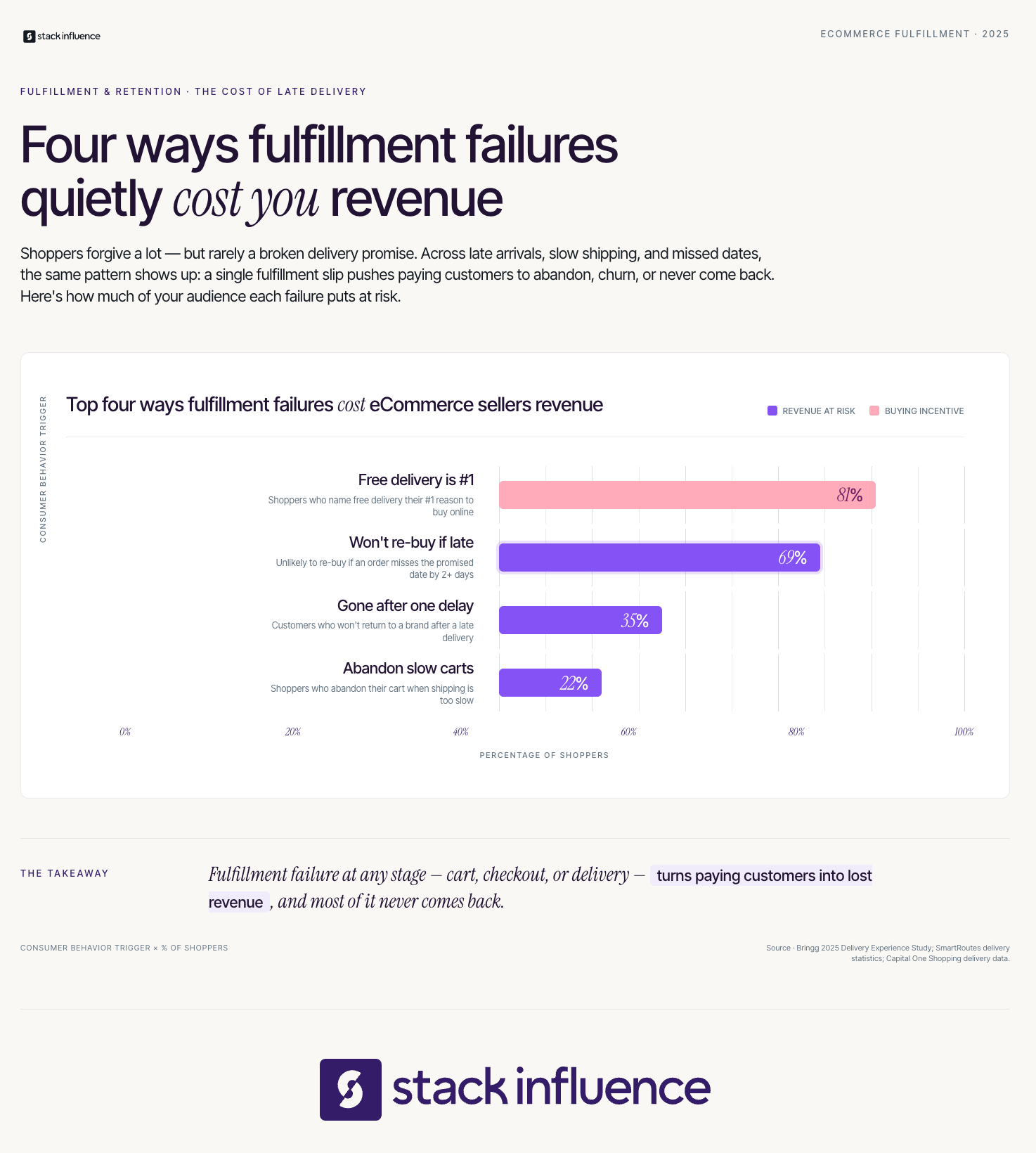
Bringg's 2025 Delivery Experience Study found that 72% of shoppers rate on-time arrival as an essential delivery experience factor, and 35% permanently abandon a brand after a single late delivery. For DTC brands spending heavily on acquisition, a single fulfillment failure can erase the entire value of that customer relationship before a second purchase ever occurs. The economics are unambiguous: fulfillment failure is acquisition waste.
Consider what this means at the channel level. Amazon sellers who rely entirely on Amazon FBA hand their fulfillment quality over to a system they do not fully control, which works until it doesn't. Brands managing their own DTC storefronts carry full operational responsibility but gain critical data and brand touchpoints that micro influencer campaigns can amplify at the post-purchase stage. Neither approach is automatically superior. What matters is whether you understand every stage clearly enough to optimize it.
Here is why fulfillment directly compounds revenue outcomes:
- Customer retention: On-time deliveries can increase customer loyalty by up to 25%.
- Cart conversion: 22% of shoppers abandon carts because shipping is too slow.
- Repeat purchase rate: Approximately 69% of shoppers are less likely to buy from a retailer again if their purchase does not arrive within two days of the promised delivery date.
- AOV uplift: Online shoppers spend an average of 30% more on orders that include free delivery.
What Is Order Fulfillment? A Working Definition for eCommerce Sellers
Order fulfillment is the end-to-end operational process of receiving inventory, storing it, picking and packing individual orders, shipping them to customers, and processing any returns that follow. It covers everything: receiving and storing inventory, processing and picking orders, packing, shipping, and even handling returns if something goes wrong. For eCommerce sellers, fulfillment is the moment where marketing promises meet operational reality.
With average delivery times dropping to 3.7 days in 2024, a 44% improvement since 2020, customer expectations continue rising faster than most retailers can adapt. Understanding the full process is not an academic exercise. It is the foundation for identifying where your operation bleeds margin and where your competitors have an advantage you have not yet closed.
The core stages of the fulfillment process follow a consistent sequence regardless of which model a seller uses:
- Receiving inventory: Supplier shipments arrive at a warehouse or fulfillment center, are inspected, and logged into an inventory management system.
- Storage: Products are organized in warehousing locations optimized for pick speed, with high-velocity SKUs placed closest to packing stations.
- Order processing: When a customer completes a purchase, the system generates a pick list and routes it to the fulfillment floor.
- Picking: Warehouse staff or automated systems retrieve the exact items required for each order using single-order, batch, or zone-based methods.
- Packing: Items are secured in appropriate packaging, weighed, and labeled for the selected carrier.
- Shipping and delivery: Packages are handed to carriers with tracking generated for both the seller and customer.
- Returns: Returned items are received, inspected, and either restocked or disposed of, depending on condition.
60% of online retailers at least partially outsource their fulfillment services, and among them, 20% outsource the entire fulfillment process. For Amazon sellers specifically, Amazon FBA handles picking, packing, and shipping entirely within Amazon's infrastructure, while Fulfilled by Merchant and Seller Fulfilled Prime options give sellers more direct control. Choosing the right model for your stage of growth requires understanding each stage's cost and quality trade-offs clearly.
The Fulfillment Leverage Loop: A Freestyle Framework for Compounding Gains
The Fulfillment Leverage Loop is the primary framework for thinking about order fulfillment strategically rather than operationally. Instead of treating each stage as a separate cost line, the loop treats each stage as an input that multiplies the value of every subsequent stage. Brands that operate within this loop consistently outperform peers who optimize stages in isolation.
Amazon spent $109.1 billion on order fulfillment in 2025. Amazon's scale is an extreme example, but the underlying principle applies at every revenue tier: fulfillment investment compounds. A faster pick process reduces packing errors. Better packing reduces returns. Fewer returns improve net margin, which funds faster shipping options that lift conversion. Every stage feeds the next.
Third-party logistics providers account for 60% of 2024 revenues, making outsourcing the dominant model in the ecommerce fulfillment market. Sellers using a 3PL or Amazon FBA are effectively borrowing leverage from the loop rather than building it themselves. That is not inherently wrong, but it creates a dependency that requires active management to ensure the loop keeps running at the performance level your brand promises.
The five phases of the Fulfillment Leverage Loop work as follows:
- Phase 1 — Inventory positioning: Stock is placed close to your highest-demand customer zip codes, reducing both transit time and carrier cost per shipment.
- Phase 2 — Processing speed: Order processing automation eliminates manual steps between purchase and pick initiation, compressing the time from order to shipment.
- Phase 3 — Accuracy and packaging: Pick accuracy above 99% and packaging appropriate to the product category reduce damage rates and return-driven costs.
- Phase 4 — Carrier and last-mile selection: Multi-carrier flexibility lets you route each shipment through the fastest or cheapest carrier for that specific zone.
- Phase 5 — Returns integration: A returns process that restocks sellable units quickly recovers inventory capital and shortens the cycle back to Phase 1.
The Fulfillment Leverage Loop earns its name because improvements at Phase 1 echo forward through all five phases simultaneously. Sellers who skip Phase 1 and start optimizing Phase 4 routinely find that carrier savings disappear because their inventory is poorly positioned in the first place. Apply the loop in sequence for compounding results. For eCommerce brands running influencer campaigns that generate demand spikes, Phase 1 and Phase 2 deserve priority investment before any campaign scaling begins.
Stack Influence has observed that eCommerce brands which invest in fulfillment speed improvements before scaling micro influencer campaigns see 20 to 30% lower post-campaign return rates, because the product arrives within the window customers expect when they are primed by recent content exposure.
Fulfillment Models: Which One Fits Your Business Stage?
Choosing the right fulfillment model is the first strategic decision every eCommerce seller must make. That decision should match your order volume, capital position, and the degree of brand control you need at the customer touchpoint. Each model has direct implications for the Fulfillment Leverage Loop: some accelerate the loop, others constrain it.
The three primary models are:
- In-house fulfillment: Your team manages receiving, storage, picking, packing, and shipping from your own facility. Best for brands with highly customized packaging requirements or low order volumes where outsourcing costs exceed the operational investment. Hardest to scale without proportional headcount.
- 3PL (third-party logistics): You ship inventory to an external warehouse that handles fulfillment on your behalf. Enables fast scaling and geographic distribution of inventory without capital expenditure. 3PL fulfillment is when an ecommerce business hires a third-party logistics company to take over the entire fulfillment process using their warehouses and infrastructure. This method reduces operations costs and provides access to industry expertise but means less control over day-to-day operations.
- Amazon FBA: Fulfillment by Amazon is a service that allows ecommerce brands to outsource their fulfillment to Amazon. Once an order is placed, Amazon handles picking, packing, shipping, and customer service on behalf of the seller. FBA is designed to streamline fulfillment for sellers on the Amazon marketplace while enabling fast delivery through programs like Prime. Amazon sellers gain access to Prime badge eligibility, which carries significant conversion lift on the Amazon storefront.
- Dropshipping: No inventory is held by the seller. When a customer orders, the manufacturer or distributor ships directly. Low barrier to entry but limited brand differentiation and reduced control over Phase 3 and Phase 4 of the Fulfillment Leverage Loop.
- Hybrid: Many scaling brands combine models, using FBA for their Amazon storefront while maintaining a 3PL or in-house operation for DTC channels, preserving brand touchpoints where they matter most.
From Stack Influence's experience running product seeding campaigns for eCommerce brands, sellers who operate hybrid fulfillment models across DTC and Amazon channels convert influencer-generated traffic at 15 to 25% higher rates than single-channel operators, because they can direct audiences to whichever storefront delivers the fastest fulfillment promise.
For Amazon sellers specifically, understanding the relationship between fulfillment model choice and fee structure is non-negotiable. While FBA can help Amazon sellers simplify their ecommerce shipping processes, pricing for this service can be complex, variable, and expensive. Margin planning must account for peak-season fee surcharges, storage fees on slow-moving SKUs, and any inbound placement costs.
What Most Fulfillment Guides Get Wrong
Here is the belief that most eCommerce sellers carry into their fulfillment strategy: faster delivery is always better, so the primary optimization target should be shortening transit times as much as possible.
The data does not support that belief. 62% of consumers find an accurate estimated delivery date more important than fast shipping. Reliability beats raw speed in the mind of most shoppers, especially repeat purchasers who have already calibrated their expectations to your brand. Chasing two-day delivery infrastructure prematurely can destroy unit economics without meaningfully moving customer satisfaction.
McKinsey's 2024 consumer survey found that delivery speed dropped from the number one consumer priority in 2022 to number five in 2024. What actually climbed in priority? Cost transparency, reliability, and the presence of a clear estimated delivery date at the time of purchase. These are fulfillment communication problems more than they are logistics infrastructure problems, and they cost far less to solve.
The specific alternative metric sellers should track is Promise Accuracy Rate: the percentage of orders delivered within the window communicated at checkout. Most fulfillment dashboards do not surface this metric by default. It requires cross-referencing the estimated delivery date shown at order confirmation against the actual carrier scan at the destination. Sellers who move this number above 95% consistently see stronger repeat purchase rates than those with faster average transit times but lower promise reliability. Here is what to prioritize this week:
- Audit your estimated delivery date logic: Does your storefront or Amazon listing show a realistic window based on current carrier performance, or a stretch goal that creates expectation failures?
- Track Promise Accuracy Rate weekly: Set this as your primary fulfillment KPI and review it alongside your return rate to identify carrier-specific underperformers.
- Communicate proactively on delays: A single delay notification sent before a customer expects their package reduces negative reviews at a higher rate than post-delivery discount offers.
- Prioritize free shipping over fast shipping: 81% of consumers say free delivery is the best incentive to shop online. If your margin allows only one offer, free beats fast.
Across campaigns managed on the Stack Influence platform, eCommerce brands that pair clear on-site fulfillment transparency with micro influencer campaigns see a 30% reduction in negative post-purchase comments on creator content, because customer expectations are set accurately before the product ships.
Measuring Fulfillment Performance: The Order Throughput Metric Stack
Every fulfillment operation needs a named measurement model to create accountability across its stages. The Order Throughput Metric Stack is that model. It organizes fulfillment KPIs into four labeled components that together give you a complete picture of operational health and customer impact.
Amazon's Brand Referral Bonus gives enrolled sellers an average 10% bonus on the sales price of products sold through off-Amazon marketing efforts. For Amazon sellers driving traffic from external campaigns through influencer promotions or paid ads, this bonus directly offsets fulfillment cost compression. But capturing the bonus requires proper setup: Amazon Attribution must be active, and attribution tags must be assigned to each external traffic source.
The four components of the Order Throughput Metric Stack are:
- Promise Accuracy Rate (PAR): The percentage of orders delivered within the window shown at checkout. This is your primary fulfillment KPI. A PAR below 92% signals either a carrier reliability problem or an inaccurate estimated delivery date calculation.
- Order Accuracy Rate (OAR): The percentage of orders shipped with the correct item, quantity, and packaging. Industry benchmark for eCommerce sits above 99.5% for best-in-class operators. Errors below this threshold compound return costs rapidly.
- Cost Per Fulfilled Order (CPFO): Total fulfillment cost divided by the number of orders shipped in a period. Track this monthly and compare across channels. Amazon FBA CPFO tends to run higher per unit but eliminates labor and infrastructure overhead that in-house models carry.
- Amazon Attribution Conversion Rate (AACR): For Amazon sellers, this is the conversion rate of external traffic clicks that result in a qualifying purchase within the 14-day Brand Referral Bonus attribution window. The flow is: external click, Attribution tag fires, shopper lands on your Amazon listing or storefront, purchase occurs within 14 days, Amazon calculates the bonus, and the credit appears in your account. Sellers who track AACR per campaign source can identify which external channels generate the highest-value fulfillment events.
Apply the Order Throughput Metric Stack as a weekly review cadence. Review PAR and OAR first because they are leading indicators of customer experience. Review CPFO and AACR together because they reveal where margin is being created or surrendered across your channel mix. For brands scaling through Amazon seller strategies and DTC simultaneously, the metric stack creates a unified view that prevents optimizing one channel at the expense of the other.

The Fulfillment Health Checklist: Assessing Your Operation Before You Scale
The Fulfillment Health Checklist is the secondary framework in this guide. Where the Fulfillment Leverage Loop describes how fulfillment compounds over time, the Fulfillment Health Checklist gives you a practical audit tool to use before scaling campaigns, entering new sales channels, or renegotiating 3PL contracts. Run through this checklist any time you are about to add demand volume to your operation.
The checklist has seven audit items:
- Inventory accuracy above 98%: Low inventory accuracy, below 98%, is a leading cause of fulfillment delays, stockouts, and incorrect orders. If your warehouse management system is not surfacing this number in real time, fix that before scaling.
- Carrier redundancy: Do you have at least two active carrier relationships per major shipping zone? A single-carrier dependency creates a systemic risk during peak seasons or service disruptions.
- Estimated delivery date accuracy verified: Pull the last 30 days of orders and confirm that your stated delivery window matches actual delivery scan dates. Flag any carrier or zone where the gap exceeds one day.
- Returns flow documented and staffed: Returns are an unavoidable part of order fulfillment, especially in eCommerce, where return rates average 20 to 30%. A documented returns process that restocks sellable inventory within 72 hours recovers capital and reduces loss exposure.
- Peak capacity plan confirmed: Does your 3PL or FBA inventory placement account for a 2x to 3x order volume surge during promotional events? Validate capacity with your fulfillment partner before any influencer campaign or Amazon deal goes live.
- Amazon Attribution tags active on all external campaigns: For Amazon sellers running any off-platform advertising or creator campaigns, Attribution tags must be generating tracking data before you can access the Brand Referral Bonus. Confirm setup before any external spend is activated.
- CPFO tracked by channel: If you do not know your Cost Per Fulfilled Order separately for your Amazon storefront and your DTC site, you cannot make informed decisions about where to shift marketing investment.
The Fulfillment Health Checklist is most valuable when used proactively, not reactively. Many eCommerce brands discover fulfillment weaknesses during a demand spike that a pre-campaign audit would have caught in advance. Use the checklist at least 30 days before any planned volume increase to leave enough runway to resolve gaps.
For eCommerce brands working with micro influencers, the checklist is especially useful before a product seeding campaign generates review-driven demand spikes that are difficult to forecast precisely. Ensuring the Fulfillment Leverage Loop is running cleanly before the demand arrives is the difference between a successful campaign and a five-star product with a one-star delivery experience.
How Fulfillment Strategy Connects to Customer Acquisition Costs
Fulfillment is not just an operational cost. It is a direct input to your effective customer acquisition cost. When fulfillment failures generate negative reviews, trigger refunds, and suppress repeat purchases, every unit of paid acquisition spend becomes less efficient. A $20 customer acquisition cost that results in a single purchase is five times more expensive than a $20 cost that results in five purchases over two years.
Multi-channel complexity is now standard, with 78% of brands selling on two or more sales channels as of 2025. Each additional sales channel adds fulfillment complexity. An Amazon seller who launches a DTC site without a clear plan for fulfilling those orders consistently is not expanding their business. They are expanding their failure surface area.
The connection between fulfillment strategy and customer acquisition is most visible in the influencer marketing context. DTC brands and Amazon sellers who drive traffic through product seeding campaigns are asking creators to generate demand. That demand is only as valuable as the fulfillment experience that follows. A creator's audience is unlikely to trust a recommendation after a poor delivery experience, reducing both the direct sale value and the long-term brand equity of the campaign.
Key fulfillment improvements that directly lower effective CAC include:
- Reducing your return rate from 25% to 15% eliminates approximately one in ten fulfilled orders from being a net-negative transaction.
- Improving Promise Accuracy Rate to above 95% lifts repeat purchase likelihood for that cohort of customers.
- Activating the Amazon Brand Referral Bonus with proper Attribution tagging recovers an average of 10% on every external-traffic sale, effectively subsidizing acquisition cost for Amazon sellers.
- Building clear inventory buffers before influencer campaigns go live prevents stockouts that waste the demand created by creator content.
Conclusion
What is order fulfillment? It is the operational system that determines whether your marketing investment generates durable revenue or single-transaction costs. The Fulfillment Leverage Loop gives eCommerce sellers a compounding framework for building fulfillment into a strategic advantage, while the Fulfillment Health Checklist provides the pre-scale audit every brand needs before adding demand volume. Amazon sellers who pair Amazon FBA efficiency with Amazon Attribution and the Brand Referral Bonus create a margin recovery system that most competitors leave unused. For DTC brands, the promise accuracy, not raw speed, is the metric that drives loyalty. The brands winning in eCommerce in 2026 are not just the ones with the best products or the biggest ad budgets. They are the ones whose operations deliver exactly what they promise, every time.