



%20main%20image.avif)
After coordinating product seeding campaigns across thousands of eCommerce brands, Stack Influence's data shows one consistent pattern: gifted activations with micro influencers generate stronger engagement rates and more reusable content than their paid counterparts at a fraction of the cost. The debate over paid vs gifted influencer strategy is one of the most consequential decisions a seller can make, and most brands get it wrong by defaulting to paid before they have tested gifted at scale. This guide breaks down how each model works, when to use each one, and how to measure the results accurately so your next influencer campaign drives real revenue.
Key Takeaways
- Gifted influencer campaigns consistently outperform paid placements on engagement rate and authenticity because creators post from genuine enthusiasm rather than contractual obligation.
- Paid sponsorships offer guaranteed deliverables, set timelines, and creative control, making them better suited for product launches and time-sensitive promotions.
- Micro influencers and nano influencers are the highest-ROI tier for gifted campaigns, with nano-influencers often accepting product-only compensation and returning engagement rates as high as 8 to 12%.
- Both paid and gifted influencer posts require FTC disclosure, so "gifted" does not mean "unregulated."
- Amazon sellers can use Amazon Attribution and the Amazon Brand Referral Bonus to measure and recover value from both gifted and paid influencer traffic.
What Is the Paid vs Gifted Influencer Distinction?
In influencer marketing, a paid influencer receives monetary compensation in exchange for creating and publishing content under a formal contract with specific deliverables. A gifted influencer, by contrast, receives a free product through product seeding with no guaranteed posting obligation. The creator posts only if they genuinely want to, which changes the psychology of the content entirely.
This distinction matters most to eCommerce sellers because it shapes three things: the cost structure of your campaign, the authenticity of the resulting content, and the type of UGC you can collect and repurpose. Both models live inside the broader creator economy, but they operate on fundamentally different incentive structures that produce meaningfully different outcomes.
Here is how the two models compare at a structural level:
- Paid sponsorships: Contractual deliverables, set deadlines, creator fee (flat rate, CPM, or commission), required disclosures, and brand-approved scripts or talking points.
- Gifted campaigns: Product cost plus shipping only, no guaranteed post, full creative freedom for the creator, still requires FTC disclosure, and content tends to feel more organic.
- Hybrid models: Product plus affiliate commission, or product plus a small activation fee, combining authenticity with some performance incentive.
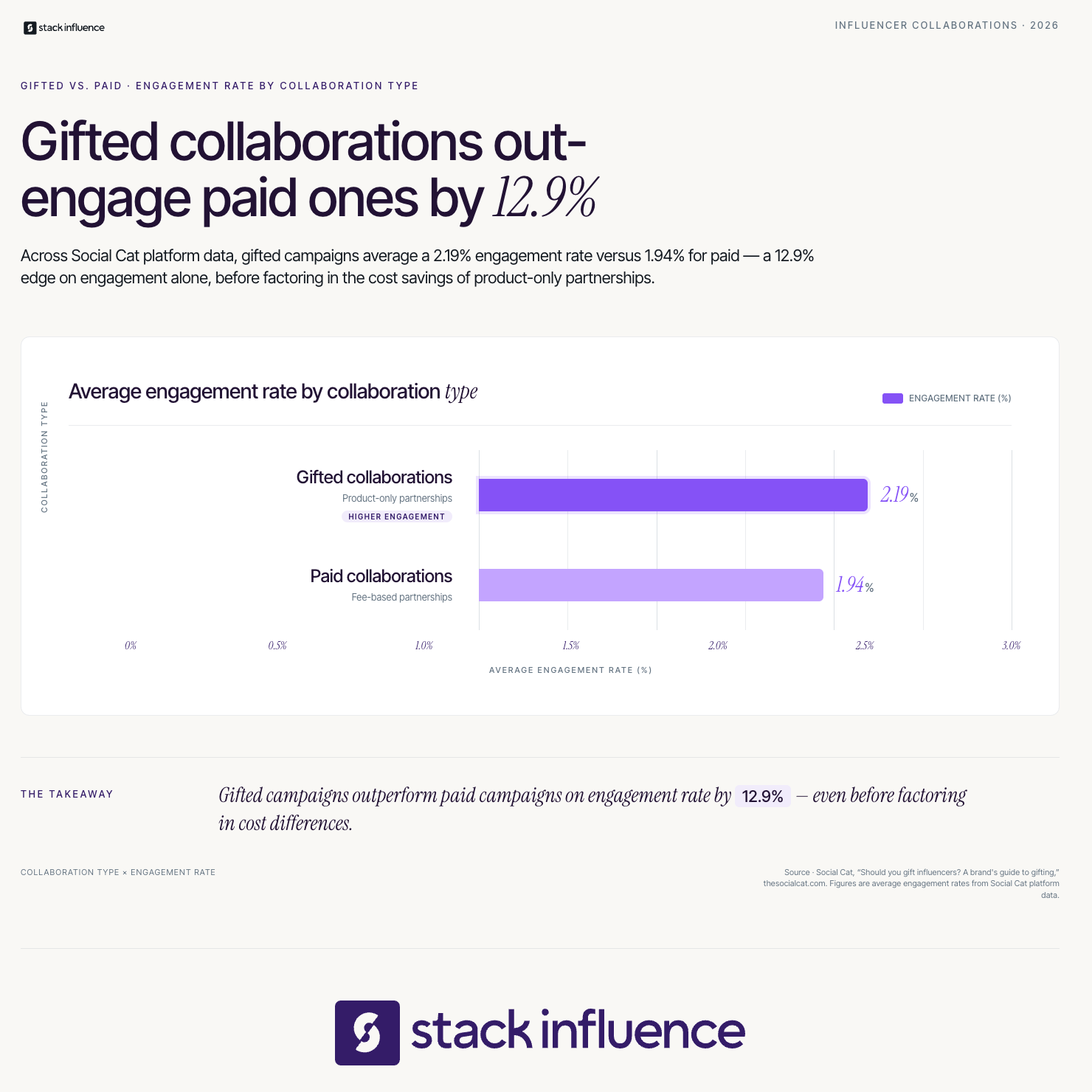
According to Social Cat's platform data, gifted influencer collaborations generate an average engagement rate of 2.19%, compared to just 1.94% for paid collaborations. That gap may appear narrow, but across a campaign of 50 to 200 micro influencers, it compounds into meaningfully more comments, shares, and saves per dollar spent.
Why Gifted Campaigns Outperform on Authenticity
The core reason gifted content outperforms paid content on engagement is not the platform algorithm, it is the human signal underneath the post. When a creator receives a product they did not ask for, tries it genuinely, and then chooses to post about it, their audience detects that enthusiasm. It reads differently than a scripted brand sponsorship, and audiences in 2026 have become extraordinarily good at recognizing the difference.
One 2025 analysis found that gifted collaborations delivered roughly 12.9% more engagement than paid partnerships, because content created without a payment obligation tends to feel more authentic to audiences. That authenticity carries downstream into conversion rates, comment quality, and UGC reuse value.
The financial case is equally compelling:
- A single paid macro-influencer post can cost $10,000 to $50,000 or more.
- The same budget can seed 100 to 500 nano influencers or micro influencers with your product.
- Each seeded creator generates independent UGC video content, social posts, and organic endorsements.
- That content library fuels paid media creative, Amazon listing imagery, and email campaigns for months.
Research from GRIN's 2026 product seeding report shows that well-run product seeding programs typically deliver 3 to 8x ROI when UGC reuse value and pipeline conversion are factored into the total return. Stack Influence's internal campaign data shows that eCommerce brands using gifted micro influencer programs as their primary awareness channel consistently generate UGC libraries they can repurpose into paid Meta and TikTok creative, effectively doubling the return on their product cost investment.
The strongest gifted campaigns share a specific workflow pattern. Brands that pre-qualify creators by niche and audience fit, personalize the outreach, and follow up after delivery see post rates two to three times higher than brands that blast generic outreach to large lists. The quality of your creator selection matters more than the quantity of products you ship.
The Gifted Advantage Score: An Audit Checklist for Your Next Campaign
The Gifted Advantage Score is a five-item pre-campaign checklist that helps eCommerce sellers evaluate whether a gifted approach will outperform a paid one for a specific product and goal. Apply it before allocating budget, not after.
Run through each item before committing to a campaign structure:
- Creator niche alignment: Does the creator's content category overlap directly with your product's use case? Off-niche seeding wastes inventory and produces low-quality UGC.
- Audience size tier: Nano influencers (1K to 10K followers) and micro influencers (10K to 100K followers) are the optimal tiers for gifted campaigns. Creators above 100K typically expect cash compensation.
- Product-to-seeding ratio: Is your product's retail cost high enough to feel valuable to the creator, but low enough to make seeding at volume economically viable? Products under $75 retail are strong gifting candidates.
- UGC reuse potential: Will the content be repurposable as paid ad creative, Shopify product photography, or Amazon listing imagery? High-reuse products justify more aggressive seeding volume.
- Post-rate sustainability: Have you built a follow-up sequence? Campaigns with structured follow-up after delivery see significantly higher organic post rates than campaigns that ship and go silent.
A 2024 survey cited by StreetInsider found that 80% of marketers saw a positive return from influencer gifting, with 83% saying they plan to use it more in future campaigns. Those results are not guaranteed, they are earned by running the Gifted Advantage Score before launch.
Revisit the Gifted Advantage Score again at the 30-day campaign mark to decide whether any gifted creators have earned an upgrade to paid ambassador status. This is the most cost-efficient way to build a creator roster: let the gifted tier identify your top performers before you pay them.
When Should You Use a Paid Influencer Instead?
Paid sponsorships are not the enemy of gifted campaigns. They serve a fundamentally different purpose and belong in your influencer marketing mix at specific moments. Understanding the division of roles prevents the most common mistake DTC brands make: paying for reach when they should be seeding for authenticity, or seeding for awareness when they actually need guaranteed deliverables.
From Stack Influence's experience running product seeding campaigns at scale, brands that reserve paid sponsorships for product launches, seasonal promotions, and brand awareness spikes, while using gifted campaigns for ongoing organic content generation, build more sustainable creator ecosystems at lower overall CAC.
Use paid influencer sponsorships when you need:
- A guaranteed post on a specific date for a product launch or promotional event.
- A precise content format such as a scripted unboxing video, a comparison review, or a sponsored TikTok Spark Ad.
- A specific creator tier with 100K or more followers, where product-only compensation is not realistic.
- Exclusivity or content licensing rights for your own paid media campaigns, which typically require a formal contract.
- A measurable affiliate commission structure tied to a trackable link or discount code.
Paid brand deals also make sense when you are working with brand ambassadors on an ongoing retainer. According to Sprout Social's 2025 Influencer Marketing Report, 71% of influencers offer discounts for longer-term brand partnerships, which means the cost of paid retainers becomes more competitive at volume. Building toward a long-term brand partnership often starts with a gifted activation and escalates to paid once the creator proves their audience responds.
The Campaign Mode Selector: A Decision Matrix for eCommerce Sellers
The Campaign Mode Selector is a two-variable decision framework that maps your campaign goal against your available budget to produce a recommended model. Use it alongside the Gifted Advantage Score to finalize your approach before launch.
The two variables are Campaign Urgency (low or high) and Budget Flexibility (constrained or open). Each combination maps to a recommended campaign mode:
- Low urgency + constrained budget: Run a pure gifted seeding campaign targeting nano and micro influencers. Prioritize UGC collection over posting guarantees. This is the highest-ROI mode for early-stage eCommerce brands and Amazon FBA sellers.
- Low urgency + open budget: Run a gifted seeding campaign at volume and promote the strongest organic posts using TikTok Spark Ads or Meta Partnership Ads. Paid media budget amplifies the best gifted content rather than buying guaranteed content from the start.
- High urgency + constrained budget: Run a hybrid model. Offer product plus a small affiliate commission to incentivize post timing without committing to full sponsorship fees. This preserves budget while increasing the probability of on-time content.
- High urgency + open budget: Run paid sponsorships with mid-tier or macro influencers for guaranteed reach and timing, while maintaining a background gifted program to generate organic UGC for post-campaign creative reuse.
Across campaigns managed on the Stack Influence platform, eCommerce brands that apply the Campaign Mode Selector before briefing creators reduce their content non-delivery rate by structuring compensation to match the actual urgency of the campaign. Sellers using the gifted mode for ongoing always-on programs and reserving paid for launch moments consistently report more balanced creator relationships and lower burnout across their rosters.
The Campaign Mode Selector works best when used in conjunction with the Gifted Advantage Score. Together, the two frameworks give you a complete pre-campaign brief that answers both "should this be gifted or paid?" and "does this specific product and creator pair make sense?"
FTC Disclosure and Compliance: What Changed in 2026
The most important regulatory development for eCommerce brands running influencer campaigns is the convergence of disclosure rules across paid and gifted content. Many sellers still believe that gifted campaigns exist in a regulatory gray zone where disclosure is optional. That belief is incorrect and increasingly expensive.
According to the FTC's official Disclosures 101 guidance, a "material connection" includes any financial relationship or the receipt of free or discounted products, meaning gifted campaigns carry the same disclosure obligations as paid sponsorships. The FTC's 2025 updates confirmed that "gifted by" or "#gifted" counts as sufficient disclosure language when placed prominently at the start of a caption or on-screen in a video.
Key compliance checkpoints for influencer campaigns in 2026:
- Placement: Disclosure must appear at the start of the caption, not buried in hashtags or after the "more" cutoff.
- Video format: Disclosure must be both spoken and on-screen, not just in the description. This applies to Reels, TikTok videos, and YouTube Shorts.
- Gifted language: "Gifted by [Brand]" or "Thanks to [Brand] for the free product" are FTC-compliant. "#PR" alone is not.
- Brand responsibility: The FTC expects brands to actively monitor creator posts and ensure compliance. The brand, not just the creator, faces enforcement exposure.
- Penalty scale: Civil penalties for FTC violations currently stand at $53,088 per violation, with every non-compliant post counted separately.
The practical implication for brands is that your gifted campaign brief must include clear disclosure instructions. Treat FTC compliance as a campaign deliverable, not an afterthought. This protects your brand, reinforces consumer trust, and prevents the kind of enforcement risk that has generated over $1 billion in class action damages sought against brands in H1 2025.
How to Measure Gifted vs Paid Campaigns: The Creator Value Metric Stack
Attribution is where most eCommerce sellers leave money on the table. They run gifted campaigns, count likes, and declare success or failure without measuring the full return on invested product. Paid campaigns get better measurement by default because a contract forces you to define deliverables, but gifted campaigns are often measured loosely.
The Creator Value Metric Stack is a four-component measurement model that applies equally to both gifted and paid influencer campaigns. It ensures you are capturing the full economic return of every creator relationship, not just the surface-level social metrics.
The four components are:
- Component 1: Direct Attributed Revenue. Use unique trackable discount codes or Amazon Attribution links to measure sales directly driven by each creator. This is the only metric that closes the loop between a post and a purchase.
- Component 2: UGC Asset Value. Assign a dollar value to every piece of reusable content the creator generates based on what you would pay a studio to produce the equivalent asset. A single UGC video used in Meta ads has a replacement cost of $200 to $1,500.
- Component 3: Earned Media Value (EMV). Calculate the estimated cost to reach the same audience through paid advertising. For micro influencers, EMV provides a useful upper-bound estimate of awareness value.
- Component 4: Creator Lifetime Value (CLV). Track whether gifted creators convert into paid brand ambassadors, affiliate partners, or repeat content contributors over 6 to 12 months. CLV is the metric that justifies ongoing gifted programs even when individual posts drive modest immediate revenue.
The Amazon Brand Referral Bonus program returns an average 10% credit on sales driven through Amazon Attribution links, effectively reducing referral fees on every sale that originates from an influencer's external traffic. For Amazon sellers running gifted campaigns with nano influencers, this bonus materially improves the unit economics of every attributed purchase within the 14-day attribution window. Pair Attribution links with the Creator Value Metric Stack and you have a complete picture of each creator's economic contribution to your business.
Data from Digital Applied's 2026 influencer marketing report shows that micro-influencers deliver 3.2x higher engagement at 60% lower cost than mega-influencers, making them the strongest ROI tier in the category. That performance advantage is amplified when gifted campaigns are measured using the full Creator Value Metric Stack rather than engagement rate alone.
Apply the Creator Value Metric Stack at the 30-day and 90-day marks for every campaign. The 30-day read tells you which creators to follow up with for additional gifting rounds. The 90-day read tells you which creators have earned a paid sponsorship upgrade and which gifted-to-ambassador paths have converted.
What Changed in Gifted Influencer Marketing This Year
The most significant shift in paid vs gifted influencer strategy in 2026 is not the engagement data, it is the structural change in how brands think about creator pipelines. Two years ago, gifted programs were primarily a cost-saving measure for brands that could not afford paid talent. Today, the leading eCommerce brands treat gifted seeding as a deliberate talent discovery engine that feeds their paid program with pre-qualified, audience-proven creators.
This shift matters because it inverts the typical influencer marketing workflow. Instead of negotiating a paid deal with a creator whose audience alignment you cannot confirm until after the content goes live, gifted seeding lets you run a low-cost proof-of-concept with dozens of creators simultaneously. The creators who generate strong organic posts, high save rates, and measurable link traffic are the ones worth investing in with a formal paid sponsorship.
The operational upside for Shopify influencer marketing and Amazon sellers is significant. Brands using this pipeline approach to influencer campaigns report lower content non-delivery rates on paid deals because every paid creator in their roster has already demonstrated performance on a gifted activation. You are not paying for reach anymore. You are paying to amplify a relationship that has already been proven to work.
For brands looking to scale this pipeline efficiently, automated product seeding tools remove the manual logistics burden of shipping to hundreds of nano and micro influencers simultaneously. The technology manages outreach, creator opt-in, shipping coordination, and content tracking, so your team focuses on relationship management and content amplification rather than spreadsheet logistics. Pair that infrastructure with a Shopify-native attribution setup or an Amazon marketplace influencer program and you have a complete gifted-to-paid pipeline that scales without proportional headcount growth.
This workflow is especially powerful for niche micro influencer campaigns where the creator-to-category alignment is tight, post rates from gifted seeding tend to run higher, and the resulting content is narrowly targeted enough to convert in paid ad placements. It is the structural evolution that separates brands building durable creator ecosystems from brands still treating every influencer as a one-off transaction.
The paid vs gifted influencer decision is not a binary choice. It is a sequencing strategy. Start with gifted to discover your best creator partners at low cost. Amplify their top content with paid media. Promote the strongest performers to paid brand ambassadors on performance-based contracts. That three-step cycle compounds over time in ways that no amount of upfront paid spend can replicate.