




Key Takeaways
- Whitelisting meaning in influencer marketing refers to a creator granting a brand permission to run paid ads directly from the creator's social media account handle.
- Whitelisted ads combine the authenticity of creator content with the precision of paid media targeting, consistently outperforming standard brand-account ads on CTR and cost per acquisition.
- Micro influencers and nano influencers are particularly effective for whitelisting because their audiences are tightly engaged and more receptive to recommendations.
- eCommerce sellers on Amazon, Shopify, and DTC channels can pair whitelisted ads with Amazon Attribution to track attributed sales, capture the Brand Referral Bonus, and optimize spend in real time.
- Brands should negotiate whitelisting rights before content is created, secure time-bound permissions, and use the CLEAR Framework to structure every campaign.
How eCommerce Sellers Can Use Whitelisting to Cut Ad Costs
Most eCommerce sellers treat influencer campaigns and paid ads as two completely separate budget lines. That separation is costing them money. When you whitelist a creator's content, you collapse that gap entirely, running trusted social proof as a performance ad without rebuilding the creative from scratch.
The core mechanic is straightforward. You pay a creator to produce content, secure permission to run ads from their account handle, and then use your own Ads Manager to target, test, and scale. The ad appears to come from the creator, not your brand, which is the trust signal that actually moves the needle for eCommerce influencer marketing campaigns.
Done well, this approach solves three expensive problems at once. It reduces creative production costs, extends the shelf life of every piece of creator content, and improves paid ad performance without requiring a bigger media budget.
The key is knowing what whitelisting actually involves, how to structure it, and which creators to prioritize. The sections below walk you through all three using a practical framework built for product sellers.
What Is Whitelisting Meaning in Influencer Marketing?
Whitelisting meaning, in the context of influencer and social media marketing, refers to the process of a creator granting a brand advertiser permission to run paid ads through the creator's own social media account handle. The ad looks as though it comes directly from the influencer, not the brand. The brand controls all the targeting, budget, and ad copy behind the scenes.
You may also hear this practice called allowlisting, creator licensing, or partnership ads, depending on the platform and team using the term. On Meta, this operates through Meta Business Manager for Facebook and Instagram. On TikTok, the equivalent format is called Spark Ads, where the creator authorizes a specific video for paid promotion through a unique code in TikTok Ads Manager.
According to Influencer Marketing Hub's 2025 Benchmark Report, the global influencer marketing industry reached an estimated $32.55 billion in 2025, more than tripling in size since 2020. Whitelisting has emerged as one of the fastest-growing substrategies within that expansion because it closes the gap between creator-led authenticity and the measurability demands of performance marketing teams.
It is worth distinguishing whitelisting from two adjacent tactics that sellers sometimes confuse it with:
- Boosted posts: The brand pays to amplify a post from its own page. Whitelisting runs from the creator's handle, not the brand's.
- Reposting creator content: The brand publishes creator content on its own feed. Whitelisting keeps the creator's identity and social proof intact by running ads under their name.
- Dark posts: A whitelisting-specific format where the ad only appears to a targeted audience and does not show on the creator's public profile. This is ideal for A/B testing without cluttering the creator's feed.
Each format serves a different goal. Understanding the distinction helps eCommerce brands budget correctly and brief creators without confusion before any content is produced.
The CLEAR Framework: How Whitelisting Works Step by Step
Every successful whitelisting campaign runs through five operational stages. The CLEAR Framework gives eCommerce sellers a repeatable sequence to follow whether they are working with nano influencers on a product seeding trial or scaling a multi-creator Meta campaign.
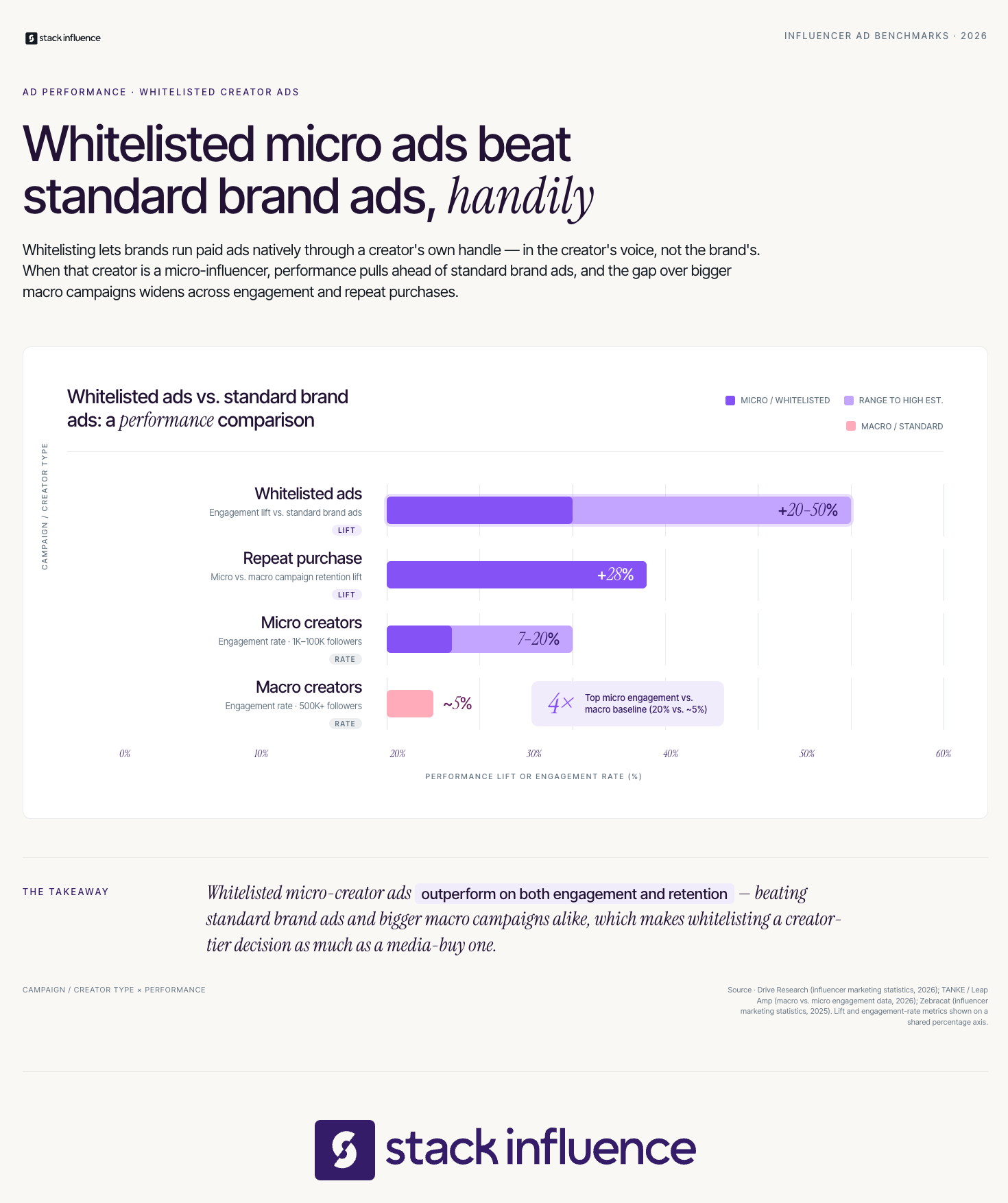
Research compiled by Drive Research shows that influencer whitelisting consistently outperforms standard paid social ads by 20 to 50 percent in engagement and conversion metrics. The CLEAR Framework is designed to capture that performance lift consistently across campaigns of any size.
The five stages are:
- Creator selection: Identify creators whose audience demographics, platform behavior, and content style match your product category. Prioritize engagement rate, comment quality, and audience authenticity over raw follower count.
- Legal alignment: Negotiate and document whitelisting rights before any content is created. Specify the platform, duration, geographic scope, and the additional fee on top of the base content rate.
- Execution and access: The creator grants access through Meta Business Manager (for Instagram and Facebook) or provides a Spark Ad authorization code for TikTok. The brand then sets up ads using the creator's handle as the publisher.
- Ad management: The brand applies its own targeting, budget, and creative variations including copy edits, CTAs, and audience segments. This includes the option to run dark posts that never appear on the creator's organic feed.
- Results tracking: Use platform-native analytics, UTM parameters, and Amazon Attribution where applicable to measure click-through rate, cost per acquisition, attributed sales, and ROAS at the creator and creative level.
The CLEAR Framework is referenced across this article because it applies at every stage of campaign planning, not just setup. Return to it when evaluating creative performance, negotiating renewals, and building briefs for new creator partners.
Stack Influence's internal campaign data shows that eCommerce brands using a structured, pre-production whitelisting agreement, rather than negotiating permissions after content is created, generate significantly higher on-time creative delivery rates and fewer mid-campaign access issues.
Why Micro Influencers Are the Hidden Power Source for Whitelisting
Most brands default to macro influencers when they think about paid amplification. That instinct is understandable but often wrong for product sellers with tight CAC targets. Micro influencers and nano influencers consistently outperform on the metrics that matter most to eCommerce campaigns.
According to data from Leap Amp cited by TANKE, micro influencers consistently achieve engagement rates ranging from 7% to 20%, compared to macro influencers who typically hover around 5%. When you whitelist content from a creator with a 12% engagement rate, you are amplifying a signal that your audience already trusts, not blasting reach that their followers scroll past.
A 2025 study cited by Zebracat found that campaigns using micro influencers see 28% higher repeat customer purchases compared to campaigns using macro influencers. For Shopify and Amazon FBA sellers optimizing for lifetime value rather than one-time conversions, that repeat purchase premium is a meaningful commercial advantage.
Whitelisting amplifies micro influencer strengths in several specific ways:
- Tight niche audiences translate into better ad targeting match rates when you build lookalike audiences from creator data.
- Lower base content rates mean the whitelisting premium (typically 20 to 50 percent on top of the base fee) stays within budget for most DTC brands.
- Multiple micro influencers can be whitelisted simultaneously, giving brands multiple creative angles to test without dependency on a single creator.
- Content from micro influencers tends to feel native to the feed, which reduces scroll-stopping friction and improves hook rates in paid placement.
From Stack Influence's experience running micro influencer campaigns for eCommerce brands, product categories with high visual demonstration value, such as beauty, personal care, home goods, and kitchen tools, see the strongest lift from whitelisting micro influencer content versus running the same spend through brand-handle ads.
To explore how micro influencers and UGC platforms can power this strategy, the product seeding workflow for eCommerce provides a practical starting point for brands building their first creator list.
The Creator Contract Checklist
Before any whitelisting campaign launches, the brand and creator need to reach a written agreement covering the specific terms of advertising access. Skipping this step is the single most common cause of mid-campaign access revocations, fee disputes, and creative conflicts.
According to Refunnel's 2026 whitelisting analysis, creators typically charge 20 to 50 percent of their base rate for whitelisting rights spanning 30 to 90 days, yet that investment often delivers stronger ROI because content reaches larger, more targeted audiences. The Creator Contract Checklist ensures that fee structure is clearly documented and that both parties know exactly what they agreed to.
The Creator Contract Checklist covers eight items that must be resolved before any ad goes live:
- Platform scope: List every platform where whitelisting rights apply. Meta, TikTok, and others require separate permissions.
- Duration: State the exact number of days the brand may run ads. Typical terms run 30 to 90 days.
- Geographic scope: Specify which countries or regions the ads may target.
- Content scope: Confirm whether rights apply to an existing post, a new post, or dark post formats that never appear on the creator's profile.
- Fee structure: Document the base content fee and the whitelisting fee as separate line items. Combining them into a single number creates disputes at renewal time.
- Edit rights: Define what the brand may change, such as captions, CTAs, and overlays, and what requires creator approval.
- Spend limits: Some creators negotiate a cap on media spend running through their handle. Know this threshold before scaling.
- Revocation terms: Specify under what conditions the creator may revoke access and how much notice they must provide.
The Creator Contract Checklist is the companion to the CLEAR Framework. Once the legal alignment stage is complete using the checklist, the execution stage of CLEAR can proceed without operational risk.
How Should eCommerce Sellers Measure Whitelisted Campaigns?
Measurement is where most eCommerce brands leave money on the table. They run whitelisted ads, see a lift in engagement, and call the campaign a success without connecting that lift to attributed revenue. A named metric model closes that gap.
The Whitelisted Revenue Stack is a four-layer measurement model designed specifically for product sellers running paid campaigns from creator handles. It works across Meta, TikTok, and Amazon campaigns.
- Layer 1 -- Hook Rate: The percentage of viewers who watch past the first three seconds of a video ad. This confirms the creative is stopping the scroll and measures creator-specific appeal.
- Layer 2 -- Click-Through Rate (CTR): The ratio of clicks to impressions on the whitelisted ad. Compare creator-handle CTR against brand-handle CTR using the same creative to isolate the trust signal value.
- Layer 3 -- Cost Per Acquisition (CPA): The total ad spend divided by the number of conversions attributed to that creator's whitelisted content. This is the primary performance KPI for eCommerce sellers.
- Layer 4 -- Attributed Revenue and Brand Referral Bonus: For Amazon sellers, this layer includes sales tracked through Amazon Attribution tags and the brand's Brand Referral Bonus earnings.
Amazon Attribution is a free measurement solution that tracks how non-Amazon marketing channels, including influencer campaigns, drive traffic, conversions, and sales directly on Amazon. Amazon Attribution uses a 14-day lookback window, meaning any purchase made within 14 days of a click on a creator's attributed link is credited to that campaign. Brand-registered Amazon FBA sellers who drive that traffic also earn an average 10 percent rebate through the Amazon Brand Referral Bonus, effectively reducing referral fees on attributed sales.
For Shopify sellers, the same logic applies using UTM parameters tied to each creator's unique tracking link. The Whitelisted Revenue Stack works whenever the brand connects creative-level data in Layer 1 and 2 to revenue data in Layer 4. Brands that skip Layers 1 and 2 lose the creative intelligence that makes the next campaign better.
Across campaigns managed on the Stack Influence platform, eCommerce brands that connect creator-level CTR data from whitelisted ads to attributed revenue consistently make faster optimization decisions and scale winning creatives 40 to 60 percent faster than brands measuring only total campaign ROAS.
What Do Most Sellers Get Wrong About Whitelisting?

The most persistent misconception about whitelisting is that it works like a traditional media buy, where bigger reach automatically produces better results. That framing leads sellers to prioritize large-account creators, overpay for macro influencer whitelisting rights, and then underperform against simpler micro influencer campaigns.
Aspire's 2025 data, cited by SQ Magazine, found that approximately 91% of brands using influencer marketing say creator content drives more ROI than traditional digital ads. But the gains are not evenly distributed. The lift concentrates in campaigns where creator-audience fit is tight, not in campaigns where reach is simply large.
The second mistake is treating whitelisting as a one-time test rather than a creative inventory strategy. Whitelisted ads can run indefinitely as long as the permission window is active. A single piece of creator content that converts well can be tested against different audiences, different CTAs, and different placements across weeks without producing new creative assets.
Here is what the highest-performing eCommerce brands do differently:
- They start with product seeding to identify which creator content resonates organically before committing to whitelisting fees.
- They whitelist the posts that already showed strong organic engagement rather than whitelisting content before knowing how it performs.
- They run two to four micro influencer whitelisted ads simultaneously and let platform data determine which creative to scale, rather than picking a winner based on intuition.
- They renegotiate whitelisting terms at the 60-day mark rather than waiting for an agreement to expire, which prevents gaps in high-performing ad campaigns.
The TikTok Spark Ads format and Meta Partnership Ads are the two native whitelisting formats available directly on those platforms. Both support dark post variations, audience targeting, and creative A/B testing, giving brands the full performance toolkit without requiring the creator to produce additional content.
For brands exploring how to structure an influencer campaign that feeds a whitelisting pipeline, the 2026 influencer marketing predictions and the holistic marketing with micro influencers guide both provide channel-level planning context.
Where Does Whitelisting Fit in a Full Creator Marketing System?
Whitelisting is not a standalone tactic. It is the paid amplification layer that sits on top of an organic creator strategy. Brands that treat it as a separate campaign type, rather than as the natural extension of a well-run creator partnership, tend to pay more and get less.
The sequence that works consistently for eCommerce brands looks like this. First, you run an influencer seeding campaign where creators receive the product and post organically. Then you analyze which UGC video and static content formats generated the highest engagement. Finally, you approach the creators with the best-performing content and negotiate whitelisting rights on those specific assets.
This sequence means you are amplifying proven creative, not guessing which angle will work. It also means your whitelisting budget is informed by organic performance data, which is a much stronger basis for paid media decisions than hunches about which creator's handle sounds most credible.
For Amazon sellers specifically, UGC creators who produce strong product demonstration content can serve a dual purpose. Their whitelisted social ads drive external traffic to the Amazon listing, and their content can be repurposed for product detail pages, brand storefronts, and Amazon video ads. That multi-use model makes each creator partnership significantly more cost-efficient.
The micro influencer promotions workflow is the operational layer where brands manage creator outreach, brief delivery, and content approval before content moves into whitelisting.
Conclusion
Understanding whitelisting meaning is the first step. Applying it strategically is what separates eCommerce sellers who pay for reach they cannot measure from those who build a repeatable, data-backed paid creative system. The CLEAR Framework gives you the sequence. The Creator Contract Checklist protects the campaign before it launches. The Whitelisted Revenue Stack connects creator content directly to revenue.
If you are selling on Amazon, Shopify, or running DTC campaigns, whitelisting opens a path to lower cost per acquisition, better creative testing infrastructure, and longer content shelf life from every creator partnership. Start with one micro influencer, negotiate rights upfront, and run the Whitelisted Revenue Stack before committing more budget. That one campaign will tell you more than any benchmark report about what your audience actually responds to.