




Why Your Shopify Ad Stack Determines Your Growth Ceiling
Every Shopify seller eventually runs the same painful experiment: spend more on ads, watch ROAS plateau, then scramble to understand why. The platforms driving real revenue in 2026 are not necessarily the ones with the biggest ad budgets behind them. They are the ones with the smartest ad infrastructure underneath them. This guide breaks down the Shopify top ads platforms built for eCommerce sellers who are done guessing and ready to scale with precision.
Key Takeaways
- The right Shopify top ads platform depends on your team size, attribution needs, and whether you run on Amazon alongside Shopify.
- UGC-powered ad creative consistently outperforms polished brand-produced content across all major paid channels.
- Amazon FBA sellers running Shopify storefronts can stack the Amazon Brand Referral Bonus on top of any external ad spend.
- Choosing the wrong attribution tool is not a neutral decision; it is an active budget leak.
- The SNAP Ad Audit Checklist and the Revenue Signal Stack provide two frameworks for choosing and measuring any platform in this guide.
How eCommerce Sellers Should Choose a Shopify Ad Platform
Before comparing any specific tool, eCommerce sellers need a structured decision process. Most brands choose an ad platform based on peer recommendation or a free trial, not a systematic evaluation. That approach leads to fragmented stacks, duplicate attribution, and wasted retainer spend.
The primary framework for this article is the SNAP Ad Audit Checklist (Signal, Network, Attribution, Profitability), a five-item named checklist that every Shopify seller should run before committing to any ad platform in 2026. Reference this checklist when evaluating each tool reviewed below.
The SNAP Ad Audit Checklist items:
- Signal quality: Does the platform use first-party or server-side data, or does it rely on browser pixels vulnerable to iOS tracking loss?
- Network fit: Does the platform's native audience match your product category and your customer acquisition stage?
- Attribution honesty: Does the platform deduplicate credit across channels, or does it claim full credit for every touchpoint?
- Profitability view: Can you see gross margin and contribution margin, not just ROAS?
- Amazon storefront integration: If you operate on both Shopify and Amazon, can the platform track and attribute cross-marketplace revenue?
Running the SNAP Ad Audit Checklist before every new platform evaluation prevents the most common mistake in eCommerce ad stack building: adding tools without removing confusion.
What Are Shopify Top Ads, and Why Do They Matter Now?
Shopify top ads refer to the highest-performing advertising strategies and platforms used by Shopify merchants to drive traffic, conversions, and revenue from external channels. The category spans paid social, paid search, influencer-driven UGC ads, Amazon external traffic, and attribution infrastructure that connects all of them.
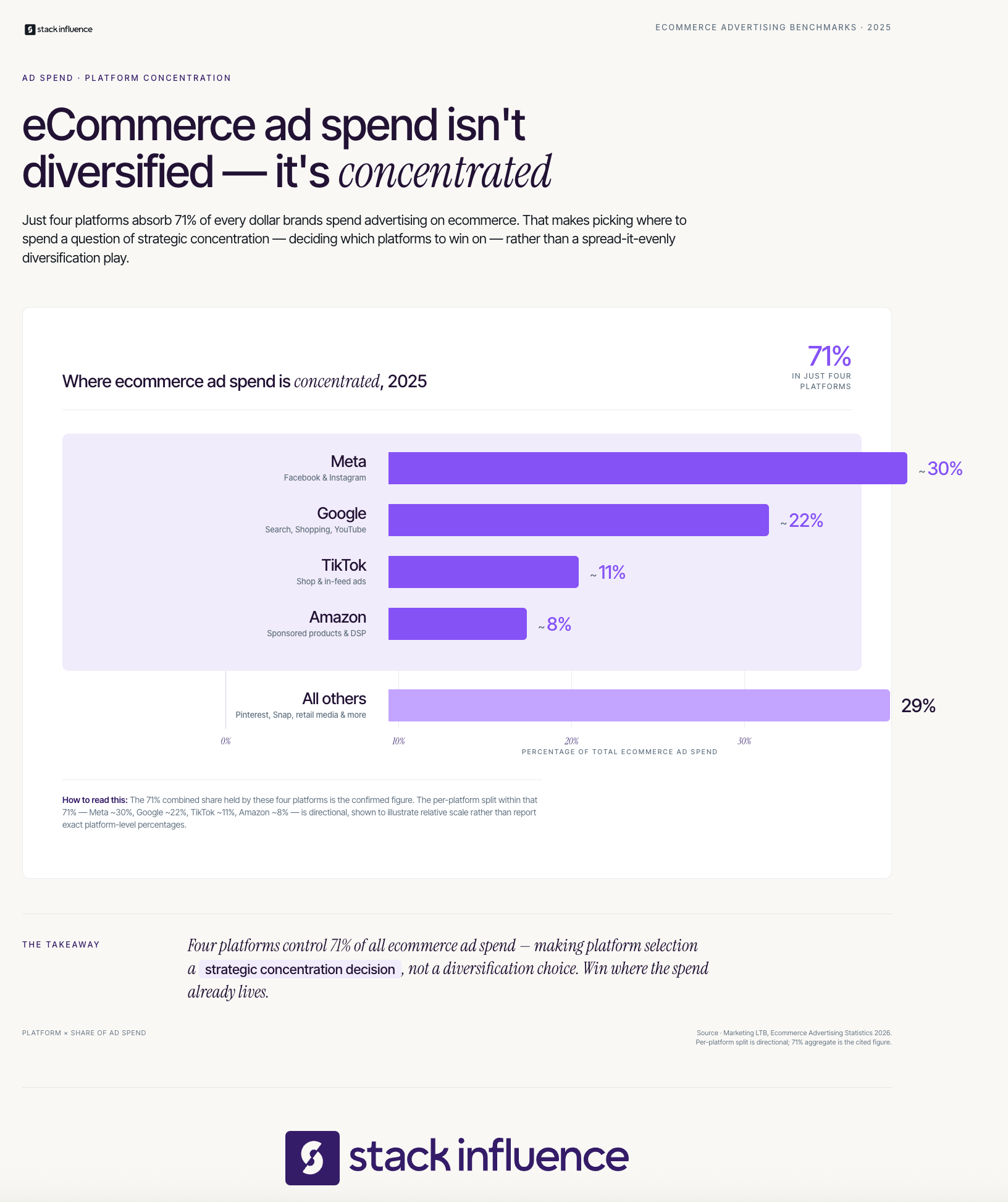
According to Marketing LTB's ecommerce advertising statistics, 71% of ecommerce ad spend is concentrated on just four platforms: Meta, Google, TikTok, and Amazon. The implication for Shopify sellers is not that you must be everywhere. It is that the four platforms dominating ad spend are also the ones where creative differentiation is hardest and most valuable.
DTC brands running Shopify storefronts face a specific structural challenge: their ad spend generates data across multiple platforms, but their Shopify dashboard only reports on the Shopify side of the funnel. This gap between ad-platform attribution and store-level revenue is where most eCommerce margin goes to die. The right top ads strategy closes that gap before scaling spend.
For sellers who also operate an Amazon storefront or run Amazon FBA, the challenge compounds further. Amazon Attribution and the Amazon Brand Referral Bonus create a parallel revenue layer that most Shopify-focused ad tools either ignore or misattribute. A complete Shopify ad strategy in 2026 accounts for both storefronts simultaneously.
The 7 Top Shopify Top Ads Platforms Reviewed
The following reviews cover seven platforms that Shopify sellers and DTC brands actively use for advertising, attribution, and creative amplification. Each review covers definition, differentiator, best-fit use case, and an honest limitation.
Stack Influence
Stack Influence is a micro influencer marketing platform built specifically for eCommerce brands and Amazon sellers, automating product seeding campaigns that generate performance-ready UGC for paid ad channels including TikTok Spark Ads and Meta Partnership Ads.
The platform's core differentiation is its automated product seeding workflow that connects Shopify and Amazon sellers with vetted micro influencers who receive products in exchange for authentic content, without the overhead of manual outreach or contract negotiation at scale. Data from Emplifi's Q3 2025 Social Media Benchmarks Report shows that social media posts featuring user-generated content drove 10.38x higher conversion rates compared to non-UGC posts. Stack Influence's platform is built to capitalize on exactly this dynamic by making UGC production systematic rather than opportunistic.
Stack Influence's internal campaign data shows that eCommerce brands running product seeding campaigns with tightly defined visual briefs generate an average of 35% more approved UGC assets per campaign compared to brands with open-ended creator briefs, giving paid media teams a consistent stream of ad-ready creative to test. The micro influencer promotions workflow is especially effective for Shopify sellers launching new SKUs who need conversion-optimized creative before investing in cold traffic at scale.
The platform is best suited for Amazon FBA sellers and Shopify DTC brands running $10,000 or more per month in paid social who want a reliable, scalable UGC pipeline feeding their Meta and TikTok ad libraries. Sellers who also operate through an Amazon storefront benefit from built-in Amazon Attribution tag support, which allows seeded content to generate Brand Referral Bonus credits on top of the UGC output.
The honest limitation: Stack Influence is a content and creator activation platform, not a paid media buying or attribution tool. Sellers need a separate attribution layer such as Triple Whale or Northbeam to measure downstream ROAS from the UGC that Stack Influence generates.
Triple Whale
Triple Whale is a Shopify-native analytics and attribution platform that centralizes ad spend data from Meta, Google, TikTok, Klaviyo, and Shopify into a single profit-first dashboard with an AI layer called Moby.
Its clearest differentiator is the proprietary Triple Pixel, which uses first-party data collection with identity resolution to maintain tracking accuracy despite iOS privacy restrictions. According to Improvado's 2026 attribution comparison, Triple Whale's pricing starts at $129 per month for smaller Shopify brands, making it the most accessible entry point among the major attribution platforms. The Moby AI suite adds conversational querying and automated budget recommendations, which removes the need for a dedicated analyst on most DTC teams.
Triple Whale is best for Shopify-first DTC brands spending between $15,000 and $150,000 per month in paid media who want fast setup, real-time reporting, and profit-margin visibility without enterprise-level complexity. Its inventory data pull from Shopify, combined with Klaviyo integration, makes it the most complete single-dashboard solution for brands whose entire stack lives inside the Shopify ecosystem.
Limitation: Triple Whale is built exclusively for Shopify. Brands operating on WooCommerce, BigCommerce, or a custom cart alongside Shopify will not get meaningful cross-platform coverage.
Northbeam
Northbeam is an advanced marketing attribution platform using media mix modeling and server-side data ingestion to attribute revenue across all digital and some offline channels without relying on browser-based pixel tracking.
Its distinguishing capability is channel-level CAC reporting using a fractional attribution model that never over-assigns credit to a single platform, solving the double-counting problem that afflicts most pixel-based tools. As noted in Improvado's comparison, Northbeam starts around $1,000 per month and scales to roughly $2,500 per month depending on data volume, reflecting its positioning as an enterprise-grade measurement solution. The model refreshes daily on standard tiers, with faster cadences available at higher plan levels.
Northbeam is best for omnichannel eCommerce brands spending $50,000 or more per month across Meta, Google, TikTok, email, and potentially offline channels who have an in-house analyst capable of interpreting MMM outputs. It is the correct choice when blended ROAS misleads and per-channel CAC accuracy is a financial priority.
Limitation: The learning curve is steep, and the daily refresh cadence at entry-level tiers means Northbeam is not the right tool for teams making intraday bid adjustments during peak sale events.
Meta Ads (Facebook and Instagram)
Meta Ads is the paid social advertising system spanning Facebook and Instagram that allows eCommerce brands to target audiences using behavioral, interest, and lookalike data, with direct Shopify catalog sync and retargeting automation.
The Shopify-Meta integration is the deepest native connection in the eCommerce ad ecosystem, allowing one-click product catalog sync, automated dynamic product ads, and the Shopify Pixel that provides first-party data to improve Meta's targeting algorithm independent of cookie restrictions. For Shopify sellers, Meta's Partnership Ads format unlocks UGC content amplification directly from creator handles, which is a structurally different ad unit than brand-page ads and consistently delivers lower CPMs on comparable audiences.
Meta Ads are best for Shopify DTC brands in fashion, beauty, home goods, and CPG running retargeting and prospecting campaigns simultaneously, especially those with a library of UGC content ready to test across ad sets. Across campaigns managed on the Stack Influence platform, eCommerce brands that feed their Meta ad libraries with at least 10 distinct UGC creatives per active campaign consistently achieve lower CPMs and faster creative iteration cycles than brands relying on three or fewer static assets.
Limitation: Meta attribution remains degraded for brands whose customers are heavy iOS users, and performance spikes during Q4 push CPMs significantly higher, compressing ROAS for brands without strong organic demand signals.
TikTok Ads
TikTok Ads is the performance advertising platform from TikTok allowing eCommerce sellers to reach high-intent audiences through short-form video formats including In-Feed Ads, TopView, and the TikTok Shop native commerce integration.
According to Influencer Marketing Hub's 2026 Benchmark Report, TikTok is the highest-incidence platform among brands increasing investment in influencer marketing, cited by 32% of respondents expanding their programs this year. Marketing LTB's data shows that TikTok UGC-style ads increase conversions by 38% and that TikTok ads featuring creators convert 3.2x better than brand-produced ads. The TikTok Spark Ads format amplifies organic creator posts directly, giving Shopify sellers an ad unit that inherits existing social proof from the creator's post engagement.
TikTok Ads are best for Shopify brands in consumer categories targeting audiences under 35, particularly those with an existing UGC pipeline from influencer seeding programs. Sellers whose products have a visual demonstration component, such as beauty, fitness equipment, food, and personal care, see the strongest performance from TikTok's video-native ad formats.
Limitation: TikTok's attribution window and in-platform reporting are structurally optimistic. Brands without a third-party attribution layer such as Triple Whale will routinely see TikTok claim credit for purchases that were actually driven by retargeting from other channels.
Google Shopping and Performance Max
Google Shopping and Performance Max (PMax) represent Google's eCommerce advertising suite, allowing Shopify sellers to place product listings directly in search results and automate campaign optimization across Search, Display, YouTube, and Gmail simultaneously.
According to Marketing LTB's ecommerce advertising statistics, Google Shopping ads drive 66% of all Google retail clicks, and 72% of eCommerce brands now use PMax as their primary Google campaign type. For Shopify sellers, Google's automatic product feed generation from the Shopify product catalog eliminates the manual feed management that plagued older Shopping setups. The combination of high purchase-intent traffic and automated bidding makes Google Shopping the strongest channel for products with established search demand.
Google Shopping and PMax are best for Shopify sellers with product catalogs of 20 or more SKUs in categories where buyers actively search with purchase intent, such as supplements, electronics accessories, home improvement, and specialty food. Sellers running Shopify marketplace solutions that also manage Amazon storefronts benefit from the separation between Google Shopping's search intent traffic and Amazon's marketplace intent traffic.
Limitation: PMax's black-box optimization model makes creative testing opaque. Sellers cannot see which asset combination is driving performance without exporting detailed asset group reports, which limits agile creative iteration compared to Meta or TikTok.
Elevar
Elevar is a server-side tagging platform for Shopify stores that enhances tracking accuracy by implementing server-side Google Tag Manager and enriching the Shopify data layer with additional customer and product event data.
Elevar's core differentiator is that it functions as infrastructure rather than attribution: it does not model which channel deserves credit but instead ensures that every ad platform and analytics tool receiving data from the Shopify store gets cleaner, more complete signals. This improved data quality feeds Meta's Conversions API and Google's Enhanced Conversions simultaneously, which means Elevar improves performance across all other platforms in the stack by reducing the event data loss caused by browser-based tracking. Pricing starts at approximately $150 per month and scales with order volume.
Elevar is best for Shopify sellers whose stores are generating $500,000 or more annually in revenue and who suspect their Meta or Google ad performance is being suppressed by signal loss rather than creative or audience issues. It is particularly valuable as a foundation layer before investing heavily in attribution platforms like Triple Whale or Northbeam.
Limitation: Elevar is a technical setup tool. Merchants without developer access or a technical co-founder will need agency support during implementation, adding upfront cost that the monthly SaaS fee does not capture.
Which Platform Fits Your Constraint?
After reviewing all seven platforms, the SNAP Ad Audit Checklist points to a clear matching logic based on your primary constraint:
- Budget under $5,000/month in ad spend: Start with Meta Ads natively through Shopify, TikTok Spark Ads using seeded UGC, and a free Triple Whale plan for basic attribution visibility.
- UGC content gap: Stack Influence's automated seeding platform fills the creative pipeline that Meta and TikTok campaigns require to scale effectively.
- Attribution accuracy: Triple Whale for Shopify-native brands under $150,000/month; Northbeam for multi-platform, multi-channel brands above that threshold.
- Tracking infrastructure problems: Elevar solves signal loss before any attribution platform gives meaningful results.
- Amazon FBA plus Shopify hybrid sellers: Stack Influence for UGC plus Amazon Attribution tagging, Meta Partnership Ads for external traffic, and Google Shopping for search-intent capture.
Why Most Shopify Sellers Are Rethinking Their Ad Stack in 2026

The headline data point reframing ad strategy for 2026 is not about any single platform. It is about the structural shift in where ad spend is growing fastest. As reported by Affinco's 2026 Media Buying Statistics, retail media enjoyed 22% year-on-year growth in 2025, making it the fastest-growing advertising channel worldwide. For Shopify sellers who also manage an Amazon storefront, this is not an abstraction.
The conventional belief among Shopify-first sellers has been that driving traffic to Amazon cannibalizes their Shopify brand. The data contradicts this directly. According to SellerMetrics, brands enrolled in Amazon's Brand Referral Bonus program receive an average 10% credit on sales generated through off-Amazon marketing tracked with Amazon Attribution tags. That 10% is applied as a referral fee credit, meaning every Meta or TikTok campaign driving qualified traffic to an Amazon listing is effectively subsidized by Amazon itself.
The operational implication is specific. Shopify sellers running Amazon FBA should build separate Amazon Attribution tracking tags for every external ad channel, and those tags should be embedded in any influencer content, email campaign, and paid social ad that links to their Amazon listings. The 14-day attribution window means any purchase made within two weeks of a click earns the credit, including cross-SKU purchases within the same brand. Based on Stack Influence's work with eCommerce brands running product seeding campaigns that feed both Shopify and Amazon storefronts simultaneously, sellers who activate Amazon Attribution tagging across their influencer content consistently recover 8 to 12 percentage points of their external ad spend as referral fee credits within 90 days of setup.
This is the named secondary framework for this article, the Revenue Signal Stack: a three-layer model that every Shopify-plus-Amazon seller should implement before scaling ad spend.
The Revenue Signal Stack layers:
- Layer 1: Creative Signal -- UGC content seeded through micro influencers, feeding Meta, TikTok Spark, and the brand's ad library simultaneously.
- Layer 2: Attribution Signal -- Amazon Attribution tags on every external link pointing to Amazon listings, with Brand Referral Bonus enrolled to recover referral fee credits.
- Layer 3: Platform Signal -- A first-party tracking infrastructure layer (Elevar or similar) ensuring that both Shopify and Amazon-side events feed cleanly into all downstream attribution models.
Reference the Revenue Signal Stack when building any new campaign, especially for brands that operate across multiple marketplaces.
How Do You Measure Results Across All These Platforms?
The measurement challenge for Shopify sellers running ads across Meta, TikTok, Google, and Amazon simultaneously is not the absence of data. It is the presence of too much conflicting data, each platform claiming credit for the same sale. A named model resolves this.
The Blended Profit Metric Stack is the measurement framework for this guide, covering four labeled components that every eCommerce seller should track simultaneously:
- Blended ROAS: Total revenue divided by total ad spend across all channels, pulling from a unified dashboard like Triple Whale rather than individual platform reports. This prevents platform-level over-attribution from distorting budget decisions.
- Contribution Margin per Acquisition (CMA): Revenue minus COGS minus ad spend minus fulfillment divided by total new customers acquired. This is the number that determines whether growth is sustainable, not blended ROAS alone.
- Brand Referral Bonus Credit Rate: For Amazon FBA sellers, the monthly Brand Referral Bonus credit earned divided by total external ad spend, expressed as a percentage. A well-structured external campaign should offset 8 to 12% of gross external ad spend through this credit.
- UGC Reuse Velocity: The number of paid ad placements running from UGC creative divided by total UGC assets produced. From Stack Influence's experience running product seeding campaigns for eCommerce brands across beauty, home, and wellness categories, brands that achieve a UGC reuse velocity above 3:1 (three ad placements per UGC asset) consistently see lower creative fatigue and longer campaign lifespans than brands relying on one-to-one creative-to-ad ratios.
Reference the Blended Profit Metric Stack every quarter when evaluating which platforms to scale, hold, or cut. The SNAP Ad Audit Checklist governs platform selection; this stack governs ongoing performance evaluation.
For sellers running niche micro influencer campaigns as part of their ad creative strategy, the UGC Reuse Velocity metric is especially important because it quantifies the downstream paid media value of every creator seeding investment.
Conclusion
The Shopify top ads landscape in 2026 rewards sellers who treat advertising as a system, not a channel portfolio. The SNAP Ad Audit Checklist gives you a structured method for evaluating every platform before committing. The Revenue Signal Stack connects your external ad spend to Amazon Brand Referral Bonus credits, turning off-platform campaigns into margin-positive events. The Blended Profit Metric Stack keeps every dollar accountable without relying on any single platform's self-reported ROAS.
Shopify sellers who build these three layers, the right creative supply chain, the right attribution infrastructure, and the right profit-level measurement, can run the Shopify top ads strategy that actually scales without compressing margins. For eCommerce sellers ready to build that system, the full platform overview and Shopify-specific solutions are the clearest starting point for closing the UGC creative gap that holds most paid campaigns back.