




Every content creator eventually faces the same resource allocation question: if you can only go deep on one platform, should it be TikTok or YouTube? The answer is not the same for every creator, and the guides that give a single universal recommendation are oversimplifying a decision that depends on your content format, income goals, audience growth timeline, and risk tolerance. The TikTok vs YouTube debate is really a question about what kind of creator business you are building. This guide compares both platforms across the dimensions that matter most: income potential, algorithmic reach, brand deal opportunity, creator longevity, and the measurement frameworks you need to track whether your platform choice is actually working. By the end, you will have a clear decision model rather than a vague recommendation.
Key Takeaways
- YouTube pays creators significantly more per view through AdSense than TikTok's Creator Fund or Creator Rewards, but YouTube's higher income floor requires substantially more content production investment to reach.
- TikTok's algorithm distributes content to non-followers based on engagement signals, giving new creators faster initial audience growth than YouTube's search and subscription-driven model.
- Brand deal rates are higher per post on YouTube for established creators, but TikTok's lower follower thresholds make paid brand partnerships accessible earlier in a creator's growth trajectory.
- The most financially stable creators in 2026 operate on both platforms with a deliberate repurposing workflow rather than treating the TikTok vs YouTube choice as mutually exclusive.
- UGC production is the fastest income path for creators on either platform because it pays for content skills rather than audience size, making it a viable parallel income stream regardless of which platform you prioritize.
Why the TikTok vs YouTube Decision Matters More Than Ever in 2026
The stakes of the platform prioritization decision have risen significantly in the last two years. TikTok's regulatory uncertainty in the United States created a period in early 2025 where millions of creators who had built their entire business on TikTok faced the possibility of losing their primary distribution channel overnight. YouTube, by contrast, has operated continuously for over 20 years without a comparable existential threat. The platform risk dimension of the TikTok vs YouTube question is no longer theoretical.
At the same time, TikTok has doubled down on its creator monetization infrastructure with TikTok Shop, expanded Creator Rewards Program payouts, and an improving live gifting economy that gives creators more ways to earn than YouTube offered at an equivalent stage. Both platforms have grown more sophisticated in how they compensate creators, which makes the comparison more nuanced and the decision more consequential than it was even two years ago.
Three macro forces shaping the TikTok vs YouTube landscape in 2026:
- Platform risk asymmetry: YouTube operates under Google's infrastructure and regulatory umbrella. TikTok's ownership by ByteDance continues to attract regulatory scrutiny in multiple markets. Creators building a long-term business need to factor platform survival probability into their primary platform decision.
- Monetization infrastructure divergence: YouTube has built its creator economy around long-form AdSense revenue, memberships, and Super Thanks. TikTok has built its around short-form shopping, live gifting, and affiliate commissions. The income structures reward different content formats and creator behaviors.
- Algorithm philosophy difference: YouTube rewards searchable, referenceable, long-shelf-life content. TikTok rewards immediate emotional engagement and scroll-stopping hooks. These different distribution philosophies produce different audience relationships, brand deal dynamics, and long-term creator asset values.
How Do TikTok and YouTube Compare on Creator Income?
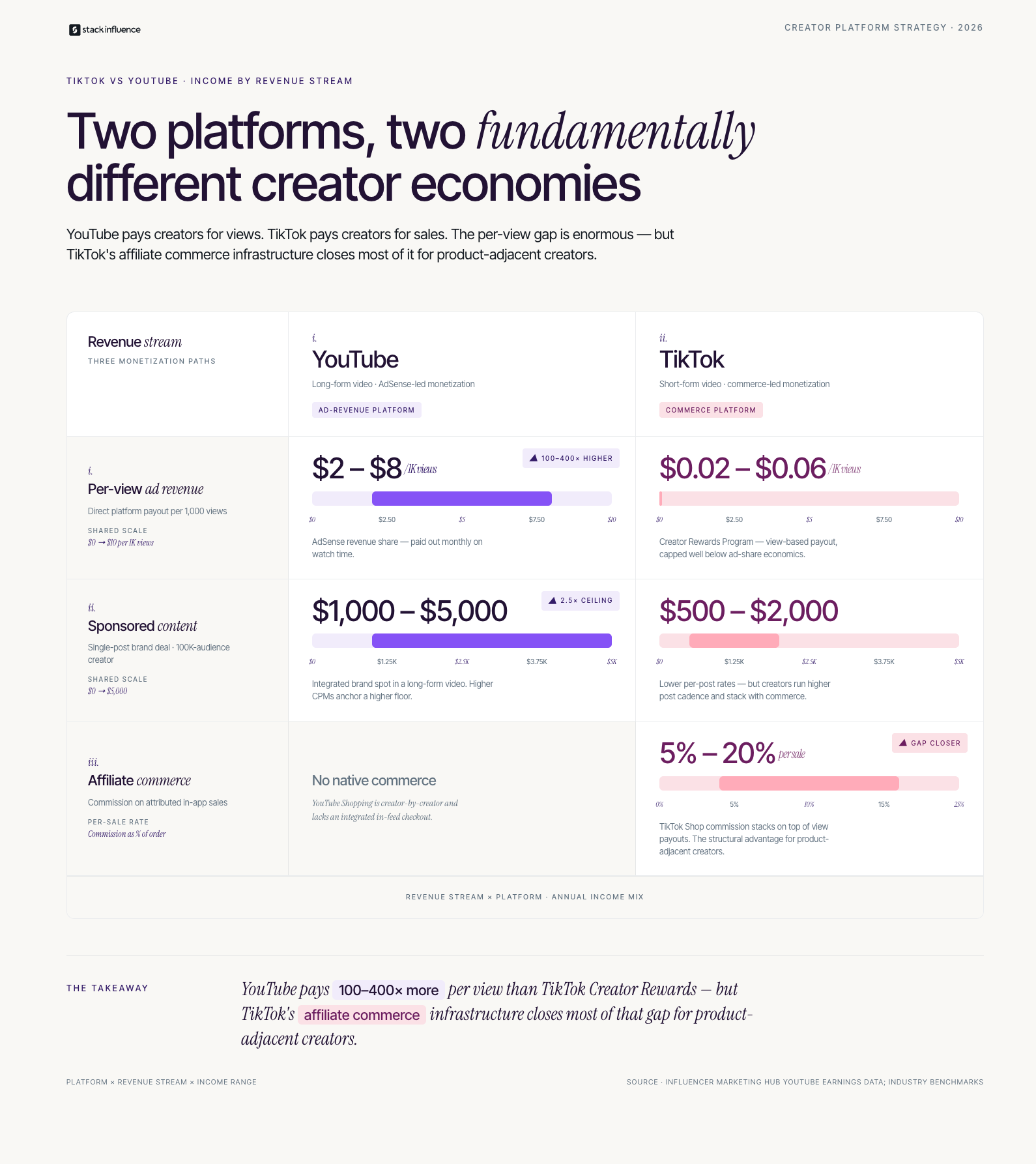
Platform income comparisons are frequently misleading because they compare maximum earnings on one platform to average earnings on another. The more useful comparison is what a creator at a specific stage and output frequency can realistically expect to earn from each platform's native monetization tools.
YouTube AdSense vs TikTok Creator Rewards
YouTube pays creators through AdSense at a rate typically between $2 and $8 per 1,000 views (CPM varies significantly by niche, with finance, technology, and business content earning the highest rates). According to Influencer Marketing Hub's YouTube earnings data, a creator generating 500,000 monthly views in a mid-tier niche can expect $1,000 to $4,000 in monthly AdSense income. Reaching that view volume typically requires 12 to 24 months of consistent output for most creators starting from zero.
TikTok's Creator Rewards Program, which replaced the original Creator Fund, pays creators significantly less per view than YouTube AdSense. Rates vary but typically fall between $0.02 and $0.06 per 1,000 views, meaning a creator generating 500,000 monthly views on TikTok earns roughly $10 to $30 from the Creator Rewards Program alone. The gap in platform-native ad revenue between TikTok and YouTube is substantial enough that TikTok creators who rely primarily on Creator Rewards as their income strategy will almost always earn less than equivalent YouTube creators.
The direct income comparison by channel:
- YouTube AdSense: $2 to $8 per 1,000 views, requires 1,000 subscribers and 4,000 watch hours for eligibility.
- TikTok Creator Rewards: $0.02 to $0.06 per 1,000 views, requires 10,000 followers and 100,000 views in the past 30 days for eligibility.
- TikTok Shop affiliate commissions: 5% to 20% per sale, no follower minimum, significantly higher income potential than Creator Rewards for product-adjacent content.
- YouTube channel memberships and Super Thanks: Variable, typically $1 to $5 per member per month, requires established audience trust.
- YouTube Shopping and affiliate: Commission rates similar to TikTok Shop, available through YouTube's integrated shopping tools.
Brand Deal Rates by Platform
Brand deal income is where the comparison becomes more nuanced. YouTube commands higher flat-fee rates per sponsored video because of longer average watch time, deeper audience attention, and the searchable permanence of YouTube content. A mid-tier YouTube creator with 100,000 subscribers typically earns $1,000 to $5,000 per sponsored video. A TikTok creator with equivalent followers typically earns $500 to $2,000 per sponsored post, though TikTok's lower engagement threshold for brand deals means creators access paid sponsorships earlier in their growth.
What Does Each Platform's Algorithm Actually Reward?
The algorithmic difference between TikTok and YouTube is the most practically important distinction for content creators deciding where to invest their time, because the algorithm determines both how quickly you grow and what type of content you need to produce consistently to sustain that growth.
TikTok's For You Page distributes content based on immediate engagement signals: view completion rate, like rate, share rate, and comment engagement within the first few hours of posting. A creator with 500 followers can reach 500,000 people with a single video if the engagement signals in the first two hours are strong enough. This is TikTok's most powerful creator advantage: it removes the follower count barrier to reach that YouTube's subscription model imposes. According to Hootsuite's social media statistics, TikTok users open the app an average of 19 times per day, with average sessions of 10 minutes or more, creating significant daily impression opportunities for creator content.
YouTube's algorithm distributes content primarily through search results and homepage recommendations based on click-through rate, watch time, and viewer satisfaction signals measured through post-video surveys. A YouTube video has a much longer distribution tail than a TikTok video: a well-optimized YouTube video continues generating views through search for months or years after upload, while most TikTok videos complete their distribution cycle within 72 hours of posting.
The Platform Algorithm Comparison covers six dimensions:
- Discovery mechanism: TikTok distributes to non-followers algorithmically. YouTube distributes primarily through search and subscription.
- Content shelf life: YouTube content earns views for months or years. TikTok content earns views within 24 to 72 hours of posting.
- Growth speed: TikTok produces faster initial follower growth for most creators. YouTube produces slower but more durable subscriber accumulation.
- Content length requirements: TikTok rewards 15 to 60 second content for discovery. YouTube rewards 8 to 20 minute content for AdSense and algorithm satisfaction.
- Audience relationship depth: YouTube builds deeper audience relationships through longer watch sessions. TikTok builds broader but shallower discovery-stage reach.
- Search discoverability: YouTube is the world's second-largest search engine. TikTok's search function is growing but less mature as a discovery mechanism.
Which Platform Is Better for Brand Deals and Creator Partnerships?
For [micro influencers](INTERNAL: micro influencer brand deal platform comparison) evaluating where to focus their brand partnership development, the platform decision directly affects what types of deals are available, at what follower counts, and with what rate expectations.
TikTok's lower follower thresholds for brand engagement make it the faster path to first paid brand deal for most creators. [Nano influencers](INTERNAL: nano influencer TikTok brand partnership guide) with 1,000 to 10,000 followers can access TikTok Shop affiliate deals and product seeding campaigns immediately, generating real income from brand relationships before their YouTube channel has enough content or subscribers to attract brand interest. The [creator economy](INTERNAL: creator economy platform income guide) on TikTok has also normalized very small creator collaboration, with brands that work with micro influencers running high-volume seeding programs specifically designed for TikTok's smaller creator tier.
YouTube's brand deal advantages are strongest for established creators in high-value niches. A 50,000-subscriber YouTube channel in personal finance, tech, or fitness can command significantly higher per-video sponsored rates than a TikTok account with equivalent followers because YouTube's longer content format allows deeper product integration, more detailed demonstrations, and longer audience exposure per sponsored mention.
Three platform-specific brand deal dynamics creators need to know:
- TikTok UGC and creator seeding: Brands running [product seeding](INTERNAL: product seeding for TikTok and YouTube creators) programs on TikTok typically require one to three short-form videos, natural product integration, and affiliate link usage. Entry is low-barrier and volume is high. This is the most accessible brand income path for new creators regardless of platform.
- YouTube long-form integrations: Brands pay a premium for YouTube because a 60-second mid-roll sponsorship in a 15-minute video delivers more message exposure per viewer than any social post format. These deals are available once a channel has established audience trust and search-driven viewership.
- Cross-platform deals: Brands increasingly ask for cross-platform packages that include both a TikTok short-form post and a YouTube Shorts or long-form video for the same product. Creators active on both platforms can command 30 to 50% higher deal values than creators offering a single platform placement.
Stack Influence's internal campaign data shows that [content creators](INTERNAL: content creator brand deal income guide) who maintain active profiles on both TikTok and YouTube receive 55% more inbound brand partnership inquiries than creators active on only one platform, because brands running multichannel campaigns prefer to consolidate creator relationships rather than source separately for each platform.
Measuring Your Creator Business: The Platform ROI Stack

Most creators evaluate platform performance by follower count and view numbers, neither of which directly measures the health of a creator business. The Platform ROI Stack is a three-tier measurement framework that connects your platform activity to actual financial outcomes and helps you make evidence-based decisions about where to invest your production time.
The three tiers of the Platform ROI Stack:
- Tier 1: Reach efficiency metrics. For TikTok, track For You Page reach rate (views divided by followers), video completion rate, and share rate per video. For YouTube, track click-through rate from thumbnails, average view duration as a percentage of video length, and impressions-to-views conversion. These metrics tell you whether your content is earning its algorithmic distribution. A TikTok video completion rate below 40% or a YouTube click-through rate below 4% both signal content or thumbnail problems worth addressing before scaling output volume.
- Tier 2: Audience quality metrics. Track comment sentiment, saves on TikTok, and YouTube subscriber retention rate (subscribers gained minus unsubscribes per video). High view counts with low saves and low comment engagement indicate shallow viral reach rather than genuine audience building. The distinction matters because brand deals are priced on audience quality, not on peak view spikes.
- Tier 3: Income efficiency metrics. Divide your total monthly platform income, including AdSense or Creator Rewards, brand deals, affiliate commissions, and any UGC contracts sourced through platform visibility, by the hours you invested producing content for that platform. This is your effective hourly platform rate, and it is the only number that tells you whether your platform prioritization is financially rational.
According to Sprout Social's creator benchmark data, engagement rate for video content on YouTube averages 1.63% while TikTok averages 2.65% for equivalent account sizes. Knowing these benchmarks lets creators contextualize their own performance data rather than evaluating it in a vacuum.
Across campaigns managed on the Stack Influence platform, creators who track Tier 3 income efficiency monthly and compare it across platforms reallocate their production time within 90 days toward the platform generating the highest effective hourly rate, which produces an average 25 to 35% income increase within two production cycles without increasing total content output.
What Most TikTok vs YouTube Guides Get Wrong
Most comparison guides treat this as a binary choice and optimize their recommendation for audience growth speed alone, because growth metrics are measurable and satisfying to compare. What they consistently underweight is the long-term asset value difference between a YouTube channel and a TikTok following, which is the more financially consequential dimension of the decision for creators building businesses rather than just audiences.
A YouTube channel is a compounding asset. Every video you upload continues generating views, subscribers, and AdSense revenue for years after publication. A well-optimized video in a durable niche generates more revenue in year three than it did in week one. A TikTok following is a real-time attention asset. The views and engagement exist while you are actively posting. The moment you stop posting, your distribution drops to near zero within weeks. TikTok content does not have the search-driven long tail that YouTube content does.
Three things most TikTok vs YouTube comparison guides leave out of the decision framework:
- Platform risk is a financial variable: TikTok's ownership structure and ongoing regulatory scrutiny mean that building a creator business exclusively on TikTok carries a real platform risk that YouTube does not. Creators who experienced TikTok's US availability disruption in early 2025 learned this directly. Diversification across platforms is not just a growth strategy. It is a risk management decision.
- The repurposing model changes the math: Creators who produce one piece of long-form YouTube content and repurpose it into three to five TikTok clips effectively eliminate the "one platform or the other" constraint. The production cost of being on both platforms drops significantly when repurposing is built into the workflow from day one.
Conclusion
The TikTok vs YouTube question does not have a single right answer, but it does have a right framework. TikTok offers faster audience growth, lower brand deal entry thresholds, and a native commerce infrastructure through TikTok Shop. YouTube offers higher per-view income, deeper audience relationships, compounding content assets, and lower platform risk. The Platform ROI Stack gives you the measurement discipline to evaluate which platform is actually producing returns for your specific situation. And the repurposing model gives you the operational path to stop treating the TikTok vs YouTube decision as a forced choice and start building a creator business with durable assets on both.
If you are ready to add brand partnership income to your creator strategy regardless of which platform you prioritize, Stack Influence connects micro influencers and content creators with eCommerce brands running product seeding campaigns across TikTok, YouTube, Instagram, and beyond.