



The TikTok Creator Fund was supposed to be the moment TikTok started paying its creators fairly. When it launched in 2020 with a $200 million initial commitment, it generated real excitement among content creators who had been building massive audiences on the platform without any direct platform compensation. Then the checks started arriving. Creators with millions of views were earning a few dollars. The math did not work, and the backlash was significant enough that TikTok eventually replaced the Creator Fund with the Creator Rewards Program in 2023. This guide covers the full history of the TikTok Creator Fund, what went wrong with it, how the Creator Rewards Program compares, and why the most financially stable creators on TikTok have always treated platform-native pay as the smallest part of their income strategy.
Key Takeaways
- The TikTok Creator Fund launched in 2020 with a $200 million commitment but paid creators as little as $0.02 to $0.04 per 1,000 views, far below what YouTube AdSense pays for equivalent reach.
- TikTok replaced the Creator Fund with the Creator Rewards Program in 2023, which pays higher rates for longer, search-optimized content but still represents a small fraction of what most creators earn from brand deals and affiliate income.
- Platform-native creator pay on TikTok has never been a viable standalone income source, and creators who relied on it exclusively as their primary revenue stream consistently underearned relative to their audience size.
- Brand partnerships, product seeding, UGC production, and TikTok Shop affiliate income all generate significantly higher per-hour returns than Creator Fund or Creator Rewards earnings for most content creators.
- Understanding TikTok's monetization history helps creators make smarter income diversification decisions rather than waiting for platform pay rates to improve to livable levels.
What Was the TikTok Creator Fund and Why Did It Fail?
The TikTok Creator Fund launched in July 2020 with an initial $200 million pool intended to compensate US creators for their content. TikTok later announced plans to expand the fund to $1 billion over three years. The concept was straightforward: creators with at least 10,000 followers and 100,000 views in the previous 30 days could apply to receive payment based on their content's performance. It positioned TikTok as a platform that valued its creator community with actual dollars rather than just organic reach.
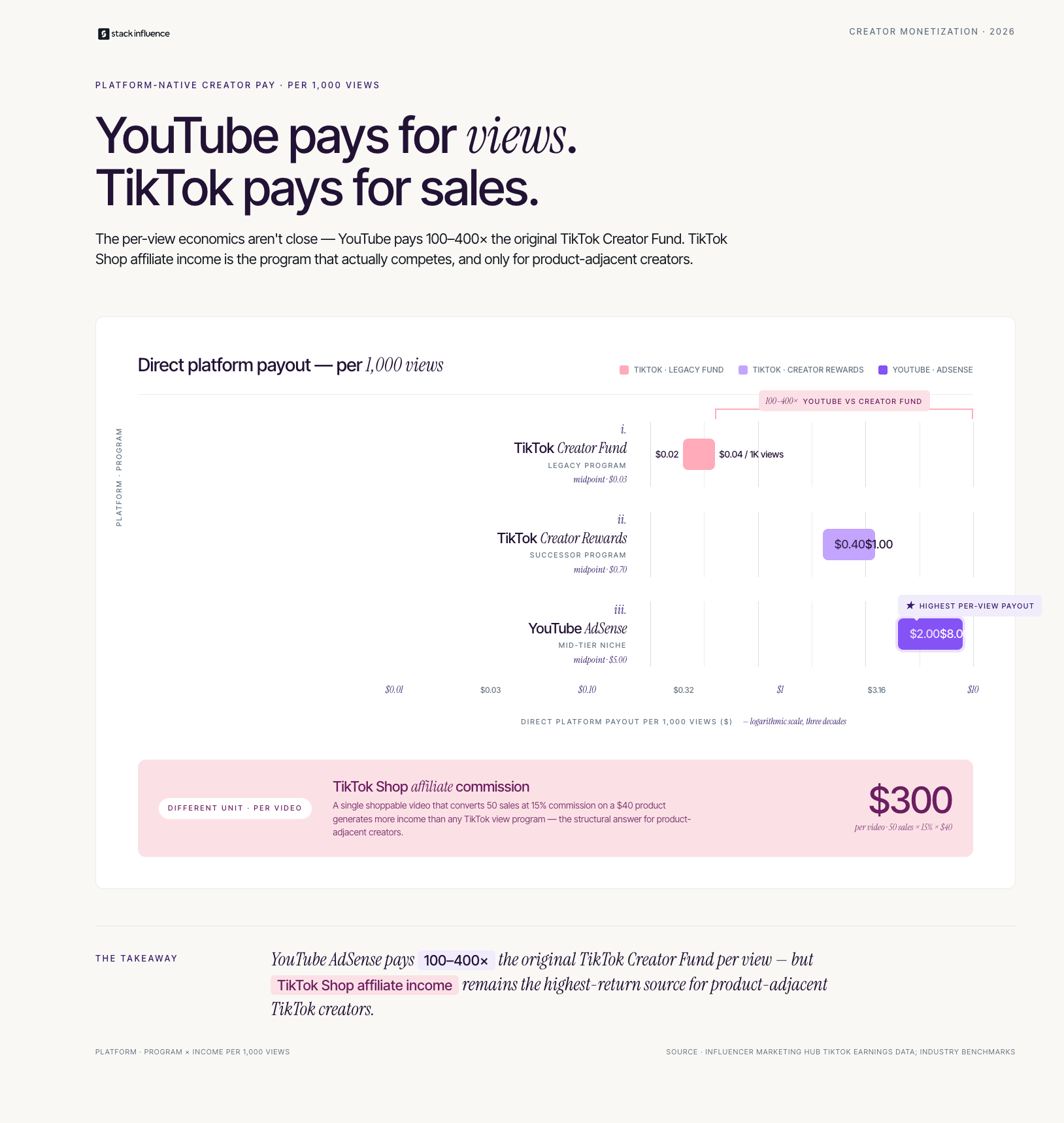
The reality was immediately disappointing. Because the fund was a fixed pool distributed across all eligible creators, every new creator who joined the program diluted the per-view payment rate for everyone else. According to Influencer Marketing Hub's TikTok earnings research, Creator Fund payouts typically ranged from $0.02 to $0.04 per 1,000 views, meaning a creator who generated 1 million views in a month earned roughly $20 to $40 in platform income. A YouTube creator generating the same views would typically earn $500 to $2,000 through AdSense in the same period.
Three structural reasons the TikTok Creator Fund failed creators:
- Fixed pool dilution: The total fund size did not grow proportionally as the creator base expanded, which meant per-creator rates fell continuously as more creators joined. TikTok's explosive growth in 2020 and 2021 accelerated the dilution problem significantly.
- No CPM transparency: Unlike YouTube's AdSense system, which allows creators to see their RPM (revenue per mille) and understand which content types earn more, the Creator Fund operated as a black box. Creators had no way to optimize for higher earnings because the payment variables were not disclosed.
- Engagement suppression reports: Multiple high-profile creators publicly reported that their organic reach and engagement dropped after joining the Creator Fund, suggesting the algorithm may have adjusted distribution for fund-eligible content in ways that benefited platform ad revenue over creator visibility. TikTok denied these claims, but the perception was widespread enough to affect creator behavior.
How Does the TikTok Creator Rewards Program Compare to the Original Fund?
TikTok began rolling out the Creator Rewards Program in 2023 as a replacement for the Creator Fund, with higher stated rates and different eligibility requirements designed to reward longer, more search-friendly content rather than short viral clips. Understanding the difference helps creators calibrate their income expectations for 2026 accurately.
The Creator Rewards Program pays creators based on a different formula than the Creator Fund. TikTok has indicated that payments are influenced by video originality, play duration (favoring videos over one minute), search value (whether the content answers queries people are actually searching), and audience engagement quality. According to later.com's TikTok monetization research, reported Creator Rewards rates range from $0.40 to $1.00 per 1,000 views for qualifying content, a meaningful improvement over the Creator Fund's rates but still significantly below YouTube AdSense benchmarks for equivalent audiences.
The key differences between the Creator Fund and Creator Rewards Program:
- Eligibility threshold: Creator Rewards requires 10,000 followers, a personal (not business) account, and content meeting specific originality and length standards. The Creator Fund had similar follower requirements but different content criteria.
- Payment rate range: Creator Rewards pays an estimated $0.40 to $1.00 per 1,000 qualifying views vs the Creator Fund's $0.02 to $0.04. The improvement is real, but actual rates vary significantly based on niche, audience geography, and content format.
- Content format incentive: Creator Rewards explicitly favors videos over one minute, which represents a shift in TikTok's content strategy toward longer, more searchable content rather than the short-form viral clips that built the platform's original audience.
- Geographic variation: Creator Rewards rates vary significantly by audience location. Creators whose audiences are primarily in high-income markets like the United States, United Kingdom, and Australia earn higher rates than those with primarily developing market audiences.
The Creator Rewards Program is a genuine improvement over the Creator Fund, but the fundamental reality has not changed: TikTok platform-native pay is not a viable primary income source for most content creators at any realistic view volume.
What Should Creators Earn Instead of Relying on the TikTok Creator Fund?
The most important strategic insight about the TikTok Creator Fund and its successor is not what they pay. It is what the existence of low platform-native pay means for how creators should structure their income. A platform that pays $0.40 to $1.00 per 1,000 views is not a payment platform. It is a distribution platform. The income comes from what you do with that distribution, not from the platform itself.
The Creator Income Diversification Stack is the framework for building the income portfolio that TikTok's distribution powers but does not directly provide. It covers five income streams organized by accessibility at different creator stages:
- Tier 1: UGC production contracts (accessible immediately, no follower minimum). Brands pay [UGC creators](INTERNAL: UGC creator income strategy guide) $150 to $500 per video deliverable for authentic product demonstration content used in paid ads. TikTok distribution builds your portfolio credibility, but the UGC income does not require TikTok reach. A creator with 500 followers and strong production skills can earn $2,000 to $5,000 per month from UGC work alone.
- Tier 2: Product seeding and brand partnerships (accessible at 1,000 to 5,000 followers). [Nano influencers](INTERNAL: nano influencer brand partnership income guide) with small but engaged TikTok audiences can access [product seeding](INTERNAL: product seeding for TikTok creators) programs that provide free product and sometimes small fees in exchange for authentic content. These relationships build the brand portfolio that supports higher-rate deals later.
- Tier 3: TikTok Shop affiliate commissions (accessible at 1,000 followers). Affiliate commission rates of 5% to 20% on TikTok Shop products generate significantly more income per piece of content than Creator Rewards for creators in product-adjacent niches. A single video driving 50 sales of a $40 beauty product at 15% commission generates $300, compared to roughly $0.40 to $1.00 for 1,000 views from Creator Rewards.
- Tier 4: Paid brand sponsorships (accessible at 10,000 to 50,000 followers). Direct brand deals for sponsored posts typically range from $300 to $3,000 per post for [micro influencers](INTERNAL: micro influencer sponsored post rate guide) on TikTok. This tier becomes increasingly accessible as your follower count and engagement data build.
- Tier 5: Platform Creator Rewards (supplementary income at any scale). Creator Rewards should be enrolled in and collected but never treated as a primary income driver. It functions best as a supplementary income stream that compounds with your other tiers rather than as a standalone revenue source.
The Creator Income Diversification Stack is most effective when Tiers 1 and 2 are activated before relying on Tier 3 or above, because UGC and seeding work builds brand relationships and portfolio depth that compound into higher-rate deals faster than waiting for organic follower growth to unlock upper-tier income.
How Do You Qualify for and Maximize the TikTok Creator Rewards Program?
Even if Creator Rewards represents a small percentage of total creator income, qualifying for it and earning the maximum possible rate is worth doing because it requires no additional content production. The optimization decisions are structural, meaning you build them into your content strategy once and they continue earning without extra effort.
Eligibility requirements for the TikTok Creator Rewards Program in 2026:
- Account type: Must be a personal account, not a TikTok Business account. If you switched to a business account for analytics access, switching back to personal is required to access Creator Rewards.
- Follower minimum: 10,000 followers.
- View requirement: 100,000 video views in the past 30 days.
- Age requirement: 18 years or older.
- Content originality: Content must be original and not primarily consist of repurposed content from other creators or low-effort compilations.
- Geographic availability: Creator Rewards is available in the United States, United Kingdom, Germany, France, Brazil, Japan, South Korea, and additional markets. Check TikTok's current documentation for the complete list.
To maximize Creator Rewards earnings within the program's framework:
- Post videos over one minute: Creator Rewards explicitly favors longer content. Videos between one and three minutes appear to receive the highest per-view rates within the program based on creator-reported data.
- Optimize for search intent: Creator Rewards weights content that generates search-driven views more heavily than purely algorithmically distributed viral content. Include specific, searchable terms in your captions and first spoken sentence.
- Target US and UK audiences: If your niche allows it, creating content that resonates with higher-CPM markets generates better Creator Rewards payouts because the program's rates reflect the advertising value of your audience's geographic location.
- Maintain original content standards: Creator Rewards has de-prioritized content that is primarily duets, stitches, or repurposed material. Building your strategy around original content protects your eligibility and maximizes rates.
According to Social Media Today's creator monetization analysis, the Creator Rewards Program represents TikTok's most significant improvement to creator compensation since the platform launched, but industry analysts note that it still places TikTok below YouTube AdSense in per-view payout for most creator tiers.
Stack Influence's internal campaign data shows that creators who enrolled in the Creator Rewards Program and simultaneously activated TikTok Shop affiliate income earned an average of four to six times more total monthly TikTok income than creators relying on Creator Rewards alone, confirming that the affiliate commerce layer is the highest-return activation available to TikTok creators regardless of their follower count.
Measuring Your Total TikTok Income: The Creator Revenue Stack

Most creators measure their TikTok income by checking their Creator Rewards dashboard and stopping there. That number represents a fraction of the total income their TikTok content is generating when you account for all the revenue streams that TikTok distribution enables. The Creator Revenue Stack is a three-tier measurement framework for understanding your complete TikTok income picture.
The three tiers of the Creator Revenue Stack:
- Tier 1: Direct platform income. This is the Creator Rewards payment, TikTok LIVE gifting income, and TikTok Shop affiliate commissions. Track these monthly and separately from each other so you understand which component is growing and which is stagnant. Most creators find that TikTok Shop affiliate income grows faster than Creator Rewards as their content library expands.
- Tier 2: Brand income sourced through TikTok. Track every brand deal, product seeding arrangement, and UGC contract where the brand discovered or evaluated you through your TikTok content. Even if the payment does not come from TikTok directly, it is income that TikTok distribution made possible. Many creators are surprised to find that Tier 2 income is three to five times larger than Tier 1 when they track it systematically.
- Tier 3: Cross-platform income enabled by TikTok content. If your TikTok videos drive traffic to your YouTube channel, Instagram, or a personal website, the income generated on those platforms from audience members who originally discovered you on TikTok belongs in this tier. Tracking it requires UTM parameters, platform referral data, or a simple self-reported survey asking new subscribers or followers where they found you.
Based on Stack Influence's work with [content creators](INTERNAL: content creator total income tracking guide) building multi-stream income, creators who track all three tiers of the Creator Revenue Stack consistently discover that their total TikTok-enabled income is two to three times higher than their platform-direct income suggests. That fuller picture changes how creators evaluate whether TikTok is worth their continued production investment, because the distribution value extends well beyond what the Creator Rewards dashboard shows.
What Changed About TikTok Creator Pay That Most Guides Have Not Caught Up To
Most articles about the TikTok Creator Fund were written during the fund's peak controversy period of 2021 and 2022, when creator frustration was highest and the payment rates were at their worst. The information in those articles remains accurate for that era but has not been updated to reflect two significant developments that change the income picture for TikTok creators in 2026.
The first development is the Creator Rewards Program replacing the Creator Fund with meaningfully higher stated rates. The second, and more impactful, development is the maturation of TikTok Shop's affiliate commerce infrastructure into a genuine income engine for product-adjacent creators. The combination of these two changes means that a creator entering TikTok today has access to a substantially better monetization ecosystem than existed in 2021 or 2022, even if the platform still pays less per view than YouTube for platform-native ad revenue.
Three things most TikTok Creator Fund articles leave out of the current picture:
- TikTok Shop has changed the income math completely: For creators in beauty, wellness, fitness, food, and lifestyle niches, affiliate commissions from TikTok Shop now dwarf Creator Rewards income at equivalent view volumes. A creator earning $30 per month from Creator Rewards can earn $300 to $3,000 per month from TikTok Shop affiliates with the same content if they have integrated product links into their workflow.
- The [creator economy](INTERNAL: creator economy TikTok income diversification) infrastructure has matured around TikTok: [Influencer marketing platforms](INTERNAL: influencer marketing platform guide for TikTok creators) now actively source creators from TikTok for brand campaigns, which means a TikTok following generates brand deal inquiries that did not exist as systematically in 2021. Creators who build on TikTok today are building into a more developed brand partnership ecosystem.
- Platform risk has become a real variable: TikTok's US availability disruption in early 2025 was a real-world demonstration that building exclusively on TikTok carries risks that YouTube and Instagram do not. Creators who build TikTok as one channel in a multi-platform strategy rather than their entire business are significantly better positioned regardless of what Creator Rewards pays.
Conclusion
The TikTok Creator Fund was a well-intentioned but structurally flawed attempt to compensate creators that paid far less than it promised. Its successor, the Creator Rewards Program, is a genuine improvement but still represents a small fraction of what most creators can earn from the brand partnership, affiliate, and UGC income streams that TikTok's distribution makes accessible. The Creator Income Diversification Stack and the Creator Revenue Stack give you the framework to build and measure a TikTok income strategy that treats the platform for what it actually is: an exceptional distribution engine that powers real income when you build the right revenue infrastructure around it.
If you are ready to build brand partnership income alongside your TikTok strategy, Stack Influence connects micro influencers and content creators with eCommerce brands running product seeding campaigns, with no minimum follower requirement to get started.