



Most people who start posting on TikTok are not thinking about a career. They are thinking about a video. But the creators who build sustainable income from the platform are the ones who eventually stop treating it as a hobby and start treating it as a business with job functions, income streams, and professional development requirements. TikTok careers in 2026 take more forms than most guides acknowledge, from the direct creator monetization paths most people imagine to the brand-side, agency-side, and platform-side professional roles that the TikTok ecosystem has created. This guide covers every category of TikTok career available to content creators and creator-economy professionals in 2026, what each path realistically pays, and how to build the professional infrastructure that makes a TikTok-adjacent career durable rather than dependent on algorithm luck.
Key Takeaways
- TikTok careers in 2026 fall into four categories: creator monetization paths, UGC and content production roles, brand and agency roles, and platform or creator economy support roles.
- Full-time creator income typically requires three to five active income streams operating simultaneously, not a single platform's monetization program.
- The creator economy has produced a significant number of professional roles that do not require a personal following, including UGC production, creator management, influencer marketing strategy, and content operations.
- Nano influencers and micro influencers often reach full-time income faster than larger creators because they diversify into brand partnership income earlier rather than waiting for platform-native monetization to scale.
- Building a TikTok career that survives algorithm changes, platform disruptions, and brand budget shifts requires treating your creator business like a company: with defined revenue streams, tracked metrics, and a clear growth strategy.
The State of TikTok Careers in 2026
The [creator economy](INTERNAL: creator economy career guide 2026) has matured considerably from its early "anyone can go viral and get rich" framing. Professional creators in 2026 operate in a more sophisticated ecosystem where platform-native pay is one small component of a larger income architecture, brand partnerships are increasingly structured and performance-tracked, and the supporting professional infrastructure, talent management, creator operations, and influencer marketing strategy, has grown into a genuine employment sector.
According to Goldman Sachs research, the creator economy is projected to approach $480 billion by 2027, generating income for professional creators as well as the agencies, platforms, and brands that work with them. That scale has created a professional layer around TikTok that did not exist five years ago and is now large enough to support careers at multiple points in the ecosystem.
Three macro forces shaping TikTok careers in 2026:
- Professionalization of creator management: The informal creator-brand relationship model of 2019 and 2020 has evolved into structured talent management, standardized campaign contracts, and professional rate cards. Creators who operate with professional infrastructure earn significantly more than those who approach brand deals informally.
- Employer demand for creator economy skills: Brands, agencies, and platforms are actively hiring professionals with direct creator economy experience. Social media managers who have personally built TikTok audiences, influencer campaign managers with hands-on creator relationship experience, and UGC producers who understand content performance are in demand in ways that traditional marketing credentials alone do not satisfy.
- Income stream diversification as standard practice: The full-time creators earning the most stable income in 2026 are not those with the most followers. They are those with the most income streams, typically three to five operating simultaneously across brand deals, UGC production, affiliate commissions, and platform-native pay.
What TikTok Career Paths Are Actually Available in 2026?
Understanding the full landscape of TikTok-adjacent careers prevents creators from assuming the only viable path is growing a massive personal following. The ecosystem has diversified significantly, and many of the most financially stable TikTok careers in 2026 do not require a personal audience at all.
The TikTok Career Roadmap organizes available career paths into four tracks based on the primary skill set and business model each requires:
- Track 1: Creator monetization. Building income directly from content production and audience development. This includes sponsored posts, TikTok Shop affiliate commissions, Creator Rewards, LIVE gifting, and digital product sales. Requires content creation skills, niche positioning, and audience growth. This is the track most people imagine when they think about TikTok careers.
- Track 2: UGC and content production. Producing video and photo content for brands as a paid service, with no requirement for a personal following. UGC creators charge $150 to $500 per video deliverable for content brands use in paid ads, listing images, and email campaigns. This is the fastest income path for creators who have production skills but have not yet built a large audience.
- Track 3: Brand and agency roles. Working on the demand side of the influencer marketing ecosystem as a campaign manager, talent coordinator, influencer strategist, or social media manager for brands or agencies. These roles pay salaries of $45,000 to $90,000 annually for mid-level professionals with direct creator economy experience.
- Track 4: Platform and creator economy support. Roles at TikTok directly, or at the technology companies, influencer marketing platforms, and creator tools that support the ecosystem. These include creator partnerships manager roles, trust and safety positions, product marketing, and creator education.
The TikTok Career Roadmap is useful because it clarifies that a creator who wants to build a career in this space has genuine optionality. They are not choosing between "going viral or giving up." They are choosing which of four professionally viable tracks fits their skills, risk tolerance, and income timeline.
How Do You Build a Full-Time Income as a TikTok Creator?
Track 1 of the TikTok Career Roadmap, building income directly from content creation, is the most aspirational and the most misunderstood. The creators who achieve full-time income through this path in 2026 almost never do it through a single income stream, and they almost never do it by chasing follower growth as the primary strategy. They do it by building a diversified income portfolio that generates meaningful revenue at a relatively modest audience size.
A creator with 15,000 highly engaged TikTok followers in a specific niche can realistically earn $3,000 to $6,000 per month from a combination of brand deals, TikTok Shop affiliate commissions, and UGC production contracts. That income does not require millions of followers. It requires niche clarity, professional positioning, and three to five active income streams operating simultaneously.
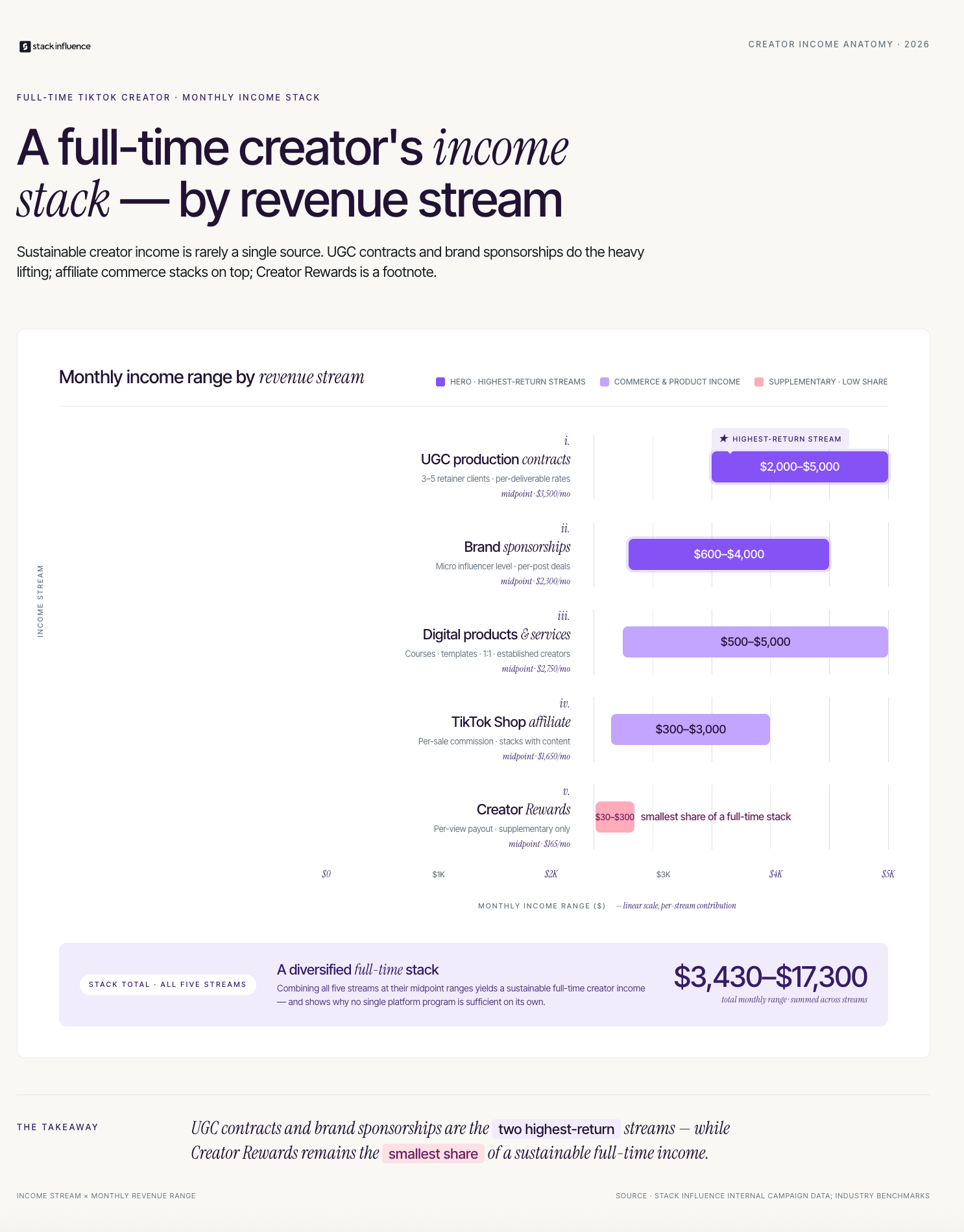
The practical income architecture for a full-time TikTok creator career:
- Brand sponsorships (flat-fee posts): $300 to $2,000 per post for micro influencers with 10,000 to 100,000 followers, depending on niche and engagement rate. Requires a media kit, a rate card, and either inbound brand interest or active outreach.
- TikTok Shop affiliate commissions: 5% to 20% per sale on products linked in videos and LIVE streams. Accessible at 1,000 followers with no follower minimum for open plan products. The fastest income path for creators with product-adjacent content.
- UGC production contracts: $150 to $500 per video deliverable for content produced for brand use in paid ads. No follower requirement. Three to five consistent brand clients can generate $2,000 to $5,000 per month from this stream alone.
- Creator Rewards Program: $0.40 to $1.00 per 1,000 qualifying views. A supplementary income stream, not a primary one. Enrolled as a baseline while other income streams carry the majority of revenue.
- Digital products and services: Courses, templates, coaching, or consulting. High-margin and scalable but requires an established audience with documented trust before it converts reliably.
Stack Influence's internal campaign data shows that [nano influencers](INTERNAL: nano influencer full-time income strategy) who activated all three of the first income streams on this list within their first six months reached a combined monthly income of $2,000 to $4,000 on average, with TikTok Shop affiliates and UGC contracts contributing more than Creator Rewards in every case. The platform-native pay is the smallest piece of a viable creator income at any realistic follower count.
What TikTok Careers Exist Behind the Camera?
The assumption that TikTok careers require a personal following overlooks a significant and growing professional sector. Every creator who runs a serious content business needs support functions that are themselves career paths. Every brand running creator campaigns needs professionals who understand the ecosystem from the inside. These behind-the-scenes TikTok careers are in many cases more financially stable and accessible than the creator path itself.
The most in-demand behind-the-camera TikTok career categories in 2026:
- Influencer marketing manager: Works within a brand or agency to source, brief, and manage creator campaigns. Requires understanding of creator rates, content brief writing, performance measurement, and platform mechanics. Mid-level salary range: $55,000 to $80,000 annually. Increasingly requires direct creator economy experience rather than just traditional marketing credentials.
- Creator talent manager: Represents individual creators or a roster, negotiating brand deals, managing campaign logistics, and advising on career development. Can operate independently (earning 10 to 20% of deals managed) or within a talent management agency. Requires strong relationship skills and deep knowledge of brand deal structures.
- UGC content strategist: Develops the content brief, product selection, and distribution strategy for brands running UGC campaigns. Bridges the gap between brand marketing objectives and creator production realities. A growing role at eCommerce brands and [influencer marketing agencies](INTERNAL: influencer marketing agency career guide) as UGC becomes a primary paid ad creative source.
- Social media content producer: Creates or coordinates TikTok content for brands that do not produce their own. May involve scripting, filming, editing, or directing creator shoots. In-house salary range: $40,000 to $65,000. Freelance rates: $50 to $150 per hour depending on experience.
- Creator economy analyst or researcher: Tracks platform trends, creator performance benchmarks, and industry data for brands, agencies, or media companies. Increasingly valued as influencer marketing moves from intuition-based to data-driven decision-making.
According to LinkedIn's emerging jobs data, influencer marketing and creator economy roles have been among the fastest-growing professional categories in marketing, with demand continuing to grow as brand investment in creator channels expands. Professionals with direct platform experience and measurable campaign results are commanding premium salaries over those with only traditional marketing backgrounds.
Measuring Your TikTok Career Progress: The Creator Business Scorecard

Most creators have no systematic way of evaluating whether their TikTok career is actually advancing or whether they are generating activity without building toward professional sustainability. The Creator Business Scorecard is a four-dimension measurement framework that tracks career progress across the variables that matter for long-term income stability.
The four dimensions of the Creator Business Scorecard:
- Income stream count: Track how many separate income streams are generating real income each month. A creator with three or more active income streams is significantly more resilient to any single stream's underperformance than one relying on a single source. The target for a full-time TikTok career is three to five active streams generating at least $500 per month each.
- Income predictability ratio: Divide your predictable monthly income (contracted brand deals, recurring UGC clients, and platform subscriptions) by your total monthly income. A ratio above 60% indicates that most of your income is predictable before the month begins, which is a financial stability signal. A ratio below 30% means your income is primarily variable and high-risk.
- Brand relationship depth: Track the number of brand relationships you have that have resulted in more than one campaign. Recurring brand relationships are significantly more valuable per hour of work than sourcing new relationships each time, because the briefing overhead, trust-building, and content revision cycles are all reduced for established relationships.
- Professional asset quality: Evaluate your media kit, rate card, and content portfolio on a quarterly basis. These are the tools brands use to evaluate you, and their quality determines both the rate you can command and the tier of brand you can access. A professional media kit with current statistics and past campaign examples is worth maintaining regardless of your current follower count.
Based on Stack Influence's work with [content creators](INTERNAL: content creator career progression guide) building professional income, creators who review their Creator Business Scorecard quarterly and address their lowest-scoring dimension as a focused improvement project increase their total annual income by an average of 30 to 45% within 12 months. The scorecard converts vague career ambition into specific actionable priorities.
What Most TikTok Career Guides Get Wrong
Most content about TikTok careers either focuses exclusively on the viral creator path, treating follower count as the primary variable, or it lists job opportunities at TikTok's corporate offices without addressing the far larger ecosystem of creator-adjacent careers available outside the company itself. Both framings miss the most important insight: a TikTok career is not a single destination. It is a collection of professional skills and relationships that can be monetized in multiple directions simultaneously.
The most financially stable TikTok professionals in 2026 often have hybrid careers that combine personal creator income with professional roles in the ecosystem. A creator who also consults for brands on their TikTok strategy has income that comes from two directions simultaneously: their own content and their advisory work. A UGC producer who also manages a small roster of other creators earns from both production and management. These hybrid models are what actually sustain TikTok careers long-term through algorithm changes and platform disruptions.
Three things most TikTok career guides leave out:
- The brand-side learning advantage: Working on the brand or agency side of influencer marketing, even temporarily, teaches creators things about how brands evaluate and compensate creators that are nearly impossible to learn from the creator side alone. Creators who understand how brand campaign budgets are structured, what makes a brief effective, and how campaign ROI is measured negotiate better deals than those who lack that context.
- [Influencer marketing platforms](INTERNAL: influencer marketing platform career guide) are themselves career accelerators: Platforms like Stack Influence do not just connect creators with brands for individual campaigns. They build campaign experience, professional reputation, and brand relationship history that compounds into higher-value opportunities over time. Treating platform participation as purely transactional misses the career development value it generates.
- Platform skills transfer across the creator economy: The content production, audience psychology, algorithmic understanding, and brand communication skills developed building a TikTok presence are directly applicable to YouTube, Instagram, brand marketing teams, and digital media companies. A TikTok career is building transferable professional capital whether or not TikTok itself remains dominant.
Across campaigns managed on the Stack Influence platform, [micro influencers](INTERNAL: micro influencer career development through brand campaigns) who complete five or more platform campaigns within their first year build a brand partnership portfolio that qualifies them for higher-value direct brand deals at a measurably faster rate than creators who approach brand relationships on an ad-hoc basis, because the documented campaign history functions as professional experience rather than just a follower metric.
Conclusion
TikTok careers in 2026 are genuine professional paths, but they reward creators who treat them as businesses rather than side projects waiting to scale. The TikTok Career Roadmap gives you the full landscape of viable paths, including both the creator monetization tracks and the behind-the-camera professional roles that most guides do not address. The Creator Business Scorecard gives you the measurement infrastructure to track whether your career is advancing in the dimensions that matter for long-term income stability. And the hybrid career model, combining personal creator income with professional ecosystem roles, gives you the structural resilience that no single income stream or follower count milestone can provide on its own.
If you are ready to build the brand partnership history that accelerates your creator career, Stack Influence connects content creators and micro influencers with eCommerce brands running product campaigns across TikTok and every major platform.