




Most eCommerce sellers look at Shopify's subscription line and assume that is the number that matters. It is not. The subscription is the entry fee, and the real cost compounds through payment processing, third-party app fees, and transaction surcharges that appear only after your first billing cycle. For sellers running Shopify influencer marketing campaigns or managing paid traffic at any meaningful volume, the gap between the listed price and the actual monthly bill can be substantial.
According to Fortune Business Insights, the global eCommerce platform market was valued at $11.55 billion in 2025 and is projected to grow from $13.92 billion in 2026 to $61.83 billion by 2034, at a CAGR of 20.49%. That growth rate reflects how central platform selection has become to competitive positioning, not just operations. Choosing the wrong tier locks in cost inefficiencies that compound with every sale you process.
According to Red Stag Fulfillment's tracking data, Shopify commands approximately 29% of the United States eCommerce software market and powers 4.8 million active storefronts globally. With that kind of adoption, the platform's fee architecture has a real financial impact across the entire DTC brands ecosystem. Understanding exactly how those fees stack is the first move any serious seller should make.
Here is what the true cost structure includes:
- Subscription fee: The published monthly rate, ranging from $5 to $2,300-plus per month depending on plan and billing cadence
- Payment processing fees: Charged per transaction through Shopify Payments, ranging from 2.5% to 2.9% plus 30 cents online
- Third-party transaction surcharge: An additional 0.5% to 2.0% layered on top if you use Stripe, PayPal, or any processor other than Shopify Payments
- App stack fees: Most mid-market DTC stores run 12 to 20 apps, with monthly totals running $200 to $800 or higher
- Theme and development costs: One-time premium theme purchases range from $200 to $400, with custom agency builds far beyond that
What Are Shopify Pricing Plans?
Shopify pricing plans are tiered subscription options that determine the base monthly cost of running a Shopify storefront, the credit card processing rates you pay per transaction, the number of staff accounts available, and the reporting features you can access. As of 2026, Shopify offers five distinct plans designed to serve sellers from social commerce beginners to enterprise operators managing complex fulfillment operations.
Shopify offers five US pricing plans in 2026: Starter at $5 per month for social selling, Basic at $39 to $49 per month for new stores, Grow at $105 to $135 per month for scaling businesses, Advanced at $399 to $525 per month for established merchants, and Plus starting from approximately $2,300 per month for enterprise operations. The range between the lowest and highest tier spans more than 450 times in base monthly cost alone. That spread makes plan selection one of the highest-leverage decisions for any eCommerce business.
Shopify pricing includes several components: subscription cost, payment fees, app fees, and transaction fees. The subscription is the smallest component for most high-volume sellers. Here is what each plan tier unlocks beyond the subscription fee:
- Starter ($5/month): A shareable checkout link only, not a full storefront; 5% transaction fees; designed for social sellers with existing audiences
- Basic ($39/month monthly, $29/month annual): Full storefront, two staff accounts, basic analytics, abandoned cart recovery, Shopify Payments at 2.9% plus 30 cents online
- Grow ($105/month monthly, $79/month annual): Professional reports, five staff accounts, Shopify Payments drops to 2.6% plus 30 cents online
- Advanced ($399/month monthly, $299/month annual): Custom reports, 15 staff accounts, third-party calculated shipping, Shopify Payments at 2.5% plus 30 cents online
- Plus (from $2,300/month on a 3-year term): Unlimited staff, 200 inventory locations, customizable checkout extensibility, negotiated payment rates, dedicated merchant success manager
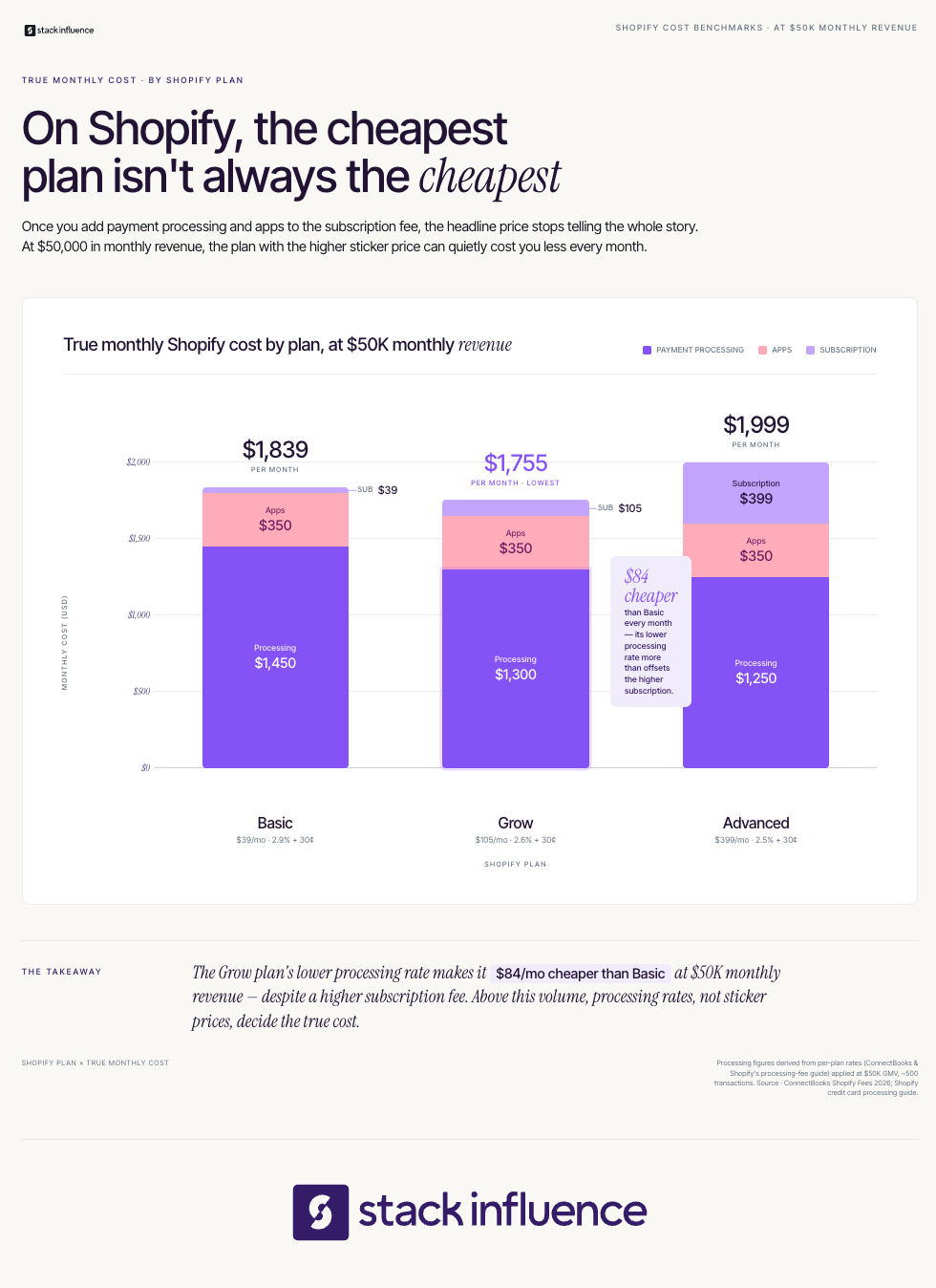
A seller on the $39/month Basic plan doing $50,000 in monthly revenue actually pays Shopify closer to $1,500 once payment processing and apps are counted , according to a ConnectBooks fee breakdown. That figure represents roughly 3% of revenue, which is not trivial for sellers operating on DTC margins that are already under pressure from rising customer acquisition costs.
The Plan-to-Fee Fit Checklist
The Plan-to-Fee Fit Checklist is a six-item audit framework designed to help eCommerce sellers determine whether their current Shopify plan aligns with their actual revenue stage and operational needs. Run this checklist before your next billing renewal or any time your monthly GMV crosses a major threshold. The checklist identifies mismatches between subscription cost and processing savings, which is where most sellers leave money on the table.
Per Shopify's own credit card processing guide, in-person payments on the Basic plan are charged at 2.6% plus 10 cents; Grow charges 2.5% plus 10 cents; and Advanced charges 2.4% plus 10 cents, while online transactions range from 2.5% to 2.9% plus 30 cents depending on plan level. Those fractions of a percent represent real dollars at scale, and the Plan-to-Fee Fit Checklist makes the math tangible. Apply each item honestly against your last 30 days of revenue data.
Here are the six audit items in the Plan-to-Fee Fit Checklist:
- Monthly GMV check: Calculate your last 30 days of gross merchandise value. Below $10,000 generally keeps you in Basic. Between $25,000 and $50,000 starts justifying the Grow plan based on processing rate savings alone.
- Payment processor audit: Confirm whether you are using Shopify Payments or a third-party processor. Using Stripe or PayPal on Basic adds a 2% surcharge on every sale, which can cost more than upgrading plans.
- App stack inventory: List every installed app and its monthly cost. If total app fees exceed $800 per month, audit for overlap before upgrading your plan tier.
- Reporting needs assessment: Determine whether your current plan's analytics satisfy your decision-making needs. Custom and advanced reports are locked to the Advanced plan and above.
- Staff account count: If you have hired contractors, customer service reps, or warehouse staff who need Shopify access, confirm whether your current plan's staff account limit covers them without additional workarounds.
- Annual billing evaluation: Check whether you can commit to a full year. You can save 25% by paying for your Shopify subscription annually instead of monthly. For sellers with stable revenue, the annual billing discount is one of the simplest ways to reduce total platform cost.
Across campaigns managed on the Stack Influence platform, brands using Shopify as their primary DTC channel consistently find that the processing rate gap between Basic and Grow pays for the plan upgrade at around $28,000 to $32,000 in monthly revenue, which aligns closely with the breakeven thresholds that independent cost analyses have confirmed. Running the Plan-to-Fee Fit Checklist at least quarterly prevents sellers from sitting on the wrong plan during high-revenue months.
The Seller Stage Model: Matching Plans to Revenue Thresholds
The Seller Stage Model is a tiered framework that maps Shopify plan selection directly to three distinct seller revenue stages. Rather than choosing a plan based on features alone, this model anchors the decision to the revenue range where each plan generates positive financial leverage versus the alternative. The Seller Stage Model works alongside the Plan-to-Fee Fit Checklist: the checklist tells you whether your current plan fits, and the model tells you which plan to target next.
Many Amazon sellers and Amazon FBA operators launching Shopify DTC channels struggle with this decision because they anchor to the subscription price rather than the total effective rate. The Seller Stage Model eliminates that error by framing the choice as a processing economics question rather than a features question.
Here are the three tiers of the Seller Stage Model:
- Stage 1: Launch (under $25,000/month GMV) Best plan: Basic ($29/month annual). At this revenue level, the lower processing rate on Grow does not generate enough savings to offset the higher subscription. Focus on validating product-market fit and keeping overhead lean. Use Shopify Payments to avoid the 2% third-party transaction surcharge.
- Stage 2: Scale ($25,000 to $150,000/month GMV) Best plan: Grow ($79/month annual). The processing rate drop from 2.9% to 2.6% online and the addition of professional reports deliver meaningful value in this range. Sellers running micro influencer promotions and driving external traffic to their Shopify storefront will see ROI on the upgrade through improved attribution reporting.
- Stage 3: Optimize ($150,000-plus/month GMV) Best plan: Advanced ($299/month annual) or Plus (from $2,300/month). The Advanced plan's third-party calculated shipping and custom reports provide competitive advantage at this volume. Advanced is best for stores doing $50,000-plus per month where lower processing rates offset the higher subscription cost. Plus becomes financially rational when checkout customization, B2B functionality, or multi-store operations create value that outweighs the base fee.
The economics of DTC have fundamentally shifted, with customer acquisition costs rising 222% over the past eight years, including 40% to 60% increases between 2023 and 2025 alone. As a result, keeping platform costs as lean as possible at each stage of growth is no longer optional; it is a margin requirement. The Seller Stage Model gives sellers a revenue-anchored framework for making that call without guessing.
What Most Guides Get Wrong About Shopify Costs

Most Shopify pricing guides focus entirely on the subscription tiers and treat the fee structure as a secondary footnote. That framing misleads sellers into thinking the plan selection decision is primarily about features. It is not. The dominant cost variable for any store above $20,000 in monthly revenue is payment processing fees, not the subscription line.
If you use Stripe, PayPal, Amazon Pay, or any non-Shopify payment processor, Shopify charges a surcharge on top of whatever that processor charges: 2% on Basic, 1% on Grow, and 0.5% on Advanced. A seller doing $100,000 per month on Basic with a third-party processor is paying $2,000 per month in surcharges before a single app fee is counted. Upgrading to Advanced at $299 per month would cut that surcharge to $500, a net saving of over $1,200 per month. The plan cost conversation is really a processing rate conversation.
The majority of online stores in the US are powered by Shopify and Wix , according to SellersCommerce's 2026 eCommerce data, with Shopify alone powering 29% of stores. That market dominance means platform switching costs are high, which makes optimizing within the Shopify ecosystem a more practical priority than evaluating alternatives for most established sellers. Most guides bury this insight, if they include it at all.
Stack Influence's internal campaign data shows that eCommerce brands running product seeding campaigns to drive external Shopify traffic tend to underestimate their effective platform cost by 40% to 60% because they calculate fees only on their existing revenue baseline, not on the incremental volume that influencer-driven traffic adds. That gap matters most during campaign scaling periods when transaction volume spikes but plan tier has not been reviewed.
The actionable correction is straightforward. Before launching any significant external traffic campaign, whether through influencer seeding, paid social, or the Amazon Influencer Program, run a forward-looking fee simulation at your projected post-campaign revenue. If the simulation shows you crossing a plan breakeven threshold, upgrade proactively rather than reactively.
Here is what most guides skip entirely in their Shopify pricing coverage:
- Gift card and store credit fees: For Shopify stores created on or after May 12, 2025, orders that include store credit or gift cards as a payment method are charged third-party transaction fees on the amount paid using store credit or gift cards. This is a new fee category that many sellers have not accounted for.
- International card surcharges: Cross-border card transactions add an extra 1% on top of standard processing rates, which matters for any brand selling internationally.
- App redundancy cost: The typical ecommerce store runs 12 to 20 apps. Many of those apps overlap in functionality, and unused or redundant apps are one of the most common sources of avoidable monthly spend.
- Theme upgrade timing: Premium themes range from $200 to $400 as a one-time purchase, but agency-built custom themes can exceed $12,500. Timing this investment to align with a plan upgrade avoids double budget pressure.
How to Measure the True ROI of Your Shopify Plan
Understanding what your plan costs is half the equation. Understanding what it returns is the other half. The Platform ROI Stack is a named four-component measurement model designed to help eCommerce sellers evaluate whether their current plan is generating positive financial leverage relative to its all-in cost.
The Platform ROI Stack consists of four labeled components that work together to give a complete picture of plan-level return:
- Net Revenue Per Transaction (NRPT): Revenue minus payment processing fees minus per-transaction surcharges. This is the true per-order yield after platform extraction, and it is the number that changes most dramatically when you upgrade plans.
- Plan Breakeven Volume (PBV): The monthly GMV at which the processing rate savings from upgrading plans exactly equal the subscription cost increase. Calculating PBV gives you a precise trigger point for when to upgrade.
- App Stack Efficiency Rate (ASER): Total monthly app revenue contribution divided by total app spend. Apps should pay for themselves. Any app with an ASER below 3x should be reviewed for removal or replacement.
- External Traffic Attribution Credit (ETAC): For Amazon sellers and multi-channel brands, this component accounts for revenue that platforms like Amazon attribute back to you through programs like Amazon Attribution and the Amazon Brand Referral Bonus.
Amazon's Brand Referral Bonus gives enrolled sellers an average 10% bonus on the sales price of products sold through off-Amazon marketing efforts , according to Advertise Purple's Brand Referral Bonus guide. For sellers running a hybrid Shopify-plus-Amazon strategy, this 10% credit directly reduces effective referral fees on Amazon-attributed sales and should be factored into ETAC calculations as an offset against Shopify traffic acquisition costs.
Amazon extends the same Brand Referral Bonus to customer purchases of additional products from your brand for up to 14 days after the initial referral. That 14-day lookback window means a single influencer-driven click can generate multiple attributed sales, making the Amazon Attribution tag one of the highest-value free tools available to multi-channel eCommerce sellers. Integrating this data into the Platform ROI Stack gives you a fuller picture of external traffic value than Shopify's native analytics provide alone.
DTC Pages' 2026 conversion benchmark study found that top-performing Shopify stores in the 75th percentile convert at 4.40% or higher, while the median range across all stores sits between 1.4% and 2.5%. That conversion spread matters directly to the Platform ROI Stack: a store converting at 4.40% generates roughly three times the NRPT yield from the same ad spend as a store converting at 1.4%, which means higher-converting stores can absorb more plan cost and still maintain positive platform ROI.
Based on Stack Influence's work with eCommerce brands running influencer-to-Shopify traffic strategies, brands that track NRPT and PBV as primary platform KPIs make plan upgrade decisions two to three months faster than brands that rely on subscription cost alone as their decision metric. The Platform ROI Stack removes ambiguity from what is otherwise a gut-feel decision for most sellers. Pairing this model with the user-generated content that micro influencer campaigns produce gives brands both the traffic velocity and the on-site trust signals that improve conversion rates and justify plan upgrades.
For sellers also running an Amazon storefront in parallel with their Shopify channel, the ETAC component of the Platform ROI Stack creates a single measurement layer that bridges both revenue streams. Tracking Amazon Attribution alongside Shopify analytics lets you evaluate which traffic sources generate the highest NRPT across both platforms simultaneously.
Conclusion
Shopify pricing plans are not a static cost to be accepted at face value. They are a dynamic financial variable that shifts with every dollar of revenue growth, every new app you install, and every traffic campaign you launch. The sellers who manage their plan tier actively, using frameworks like the Plan-to-Fee Fit Checklist and the Seller Stage Model, consistently operate at lower effective rates than sellers who set their plan at launch and never revisit it.
The Platform ROI Stack gives you four labeled metrics to track that question honestly: NRPT, PBV, ASER, and ETAC. When those numbers are clear, plan selection decisions become data-driven instead of instinct-driven. Whether you are a solo DTC seller on Basic or a multi-channel brand splitting volume between a Shopify storefront and Amazon FBA, the principle is the same: platform cost is manageable when it is measured.
Run the Plan-to-Fee Fit Checklist today against your last 30 days of revenue data. If you are crossing a breakeven threshold on processing fees, an upgrade will pay for itself within the month.