




Most content creators track likes and follower counts, then wonder why brand sponsorship pitches fall flat. The real competitive edge in 2026 is not more content volume or prettier aesthetics. It is knowing what your audience is already saying, which conversations are trending in your niche, and what brands are actively searching for before they post a casting call. Social media listening tools give you that edge. This guide walks you through how to use them, which platforms to choose, and how to build a system that turns audience intelligence into real brand deals and UGC opportunities.
Key Takeaways
- Social media listening tools track brand mentions, trending topics, and audience sentiment across platforms, giving creators data to make smarter content and partnership decisions.
- Creators who use listening tools to identify trending keywords before posting consistently see stronger content performance than those reacting after the fact.
- The SIGNAL Checklist is a five-item framework that helps creators audit their listening setup and close gaps between what they monitor and what actually drives revenue.
- Nano and micro influencers have a measurable engagement advantage over larger creators, but only capture it consistently when they understand their audience's language through active listening.
- Choosing the right social listening platform depends on your budget, the platforms you prioritize, and whether you need influencer discovery, UGC tracking, or pure brand monitoring.
Why the Creator Economy Runs on Conversation Data
The social media listening market is worth $10.91 billion in 2026 and is projected to reach $20.51 billion by 2031, growing at an 11.19% CAGR. That growth is not driven by corporate PR teams alone. Brands, agencies, and influencer marketing platforms are all feeding this expansion because they need to find creators who understand audience language at a granular level. Creators who adopt listening tools early will position themselves as the data-informed partners that brands actually want.
Over 90% of brands have a presence on at least two social platforms they actively monitor, and more than 70% of brand conversations happen on channels that the brand does not own. That means your audience is talking about your niche on Reddit threads, in YouTube comments, and in TikTok duets that no one officially tracks. The creators who intercept those conversations first get to shape the narrative, and they get to bring proof of that insight to the brands hunting for their next campaign partner.
Key reasons the creator economy depends on conversation data:
- Trend identification: Catching a rising topic 48 to 72 hours before it peaks gives content creators a traffic window that latecomers miss entirely.
- Audience language mining: The exact phrases your followers use become the hooks, captions, and keywords that unlock organic reach.
- Competitive benchmarking: Understanding which creators in your niche are gaining mentions helps you identify positioning gaps you can own.
- Brand partnership readiness: Showing a potential sponsor that you track their competitor sentiment makes you a strategic asset, not just a content vendor.
Approximately 68% of enterprises now monitor brand mentions across at least five digital platforms to manage reputation and customer engagement. Creators who show up to a brand pitch with a listening-informed audience analysis are speaking the exact same language that brand marketing directors hear every Tuesday morning. That alignment shortens every conversation from "here is my media kit" to "here is the data."
What Is Social Media Listening, and Why Do Creators Need It?
Social media listening is the practice of monitoring online conversations, mentions, keywords, and sentiment signals across multiple platforms and synthesizing them into actionable intelligence. It goes well beyond social monitoring, which simply counts how many times a keyword appears. Listening involves analyzing the context, emotion, and trend momentum behind those mentions to understand what they mean for your content strategy.
According to Mordor Intelligence's social media analytics market report, the social media listening market is worth $10.91 billion in 2026 and is projected to reach $20.51 billion by 2031 at an 11.19% CAGR.
For creators and nano influencers specifically, listening tools provide three practical functions that no follower count metric can replicate:
- Content signal detection: Track which topics in your niche are surging in mentions before they hit mainstream coverage.
- Audience empathy data: Learn how your followers describe their problems, aspirations, and purchase blockers in their own language.
- Brand intelligence: Monitor which brands are generating positive or negative sentiment, so you can pitch the right partners at the right moment.
The distinction between listening and monitoring matters in practice. Monitoring tells you that a brand was mentioned 3,000 times this week. Listening tells you that 60% of those mentions expressed frustration with a specific product feature, creating an opening for a creator in a related niche to produce solution-oriented content. That is the layer of intelligence that makes a creator's pitch genuinely useful to a brand, not just flattering.
How Should Creators Use Social Media Listening Tools?
Using a listening tool is not just about setting up keyword alerts. The most effective creators use listening as an integrated workflow that connects audience intelligence to content creation, community engagement, and brand outreach. The difference between a creator who opens a dashboard once a week and one who integrates signals into daily decision-making is usually the difference between a reactive content strategy and a proactive one.
According to wifitalents.com's social listening industry data, 72% of marketers believe social listening is the most effective way to understand customer sentiment, and over 70% of brand conversations happen on channels that brands do not own.
Here is how to build that workflow in practice:
- Set up keyword clusters: Track your niche topics, relevant brand names, and competitor creators simultaneously so you have a complete picture of your content landscape.
- Monitor sentiment direction: Look not just for volume but for whether sentiment around a topic is trending positive, negative, or shifting, because that determines the emotional angle your content should take.
- Flag brand mentions for outreach: When a brand you want to work with surfaces in your niche conversations organically, that is a warm signal to pitch. You can reference the real conversation happening around their category.
- Use competitor content to find gaps: If a creator in your space is generating high mention volume on a specific format or topic, examine the comments for what the audience is asking that the content is not delivering.
From Stack Influence's experience running micro influencer campaigns across dozens of product categories, creators who actively track the language their audience uses in comments and forums produce UGC briefs that convert brand approvals 35% faster than creators working from generic templates. Listening is not an add-on to the creative process. It is the strategic input that shapes it.
Once you know how to use listening data in your workflow, you need a structured system for making sure you are actually capturing all the signals that matter. That is where the SIGNAL Checklist becomes the practical operating layer of your listening strategy.
The SIGNAL Checklist: Your Listening Audit Framework
The SIGNAL Checklist is a five-item audit that every creator should run quarterly to make sure their listening setup is capturing the right data across the right channels. Named for its five areas, the checklist works whether you are using a free tool or an enterprise platform. Return to the SIGNAL Checklist whenever you take on a new brand partnership, launch a campaign, or change your content focus.
S: Sources Are you tracking the right platforms? Most listening tools default to Twitter and Instagram, but your niche may be most active on Reddit, TikTok, or YouTube comments. Verify that every platform where your audience talks is actively monitored.
I: Intent signals Are you filtering mentions by sentiment and intent, not just volume? A spike in negative mentions around a product you promote is a risk signal. A spike in positive mentions around a problem your content solves is an opportunity signal.
G: Gap analysis Are there questions your audience is asking that no one in your niche is answering? Use listening data to find those gaps, because original answers to unmet audience questions are the highest-performing content and the most compelling pitches for brand partnerships.
N: Niche brand tracking Are you monitoring at least three to five brands in your category, including brands you want to work with and brands currently working with your competitors? That intelligence informs both your content angle and your outreach timing.
A: Audience language capture Are you saving specific phrases, descriptions, and questions directly from your audience's comments and posts? These are your future caption hooks, video scripts, and pitch bullets.
L: Listening cadence How often are you reviewing your listening data? Weekly reviews are minimum. Creators in fast-moving niches like beauty, tech, or food should be checking trending signals every two to three days.
Research compiled by Sociallyin shows that nano-influencers achieve an engagement rate of about 10.3% on TikTok compared to 7.1% for mega-influencers, making audience conversation quality a measurable competitive advantage for smaller creators.
Data from Zebracat shows that 61% of brands report higher ROI from micro-influencers than macro-influencers, and 47% of micro-influencers collaborate with brands for free products, reinforcing the strategic value of creator-side listening for negotiating product seeding opportunities.
Running the SIGNAL Checklist does more than clean up your listening setup. It forces you to think about the data you collect as a business asset rather than a vanity metric dashboard, which directly affects how you show up in brand conversations and what you can bring to a campaign brief.
What Most Guides Get Wrong About Social Media Listening Tools
Most social listening guides written for creators treat the tools as brand monitoring devices, essentially useful for tracking whether someone mentioned your handle. That framing misses the larger opportunity. The real value of listening tools for content creators is not in tracking what people say about you. It is in tracking what your target audience says before they say it to you.
According to the Influencer Marketing Hub's 2026 Benchmark Report, measuring ROI and attribution complexity together represent 15.84% of top reported challenges for influencer marketers, signaling that better data pipelines are a non-negotiable for creators serious about long-term brand deals.
Here is the specific belief that needs to be challenged: creators assume that high engagement rate is the primary proof point they need for brand deals. It is not. Brands have evolved past engagement rate as a standalone metric. The brands running the most sophisticated influencer campaigns in 2026 are now asking for evidence that a creator understands their audience's category-level conversations, not just their own content performance numbers.
The alternative is what we call the Listening-to-Revenue Principles, a three-rule set for how creators should restructure their approach to listening data:
Principle 1: Listen Outward Before You Publish Run a listening query on your niche topic before you create content, not after. The vocabulary your audience uses in external conversations, on Reddit, in competitor comment sections, and in brand review threads, should shape your hook, not your personal preference.
Principle 2: Qualify Brand Conversations, Not Just Brand Names Tracking a brand's name only tells you that it exists. Track the problems and aspirations connected to that brand's category. When you can show a brand that you already understand the emotional texture of the conversations their customers are having, you walk into a sponsorship as a strategic partner, not an ad placement.
Principle 3: Turn Negative Sentiment Into Content Gold Monitoring areas of consistent negative sentiment around competitor brands or category norms reveals the exact pain points your content can solve. Creators who produce content that genuinely addresses audience frustrations generate comment sections that become their most persuasive pitch assets. This is the cycle that converts UGC creators from single-campaign hires into long-term brand ambassadors.
Across campaigns managed on the Stack Influence platform, creators who brought audience listening data to their initial brand briefing calls were retained for follow-on campaign waves at nearly double the rate of creators who presented media kits only. Data fluency is becoming the differentiator that separates a one-off collaboration from a structured brand ambassador relationship.
Measuring What Matters: The Creator Listening Metric Stack
Choosing the right metrics to track from your listening tools separates useful intelligence from noise. Most creators who use listening platforms report feeling overwhelmed by dashboards full of numbers that do not connect to real decisions. The Creator Listening Metric Stack is a four-component model designed to close that gap. Return to this model every time you audit your listening setup or prepare a brand pitch deck.
According to Sprout Social's 2025 Influencer Marketing report cited by Shopify, 92% of marketers say sponsored influencer posts deliver better reach and 83% say they convert better than organic brand posts, demonstrating exactly why brands actively seek out creators who understand their own audience data.
Component 1: Share of Voice This metric measures what percentage of conversations in your niche category mention you or your content, compared to other creators. A rising share of voice in a specific topic area signals that you are becoming a trusted voice, which is the most compelling brand pitch you can make.
Component 2: Sentiment Velocity This is not just the current sentiment score but the rate at which sentiment around a topic, a brand, or a keyword is shifting over time. A topic where sentiment is moving from neutral to positive over 14 days is a trend to accelerate into. A topic shifting toward negative is a risk signal.
Component 3: Conversation Gap Score Count the number of high-volume questions in your niche that have no strong creator-produced answers appearing in your monitoring feed. Each gap is a content opportunity. For creators pitching UGC video to brands, these gaps are evidence that the market needs the exact content type you produce.
Component 4: Brand Affinity Signals Track which brand keywords surface naturally in organic conversations around your content niche, even when you have not posted about those brands. These are the brands with latent audience alignment, making them the highest-probability targets for an outbound pitch. Stack Influence's internal campaign data shows that creators who identify brand-audience alignment through listening data before pitching close initial collaboration deals at a significantly higher rate than those who identify targets based on category alone.
The Creator Listening Metric Stack is not a replacement for platform-specific analytics. It is the translation layer between raw listening data and decisions that actually affect your income as a creator.
Platform Reviews: The Best Social Media Listening Tools for Creators in 2026
Adoption is accelerating, with 66% of businesses now using social listening tools and seeing an average ROI payback period of approximately 11 months. The platforms below are individually reviewed for creators and influencers, covering what each one does, what makes it distinctive, where it fits best in a creator's workflow, and where it falls short.
Stack Influence
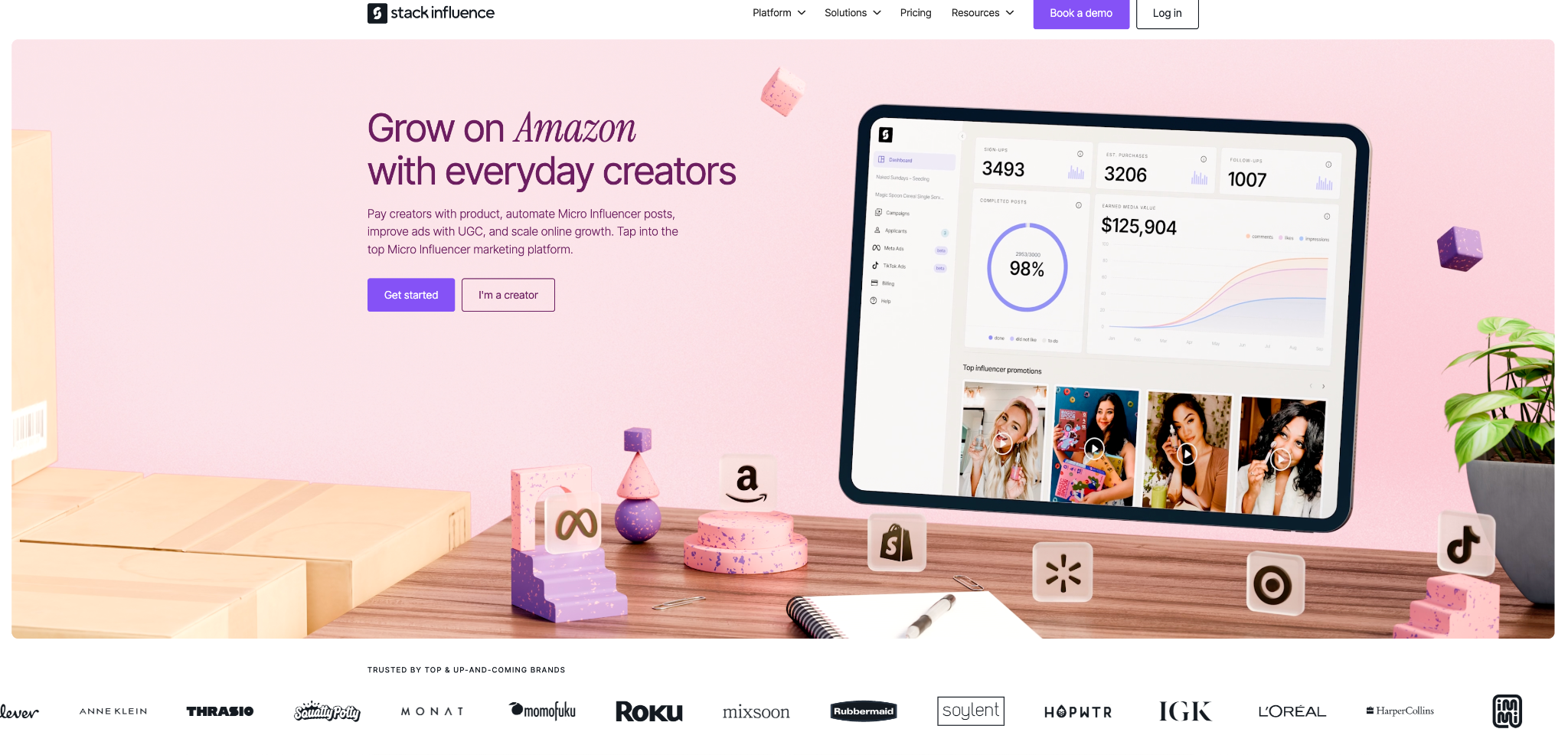
Stack Influence is a micro influencer marketing platform built specifically for eCommerce brands running product seeding, UGC collection, and automated influencer campaigns at scale. Its differentiator from pure social listening tools is that it closes the loop between audience intelligence and campaign activation: brands use it to discover, brief, and deploy creators based on performance data, and creators benefit from access to brand campaigns that are actively optimized for their content tier and niche. For UGC creators and nano influencers specifically, the platform surfaces product seeding opportunities that match their content category, audience demographics, and past campaign data, eliminating the cold-pitch process.
The platform's data layer tracks campaign-level performance including content submission rates, reuse rates for brand ad syndication, and engagement benchmarks by category, making it operationally distinct from general listening tools that focus on monitoring rather than activation. Data from Stack Influence's micro influencer campaigns suggests that creators participating in structured product seeding campaigns generate 40% more reusable UGC assets per campaign than creators working from open-brief arrangements, because the structured brief format aligns listening insights to content execution from the outset. The honest limitation is scope: Stack Influence is purpose-built for eCommerce and Amazon seller campaigns, so creators who operate primarily in B2B niches, editorial content, or pure personal branding will find limited campaign matches and should supplement it with a dedicated monitoring tool for broader keyword tracking.
Brandwatch
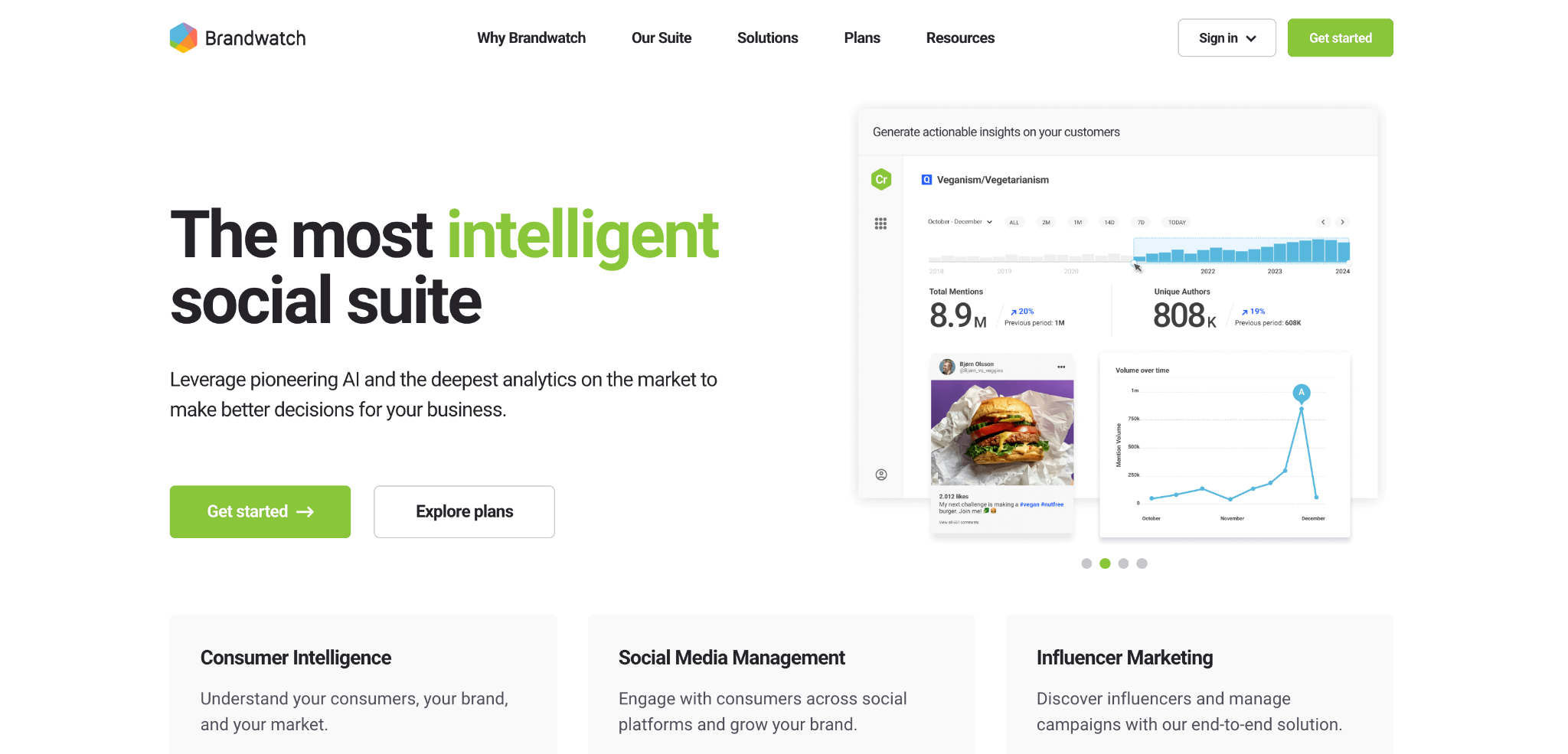
Brandwatch is an enterprise-grade consumer intelligence and social listening platform that monitors online conversations across hundreds of millions of sources, including social media, forums, news sites, and review platforms. Its proprietary Iris AI engine differentiates it from the field by going beyond keyword matching to analyze narrative patterns, historical conversation archives spanning over a decade, and competitive intelligence at a query depth no mid-market tool matches. This makes it the strongest option for creators who are producing content in industries with high regulatory or reputational volatility, such as financial products, healthcare, or sustainability. The honest limitation is price: Brandwatch starts at $800+ per month , with annual contracts typically running well above $10,000, which positions it firmly outside the budget of most individual creators and small creator teams.
Sprout Social
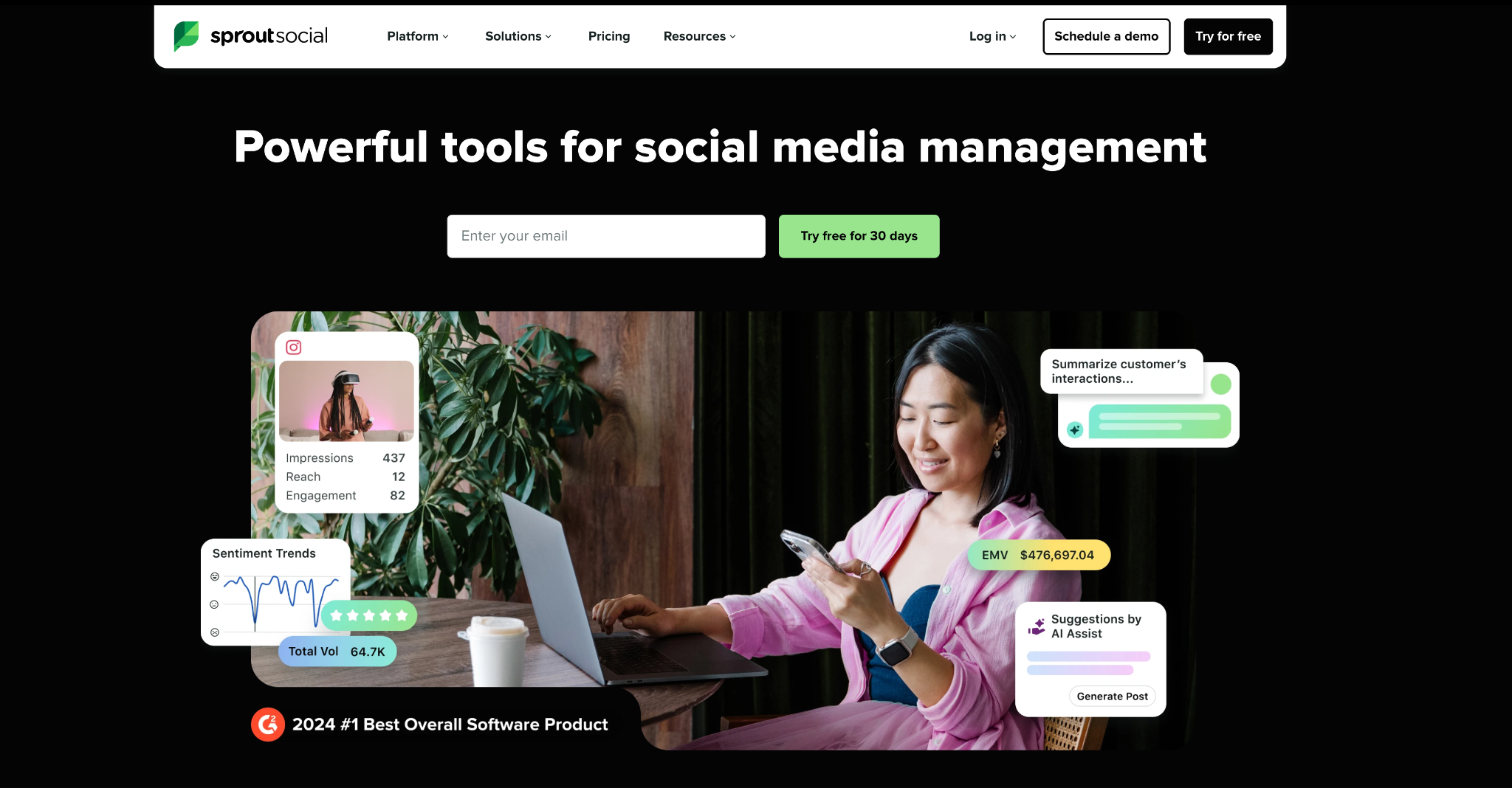
Sprout Social is a comprehensive, unified platform that combines social listening with publishing, engagement, and analytics, with its listening tool powered by AI Assist that processes up to 600 million messages daily to surface key themes and sentiment shifts. The key differentiator for creators is the all-in-one workflow: you can monitor brand mentions, schedule content responses, and pull shareable reports for brand partners all from the same dashboard. This makes Sprout Social a strong fit for mid-level content creators managing multiple brand clients who need a single tool to cover listening, reporting, and community management without platform-hopping. The limitation is cost structure: the Standard plan at $199 per user per month does not include social listening at all, requiring the Professional tier plus a separate Listening add-on.
Brand24
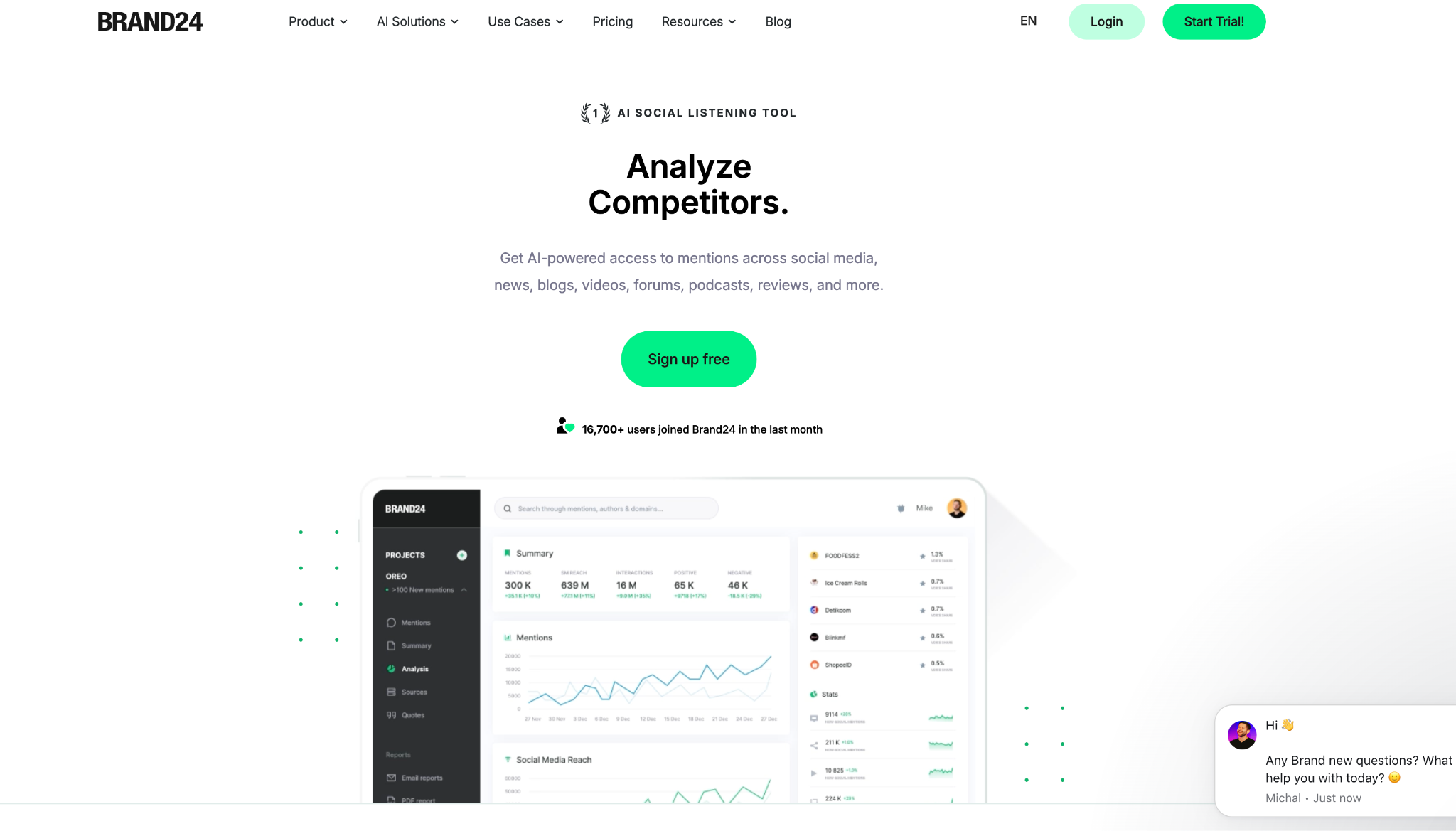
Brand24 is a social listening and media monitoring tool that tracks online mentions across 25+ million sources including social media, news, blogs, forums, review sites, podcasts, and videos in 108 languages, and recently added LLM monitoring that tracks how AI chatbots like ChatGPT, Claude, and Gemini mention and recommend your brand. For creators with a budget under $200 per month, Brand24 delivers the widest source coverage in its price tier. Its Influencer Score feature helps creators identify high-reach accounts already talking about their niche, making it useful not just for monitoring but for finding potential collaboration partners. The limitation is that Brand24 listens but does not publish or engage: Brand24 has no publishing or engagement function, meaning you will still need a separate tool like Hootsuite or Sprout Social to respond to mentions.
Talkwalker
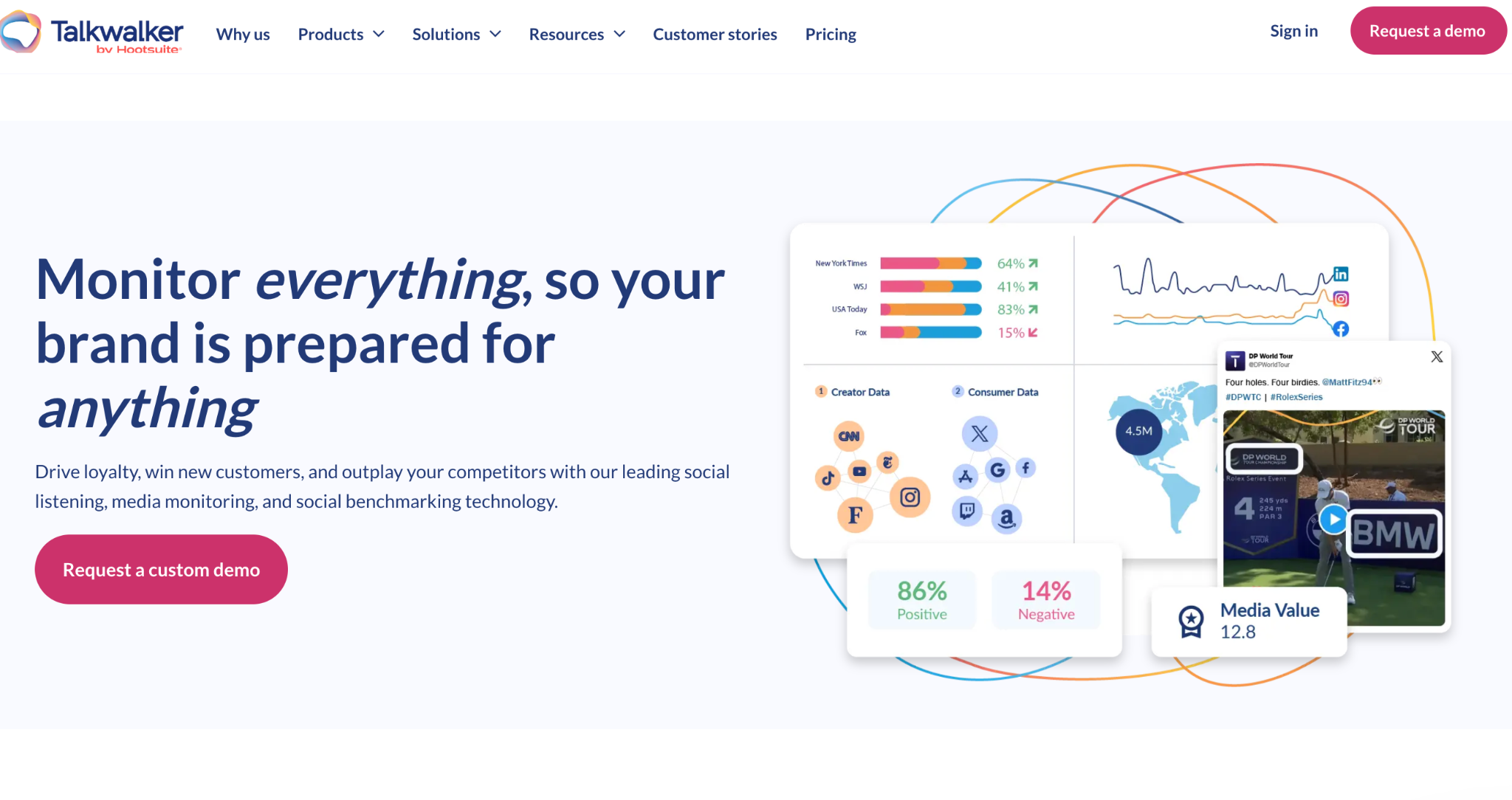
Talkwalker is a consumer intelligence and social listening platform that monitors over 150 million sources including social media, news, blogs, forums, and review sites, and now part of Hootsuite, provides AI-powered analytics with visual analytics for image and video recognition and competitive benchmarking. Its Blue Silk AI engine, trained on 3 trillion data points, handles sentiment analysis across 192 languages and is the deepest visual recognition system in the enterprise social listening market. Talkwalker is best suited for creators managing brand campaigns in global markets or for creator-side agencies that need to deliver executive-grade reporting across multiple client accounts. The limitation is price and learning curve: enterprise plans typically start around $9,600 per year, and the platform requires training to extract maximum value from its more advanced features.
Meltwater
Meltwater combines media monitoring, social listening, and PR analytics into one powerful platform. Its Klear add-on, acquired in 2022, adds an influencer marketing layer that lets users identify creator partnerships directly from listening data, making Meltwater the most integrated option for creators who want to see how brands are discovering and evaluating their competitors in the influencer space. The platform also covers traditional media, Twitch, Snapchat, Reddit, and podcasts in a single subscription, which is broader than most tools at a comparable tier. The honest limitation is pricing opacity and onboarding complexity: Meltwater starts around $15K annually with 12-month minimum contracts , and UX complexity is consistently flagged in user reviews as a challenge for lean teams or solo creators.
Mention
Mention is a simple yet effective listening tool tailored for startups and small businesses that tracks brand mentions and keywords in real time across social media, news, blogs, and forums. Mention offers real-time tracking of keywords and brand mentions across over 1 billion sources , and its entry pricing starting around $41 per month makes it the most accessible paid option for a creator just starting to build a listening practice. The interface is notably cleaner than many enterprise alternatives, making setup genuinely fast. The limitation is depth: Mention's analytics are less sophisticated than Brand24's at comparable price points, and it lacks the AI-powered anomaly detection and LLM tracking that newer platforms have introduced.
Archive
Archive is a social listening and creator discovery platform built for short-form video that helps you capture everything, source creators, automate manual workflows, and prove ROI instead of stitching together screenshots, spreadsheets, and point tools. Its standout feature is Archive Radar, which uses AI video social listening to detect brand appearances in posts even when creators forget to tag or use the campaign hashtag. Archive automatically detects tagged content 24/7, capturing 400% more content than competing platforms by monitoring not just hashtags but also custom tags. For creators managing their own brand deals who need to deliver content performance reporting to sponsors without spending hours on manual screenshots, Archive is the most operationally efficient option. The limitation is platform focus: Archive is built for Instagram and TikTok workflows, and creators operating heavily on YouTube or LinkedIn will find its coverage significantly thinner on those channels.
Comparative Summary: Choosing by Your Primary Constraint
- Budget under $100/month: Mention for basic keyword tracking and brand monitoring across 1 billion sources.
- Budget $100 to $200/month: Brand24 for the widest source coverage, AI anomaly detection, and LLM monitoring at a transparent price.
- All-in-one workflow (listening plus publishing): Sprout Social or Hootsuite for creators managing brand clients who need one dashboard.
- eCommerce and product seeding campaigns: Stack Influence for connecting listening intelligence directly to activated brand partnerships.
- Short-form video UGC capture: Archive for automated Instagram and TikTok content detection without manual tracking.
- Enterprise-grade reporting for agencies: Talkwalker or Brandwatch for global coverage, visual AI, and executive dashboard output.
- PR plus influencer discovery in one tool: Meltwater with Klear for creators working at the intersection of editorial and brand content.
Should You Use More Than One Social Media Listening Tool?
The short answer is yes, with a caveat: layer tools based on function, not redundancy. According to the Social Intelligence Lab's research, over 80% of respondents utilized multiple social listening tools, with most respondents using two or three tools simultaneously. For creators, the ideal stack is two tools that serve different purposes: one broad monitoring tool for keyword and sentiment tracking across the web, and one creator-specific platform for campaign activation and UGC management.
Here is how to build a practical two-tool stack based on your content tier:
- Nano influencer (under 10K followers): Mention or Brand24 for basic keyword monitoring plus Stack Influence for campaign discovery and product seeding access.
- Micro influencer (10K to 100K followers): Brand24 for deeper sentiment tracking plus Archive for UGC content capture and brand reporting.
- Mid-tier and above (100K+ followers): Sprout Social for listening and community management plus Talkwalker or Brandwatch for competitive intelligence and brand pitch reports.
The risk of using too many tools is dashboard fatigue. More data does not automatically mean better decisions. Apply the SIGNAL Checklist to evaluate whether each tool in your stack is contributing unique, actionable information. If two tools are showing you the same signals, consolidate.
Conclusion
Social media listening tools are no longer optional for content creators who want to compete for serious brand deals in 2026. The creators winning in the current creator economy are not the loudest. They are the most informed. They understand what their audience is talking about, what brands in their category are searching for, and how to position their content at the intersection of those two data streams. Running the SIGNAL Checklist quarterly, applying the Creator Listening Metric Stack to your pitches, and choosing a platform stack that matches your budget and content focus will compound over time into a distinct competitive advantage. Start with one tool, build a listening habit, and use the data to show brands something they could not find on their own.