




The global online jewelry market is projected to reach $85.7 billion in 2026, growing at a 13% annual rate that significantly outpaces traditional retail. For eCommerce sellers, that growth signals opportunity — but it also signals crowding. Knowing how to start selling jewelry online is not the hard part. Building a jewelry brand that generates repeat revenue, earns trust from buyers who cannot physically handle your product, and survives long enough to compound is. This guide covers the strategy most launch articles skip: how to sequence your business model choice, marketing investment, and attribution setup for sustainable growth.
Key Takeaways
- The online jewelry market is projected to reach $85.7 billion in 2026 and grow at a 13.8% CAGR through 2032, making it one of the fastest-growing eCommerce categories.
- Trust is the primary conversion lever in jewelry eCommerce — product photography, materials transparency, and social proof from UGC and micro influencers directly determine whether browsers become buyers.
- Amazon led with approximately 42% of US online jewelry sales in 2023, making it an essential channel for new sellers, especially when combined with a DTC store for brand building.
- The Jewelry Revenue Tiers framework maps your marketing investment to your revenue stage, preventing the most expensive mistake new jewelry sellers make: scaling paid ads before trust infrastructure is built.
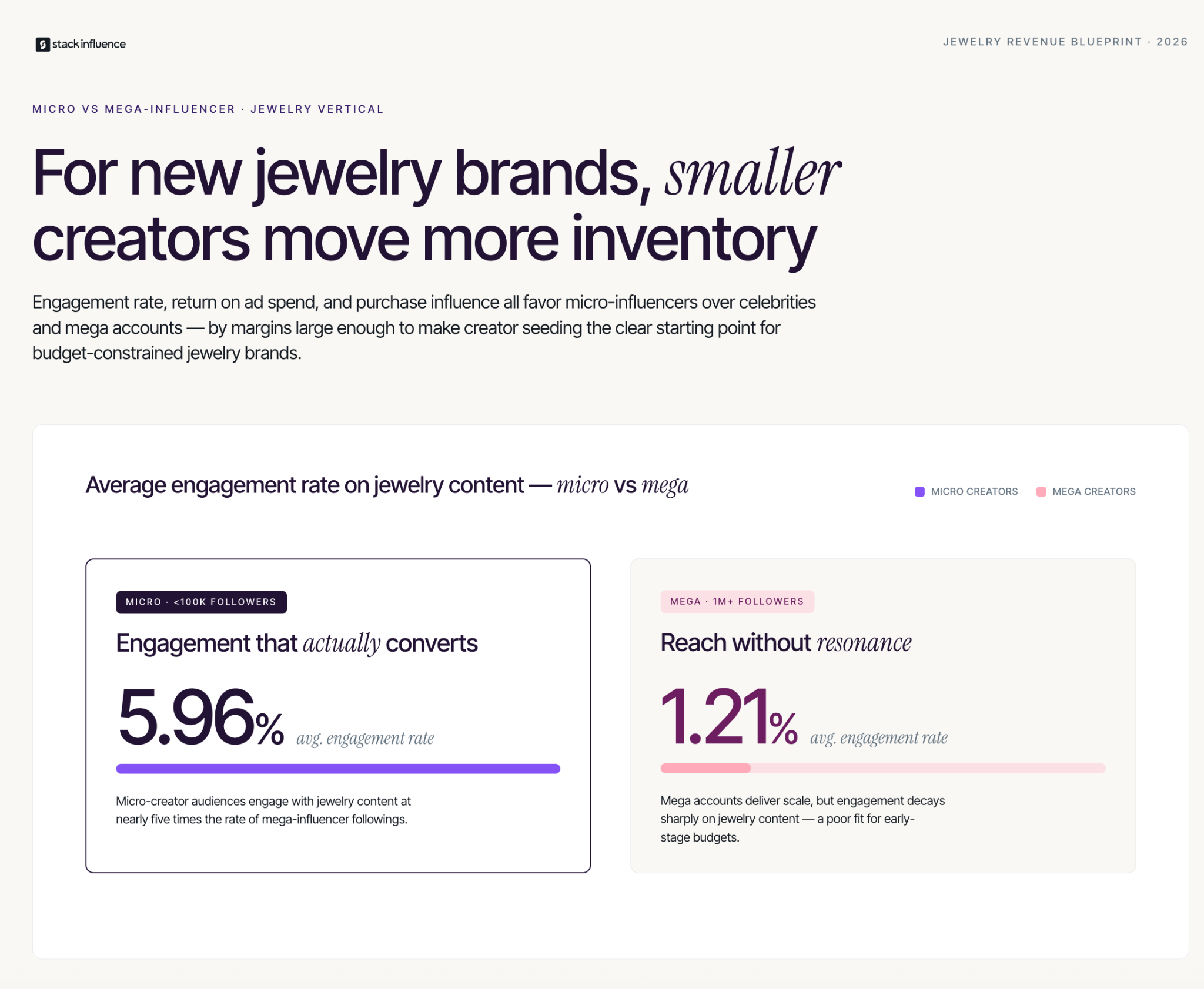
- Micro influencers in the jewelry niche deliver a 5.96% average engagement rate versus 1.21% for mega-influencers, making creator seeding the highest-ROI first marketing investment for new jewelry brands.
The 2026 Online Jewelry Market: What New Sellers Are Actually Entering

The narrative that jewelry is too high-stakes for online purchase has been definitively disproven. In 2025, online jewelry penetration reached approximately 25% of total global jewelry sales, a significant leap from pre-pandemic levels, with the global online jewelry market projected to be worth $85.7 billion in 2026 and growing at a CAGR of 13%. That growth is structural, not cyclical — it is driven by AR try-on technology, better product visualization, and younger buyers who default to digital for every purchase category.
Lab-grown diamonds now account for over 45% of US engagement ring sales, and personalized jewelry is one of the fastest-growing subcategories as consumers seek custom engraving, birthstone integrations, and modular designs. For new sellers, both of these trends represent accessible entry points that do not require competing on price with established fine jewelry retailers.
The competitive landscape for new jewelry sellers is shaped by three distinct buyer behaviors. First, lower price-point fashion jewelry buyers decide quickly and are highly influenced by visual social content. Second, mid-range gift buyers spend $100 to $400 and rely heavily on reviews, UGC, and social proof before purchasing. Third, fine jewelry buyers at $500 and above require extensive trust signals including materials certification, return policies, and brand narrative. Your niche selection determines which buyer you are designing your entire store experience for.
What Is an Online Jewelry Business? Models, Margins, and the Right Starting Point
An online jewelry business is a direct-to-consumer or marketplace-based eCommerce operation that sells jewelry through digital channels — either through your own storefront, third-party marketplaces like Amazon or Etsy, or both simultaneously. The business model you choose determines your inventory risk, margin structure, and how much creative control you have over your product.
The four primary models for new jewelry sellers are:
- Handmade / artisan. You design and produce each piece yourself. Highest brand differentiation and storytelling potential, but limited scale and production bottleneck as demand grows. Best for sellers entering with a unique creative perspective and small initial catalog.
- Dropshipping. Jewelry dropshipping lets you operate an online jewelry store without holding inventory — you curate products from suppliers and pay only after your jewelry sells, making it a cash-flow-positive model. Margins are thinner (typically 20 to 30%) and differentiation is harder because competitors may list identical items.
- Private label / wholesale. You source finished jewelry or work with a manufacturer to produce pieces under your brand. Better margins (40 to 60%), stronger brand equity, and much better UGC potential because the product is unique and photographable.
- Print-on-demand custom jewelry. Platforms print custom text or designs on jewelry pieces per order. Low upfront cost and good for personalization-focused brands, though production quality varies by supplier.
For sellers who intend to build a sustainable brand and use influencer marketing and UGC as their primary traffic strategy, private label or artisan models are the strongest starting point. Dropshipping can generate early revenue, but the identical-product problem makes it difficult to build the kind of authentic creator content that drives social proof for jewelry buyers.
The Jewelry Revenue Tiers Framework
The Jewelry Revenue Tiers is a four-level progression model that maps your marketing investment to your current business stage. The framework prevents the most common and costly mistake new jewelry sellers make: spending on traffic before their store has the trust infrastructure to convert it. Reference the Jewelry Revenue Tiers whenever you are deciding where to invest your next marketing dollar.
The four tiers:
- Tier 1: Trust Foundation (pre-launch to first 10 sales). Build your product photography, size and materials specifications, return policy, and social proof infrastructure before spending on traffic. A jewelry store without close-up photography, materials transparency, and at least a handful of reviews will not convert paid traffic regardless of how well-targeted it is.
- Tier 2: Creator Proof ($0 to $5K monthly revenue). Seed your product to 10 to 20 niche micro influencers in exchange for UGC content and honest reviews. Use this content on your product pages and in early social campaigns. The Jewelry Revenue Tiers framework positions this stage as the highest-leverage activity because jewelry UGC from real wearers addresses the core objection — "how does it actually look on a person?" — that every browser has.
- Tier 3: Channel Expansion ($5K to $20K monthly revenue). With conversion rate above 2% and at least 20 reviews, add Amazon as a sales channel and set up Amazon Attribution before launching any external traffic campaigns. Activate the Amazon Brand Referral Bonus to earn back an average 10% credit on sales driven from your creator content and social campaigns.
- Tier 4: Compounding Scale (above $20K monthly revenue). Systematize your creator program into a recurring ambassador structure, repurpose high-performing UGC into paid social and Amazon Sponsored Brand video ads, and invest in content SEO. At Tier 4, your brand asset — built in Tiers 1 through 3 — begins to compound organically.
Return to the Jewelry Revenue Tiers any time you feel stuck or tempted to skip ahead. Most growth plateaus in jewelry eCommerce trace back to a seller who moved from Tier 1 to Tier 3 without completing Tier 2.
Why Paid Ads Are the Wrong First Investment for Most Jewelry Sellers
This is the contrarian take that platform-sponsored guides will never tell you: for a new jewelry brand with under $5,000 in monthly revenue and no UGC, paid advertising is an expensive way to validate that your store does not yet convert. The jewelry category has a specific trust barrier that paid traffic cannot overcome on its own.
The 2026 Influencer Marketing Hub data shows that micro-influencers in the jewelry niche deliver a 5.96% average engagement rate, versus 1.21% for accounts with over one million followers. The return on ad spend was 3.1x higher for micro-tier creators. That data tells you something specific about how jewelry buyers make decisions: they are looking for social validation from people who look like them, wearing the piece in a real context, not a studio shot.
Consumer-generated content influences the purchasing decisions of 79% of jewelry buyers, compared to just 8% who respond primarily to celebrity influencer content. For a jewelry brand with a limited marketing budget, this means your first investment should go toward product seeding and UGC collection, not Meta or Google ads. The UGC you collect becomes your ad creative anyway — and it performs better than anything you could produce in a studio.
From Stack Influence's experience running product seeding campaigns for jewelry and accessories brands, sellers who launch with at least 15 pieces of creator-generated content across their product pages see conversion rates roughly double compared to comparable stores launching with brand-produced photography alone. The wearability signal from UGC is the closest substitute for the in-store try-on experience that jewelry buyers instinctively want.
Turning Jewelry Creator Seeding into Ongoing UGC Without a Full-Time Manager
Jewelry product seeding is one of the most effective but operationally complex early-stage marketing tactics. Managing outreach, shipping, follow-up, and content rights across 20 to 50 creators simultaneously is a significant lift for a one or two-person team. The operational complexity is why most jewelry brands either skip this stage entirely or run one campaign and stop.
Platforms like Stack Influence coordinate product seeding at scale by handling creator sourcing, product shipping, and deliverable tracking in one automated workflow. For a jewelry brand in the Jewelry Revenue Tiers Tier 2 stage, this removes the bottleneck that prevents consistent UGC collection. The platform model also ensures that usage rights are included in the deliverable agreement, which matters for jewelry brands that want to repurpose creator content in ads, Amazon listings, and email.
Stack Influence has observed that jewelry brands using standardized seeding workflows — with a clear shot list that specifies close-up detail shots, wrist or neck wear shots, and lifestyle context shots — receive higher-quality UGC on the first submission than brands that leave creative direction open. The shot list requirement aligns creator output with the specific visual needs of jewelry product pages without restricting the authentic styling that makes creator content convert.
How Do You Measure What Is Actually Working for a Jewelry Store?
Measurement for a jewelry eCommerce business requires a tiered approach that separates trust-building metrics from traffic metrics from revenue metrics. Use the Jewelry Metric Stack to evaluate your store's health across all three layers simultaneously.
The three layers of the Jewelry Metric Stack:
- Layer 1: Trust metrics. Track UGC-to-listing coverage (what percentage of product pages have creator content), review count per SKU, and return rate. These tell you whether your store's trust infrastructure is working. A return rate above 12% on fashion jewelry typically signals a product description or photography problem.
- Layer 2: Traffic and conversion metrics. Track conversion rate by source, add-to-cart rate, and time on product page. For jewelry, time on product page is an underused signal — buyers who are genuinely considering a piece spend significantly longer than average session duration. If time on page is high but conversion is low, the trust gap is in your social proof or return policy, not your traffic source.
- Layer 3: Revenue attribution metrics. For any external traffic campaign — creator content, email, or paid social — use Amazon Attribution tags to track which campaigns actually convert to Amazon purchases. The Amazon Brand Referral Bonus credits back an average 10% of your referral fee on sales from external traffic, which directly offsets your creator seeding costs when you have Attribution set up correctly.
Across campaigns managed on the Stack Influence platform, jewelry brands that track UGC performance at the individual creator level — capturing which creators produce content that drives the highest add-to-cart rates — consistently reallocate their next seeding batch toward creators with proven conversion patterns rather than selecting purely on follower count or aesthetic. That feedback loop, tracked through the Jewelry Metric Stack, is what separates brands that build compounding creator programs from those that run isolated seeding campaigns without follow-through.
Conclusion
Knowing how to start selling jewelry online in 2026 is easier than it has ever been — the platforms are accessible, the business models are documented, and the creator infrastructure to drive traffic exists at every budget level. The sellers who build sustainable jewelry businesses are the ones who sequence the Jewelry Revenue Tiers correctly: establish trust infrastructure before spending on traffic, build UGC before running paid ads, and set up Amazon Attribution before launching external campaigns. Work through each tier deliberately, measure with the Jewelry Metric Stack, and treat your first creator partnerships as the foundation of your brand's social proof. When you are ready to build the product seeding program that anchors this strategy, Stack Influence automates the creator logistics so your team can focus on product and brand rather than campaign management.