



Selling on a marketplace and running an owned store are not the same growth play. One gives you borrowed demand, faster validation, and tighter platform rules. The other gives you more control, more data, and more responsibility.
That is why Shopify vs Etsy is not really a beginner question. It is a margin, traffic, and asset-building decision for eCommerce sellers. This guide shows how to choose the right first channel, when to run both, and how DTC brands and Amazon sellers can measure what actually drives profit.
Key Takeaways
- Etsy is usually the faster way to test product demand, but Shopify is usually the better way to compound margin, customer data, and brand assets.
- The right choice depends less on setup speed and more on six factors: demand source, category fit, margin structure, customer capture, content reuse, and scale path.
- Many sellers should not think in either-or terms. A hybrid channel stack can use Etsy for discovery and Shopify for repeat purchase, bundles, retention, and DTC growth.
- If you also sell through Amazon, measure creator and social traffic with channel-specific links, Amazon Attribution, and contribution margin instead of revenue alone.
Why Does Shopify vs Etsy Come Down to Margin and Ownership?
Most comparisons frame Shopify and Etsy as a simple platform choice. The more useful framing is economic. Etsy helps you access built-in marketplace demand, while Shopify asks you to create demand around a store you control.
That matters because channel cost behaves differently over time. Etsy's fee policy layers listing, transaction, processing, and sometimes Offsite Ads fees onto orders, while Shopify's pricing starts with a fixed software cost plus payment fees that decline by plan tier.
Before you pick a channel, pressure-test these four realities:
- Speed To First Sale: Etsy can shorten the path to first orders because shoppers are already browsing with purchase intent.
- Variable Fee Drag: Etsy can feel cheaper at launch, but variable fees can keep taking a larger bite as orders rise.
- Owned Customer Relationship: Shopify makes it easier to build first-party data, repeat purchase flows, and merchandising control around your own store.
- Traffic Responsibility: Shopify only compounds when you can drive traffic through SEO, email, creators, paid media, partnerships, or repeat buyers.
For a representative $40 order in the United States, Etsy's core fee stack is already material before ads are added. You pay the $0.20 listing fee, a 6.5% transaction fee, and a 3% plus $0.25 processing fee. On the same order, Shopify's Basic plan still carries a fixed subscription, but the variable payment cost is lower when you use Shopify Payments on Basic.
That simple math changes the question from "Which one is cheaper?" to "At what order volume do I want fixed cost instead of variable fee drag?" It also explains why sellers who care about bundles, subscriptions, merchandising, and retention often move toward owned-store economics even if they begin on a marketplace.
What Is the Real Difference Between Shopify and Etsy?
Shopify is commerce infrastructure. Etsy is a marketplace with rules, shared demand, and category-specific buyer intent. When sellers confuse those roles, they usually end up optimizing for the wrong outcome.
Etsy's seller page says the marketplace is built for items that are made, designed, handpicked, or sourced by a seller. Etsy also reported 86.5 million active buyers and 5.6 million active sellers in its fourth quarter 2025 results. Shopify, by contrast, positions itself as a store platform and multichannel operating system for merchants that want their own storefront and operating layer.
Use this distinction to simplify the decision:
- Choose Etsy First: If your products fit handmade, custom, vintage, or craft-supply demand and you need validation quickly.
- Choose Shopify First: If you are building a DTC brand with repeat purchase potential, broader category freedom, or merchandising needs that go beyond a marketplace listing.
- Use Both: If Etsy can validate demand while Shopify becomes your owned destination for retention and higher-margin orders.
- Add Amazon Intentionally: If Amazon FBA or an Amazon storefront already matters to your business, treat Shopify as the DTC hub and Etsy as a selective acquisition channel, not as your only growth engine.
The fee structure reinforces the role difference. Etsy publicly lists a $0.20 listing fee, a 6.5% transaction fee, and US payment processing of 3% plus $0.25, with Offsite Ads fees that can run 12% or 15% on attributed orders. Shopify's published entry plan starts at $29 a month when billed yearly, with 2.9% plus $0.30 online card rates on Basic.
A useful break-even shortcut comes from comparing variable fees only. On that same $40 US order, Shopify's payment cost is about $1.46, while Etsy's core fees total about $4.25 before Offsite Ads. At roughly 11 such orders a month, the yearly billed Basic subscription is effectively covered by the variable-fee gap alone, although apps, shipping, and category realities can still change the answer.
The Channel Fit Checklist for Shopify vs Etsy
Most sellers answer Shopify vs Etsy too early. They compare setup screens, not business models. The Channel Fit Checklist is a better way to decide because it forces you to score the channel against how your business will actually grow.
Run every option through the Channel Fit Checklist before you move inventory, creative budget, or time. A channel can win on convenience and still lose on contribution margin, customer capture, or long-term reuse of the content and data you pay to create.
Score each item from 1 to 5, then compare your totals for Shopify, Etsy, or a hybrid setup:
- Demand Source: Are you relying on marketplace discovery, or do you already have traffic from search, email, paid social, affiliates, or creators?
- Category Fit: Does your product match Etsy's strongest intent patterns, or does it need the flexibility of an owned store and a broader conversion funnel?
- Margin Structure: Can your gross margin absorb marketplace fees, optional ads, and creator costs without turning growth into break-even revenue?
- Customer Capture: Do you need email, SMS, subscriptions, bundles, post-purchase upsells, and first-party data to make the business work?
- Content Reuse: Will product photos, testimonials, creator videos, and social proof increase conversion enough to justify systematic content collection?
- Scale Path: Will this channel still make sense when you add SKUs, open Amazon, test paid traffic, or hire a team that needs repeatable workflows?
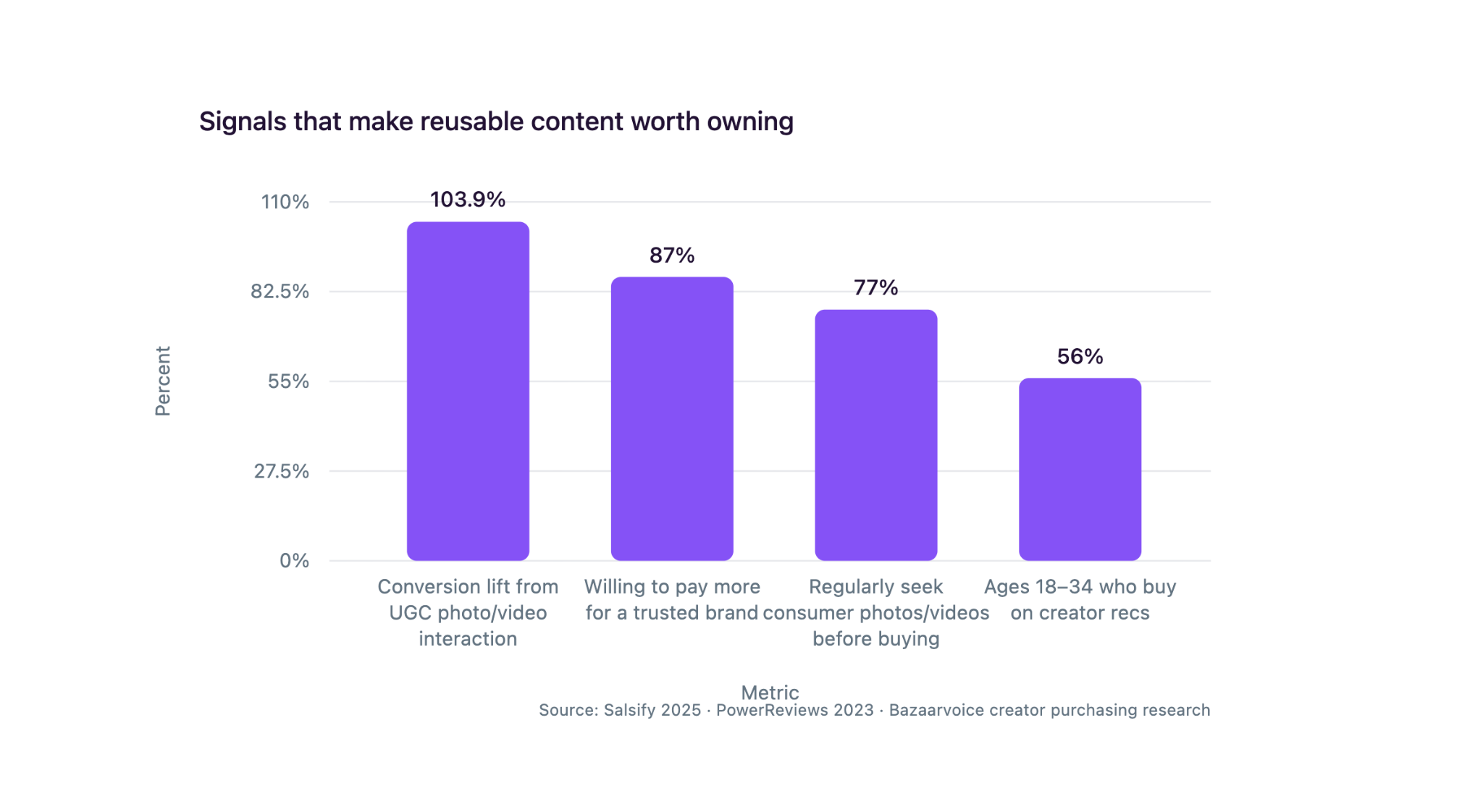
The Channel Fit Checklist gets especially valuable on the content line item. PowerReviews found that visitors who interacted with user-generated photos and videos saw a 103.9% lift in conversion, and Bazaarvoice reports that 56% of shoppers aged 18 to 34 have made purchases based on creator recommendations. If content influences the sale, it should influence the channel choice too.
That usually favors Shopify for sellers who want every photo, quote, review, and creator clip to strengthen a product page, an email flow, a paid ad, and an Amazon listing at the same time. It does not make Etsy wrong. It means Etsy is strongest when built-in marketplace demand outweighs the value of owning and recycling the asset library yourself.
Based on Stack Influence's work with eCommerce brands, lean teams often discover that creator logistics, not creator sourcing, becomes the real bottleneck once they try to scale product seeding and UGC. That is why pages such as Automated Product Seeding, User Generated Content for eCommerce, and Content Syndication emphasize throughput, reuse, and verified delivery. Stack Influence's published pricing benchmarks also highlight about 175 hours saved per month for active brands, which matters when Shopify growth depends on a steady flow of usable content instead of one-off posts.
Use the Channel Fit Checklist one more time before making your final call. If Shopify wins on customer capture, content reuse, and scale path, it is probably the platform that compounds. If Etsy wins on category fit, speed to demand, and low up-front risk, it is probably the platform that validates the offer first.
Should You Run Shopify and Etsy Together?
For many sellers, the smartest answer is not a winner-take-all choice. It is sequencing. You can keep Etsy live for discovery while Shopify becomes the place where your best customers buy again, join your list, or purchase higher-margin bundles.
That sequencing becomes even more useful if you also sell on Amazon. A multichannel stack lets one channel discover demand, another retain it, and a third capture high-intent marketplace shoppers. Shopify's own migration guidance notes that sellers can keep Etsy as a sales channel while expanding onto Shopify, and Shopify's multichannel management guidance argues for one operating model across channels instead of disconnected storefronts.
Use the Test-to-Own Ladder to plan the handoff:
- Tier One, Marketplace Proof: Start on Etsy when you need demand feedback, shopper language, and low-friction validation.
- Tier Two, Hybrid Repeatability: Keep best-selling SKUs active on Etsy, but move serious merchandising, bundles, email capture, and creator landing pages onto Shopify.
- Tier Three, Owned Brand Engine: Make Shopify the operating center, keep Etsy selective, and use Amazon only where it adds high-intent volume or category reach.
The Test-to-Own Ladder helps prevent a common mistake. Sellers often stay too long in proof mode and keep paying variable marketplace costs after the brand has already earned the right to own more margin. That is especially true for DTC brands that now need consistent content output and post-purchase systems, not just more listings.
If you already sell through Amazon or use Amazon FBA, the Ladder still works. Shopify can become your DTC conversion and retention layer, Etsy can stay curated around its strongest intent, and an Amazon growth workflow or a guide like How to Build an Amazon Brand in 2026 can keep marketplace traffic aligned with the rest of your stack.
Do Your Metrics Actually Separate Traffic From Margin?
Channel comparisons fall apart when sellers track revenue without tracking contribution margin. A marketplace order, a Shopify order, and an Amazon order can all look identical in gross sales while producing very different profit, repeat rate, and data value.
That is why Shopify vs Etsy should be measured with a tiered framework, not a single top-line dashboard. Use the Demand-to-Margin Stack so each channel is judged on the role it plays, the traffic it captures, and the profit it leaves behind after all channel-specific costs.
Track these four layers every month:
- Acquisition Layer: Sessions, creator clicks, marketplace visits, ad traffic, and source-specific click-through rates.
- Conversion Layer: Product page conversion rate, add-to-cart rate, Etsy listing conversion, and Amazon Attribution orders from non-Amazon traffic.
- Economics Layer: Contribution margin per order after platform fees, payment fees, shipping, returns, discounts, and creator costs.
- Compounding Layer: Repeat purchase rate, email or SMS capture, content reuse rate, review volume, and any Brand Referral Bonus credits.
For Shopify, this stack should connect landing pages, campaign links, checkout behavior, and post-purchase retention. For Etsy, it should isolate marketplace search demand from Offsite Ads and any sales you generated with your own social or creator traffic. For Amazon, the stack should include Amazon Attribution, because Amazon requires attribution tagging if you want to qualify for the Brand Referral Bonus, which Amazon says averages about 10% of qualifying sales.
Checkout quality still matters after the click. Baymard Institute reports a global average cart abandonment rate of 70.19%, and Baymard's checkout benchmarks note that large ecommerce sites can gain as much as a 35% increase in conversion rate through checkout improvements. That means Shopify's advantage is not just control. It is the ability to improve the full journey after the shopper arrives.
Across campaigns managed on the Stack Influence platform, teams get cleaner reporting when every creator brief names one primary conversion destination before outreach starts. That destination might be a Shopify product page, an Etsy listing, or an Amazon Attribution URL that points to an Amazon storefront. For a practical planning model, Stack Influence's ROI of Influencer Marketing Checklist and How to Budget Influencer Marketing for Amazon Brands 2026 are useful references because they keep creator traffic, off-platform demand, and downstream asset reuse inside the same measurement plan.
One more metric belongs in the stack: content efficiency. If a creator post drives a modest click count but also gives you reusable video, testimonials, and product imagery, the return should not be judged on one session window alone. Your measurement system should capture both immediate sales and the downstream value of the asset library.
Hidden Economics of Customer Ownership
The most expensive mistake in Shopify vs Etsy is not paying the wrong fee. It is underestimating the future value of assets that only compound well on owned channels. Marketplace demand can validate a product, but it rarely becomes a durable brand moat by itself.
That hidden economics layer gets stronger when competition rises and paid traffic gets more expensive. The more you spend to earn attention, the more valuable it becomes to keep the customer relationship, the merchandising freedom, and the content asset after the first sale. That logic gets even stronger for DTC brands that want product pages, retention flows, and creator content working together.
These four assets usually become more valuable over time on Shopify:
- First-Party Customer Data: Better email, SMS, segmentation, and lifecycle marketing in a post-cookie environment.
- Reusable Product Page Content: More freedom to place reviews, creator videos, testimonials, bundles, and comparison blocks where they convert best.
- Merchandising Control: Better control over upsells, subscriptions, landing pages, and category architecture.
- Cross-Channel Leverage: Stronger reuse of creator content across social ads, website product pages, blog content, and even Amazon storefront traffic.
The trust data supports that long-view argument. Salsify's 2025 Consumer Research found that 87% of shoppers will pay more for a product from a brand they trust, while PowerReviews says 77% of shoppers regularly seek photos and videos from other consumers before buying. That makes customer trust and reusable proof part of the channel decision, not just part of the marketing plan.
Data from Stack Influence's micro influencer campaigns suggests that creator output becomes more valuable when it is treated as a reusable asset library instead of a one-post deliverable. That is why Stack Influence frames UGC Creator workflows, Micro-Influencers and UGC in eCommerce, and How Brands Manage UGC Licensing Rights in 2026 around downstream reuse, rights readiness, and marketplace-safe distribution. The platform also says syndicated creator assets can drive up to 4x ad conversions when they are pushed into paid media and listing support.
Choosing the Right First and Second Channel
The best Shopify vs Etsy answer depends on what problem you are solving first. If you need fast product validation inside a marketplace that already has strong buyer intent, Etsy can be the right opening move. If you need a brand asset that compounds margin, customer data, and content reuse, Shopify is usually the stronger long-term home.
Use this short version when you make the call:
- Start With Etsy: If your catalog fits handmade, custom, vintage, or craft-supply demand and you need low-friction validation.
- Start With Shopify: If your offer depends on DTC branding, repeat purchase, bundles, subscriptions, or channel-level control.
- Run Both Strategically: If one channel proves demand and the other captures more profit, retention, and reusable brand assets.
For eCommerce sellers, the real win is not picking a side. It is sequencing the channels so each one does the job it is best at. Make your next move around contribution margin, customer ownership, and content leverage, and Shopify vs Etsy becomes a growth system instead of a false choice.