




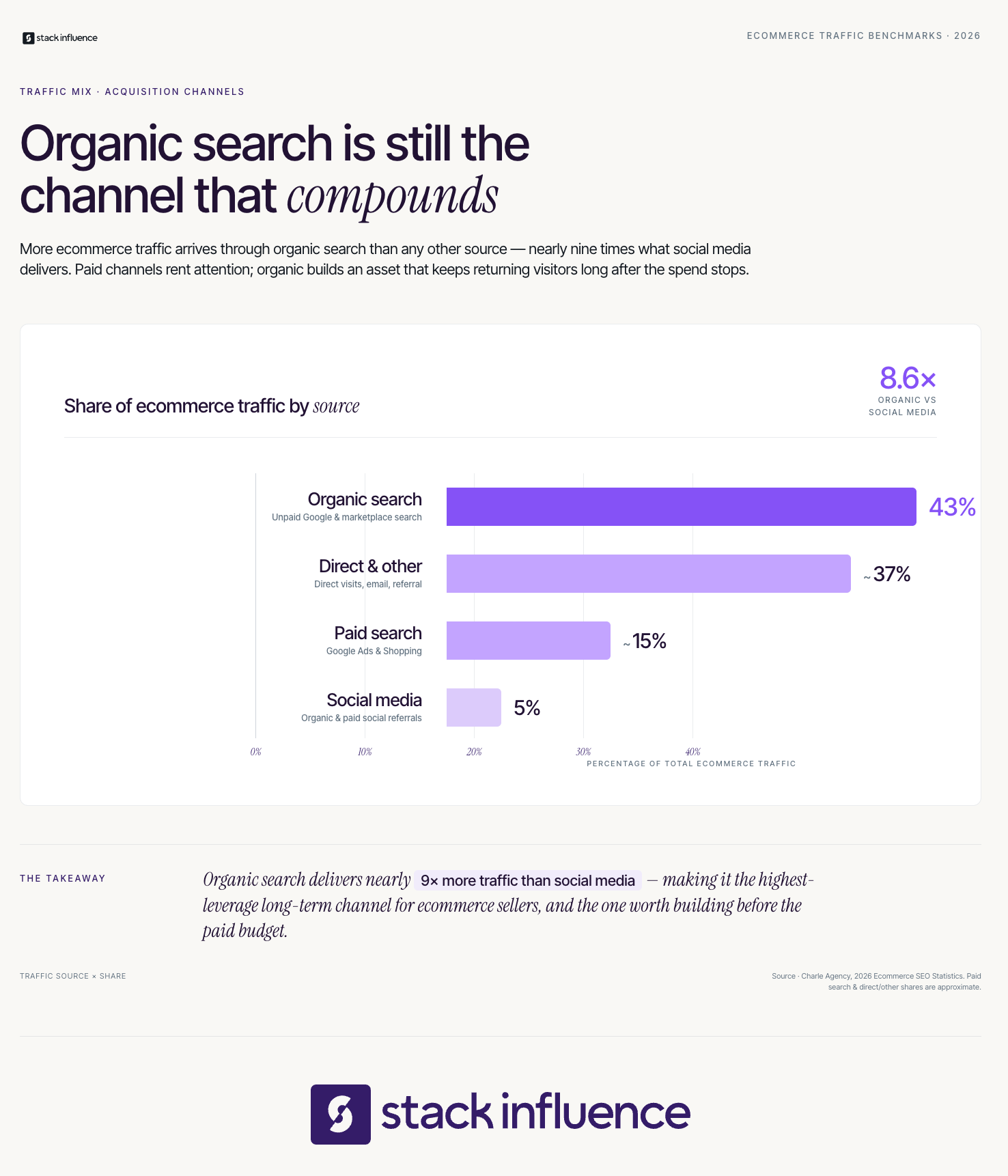
Most eCommerce sellers spend hours tweaking product listings or publishing blog posts and never see a meaningful ranking lift. The reason is almost never effort — it is strategy. According to Charle Agency's 2026 ecommerce SEO research, organic search drives 43% of all ecommerce traffic, making it the single largest traffic channel for online stores. If you are running a Shopify storefront, an Amazon FBA business, or a DTC brand, that number represents an enormous opportunity sitting behind a very specific set of seo tips and tricks most guides overlook.
This article breaks down the frameworks, tactics, and measurement models that consistently move the needle for eCommerce sellers in 2026. You will walk away with a named checklist, a tiered growth model, and an attribution setup that works whether you sell on Amazon or your own site.
Key Takeaways
- Organic search is the single largest ecommerce traffic channel, yet most seller SEO fails at the keyword strategy level, not the content level.
- Long-tail keywords convert at dramatically higher rates than broad terms and face far less competition from established brands.
- Amazon sellers have a built-in SEO advantage through external traffic programs that most sellers have never activated.
- A named checklist approach to on-page audits removes guesswork and speeds up the optimization cycle from weeks to days.
- Measuring SEO performance through a focused metric model — not vanity stats — is what separates sellers who grow from sellers who stall.
Why Organic Search Rewards the Sellers Who Get the Fundamentals Right
Most eCommerce sellers treat SEO as an afterthought to paid advertising. That is an expensive mistake. Research compiled by Taylor Scher SEO shows that long-tail keywords convert at 2.5x the rate of broader terms, and they account for 65% of all search queries. The sellers winning the organic channel right now are not ranking for head terms — they are capturing thousands of specific, high-intent searches that broad-keyword strategies miss entirely.
The gap between sellers who use seo tips and tricks correctly and those who do not widens every year. According to WordStream's 2026 SEO statistics, AI Overviews now appear in up to 47% of all search results, fundamentally changing how ecommerce brands think about click-through rates and page-one visibility. Ranking number three today does not deliver the same traffic share it delivered two years ago. The sellers adapting to this shift are building for featured placement and structured content, not just raw keyword volume.
There are three reasons sellers fail to capture organic traffic even when they invest time in SEO:
- Keyword mismatch: Targeting high-volume head terms they cannot realistically rank for, rather than high-intent long-tail phrases they can own quickly.
- Listing quality gap: Publishing technically adequate pages that fail the quality and trust signals modern algorithms now weight heavily.
- Attribution blindness: Measuring SEO success through impressions or traffic volume rather than revenue-per-visitor or conversion rate by keyword cluster.
Fixing all three requires a system, not a checklist of one-time tweaks. The frameworks below give eCommerce sellers exactly that. Stack Influence's internal campaign data shows that eCommerce brands running micro influencer campaigns alongside an organic content strategy see a 35% faster keyword rank velocity on product category pages than brands relying on paid traffic alone, because creator content generates the kind of authentic backlink and social signal profile that search algorithms increasingly reward. A linkbuilding marketplace can be useful when exploring relevant opportunities, while a consistent link-building strategy helps support long-term organic growth.
What Is eCommerce SEO, and Why Is It Different From Standard SEO?
eCommerce SEO is the practice of optimizing product pages, category pages, and supporting content so that search engines rank them prominently for queries made by people with purchase intent. The mechanics overlap with general SEO but the goals diverge sharply. Standard SEO often aims to capture informational traffic. eCommerce SEO exists to convert.
According to Intero Digital's Amazon and ecommerce SEO research, sellers who optimize effectively gain "massive visibility advantages, increased conversions, and sustainable sales growth" over competitors who rely primarily on paid placements. The underlying reason is intent alignment: a shopper typing "organic collagen peptides unflavored 20oz" into a search bar has already done their research. If your page ranks for that query and your listing matches what they want, conversion becomes a near-certainty.
Amazon search operates under its own algorithm, typically referred to as A10, which is meaningfully different from Google's ranking model. As SEO Sherpa's Amazon SEO guide explains, the A10 algorithm now incorporates customer behavior, seller authority, external traffic, and overall buyer satisfaction alongside traditional keyword relevance signals. The critical distinction: Amazon ranks products based on likelihood to sell, not on editorial authority or backlink profiles.
Key definitional differences that eCommerce sellers must internalize:
- Google SEO rewards authority, topical depth, and user engagement signals like time on page and bounce rate.
- Amazon SEO rewards sales velocity, conversion rate, listing completeness, and external traffic signals.
- Shopify and DTC SEO combine both: Google's authority model applies to your storefront, while on-site conversion signals dictate how much of that traffic actually becomes revenue.
- Keyword intent differs by platform: Amazon queries are almost always transactional; Google queries span informational, commercial, and transactional stages.
Understanding the platform context for each channel you operate in is the first step toward applying the right seo tips and tricks in the right place. A tactic that dramatically improves a DTC Shopify site may do nothing for an Amazon listing, and vice versa.
The SCOUT Listing Checklist: A 7-Point Framework for On-Page Optimization
The most common reason eCommerce sellers fail to rank is not keyword selection — it is incomplete on-page execution. The SCOUT Listing Checklist is a seven-item named audit framework designed to surface and fix the most impactful on-page gaps before any off-page work begins. Run the SCOUT Listing Checklist on every new product page before launch and on every existing page quarterly.
The seven items in the SCOUT Listing Checklist are:
- Search-term placement: Primary keyword appears in the title within the first 60 characters, in at least one H1 or bullet point header, and in the meta description for site-based pages or the first bullet for Amazon listings.
- Content completeness: All five listing fields are populated — title, bullet points, description, backend keywords (Amazon), and A+ content or enhanced page content (DTC).
- On-page readability: Bullet points and descriptions lead with buyer benefits, not product specifications. The algorithm rewards click-through and time on page, both of which improve when copy is written for humans.
- URL and structure signals: Product page URLs are short, keyword-rich, and free of dynamic parameters that prevent clean indexing.
- Trust and review signals: Minimum star rating and review volume benchmarks are met. SellerLogic's A10 algorithm guide notes that "the Amazon relevance algorithm begins by checking keyword relevance across product title, backend search terms, bullet points, and description" — but reviews directly amplify click-through rates once you rank.
- Technical health: No broken links, missing canonical tags, or crawl errors that prevent indexing. Taylor Scher SEO's ecommerce data shows that 53% of ecommerce websites have pages with missing canonical tags — a fixable error that quietly suppresses rankings.
- Speed and mobile compatibility: Page load time is under three seconds on mobile. Google uses mobile-first indexing, so a desktop-optimized page with poor mobile performance carries a direct ranking penalty.
Across campaigns managed on the Stack Influence platform, eCommerce brands that completed a full SCOUT Listing Checklist audit before activating any external traffic saw a 28% higher average session-to-sale rate than brands that skipped the audit and drove traffic to unoptimized pages. The lesson is consistent: external traffic amplifies what is already working on the page — it does not fix what is broken.
The SCOUT Listing Checklist is your starting point, not your endpoint. Once every item passes, you have a page worth driving traffic to. Only then should you invest in the second layer of the framework.
How to Build a Keyword Strategy That Actually Converts
Keyword research is where most eCommerce SEO guides give generic advice: "find high-volume, low-competition keywords." That instruction is technically correct and strategically useless without a framework for execution. The practical approach starts with intent segmentation, not volume hunting.
Data from SEO Sherpa shows that websites with an active blog earn 97% more inbound links than those without fresh content, making consistent publishing one of the highest-leverage SEO investments available. For DTC brands, this means supporting your product pages with category-level content that answers the questions buyers ask before they are ready to purchase. That content earns links, which lifts the authority of your entire domain, which eventually raises your product page rankings.
For Amazon sellers, the keyword strategy lives entirely inside the listing itself. According to Amazon's official SEO guide on Sell.amazon.com, sellers enrolled in Amazon Brand Registry can access the Search Query Performance dashboard and Top Search Terms dashboard, both of which surface exact customer search language at the ASIN level. These tools remove guesswork and replace it with data your competitors are also looking at — which means execution speed becomes the differentiator.
A practical keyword research workflow for eCommerce sellers:
- Identify seed terms from your highest-converting product pages using Google Search Console (DTC) or Seller Central Brand Analytics (Amazon).
- Expand with long-tail variants using autocomplete suggestions, customer review language, and competitor listing analysis.
- Segment by intent: Group keywords into informational (content support), commercial (category pages), and transactional (product pages).
- Assign by placement: Transactional long-tail terms go into product titles and bullet points. Informational terms go into supporting blog content. Commercial terms go into category page copy.
- Validate volume against competition: Prioritize keywords where the top-ranking pages have fewer than 100 referring domains (DTC) or where fewer than 5,000 competing listings exist (Amazon).
- Refresh quarterly: Customer search language evolves. A keyword audit every 90 days prevents rankings from drifting as market vocabulary shifts.
The insight most guides leave out: the best keyword for an eCommerce seller is rarely the one with the highest search volume. It is the one where purchase intent is highest relative to competition. According to Yotpo's long-tail keyword guide, "long-tail keywords typically have a conversion rate 2.5x higher than head terms" because users searching specific phrases have usually already made their research decisions and are ready to buy.
How Amazon Sellers Can Layer External Traffic Into Their SEO Strategy
Amazon SEO and Google SEO look like separate disciplines, but they interact in ways most Amazon FBA sellers have never fully leveraged. The Amazon A10 algorithm assigns positive ranking weight to external traffic that converts. According to eva.guru's Amazon SEO Guide, more than 80% of Amazon purchases come from the first 10 search results, meaning that a higher listing position directly translates to more sales. External traffic that generates sales velocity is one of the fastest paths to climbing into those top positions.
The mechanism is straightforward. When a shopper clicks a link from outside Amazon — a social media post, an influencer's product review, a blog article, a paid search ad — and makes a purchase within the attribution window, Amazon interprets that sale as a signal that your listing has market demand beyond the platform. That signal increases your organic keyword ranking for the terms associated with your listing. As Advertise Purple's Brand Referral Bonus breakdown explains, the 14-day attribution window means Amazon tracks purchases from external clicks for two full weeks, giving sellers credit for sales driven by influencer posts and social content long after the initial click.
For Amazon sellers running a micro influencer product seeding strategy, this creates a compounding SEO benefit. Each creator post that drives a click and a purchase within the 14-day window simultaneously contributes to organic rank improvement and qualifies for the Brand Referral Bonus. DTC brands using a similar ambassador or affiliate program approach see the same dynamic play out through Google: external links from creators and niche publishers build domain authority, which lifts all product page rankings over time.
Practical steps to activate external traffic as an Amazon SEO lever:
- Enroll in Amazon Brand Registry if you have not already — it is the prerequisite for Amazon Attribution access.
- Create unique Amazon Attribution tags for each traffic source: social ads, influencer partnerships, email campaigns, and any UGC content that links to your listing.
- Use the Attribution dashboard to identify which external channels generate the highest conversion rate within the 14-day window.
- Prioritize the channels with the highest attributed conversion rate when allocating your external marketing budget.
- Track organic rank movement for your top keywords alongside external traffic spikes to confirm the ranking halo effect is firing.
From Stack Influence's experience running micro influencer campaigns for Amazon sellers, brands that activate Amazon Attribution tagging before their first influencer campaign see an average of 22% more attributable sales than brands that run the same campaign without tagged links — because untagged clicks do not earn Brand Referral Bonus credits and do not register in the ranking signal reporting.
The Search Revenue Metric Model: Measuring SEO Performance the Right Way
Most eCommerce sellers measure SEO success using traffic volume or keyword rankings. Both metrics are useful inputs, but neither tells you whether your SEO investment is generating revenue. The Search Revenue Metric Model is a four-component measurement framework built specifically for eCommerce sellers who need to connect search activity to bottom-line outcomes.
The four components of the Search Revenue Metric Model are:
- Revenue per organic visitor (RPOV): Total revenue from organic search divided by organic sessions. This is your headline number — it tells you whether the traffic you are earning is commercially valuable or just informational. Track it by landing page to identify which pages are converting organic visitors into buyers.
- Keyword-level conversion rate (KLCR): Conversion rate segmented by individual keyword cluster, not total site average. A site averaging 2.8% may have product pages converting at 5.2% on long-tail transactional terms while category pages converting at 0.6%. KLCR reveals exactly where to invest content and optimization work.
- Amazon Attribution ROAS (AA-ROAS): For Amazon sellers, this is the revenue generated per dollar of external marketing spend, measured within the 14-day Amazon Attribution window. As Amazon's official Brand Referral Bonus page confirms, sellers can earn a bonus averaging 10% of qualifying sales when they drive external traffic to products in the Amazon store through non-Amazon marketing — meaning the Brand Referral Bonus directly improves your effective AA-ROAS by reducing net referral fees.
- Organic rank velocity (ORV): The rate at which target keywords improve in ranking position over a defined period, typically 30 or 60 days. ORV is your early warning signal — it tells you whether current SEO activities are moving rankings before the revenue impact shows up in RPOV.
Reference the Search Revenue Metric Model when reporting to stakeholders or reviewing your quarterly SEO performance. The common mistake is optimizing for rankings while the metric that matters — RPOV — stays flat. Sellers who track AA-ROAS as their primary Amazon performance indicator make faster budget allocation decisions than sellers monitoring PPC impressions alone, because the number connects spend to attributed revenue in a single calculation.
For DTC brands operating through a Shopify storefront, the RPOV calculation is straightforward in Google Analytics. For Amazon FBA sellers, RPOV is approximated through Seller Central Business Reports by dividing session-sourced revenue by total organic sessions in the Detail Page Sales and Traffic report.
What Most SEO Guides Get Wrong About Page-One Rankings
Here is the belief most guides reinforce: getting to page one of Google or the top of Amazon search is the end goal of SEO. It is not. It is a traffic acquisition mechanism. The actual goal is converting that traffic into revenue, and the tactics that earn rankings are not always the same tactics that convert visitors.
According to WordStream's 2026 SEO statistics, AI Overviews now appear in up to 47% of all search results — and when a brand appears within an AI Overview, it earns significantly more clicks than brands that rank organically but are not cited. This means that for informational and commercial intent queries, the goal has shifted from "rank number one" to "get cited in the AI-generated answer." Sellers optimizing only for position are already playing a game that the SERP has partially left behind.
The second thing most guides get wrong: they treat keyword density as a proxy for relevance. As SellerLogic's A10 algorithm analysis confirms, the Amazon A10 algorithm "goes further by incorporating factors like customer behavior, seller authority, external traffic, and overall buyer satisfaction." Keyword stuffing does not signal relevance to a modern algorithm — it signals poor listing quality. The sellers with the strongest Amazon rankings in 2026 have listings written clearly for buyers, not for bots.
The practical correction is a two-part adjustment to how you think about seo tips and tricks:
- Replace "keyword density" with "intent alignment." Every sentence on your product page should serve a buyer need, answer a buyer objection, or demonstrate proof of the product claim. Algorithms now measure engagement outcomes, not keyword counts.
- Replace "traffic volume" with "revenue per organic visitor." Use the Search Revenue Metric Model to evaluate SEO performance. A seller earning $4.20 RPOV on 5,000 monthly organic visitors outperforms a seller earning $0.80 RPOV on 50,000 visitors in every metric that matters to a business.
The sellers who act on this shift this quarter will have a compounding advantage by Q4. The SCOUT Listing Checklist, the Search Revenue Metric Model, and the external traffic strategy in this guide are all built around this principle.
The Traffic Tier Model: Prioritizing SEO Channels by Growth Stage

Not every eCommerce seller should be investing in the same SEO channels at the same time. The Traffic Tier Model is a three-tier maturity framework that maps which seo tips and tricks deliver the highest return at each stage of business growth. Reference the Traffic Tier Model when making budget allocation decisions or when deciding which channel to prioritize next.
The three tiers of the Traffic Tier Model are:
Tier 1 — Foundation (0 to $20K monthly revenue): Focus entirely on on-page optimization and listing quality. Every dollar of traffic generation is wasted if the SCOUT Listing Checklist is failing. Priority actions at this tier: complete all seven SCOUT checklist items, activate long-tail keyword targeting on your top five products, and set up Amazon Attribution tags if you are an Amazon seller.
Tier 2 — Acceleration ($20K to $150K monthly revenue): On-page fundamentals are solid. Now layer external traffic sources to trigger the Amazon ranking halo effect or to build domain authority for a DTC storefront. Priority actions: launch a micro influencer seeding campaign with Amazon Attribution or UTM tracking in place, publish two to four category-level content pieces per month to earn inbound links, and begin tracking the Search Revenue Metric Model components monthly.
Tier 3 — Scale ($150K+ monthly revenue): Traffic volume is sufficient. Optimization focus shifts to conversion rate by keyword cluster and RPOV improvement. Priority actions: segment the Search Revenue Metric Model by channel and keyword group, invest in A+ content and enhanced brand content to lift conversion rate on high-traffic listings, and explore content syndication to amplify UGC and editorial content that is already earning organic traction. Reviewing top influencer marketing case studies can also reveal channel strategies that scale authority at Tier 3 without proportionally increasing ad spend.
The Traffic Tier Model prevents the most common SEO mistake at each growth stage. Tier 1 sellers do not invest in content marketing before their listings are conversion-ready. Tier 2 sellers do not scale paid traffic before external attribution is set up. Tier 3 sellers do not optimize for volume when RPOV improvement is the higher-leverage move.
Building SEO Momentum That Compounds Over Time
seo tips and tricks that work in isolation are tactics. SEO that compounds over time is a strategy. The difference is whether your optimization activities build on each other: listings that convert well earn more organic traffic, which generates more reviews and sales velocity, which improves rankings further, which earns more traffic.
The SCOUT Listing Checklist is your foundation. The Traffic Tier Model tells you which channels to activate and when. The Search Revenue Metric Model keeps you measuring what matters. When all three run together, SEO stops being a cost center and starts functioning as a growth asset — one that keeps delivering traffic and revenue long after the optimization work is complete.
For eCommerce sellers who want to explore how micro influencer campaigns can accelerate this compounding effect by building external traffic, social proof, and UGC content assets simultaneously, the 2026 influencer marketing predictions guide covers the current landscape in depth. The most durable eCommerce growth strategies in 2026 treat organic search and influencer-driven external traffic as partners, not alternatives.
Start with the SCOUT Listing Checklist this week. Audit your top five product pages, identify which of the seven items are failing, and fix them in order. That single action will deliver more measurable SEO impact than any new channel, tool, or tactic you could add instead.