



Audio is not decoration on TikTok. It is infrastructure. The popular TikTok songs of 2026 are not just background music for your videos; they are distribution signals the algorithm actively uses to categorize, group, and push your content to audiences who are already engaging with that sound. Creators who understand how to find trending audio at the right moment, select sounds that match their niche's engagement patterns, and build their posting workflow around audio timing consistently outperform creators who choose music based on what they personally like. This guide covers what is trending on TikTok audio in 2026, why the audio landscape has shifted significantly from previous years, how to identify the right sounds before they peak, and how to turn your audio strategy into a measurable growth and brand partnership asset.
Key Takeaways
- TikTok's algorithm groups videos using the same sound into audio communities, meaning trending audio gives your video distribution exposure to every viewer who has already engaged with that sound, regardless of whether they follow you.
- The 2026 wave of TikTok viral songs feels distinctly different from previous cycles, with many of the biggest sounds driven by mood, atmosphere, and emotional resonance rather than high-energy dance routines alone.
- The optimal window to post with a trending sound is when it has between 50,000 and 500,000 uses, after it has proven viral potential but before it becomes so saturated that your video is buried in millions of others.
- Trending audio strategy and niche authenticity are not in conflict: the creators who grow fastest choose sounds that are trending within their specific content category, not just platform-wide viral tracks.
- Brand campaigns increasingly incorporate trending audio as a creative brief element, meaning creators who stay current on popular TikTok sounds are more valuable campaign partners than those who post with generic or outdated audio.
What Is Driving the Popular TikTok Songs of 2026?
A single video from a mid-tier influencer with strong aesthetic consistency can launch a song more effectively than traditional marketing campaigns. Labels have adapted accordingly, with many now monitoring trending audio daily and reaching out to creators before a song even hits streaming platforms. Some artists are strategically holding back full releases, choosing instead to let the TikTok version build anticipation and cultural relevance first.
This shift means the music discovery pipeline has inverted. In previous decades, a song reached radio, then streaming, then social media. In 2026, a sound surfaces on TikTok first, creators build video culture around a 15-second clip, and streaming numbers follow weeks later. Instead of albums or even singles, many listeners now experience songs first as 15-second fragments that later reveal their full emotional weight. The platform has trained a generation to fall in love with music in micro-moments.
Three forces shaping the popular TikTok song landscape in 2026:
- Mood-led virality: Dance challenge sounds still circulate, but the dominant audio trend in 2026 is mood-driven. Atmospheric tracks that fit quiet luxury edits, aesthetic day-in-the-life content, and introspective lifestyle videos are generating more total video volume than high-energy dance tracks in many content categories.
- Global sound discovery: TikTok's international reach means trending sounds now regularly originate from non-English-speaking markets before crossing into mainstream US TikTok. REDRED by CORTIS, a high-energy K-pop track, has been taking over dance videos and choreography clips across TikTok, with creators using its sharp beat changes for synchronized routines and performance edits.
- Niche audio ecosystems: Different creator communities, skincare, fitness, food, home decor, education, each develop their own internal audio culture alongside platform-wide trending sounds. A track that is dominant in wellness content may be barely visible in gaming content, and vice versa.
According to Metricool's weekly TikTok trending songs tracker, the most consistently viral sounds share three characteristics: a strong emotional hook within the first three seconds, a beat pattern that lends itself to natural video cut points, and a lyrical or melodic phrase that viewers can respond to or parody in their own content.
How Do You Find Trending TikTok Audio Before It Peaks?
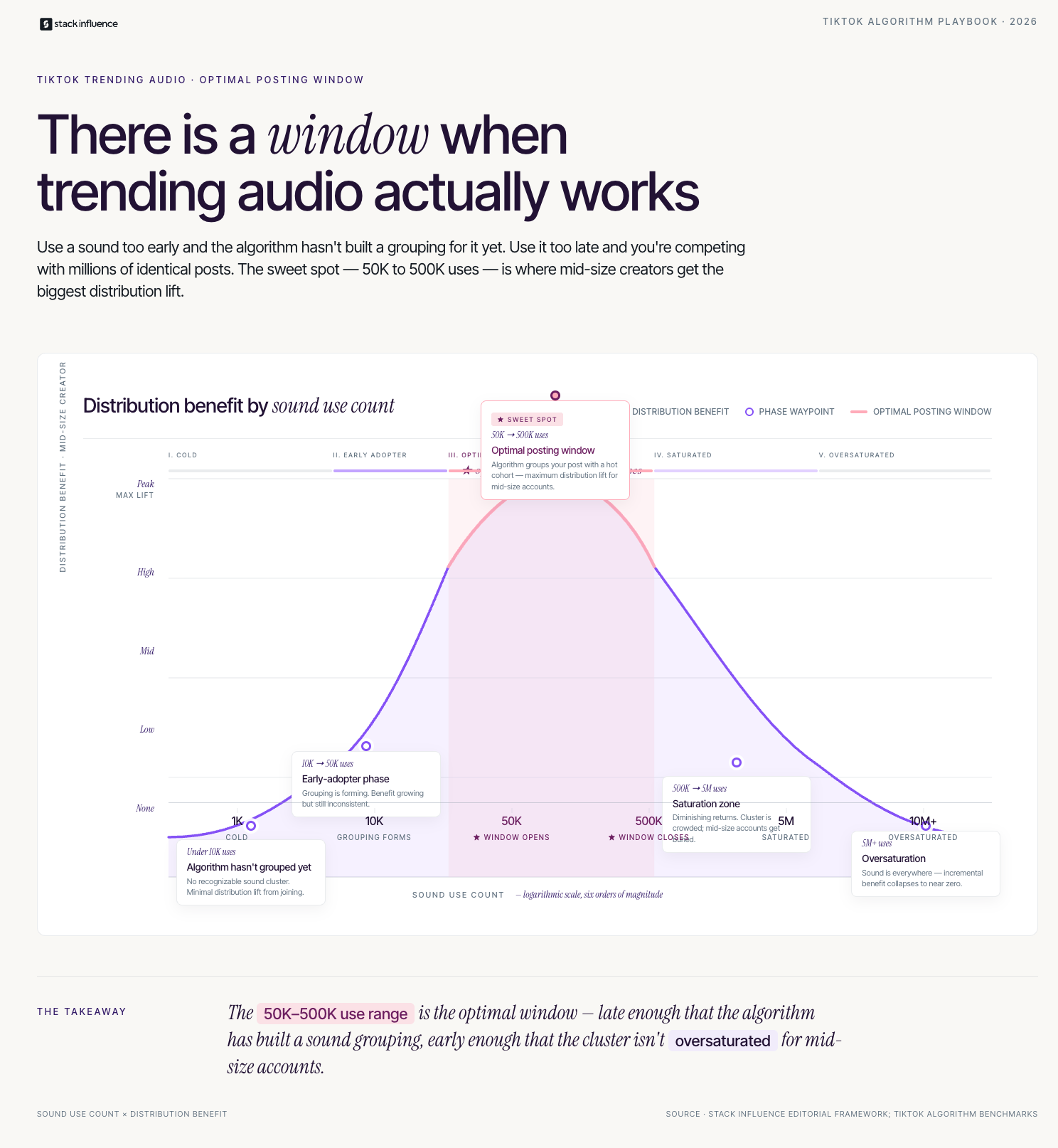
Knowing what is already viral is useful but not strategic. By the time a sound has 5 million uses, posting with it means competing with an enormous volume of content for the same algorithmic attention. The creators who get the most distribution benefit from trending audio are the ones who post when a sound is in its growth phase, not at its peak.
The TikTok Audio Timing System is a four-step framework for identifying and activating trending sounds at the optimal moment in their growth cycle. Following the system consistently positions your content in the distribution window where algorithmic grouping benefits are highest and competition is lowest.
The four steps of the TikTok Audio Timing System are:
- Source identification: Check TikTok's Creative Center daily for the trending sounds dashboard, which shows which audio tracks are growing in use velocity over the previous 7 days. Sort by growth rate rather than total use count to surface sounds in their early phase.
- Use count evaluation: A trending sound in the 50,000 to 500,000 use range is in the optimal posting window. Below 50,000 uses, the sound may not yet have enough algorithmic momentum to generate meaningful distribution. Above 500,000 uses, you are entering a saturated environment where the distribution benefit diminishes for smaller accounts.
- Niche relevance filter: Before using any trending sound, check the top videos currently using it. If the content category of those top videos does not match your niche, the algorithmic grouping will expose your video to the wrong audience, which generates views without follows and can actually signal poor content relevance to the algorithm.
- Timing activation: Post your video using the trending sound as close to your peak audience active time as possible. For most creators, that window falls between 6 and 9 am and 7 and 10 pm in their primary audience's time zone. Posting at peak audience time with trending audio maximizes the initial engagement velocity that determines whether the algorithm extends your distribution.
The TikTok Audio Timing System works because it separates sound popularity from sound relevance and timing, the two variables that actually determine whether trending audio helps or hurts your specific video's performance.
What Are the Popular TikTok Songs and Sounds Trending in 2026?
Rather than a static list that becomes outdated within weeks, the more useful framework for creators is understanding which categories of audio are generating the most sustained engagement in 2026, alongside specific tracks currently in their growth or peak phase that illustrate each category.
This year's wave of TikTok viral songs 2026 feels distinctly different from previous cycles. Rather than relying solely on high-energy dance routines, many of the biggest sounds are driven by mood, atmosphere, and emotional resonance. Creators are building aesthetic edits, quiet luxury montages, and introspective day-in-the-life videos around songs that would have once been considered too subtle for virality.
The five audio categories generating the most creator activity and brand interest in 2026:
- Emotional storytelling audio: Tracks with raw, specific lyrical content that audiences can map onto their own experiences. The Fifth of May by Zach Bryan is connecting with TikTok users through its raw breakup lyrics, with creators pairing it with nostalgic edits and emotional storytelling clips that tap into heartbreak and moving on. This category consistently generates the highest comment and share rates of any audio type.
- High-energy dance and choreography sounds: REDRED by CORTIS, the high-energy K-pop track, is taking over dance videos and choreography clips with its sharp beat changes and catchy hooks for synchronized routines. Dance challenge audio continues to drive follower growth fastest for creators willing to participate in trend choreography early.
- Celebration and event-specific audio: Cinco de Mayo 2026 by Slick Stomp blends festive lyrics with a modern sound, with creators using it for celebration clips, food content, nightlife edits, and upbeat videos thanks to its catchy hooks and energetic production. Seasonal and event audio creates short high-volume windows that reward early posting.
- Atmospheric and aesthetic audio: Instrumental or minimal vocal tracks that function as mood-setting background for visual content. These dominate in beauty, home decor, and lifestyle niches where the visual content carries the narrative and audio amplifies the mood.
- Remix and nostalgia tracks: Remixes of recognizable songs from previous decades that blend familiarity with a fresh production angle. These cross age demographics more effectively than original contemporary tracks, which makes them attractive for creators whose audiences span multiple age groups.
Should You Always Use Trending Audio or Build Your Own Sound Identity?
This is one of the most commonly debated questions in the [creator economy](INTERNAL: creator economy audio strategy guide) around TikTok growth strategy, and the answer changes depending on your current stage and goals. Trending audio and signature sound identity are not competing choices. They are tools for different objectives used in different proportions at different creator stages.
For creators under 10,000 followers, trending audio is the primary growth mechanism available from an audio standpoint. The For You Page distribution boost from algorithmic audio grouping is one of the fastest ways for a small account to reach non-follower audiences at scale. Resisting trending audio at this stage in favor of building a niche sound identity is sacrificing reach for an aesthetic preference that will have limited audience to appreciate it.
For creators above 50,000 followers, the calculus begins to shift. At this point you have an audience that has found you for specific reasons and has developed expectations about your content's feel. Posting exclusively with trending audio begins to make your content interchangeable with every other creator using the same sound. Introducing signature sounds, or a consistent audio aesthetic that is not dependent on what is trending this week, builds the content differentiation that brands look for when they evaluate creators for longer-term ambassador relationships rather than one-off campaigns.
Stack Influence's internal campaign data shows that [micro influencers](INTERNAL: micro influencer audio strategy for brand campaigns) who develop a recognizable content aesthetic, including consistent audio preferences alongside consistent visual style, receive brand partnership inquiries with 40% higher average deal values than creators with equivalent follower counts who rely exclusively on trending audio without any consistent signature approach. The brand is paying for a predictable creative environment, and audio is part of that predictability.
Three audio strategy approaches calibrated to creator stage:
- Under 10,000 followers: Post with trending audio in the 50,000 to 500,000 use range for 80% of your content. Reserve 20% for original audio or sounds specific to your niche community to begin building a recognizable tone.
- 10,000 to 100,000 followers: Balance platform-wide trending audio with niche-specific trending sounds. Introduce a signature audio element, such as a consistent intro sound or a recurring audio format, in at least one video per week.
- Above 100,000 followers: Use trending audio strategically for discovery-oriented content while maintaining a consistent audio aesthetic across the majority of your content. Your signature sound is a brand asset worth protecting.
Measuring How Audio Affects Your TikTok Performance: The Audio Impact Model
Most creators have no systematic way to evaluate whether their audio choices are helping or hurting their distribution performance. Views go up, views go down, and it is difficult to isolate audio as a variable when content quality, posting time, caption, and thumbnail are all changing simultaneously. The Audio Impact Model is a three-measurement framework that isolates audio's contribution to video performance.
The three measurements of the Audio Impact Model:
- Audio reach rate: For each video, divide the total views by your follower count. A video using trending audio should produce a reach rate above 3x your follower count if the audio is genuinely boosting distribution. A video with trending audio that only reaches 0.5x your follower count suggests either a use-count timing problem, a niche relevance mismatch, or a content quality issue suppressing the audio advantage.
- Audio category comparison: Over a rolling 30-day period, segment your videos by audio category: trending platform-wide, trending niche-specific, original, and non-trending. Calculate average views per category. Most creators discover that niche-specific trending audio outperforms platform-wide trending audio for their specific account, which is data worth acting on.
- Follower conversion rate by audio type: Divide new followers gained on each video's posting day by that video's total views. Higher follower conversion rates indicate that the audience the audio brought to your video was genuinely interested in your content beyond the sound. Low conversion rates with high views suggest the trending audio attracted the wrong audience, which generates views but not community growth.
TikTok's Creative Center shows top trending songs by region and time period, making it TikTok's built-in trend tracker for sounds, creators, and hashtags. Running the Audio Impact Model monthly and using the Creative Center as your sourcing tool gives you a closed feedback loop between audio selection and measurable performance outcomes.
Based on Stack Influence's work with [UGC creators](INTERNAL: UGC creator audio selection guide) and eCommerce brand campaigns, creators who actively select audio using a data-backed framework rather than intuition alone show an average For You Page reach improvement of 25 to 40% per video over a 60-day optimization period. The compounding effect of consistently better audio choices is one of the most underestimated growth variables available to creators who are willing to track it.
What Most Audio Guides for TikTok Creators Get Wrong
Most guides to popular TikTok songs frame audio selection as a trend-following exercise: here is what is viral this week, use these sounds, get more views. That framing is accurate as far as it goes, but it misses the strategic layer that separates creators who experience one-off viral moments from creators who build sustainable growth using audio as a systematic tool.
The first gap is the failure to address audio-niche fit. A trending sound with 2 million uses is not equally valuable to every creator. Its value depends entirely on whether the audience already engaging with that sound matches your target audience. A wellness creator using a trending gaming sound may see a temporary view spike and zero new followers, because the distribution brought the wrong community to their content.
The second gap is the failure to address audio and brand deal alignment. Brands planning TikTok campaigns around popular TikTok songs need creators who understand how to integrate audio trends authentically into product content rather than forcing a trending sound onto a scripted brand message that does not fit. [Nano influencers](INTERNAL: nano influencer TikTok audio brand deal guide) and micro influencers who demonstrate audio fluency in their organic content are significantly more attractive campaign partners for brands that want their sponsored content to feel native rather than advertised.
Three things most popular TikTok songs guides leave out:
- Audio saves as a research tool: When you save an audio track in TikTok before using it, you can monitor its use count growth over subsequent days. This turns the save function into a trend-timing research tool that costs nothing and takes ten seconds per sound.
- [Influencer marketing](INTERNAL: influencer marketing TikTok audio strategy) campaigns with a defined audio brief outperform those without one by a significant margin. Brands that specify a trending sound or audio category in their creator brief get content that feels more platform-native because creators are already operating with that audio context.
- Original audio is one of the most underused brand differentiation tools available to established creators. A creator who introduces an original sound that gains traction across thousands of other creators' videos receives ongoing For You Page attribution credit for every video using that sound, which generates compounding discovery exposure that no trending audio strategy can replicate.
Conclusion
Staying current on popular TikTok songs in 2026 is not about trend-chasing. It is about understanding that audio is a core distribution mechanism on TikTok, and that strategic audio selection using the TikTok Audio Timing System and the Audio Impact Model produces measurably better content performance than intuition-based choices. The shift toward mood-driven and emotionally resonant audio in 2026 also creates an opportunity for creators in lifestyle, wellness, and aesthetic niches to build genuine signature sound identities alongside their trending audio strategy, which is the combination that builds both algorithmic momentum and brand partnership value.
If you are ready to connect with brands building creator campaigns around current TikTok audio trends and authentic content, Stack Influence matches micro influencers and content creators with eCommerce brands running product campaigns designed to feel native to whatever platform you create on.