




TikTok Shop search is not a smaller copy of Google or Amazon. A shopper can move from a video to a search, from a search to a product card, and from a product card to checkout without leaving the platform.
For ecommerce sellers and content creators, learning how to SEO TikTok Shop means connecting the words shoppers use with an accurate listing, useful content, strong product proof, and reliable operations. Keyword placement matters, but it is only one part of the system.
This guide explains how to research demand, structure titles and backend terms, create query-aligned videos, measure search performance, and run a focused 30-day optimization sprint.
Key Takeaways
- TikTok Shop SEO connects search demand, product listings, creator content, conversion quality, and operational reliability.
- Seller Center Search Insights should guide keyword selection because it shows search performance, industry keywords, rankings, and post-view searches.
- A strong listing uses one clear product concept across the title, category, attributes, description, Search terms, Product highlights, images, and variations.
- Creator videos should reinforce the same customer problem and product language without sounding scripted or repetitive.
- Search impressions are only a leading indicator. Click-through rate, conversion rate, orders, contribution margin, and content source determine whether visibility is useful.
What Is TikTok Shop SEO?
TikTok Shop SEO is the process of making a product easier to match, understand, and buy across TikTok search and commerce surfaces. It combines search-demand research, listing relevance, creator content, conversion quality, and operational reliability. The practical goal is qualified discovery that produces profitable orders, not simply more views or a longer keyword list.
TikTok's March 2026 search update reported billions of daily searches, growth of more than 40% year over year, one in four users searching within 30 seconds of opening the app, and two in three discovering useful things beyond their original intent. A Sprout Social Q2 2025 Pulse Survey found that 41% of Gen Z respondents turned to social platforms first for information.
That behavior makes TikTok Shop SEO broader than ordinary video SEO. TikTok SEO can help a video surface for a topic, while TikTok Shop SEO must also help the correct product appear, earn the click, answer the shopper's objection, remain available, and convert through the linked commerce experience.
TikTok Shop SEO therefore spans four jobs: content discovery, product matching, commercial proof, and reliable delivery after visibility increases.
How to SEO TikTok Shop With the Search-to-Sale Loop
To SEO TikTok Shop effectively, run one repeating loop: mine shopper demand, align the product listing, reinforce the same concepts in content, improve conversion proof, and feed performance data back into the next test. Each stage solves a different failure point, so skipping one usually turns visibility into weak clicks or clicks into weak sales.
1. Mine Demand From TikTok Data
Start with evidence from TikTok rather than a generic keyword tool. TikTok Shop's Search Insights reports Search GMV, Search Orders, Search Impressions, search click-through rate, search conversion rate, category rankings, hot keywords, trending keywords, low-competition keywords, and searches that occur after people watch videos.
Build a keyword map around five types of intent:
- Product type: What the item is.
- Problem: What the shopper needs solved.
- Use case: Where or when the product is used.
- Proof request: The demonstration or evidence the shopper wants.
- Audience qualifier: The person, setting, or constraint that narrows intent.
Content creators can use Creator Search Insights to explore searched topics, content gaps, and searches by followers. Sellers should compare those content themes with Seller Center data so the video idea and the product listing answer the same demand.
Use Google Trends only as a secondary signal for seasonality, regional language, or comparisons among broader terms. Google Trends is normalized Google search interest, not TikTok search volume, so it should validate timing rather than replace first-party TikTok data. The Stack Influence guide to SEO tools for social media provides additional ways to combine platform-native and cross-channel research.
2. Build a Listing That Matches the Query
The title should state what the product is before it tries to persuade. TikTok's current product-title guidance recommends 40 to 150 characters and a structure that can include brand, product content, application scope, product type, and main features. It also warns against repetitive variants, inventory claims, discounts, and subjective language such as “best” or “great value.”
A practical title formula is:
[Brand] + [Product Type] + [Primary Use Case] + [Size or Variant] + [Defining Feature]
A weak title might read, “BEST BOTTLE 50% OFF BLUE RED GREEN LOW STOCK.” A clearer version is, “NorthPeak Insulated Water Bottle for Hiking, 32 oz, Leak-Resistant Stainless Steel.”
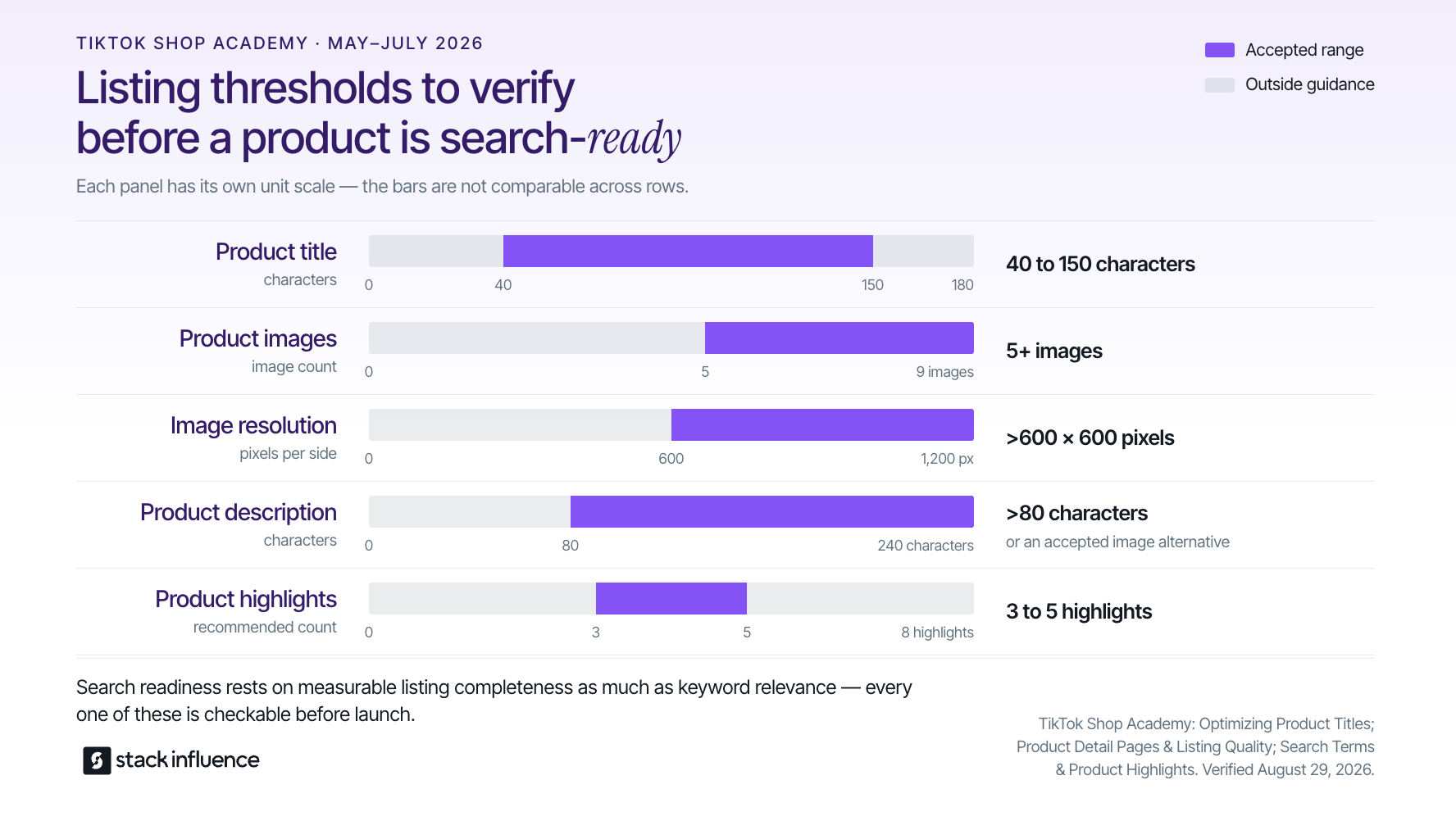
Treat the rest of the product detail page as part of search relevance. TikTok's listing-quality guidelines define a Good-tier listing around an accurate title, at least five high-resolution images above 600 by 600 pixels, a valid description longer than 80 characters or an image in the description, and complete category-specific information. Missing category details can cap a listing at Fair.
Use these numeric thresholds as a pre-publish QA check:
- Product title: 40 to 150 characters.
- Product images: at least 5.
- Image dimensions: greater than 600 by 600 pixels.
- Product description: more than 80 characters, unless the accepted image alternative applies.
- Product highlights: 3 to 5 concise benefits.
TikTok's newer Search terms and Product highlights fields add two relevance layers. Search terms hold accurate backend synonyms, while Product highlights display three to five concise benefits on the product page.
For Shopify brands, the TikTok sales channel can sync catalog, inventory, fulfillment, and orders. Audit the imported category, title, attributes, images, variants, and product status inside Seller Center before treating the listing as search-ready.
3. Reinforce Query Language in Creator Content
A listing and a video should describe the same product reality. When the listing targets “leak-resistant hiking water bottle” but creators repeatedly frame the product only as a “cute gym accessory,” TikTok receives fragmented context and shoppers receive an inconsistent promise.
Give creators a query brief rather than a rigid script. The brief should include:
- The primary customer problem.
- One target query theme and natural variations.
- The feature and demonstration that prove the claim.
- The correct product card and variant.
- Claims guardrails and the required disclosure.
The creator can then express the idea in an original voice through the spoken hook, demonstration, on-screen text, caption, and correct product card. The goal is vocabulary continuity, not mechanical repetition.
Commercial relationships must remain clear. The Federal Trade Commission's influencer disclosure guidance says free or discounted products count as a material connection, disclosures should be hard to miss, and video disclosures should appear in the video rather than only in the description. Sellers should include disclosure expectations in every creator brief and monitor published content.
Creator relevance matters as much as follower count. The Stack Influence guide to finding TikTok influencers who fit your brand explains how to search by customer problem, content format, category, and commerce intent instead of building a list around popularity alone.
4. Convert Search Traffic Into Orders
Search relevance earns an opportunity, but the product page must confirm the promise. A shopper should immediately see the product's size, use context, substantiated benefits, instructions, and correct variation.
Improve conversion proof in this order:
- Make the first image identify the product clearly at mobile size.
- Show scale, use, material, texture, or fit.
- Translate features into customer benefits and answer the query's implied objection.
- Keep price, shipping, returns, SKU mapping, and inventory accurate.
Do not diagnose every low conversion rate as an SEO problem. Price, weak proof, slow delivery, variation confusion, category mismatch, policy friction, or an unqualified query can all produce clicks without orders. The TikTok Shop seller revenue playbook explains why sellers should evaluate contribution margin and operations alongside traffic and GMV.
5. Feed Performance Back Into the Next Sprint
Close the loop with a simple diagnosis model:
- Low search impressions: Recheck keyword demand, category, attributes, Search terms, indexing, and listing quality.
- Healthy impressions but weak click-through rate: Rework the title, first image, visible offer, and query match.
- Healthy clicks but weak conversion rate: Improve product proof, variation clarity, price, shipping, and the objection answered on the page.
- Orders rising but margin weakening: Review discounts, affiliate commission, fulfillment, returns, and paid support before scaling.
- A video creates post-view searches: Add the newly observed language to the next listing and content test when it accurately describes the product.
Change one major element at a time when possible and keep a dated test log. Search Insights can show whether performance changed, but it cannot prove that a title edit alone caused the result when content volume, pricing, inventory, promotions, or creator activity also changed.
The Query Continuity Score Finds Hidden Gaps
The Query Continuity Score is a five-point editorial audit for finding disconnects between demand, listings, content, and checkout. It is a planning tool, not a TikTok ranking factor or an industry benchmark.
Give one point for each condition:
- Demand: The query or close concept appears in current TikTok search research.
- Listing: The title, category, attributes, or backend Search terms represent the concept accurately.
- Proof: Images, description, and Product highlights answer the intent behind the query.
- Content: Creator or brand content demonstrates the same problem, use case, or benefit in natural language.
- Commerce: The content links to the correct in-stock product card and variation.
A score of zero to two indicates fragmentation, three or four indicates a specific gap, and five indicates continuity from discovery through checkout. The score does not guarantee ranking or sales.
The Stack Influence video content optimization guide can help turn a query theme into a clearer hook, demonstration, caption, and content series without replacing the creator's voice.
Scaling query continuity across many creators is an operational problem as much as an SEO problem. Stack Influence is a micro-influencer marketing platform built around gifted-first product seeding, vetted creator activation, UGC generation, campaign coordination, and completed-post accountability. The company works with roughly 600,000 vetted creators, and its TikTok creator campaign workflow connects product seeding with creator content and ecommerce execution.
- Best-Fit Workflow: A managed campaign is particularly practical when a brand wants micro influencers or nano influencers to create multiple query-aligned product demonstrations without manually coordinating every invitation, shipment, deadline, and completion.
How Should TikTok Shop SEO Be Measured?

Measure TikTok Shop SEO as a chain, not a single ranking. Track demand signals, search impressions, click-through rate, conversion rate, orders, Search GMV, contribution margin, and the content or product-card source. A higher rank is useful only when the added visibility attracts the right shopper and the resulting orders remain economically worthwhile.
Use a five-layer metric stack:
- Demand: Hot, trending, low-competition, and post-view queries.
- Visibility: Search impressions and category ranking.
- Click: Search click-through rate and product-card clicks.
- Outcome: Conversion rate, orders, Search GMV, refunds, and contribution margin.
- Content: Videos or LIVE sessions associated with searches, clicks, and orders.
The relationship matters more than any isolated number. Expected orders equal search impressions multiplied by click-through rate and conversion rate.
Consider this clearly labeled illustrative scenario, not a platform benchmark:
- Baseline: 10,000 search impressions × 2% click-through rate × 4% conversion rate = 8 expected orders.
- Higher click-through rate only: 10,000 × 3% × 4% = 12 expected orders.
- Higher conversion rate only: 10,000 × 2% × 6% = 12 expected orders.
- Both improvements: 10,000 × 3% × 6% = 18 expected orders.
The example shows why title and image work should not be separated from product-page proof. With the same 10,000 impressions, modest improvements at both stages increase expected orders from 8 to 18 in the illustrative model.
TikTok says sellers may see higher search exposure within seven days after adopting recommended title keywords. Use that as an early checkpoint, then compare 14- to 28-day periods when traffic, inventory, pricing, and content cadence are stable enough to interpret.
Attribution will remain imperfect. Organic search, creator content, affiliate activity, LIVE, promotions, paid media, seasonality, and external traffic can overlap. Use Seller Center source filters, a change log, SKU-level margin reporting, and consistent comparison windows, then describe results as associated with the measured period rather than proof that one edit caused every outcome.
A 30-Day TikTok Shop SEO Sprint
Start the sprint with one product that has enough inventory, compliant claims, acceptable margins, and visual demonstration potential.
Days 1 to 5: Establish the Baseline
- Record the core search, order, refund, and margin metrics.
- Record priority and post-view terms.
- Score the product and save the current listing.
Sellers still building the account should complete the operational foundation in the TikTok Shop creation guide before testing visibility. A listing cannot produce dependable learning when verification, tax, fulfillment, or product approval remains incomplete.
Days 6 to 10: Repair the Listing
- Choose one primary query cluster and two closely related variations.
- Rewrite the title for clarity and query match.
- Correct the category and required attributes.
- Add accurate backend Search terms and three to five Product highlights.
- Upgrade the image set and description to meet Good-tier guidance.
- Confirm the correct variation, price, stock, and shipping information.
Days 11 to 20: Publish Query-Aligned Content
- Create three to five distinct video angles around the query cluster.
- Vary the hook, demonstration, objection, and proof format.
- Link the exact product card.
- Track which concepts create clicks, orders, comments, and post-view searches.
Days 21 to 30: Promote Evidence, Not Assumptions
- Compare the new period with the baseline.
- Keep terms that attract qualified clicks and orders.
- Remove language that creates impressions without intent.
- Expand winning concepts only when operations and margin support more demand.
Brands selling across marketplaces should also separate TikTok Shop orders from any Amazon halo effect. The Stack Influence guide to a TikTok Shop and Amazon strategy explains why discovery and demand capture need different measurement layers.
Mistakes That Suppress Useful Discovery
Several common tactics create activity without building a durable search system:
- Stuffing every synonym into the title: Backend Search terms can hold relevant variations without making the customer-facing title unreadable.
- Choosing a broad category for reach: The wrong category weakens relevance and can remove required attributes.
- Copying marketplace text without review: Imported Amazon or Shopify copy may be accurate but poorly structured for TikTok Shop fields and mobile presentation.
- Using creator scripts that all sound alike: Repetition can reduce authenticity and limits the number of useful search angles tested.
- Chasing views without a product card: Reach cannot become a TikTok Shop order when the viewer cannot reach the correct listing.
- Changing title, price, images, commission, and content volume together: Too many simultaneous changes make the result difficult to interpret.
- Scaling before fulfillment is ready: A visibility gain is not useful when inventory, shipping, returns, or customer service deteriorate.
- Treating hashtags as the strategy: Hashtags can add context, but they cannot repair a weak product title, missing attributes, poor proof, or low conversion.
A broader guide to selling on TikTok Shop can help teams connect SEO work with product selection, affiliate activation, content, and overall shop operations.
Build a Search System, Not a Keyword List
The strongest answer to how to SEO TikTok Shop is to connect shopper language, listing relevance, creator explanation, product proof, checkout, and measurement. A keyword earns value only when the product matches the intent and the experience converts that attention responsibly.
Start with one SKU and one query cluster. Improve the listing, publish several original content angles, measure the full search-to-sale chain, and expand only after the evidence shows where useful demand is forming. Ecommerce teams that need more content volume can then evaluate a managed micro-influencer workflow around the same standards.