




Most eCommerce sellers measure success by how many new customers they acquire. The problem is that the average eCommerce store loses nearly 72% of its buyers after the first transaction, and every replacement customer costs more than the last. Customer acquisition costs have increased nearly 60% over the last five years, making retention more valuable than ever. This article lays out a complete, repeatable strategy, not a list of tips, for turning one-time buyers into loyal customers who spend more, refer others, and compound your revenue over time.
Key Takeaways
- Retention is a system, not a tactic: it requires sequential stages, consistent signals, and layered touchpoints that build on each other. - Existing customers typically spend 67% more than new customers, making retention strategies essential for maximizing store profitability.
- Micro influencers and UGC creators are an underutilized retention asset because they generate ongoing social proof that keeps your brand visible between purchases.
- Amazon sellers have platform-specific retention levers, including Amazon Attribution and the Brand Referral Bonus, that most FBA brands leave unused.
- Measuring retention without a named metric model leads to optimization for the wrong KPIs.
How Most eCommerce Sellers Approach Retention Wrong
The standard playbook is reactive: send a discount code after someone hasn't purchased in 30 days, run a win-back email at 60 days, and call it a retention program. That is not a strategy. That is a series of emergency interventions applied after value has already been lost.
Opensend's eCommerce retention data shows that existing customers typically spend 67% more than new customers, making repeat buyers a clear profit driver for any eCommerce operation. Yet most brands design their post-purchase experience around cost minimization rather than relationship building. The gap between those two orientations is where retention is won or lost.
A proactive retention strategy has three structural properties that reactive programs lack:
- It begins before the first order is fulfilled, not 30 days after it is delivered.
- It uses a sequential set of stages that compound on each other over time.
- It assigns a specific job to each channel, creator type, and metric rather than mixing them together.
The sections that follow build this structure from the ground up using two named frameworks you can apply independently.
What Are Customer Retention Strategies in eCommerce?
Customer retention strategies are the deliberate, sequenced actions a brand takes to increase the rate at which existing customers make a second, third, and ongoing purchase. The goal is not simply to reduce churn. It is to raise customer lifetime value (CLV) by deepening the relationship at each stage of the post-purchase journey.
Companies improving retention by just 5% see profit increases of 25% to 95%, a fundamental finding that demonstrates the extraordinary leverage of retention on profitability. For eCommerce sellers specifically, this leverage is amplified because the unit economics of repeat purchases are structurally stronger: no acquisition cost, higher average order values, and lower support burden. That last advantage holds only when the volume gets absorbed, which is why growing brands use retail help desks like Freshdesk to resolve retail queries instantly instead of routing every question to an agent.
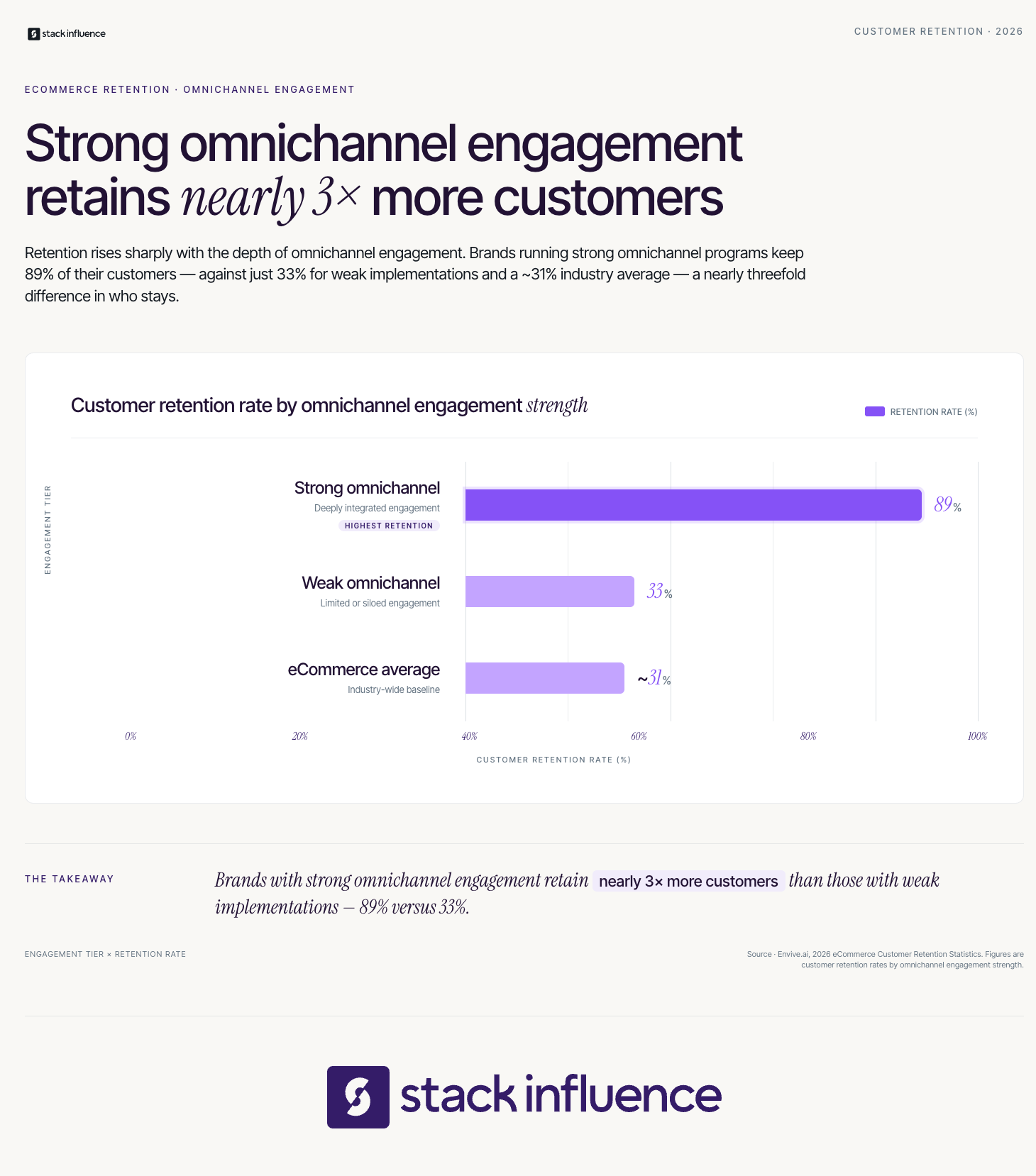
Companies with strong omnichannel engagement retain 89% of customers versus 33% for weak implementations, a gap that illustrates why retention is a systems problem. Sellers who treat email as their only retention channel leave the other 56 percentage points of possible retention on the table by ignoring post-purchase SMS, creator content, loyalty mechanics, and marketplace-native tools.
The key inputs to a retention strategy are:
- Post-purchase experience design: what happens in the 72 hours after an order is placed
- Community and content infrastructure: what keeps the brand visible between purchases
- Loyalty mechanics: what structural incentives reward repeat behavior
- Attribution and measurement: what signals tell you the system is working
The Loyalty Loop Framework: A Four-Stage Retention System
The primary framework for this strategy is called the Loyalty Loop Framework, a four-stage sequential model that moves customers from first-time buyers to active brand advocates. Each stage has a specific objective and a specific set of levers. Journey orchestration platforms can help coordinate these stages by connecting customer interactions across the retention journey. You must complete each stage before the next one will perform.
Stage 1 — Deliver. The objective is to exceed the expectation set at purchase. Packaging, speed, unboxing experience, and the first communication after delivery all set the anchor for the relationship. Brands that ship a thoughtful insert, a relevant recommendation, or a personal note at this stage see measurably higher second-purchase rates than those that ship a blank box. This stage happens before any marketing touchpoint can be effective.
Stage 2 — Engage. The objective is to keep the brand in the customer's world between purchase cycles. Smile.io's State of Ecommerce Customer Loyalty report, which analyzed 585 million orders across 100,000+ merchants, found that loyalty-generated value grew year over year across all major commerce industries in 2024. That growth was driven by merchants who maintained consistent post-purchase touchpoints, including email flows, loyalty program check-ins, and creator-generated content that appeared on the customer's social feed organically. Engagement is not a one-time email. It is a sustained presence.
Stage 3 — Reward. The objective is to create structural incentives for repeat behavior. Rewards can be points-based, tier-based, or access-based. The most effective loyalty mechanics in eCommerce combine at least two reward types: one transactional (points, discounts) and one relational (early access, community membership). Companies that personalize rewards and communication see retention rates rise by up to 10%, and 82% of high-performing loyalty programs include personalized experiences such as tailored offers or birthday perks.
Stage 4 — Amplify. The objective is to convert retained customers into a distribution channel. This is where brand ambassadors, UGC creators, and referral programs transform customer relationships into organic acquisition. The Loyalty Loop closes when your most retained customers become the reason new customers find you.
The Loyalty Loop Framework is most effective when all four stages are active simultaneously. Running Stage 3 without Stage 1 is the same as rewarding customers you have not yet impressed.
From Stack Influence's experience running product seeding campaigns across DTC and Amazon seller brands, eCommerce brands that engage a creator layer during Stage 2 of the Loyalty Loop consistently see stronger repeat purchase signals from customers who were exposed to ongoing creator content between purchase cycles versus those reached only through branded email. The creator touchpoint acts as a social reminder that operates outside the inbox.
The Creator Retention Engine: Using Influencers to Hold Attention Between Purchases
One of the most underutilized levers in eCommerce retention is the influencer campaign that runs between launch events. Most brands activate creators for product launches and go quiet between them. That approach maximizes awareness but contributes nothing to the Engage stage of the Loyalty Loop Framework.
Research from Stackla shows that 88% of consumers say authenticity is a deciding factor in which brands they support. Micro influencers and nano influencers deliver that authenticity at a fraction of the cost of macro partnerships because their audiences are smaller, more trust-based, and more likely to overlap with your existing customer pool. A customer who sees a creator they already follow mention your brand a second time between purchases is receiving a retention signal, not an acquisition signal.
According to Collabstr's analysis of over 21,000 influencer collaborations, UGC campaigns more than doubled year-over-year, growing from 15% to 35% of all influencer campaigns in 2025. The reason is structural: UGC video and creator content can be repurposed across email flows, product pages, paid ads, and Amazon storefronts, multiplying the retention value of each piece of content far beyond its original post.
Here is how to structure a Creator Retention Engine alongside the Loyalty Loop:
- Use product seeding to activate micro influencers at Stage 1 of the Loop, creating unboxing content that mirrors the customer experience.
- Assign a cohort of niche micro influencers to post organic content during Stage 2 to maintain social visibility between email touches.
- Move top-performing creators into ambassador and affiliate programs at Stage 4, where their audience becomes a referral channel.
- Collect UGC from every creator interaction for use in content syndication across product pages and paid retargeting.
Micro influencers with 10,000 to 100,000 followers have 2 to 3 times the engagement rates of macro influencers across every platform, which means their organic content is more likely to reach and register with your existing customer base. For Shopify influencer marketing and Amazon sellers running external traffic campaigns, this engagement advantage translates directly into repeat visit behavior.
Stack Influence's internal campaign data shows that eCommerce brands pairing an automated product seeding program with a structured ambassador tier see a meaningful reduction in the time between first and second purchase, particularly in beauty, wellness, and consumable categories where the repurchase window is 30 to 90 days.
The Retention Readiness Audit: A Pre-Launch Checklist
Before scaling any retention program, you need to confirm the operational conditions that make retention possible. The Retention Readiness Audit is a seven-point secondary framework that functions as a pre-flight check before you invest in loyalty mechanics, creator partnerships, or measurement infrastructure. Run this audit quarterly.
- Post-purchase email sequence active: A minimum three-email sequence covering delivery confirmation, product onboarding, and a follow-up check-in should be live before any loyalty program launches.
- Customer segmentation in place: Your customer data platform should separate first-time buyers from repeat buyers, with distinct flows for each segment.
- UGC collection system running: You should have a mechanism to capture, rights-clear, and store creator and customer content for reuse across channels.
- Loyalty touchpoint mapped: Every customer should know how to earn and redeem rewards before their second purchase window opens.
- Creator brief library ready: If you are running influencer campaigns, your briefs should be templated and reusable so campaigns can launch without a four-week production delay.
- Retention KPI dashboard live: At minimum, repeat purchase rate, CLV, and time-between-orders should be visible in a single dashboard before you optimize anything.
- Amazon Attribution tags active (for Amazon sellers): External traffic from creators and ads should be tagged so that the Amazon storefront can capture attribution data and qualify for the Brand Referral Bonus.
The Retention Readiness Audit is not a one-time setup task. Run it every quarter to identify which conditions have drifted out of compliance as your catalog and creator roster scale.
Across campaigns managed on the Stack Influence platform, brands that complete the Retention Readiness Audit before launching a product seeding or ambassador program consistently activate their creator cohorts faster and recover usable UGC assets at higher rates than brands that seed without a pre-launch operational check.
What Does Retention Actually Cost You to Ignore?
Here is the contrarian perspective most retention guides skip: the real cost of poor retention is not the customers you lose. It is the compounding of acquisition costs you pay to replace them. Acquiring new customers costs five to seven times more than retaining existing ones, making poor retention an expensive problem for marketers.
Most eCommerce sellers benchmark their CAC against their first-order revenue. That is the wrong comparison. The correct benchmark is CAC against CLV projected across the full customer relationship. When you calculate it that way, a customer retained for three purchase cycles is typically worth four to seven times what the acquisition ledger shows.
It is estimated that 35% of an eCommerce store's revenue is generated by the top 5% of customers. Those top 5% are not acquired differently. They are retained differently. They received a better post-purchase experience, more consistent engagement, a loyalty mechanic that rewarded their behavior, and brand ambassadors whose content kept the brand present in their world.
The practical implication for DTC brands and Amazon FBA sellers is this: your acquisition spend has a ceiling set by your retention rate. Every percentage point of retention improvement directly lowers the effective CAC for the next cohort of buyers. This is the compounding logic behind the Loyalty Loop Framework, and it is why the framework is sequential rather than modular.
For brands using Shopify influencer marketing or running Amazon influencer program integrations, the creator layer is the most scalable retention investment available at a per-unit cost that matches or beats email for high-intent repeat buyers.
How Do You Measure Retention Without Getting Lost in Vanity Metrics?

The measurement problem in eCommerce retention is not a lack of data. It is the absence of a named, agreed-upon model that tells everyone on the team which numbers actually move the needle. The following model, called the Retention Signal Stack, defines four components that together give you a complete picture of your retention system's health.
The Retention Signal Stack has four labeled components:
- Repeat Purchase Rate (RPR): The percentage of customers who make a second purchase within 90 days of their first. This is the primary early-warning signal for Stage 1 and Stage 2 of the Loyalty Loop Framework. A declining RPR signals a breakdown in the post-purchase experience before any other metric will surface it.
- Customer Lifetime Value by Cohort (CLV-C): CLV calculated separately for each acquisition cohort (by month or campaign source). This allows you to compare the retention performance of customers acquired through influencer campaigns versus paid search versus organic, and optimize acquisition spend toward the channels that produce the most retainable customers.
- Time Between Orders (TBO): The average number of days between a customer's first and second purchase. Reducing TBO by even a few days across your full customer base can materially increase annual revenue without acquiring a single new customer.
- Amazon Attribution Conversion Window (for Amazon sellers): Amazon's Brand Referral Bonus lets sellers earn a bonus when they use non-Amazon advertising to help customers discover products in the Amazon store, with bonuses accumulating as credits to offset referral fees when Amazon Attribution tags are used. Tracking which creator-driven campaigns generate the highest-converting Attribution clicks closes the loop between influencer spend and marketplace revenue.
Reference the Retention Signal Stack in your monthly reporting to avoid the common mistake of optimizing for open rate or follower count instead of the revenue signals that actually predict retention.
Where Creator Partnerships Fit Inside a Retention System
Most brands treat influencer marketing as an acquisition tool. The more accurate framing is that creator partnerships serve both acquisition and retention simultaneously, and the retention function is the one most brands fail to build intentionally.
A micro influencer agency or self-managed creator program that runs ongoing, always-on content gives your existing customers a reason to feel culturally connected to your brand between purchase cycles. This is what brands like Glossier and Liquid I.V. have demonstrated at scale: the creator layer is not a campaign. It is a perpetual presence layer.
For eCommerce brands and Amazon sellers, the most efficient structure is a three-tier creator architecture:
- Seeding tier: 20 to 50 nano influencers and micro influencers receiving product through an automated seeding program, generating UGC and organic reach at the lowest cost per asset.
- Ambassador tier: 5 to 15 creators selected from the seeding tier based on performance, converted into ongoing brand ambassadors with affiliate codes and structured content calendars.
- Strategic tier: 1 to 3 niche macro creators or brand partnerships used selectively for product launches or seasonal amplification.
User-generated content achieves a 28% higher engagement rate on social media compared to traditional branded content. When that UGC is routed back into UGC platforms and displayed on product pages, the retention loop closes: existing customers see their community reflected in the brand, and new customers convert at higher rates because social proof is present at the point of decision.
For Amazon FBA sellers, the creator tier connects directly to the Retention Signal Stack through Amazon Attribution. Each influencer campaign tagged with an Attribution link generates data on which creators drive customers with the highest CLV-C, allowing you to reinvest the Brand Referral Bonus credits into the creator tiers that produce the most retainable buyers.
Conclusion
The difference between eCommerce brands that grow sustainably and those that stay trapped in an acquisition treadmill is not budget. It is the presence of a deliberate customer retention strategy that operates as a system rather than a collection of disconnected tactics. The Loyalty Loop Framework gives you the sequential structure. The Retention Readiness Audit gives you the operational checklist. The Retention Signal Stack gives you the measurement model. And the Creator Retention Engine gives you the always-on social layer that keeps your brand present in customers' lives between purchase cycles. Apply these frameworks in order, measure the right signals, and the compounding economics of retention will do the rest.