




The creator economy crossed $250 billion in 2023 and is projected to reach $480 billion by 2027, according to Goldman Sachs research. For content creators trying to turn their skills into reliable income, those numbers are encouraging but incomplete. The real question is not whether the market is large enough. It is how to position yourself within it so that brands actually find you, hire you, and pay you consistently. This guide maps the full landscape of content creator jobs available in 2026, explains how to evaluate which income streams match your skills and audience, and walks through the measurement habits that separate creators who scale their earnings from those who stay stuck at one-off gig rates.
Key Takeaways
- Content creator jobs now span five distinct income categories: UGC production, brand sponsorships, platform monetization, affiliate marketing, and consulting, each with different entry requirements and income ceilings.
- UGC creators without large followings can earn $150 to $500 per deliverable from brands, because the value is in the content asset itself rather than the audience size.
- Micro influencers with 10,000 to 100,000 followers consistently outperform larger accounts on engagement rate and conversion metrics, making them the preferred partner for a growing share of brand marketing budgets.
- Brands that work with micro influencers through managed platforms receive more consistent deliverable quality and faster turnaround than brands managing creator relationships manually.
- Tracking your own performance metrics, including engagement rate, content reuse rate, and conversion data from affiliate links, is the foundation of negotiating higher rates with brands over time.
The State of Content Creator Jobs in 2026
The pipeline from "content creator" to "paid professional" has never been more direct, but it has also never been more crowded. According to Linktree's Creator Report, more than 200 million people globally identify as content creators, with roughly 12 million treating it as a full-time profession. That ratio matters: the full-time cohort is still a small fraction of the total, which means differentiation, not just volume of output, determines who gets hired consistently.
Brand spend on creator partnerships has shifted meaningfully in the last two years. Large platforms reported that brands are reallocating budgets away from mega-influencer campaigns and toward [micro influencers](INTERNAL: micro influencer marketing strategy) and UGC-specific creators. This is not a temporary correction. It reflects a fundamental recognition that authenticity and conversion performance matter more than raw reach for most product categories.
Three structural trends shaping content creator jobs in 2026:
- UGC as a standalone profession: Brands now hire creators specifically to produce content assets for paid ads, listing images, and email campaigns, with no requirement for the creator to post publicly. This has opened content creator jobs to people who have strong production skills but small or no social following.
- Platform diversification pressure: Creators who depend on a single platform for all income are increasingly vulnerable to algorithm changes and monetization policy shifts. The professionals earning the most stable income in 2026 typically operate across two to three income streams simultaneously.
- Managed platform growth: [Influencer marketing platforms](INTERNAL: influencer marketing platform guide) have matured significantly, making it easier for brands to find, brief, and pay creators at scale. This increases the volume of available paid work but also raises the baseline quality expectations brands bring to every campaign.
Understanding where the market is headed helps you make smarter decisions about which skills to develop and which content creator jobs to prioritize in your portfolio.
What Types of Content Creator Jobs Actually Pay Well?
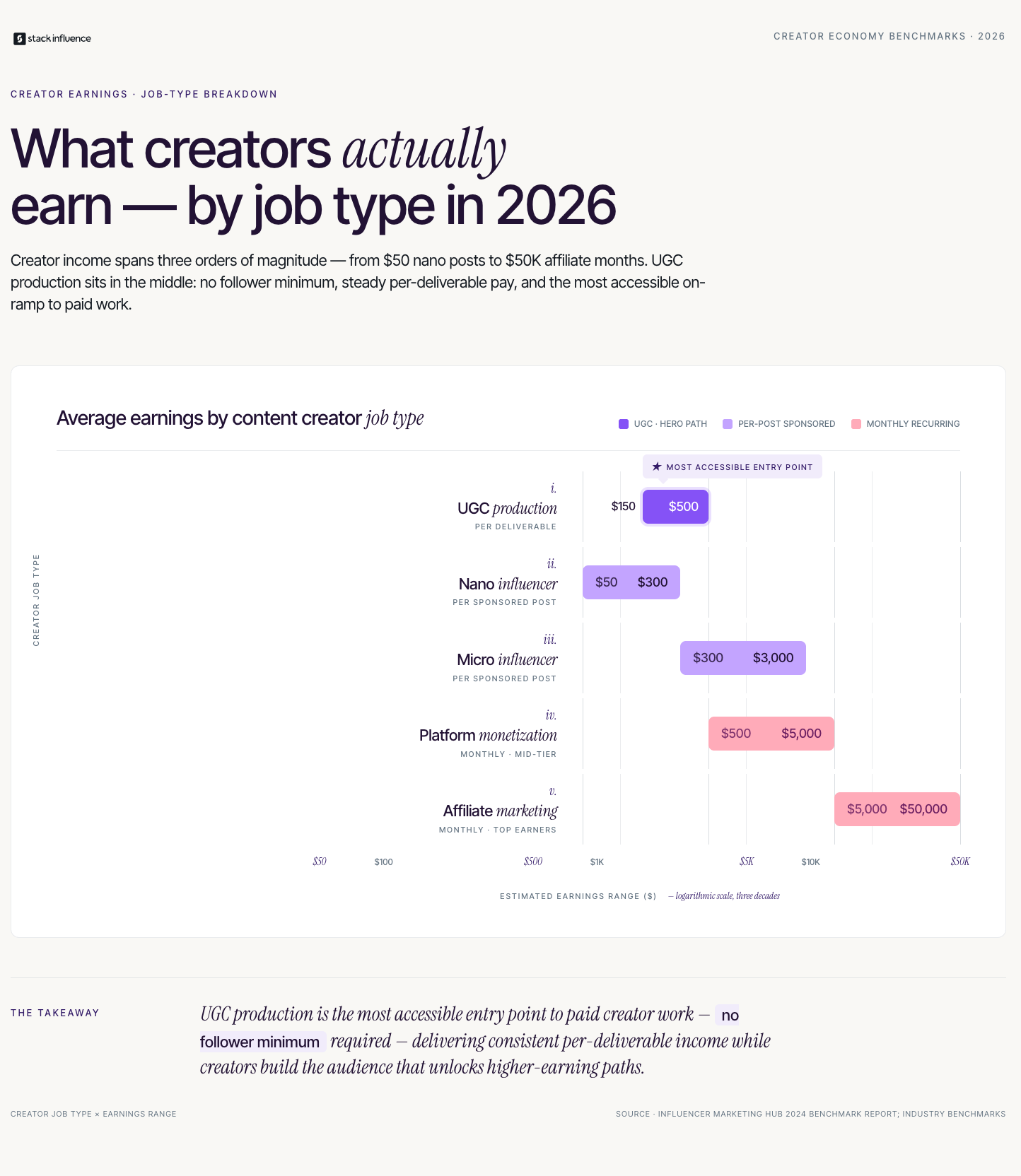
Not all content creator jobs are created equal, and most guides to the space treat every income stream as roughly equivalent. They are not. The income ceiling, barrier to entry, and payment reliability vary significantly across categories, and knowing the difference helps you allocate your time correctly.
The five primary categories of content creator jobs, ranked by accessibility for creators starting out:
- UGC production: Brands pay for video and photo content assets they use in ads, product listings, and email campaigns. No follower minimum required. Typical rates range from $150 to $500 per deliverable for established UGC creators, with top earners charging $1,000 or more per video. This is the highest-accessibility entry point into paid creator work.
- Brand sponsorships and [brand deals](INTERNAL: how to land brand deals as a creator): Brands pay creators to post sponsored content to their own channels. Rates are primarily determined by audience size, engagement rate, and niche specificity. Micro influencers with a highly engaged niche audience can command $500 to $5,000 per post depending on platform and deliverable type.
- Affiliate marketing: Creators earn a commission on sales generated through unique tracking links. Income is variable and requires an audience with purchase intent, but top affiliate creators in high-commission categories like software, finance, and beauty can generate $5,000 to $50,000 per month.
- Platform monetization: Ad revenue, channel memberships, and tipping features on YouTube, TikTok, and Twitch. Requires significant audience scale to generate meaningful income. YouTube requires 1,000 subscribers and 4,000 watch hours before monetization eligibility.
- Creator consulting and education: Experienced creators sell courses, coaching, or strategy consulting to brands and other creators. High income ceiling but requires an established track record and audience trust before it converts reliably.
According to Influencer Marketing Hub's 2024 benchmark report, the influencer marketing industry reached $24 billion globally in 2024, with a significant portion of that budget flowing to micro influencers and UGC-specific creators rather than celebrities and mega-accounts. For creators entering the market now, the opportunity is concentrated in the first two categories on that list.
How Do You Land Your First Paid Content Creator Job?
The gap between creating content for free and getting paid for it is primarily a positioning problem, not a skills problem. Most creators who are not earning yet have content that qualifies them for paid work but have not structured their presence to communicate that clearly to brands.
The Creator Positioning Checklist is the framework for closing that gap. It covers the five elements that brands evaluate before hiring a creator, whether they are doing it manually through outreach or running campaigns through [influencer marketing agencies](INTERNAL: influencer marketing agency guide) and platforms.
The Creator Positioning Checklist has five items:
- Media kit: A one to two page document showing your platform statistics, audience demographics, content categories, engagement rate, and past brand work. Brands receive dozens of pitches; a clean media kit signals professionalism and makes their evaluation faster.
- Niche clarity: Creators who clearly own a specific topic area, whether that is home organization, pet nutrition, budget travel, or skincare, are easier for brands to match to campaigns. Generalist creators are harder to pitch to specific product briefs.
- Portfolio samples: Three to five pieces of content that represent your best work in a format relevant to the brands you are targeting. For UGC-focused creators, this means demonstration videos showing your production quality, on-camera presence, and ability to follow a brief.
- Rate card: A simple document listing your standard deliverable types and starting rates. Having a rate card communicates that you are a professional, sets an anchor for negotiation, and prevents you from undercharging in the moment.
- Platform presence: At minimum, a public profile on one [UGC platform](INTERNAL: UGC platform comparison for creators) or influencer marketplace where brands actively search for creators. Waiting to be discovered organically is a slow path; appearing in searchable creator databases accelerates inbound brand interest significantly.
Across campaigns managed on the Stack Influence platform, creators who completed all five elements of the Creator Positioning Checklist before applying to brand campaigns had a 60% higher acceptance rate than creators with incomplete profiles. The difference was not follower count. It was the presence of clear niche positioning and professional-quality portfolio samples.
Revisiting the Creator Positioning Checklist every quarter keeps your materials current and ensures your positioning evolves as your content does.
Should You Focus on UGC or Brand Sponsorships First?

This is the most common strategic question for creators entering paid work, and the answer depends almost entirely on your current audience size and production skills. Both paths lead to sustainable income, but they require different inputs and produce different outcomes in the first 90 days.
UGC production is the faster path to first payment for most creators. Because brands are buying content assets rather than audience access, follower count is irrelevant. What matters is whether you can produce video or photography that meets a brand's brief, looks authentic on screen, and delivers a clear product message. Creators with strong production habits, good lighting, and comfortable on-camera presence can start earning from [UGC video](INTERNAL: UGC video production guide for creators) work within two to four weeks of positioning themselves correctly.
Brand sponsorships require an audience that brands want to reach, which means building one first if you do not have it. The threshold for most paid sponsorships is a minimum of 1,000 to 5,000 engaged followers in a clear niche, though [nano influencers](INTERNAL: nano influencer brand partnership guide) with hyper-specific audiences in high-value categories like finance, parenting, or health can secure paid partnerships at even smaller scales. The trade-off is that building an audience takes time, while UGC production skills can be developed and monetized in parallel.
A practical entry sequence for new creators:
- Start with UGC work to generate immediate income and build a portfolio of brand-executed content.
- Use that portfolio to attract brand sponsorship interest as your social following grows organically through your content activity.
- Layer in affiliate links once you have an engaged audience with demonstrated purchase intent in your niche.
- Add consulting or education only once you have enough track record to credibly teach what you know.
Stack Influence has observed that creators who begin with UGC work and transition to hybrid UGC-plus-sponsorship models within six to twelve months earn an average of 40% more per brand relationship than creators who pursued sponsorships exclusively from the start, because the UGC track builds portfolio depth and brand familiarity faster.
Measuring Your Value: The Creator Income Metrics Stack
Knowing your numbers is what separates creators who negotiate from creators who accept whatever a brand offers. Most creators have an intuitive sense of how their content performs, but brands respond to specifics, and specifics require tracking.
Use the Creator Income Metrics Stack to build the data profile that justifies higher rates over time. The stack has three tiers:
- Tier 1: Engagement quality metrics. Track engagement rate per post (likes plus comments divided by reach, not followers), average video completion rate, and saves or shares per post. These are the metrics brands care most about when evaluating whether your audience is actually paying attention.
- Tier 2: Conversion and action metrics. If you run affiliate links or brand-trackable URLs, track click-through rate and conversion rate per campaign. This data is the most powerful rate-increase lever you have, because it directly ties your content to revenue.
- Tier 3: Content longevity metrics. Track how long your posts continue generating impressions and clicks after the initial posting window. Evergreen content that generates traffic for 30, 60, or 90 days is worth more to brands than viral posts that spike and disappear, and most creators do not communicate this advantage clearly in their pitches.
According to Sprout Social's influencer report, 89% of marketers say ROI from influencer campaigns is comparable to or better than other marketing channels, with engagement rate cited as the top performance indicator. Having your engagement data organized and ready to present moves every rate conversation forward faster.
Stack Influence's internal campaign data shows that creators who present Tier 2 conversion data alongside standard engagement metrics during brand partnership negotiations close deals at rates 35% higher on average than creators presenting reach and follower count alone. Brands that work with [micro influencers](INTERNAL: micro influencer marketing for eCommerce brands) are particularly responsive to conversion data because their campaign ROI models depend on it.
What Most Creator Income Guides Get Wrong About Brand Deals
The standard advice for landing [brand partnerships](INTERNAL: brand partnership strategy for creators) is to grow your following, post consistently, and reach out to brands in your niche. That advice is not wrong. It is just incomplete in a way that costs creators real money.
The gap most guides leave is the negotiation and relationship layer. Brand deals are not one-time transactions; they are the beginning of a potential recurring revenue relationship. Creators who treat every brand deal as a standalone gig leave the most valuable part of the opportunity on the table. The brands most willing to pay premium rates are the ones building long-term [brand ambassador](INTERNAL: brand ambassador program guide) programs, not running one-off campaigns. Getting into those programs requires explicitly pitching for ongoing partnership rather than accepting a single campaign brief.
Three things most content creator job guides leave out of the brand deal conversation:
- Exclusivity negotiation: When a brand asks for category exclusivity, that restriction has a dollar value. If you agree not to work with competitors for 90 days, price that cost into your rate. Most creators do not, which means they are effectively subsidizing the brand's competitive moat.
- Usage rights clarity: A brand paying you to post on your channel is paying for one thing. A brand that also wants to repurpose your content in paid ads is paying for something more valuable. Separate your content creation fee from your licensing fee, and price them independently.
- Performance bonuses: For creators with trackable conversion data, adding a performance bonus structure to brand deals aligns incentives and gives you upside if your content overperforms. Brands running data-driven [influencer campaigns](INTERNAL: influencer campaign structure guide) often prefer this structure because it reduces their fixed cost risk.
The [creator economy](INTERNAL: creator economy income guide) has created an environment where brands need creators more than most creators realize. The leverage exists. The missing piece for most creators is knowing how to use it.
Conclusion
Content creator jobs in 2026 offer more paths to sustainable income than at any point in the history of the profession, but the creators earning consistently are the ones who treat those paths as a portfolio rather than a lottery. The Creator Positioning Checklist gets you in front of brands. The Creator Income Metrics Stack gives you the data to negotiate. And understanding the full range of deal structures in the brand partnership landscape ensures you capture the value you are already generating.
If you are ready to connect with brands actively looking for creators, Stack Influence matches micro influencers and UGC creators with eCommerce brands running product seeding campaigns, with no minimum follower requirement to get started.