




Most ecommerce sellers chase the same tactics: more ad spend, wider audience targeting, another discount code. The result is predictable — CAC climbs, margins compress, and growth stalls. According to Shopify's global ecommerce sales data, global ecommerce revenue is set to reach $6.88 trillion in 2026, a 7.2% increase from the prior year. The opportunity is real, but the window for low-cost growth has already closed for most DTC brands. After managing thousands of micro influencer campaigns for eCommerce brands across categories, Stack Influence's data shows that sellers who diversify beyond paid ads before scaling see dramatically better unit economics than those who don't.
Key Takeaways
- A structured ecommerce growth strategy built around tiered priorities consistently outperforms ad-spend-first approaches.
- Customer acquisition cost has risen 40-60% since 2023, making lower-CAC channels like UGC and product seeding more strategically important than ever.
- Amazon sellers who use Amazon Attribution and the Amazon Brand Referral Bonus earn back a portion of referral fees on every externally driven sale.
- User-generated content from micro influencers can lift product page conversion rates significantly while producing reusable creative assets.
- Measuring the right metrics, not vanity KPIs, is what separates brands that scale from brands that just spend.
What Is an Ecommerce Growth Strategy?
An ecommerce growth strategy is a coordinated set of decisions about how a brand acquires new customers, retains existing ones, and increases revenue per transaction over time. It is not a single tactic or a seasonal campaign. It is the operating logic that connects your marketing channels, your conversion funnel, and your unit economics into one coherent system.
The defining difference between a growth strategy and a collection of tactics is intentionality. Tactics respond to short-term gaps. A strategy maps the path from where your business is today to where it needs to be in 12 to 24 months, with clear inputs, measurable outputs, and defined decision rules along the way.
For eCommerce sellers operating on Amazon FBA, Shopify, or both, a growth strategy has to address at least three competing pressures: rising paid media costs, platform algorithm changes, and the growing consumer demand for authentic brand experiences. Ignoring any one of these three makes the other two harder to solve.
Here is what a strong ecommerce growth strategy covers:
- Acquisition channels: Which traffic sources will you invest in, and how will you measure their true contribution to revenue?
- Conversion infrastructure: Are your product pages, listings, and storefronts built to convert the traffic you are already generating?
- Retention mechanics: What pulls customers back for a second purchase, and how are you tracking repeat purchase rate?
- Content and social proof: Do you have a system for generating user-generated content and distributing it across paid and organic channels?
- Attribution and feedback loops: Are you able to tell, with confidence, which channels are actually driving profitable growth?
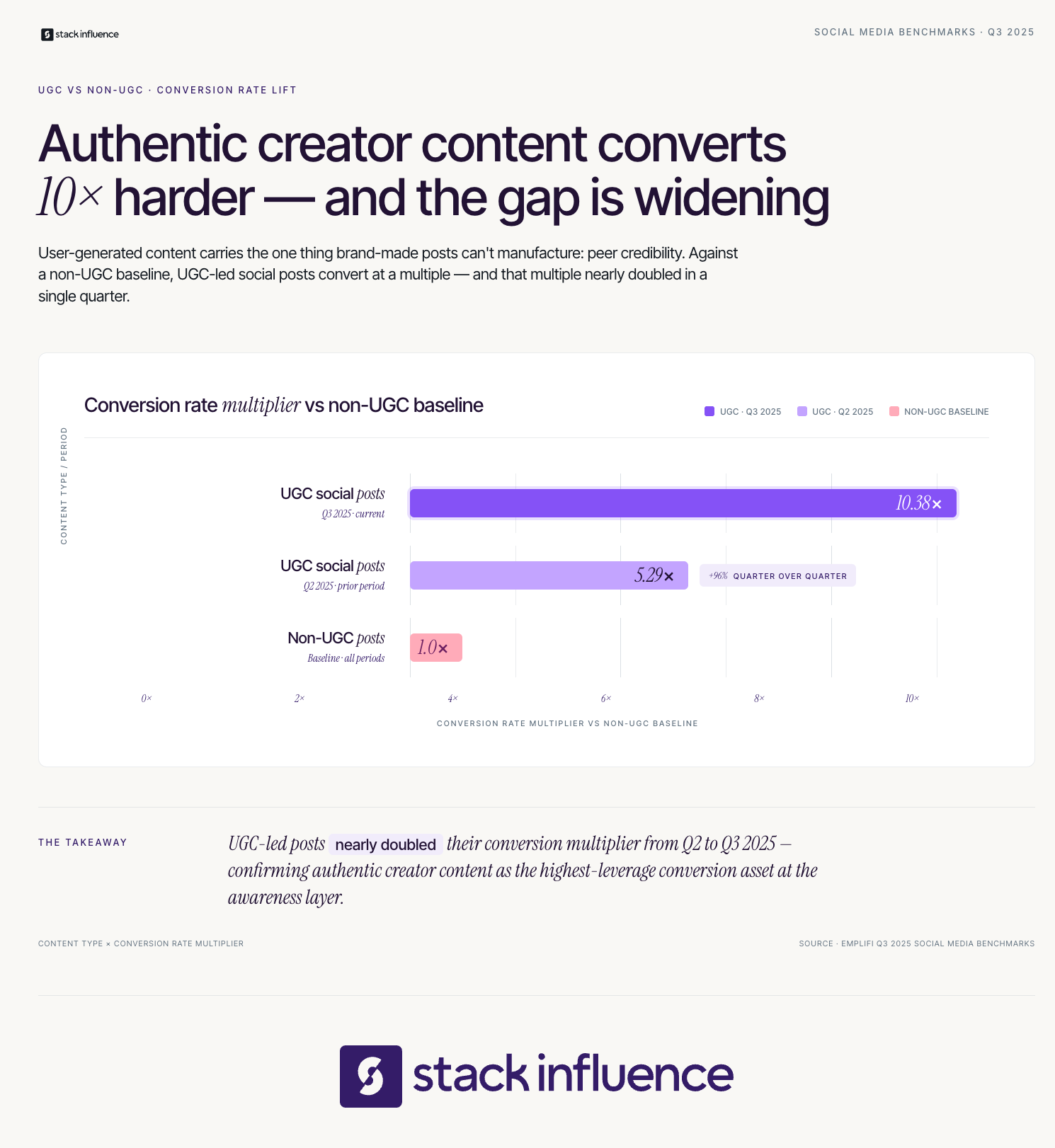
According to Emplifi's Q3 2025 Social Media Benchmarks report, social media posts featuring user-generated content drove 10.38X higher conversion rates compared to non-UGC posts. That single data point illustrates how much leverage authentic content has over traditional brand creative at the acquisition layer. It also explains why product seeding has moved from a nice-to-have into a core component of modern ecommerce growth strategy for brands that understand their unit economics.
Across campaigns managed on the Stack Influence platform, ecommerce brands that incorporate UGC into their product listings within the first 60 days of launch consistently see stronger add-to-cart rates than brands relying solely on professional photography, particularly in competitive beauty, wellness, and home goods categories.
The SCALE Tiers: A Framework for Sustainable Growth
The most common failure mode in ecommerce growth planning is treating all channels and tactics as equal. They are not. Some activities build compounding assets, some produce immediate revenue, and some only work once earlier conditions are met. The SCALE Tiers framework organizes your growth investments into four maturity stages, each with a clear entry condition and a primary output.
The SCALE Tiers are designed to stop sellers from investing in Tier 3 tactics before their Tier 1 foundation is stable. Think of the framework as a growth readiness ladder rather than a menu of options.
Here is how the SCALE Tiers are structured:
- Tier 1 — Stabilize: Get your product-market fit confirmed, your listing or storefront conversion-ready, and your baseline attribution in place. No growth investment works without this.
- Tier 2 — Capture: Activate low-CAC acquisition channels first, including organic social, micro influencer product seeding, and owned email. These build assets, not just impressions.
- Tier 3 — Amplify: Layer paid media on top of proven organic and creator-driven signals. Use what works in creator content as ad creative to reduce production costs and improve relevance.
- Tier 4 — Leverage: Systematize retention, launch ambassador or affiliate structures, and expand to additional sales channels like Walmart or TikTok Shop once your unit economics support the investment.
According to Mobiloud's 2026 ecommerce CAC benchmark report, influencer-generated content delivers roughly 30% lower cost per acquisition than brand-produced content. For brands in the Tier 2 stage of the SCALE Tiers, this is the clearest argument for making creator-led acquisition a primary channel rather than a supplemental experiment.
According to eMarketer data reported by Captiv8, micro-influencers with 50,000 to 100,000 followers saw conversion rates rise 46% year-over-year to 1.3%, while nano-influencers saw revenues per click jump 74%. These numbers make a strong case for why Tier 2 of the SCALE Tiers should prioritize smaller creator relationships over large influencer partnerships, especially for brands that are not yet at Tier 3 scale.
From Stack Influence's experience running product seeding campaigns for eCommerce brands, the brands that move from Tier 1 to Tier 2 fastest are those that brief their creator partners on specific conversion goals, not just awareness metrics. When creators are aligned on what action the brand wants shoppers to take, the resulting content is more likely to include purchase triggers like direct product comparisons, review-style unboxings, and specific use-case demonstrations that resonate with buyers rather than browsers.
The SCALE Tiers framework is also useful for diagnosing growth plateaus. If a brand is stalled, the answer is almost always found by identifying which tier is underdeveloped, not by simply increasing spend on what already exists. Returning to Tier 1 and reinforcing conversion fundamentals is often more valuable than accelerating Tier 3 ad spend on a leaky funnel.
You can see how this framework connects to influencer seeding workflows for ecommerce and why the sequencing matters for brands at different stages of development. For Amazon sellers specifically, strategies designed for Amazon storefronts follow this same tiered progression from listing readiness to external traffic activation.
How Do You Lower CAC Without Sacrificing Scale?
This is where most ecommerce growth strategy conversations get honest. Swell's 2026 DTC ecommerce benchmarks show that average ecommerce customer acquisition costs increased 40-60% from 2023 to 2025, now averaging $68 to $84 across categories. For DTC brands, that number is being pushed higher by iOS privacy changes, rising Meta CPMs, and increased competition from well-funded marketplace sellers.
The genuine insight that most growth guides skip past is this: the answer to a rising CAC is not simply to find a cheaper ad platform. The answer is to reduce the number of paid impressions required before a shopper converts, which means improving the quality of trust signals before and at the point of purchase. That is a content and social proof problem more than it is a media buying problem.
Here are the most effective lower-CAC levers for ecommerce sellers in 2026:
- Micro influencer product seeding: Give product to creators with authentic niche audiences in exchange for honest content. The resulting UGC serves as both trust-building creative and paid ad raw material, making it a dual-purpose asset. Learn more about how UGC from micro influencers reduces paid creative costs.
- Email list building from creator traffic: Driving influencer audiences to a landing page before an Amazon storefront or Shopify checkout allows you to capture emails, creating a retargeting pool that dramatically lowers subsequent acquisition costs.
- Amazon Brand Referral Bonus stacking: For Amazon sellers, combining external traffic with the Brand Referral Bonus program effectively subsidizes the cost of creator campaigns by returning a portion of referral fees on every attributed sale.
- UGC repurposing into paid creative: Brands that use content syndication strategies to repurpose creator content into Meta and TikTok ads consistently report lower CPMs than those using brand-produced video, because the authenticity of creator content reduces ad fatigue.
- Niche micro influencer targeting: Working with niche micro influencers whose audiences match your buyer persona means you are paying for qualified attention, not raw reach. The conversion efficiency of targeted creator audiences offsets the higher per-unit cost of product seeding.
Stack Influence's internal campaign data shows that eCommerce brands using product seeding campaigns structured around creator content repurposing reduce their paid social creative production costs by an average of 35 to 45%, compared to brands sourcing all ad creative through traditional production channels. That cost reduction compounds over time as the UGC library grows, giving the brand progressively more creative variety without additional production spend.
For Amazon FBA sellers, the most overlooked piece of the CAC reduction puzzle is the connection between external traffic quality and organic ranking velocity. Bringing high-intent shoppers from creator posts or email campaigns to your Amazon listing does not just generate sales. It signals purchase intent to the A10 algorithm, which rewards conversion velocity with improved organic placement. That improved placement then generates sales without additional paid spend, making the original creator investment self-reinforcing.
Measuring What Actually Moves the Needle

Every ecommerce growth strategy needs a named measurement system that connects channel activity to business outcomes. Without it, sellers end up optimizing for vanity metrics, including total impressions, follower counts, and broad ROAS numbers, that feel good but do not explain whether the business is actually growing profitably.
The framework for measurement is called the Revenue Clarity Stack, and it has four defined components that work together to give a complete picture of growth health.
Here are the four components of the Revenue Clarity Stack:
- CAC by channel: Track acquisition cost separately for each traffic source, including Amazon PPC, paid social, email, and creator campaigns. Blended CAC hides which channels are profitable and which are subsidized.
- Revenue per visitor: Divide total revenue by total unique visitors for each channel. This single metric tells you whether the traffic you are paying for is actually converting into dollars, not just sessions.
- LTV:CAC ratio: For every $1 spent acquiring a customer, how many dollars does that customer return over their lifetime? The minimum viable ratio for sustainable ecommerce growth is 3:1; most high-growth brands target 4:1 or better.
- Amazon Attribution window performance: For Amazon sellers, this means tracking not just the initial attributed purchase but all purchases made within the 14-day Brand Referral Bonus lookback window. Sales of additional products within that window also earn the bonus credit.
According to Advertise Purple's 2025 guide to the Amazon Brand Referral Bonus, enrolled sellers earn an average 10% bonus on the sales price of products sold through off-Amazon marketing efforts, effectively reducing net referral fees on every attributed sale. For a brand driving $50,000 per month in externally attributed sales, that represents $5,000 in referral fee credits returning to the seller each month.
According to Seller Labs' 2026 external traffic analysis, sellers using external traffic see up to 25% higher conversion rates compared to those relying solely on internal Amazon traffic. When you apply the Revenue Clarity Stack to these numbers, the conclusion is clear: external traffic campaigns that are tracked with Amazon Attribution tags do not just lower CAC. They produce better conversion rates, earn Brand Referral Bonus credits, and improve organic ranking simultaneously.
The Revenue Clarity Stack is also the right lens for evaluating influencer campaigns. Sellers who track revenue per visitor from creator-driven traffic rather than engagement rates make faster optimization decisions. Engagement measures attention; revenue per visitor measures intent. For the purposes of an ecommerce growth strategy, intent is the only metric that feeds the unit economics model.
Apply the Revenue Clarity Stack to your Amazon storefront analytics and attribution setup as the primary measurement layer before layering on platform-specific metrics. You can also integrate this measurement framework with holistic marketing approaches that connect creator activity to downstream conversion data.
The Growth Readiness Checklist
Before adding a new channel or scaling an existing one, the Growth Readiness Checklist gives sellers a fast diagnostic to confirm whether the foundational conditions for profitable growth are actually in place. This secondary framework is designed to be run every quarter, or any time a growth initiative is underperforming expectations.
The Growth Readiness Checklist has seven items, each serving as an independent gate. A "no" on any item is a signal to address that condition before investing further in the channel above it.
Here is the Growth Readiness Checklist:
- Listing or storefront quality: Are your product images, title, bullet points, and A+ content (for Amazon sellers) conversion-optimized and current? Weak listings waste all upstream traffic investment.
- Social proof baseline: Do your products have a sufficient volume of authentic reviews or UGC to establish trust for a first-time visitor? Fewer than 20 reviews on a primary Amazon listing is a red flag before scaling external traffic.
- Attribution infrastructure: Are Amazon Attribution tags or UTM parameters active on every external link? Spending without tracking is guaranteed to produce an unattributable result.
- Email capture mechanism: Is there a mechanism in place to capture email addresses from creator-driven or social traffic before or alongside the purchase? Email is the lowest-CAC retention channel available.
- Creator content library: Do you have at least five to ten pieces of authentic UGC available for creative testing and paid amplification? Without a creative library, paid social performance degrades quickly from ad fatigue.
- CAC by channel visibility: Can you see your acquisition cost for each individual channel today, not just blended across all channels? If not, you are making budget decisions with incomplete information.
- LTV tracking: Do you know what a customer acquired from each channel is worth at 90 days and 365 days? Without LTV data by channel, you cannot accurately evaluate whether a given acquisition investment is profitable.
The Growth Readiness Checklist works alongside the SCALE Tiers framework to give sellers both a maturity roadmap and an operational gate. The SCALE Tiers tell you where to go next. The Growth Readiness Checklist tells you whether you are actually ready to go there. Used together, they prevent the most common growth mistake in ecommerce: scaling a channel before the foundation beneath it is solid.
For brands that are newer to creator-led acquisition, reviewing how micro influencer campaigns work at the platform level and checking influencer marketing case studies from comparable brands can accelerate the checklist process by showing what good looks like before committing significant budget. Many sellers also find it useful to review 2026 influencer marketing predictions to ensure their Growth Readiness Checklist includes channels that will still be worth investing in 12 months from now.
Data from Stack Influence's micro influencer campaigns suggests that brands with a complete UGC content library of at least ten pieces of reusable creator content before launching paid amplification see 2 to 3 times the click-to-purchase rate on their paid social ads compared to brands launching paid campaigns with only brand-produced creative. The library is the leverage. Building it through product seeding before scaling paid is the sequencing decision that separates efficient growers from expensive ones.
Conclusion: Build the Strategy, Then Build the Scale
An ecommerce growth strategy is not something you set once and revisit annually. It is a living system that requires quarterly recalibration as CAC shifts, platforms evolve, and consumer trust preferences change. The five pillars covered here, including clear strategic framing, the SCALE Tiers framework, low-CAC acquisition through creator content, measurement via the Revenue Clarity Stack, and pre-scaling diagnostics through the Growth Readiness Checklist, give eCommerce sellers a structured way to grow without burning budget on an unstable foundation.
The brands that will win in 2026 and beyond are not necessarily the ones with the largest ad budgets. They are the ones that build compounding assets including creator content, email lists, authentic reviews, and attribution clarity, and then invest paid dollars on top of an already-converting system. Start with the SCALE Tiers to locate where you are in your growth journey. Then run the Growth Readiness Checklist before you write the next media check.
Sustainable ecommerce growth strategy requires patience with the foundation and boldness with the scale. The sequence matters as much as the investment.