
The latest info on influencer marketing trends, micro influencer news, and the world of social media

The full 2026 eCommerce news archive, updated every month with every Amazon, Shopify, and DTC update from our weekly recaps.
This article was last updated on Septemeber 8th, 2026.
This page is the complete, continuously updated archive of every eCommerce news update we've covered so far in 2026. Instead of a one-time year-end wrap-up, it grows every month as each new monthly recap closes out, so by December it holds the full year of Amazon, Shopify, and direct-to-consumer news in one place, all on one page.
We add a new month to the top of this page right after that month's recap goes live, so this is the best single spot to scan the whole year of eCommerce news at a glance. For the most recent week-by-week detail, check out the live August 2026 monthly recap.
Want these updates delivered as they break instead of waiting for the monthly rollup? Subscribe to The Merchant Memo to get the weekly version in your inbox.
Also worth bookmarking:
This page grows every month, so the further into 2026 we get, the more useful it becomes as a single scan of everything that mattered in ecommerce this year, no digging through individual newsletters required. Bookmark it and check back after each monthly recap closes.
If you're a seller looking to fill the gap between organic reach and paid ads, worth noting: Stack Influence connects Amazon and Shopify brands with everyday creators for gifted-product collaborations, a workflow that touches several of the trends covered above, from social platforms becoming commerce channels to brands leaning harder on creators for distribution.
Want every update like this as it happens, rather than waiting for the monthly rollup? Subscribe to The Merchant Memo for the weekly version.
Creators who post consistently earn brand deals at a higher rate than those who don't, yet the majority of nano and micro-influencers still rely on manual posting as their default strategy. The gap between knowing you need a system and actually building one is where most creator careers stall. Whether you're managing three platforms or ten, your content scheduler decision shapes not just your output cadence but your perceived professionalism to the brands looking for influencers who can deliver reliably. This guide breaks down exactly what each approach costs you in time, visibility, and partnership opportunity, so you can make the right call for your stage of growth.
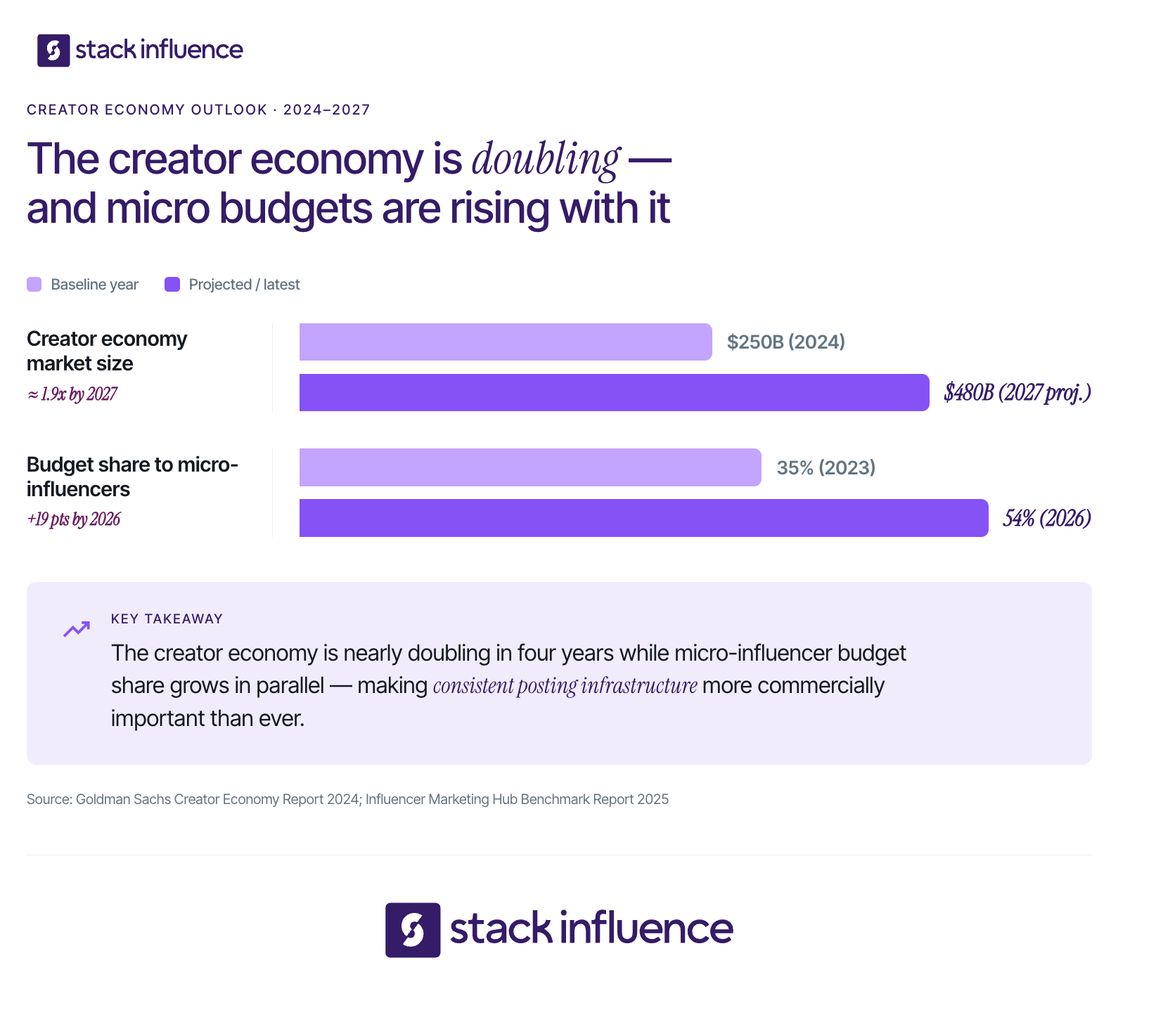
The creator economy has matured past "passion project" territory. According to Goldman Sachs' Creator Economy report, the global creator economy is projected to approach half a trillion dollars by 2027, and brands are allocating larger portions of their influencer budgets to micro-influencers and nano-influencers specifically because of their higher engagement-to-follower ratios. The pressure this creates for individual creators is real: the bar for brand partnerships has risen from "do you post?" to "do you post on a schedule that fits our campaign window?"
Platform algorithms have shifted the stakes further. Instagram's 2026 algorithm guidance now explicitly rewards publishing cadence and watch-time consistency over raw follower count, which means sporadic manual posting has a measurable negative effect on organic reach, not just on brand perception. This algorithmic reality is the single biggest reason creators at every level are reconsidering what manual posting actually costs them.
The debate is no longer philosophical. It's operational. Creators who treat content scheduling as a production tool, not a shortcut, are consistently landing more brand deals, building stronger UGC portfolios, and maintaining the audience engagement metrics that platforms like Stack Influence evaluate when vetting creators for product-seeding campaigns.
A content scheduler is a software tool that allows creators to write, design, queue, and automatically publish content across one or more social platforms at a pre-set time, without requiring the creator to be present when the post goes live. Most schedulers also include features like analytics dashboards, hashtag suggestions, link-in-bio management, and multi-platform cross-posting. The distinction matters: a content scheduler is a publishing automation layer, not a content creation tool.
Modern schedulers range from free-tier products like Later and Buffer to more robust platforms such as Hootsuite, Sprout Social, and Metricool. The most important functional difference between them is whether the tool supports native posting (where the post publishes automatically without a push notification reminder) or reminder posting (where it notifies you to publish manually at the right time). Native posting is the only option that fully removes the manual step.
Manual posting means logging into each platform and publishing content in real time or in the moment. It's the default workflow for most creators starting out, and for very low-volume publishing (one to three times per week, single platform), it's genuinely adequate. The perceived advantage is control: you can react to trending audio, adjust captions based on what's happening in your niche, and engage in the comment section immediately after posting to boost the early engagement signal.
The breakdown happens at volume. As soon as a creator manages two or more platforms, launches a brand partnership campaign, or targets optimal posting times across multiple time zones, manual posting becomes a cognitive drain that bleeds into content quality. HubSpot's 2025 Social Media Trends Report found that creators who batch-create and schedule content report significantly higher output consistency than those who post manually, even when both groups are producing the same weekly volume. The friction of manual posting isn't just inconvenient, it's a compounding tax on creative output.
Consider what manual posting actually requires at the campaign level:
None of this is impossible, but every step adds cognitive load that could be redirected toward shooting better content, writing stronger pitches, or developing your UGC strategy for the next campaign.
The central framework for building a scalable creator workflow is what we call the Creator Dispatch Sequence, a five-step process that takes content from idea to scheduled queue without sacrificing the authentic voice that brands want from micro-influencers and UGC creators. Reference this sequence whenever you're evaluating whether your current system can support campaign-level deliverables.
Rather than creating one post at a time, dedicate a single 90-minute session to producing a full week of content. This protects your creative energy and ensures visual consistency across posts. The Creator Dispatch Sequence starts here because batching removes the daily decision fatigue that derails manual posting schedules.
Move all finished content into your scheduling tool's media library in one upload session. Keeping everything in one queue prevents the asset-hunting that wastes time on manual posting days. For creators managing brand-deal deliverables, this also creates a shared library that's easy to hand off or reference for campaign reporting.
Draft captions in a separate document before pasting them into your scheduler. Writing off-platform removes the distraction of live feeds, allows proper proofing, and makes it easier to hit FTC disclosure requirements (FTC's 2023 endorsement guidelines require clear and conspicuous disclosure for sponsored content, and scheduling in advance gives you time to double-check compliance before the post goes live).
Use your scheduler's analytics tab to assign each post to its recommended time slot. This is where native scheduling outperforms reminder-based tools: the post fires automatically without requiring you to stop whatever you're doing at 7:14 AM on a Tuesday. The Creator Dispatch Sequence treats timing as a variable to optimize, not a constraint to work around manually.
Schedule 15-minute check-ins at 30 minutes, 4 hours, and 24 hours after each post goes live to respond to comments and engage with early reactions. This step keeps automated scheduling from creating a "post and ghost" dynamic that lowers engagement rates and reduces algorithmic reach. Brands and micro-influencer platforms evaluate engagement rates alongside post frequency, so protecting this window matters.
The Creator Dispatch Sequence is designed for creators at the nano-influencer and micro-influencer level who are beginning to take on brand partnerships. Reference the sequence when auditing your current posting workflow or when onboarding a new brand deal that requires consistent deliverable scheduling.

Choosing between content scheduler tools depends on three primary variables: the number of platforms you manage, the volume of brand-deal deliverables you're producing, and whether you need native auto-publishing or can tolerate reminder-based posting. For creators running one or two platforms with fewer than five posts per week, a free-tier tool like Buffer or Later covers the basic queue and timing functions without added cost. Creators managing three or more platforms or producing UGC content at campaign volume need native multi-platform posting, analytics reporting, and ideally a media library.
The Creator Dispatch Sequence works inside any scheduler that supports native publishing. The tool choice matters less than the workflow discipline.
Here's a practical breakdown by creator stage:
For creators working within structured influencer campaigns, the scheduling layer integrates with the broader campaign workflow. Stack Influence, for example, coordinates product-seeding campaigns across its network of roughly 600,000 vetted creators, and the completed-post accountability model it uses means creators who arrive with a reliable scheduling system are better positioned to execute deliverables on time and at the posting frequency campaigns require. The Creator Dispatch Sequence maps directly to how vetted micro-influencer campaigns are executed in practice.
Two shifts make 2026 materially different from prior years for creators evaluating their scheduling approach. First, short-form video native scheduling has finally matured. Until late 2024, platforms including TikTok and Instagram Reels required third-party workarounds or only supported reminder-based scheduling rather than true auto-publishing. Multiple major schedulers now support native Reels and TikTok auto-publishing, which removes the last significant friction point that drove creators toward manual posting for video content.
Second, AI-assisted caption generation has moved from gimmick to genuine workflow accelerator. Buffer's 2025 State of Social Media report noted that creators using AI-assisted draft features in scheduling tools cut caption writing time by a meaningful margin without a measurable drop in engagement quality, as long as they edited the output rather than posting AI drafts verbatim. This matters for UGC creators specifically: the expectation for authentic, brand-specific voice means AI-assisted drafting works best as a first-pass tool within the Creator Dispatch Sequence's Step 3, not as a replacement for human editing.
A third shift worth flagging is the rise of cross-platform scheduling penalties. Some platforms now suppress content that is detected as being posted with identical captions and hashtags simultaneously across multiple channels. This penalizes lazy batch scheduling but does not affect well-executed scheduling, where captions are platform-adapted before publishing. The Creator Dispatch Sequence's off-platform caption writing step addresses this directly.
Measuring the effectiveness of your content scheduling system requires tracking outputs at two levels: publishing performance and business impact. Publishing performance tells you whether the system is working mechanically. Business impact tells you whether it's working commercially. A good scheduling system should improve both.
Use the following three-tier metric stack, which we call the Creator Posting ROI Stack:
Tier 1: Publishing Consistency
Tier 2: Algorithmic Performance
Tier 3: Commercial Impact
Attribution in influencer marketing is genuinely complex, and creators shouldn't assume a scheduler alone drives commercial outcomes. But a creator who tracks Tier 1 consistently, reviews Tier 2 weekly, and monitors Tier 3 across campaign cycles has the data to make a credible case to brand partners that their content operation is reliable and performance-oriented. That data readiness is part of what a product-seeding platform evaluates when matching creators to campaigns.
Most scheduling guides focus on when to post and how often. The metric they consistently omit is deliverable consistency rate, which measures what percentage of your brand-deal posts go live on time, on platform, and with the correct disclosures within the agreed campaign window. This figure is invisible to public analytics tools, but it's exactly what brands track internally when deciding whether to re-engage a creator.
For micro-influencers and nano-influencers building toward repeat brand partnerships, deliverable consistency rate is arguably more important than follower count or engagement rate in isolation. A creator with 15,000 followers and a perfect deliverable record is a lower-risk investment than one with 80,000 followers and a history of late or missing posts. Forrester's B2B influencer marketing research consistently highlights creator reliability and campaign execution quality as top factors brands cite when selecting long-term partners.
To track your own deliverable consistency rate: log the agreed posting date for every brand campaign deliverable, log the actual posting date, and calculate the percentage that were on time. This is a single column in a spreadsheet, takes two minutes per campaign, and produces the one data point brands wish more creators could cite in a pitch meeting.
A verified Stack Influence case study for Blueland, a plastic-free home essentials brand, illustrates what campaign execution at scale can produce: during a 3-month campaign, average monthly unit sales increased 4.7x from 542 to 2,562, and the brand started ranking for 927 new keywords. Those results required 211 creator promotions to execute reliably, which is the kind of campaign volume that collapses without creator-side scheduling systems in place.
Once you've committed to a scheduling workflow, the setup decisions you make in the first week shape whether the system compounds or decays over time. Here is a practical implementation checklist for creators who are new to scheduled posting or who are upgrading from a reminder-based tool to native auto-publishing.
Start by auditing your current posting performance before switching tools. Pull the last 30 days of data from each platform's native analytics and note your actual posting frequency versus your intended frequency. This gap number is your baseline problem, and it tells you how much structure your new system needs to provide.
Connect all active platforms to your scheduler in a single onboarding session. Avoid the common mistake of connecting platforms one at a time over several weeks, which creates inconsistent data in your analytics dashboard and makes the Creator Dispatch Sequence harder to execute cleanly. Most tools offer a guided connection flow that takes 10 to 15 minutes per platform.
Set a weekly batching appointment in your calendar for 90 minutes, then protect it the way you would protect a brand-deal meeting. Hootsuite's 2025 Social Trends Report found that creators who schedule content creation time as a calendar block publish 40% more consistently than those who create ad-hoc, even when both groups report the same weekly intention. The scheduling habit is the result, but the calendar block is the cause.
Creators managing active brand partnerships can learn more about how product seeding campaigns are structured at the campaign level, and how a reliable posting workflow plugs into that execution model. If you're building toward UGC creator work specifically, the UGC creator resources on Stack Influence offer a useful reference for the deliverable expectations brands set when working with creators at the micro and nano level.
The final setup step is to define your posting calendar format before the first batch session. Whether you use a shared Google Sheet, your scheduler's built-in calendar view, or a dedicated project management tool is less important than committing to one format and using it consistently. Creators who can show a brand partner a documented content calendar during a pitch conversation signal operational maturity that most of their competitors cannot.
Manual posting still has a legitimate place in the creator toolkit for specific scenarios. Breaking news and trending moments require real-time publishing that a scheduled queue cannot anticipate. Live event coverage, same-day product launches, and reaction content are all situations where the value of immediacy outweighs the efficiency of a pre-set queue. The answer for most creators is not manual versus scheduled but rather when to use each within the same workflow.
A practical rule of thumb: schedule your core content calendar using the Creator Dispatch Sequence, then reserve 20% of your posting slots as open windows for reactive or real-time content. This hybrid model captures the consistency benefits of scheduling without making your feed feel robotic or disconnected from what's happening in your niche right now.
The creator workflows that perform best in 2026 treat a content scheduler not as a replacement for creative judgment but as the operational infrastructure that frees creative judgment to work at its best. Brands looking for influencers who can be trusted with product launches, gifted campaigns, and brand ambassador programs are not looking for creators who post whenever the mood strikes. They're looking for creators who post reliably, measure their own performance, and bring a deliverable history that makes a campaign manager's job easier. Your content scheduler is the most direct investment you can make in becoming that creator.
If you're building toward brand partnerships or creator partnerships that go beyond one-off posts, explore how micro-influencer campaigns are structured to support creators at every stage, from first brand deal to repeat campaign partner.
The global influencer marketing platform market was valued at $20.24 billion in 2026 and is projected to grow to $70.86 billion by 2032, with 93% of brands using Instagram for influencer marketing. Yet most eCommerce sellers who open an Instagram influencer database for the first time walk away frustrated. They find enormous creator lists but no practical path from discovery to completed post. Choosing the right database is not about the biggest number on a pricing page. It is about finding the workflow that matches how your brand actually runs campaigns.
Influencer marketing is entering 2026 with a contradiction that every marketer will recognize: budgets are set to expand quickly, while the operational realities of execution, creator costs, authenticity risk, and measurement friction, are not getting easier. That tension is most visible in creator discovery. Finding the right Instagram creator still feels manual, even when the database has millions of profiles.
Across one benchmark survey, 600+ respondents reported aggressive budget expansion and short payback expectations, paired with a continued shift toward nano and micro and UGC-driven production. The takeaway is that 2026 rewards teams that treat influencers as an operating system: clear platform roles, repeatable creative iteration, defensible measurement design, and quality controls that scale with volume.
For eCommerce sellers specifically, two bottlenecks dominate:
An Instagram influencer database is a searchable platform or software tool that indexes creator profiles from Instagram and other social channels, allowing brands to filter by follower count, engagement rate, audience demographics, niche, location, and fraud signals. These platforms contain analytics data including follower counts, engagement rates, audience demographics, content categories, and verified contact information. They help brands discover, evaluate, and connect with Instagram influencers for marketing campaigns.
The category spans a wide range of product types. Some tools function purely as discovery engines, giving brands a searchable index with no built-in outreach or campaign management. Others bundle discovery with CRM, gifting workflows, affiliate tracking, and post verification. A third category, the managed execution platform, removes discovery almost entirely and handles sourcing, vetting, shipping, and post confirmation on behalf of the brand.
Knowing which type matches your current stage prevents the most common mistake sellers make: paying for a large self-serve database when what they actually need is operational support.
The 3 Laws of Database Fit is a named principle set designed to help eCommerce sellers choose the right Instagram influencer database before they pay a subscription fee. Most comparison articles rank platforms by feature count. The 3 Laws of Database Fit cuts to the three decisions that actually determine whether a platform creates ROI.
Apply these three laws before committing to any Instagram influencer database:
The 3 Laws of Database Fit appear in the platform reviews below to help anchor each recommendation to a real operational decision.
The most counterintuitive truth in influencer discovery is that a larger database does not guarantee better creator matches. This is the contrarian position most sellers do not hear before they purchase the wrong tool.
Platforms compete aggressively on database size as a marketing metric. [Modash indexes 380M+ influencer profiles](https://www.modash.io/influencer-database) across Instagram, TikTok, and YouTube.
HypeAuditor's database contains 227.8M+ accounts across Instagram, YouTube, TikTok, X, and Twitch. These are genuinely large pools. But raw volume creates its own problem: without tight fraud detection and audience-side filters, a massive database simply multiplies the number of irrelevant or fraudulent results a brand has to sift through.
The smarter frame is not "how many creators are indexed?" but rather "how many qualified creators can I reach given my product, price point, and target audience?" A database of 30 million profiles with verified engagement data and four years of historical sponsorship history can outperform a database of 380 million profiles with no fraud layer.
Brands using three-layer verification, which combines AI fraud detection, manual audience audit, and performance-based payment structures, report 89% lower fraud exposure than brands relying on follower count alone. For Amazon FBA and Shopify sellers running product seeding campaigns, that fraud gap translates directly into wasted product and lost budget. The 3 Laws of Database Fit rewards the seller who tests quality signals before signing an annual contract.
The platforms below are reviewed by type and use case. Each review covers definition, differentiator, use-case scenario, and limitation. Stack Influence is reviewed first as an eCommerce-first managed platform, followed by self-serve database tools organized by the problem they solve best.
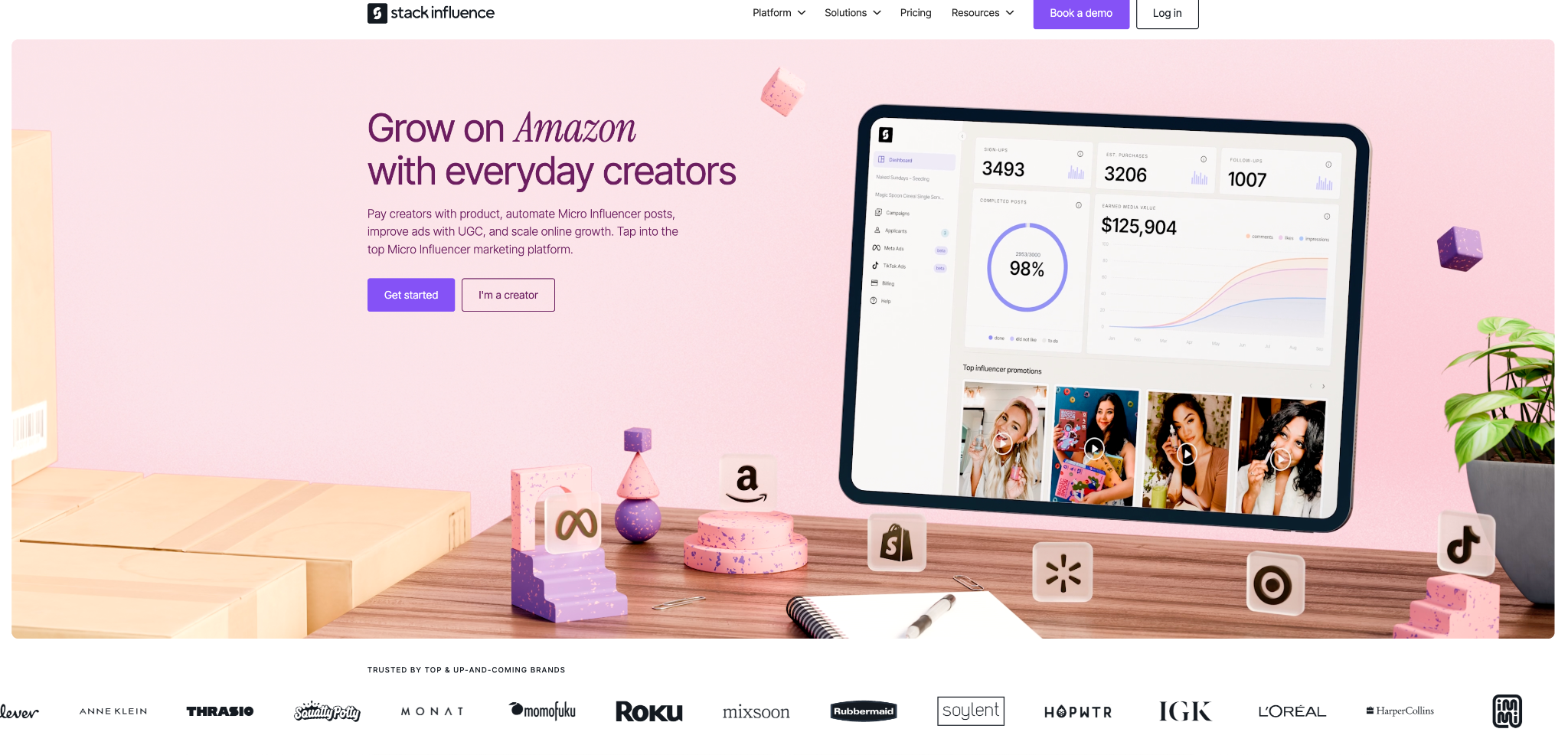
Stack Influence is a micro-influencer marketing platform built for eCommerce sellers who need completed posts, not just creator lists. Unlike traditional Instagram influencer databases, Stack Influence operates on a gifted-first, product-seeding model: creators receive the product, post to their audience, and the brand pays only after post completion. The platform's network consists of roughly 600,000 vetted creators, approximately 78% female, sourced and vetting through an AI-driven process that evaluates psychographic, demographic, and geographic fit before matching.
The key differentiator is the "influencer insurance" mechanism. Because creators buy the product directly through the platform workflow and payment is triggered only by a verified post, sellers face no inventory loss from creator drop-off. This makes Stack Influence structurally different from a discovery database: it functions as a managed execution layer. A verified Stack Influence case study for Blueland, a plastic-free home essentials brand, shows average monthly unit sales increasing 4.7x from 542 to 2,562 during a 3-month campaign, paired with 927 new keyword rankings and page-1 placement for "foaming hand soap," a keyword with 26K monthly searches. The campaign also delivered 13x ROI across 211 creator promotions. Sellers running Amazon FBA or Shopify stores who want micro-influencer UGC at volume without managing outreach, logistics, and completion follow-up themselves will find this model reduces operational overhead significantly compared to self-serve databases.
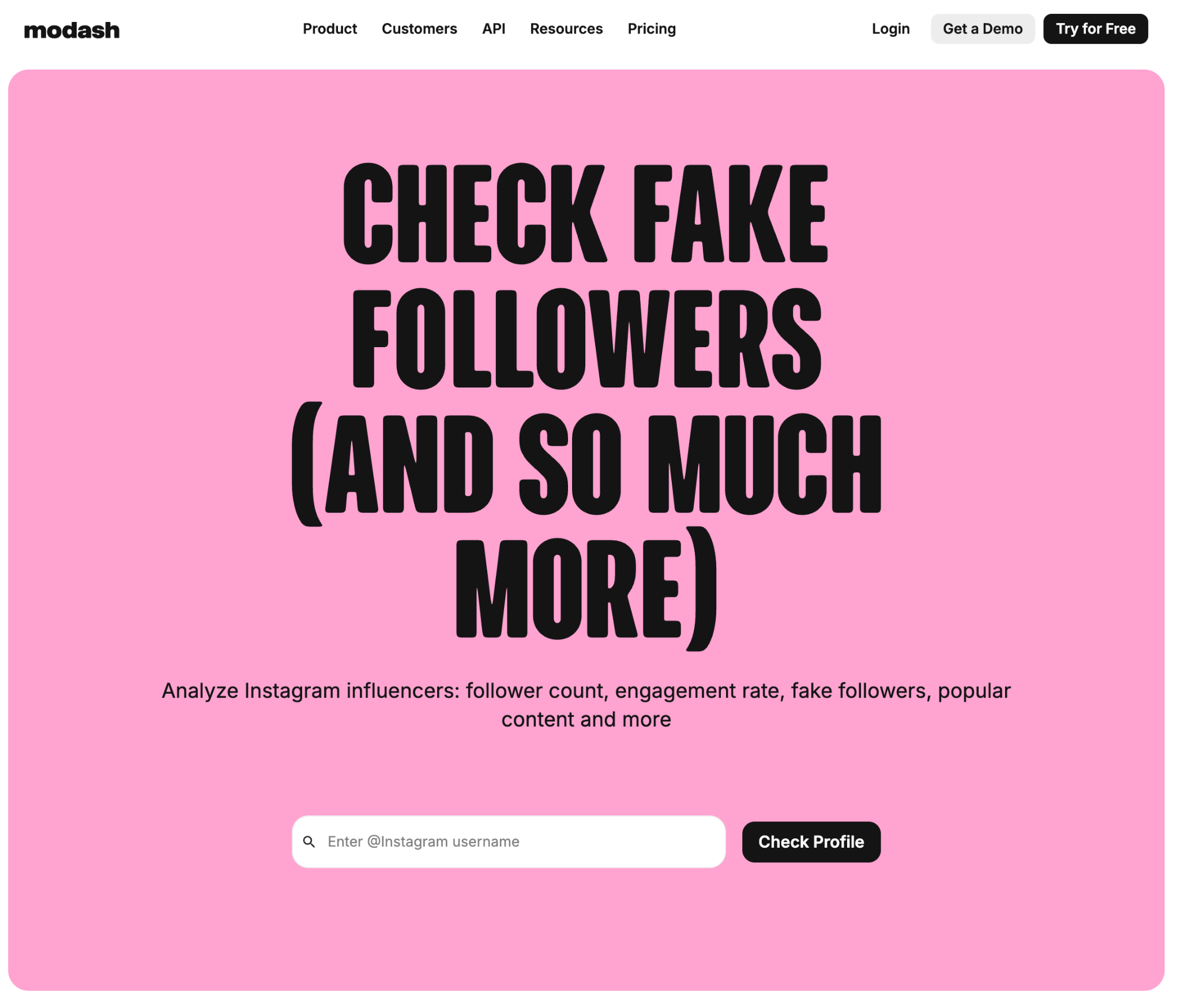
Modash is a self-serve influencer discovery and analytics platform that saves brands time by providing all the data needed upfront: fake follower checks, engagement rates, growth rates, audience demographics, and more. Its database covers every public Instagram, TikTok, and YouTube profile over 1,000 followers.
The differentiator is scale combined with transparent pricing. Modash indexes 380M+ influencer profiles across platforms. One multi-year user described it as one of the best tools for influencer discovery and analytics. For eCommerce teams that need to shortlist hundreds of creators across a niche category quickly, Modash's filter depth, which includes audience location, engagement quality, past sponsorships, and email-finder functionality, makes it one of the most efficient research tools available.
A Shopify seller or Amazon brand that has an internal team member handling outreach should use Modash as a discovery and pre-vetting layer. Modash also covers Shopify affiliate tracking at a lower price point than enterprise alternatives, making it practical for mid-market teams. The limitation is that discovery is where Modash stops. It does not handle gifting logistics, post confirmation, or managed outreach at scale. Sellers who need the full workflow covered will need to stack additional tools or a managed service alongside it.
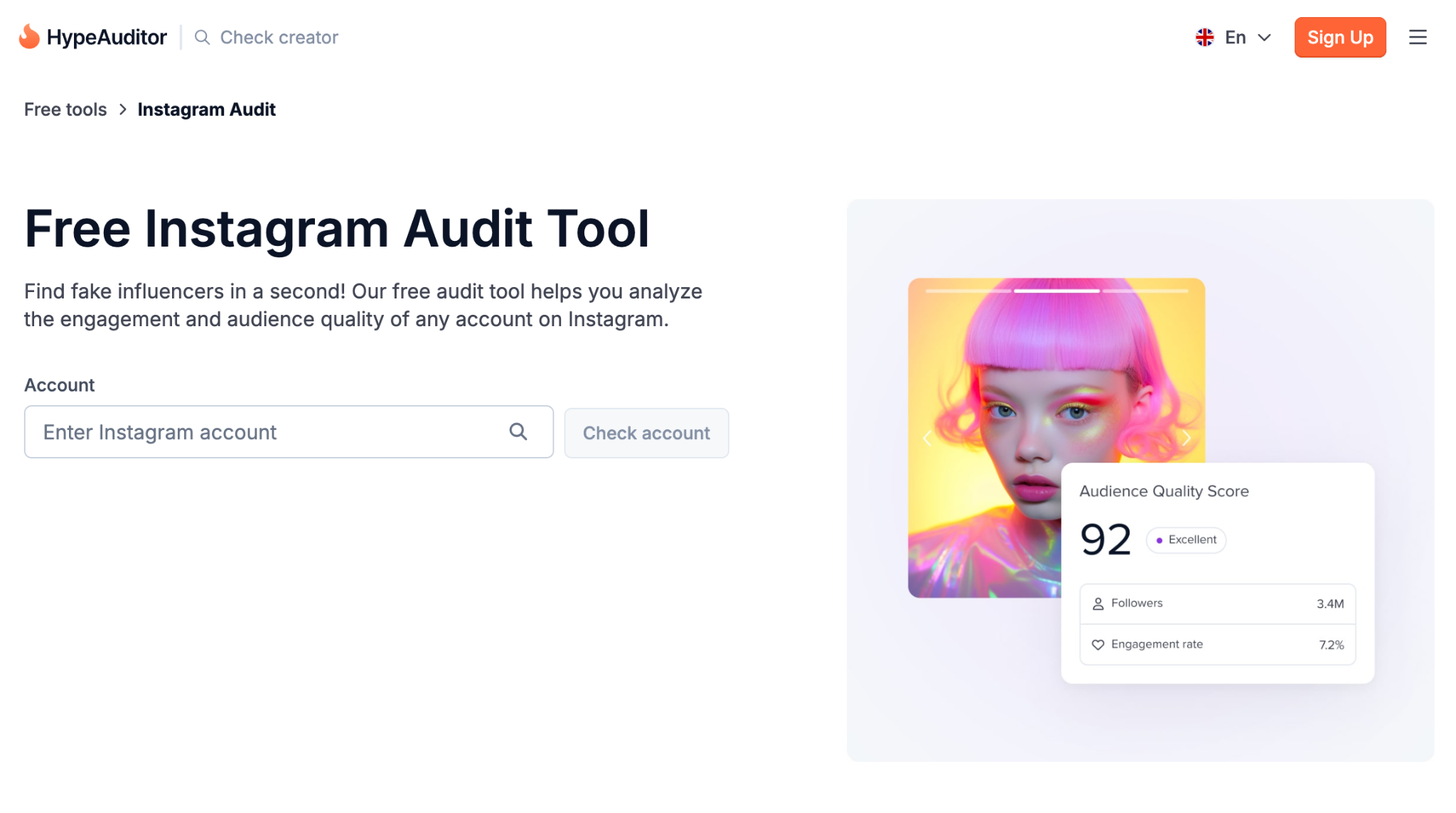
HypeAuditor offers a massive influencer database containing 227.8M+ accounts across Instagram, YouTube, TikTok, X, and Twitch. Brands apply filters to discover the perfect influencer match. Its defining capability is audience quality scoring, which is particularly valuable for sellers who have been burned by bot-inflated follower counts.
HypeAuditor's Audience Quality Score assigns a numerical rating to each creator based on follower authenticity, engagement legitimacy, and audience composition. HypeAuditor provides an Audience Quality Score that automatically flags suspicious activity so brands don't waste budget on inactive accounts. For beauty, health, or CPG sellers on Amazon where fake followers create real risk of wasted product seeding budget, HypeAuditor's fraud layer is one of the most rigorous available. The platform also supports brand-mention monitoring, so sellers can identify creators who already post about their product category without being approached.
The limitation is positioning: HypeAuditor is primarily a research and vetting tool. Campaign management, outreach automation, and gifting logistics require integration with separate systems. Teams that want a combined discovery-plus-execution environment will need to pair HypeAuditor with a CRM or managed service.
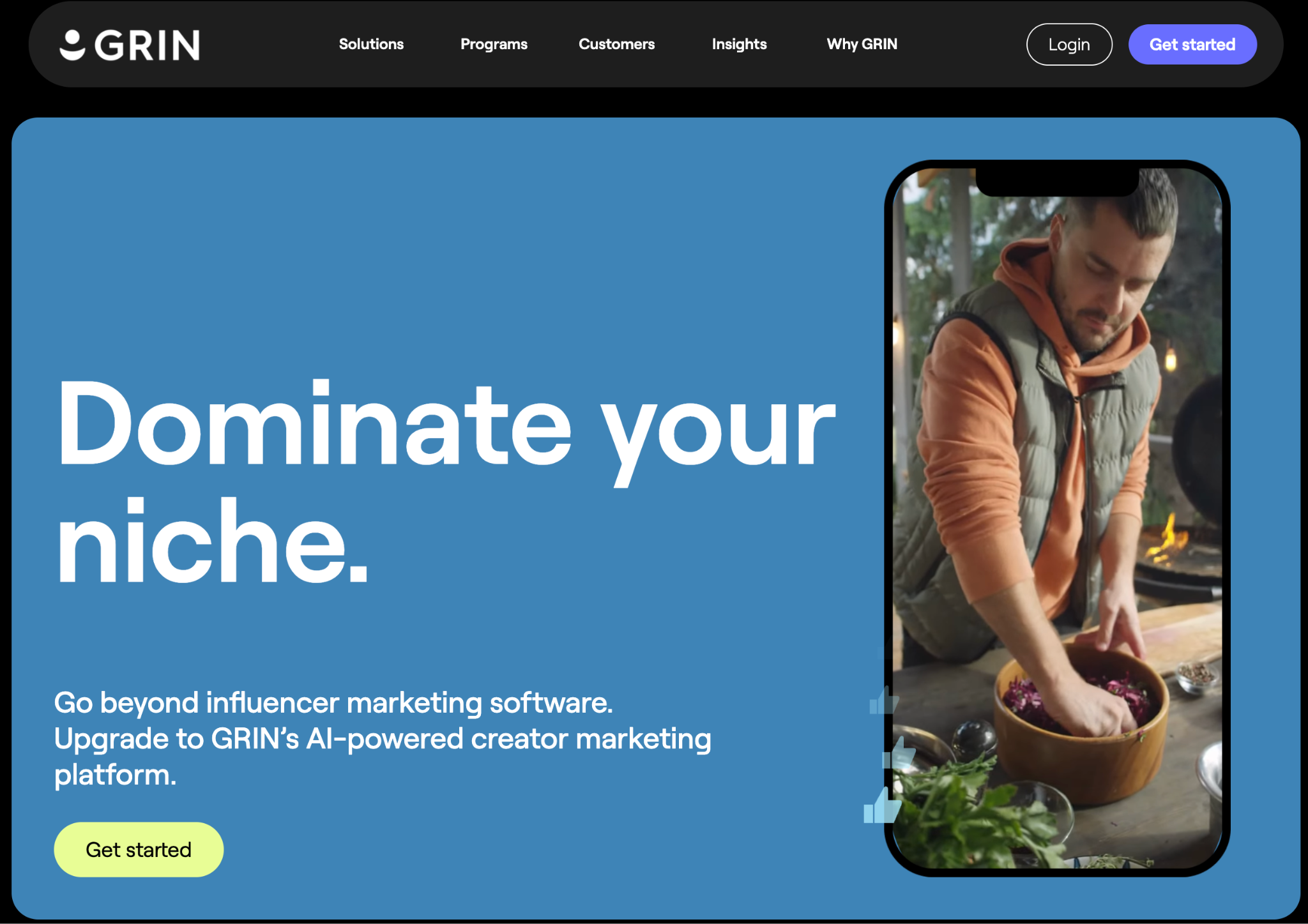
Billed as the world's first influencer marketing platform, GRIN has features that automate a ton of workflows. From housing all communication under one roof to product seeding, payment, and contract management, GRIN simplifies a great deal of influencer marketing tasks. The platform integrates with all major ecommerce software, making it an ideal choice for large ecommerce brands in the beauty, fashion, and lifestyle niches.
GRIN's differentiator is its deep Shopify and Magento connection. It connects directly to Shopify, Magento, and other storefronts, allowing brands to track influencer-driven sales at the SKU level. For an established DTC brand already running high-volume ambassador and affiliate programs, GRIN provides the most comprehensive native eCommerce integration in the self-serve category, covering gifting, contracts, content approval, and sales attribution in one place.
The limitation is in discovery. GRIN relies on first-party authentication, so their creator pool is limited. Brands that need to work with a wider range of influencers or unlock new markets may struggle and will need to purchase a separate tool for recruitment purposes. GRIN also commands enterprise pricing, which makes it harder to justify for sellers still validating their influencer channel.
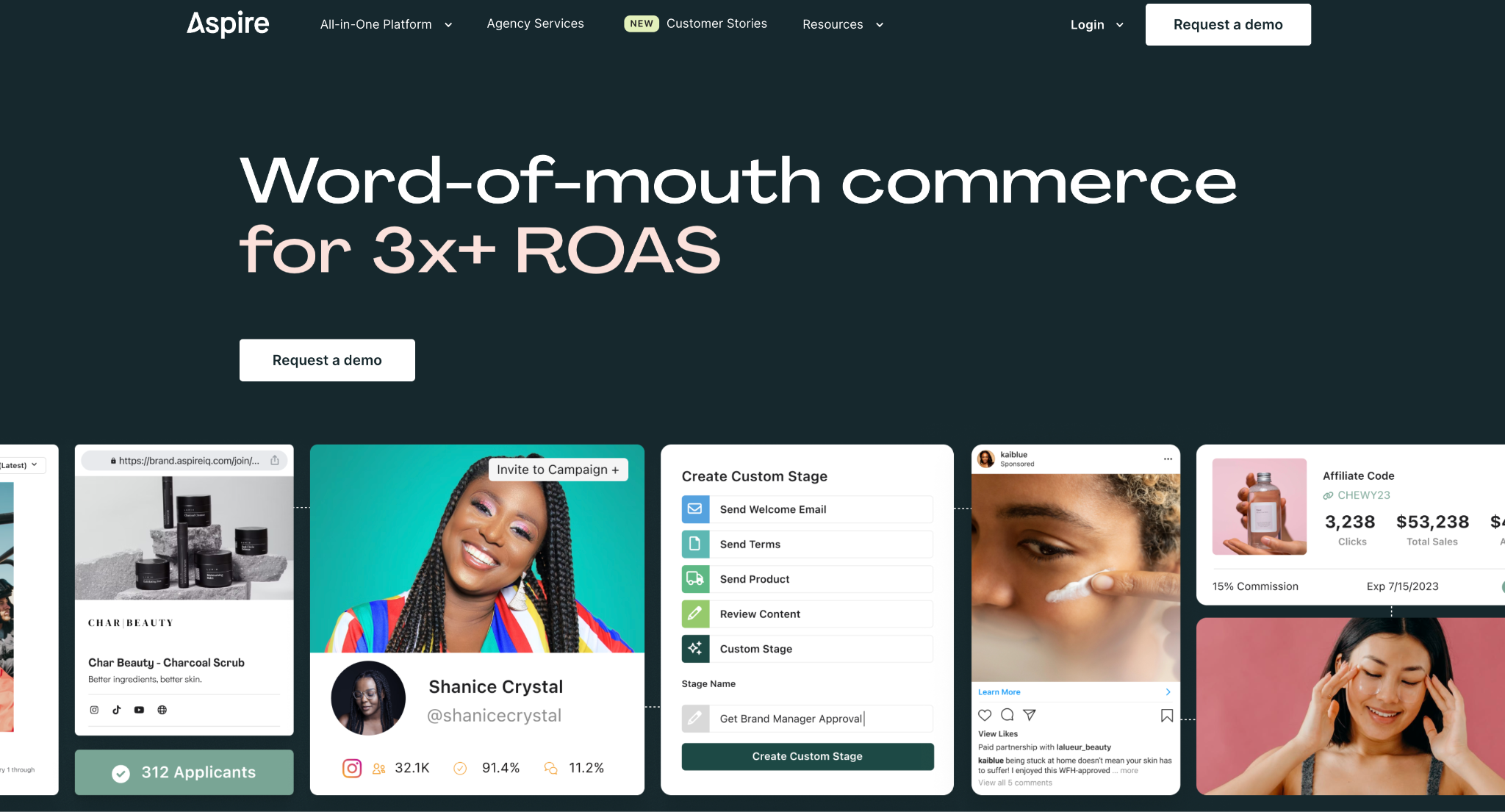
Aspire is an influencer marketing platform built for direct-to-consumer eCommerce brands that need more than a creator database. Founded in 2013, the platform covers the entire campaign lifecycle: discovering creators across Instagram, TikTok, YouTube, Pinterest, and Facebook; managing contracts and product gifting; reviewing and approving content; tracking affiliate sales; and repurposing creator content into paid social ads.
The differentiator is Aspire's inbound creator marketplace. Aspire maintains a database of over 500,000 creator profiles with image-recognition AI that lets brands search by visual content style rather than keywords alone. Creators managed through the platform generated $52 million in attributed affiliate sales in a recent reporting period, a 45% year-over-year growth, reflecting the platform's shift toward measurable social commerce performance. Aspire is best suited to mid-market and enterprise brands that want creators to apply inbound, reducing cold outreach fatigue.
The limitation is cost structure. Pricing starts around $2,299 to $2,499 per month with a mandatory 12-month contract and no free trial or self-serve option. For earlier-stage Amazon sellers or Shopify brands still testing whether influencer marketing works for their category, the annual commitment creates real financial risk before product-market fit is confirmed.
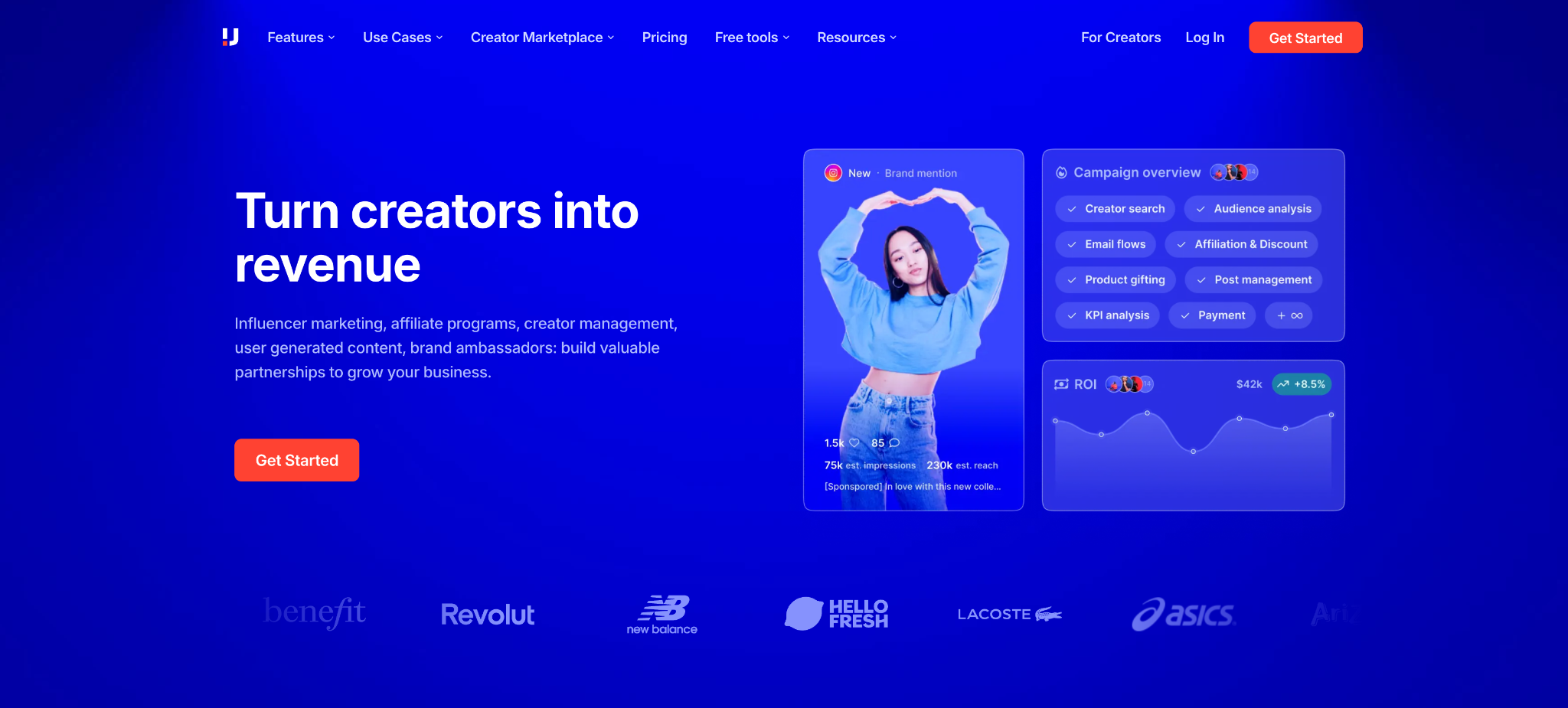
Upfluence's sharper edge is finding influencers who already buy from you. Upfluence pulls customer data from Shopify or WooCommerce and surfaces existing customers with a following, which often beats cold-sourcing strangers. This customer-to-creator capability is genuinely difficult for competitors to replicate at the same depth.
Upfluence reports that eCommerce-linked influencer campaigns produce 27% higher ROI than untracked campaigns, a stat that reflects the platform's performance-driven focus. For Shopify sellers with an existing email list or customer database large enough to surface creator-customers, Upfluence is a differentiated starting point because it uses first-party data you already own.
The limitation is pricing complexity. One user managing a couple hundred creators on Upfluence said the platform kept pushing toward the enterprise tier as soon as they started scaling. The module-based pricing on minimum 12-month contracts means you need to know exactly which features you need before signing, or you will pay for capabilities you never touch.
Traackr is an influencer marketing software solution known for its data-led approach for the influencer lifecycle. It emphasizes building authentic relationships with influencers and has a large global database. Traackr has features for discovery, vetting, campaign management, and performance measurement. It offers end-to-end campaign management features, relationship management tools, and content tracking that includes social listening for brand mentions and industry trends.
The differentiator is enterprise-grade benchmarking. Traackr data shows brands using the platform see 40% better ROI visibility and reduce influencer fraud by 22%. For brands running influencer programs across multiple international markets where compliance, governance, and category benchmarking are non-negotiable, Traackr delivers the most rigorous analytical layer in the category. Traackr also integrates with the Amazon Brand Referral Bonus ecosystem, which makes attribution cleaner for sellers using Amazon Attribution links.
The limitation is that Traackr is built for planning and analysis more than fast execution. The tradeoff is that it is a planning and intelligence tool more than an execution engine. Teams that need to move from discovery to posted content within days rather than weeks will find its implementation and governance layers create friction.
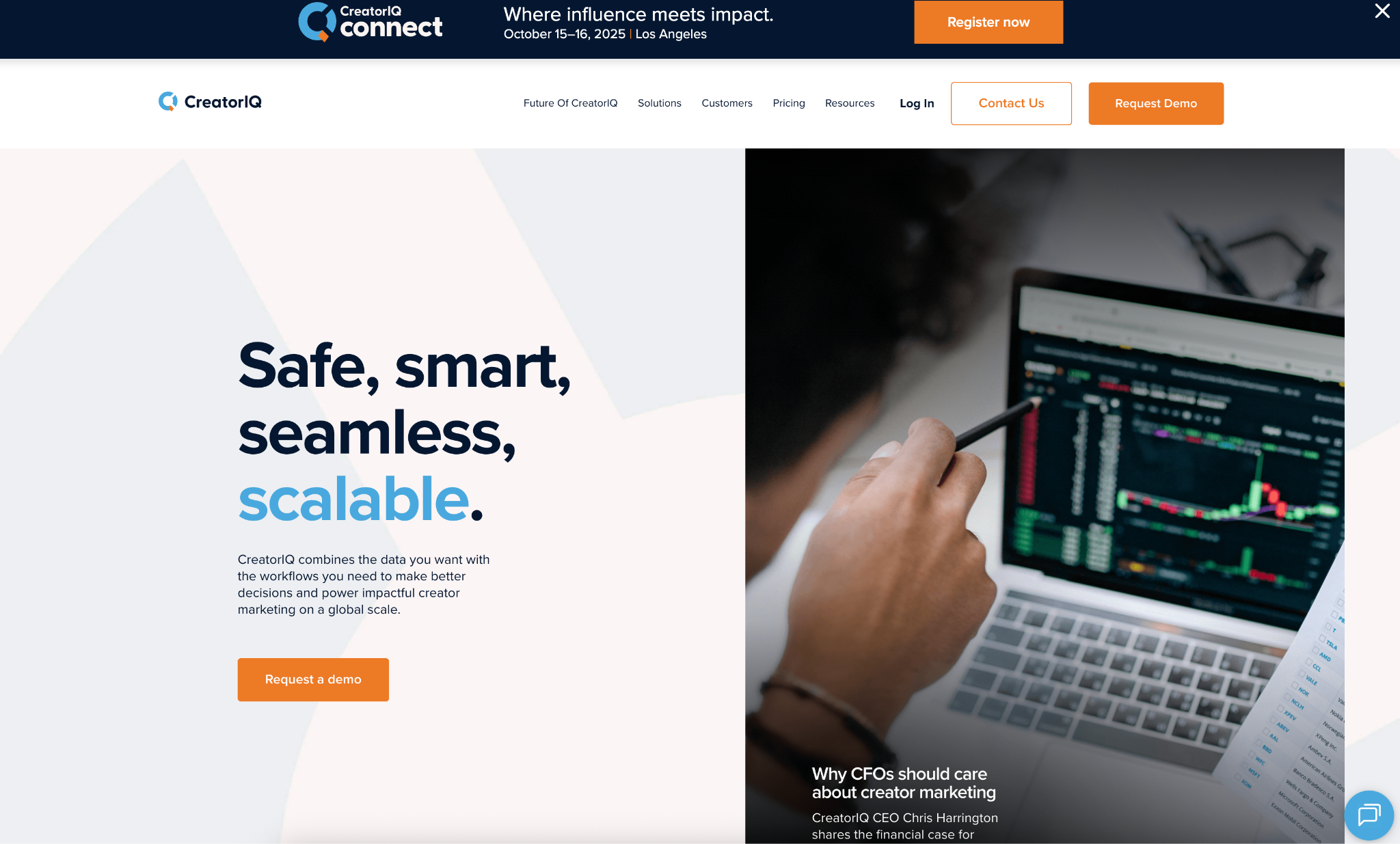
CreatorIQ is one of the most sophisticated influencer marketing platforms available. The platform has strong analytics and reporting tools, and its integrations with other marketing and ecommerce tools make it an ideal choice for brands that need an interconnected tech stack.
The differentiator is API-level data access. CreatorIQ is built for organizations where influencer partnerships go through legal review, procurement approval, and brand safety checks before anything goes live. Those steps happen inside the platform: contracts, content approvals, vetting. As an official TikTok Marketing Partner, CreatorIQ pulls data directly from TikTok's API, meaning more reliable numbers and access to metrics most platforms cannot pull at all.
The limitation is the price floor and complexity. Pricing is not listed on CreatorIQ's website. According to Capterra, it starts at $36,000 per year. This positions CreatorIQ firmly in the enterprise tier. Amazon sellers or DTC brands with fewer than $50,000 in monthly influencer-attributed revenue will rarely justify the investment.
The right Instagram influencer database depends on one primary constraint. Use the 3 Laws of Database Fit as your filter and select based on what your operation actually needs:
The right metrics for tracking Instagram influencer database performance depend on campaign stage and conversion goal. For eCommerce sellers, the most actionable metrics sit in three tiers: reach quality metrics (engagement rate, audience authenticity score), conversion proximity metrics (traffic to listing, promo code redemptions, affiliate link clicks), and business impact metrics (unit sales lift, Best Seller Rank movement, and new keyword rankings during the campaign window).
The Commerce Attribution Stack is the secondary decision tool for this article. It is a three-tier measurement model sellers can apply regardless of which Instagram influencer database they use:
Apply the Commerce Attribution Stack after every campaign wave and compare Tier 2 and Tier 3 results by creator to identify which audience segments and content formats drive actual purchases, not just views.
The most common gap in Instagram influencer database guides is the operational one: they cover search and selection but stop before product ships. For eCommerce sellers, the journey from database shortlist to verified, reusable UGC involves several workflow steps that database tools alone do not handle.
A practical execution flow using any of the platforms above looks like this:
While cash compensation remains standard, Aspire's 2026 State of Influencer Marketing report reveals that 86% of creators are still willing to work exclusively for free products. For eCommerce sellers, the gifted-only model paired with structured completion verification is one of the highest-leverage combinations available in 2026. The influencer seeding workflow reduces negotiation overhead while producing authentic content that platform algorithms favor over paid-ad creative.
The sellers who extract the most value from an Instagram influencer database are not the ones with the biggest campaign budgets. They are the ones who build a repeatable sourcing and activation system that feeds fresh UGC into every part of their marketing funnel.
Here is where Stack Influence's gifted-first product seeding model becomes operationally relevant. Rather than maintaining a self-serve database subscription and managing individual outreach, brands submit campaign goals, product details, and creator criteria. The platform sources from its vetted network, handles logistics, confirms posts, and delivers a dashboard with creator funnel status, verified social links, and downloadable UGC assets. The platform handles product seeding, conveying promotional guidelines, and purchase-to-post workflows so brands can sit back, track, and collect verified social post links with full-rights UGC assets in one simple dashboard.
For sellers who want to use a self-serve discovery database for some campaigns while delegating high-volume seeding waves to a managed platform, these two approaches are complementary. The database gives you creative research and one-off creator activations. The managed platform gives you scalable, brand-safe UGC without building an internal creator operations function.
The influencer marketing industry reached $32.55 billion in 2025 and is on track to pass $40 billion in 2026. The sellers who win in this environment are not the ones chasing the largest Instagram influencer database. They are the ones applying the 3 Laws of Database Fit to find the platform that removes their specific bottleneck, verifying creator quality before budget commits, and building a measurement stack that connects creator activity to real business outcomes.
Start by identifying your primary constraint: creator discovery, operational throughput, or sales attribution. Then match that constraint to the platform category that solves it. The right Instagram influencer database is the one that gets products in front of qualified creators and turns that activity into verifiable sales momentum, not just impressions.
The era of posting any clip and hoping the algorithm rewards it is finished. In 2026, the answer to how long TikTok videos should be is no longer "as short as possible," because the algorithms have evolved and platforms are now prioritizing meaningful watch time over simple view counts. For influencers, micro-influencers, and UGC creators building brand deals, this shift changes everything about how you plan, shoot, and cut content.
Content creators operating in 2026 are navigating a platform that has matured significantly from its short-clip origins. The average TikTok video length is now 42 seconds, up from 25 seconds in 2022, as creators shift toward 1-minute-plus content for monetization. That single data point signals a structural change in how the creator economy operates on this platform. The For You Page algorithm drives approximately 70% of total video views, meaning most discovery still comes from non-followers.
Understanding why length matters starts with understanding what the algorithm actually measures. Completion rate is TikTok's primary engagement signal, and the right length depends entirely on your content type, since TikTok's recommendation algorithm scores content on several engagement signals, with completion rate being among the most heavily weighted. A video that runs 90 seconds but earns only 30% completion will underperform against a 30-second clip that earns 80% completion every time.
Here is what the data shows about how viewers actually watch:
TikTok video length refers to the total runtime of a clip posted to the platform, which currently supports a minimum of 3 seconds and a maximum of 10 minutes for in-app recordings. The platform uses this duration alongside watch-time data to calculate completion rate, which is the percentage of your video the average viewer watches, and this metric directly influences how widely TikTok distributes your content to new audiences. Shorter videos are easier to complete, which naturally boosts completion rates, but they also limit how much value you can deliver and whether they qualify for monetization.
According to Social Insider's 2025 benchmarks, completion rate is the strongest ranking signal on TikTok, and videos with over 50% average completion rate receive significantly more algorithmic distribution regardless of how long or short they are. This means the length question cannot be answered in isolation from your hook quality, pacing, and content value. TikTok does not reward length; TikTok rewards retention.
The most useful way to think about video length decisions is as a maturity framework that maps to your goals as a creator, not just your content type. The Creator Length Maturity Model organizes decisions across three tiers based on where you are in your creator journey and what outcome you are optimizing for.
The Creator Length Maturity Model distinguishes between creators who need quick algorithmic signal, creators building loyal audiences, and creators running content like a media business.
Tier 1: Signal Builder (Under 30 Seconds)
This tier is for creators who are new, testing content concepts, or participating in trends. Short videos generate algorithmic feedback quickly because a 15-second clip can accumulate completion data in hours rather than days. The goal at this tier is learning what resonates with your audience, not maximizing watch time. The 11 to 18-second range typically generates the highest completion rates, replay loops, and engagement for maximum virality. If you are building a portfolio of UGC video content for brand pitches, short demos can also demonstrate your on-camera presence efficiently.
Tier 2: Audience Builder (30 to 90 Seconds)
This is the working tier for most established micro-influencers and nano influencers producing content regularly. For most creators in 2026, the optimal TikTok video length is 30 to 90 seconds for talking-head, educational, and opinion content because it is long enough to deliver substance while short enough to maintain strong completion rates. Brand sponsorship content typically lives in this range because it gives creators enough runway to introduce a product authentically. Based on analysis of 2.19 million TikTok clips, the most popular video length is 30 to 60 seconds, accounting for 38.5% of all content. The Creator Length Maturity Model treats this tier as the engagement sweet spot for most creators operating inside influencer campaigns.
Tier 3: Media Operator (60 Seconds and Above)
This tier is for creators running their TikTok presence as a serious revenue business. The Creator Rewards Program, TikTok's primary direct-pay program, requires a minimum of 60 seconds per video, so every creator who wants platform monetization must operate at this tier for at least some of their content. TikTok specifies that eligible content must be original, high-quality content over 1 minute long and should accumulate at least 1,000 views on the For You feed. The Creator Length Maturity Model treats Tier 3 as the destination for creators who have already validated their hooks and audience at Tiers 1 and 2.
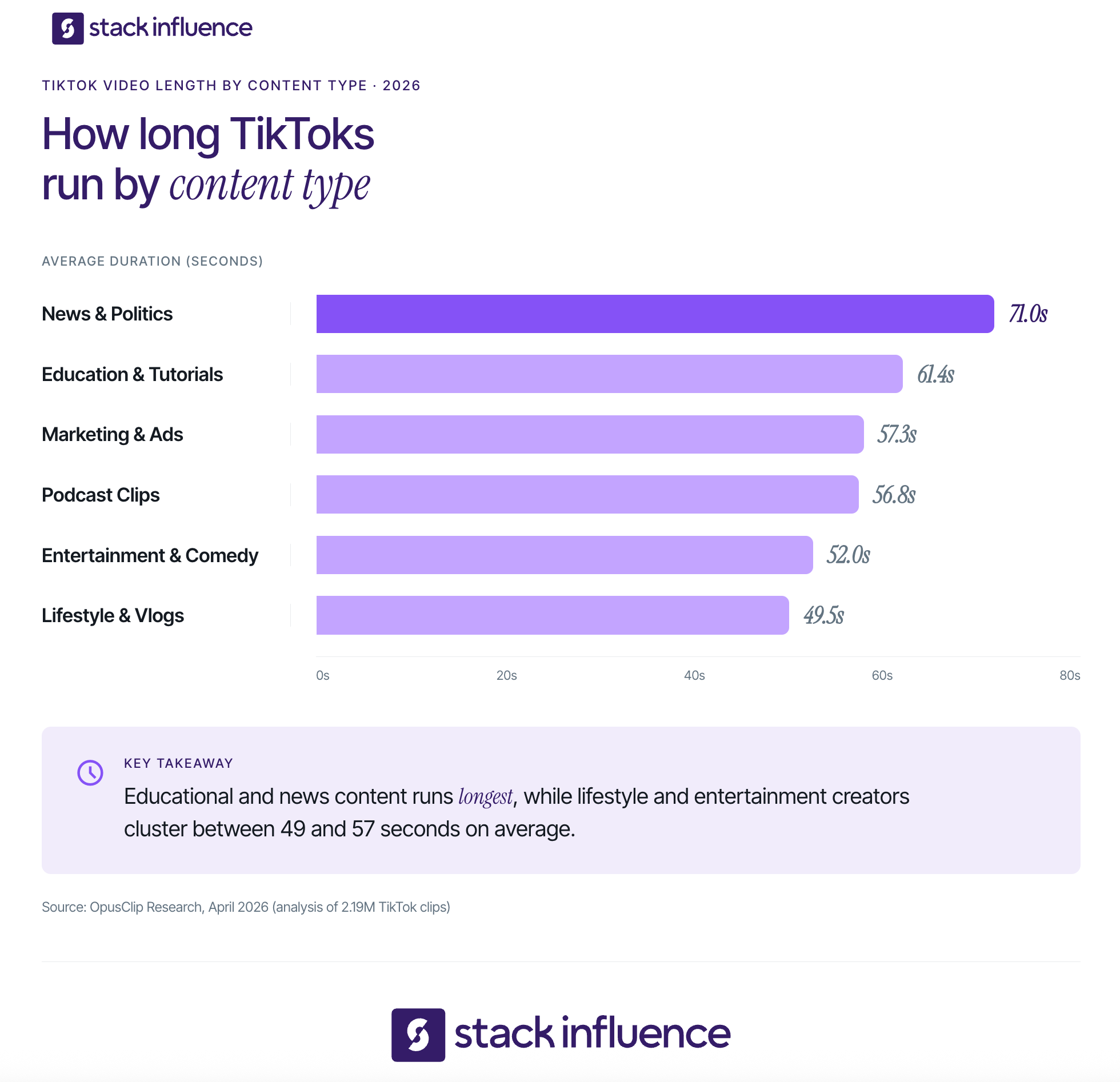
The ideal TikTok video length varies by content type because each format has a natural pace and a viewer expectation that you either match or fight. Matching the natural length of your format maximizes completion rate; fighting it by adding padding or cutting too early destroys the viewing experience and signals poor content quality to the algorithm. Here is how the data breaks down by format for creators in 2026.
Content-type duration benchmarks to use as starting points:
Most TikTok video length advice frames shorter as universally better. The data tells a more complicated story that creators optimizing for brand deals and monetization cannot afford to ignore. This is the contrarian case that most guides leave out.
Although 86% of TikTok videos are under one minute, videos that are 60 seconds or longer get at least 43.2% more reach. That gap exists because longer videos that sustain viewer attention accumulate more absolute watch time, which TikTok weighs positively in its distribution decisions. The issue is that most creators cannot sustain viewer attention through a longer video because their hooks and pacing are not strong enough, not because the algorithm penalizes length.
There is also a monetization reality that most short-form content advice ignores entirely. The one-minute minimum video length for the Creator Rewards Program represents TikTok's strategic push toward longer-form content, and artificially extended content with poor retention will be penalized by the algorithm and generate fewer qualified views even if technically eligible, so the goal is creating genuinely engaging content that holds viewers' attention throughout. Creators who post exclusively under 60 seconds are essentially leaving Creator Rewards income off the table indefinitely, regardless of their view counts.
The third overlooked dimension is TikTok Search, which is expanding rapidly as a discovery channel. Two-thirds of Gen Z users now search TikTok for product reviews, restaurant recommendations, travel planning, and how-to content, and TikTok search queries have grown 174% year-over-year, with brands optimizing for TikTok SEO reporting 3.1x more organic impressions than those relying solely on the For You algorithm.
For TikTok Search, longer videos win for three distinct reasons related to depth, time-on-page, and the ability to cover a search query thoroughly. If you want your content to rank in TikTok Search, the short-clip strategy consistently under-serves that goal.
For micro-influencers and nano influencers pursuing influencer campaigns and brand partnerships, video length is a production decision that affects deliverable quality, content reusability, and the commercial value of the UGC you create. Brands looking for influencers increasingly want content they can repurpose across paid and organic channels.
Stack Influence's gifted-first product seeding model connects creators with eCommerce brands that want authentic, platform-native UGC at scale. In a verified Stack Influence case study for Blueland, a 3-month campaign produced 211 creator promotions, 247,000 social impressions, and 11,000 engagements, with average monthly unit sales increasing 4.7x from 542 to 2,562 during the campaign. The content that performs best in these campaigns tends to match the format expectations of the product category rather than defaulting to a rigid length template.
Content creators building brand partnerships should think about length through this workflow:

Creators should measure TikTok video length performance by tracking completion rate and average view duration percentage across at least 20 to 30 videos at similar lengths before drawing conclusions. Single-video data is statistically unreliable because individual posts are subject to the algorithm's initial distribution phase, trending audio effects, and posting time. The goal is to identify which length category consistently earns the highest completion percentage for your specific content type and audience, then use that as your format baseline.
The Creator Retention Metric Stack is the framework for tracking this systematically:
Creators can access their full performance dashboard by logging into TikTok Studio at studio.tiktok.com, which tracks account metrics like total video views and follower growth alongside video-specific metrics such as average watch time, retention rates, and traffic sources. Running the Creator Retention Metric Stack monthly gives you a personal benchmark that outperforms any generic industry recommendation.
One underappreciated challenge for creators who take on multiple creator partnerships simultaneously is maintaining strong completion rates across a higher volume of posts. Posting more content at inconsistent lengths and quality creates noise in your analytics and makes it harder to identify what is actually working.
The first 2 seconds decide over 70% of viewer retention , which means the highest-leverage investment for any creator, regardless of volume, is writing a stronger hook before worrying about trimming or extending the runtime. A creator who can reliably hook viewers in the first 2 seconds can successfully post at almost any length. A creator with a weak hook will underperform at every length.
Practical production habits that protect completion rate at scale:
Understanding how long TikTok videos should be is not a one-size answer; it is a decision framework you build from your own data, your content goals, and the monetization model you are pursuing. The Creator Length Maturity Model gives you a structured way to think about this: start at Tier 1 to gather signal, build your audience at Tier 2 with 30 to 90-second content, and operate at Tier 3 when Creator Rewards monetization or depth-first search content becomes a priority. Rather than obsessing over the stopwatch, obsess over the value.
For micro-influencers and nano influencers building a content business around brand sponsorships, the most actionable step is to review your last 30 posts in TikTok Studio, sort by completion rate percentage, and identify which length range your top performers share. That data is more valuable than any benchmark. If you are ready to put your UGC content to work inside product seeding campaigns with eCommerce brands, explore what Stack Influence's gifted-first model offers creators looking to grow their brand deal portfolio.
Every eCommerce seller feels the same pressure: paid ad costs keep climbing while ROAS keeps slipping. 48% of eCommerce brands say rising ad costs are their biggest challenge , and many are discovering that the channels they've always relied on are no longer pulling their weight. Advertising social media is not simply about buying impressions anymore. In 2026, it is about combining paid placements, organic creator content, and UGC into a system that compounds over time. This article gives you a concrete, operational strategy for doing exactly that.
Advertising social media, in the eCommerce context, is the practice of using paid placements, creator partnerships, and native content formats across platforms like Meta, TikTok, Instagram, and Pinterest to drive product discovery, traffic, and direct purchases. It encompasses everything from Meta Advantage+ Shopping campaigns and TikTok Spark Ads to micro-influencer product seeding and UGC-driven creative. Unlike traditional digital advertising, which prioritizes audience size and bid strategy, effective social advertising in 2026 is primarily a creative and trust problem.
Total spend on social media advertising is projected to reach $317.33 billion in 2026 , and yet the sellers capturing disproportionate share of that value are not the ones spending most. They are the ones feeding their ad accounts the creative that platforms actually reward. TikTok ads featuring creators convert 3.2x better than brand-produced ads , and the same pattern holds across Meta, where native-feeling content consistently earns lower CPMs. The strategic shift for eCommerce sellers is from "how much to spend" to "what to feed the algorithm."
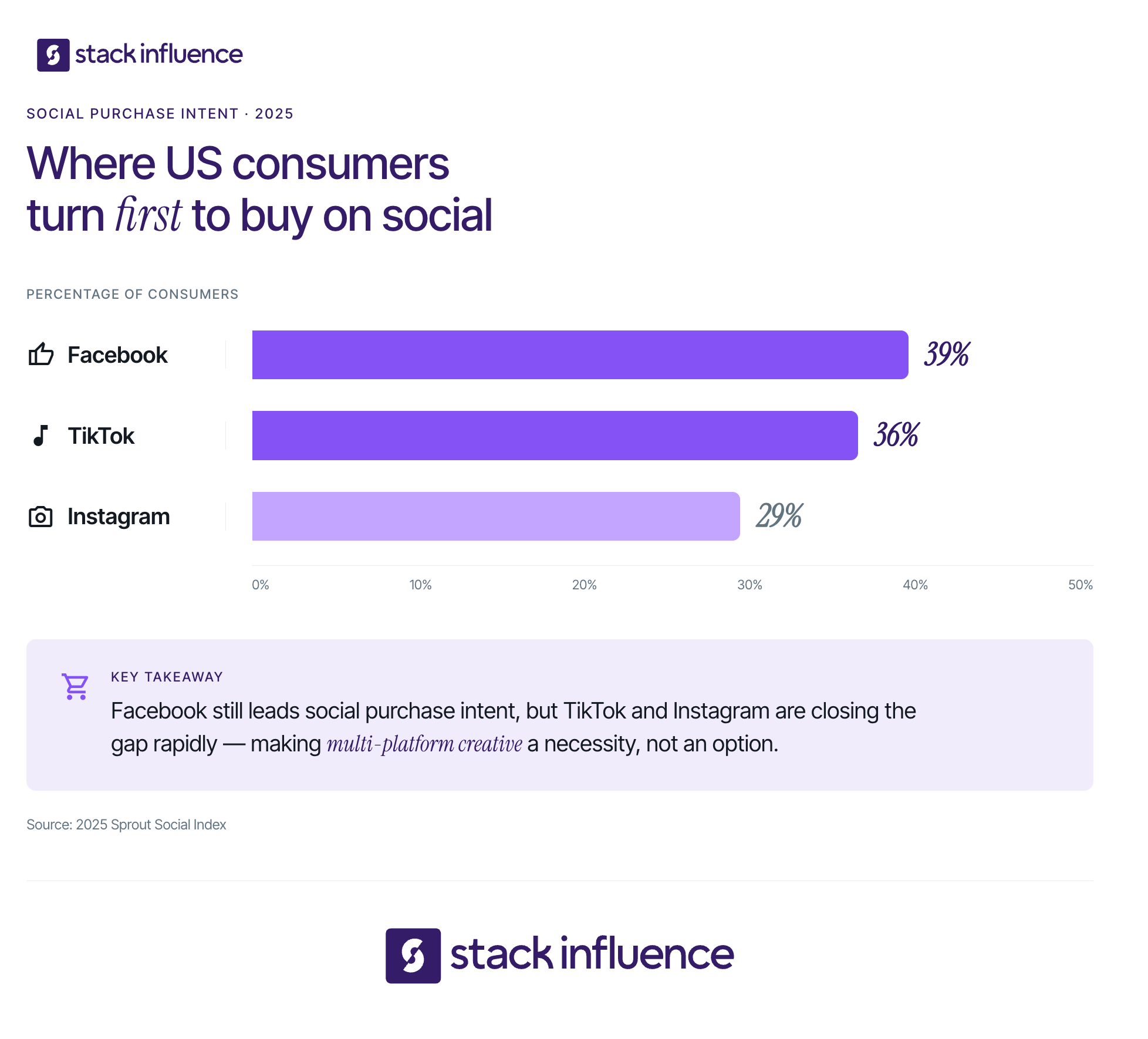
Social advertising also sits at the intersection of two powerful trends running simultaneously. As of 2026, there are 117.1 million social media buyers in the United States, equivalent to 33.5% of the country's population . At the same time, consumers are increasingly turning to social media platforms for product discovery over traditional search engines . For eCommerce sellers, that combination means social is both where your buyers live and where purchase decisions increasingly begin.
The 5-Step Social Ad Momentum Sequence is the operational framework at the core of a sustainable social advertising strategy. It treats social advertising as a compound system rather than a series of one-off campaigns. Each step builds on the last, so that creative assets, audience data, and attribution insights accumulate into a durable growth engine. Reference this sequence whenever you are evaluating which part of your social advertising program to prioritize or fix.
The five steps are:
The Sequence works because it eliminates the two most common failure modes in social advertising: creative starvation (running the same four assets until CTR collapses) and attribution blindness (spending without knowing which channels and creatives are driving actual purchases). Return to this framework after every campaign cycle to diagnose where momentum is stalling.
Creator and UGC content outperforms traditional brand-produced ads on social platforms because it matches how users already consume content on those platforms. A polished studio ad triggers immediate pattern recognition as advertising, which causes users to scroll past it. A creator's unboxing video or honest product review feels like organic content, which earns attention before the audience registers it as a promotion.
The performance gap is substantial and well-documented. UGC posts drove 10.38x higher conversion rates compared to non-UGC posts in Q3 2025, according to Emplifi's 2025 research. That is not a marginal edge, and it explains why the highest-performing brands in 2026 are treating creator content as their primary paid social creative rather than a supplement to studio production. The cost math reinforces the shift as well: UGC averages $100 to $500 per video compared to $200 to $25,000 or more for influencer posts, and UGC runs 30 to 80% less than influencer content while often delivering stronger conversion performance.
For eCommerce sellers, the practical implication is that the micro-influencer product seeding model produces two assets from one investment: an organic social post that builds trust with the creator's audience, and a UGC video you own and can run as paid creative indefinitely. That dual output is the economic case for seeding before scaling ad spend.
Here is what separates top-performing creative in 2026:
74% of brands are moving budget into creator programs in 2026 as their core strategy , measured by the same standards as paid media: customer acquisition cost, average order value, and ROAS. The shift is not experimental anymore.
Amazon sellers should focus social advertising on channels that produce both external traffic and measurable Amazon conversion data, then use that data to qualify where additional budget earns a positive return. The two platforms that most consistently deliver this combination in 2026 are Meta and TikTok, with Instagram Reels and TikTok Spark Ads as the primary ad formats for driving clicks to Amazon listings.
The attribution layer is what separates a profitable Amazon social strategy from a guessing game. Advertisers that optimized their non-Amazon media using Amazon Attribution insights experienced an average 18% increase in new-to-brand sales, according to an Amazon internal study. That lift comes from being able to see which social placements are actually driving detail page views, add-to-cart events, and completed purchases on Amazon, rather than relying on platform-reported click data alone.
Amazon sellers should also pair attribution tracking with the Amazon Brand Referral Bonus program. Amazon rewards brand-registered sellers with a bonus, typically averaging around 10% of attributed sales, when external traffic they drive converts to a purchase. That bonus is applied as a credit against referral fees, which effectively reduces the net cost of your social advertising. When you stack Amazon Attribution tagging with the Brand Referral Bonus, every social ad click that converts on Amazon becomes meaningfully cheaper than its sticker cost.
Key steps for Amazon sellers building an attribution-ready social setup:
A verified Stack Influence case study for Blueland, a plastic-free home essentials brand, illustrates how product seeding and social advertising can compound together. During a 3-month campaign, average monthly unit sales increased 4.7x from 542 to 2,562, and the campaign included 211 promotions, 247K social impressions, 11K engagements, and a 13x ROI. Blueland also started ranking for 927 new keywords during the campaign, including reaching page 1 for "foaming hand soap," a keyword with 26K monthly searches. That keyword lift is a direct byproduct of the external traffic signal created by the social campaign, which demonstrates how micro-influencer campaigns generate value beyond their immediate impression count.
The operational logic behind this approach follows the 5-Step Social Ad Momentum Sequence: seed with creators, collect UGC, activate the best assets in paid placements, tag everything with Attribution, and recycle winners into new placements. Stack Influence's gifted-first, product-seeding model means brands only pay for completed posts, which eliminates the budget waste of creators who drop off before delivering. That structure also produces a consistent volume of fresh creative assets, which is the fuel that keeps the Sequence running without creative fatigue.
Scaling this type of program requires a network of creators matched to your product category. Stack Influence's roughly 600,000 vetted creators, approximately 78% female, give eCommerce sellers access to a scalable creator pool without the manual work of outreach, contracting, and compliance tracking.
ECommerce sellers should measure social advertising ROI using a three-tier stack that separates platform-level engagement data, channel-level conversion data, and business-level outcomes. Tracking only top-of-funnel metrics like impressions and reach produces a misleading picture of what is actually working, while focusing only on last-click conversion misses the upstream content that influenced the purchase. The three tiers work together to give a complete view.
The Three-Tier Attribution Stack is the secondary decision tool for sellers who are already running campaigns but struggling to justify or optimize their social ad budget. Apply it to your reporting setup before the next campaign cycle.
Tier 1: Platform Signal Metrics (Measure Weekly)
Tier 2: Channel Conversion Metrics (Measure Per Campaign)
Tier 3: Business Outcome Metrics (Measure Monthly)
According to the 2025 Impact of Social Media Report, 68% of marketing leaders look at engagement to define social ROI , but engagement alone does not pay for inventory. The Three-Tier Attribution Stack moves sellers past vanity metrics toward the business outcomes that justify budget. Only 30% of marketers think they can accurately measure social media ROI , which means building even a basic three-tier system gives most sellers a significant competitive edge over rivals still running on gut feel.
For Shopify sellers, UTM parameters layered onto Amazon Attribution tags allow you to track social traffic to both your Shopify storefront and your Amazon listings simultaneously, giving you a cross-channel view within a single reporting setup.

This section addresses the most operationally damaging errors eCommerce sellers make in social advertising, because most guides focus on tactics without naming the specific failure modes that quietly drain budgets.
Mistake 1: Scaling Ad Spend Before Testing Creative
Most sellers treat creative testing as something you do after you find a winning audience. In 2026, creative is the primary variable. Video ads generate 42% higher ROAS than image ads , but within video, the hook, format, and authenticity level matter more than production quality. Test at least three creative variations per campaign before increasing budget.
Mistake 2: Ignoring the Listing Readiness Problem
Social traffic arrives with lower purchase intent than marketplace search traffic. If your Amazon listing has weak images, sparse bullets, or fewer than 15 reviews, external social traffic will click through and not convert. The Attribution dashboard will show high detail page views and low purchase rates, which signals a listing problem, not a traffic problem. Fix the listing before scaling the ad.
Mistake 3: Treating UGC and Influencer Marketing as the Same Thing
These are different tools with different functions. Both involve real people creating content about your product, but UGC is a content asset you own and can deploy across paid ads, email, product pages, and social indefinitely, while influencer marketing is audience access you rent for a window of time. Conflating them leads to misaligned briefs, wrong metrics, and budget allocated to the wrong objective.
Mistake 4: Running Only Cold Traffic Campaigns
Retargeting is consistently one of the highest-ROAS placements available, yet many eCommerce sellers allocate almost all social budget to cold audience prospecting. Retargeting ads produce 5 to 10x higher ROAS than cold traffic. A 70/30 prospecting-to-retargeting split is a reasonable starting point, with the ratio shifting toward retargeting as your pixel audience grows.
Mistake 5: Neglecting the Brand Referral Bonus Activation
Many Amazon Brand Registry sellers run social ads to their listings but never implement Attribution tags, which means they forfeit the Brand Referral Bonus on every qualifying external conversion. That oversight effectively makes every social ad 10% more expensive than it needs to be.
Mistake 6: Measuring Only Last-Click Attribution
Social platforms contribute to purchases that complete days later on Amazon or Shopify. Amazon credits a sale to your attribution tag if the shopper clicks the link and completes a purchase within 14 days, which means conversions do not always happen on the first visit. Sellers who evaluate social campaigns on same-session conversion rates consistently undervalue the channel.
Creative fatigue kills social ad performance faster in 2026 than in any previous year because algorithmic feeds now expose audiences to the same ad at much higher frequency within a shorter window. Engagement rate drop-off is the most reliable early signal: when a previously strong ad's engagement rate falls below 50% of its launch-week benchmark, it is fatiguing. Rotating new creative before that threshold prevents the CPM spike that follows fatigue.
The solution is not more budget for creative production. It is a systematic creative pipeline tied to your influencer marketing campaigns. A traditional photo or video shoot with an agency can cost $50,000 and yield 10 to 15 usable assets, while a micro-influencer campaign of the same budget might yield 200 or more pieces of authentic UGC, which can be repurposed across ads, emails, and product pages. That volume advantage is the structural answer to creative fatigue: you always have new assets ready to rotate before performance degrades.
Practical creative rotation steps within the 5-Step Social Ad Momentum Sequence:
Advertising social media in 2026 rewards sellers who treat it as an operating system, not a line item. The 5-Step Social Ad Momentum Sequence gives you a structured path from platform selection to creative recycling, and the Three-Tier Attribution Stack ensures you are measuring outcomes that actually connect to business performance rather than vanity metrics. The common mistakes section identifies the six operational errors most likely to be draining your ROAS right now.
The underlying principle is that creator content and UGC are the fuel, attribution infrastructure is the steering wheel, and consistent creative rotation is what keeps the engine from stalling. If you are an eCommerce or Amazon seller ready to build a creator-driven social advertising program at scale, explore Stack Influence's product seeding model to see how a gifted-first campaign can seed your paid social creative pipeline while simultaneously building organic social proof and Amazon ranking momentum.
The influencer marketing industry has crossed $32 billion globally in 2026, and the biggest budget shift inside that number is moving away from one-off sponsored posts toward ongoing ambassador relationships. For content creators, that means the question is no longer just "how do I land a brand deal?" but rather "how do I become a brand ambassador who earns recurring income and builds compounding partnerships?" This guide answers both questions with a framework designed for the current market, where engagement outranks follower count and long-term trust outranks one-time reach.
Key Takeaways
The ambassador opportunity is larger and more accessible in 2026 than at any previous point in the creator economy's history. Brands are not just running more campaigns; they are restructuring how they fund them. According to Aspire's 2026 State of Influencer Marketing report, 74% of marketers plan to actively increase their influencer marketing budgets, and much of that increase is flowing toward long-term creator relationships rather than one-time activations.
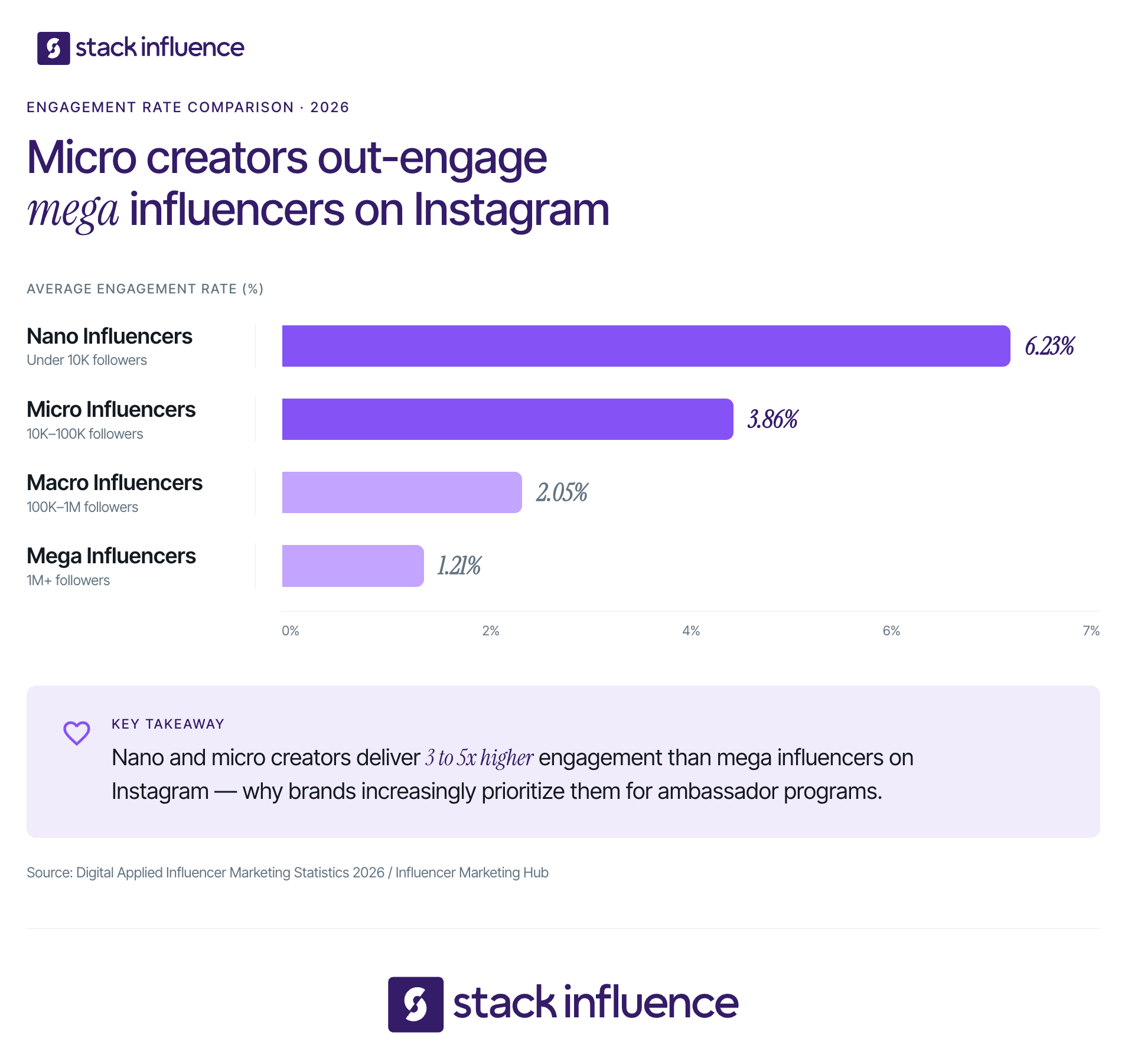
The preference shift is dramatic at every budget tier. Data from Digital Applied's 2026 influencer statistics shows micro-influencers generate an average engagement rate of 3.86% compared to 1.21% for mega-influencers, at 60% lower cost per post. That performance gap makes micro and nano creators the most commercially efficient ambassador candidates available to brands today.
What brands are looking for has also changed. According to industry research cited across the Influencer Marketing Hub's 2026 Benchmark Report, the shift toward nano and micro-creator partnerships has accelerated, with brands prioritizing engagement quality and audience trust over raw follower count. The creators winning long-term ambassador deals in 2026 are not necessarily the ones with the biggest accounts. They are the ones who behave like reliable business partners.
Understanding this context is the first step to positioning yourself correctly. The rest of this article gives you the tools to do exactly that.
A brand ambassador is a creator who represents a company on an ongoing basis, promoting its products through authentic content, community engagement, and consistent visibility across social channels. Unlike a one-off sponsored post, a brand ambassador role is built on a long-term relationship, usually lasting three to twelve months or longer, with recurring content, early product access, and performance-based incentives that align the creator's output with the brand's growth goals.
The distinction matters because it changes how you approach everything: your pitch, your content strategy, and your compensation negotiation. A sponsorship is transactional. An ambassador relationship is operational. According to industry guidance from GRIN's brand ambassador program analysis, ambassador programs typically last 3 to 12 months or longer, with creators expected to deliver consistent content, maintain posting cadence, and produce work that can be repurposed across brand channels.
Brands also draw a clear line between ambassadors and one-time influencers. The ambassador has to deliver repeatedly, without missing deadlines, drifting off-message, or becoming difficult to manage. That operational reliability is what justifies a multi-month contract, and it is the standard you are competing against when you pitch for a role.
The single most useful lens for evaluating your ambassador readiness is the Creator Progression Tiers model, an original framework that maps where every creator sits on the path from first collaboration to long-term brand partnership. Unlike follower tiers or engagement benchmarks, the Creator Progression Tiers framework organizes your positioning by the commercial depth of your relationships, not the size of your audience.
The Creator Progression Tiers framework has three levels:
The Creator Progression Tiers framework is not about follower count. It is about the depth of trust you maintain and the commercial outcomes you reliably produce. Most creators underestimate how quickly they can move from Tier 1 to Tier 2 with the right documentation habits, and how much that movement changes the quality of deals they are offered.
Use this framework as a diagnostic: where do your current brand relationships sit? If most are one-off, you are a Tier 1 creator working toward Tier 2. The actions in the following sections are designed to accelerate that progression.
The seven factors below are what brands consistently look for when evaluating ambassador candidates. They are not about follower count. They are operational and relational qualities that predict whether a creator will deliver commercial value over a sustained period.
Here is what separates creators who land long-term ambassador deals from those who cycle through one-off posts:
These seven factors map directly to the Creator Progression Tiers framework. Tier 1 creators typically demonstrate two or three of them inconsistently. Tier 2 creators demonstrate five or six consistently. Tier 3 brand collaborators demonstrate all seven and use their data proactively in pitch conversations.
Finding opportunities requires knowing where ambassador programs actually live and how to position yourself for each channel. The three main pathways are creator-brand matching platforms, direct program applications, and personalized cold outreach.
Matching platforms are the most efficient starting point in 2026. On platforms like Stack Influence, creators can access product-seeding campaigns that serve a dual function: they generate real collaboration experience and portfolio proof while sometimes converting into longer-term ambassador arrangements. Stack Influence's creator opportunities page uses a gifted-first, product-seeding model where creators receive products, post authentic content, and build a portfolio of completed brand collaborations without needing a large existing audience. That portfolio becomes the foundation of your Tier 2 positioning when you approach brands for ambassador deals.
Direct program applications work well in fitness, beauty, wellness, and lifestyle categories where brands run formal, open-enrollment ambassador programs. The key is to apply with a polished media kit that includes your niche, platform metrics, audience demographics, and past collaboration examples. Canva offers free customizable media kit templates as a starting point, and the kit should be no longer than two pages.
Personalized outreach is effective when you have a genuine brand relationship to reference. Generic copy-paste pitches are ignored, but a message that opens with a specific product you have used, names a piece of content you have already created around that category, and proposes a clear deliverable structure has a real chance of landing a response. The pitch should feel like the beginning of a business conversation, not a fan letter.
The ambassador market in 2026 looks structurally different from how it operated even two years ago, and three specific shifts matter most for creators trying to secure and retain long-term partnerships.
Long-term deals replaced one-off posts as the dominant structure. According to Aspire's State of Influencer Marketing 2026 report, 63% of creators now prefer long-term partnerships over any other type of campaign structure. Brands noticed that shift and accelerated their move toward multi-cycle contracts because returning creators require far less briefing overhead and deliver better on-brand content faster. From Stack Influence's experience running product seeding campaigns at scale, brands that convert product gifting recipients into repeat partners see 3x higher content output per dollar spent compared to brands running isolated single-activation campaigns.
Content rights became a primary deal factor. Brands now evaluate ambassador candidates partly on whether they will grant reuse rights for ads, product pages, and owned channels. Creators who proactively offer usage rights alongside standard deliverables are selected for repeat partnerships at roughly twice the rate of those who provide post-only deliverables, reflecting the growing brand demand for reusable content assets.
FTC enforcement became more aggressive. According to IQFluence's FTC compliance analysis for 2026, the FTC is now focused on how disclosure holds up in fast-moving formats like Reels, TikTok videos, and livestreams, and ongoing ambassador deals are now treated as material connections that require disclosure on every piece of brand-related content. The FTC's official guidance makes clear that terms like "thanks," "collab," "sp," or "ambassador" alone do not satisfy disclosure requirements. Use "Ad," "Sponsored," or "Paid partnership" in the first two lines of every caption. Gifted products count as pay under these rules, so disclosure applies even when no cash changes hands.
Ambassador compensation has more structure than most creators realize, and knowing the components gives you real leverage in negotiations. Most ambassador deals combine at least two of these three elements: free product, affiliate commissions, and flat fees.
Here is how to approach each:
When you move into a formal ambassador negotiation, always clarify four specific terms before signing anything: the number of deliverables per cycle, usage rights and whether the brand intends to run your content as a paid ad, exclusivity scope (which prevents you from working with competitors and should carry a meaningful rate premium), and the contract term length. A 30-day, 60-day, or 90-day initial term is standard; avoid open-ended arrangements without renewal clauses.
The Pre-Deal Negotiation Checklist is your secondary decision tool here, covering the five items you must confirm before any ambassador agreement is finalized:

You should measure your ambassador performance across three distinct metric layers: reach metrics, engagement metrics, and conversion metrics. Relying only on reach data (impressions, views, follower growth) keeps you at Tier 1. Moving to Tier 2 and Tier 3 requires tracking the downstream signals that brands actually buy: engagement rate, link click-throughs, promo code redemptions, and affiliate-driven sales.
The Ambassador Performance Metric Stack is a three-layer measurement model specifically designed for creators building toward long-term brand partnerships:
Use the Ambassador Performance Metric Stack consistently for at least two to three campaigns before pitching for ambassador roles. By that point, you will have enough Layer 2 and Layer 3 data to demonstrate commercial value with specificity rather than potential.
Learning how to be a brand ambassador in 2026 is ultimately about building a business around trust, documentation, and repeatable value delivery. The Creator Progression Tiers framework gives you a clear map: Tier 1 creators complete collaborations and collect proof, Tier 2 creators use that proof to secure returning partnerships, and Tier 3 brand collaborators co-create campaigns and earn multi-cycle contracts with real strategic weight.
The market conditions are favorable. More than seven in ten brands now favor working with micro and mid-tier creators, and long-term ambassador programs are the fastest-growing deal structure inside that shift. The creators capturing those deals are not waiting for brands to find them. They are building portfolios, tracking performance data, and pitching with specificity.
If you are ready to start building your portfolio through real campaign experience, the Stack Influence creator community offers a practical entry point where you can access product-seeding campaigns, complete collaborations, and build the proof that Tier 2 and Tier 3 ambassador pitches require.
Most eCommerce sellers budget for paid search, meta ads, and influencer campaigns before they ever consider affiliate marketing. That sequencing leaves a proven, performance-based channel sitting idle while acquisition costs on every other channel keep climbing. Understanding the full benefits of affiliate marketing means looking beyond the basic commission model and examining how it compounds with creator content, Amazon Attribution, and product seeding to build a growth engine that pays for itself.
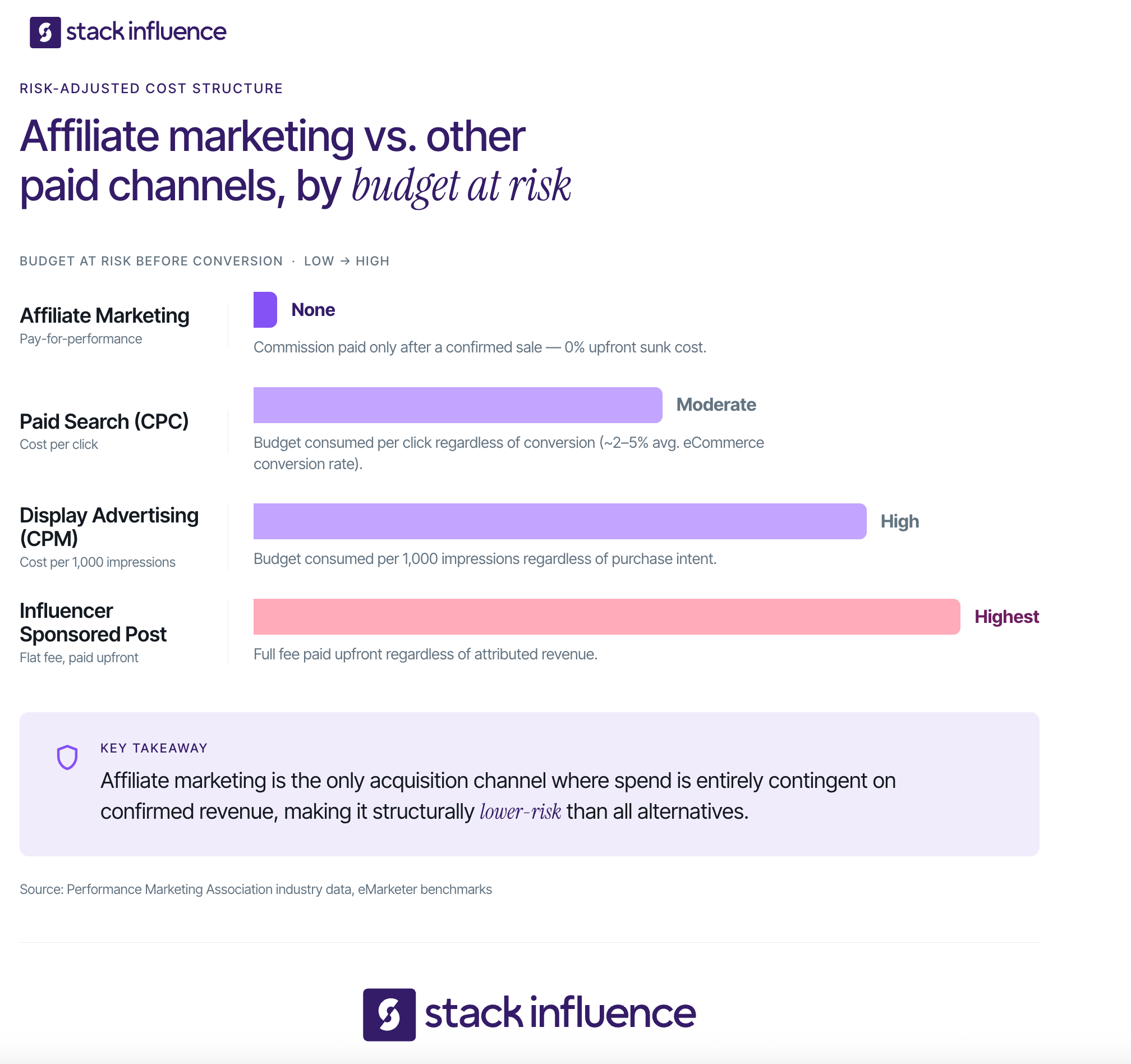
Affiliate marketing outperforms most paid acquisition channels on a risk-adjusted basis because payment is tied directly to verified outcomes. Unlike CPM or CPC advertising, where budget drains regardless of conversion, a commission model means every dollar spent corresponds to a sale that already happened. For eCommerce sellers managing tight contribution margins, this structural difference is not a minor advantage; it is a fundamental shift in how acquisition risk is allocated.
The broader performance marketing landscape confirms this dynamic. According to the Performance Marketing Association's industry data, the affiliate channel drives a return on ad spend that consistently competes with paid search, often at a fraction of the brand management overhead. That efficiency is especially relevant for Amazon FBA sellers and Shopify brands that cannot afford to scale a channel that doesn't show immediate payback.
Key risk-adjusted advantages of affiliate marketing for eCommerce sellers include:
The compounding nature of affiliate content is one of the channel's most underappreciated financial benefits. A well-placed product review ranking on page one of Google can deliver consistent referral traffic for 18 to 36 months, making its effective cost per acquisition drop with every passing week.
Affiliate marketing for eCommerce brands is a revenue-sharing model in which independent promoters (affiliates) earn a commission each time they drive a qualifying action, usually a purchase, through a unique tracking link or code. The brand sets the commission rate and terms; the affiliate handles the promotion. Neither party pays the other upfront.
For Amazon sellers, this model has a specific structural advantage in the form of the Amazon Brand Referral Bonus, which credits sellers with an average bonus of 10% of sales driven by external traffic sources. That bonus stacks on top of any organic ranking lift that external traffic signals generate, creating a double incentive for investing in an affiliate channel. Shopify brands access a parallel system through native affiliate app integrations and third-party networks.
The affiliate ecosystem spans a wide spectrum of promoter types:
Understanding the full promoter landscape matters because different affiliate types serve different stages of the buyer journey, and the most effective programs deliberately combine them.
The 5-Step Affiliate Activation Sequence is the structured process eCommerce sellers can use to build an affiliate channel from scratch within a single quarter without letting program management consume the entire marketing team's bandwidth. Reference this sequence when scoping the channel, onboarding creators, and optimizing for conversion.
Most brands stall on affiliate marketing not because the model is flawed, but because they launch it without a repeatable process. The Affiliate Activation Sequence solves that by breaking setup into five executable steps, each with a clear output that feeds the next.
Step 1: Define the Commission Economics Set a commission rate that is sustainable at your gross margin while competitive enough to attract quality affiliates. For physical products, 5% to 15% is the typical functional range depending on product price point and category margin. Calculate your maximum allowable customer acquisition cost first, then work backward to a commission that fits inside that ceiling.
Step 2: Build a Minimum Viable Affiliate Kit Create a simple brief that includes approved product images, key claims, a unique discount or landing page URL for tracking, and any platform-specific posting guidelines. Affiliates who receive clear creative direction convert at higher rates than those left to interpret the product on their own.
Step 3: Source and Vet Affiliates Before You Invite Them Recruit affiliates from three pools: organic applicants who find your program through a directory listing, outbound recruitment from your existing customer base, and creator outreach to micro-influencers already talking about your category. According to Influencer Marketing Hub's 2024 benchmark report, micro-influencers generate engagement rates three to five times higher than macro-influencers, making them a cost-efficient affiliate recruitment target.
Step 4: Seed the Product Before Asking for Promotion Gifting the product before the affiliate promotes it is not optional if authentic content is the goal. Creators who have genuinely used a product write better reviews, record more convincing demos, and produce content that performs longer. This is where a product-seeding model overlaps with affiliate marketing: when affiliates become brand advocates because they experienced the product firsthand, their conversion rates reflect it.
Step 5: Optimize on a 30-Day Rolling Basis Review performance data every 30 days. Identify the top 20% of affiliates driving 80% of conversions and deepen the relationship through higher commission tiers, early access to new SKUs, or co-created content opportunities. Cut or pause affiliates who have been active for 60 days without a qualifying conversion. The Affiliate Activation Sequence only compounds if the optimization loop runs consistently.
Reference the Affiliate Activation Sequence when planning quarterly budget reviews, because the output of Step 5 directly informs the commission economics decision in the next cycle's Step 1.
Micro-influencers typically make stronger affiliate partners for eCommerce sellers than macro-influencers because their audiences are smaller, more trusting, and more purchase-ready. A creator with 25,000 highly engaged followers in a specific niche often drives more tracked conversions per post than a creator with 500,000 generalist followers, because niche audiences follow recommendations from creators they trust as category experts. The math almost always favors depth over breadth for direct-response affiliate outcomes.
This dynamic is especially visible in categories like beauty, health, and home goods, where purchase decisions are heavily influenced by social proof and product demonstration. A study published by Nielsen found that 88% of consumers trust recommendations from people they know over any other form of advertising, and micro-influencers function as "people they know" within niche communities in a way that celebrity creators cannot replicate.
Why micro and nano influencers outperform at the affiliate level:
Stack Influence's network includes roughly 600,000 vetted creators, approximately 78% of whom are female, spanning beauty, health, grocery, and home categories where affiliate conversion is strongest. That depth of pre-vetted creator supply means eCommerce sellers can move from affiliate program launch to active creator promotions without spending months on manual outreach.

Measuring affiliate marketing ROI requires more than last-click attribution, especially for eCommerce sellers running simultaneous organic, paid, and creator channels. A single-number measurement approach will both undercount and misattribute affiliate value, leading sellers to either over-invest in low-quality affiliates or cut high-value ones prematurely. The Affiliate ROI Stack is the layered measurement model that captures the full picture.
The Affiliate ROI Stack
This secondary decision tool organizes affiliate metrics into three tiers: surface metrics, conversion metrics, and compounding value metrics. Evaluate all three tiers before making budget or commission decisions.
For Amazon sellers specifically, Amazon Attribution links give precise Tier 2 data for off-platform traffic, while the Amazon Brand Referral Bonus converts that attribution into a direct cash offset on referral fees. Pairing Amazon Attribution with affiliate tracking creates a closed-loop measurement system that captures both the immediate commission cost and the downstream referral fee rebate.
A verified Stack Influence case study for Blueland, a plastic-free home essentials brand, illustrates what Tier 3 metrics can look like at scale. During a 3-month campaign, average monthly unit sales increased 4.7x from 542 to 2,562, while the brand began ranking for 927 new keywords and reached page one for "foaming hand soap," a keyword with 26K monthly searches. The campaign generated 13x ROI. While that campaign used a product-seeding model rather than a traditional affiliate commission structure, the compounding keyword and ranking outcomes it produced are exactly the Tier 3 signals that most affiliate programs fail to track.
For Shopify brands, affiliate attribution apps such as TripleWhale, Northbeam, or platform-native tools allow multi-touch attribution that correctly credits affiliates who appear earlier in a longer purchase journey rather than only last-click.
The most damaging assumption in affiliate marketing is that the program runs itself once it is set up. It does not. Programs treated as passive channels plateau quickly, attract low-quality coupon and loyalty affiliates who cannibalize existing revenue rather than generate new customers, and produce no compounding content value because no one is actively managing creator quality. This contrarian reality is one the most widely shared affiliate marketing guides consistently skip.
The passive-channel failure mode plays out in a predictable pattern. A brand launches a program, lists it in a few affiliate directories, and waits for signups. The early applicants are often cashback and coupon sites that target customers already in the checkout flow on the brand's own site. Those affiliates generate attributed conversions, so the program looks productive on paper. But net new customer acquisition is flat or negative because the commissions are being paid on purchases that would have happened anyway, with the affiliate simply inserting itself into the final click.
Preventing this requires active program management at every step of the Affiliate Activation Sequence. Specifically:
The brands that generate consistent, compounding affiliate ROI are those that treat the channel as an active content and creator partnership strategy rather than a commission-tracking spreadsheet. That is the operational shift most guides in this space fail to make explicit.
Affiliate marketing integrates with product seeding and UGC campaigns most effectively when gifting comes first and commission tracking follows. Sending a product to a creator before asking them to become an affiliate removes the content quality problem: creators who have genuinely used and formed an opinion about a product produce more specific, more credible, and higher-converting content than those working from brand talking points alone.
This integration is particularly powerful for Amazon sellers because the Amazon Influencer Program allows creators to build storefronts that function as evergreen affiliate hubs. A creator who receives a product through a seeding campaign, creates authentic UGC around it, and then adds it to their Amazon storefront generates three simultaneous value streams: organic social content, a shoppable affiliate link, and a user-generated asset the brand can license for ads. According to eMarketer's analysis of creator commerce trends, shoppable content tied to authentic creator recommendation significantly outperforms standard display ad formats for purchase intent.
The practical integration workflow looks like this:
This sequence converts one-time creator interactions into ongoing affiliate relationships and ensures the content quality standard stays high throughout the program lifecycle.
Scaling an affiliate program past 100 active affiliates without a proportional increase in program management headcount requires deliberate automation and tiering. The most common scaling bottleneck is manual onboarding, approval workflows, and payment processing, none of which require human judgment at every step. Automating these frees the program manager to focus on the high-value work: identifying top performers, deepening key creator relationships, and designing the next tier incentive.
Rakuten Advertising's research on affiliate program management shows that brands using tiered commission structures retain top-performing affiliates at significantly higher rates than flat-rate programs, because incremental earners see a clear path to higher rewards without requiring individual negotiation.
Practical scaling tools and tactics:
For DTC brands running simultaneously on Shopify and Amazon, a cross-channel affiliate structure that includes both an Amazon Influencer storefront option and a direct-to-site tracking link gives affiliates flexibility to promote through whatever channel best fits their content format, which increases program participation rates without increasing program complexity.
The benefits of affiliate marketing for eCommerce sellers compound over time in ways that few other acquisition channels can match: risk-adjusted spend, evergreen content production, keyword ranking lift, and creator relationships that convert from one-time promotions into long-term brand partnerships. Executing that potential requires moving through the 5-Step Affiliate Activation Sequence deliberately, measuring performance across the full Affiliate ROI Stack rather than surface click data, and treating affiliate management as an active creator strategy rather than a passive directory listing.
If you are ready to build a creator-affiliate channel with vetted micro-influencers who generate authentic UGC and drive measurable sales, explore Stack Influence's product-seeding and creator-sourcing capabilities to see how gifting-first campaigns turn into high-converting affiliate relationships.
Most creators treat TikTok like a broadcast channel: post a video, hope it catches the algorithm, move on. But in 2026, that approach leaves serious discovery on the table. TikTok search has quietly become one of the most powerful organic visibility tools available to content creators, and the creators who understand it are landing brand deals, growing followings, and building authority in ways that pure feed-scrolling content cannot replicate.
This guide breaks down exactly how to use TikTok search to grow your presence, attract brand partnerships, and turn discoverability into a repeatable system.
The most effective TikTok search strategy is not a one-time optimization task. It is a publishing system where each video reinforces the last, building topical authority around a theme that the platform's search index learns to associate with your account.
Start by identifying the three to five topic clusters your channel genuinely owns. A topic cluster is a narrow subject area where you have both credibility and audience overlap. Instead of "fitness," that might be "resistance band workouts for apartment living" or "low-impact cardio for postpartum recovery." According to Adobe's 2026 social media search report, nearly half of U.S. consumers (49%) now use TikTok as a search engine—up nearly 20% in just two years—with 65% of Gen Z reporting they have searched on the platform.
Once your clusters are defined, build a content calendar where at least 60% of your videos target a specific search phrase inside one of those clusters. The remaining 40% can be trend-driven, reactive, or experimental. This ratio keeps your search footprint growing without sacrificing the spontaneity that TikTok audiences value.
Here is a practical workflow for implementing a compounding search strategy:
Stack Influence has observed through campaign execution that creators with established search footprints in specific niches consistently drive stronger campaign outcomes for eCommerce brands. When a creator ranks for a term like "best protein powder for women" or "how to clean natural hair at home," the audience arriving through that search already has demonstrated purchase intent. That is a fundamentally different viewer than someone who stumbled on a trending sound. Brands running product seeding campaigns through Stack Influence's network of roughly 600,000 vetted creators increasingly prioritize this kind of niche search presence when matching creators to campaigns.
TikTok search is the platform's native discovery engine that allows users to query videos, creators, sounds, and hashtags using typed keywords. Unlike the For You Page, which serves content algorithmically based on behavioral signals, TikTok search surfaces content based on textual relevance, topical authority, and engagement signals tied to specific queries. For creators, this means content can be discovered weeks or months after posting if it ranks well for the right terms.
The distinction between feed discovery and search discovery is critical for long-term growth. Feed virality is unpredictable and often temporary. Search discoverability is compounding: a video that ranks for a searched phrase continues to earn views every time someone types that phrase. According to a 2024 report by Later, TikTok search results are influenced by keyword relevance in captions, on-screen text, spoken audio, and hashtags, all of which are independently indexed. That means optimizing multiple layers of a single video increases the probability it surfaces for relevant queries.
Why does this matter specifically for influencers and content creators? Because search-driven discovery changes the nature of your audience relationship. A viewer who finds your video through a search query was actively looking for that content. They arrived with intent. That intent-driven viewer watches longer, follows more frequently, and converts on brand recommendations at higher rates than passive scrollers. Building a search presence means building an audience that is pre-qualified by topic interest before they ever see your face.
The REACH framework is a five-component scoring tool designed to help creators evaluate and improve any video's TikTok search potential before publishing. Rate each component from 1 to 5, then total your score out of a possible 25. A video scoring 20 or above has strong search potential. Below 15, revisit at least two components before publishing.
Use the REACH framework every time you plan a search-optimized video, reference it during your monthly content audit, and apply it when reviewing underperforming posts to diagnose what went wrong.
R: Relevance Does the video answer a specific, searched question rather than a general topic? Relevance scores highest when the video title, caption, and spoken hook all match a phrase users actually type into TikTok's search bar. Score 1 if the topic is broad and undefined. Score 5 if the video targets a single, autocomplete-validated phrase.
E: Evidence Does the video include on-screen text, captions, or visuals that reinforce the keyword? TikTok's index reads text overlays and closed captions, not just the audio track. Score 1 if no text reinforcement exists. Score 5 if the keyword appears in at least three independent layers (caption, on-screen text, spoken word).
A: Authority Signal Does the video link to a pattern of related content on your account? Authority scores higher when the video is part of a visible series or topical cluster rather than a standalone post. Score 1 if the video is isolated. Score 5 if you have five or more published videos on the same cluster and your account bio reflects the niche.
C: Click Indicators Does the hook, thumbnail, and first three seconds create a reason for a searcher (not just a scroller) to watch? Search viewers are evaluating relevance quickly. A hook phrased as a direct answer to the search query outperforms curiosity-gap hooks in search contexts. Score 1 if the hook is trend-driven with no query relevance. Score 5 if the hook directly mirrors the language of the search phrase.
H: Hook-to-Retention Path Does the video deliver on its search promise within the first 30 seconds, then extend with value so the viewer stays through the end? High retention signals to TikTok's search algorithm that the video satisfies the query. Score 1 if the payoff comes late or the video meanders. Score 5 if the direct answer appears early and the remaining runtime adds supporting depth.
Apply the REACH framework during content planning, not just at the editing stage. A video designed around a REACH score of 22 (out of 25) before filming will outperform one that reaches 18 only after post-production tweaks.
The prevailing advice for TikTok creators focuses almost exclusively on going viral: optimize your first three seconds, ride trending sounds, jump on challenges fast. That advice is not wrong for reach. But it is almost entirely the wrong goal if your ambition is sustainable brand partnerships.
Here is the contrarian reality: brands that run performance-driven influencer campaigns are not looking for your best single video. They are looking for evidence that a specific audience reliably shows up for your content on a specific topic. A creator with 8,000 followers who ranks on TikTok search for "affordable Amazon home finds" represents a more predictable campaign partner than a creator with 80,000 followers whose traffic comes entirely from one viral moment in a category unrelated to the campaign's product.
Influencer Marketing Hub's 2024 Influencer Marketing Benchmark Report found that brands are shifting budget toward micro and nano influencers at an accelerating rate, with 47% of marketers citing micro-influencers as delivering their best campaign results. Search presence is one of the most underappreciated reasons why: a creator who ranks for purchase-intent queries produces content that drives conversions long after the campaign posting window closes.
This is the creator economy's version of content ROI. A gifted-product campaign built around a creator who ranks for a relevant search term generates compounding value because the video continues to surface to new searchers after the initial post. In a verified Stack Influence case study for Blueland, a 3-month product seeding campaign drove 4.7x growth in average monthly unit sales (from 542 to 2,562 units during the campaign) and helped the brand reach page one for "foaming hand soap," a keyword carrying 26,000 monthly searches. The creators involved were not necessarily the largest accounts; they were creators whose content index matched the product category.
The takeaway for creators is direct: if you want to be chosen for brand deals consistently, build a search footprint in a category that brands care about. Viral reach is a resume item. Search authority is a job qualification.
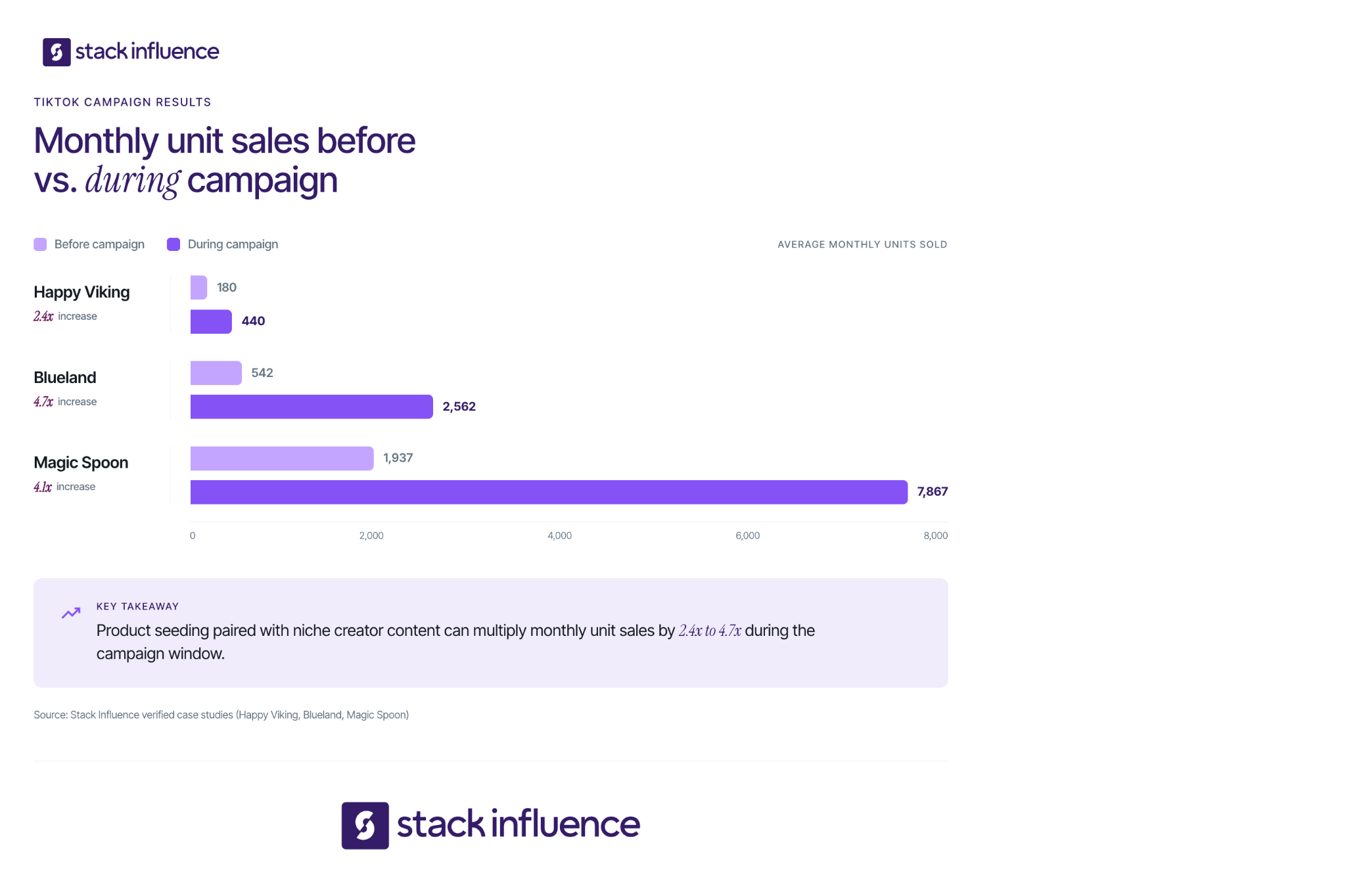
Not every video needs to be search-optimized, and forcing search intent onto trend-driven or community content will make your account feel mechanical. The most effective TikTok channels for creators pursuing brand deals operate with a deliberate split between search-optimized content (built for discoverability and long-tail value) and native TikTok content (built for algorithm reach, community engagement, and culture participation).
A practical split for most creator categories runs roughly 60% search-intent content and 40% native TikTok content. The search-optimized half builds your topical authority index and attracts brand inquiries. The native half keeps your engagement rates healthy, your For You Page reach active, and your personality visible to audiences who discover you through the algorithm rather than through queries.
Sprout Social's 2024 Social Media Trends Report notes that social media search is now outpacing traditional SEO for younger generations, with nearly one in three consumers skipping Google to start their search on networks like TikTok, Instagram, or YouTube. For creators, that insight translates directly: your search-indexed videos work while you sleep. Your trend-driven videos spike and cool. You need both.
Creators should measure TikTok search performance using a three-tier metric stack that moves from discovery signals to engagement quality to brand value indicators. Tracking only views or follower growth misses the most commercially valuable signals.
The three-tier stack: the Search Source Audit, the Search-to-Follow Conversion, and the Category Authority Score.
Use these three tiers consistently across your monthly review to understand not just whether your content is growing, but whether it is growing in the direction that attracts brand investment:
Later's TikTok SEO research confirms that engagement rate, completion rate, and keyword relevance across multiple content layers are the primary signals TikTok's search algorithm uses to rank results. That means your tier-one and tier-two metrics feed directly into your tier-three outcome: better engagement on search-sourced views improves your ranking for the queries that generate those views.
Attribution for brand deals sourced through search is straightforward: when a brand contacts you based on your content, ask how they found you. If they mention a specific video or topic, trace whether that video had high search-source traffic. Over time, this self-reported data will show which search clusters are generating commercial inquiries, allowing you to invest more content effort in the highest-value clusters.
Understanding TikTok search is one side of the creator growth equation. The other is knowing how to position your search authority as a business asset when approaching or attracting brand partnerships. Brands that run micro-influencer campaigns through platforms like Stack Influence are specifically looking for creators whose content consistently ranks within a relevant product category.
When your TikTok search footprint aligns with a brand's target category, your value to that brand extends beyond your follower count. Your indexed content represents a persistent discovery asset. A video about a brand's product category that already surfaces in TikTok search results tells that brand two things: your audience actively searches for content in this space, and your account has the topical authority to rank.
For creators building toward consistent brand deals, these steps translate your search strategy into commercial positioning:
A well-executed product seeding campaign works significantly better when creators arrive with search authority already established. According to a 2023 Nielsen study on creator marketing, audiences trust recommendations from creators they actively seek out far more than passive impressions. A viewer who found your video through a TikTok search is actively seeking your perspective, which is precisely the audience profile that converts on brand recommendations.
Most creator guides to TikTok SEO stop at hashtags and captions. Those matter, but two ranking signals are chronically underused: spoken audio indexing and profile-level topical consistency.
TikTok's search algorithm indexes the spoken words in your video's audio track through automatic speech recognition. That means if you never say the search phrase out loud in the video, you are forfeiting one of the most powerful relevance signals available. TikTok's own Creator Academy recommends incorporating natural language around the topic in the first 10 seconds of spoken audio, because early keyword density in audio carries stronger indexing weight than late-video mentions.
Profile-level topical consistency is the second underestimated signal. TikTok's system does not evaluate each video in isolation. It assigns relevance weight based on how consistently your account publishes within a topic cluster. A creator who posts 20 videos about plant-based cooking will rank higher for plant-based cooking queries than a creator who posts one exceptional plant-based video among 19 unrelated ones. This is why cluster-based publishing, not one-off optimization, is the correct strategic frame for building search authority on TikTok. Apply the REACH framework consistently across your cluster videos—targeting a score of 20 or above out of 25 for each—and the platform's index compounds your authority over time rather than treating each post as a fresh start.
For UGC creators especially, this compounding topical signal is a strategic advantage: consistent, category-specific content that ranks for searched terms is exactly what brands look for when selecting product seeding partners.

TikTok search is not a hack or a trend to chase. It is a structural feature of how the platform surfaces content in 2026, and creators who build their publishing systems around it gain an advantage that followers-first creators cannot easily replicate. Your search footprint works across time: a video you posted eight months ago can drive brand inquiries today if it ranks for the right phrase. That compounding quality is the closest thing to passive income the creator economy currently offers.
Start by applying the REACH framework to your next five planned videos. Use the three-tier measurement stack to audit your current search traffic share. Identify which of your existing videos already attract search-source views, and build your next content cluster deliberately around those topics.
If you are ready to connect your TikTok search authority with eCommerce brands actively running micro-influencer campaigns, Stack Influence's product seeding model matches vetted creators with brands in their content category. Explore how UGC creator partnerships built around genuine search authority can become the foundation of a sustainable, repeatable brand deal pipeline.
After coordinating product seeding campaigns across thousands of eCommerce brands, Stack Influence's data shows one consistent pattern: gifted activations with micro influencers generate stronger engagement rates and more reusable content than their paid counterparts at a fraction of the cost. The debate over paid vs gifted influencer strategy is one of the most consequential decisions a seller can make, and most brands get it wrong by defaulting to paid before they have tested gifted at scale. This guide breaks down how each model works, when to use each one, and how to measure the results accurately so your next influencer campaign drives real revenue.
In influencer marketing, a paid influencer receives monetary compensation in exchange for creating and publishing content under a formal contract with specific deliverables. A gifted influencer, by contrast, receives a free product through product seeding with no guaranteed posting obligation. The creator posts only if they genuinely want to, which changes the psychology of the content entirely.
This distinction matters most to eCommerce sellers because it shapes three things: the cost structure of your campaign, the authenticity of the resulting content, and the type of UGC you can collect and repurpose. Both models live inside the broader creator economy, but they operate on fundamentally different incentive structures that produce meaningfully different outcomes.
Here is how the two models compare at a structural level:
According to Social Cat's platform data, gifted influencer collaborations generate an average engagement rate of 2.19%, compared to just 1.94% for paid collaborations. That gap may appear narrow, but across a campaign of 50 to 200 micro influencers, it compounds into meaningfully more comments, shares, and saves per dollar spent.
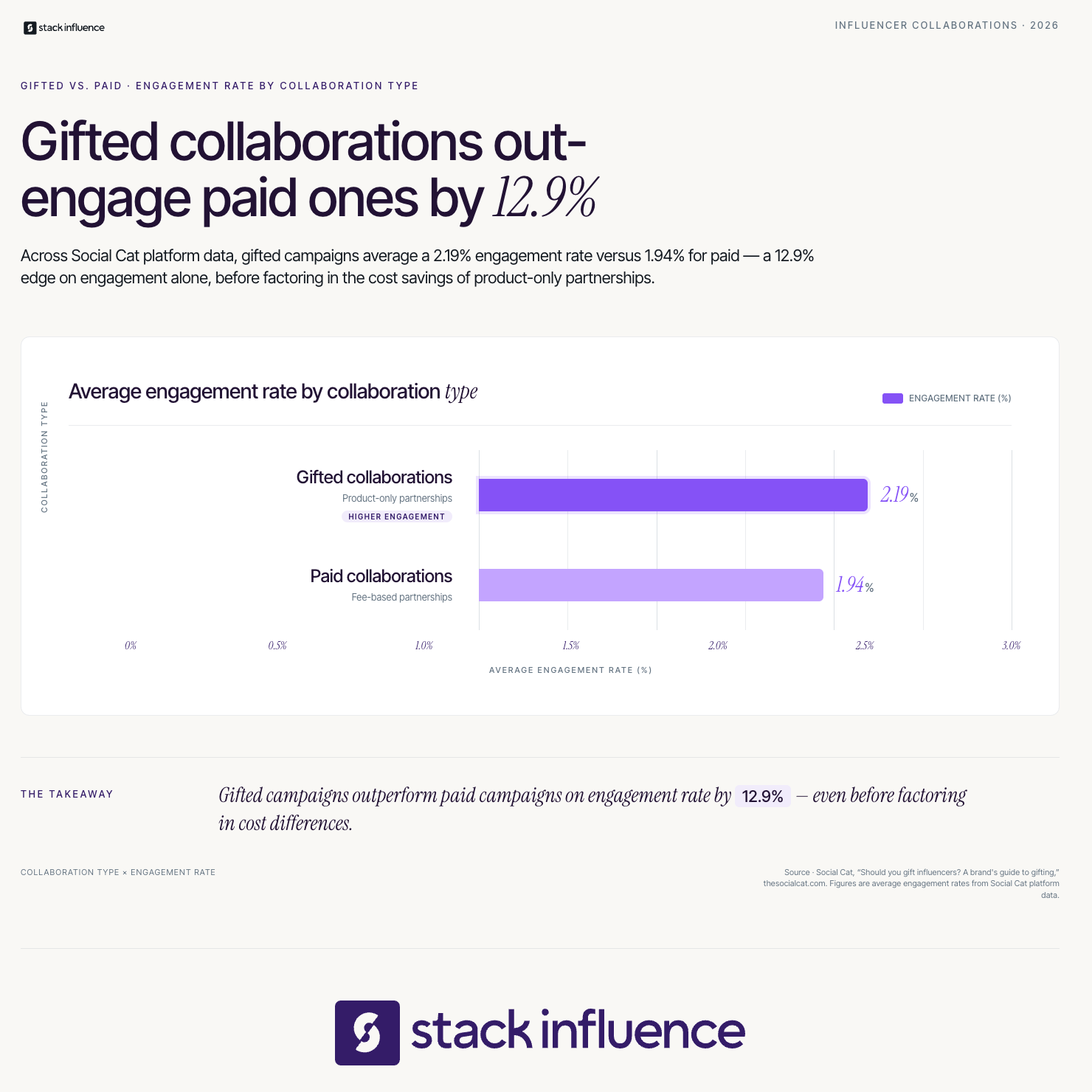
The core reason gifted content outperforms paid content on engagement is not the platform algorithm, it is the human signal underneath the post. When a creator receives a product they did not ask for, tries it genuinely, and then chooses to post about it, their audience detects that enthusiasm. It reads differently than a scripted brand sponsorship, and audiences in 2026 have become extraordinarily good at recognizing the difference.
One 2025 analysis found that gifted collaborations delivered roughly 12.9% more engagement than paid partnerships, because content created without a payment obligation tends to feel more authentic to audiences. That authenticity carries downstream into conversion rates, comment quality, and UGC reuse value.
The financial case is equally compelling:
Research from GRIN's 2026 product seeding report shows that well-run product seeding programs typically deliver 3 to 8x ROI when UGC reuse value and pipeline conversion are factored into the total return. Stack Influence's internal campaign data shows that eCommerce brands using gifted micro influencer programs as their primary awareness channel consistently generate UGC libraries they can repurpose into paid Meta and TikTok creative, effectively doubling the return on their product cost investment.
The strongest gifted campaigns share a specific workflow pattern. Brands that pre-qualify creators by niche and audience fit, personalize the outreach, and follow up after delivery see post rates two to three times higher than brands that blast generic outreach to large lists. The quality of your creator selection matters more than the quantity of products you ship.
The Gifted Advantage Score is a five-item pre-campaign checklist that helps eCommerce sellers evaluate whether a gifted approach will outperform a paid one for a specific product and goal. Apply it before allocating budget, not after.
Run through each item before committing to a campaign structure:
A 2024 survey cited by StreetInsider found that 80% of marketers saw a positive return from influencer gifting, with 83% saying they plan to use it more in future campaigns. Those results are not guaranteed, they are earned by running the Gifted Advantage Score before launch.
Revisit the Gifted Advantage Score again at the 30-day campaign mark to decide whether any gifted creators have earned an upgrade to paid ambassador status. This is the most cost-efficient way to build a creator roster: let the gifted tier identify your top performers before you pay them.
Paid sponsorships are not the enemy of gifted campaigns. They serve a fundamentally different purpose and belong in your influencer marketing mix at specific moments. Understanding the division of roles prevents the most common mistake DTC brands make: paying for reach when they should be seeding for authenticity, or seeding for awareness when they actually need guaranteed deliverables.
From Stack Influence's experience running product seeding campaigns at scale, brands that reserve paid sponsorships for product launches, seasonal promotions, and brand awareness spikes, while using gifted campaigns for ongoing organic content generation, build more sustainable creator ecosystems at lower overall CAC.
Use paid influencer sponsorships when you need:
Paid brand deals also make sense when you are working with brand ambassadors on an ongoing retainer. According to Sprout Social's 2025 Influencer Marketing Report, 71% of influencers offer discounts for longer-term brand partnerships, which means the cost of paid retainers becomes more competitive at volume. Building toward a long-term brand partnership often starts with a gifted activation and escalates to paid once the creator proves their audience responds.
The Campaign Mode Selector is a two-variable decision framework that maps your campaign goal against your available budget to produce a recommended model. Use it alongside the Gifted Advantage Score to finalize your approach before launch.
The two variables are Campaign Urgency (low or high) and Budget Flexibility (constrained or open). Each combination maps to a recommended campaign mode:
Across campaigns managed on the Stack Influence platform, eCommerce brands that apply the Campaign Mode Selector before briefing creators reduce their content non-delivery rate by structuring compensation to match the actual urgency of the campaign. Sellers using the gifted mode for ongoing always-on programs and reserving paid for launch moments consistently report more balanced creator relationships and lower burnout across their rosters.
The Campaign Mode Selector works best when used in conjunction with the Gifted Advantage Score. Together, the two frameworks give you a complete pre-campaign brief that answers both "should this be gifted or paid?" and "does this specific product and creator pair make sense?"
The most important regulatory development for eCommerce brands running influencer campaigns is the convergence of disclosure rules across paid and gifted content. Many sellers still believe that gifted campaigns exist in a regulatory gray zone where disclosure is optional. That belief is incorrect and increasingly expensive.
According to the FTC's official Disclosures 101 guidance, a "material connection" includes any financial relationship or the receipt of free or discounted products, meaning gifted campaigns carry the same disclosure obligations as paid sponsorships. The FTC's 2025 updates confirmed that "gifted by" or "#gifted" counts as sufficient disclosure language when placed prominently at the start of a caption or on-screen in a video.
Key compliance checkpoints for influencer campaigns in 2026:
The practical implication for brands is that your gifted campaign brief must include clear disclosure instructions. Treat FTC compliance as a campaign deliverable, not an afterthought. This protects your brand, reinforces consumer trust, and prevents the kind of enforcement risk that has generated over $1 billion in class action damages sought against brands in H1 2025.
Attribution is where most eCommerce sellers leave money on the table. They run gifted campaigns, count likes, and declare success or failure without measuring the full return on invested product. Paid campaigns get better measurement by default because a contract forces you to define deliverables, but gifted campaigns are often measured loosely.
The Creator Value Metric Stack is a four-component measurement model that applies equally to both gifted and paid influencer campaigns. It ensures you are capturing the full economic return of every creator relationship, not just the surface-level social metrics.
The four components are:
The Amazon Brand Referral Bonus program returns an average 10% credit on sales driven through Amazon Attribution links, effectively reducing referral fees on every sale that originates from an influencer's external traffic. For Amazon sellers running gifted campaigns with nano influencers, this bonus materially improves the unit economics of every attributed purchase within the 14-day attribution window. Pair Attribution links with the Creator Value Metric Stack and you have a complete picture of each creator's economic contribution to your business.
Data from Digital Applied's 2026 influencer marketing report shows that micro-influencers deliver 3.2x higher engagement at 60% lower cost than mega-influencers, making them the strongest ROI tier in the category. That performance advantage is amplified when gifted campaigns are measured using the full Creator Value Metric Stack rather than engagement rate alone.
Apply the Creator Value Metric Stack at the 30-day and 90-day marks for every campaign. The 30-day read tells you which creators to follow up with for additional gifting rounds. The 90-day read tells you which creators have earned a paid sponsorship upgrade and which gifted-to-ambassador paths have converted.
The most significant shift in paid vs gifted influencer strategy in 2026 is not the engagement data, it is the structural change in how brands think about creator pipelines. Two years ago, gifted programs were primarily a cost-saving measure for brands that could not afford paid talent. Today, the leading eCommerce brands treat gifted seeding as a deliberate talent discovery engine that feeds their paid program with pre-qualified, audience-proven creators.
This shift matters because it inverts the typical influencer marketing workflow. Instead of negotiating a paid deal with a creator whose audience alignment you cannot confirm until after the content goes live, gifted seeding lets you run a low-cost proof-of-concept with dozens of creators simultaneously. The creators who generate strong organic posts, high save rates, and measurable link traffic are the ones worth investing in with a formal paid sponsorship.
The operational upside for Shopify influencer marketing and Amazon sellers is significant. Brands using this pipeline approach to influencer campaigns report lower content non-delivery rates on paid deals because every paid creator in their roster has already demonstrated performance on a gifted activation. You are not paying for reach anymore. You are paying to amplify a relationship that has already been proven to work.
For brands looking to scale this pipeline efficiently, automated product seeding tools remove the manual logistics burden of shipping to hundreds of nano and micro influencers simultaneously. The technology manages outreach, creator opt-in, shipping coordination, and content tracking, so your team focuses on relationship management and content amplification rather than spreadsheet logistics. Pair that infrastructure with a Shopify-native attribution setup or an Amazon marketplace influencer program and you have a complete gifted-to-paid pipeline that scales without proportional headcount growth.
This workflow is especially powerful for niche micro influencer campaigns where the creator-to-category alignment is tight, post rates from gifted seeding tend to run higher, and the resulting content is narrowly targeted enough to convert in paid ad placements. It is the structural evolution that separates brands building durable creator ecosystems from brands still treating every influencer as a one-off transaction.
The paid vs gifted influencer decision is not a binary choice. It is a sequencing strategy. Start with gifted to discover your best creator partners at low cost. Amplify their top content with paid media. Promote the strongest performers to paid brand ambassadors on performance-based contracts. That three-step cycle compounds over time in ways that no amount of upfront paid spend can replicate.
Influencer marketing is accelerating faster than most creators realize. Across respondents surveyed about influencer marketing budget allocation in 2026, 87.49% expect their influencer marketing budgets to increase, while only 5.55% expect a decrease. That is not a gradual upward trend. That is a structural realignment of how brands spend money, and it is happening right now. The creators who understand where the industry is heading will be positioned to land better brand deals, stronger partnerships, and more sustainable income.
According to the Influencer Marketing Hub's 2026 Benchmark Report, 87.49% of marketers expect their influencer marketing budgets to increase in 2026. Yet despite this wave of investment, many creators are still pitching themselves the same way they did three years ago, focusing almost entirely on follower count. That mismatch is leaving real revenue on the table.
The Influencer Marketing Hub's 2026 Benchmark Report also notes that AI-driven creator matching is the single biggest priority for 26.89% of marketers in 2026. Brands are rapidly shifting toward data-driven selection, which means the metrics you lead with in a pitch now matter more than ever.
This article breaks down five concrete shifts shaping the future of influencer marketing. Understanding them will help you adapt your positioning, sharpen your content strategy, and capture a larger share of the brand partnership budgets flowing into the creator economy right now.
The future of influencer marketing is not about chasing bigger audiences. It is about building deeper value. The industry has matured well past the era when a high follower count alone opened brand deal doors.
Micro influencers accounted for 39.35% of the influencer marketing market size, equal to USD 12.23 billion in 2025. That single figure tells a bigger story: brands are distributing their spend across a wider pool of engaged, niche creators rather than concentrating budgets on a handful of mega personalities. The influencer marketing market size in 2026 is estimated at USD 40.51 billion, growing from 2025 value of USD 31.07 billion.
According to Mordor Intelligence's influencer marketing research, micro influencers accounted for 39.35% of the influencer marketing market in 2025, equal to roughly $12.23 billion in spend. The shift toward this tier is deliberate and data-backed. Nano-influencers with 1,000-10,000 followers now represent 75.9% of Instagram's influencer base and 87.68% of TikTok's, fundamentally reshaping partnership strategies from celebrity endorsement toward authentic community engagement. This massive shift reflects brand recognition that smaller creators often deliver superior engagement and conversion rates compared to expensive macro-influencers with diluted audience connections.
Understanding the fundamentals of influencer marketing is the starting point for navigating these shifts as a creator. The industry is no longer asking "how many followers do you have?" It is asking "what kind of community do you serve, and how deeply do they trust you?"
For creators, the practical takeaway is straightforward:
The influencer marketing industry has reached $44 billion in 2026, up 18% from $37.1 billion in 2025, as brands fundamentally reshape how they work with creators. The shift reflects a broader maturation of the market, where performance-based deals and long-term strategic partnerships are replacing the transactional, flat-fee model that dominated the creator economy for the past decade.
The primary framework organizing the future of influencer marketing is what we call The Creator Value Tiers. This tiered model describes the three levels at which creators generate value for brands, moving from transactional output to strategic partnership. Understanding which tier you currently occupy helps you know exactly where to invest your growth energy.
Tier 1 creators generate platform content and audience reach. They are primarily valued for impressions and for filling a brand's content calendar. Most brand sponsorships at this level are one-off posts, affiliate codes, or product seeding arrangements. This tier is the most competitive and the most price-sensitive.
Tier 2 creators bring an engaged, trust-based audience to the table. Brands working with Tier 2 creators expect not just content but genuine recommendation power. UGC video, authentic product reviews, and audience interaction signal that a creator belongs in this tier. Engagement rate, comment quality, and repeat audience behavior are the metrics that move a creator from Tier 1 to Tier 2.
Tier 3 creators are treated as brand collaborators. They co-create campaigns, contribute to product feedback loops, appear in paid amplification through influencer-run ad formats, and carry real equity in how a brand story is told over time. Ambassador programs and multi-cycle brand partnerships live here.
The Creator Value Tiers framework is not about follower count. It is about the depth of trust a creator maintains and the commercial outcomes they reliably produce. Data from Digital Applied's 2026 influencer statistics shows micro-influencers generate an average engagement rate of 3.86%, compared to 1.21% for mega-influencers, at 60% lower cost per post. A Tier 2 micro influencer, by this logic, delivers more ROI per dollar than a Tier 1 macro influencer with five times the reach.
Here is how creators can audit which tier they currently occupy and what to do next:
Micro-influencers (10K-100K followers) generate an average engagement rate of 3.86% compared to 1.21% for mega-influencers (1M+). Combined with per-post costs that are 60% lower, micro-influencer campaigns consistently deliver the highest ROI in the category. This performance gap is widening as audiences increasingly reward perceived authenticity over reach.
Stack Influence's internal campaign data shows that micro influencer creators who actively supply usage rights for their content alongside standard deliverables are selected for repeat brand partnerships at roughly twice the rate of creators who provide post-only deliverables, reflecting the growing brand demand for reusable content assets.
User-generated content, commonly called UGC, is any content created by real people rather than brands themselves. UGC creators are individuals who produce photo, video, and review content specifically for brands to use in paid ads, product pages, and owned channels, often without requiring a large personal following.
According to Billo's UGC research, 93% of marketers who used UGC said it outperformed traditional branded content as of 2025. That figure has compelled brands to redirect significant portions of their content budgets toward UGC creators, UGC platforms, and structured collection workflows. The economics are clear: authentic creator content converts better and costs far less than professional photography or studio production.
UGC increases ecommerce conversion rates by 25-40% on average. Product pages with customer photos convert 30-45% better than those with professional photos only. Pages with video reviews convert 40-60% better. For any creator wondering whether UGC is worth pursuing, these numbers answer the question directly.
Here are the most important things creators should understand about the UGC opportunity:
Between 2020 and 2025, interest in becoming a UGC creator skyrocketed by over 8,700%. That explosive growth signals both the opportunity and the increasing competition. Creators who invest in production quality, reliable delivery timelines, and clear communication with brand partners will separate themselves from the growing field.
Across campaigns managed on the Stack Influence platform, beauty and personal care brands consistently see UGC reuse rates above 55% when creators deliver raw footage alongside final edits, compared to under 30% reuse rates for final-only deliveries. That difference directly affects how much value each creator generates for the brand beyond a single campaign cycle.
The single most important structural shift in brand deals right now is the move from one-off sponsorships toward ongoing creator relationships. Creators themselves are signaling strong preference for lasting relationships. According to Aspire's State of Influencer Marketing 2026 report, 63 percent of creators say they prefer long-term partnerships over any other type of campaign.
A 2026 industry report from eciks.org citing Aspire's State of Influencer Marketing confirmed that 63% of creators prefer long-term partnerships over any other type of campaign. Brands are moving in the same direction. 56% of brands now prefer to work with the same creators across multiple campaigns, and nearly half of all creator ad buyers consider creators a "must buy," putting them in the same strategic tier as paid search and social media.
For the Creator Value Tiers framework, this shift is most visible at Tier 3. Brand ambassador programs are the most visible form of long-term creator relationships, and they are also the most financially rewarding. Leading brands now prioritize ongoing creator partnerships over single campaign activations, and ambassador programs rank as the most successful tactic for enterprise brands.
Creators who want to move toward long-term brand deals should be building toward these behaviors:
On the partnership side, 44.9% of surveyed creators say they value stability, consistency, and deeper brand alignment over one-off campaigns. That preference mirrors exactly what brands are seeking. The alignment creates an opening for creators who know how to articulate long-term value.
From Stack Influence's experience running product seeding campaigns at scale, brands that convert product gifting recipients into repeat partners see 3x higher content output per dollar spent compared to brands running isolated single-activation campaigns, because returning creators require far less briefing overhead and deliver on-brand content faster.

Most creators track reach, likes, and follower growth. Those numbers feel good on a dashboard but they are rarely what brands use to justify repeat spend. The future of influencer marketing is built on performance accountability, and creators who speak the language of brand ROI will win more deals.
The RISE Metric Stack is a named model for the four measurement layers that matter to brands evaluating creator partnerships in 2026. Use this framework when preparing media kits, pitching brand deals, or reporting on campaign results.
According to Grand View Research's influencer marketing platform forecast, the global influencer marketing platform market is projected to grow from $45.2 billion in 2026 to $116.2 billion by 2033, at a CAGR of 14.4%. That growth is being driven by demand for better attribution and campaign measurement tools. Brands investing in influencer marketing platforms expect to extract cleaner data from every campaign, and creators who contribute clean data to that process become preferred partners.
Applying the RISE Metric Stack in practice looks like this:
According to data from the Sprout Social 2025 Influencer Marketing Report, 65% of influencers prefer joining strategy development conversations with brands early on rather than following a rigid brief. Showing up with your own performance data puts you in that strategic conversation from the start, rather than waiting to be briefed.
The RISE Metric Stack framework also maps directly onto how influencer marketing campaigns are evaluated at the brand side. When your reporting language matches brand KPI language, you reduce the friction that kills deals before they start.
Artificial intelligence is not replacing content creators. It is, however, changing how brands find them. According to the 2025 Benchmark Report, over 60% of brands now use AI to identify influencers, predict performance, or optimize campaign results, a clear signal that the industry has moved beyond manual matching and guesswork.
For creators, this shift has a direct and practical implication: your public-facing profile is now being read by algorithms, not just humans. AI tools scrape content categories, engagement patterns, audience demographics, and brand affinity signals to build creator profiles that brands then filter against campaign objectives. If your content is inconsistent, your niche is unclear, or your bio does not reflect your actual audience, you may be invisible to the brands actively searching for creators like you.
Here is how to optimize your presence for AI-assisted discovery:
Micro-influencers (10K-50K followers) have an average engagement rate of 5.7%, while macro-influencers (500K+ followers) average 1.8%. Sponsored posts from micro-influencers cost an average of $320, compared to $4,800 for macro-influencers. The economics favor micro creators heavily, and AI-powered tools are accelerating brands' ability to identify and contract with large pools of micro influencers efficiently.
The creator economy is moving toward a model where both creators and brands rely on data infrastructure. Creators who invest in understanding that infrastructure early will have a durable competitive advantage as the tools become more powerful.
Before pursuing any brand deal in 2026, run yourself through the Creator-Ready Audit. This five-point checklist is the secondary framework that complements the Creator Value Tiers model by giving you a concrete, tactical snapshot of where you stand before entering a brand conversation. The audit is designed to be revisited quarterly as your content and business evolve.
The Creator-Ready Audit pairs with the RISE Metric Stack to give creators both a readiness check and a measurement language. These two tools together address the most common gaps brands cite when explaining why they do not return to work with a creator after a first activation. Reviewing the insights and playbooks available for creators can help fill knowledge gaps in all five audit areas.
For creators exploring what sustainable niche positioning looks like in practice, studying how niche micro influencers build durable brand relationships provides concrete examples of the Creator Value Tiers framework in action at Tier 2 and Tier 3.
The future of influencer marketing rewards creators who operate like strategic partners, not just content suppliers. The five shifts outlined here represent real, measurable changes in how brands allocate budgets, discover creators, and structure deals. Chasing follower count as the primary growth metric is increasingly a losing strategy. The brands with the fastest-growing creator programs are seeking engagement quality, content reusability, long-term reliability, and performance fluency.
Apply the Creator Value Tiers framework to assess where you currently sit and where you want to be. Run the Creator-Ready Audit quarterly to make sure your operational readiness matches your ambition. Build your RISE Metric Stack reporting habit now, before brands start asking for it, so you are already speaking their language when the conversation begins.
The opportunity for influencers and content creators has never been larger. U.S. creator ad spend is projected to reach $43.9 billion in 2026, up 18.3% from $37.1 billion in 2025, according to Interactive Advertising Bureau data. Position yourself clearly, deliver consistently, and document your results, and the future of influencer marketing will keep opening new doors for creators who show up ready.
Most eCommerce sellers measure success by how many new customers they acquire. The problem is that the average eCommerce store loses nearly 72% of its buyers after the first transaction, and every replacement customer costs more than the last. Customer acquisition costs have increased nearly 60% over the last five years, making retention more valuable than ever. This article lays out a complete, repeatable strategy, not a list of tips, for turning one-time buyers into loyal customers who spend more, refer others, and compound your revenue over time.
The standard playbook is reactive: send a discount code after someone hasn't purchased in 30 days, run a win-back email at 60 days, and call it a retention program. That is not a strategy. That is a series of emergency interventions applied after value has already been lost.
Opensend's eCommerce retention data shows that existing customers typically spend 67% more than new customers, making repeat buyers a clear profit driver for any eCommerce operation. Yet most brands design their post-purchase experience around cost minimization rather than relationship building. The gap between those two orientations is where retention is won or lost.
A proactive retention strategy has three structural properties that reactive programs lack:
The sections that follow build this structure from the ground up using two named frameworks you can apply independently.
Customer retention strategies are the deliberate, sequenced actions a brand takes to increase the rate at which existing customers make a second, third, and ongoing purchase. The goal is not simply to reduce churn. It is to raise customer lifetime value (CLV) by deepening the relationship at each stage of the post-purchase journey.
Companies improving retention by just 5% see profit increases of 25% to 95%, a fundamental finding that demonstrates the extraordinary leverage of retention on profitability. For eCommerce sellers specifically, this leverage is amplified because the unit economics of repeat purchases are structurally stronger: no acquisition cost, higher average order values, and lower support burden. That last advantage holds only when the volume gets absorbed, which is why growing brands use retail help desks like Freshdesk to resolve retail queries instantly instead of routing every question to an agent.
Companies with strong omnichannel engagement retain 89% of customers versus 33% for weak implementations, a gap that illustrates why retention is a systems problem. Sellers who treat email as their only retention channel leave the other 56 percentage points of possible retention on the table by ignoring post-purchase SMS, creator content, loyalty mechanics, and marketplace-native tools.
The key inputs to a retention strategy are:
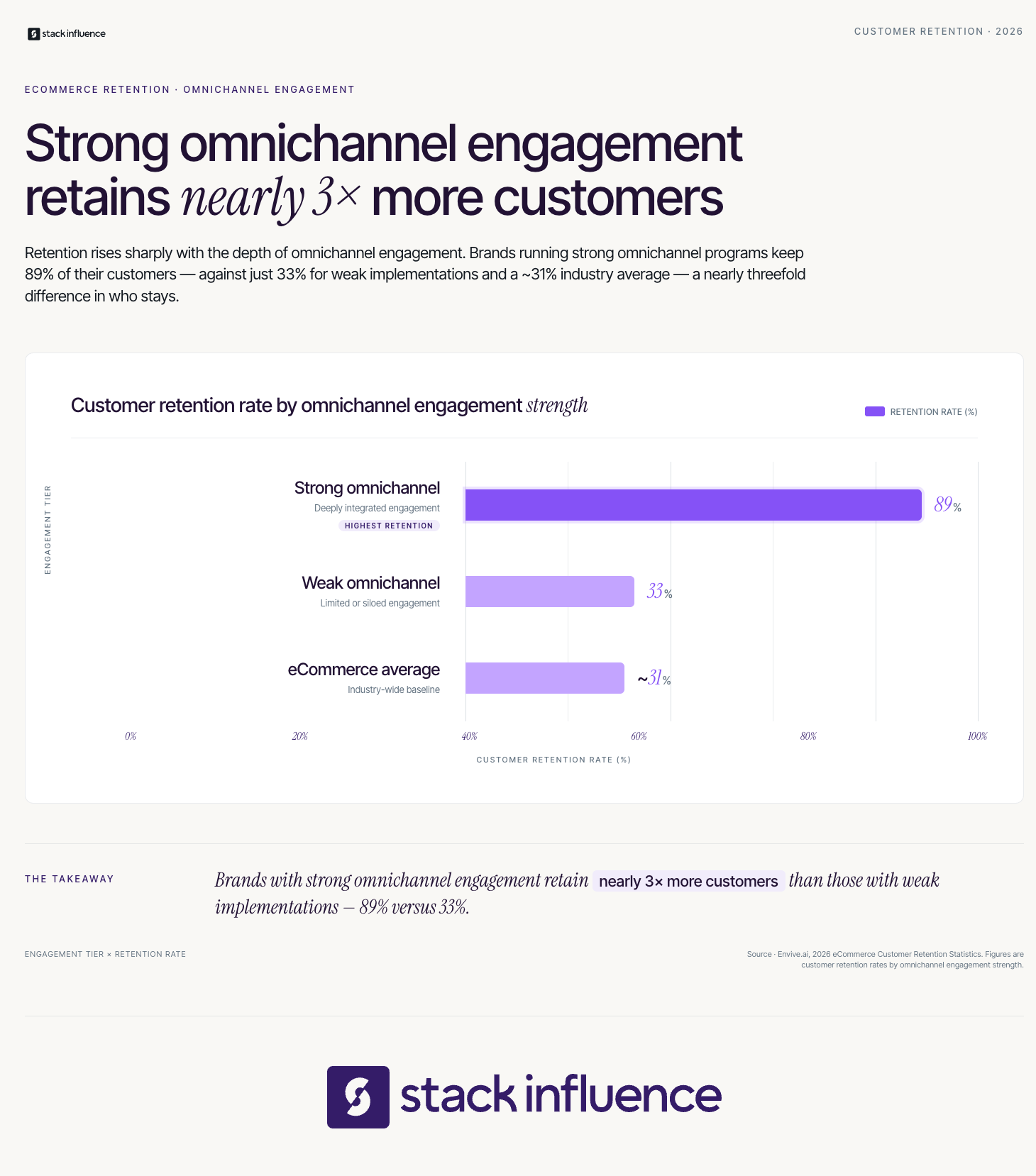
The primary framework for this strategy is called the Loyalty Loop Framework, a four-stage sequential model that moves customers from first-time buyers to active brand advocates. Each stage has a specific objective and a specific set of levers. Journey orchestration platforms can help coordinate these stages by connecting customer interactions across the retention journey. You must complete each stage before the next one will perform.
Stage 1 — Deliver. The objective is to exceed the expectation set at purchase. Packaging, speed, unboxing experience, and the first communication after delivery all set the anchor for the relationship. Brands that ship a thoughtful insert, a relevant recommendation, or a personal note at this stage see measurably higher second-purchase rates than those that ship a blank box. This stage happens before any marketing touchpoint can be effective.
Stage 2 — Engage. The objective is to keep the brand in the customer's world between purchase cycles. Smile.io's State of Ecommerce Customer Loyalty report, which analyzed 585 million orders across 100,000+ merchants, found that loyalty-generated value grew year over year across all major commerce industries in 2024. That growth was driven by merchants who maintained consistent post-purchase touchpoints, including email flows, loyalty program check-ins, and creator-generated content that appeared on the customer's social feed organically. Engagement is not a one-time email. It is a sustained presence.
Stage 3 — Reward. The objective is to create structural incentives for repeat behavior. Rewards can be points-based, tier-based, or access-based. The most effective loyalty mechanics in eCommerce combine at least two reward types: one transactional (points, discounts) and one relational (early access, community membership). Companies that personalize rewards and communication see retention rates rise by up to 10%, and 82% of high-performing loyalty programs include personalized experiences such as tailored offers or birthday perks.
Stage 4 — Amplify. The objective is to convert retained customers into a distribution channel. This is where brand ambassadors, UGC creators, and referral programs transform customer relationships into organic acquisition. The Loyalty Loop closes when your most retained customers become the reason new customers find you.
The Loyalty Loop Framework is most effective when all four stages are active simultaneously. Running Stage 3 without Stage 1 is the same as rewarding customers you have not yet impressed.
From Stack Influence's experience running product seeding campaigns across DTC and Amazon seller brands, eCommerce brands that engage a creator layer during Stage 2 of the Loyalty Loop consistently see stronger repeat purchase signals from customers who were exposed to ongoing creator content between purchase cycles versus those reached only through branded email. The creator touchpoint acts as a social reminder that operates outside the inbox.
One of the most underutilized levers in eCommerce retention is the influencer campaign that runs between launch events. Most brands activate creators for product launches and go quiet between them. That approach maximizes awareness but contributes nothing to the Engage stage of the Loyalty Loop Framework.
Research from Stackla shows that 88% of consumers say authenticity is a deciding factor in which brands they support. Micro influencers and nano influencers deliver that authenticity at a fraction of the cost of macro partnerships because their audiences are smaller, more trust-based, and more likely to overlap with your existing customer pool. A customer who sees a creator they already follow mention your brand a second time between purchases is receiving a retention signal, not an acquisition signal.
According to Collabstr's analysis of over 21,000 influencer collaborations, UGC campaigns more than doubled year-over-year, growing from 15% to 35% of all influencer campaigns in 2025. The reason is structural: UGC video and creator content can be repurposed across email flows, product pages, paid ads, and Amazon storefronts, multiplying the retention value of each piece of content far beyond its original post.
Here is how to structure a Creator Retention Engine alongside the Loyalty Loop:
Micro influencers with 10,000 to 100,000 followers have 2 to 3 times the engagement rates of macro influencers across every platform, which means their organic content is more likely to reach and register with your existing customer base. For Shopify influencer marketing and Amazon sellers running external traffic campaigns, this engagement advantage translates directly into repeat visit behavior.
Stack Influence's internal campaign data shows that eCommerce brands pairing an automated product seeding program with a structured ambassador tier see a meaningful reduction in the time between first and second purchase, particularly in beauty, wellness, and consumable categories where the repurchase window is 30 to 90 days.
Before scaling any retention program, you need to confirm the operational conditions that make retention possible. The Retention Readiness Audit is a seven-point secondary framework that functions as a pre-flight check before you invest in loyalty mechanics, creator partnerships, or measurement infrastructure. Run this audit quarterly.
The Retention Readiness Audit is not a one-time setup task. Run it every quarter to identify which conditions have drifted out of compliance as your catalog and creator roster scale.
Across campaigns managed on the Stack Influence platform, brands that complete the Retention Readiness Audit before launching a product seeding or ambassador program consistently activate their creator cohorts faster and recover usable UGC assets at higher rates than brands that seed without a pre-launch operational check.
Here is the contrarian perspective most retention guides skip: the real cost of poor retention is not the customers you lose. It is the compounding of acquisition costs you pay to replace them. Acquiring new customers costs five to seven times more than retaining existing ones, making poor retention an expensive problem for marketers.
Most eCommerce sellers benchmark their CAC against their first-order revenue. That is the wrong comparison. The correct benchmark is CAC against CLV projected across the full customer relationship. When you calculate it that way, a customer retained for three purchase cycles is typically worth four to seven times what the acquisition ledger shows.
It is estimated that 35% of an eCommerce store's revenue is generated by the top 5% of customers. Those top 5% are not acquired differently. They are retained differently. They received a better post-purchase experience, more consistent engagement, a loyalty mechanic that rewarded their behavior, and brand ambassadors whose content kept the brand present in their world.
The practical implication for DTC brands and Amazon FBA sellers is this: your acquisition spend has a ceiling set by your retention rate. Every percentage point of retention improvement directly lowers the effective CAC for the next cohort of buyers. This is the compounding logic behind the Loyalty Loop Framework, and it is why the framework is sequential rather than modular.
For brands using Shopify influencer marketing or running Amazon influencer program integrations, the creator layer is the most scalable retention investment available at a per-unit cost that matches or beats email for high-intent repeat buyers.

The measurement problem in eCommerce retention is not a lack of data. It is the absence of a named, agreed-upon model that tells everyone on the team which numbers actually move the needle. The following model, called the Retention Signal Stack, defines four components that together give you a complete picture of your retention system's health.
The Retention Signal Stack has four labeled components:
Reference the Retention Signal Stack in your monthly reporting to avoid the common mistake of optimizing for open rate or follower count instead of the revenue signals that actually predict retention.
Most brands treat influencer marketing as an acquisition tool. The more accurate framing is that creator partnerships serve both acquisition and retention simultaneously, and the retention function is the one most brands fail to build intentionally.
A micro influencer agency or self-managed creator program that runs ongoing, always-on content gives your existing customers a reason to feel culturally connected to your brand between purchase cycles. This is what brands like Glossier and Liquid I.V. have demonstrated at scale: the creator layer is not a campaign. It is a perpetual presence layer.
For eCommerce brands and Amazon sellers, the most efficient structure is a three-tier creator architecture:
User-generated content achieves a 28% higher engagement rate on social media compared to traditional branded content. When that UGC is routed back into UGC platforms and displayed on product pages, the retention loop closes: existing customers see their community reflected in the brand, and new customers convert at higher rates because social proof is present at the point of decision.
For Amazon FBA sellers, the creator tier connects directly to the Retention Signal Stack through Amazon Attribution. Each influencer campaign tagged with an Attribution link generates data on which creators drive customers with the highest CLV-C, allowing you to reinvest the Brand Referral Bonus credits into the creator tiers that produce the most retainable buyers.
The difference between eCommerce brands that grow sustainably and those that stay trapped in an acquisition treadmill is not budget. It is the presence of a deliberate customer retention strategy that operates as a system rather than a collection of disconnected tactics. The Loyalty Loop Framework gives you the sequential structure. The Retention Readiness Audit gives you the operational checklist. The Retention Signal Stack gives you the measurement model. And the Creator Retention Engine gives you the always-on social layer that keeps your brand present in customers' lives between purchase cycles. Apply these frameworks in order, measure the right signals, and the compounding economics of retention will do the rest.
Most product launches fail in the first 90 days. Not because the product is bad, but because the promotion strategy treats content creators as a last-minute distribution channel rather than a strategic asset. If you are a micro influencer, nano influencer, or UGC creator, you are sitting on more launch power than most brands realize. The creator economy has fundamentally shifted how products reach buyers, and a smart product launch strategy can turn your content, your audience, and your creative voice into genuine commercial results for you and the brands you partner with.
Product launches used to follow a linear path: PR, paid media, retailer placement. That playbook is broken in 2026. The influencer marketing industry reached $32.55 billion globally in 2025, according to Influencer Marketing Hub's data cited by Statista, and brands are no longer asking whether influencer marketing works. They are asking how to structure it around a launch window.
The core shift is this: consumers now discover and evaluate products through creator content before they ever interact with a brand directly. HypeAuditor's State of Influencer Marketing 2025 report found that nano-influencers achieve 10.3% engagement on TikTok, compared to 7.1% for mega-influencers, confirming that smaller, more targeted audiences consistently outperform larger ones on the platform. That discovery advantage is what makes the creator community so valuable to a product launch.
What this means for you as a creator is that brands are actively looking for niche micro influencers who can deliver authentic reach within a defined community. The question is whether you have a strategy to position yourself inside a launch window, or whether you are waiting for brand deals to find you.
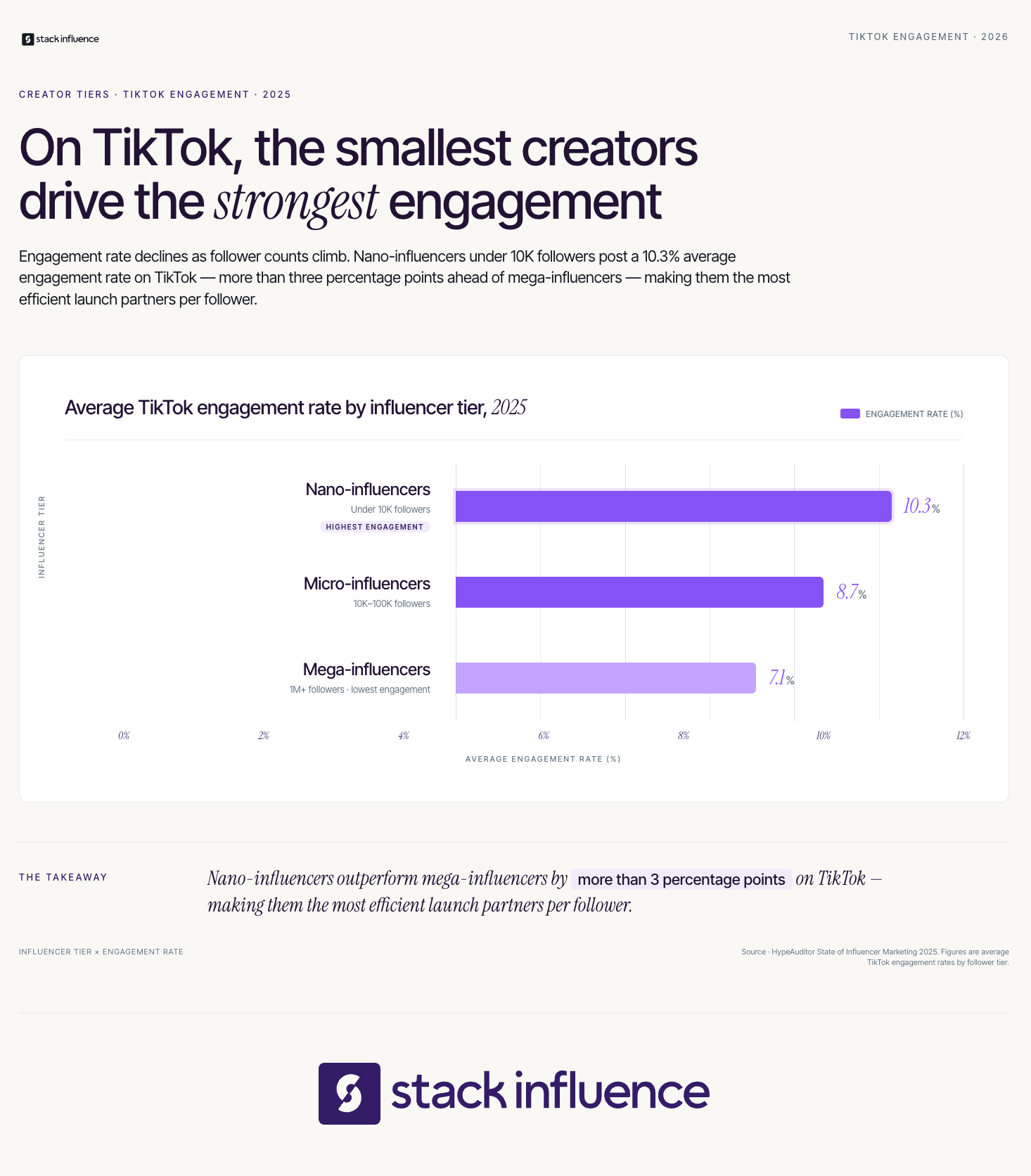
The data signals are clear:
A creator-led product launch strategy is a structured approach in which content creators and influencers are embedded into a product's go-to-market plan across three distinct phases: creator sourcing, pre-launch activation, and post-launch amplification. It is not a single sponsored post. It is not a PR gifting blast. It is a coordinated sequence of creator actions that builds audience awareness, generates social proof, and extends the revenue window of a product launch.
According to Sprout Social's 2025 Influencer Marketing Report, 65% of influencers would rather be involved in creative or product development conversations with brands early on than follow a rigid brief. That preference is not just about creator satisfaction. It produces better content because the creator has context, belief in the product, and the freedom to speak to their audience in their own voice.
The creator-led model matters especially for influencer marketing platforms, brand ambassadors, and UGC creators who want to build sustainable revenue streams from brand partnerships. When you understand the strategic logic behind a launch, you can pitch yourself as a launch partner rather than a content vendor. That positioning changes the type and duration of brand deals available to you.
The primary framework for this strategy is the Launch-Fit Checklist, a five-point audit that creators and brands both use to evaluate whether a partnership is structurally positioned to succeed before a launch brief is written. The Launch-Fit Checklist runs before any content is created and prevents the most common failure mode in influencer campaigns: launching with misaligned creators.
Here are the five items in the Launch-Fit Checklist:
A 2025 survey by influee found that 83% of creators will work for gifting alone if the brand fit is right, making micro and nano seeding campaigns viable even on tight budgets. This means the Launch-Fit Checklist works in both directions. Creators who can articulate why they pass all five criteria are more likely to receive product seeding deals and paid partnerships. Brands running automated product seeding campaigns can use the same checklist to qualify creators at volume without manual review for every profile.
Stack Influence has observed that product launch campaigns where creators and brand managers align on usage rights and posting windows before the campaign brief is written produce significantly fewer revision cycles and higher on-time submission rates than campaigns where these details are handled after outreach.
Once a creator passes the Launch-Fit Checklist, the sourcing phase is complete. The strategy moves to activation.
The pre-launch window, typically the two to four weeks before a product goes live, is where the real strategic work happens. Most brands waste this window by keeping creators silent until launch day. That is a structural mistake. The pre-launch phase is where audience priming, content production, and early social proof are built.
According to Shopify's 2025 UGC analysis, shoppers who engage with UGC reviews convert 144% more often and generate 162% higher revenue per visitor. That conversion premium does not materialize on launch day without content that already exists and has already been seen. Pre-launch content is what creates that lift.
According to Emplifi's Q3 2025 Social Media Benchmarks report, social media posts featuring user-generated content drove 10.38x higher conversion rates compared to non-UGC posts. This means every piece of pre-launch UGC video a creator posts is not just awareness. It is a conversion asset that carries economic weight into and past launch day.
Here is how the pre-launch phase should be structured for creators:
From Stack Influence's experience running product seeding campaigns at scale, brands that engage creators in the pre-launch window rather than on launch day generate three to four times more organic content volume because creators have more time to test, iterate, and post authentically.

The secondary framework for this strategy is the Momentum Tier Model, a three-tier maturity structure that categorizes where creators sit in the amplification phase and what actions are appropriate at each tier. Unlike the Launch-Fit Checklist, which runs once before the campaign, the Momentum Tier Model is a continuous evaluation tool used during and after launch.
According to Aspire's 2025 influencer marketing research, brand ambassador programs delivered the highest ROI for brands in 2024, underscoring the power of long-term creator relationships. Creators who structure their campaign activity across all three tiers of the Momentum Tier Model are the ones brands want to retain as ambassador partners because they are demonstrating consistent, compounding value rather than a single traffic spike.
For creators actively building brand ambassador relationships, Tier 3 behavior is the evidence base for negotiating retainer arrangements. It shows brands that your audience does not simply move on after launch day.
Most creators and brands track the wrong things. Follower counts and impressions feel significant but they do not tell a brand whether your content drove revenue. The metric model that actually demonstrates launch impact is the Creator Launch ROI Stack, a four-component measurement framework that creators can use to report campaign results and negotiate future partnerships.
The Sprout Social 2025 Influencer Marketing Report found that 92% of marketers report better reach, 90% see better engagement, and 83% report higher conversions when using sponsored influencer content versus organic brand posts. When you can map your content's performance against those benchmarks using the Creator Launch ROI Stack, you are speaking the language that brands actually use to evaluate their influencer marketing spend.
Across campaigns managed on the Stack Influence platform, creators who submit post-campaign performance summaries using a structured metric report are significantly more likely to be invited back for follow-on campaigns and offered ambassador contracts than those who deliver content without performance context.
For creators looking to understand how to position their metrics within a broader influencer marketing platform context, the Creator Launch ROI Stack connects your individual post performance to the business outcomes brands care about.
Here is the genuinely novel angle that most product launch strategy content ignores: creators are being used for distribution when their highest value is actually in validation sequencing.
Validation sequencing means structuring the order in which different creator types post within a launch window to maximize social proof accumulation. The standard approach sends launch content to all creators simultaneously. That creates a brief spike of noise followed by silence. A sequenced approach is architecturally different and produces measurably better results.
The sequencing works like this. Nano influencers post first, in the pre-launch window, to niche communities where they have deep trust. Their content generates authentic early engagement and comment threads that serve as social proof for what comes next. Micro influencers post on launch day, referencing a product they have already seen discussed by smaller community accounts. Their audiences encounter the product with pre-existing social context, which lowers purchase friction. Macro or mid-tier creators post in the week following launch, when UGC from nano and micro creators already exists on platform. Their audiences do not encounter a cold product. They encounter a product with a visible history of peer endorsement.
This sequenced activation structure is how brands that work with micro influencers consistently outperform brands that run simultaneous, untimed influencer blasts. It is also why influencer campaigns built around tiered creator rosters using the Momentum Tier Model generate more sustained sales velocity than single-creator or single-day launches.
The Launch-Fit Checklist ensures you have the right creators in the right sequence. The Momentum Tier Model tells you what each tier should be doing and when. Together, they make validation sequencing executable rather than theoretical.
The practical action this week: if you are a creator building a launch pitch for a brand partnership, map your audience to a specific position in the sequencing structure. A nano influencer should be pitching themselves as the pre-launch trust builder, not the launch-day megaphone. That reframing changes the conversation from "here is my follower count" to "here is where I fit in your launch architecture."
Brands looking for creators who understand launch sequencing can find influencer marketing agency level strategy from individual creators by checking whether they can articulate their role within a phased campaign rather than just quoting a rate per post.
A single product launch is a moment. A career in the creator economy is built on turning those moments into recurring relationships. The structural shift from launch partner to brand ambassador happens when creators demonstrate three specific behaviors during and after a launch window.
First, creators who proactively share performance data with brand partners after a campaign close build an evidence base for renegotiation. Second, creators who generate more content than their brief requires demonstrate production reliability that brands cannot easily find at scale. Third, creators who engage their audience around a product beyond the sponsored post window, by responding to comments, creating organic follow-ups, and referencing the product in future content, extend the revenue lifetime of the campaign for the brand.
Influencer marketing platforms are increasingly designed to track all three of these behaviors. Creators who are aware of what platforms capture can align their campaign behavior accordingly. Understanding how influencer seeding works from the brand's operational perspective gives creators insight into how their post-campaign behavior is evaluated.
The creator economy is projected to reach $528.39 billion by 2030, growing at a 22.5% CAGR from 2023, according to Collabstr's 2024 Influencer Marketing Report cited by industry analysts. That growth belongs to creators who build strategic competency around launches, not just content production volume.
A product launch strategy built around creators is not a social media tactic. It is a revenue architecture. The creators who treat it as such, using structured frameworks like the Launch-Fit Checklist and the Momentum Tier Model, measuring their impact with the Creator Launch ROI Stack, and positioning themselves within a validation sequencing structure, are the ones who build lasting brand partnerships. The product launch strategy you execute today is the portfolio that earns your next brand deal, and the one after that. Structure it deliberately.