
The latest info on influencer marketing trends, micro influencer news, and the world of social media

Most guides on hashtags for Instagram Reels were written for a platform that no longer exists. Instagram enforced a hard five-hashtag limit in December 2025, which collapsed the old "use 30 and hope" playbook overnight. For influencers trying to grow their accounts, land brand deals, and attract the right audiences for creator partnerships, that change matters more than most people realize. This guide covers how hashtags actually work on Reels today, what the algorithm rewards, and how to build a tagging system that compounds your discoverability over time.
Hashtags for Instagram Reels are keyword tags that help Instagram's algorithm categorize your content and serve it to users who follow or search that topic. As of December 2025, Instagram enforces a hard five-hashtag limit on posts and Reels, making every tag slot count more than ever. Hashtags now function as content classification signals for Instagram's algorithm rather than standalone reach drivers — content quality, watch time, and engagement behavior carry more weight.
This is a structural shift from how hashtags worked for years. Previously, creators stacked 20 to 30 tags and relied on hashtag feed pages to deliver new viewers. That mechanism has weakened considerably. Instagram's AI-driven recommendation engine now prioritizes content quality, engagement, and SEO-friendly captions over hashtag volume. Hashtags serve as content categorization tools, helping posts get discovered by the right audience over time, especially in niche communities.
For influencers, the implication is clear: hashtag strategy is no longer about reach. It is about classification. You are telling Instagram's algorithm what your content is, who it serves, and where it belongs in the interest graph. Getting that signal right is what determines whether your Reel shows up on the Explore page of your ideal audience or disappears entirely.
The most effective way to approach hashtag selection as a creator is through a tiered framework. The Reel Growth Tiers model organizes your five available hashtag slots around three distinct functions: classification, community, and brand visibility. Reference the Reel Growth Tiers each time you build a hashtag set and you will stop guessing which tags to use.
The three tiers work as follows:

The Reel Growth Tiers model solves the five-hashtag constraint by giving each slot a job. Rather than filling tags at random, you are allocating limited real estate to the signals that serve you most. Return to the Reel Growth Tiers any time your Reel reach drops or plateaus and audit whether your slots are doing the right work.
This is the question most influencer guides answer wrong. The default advice — "mix broad and niche" — misses the critical distinction between accounts that already have reach and accounts that are building it. The right answer depends on where you are in your growth curve.
For nano influencers and smaller micro influencers under 25K followers, broad hashtags are largely a wasted slot. When you use 30 hashtags, you risk "confusing" the algorithm by sending too many conflicting signals. Using 3 to 5 hyper-specific tags confirms the AI's understanding of what your content is, making it easier for the platform to serve your post to a curated interest feed. A broad tag like #fitness puts your Reel next to content from accounts with millions of followers — that is a competition you cannot win for discoverability.
The practical rule is to use community tags where your content can actually surface in the top posts. Search the hashtag before using it and look at the recent posts section. If the recent posts are consistently from large accounts, skip it. If you see creators at your follower level posting there, it belongs in your set. Stack Influence has observed that micro influencers who build niche-specific hashtag sets tied directly to their content category — rather than aspirational or trend-chasing tags — maintain more consistent Reel reach across campaigns than those who rotate tags based on trending topics.
Hashtags are a supporting signal, not the main event. Understanding what the Reels algorithm actually prioritizes helps influencers put hashtags in the right context rather than over-investing in them.
For Reels, DM shares are the most heavily weighted signal for distribution. Sends via direct message signal to the algorithm that your post is worth distributing more widely. Alongside shares, watch time and completion rate are the primary quality inputs. Data from multiple studies shows that Reels with strong 3-second hold rates above 60% outperform those with weak holds below 40% by 5 to 10 times in total reach.
According to Meta's Q3 2025 report, Reels generate 67% of Instagram's total engagement. That dominance makes Reels the highest-leverage format for influencer marketing, but it also means the competition is intense. A Reel with weak hooks and irrelevant hashtags will not survive in that environment regardless of how well-crafted the tags are.
The practical implication for your hashtag strategy: invest the bulk of your creative energy in the first three seconds and the hook of your Reel. The hashtags classify your content so the algorithm knows where to send it. The hook determines whether the people it reaches actually watch. Both matter, but in that order.
Most guides focus entirely on which hashtags to use and skip the thing that matters most: how hashtag strategy connects directly to brand deal visibility. For influencers, hashtags are not just a growth tool — they are a professional signal that brands and influencer marketing agencies use when evaluating whether to work with you.
When a brand or micro influencer agency searches Instagram for creators to pitch a product seeding campaign, they search by niche hashtags. The most effective influencer discovery strategy involves searching niche hashtags rather than broad tags — #slowfashionootd has a more engaged community than #sustainablefashion, and brands find better-fit creators there. If your Reels are tagged with generic, high-volume hashtags, you are invisible to the brands most likely to hire you.
Data from Stack Influence's micro influencer campaigns suggests that creators who consistently use three to five niche-specific hashtags on their Reels appear in brand searches at a meaningfully higher rate than creators who use broad, trend-chasing tags. The reason is simple: when a brand searches a niche hashtag looking for relevant creators, your content shows up. When you use generic tags, it does not.
The second thing most guides miss: hashtags on Reels also function as portfolio signals to brands reviewing your content before reaching out. A creator whose Reels consistently appear under #ugcbeauty or #amazonfinds is communicating their content category without saying a word. Build your hashtag sets around the categories where you want to attract brand partnerships and you will start attracting inbound interest that most influencers wait years for.
Most influencers check reach numbers and call it a day. That is the wrong measurement frame for hashtags in 2026. Use the three-tier Reel Metric Stack to evaluate your hashtag performance properly — it separates algorithmic signals from discovery signals and tells you where to make adjustments.
The Reel Metric Stack works as follows:
Across campaigns managed on the Stack Influence platform, creators who audit their hashtag performance monthly using this three-tier framework consistently identify one or two underperforming tags per set that are dragging their classification signal. Swapping those out for better-matched niche tags produces measurable reach improvement within two to three Reel cycles.
Beyond reach, the most important metric for influencers seeking brand deals is profile visits generated from Reels. When a brand clicks through to your profile after finding your Reel on a niche hashtag, that is the discovery sequence you are optimizing for. Track profile visits from Reels separately in Instagram Insights and treat it as your primary signal of brand-visibility health.
When you land an influencer campaign or brand deal, hashtag strategy becomes a shared responsibility between you and the brand. Most campaign briefs tell influencers which hashtag to use without explaining why or how to use it effectively. Understanding the mechanics puts you in a stronger negotiating position and makes you a better collaborator.
Branded campaign hashtags typically serve two functions: they aggregate UGC content for the brand to track and reuse, and they signal partnership compliance to the algorithm. Creating a unique, memorable hashtag for a campaign makes it easy to track submissions and build momentum, and brands increasingly use these tags to source UGC for repurposing in ads and organic content.

When you receive a campaign brief, treat the branded hashtag as your Tier 3 slot from the Reel Growth Tiers. Pair it with two niche community tags from Tier 2 that are relevant to the product or category. This approach satisfies the brand's tracking requirement while keeping your other tag slots working for your own account growth. Never replace all five slots with campaign-specific tags — that kills your niche classification signal entirely and often results in weaker Reel performance for the brand campaign as well.
For UGC creators working across multiple brand partnerships simultaneously, maintain a running hashtag library organized by niche. Build separate tag sets for beauty, home goods, wellness, and food categories so you can deploy the right set quickly when campaign briefs arrive. Platforms like Stack Influence that coordinate product seeding campaigns at scale typically include hashtag and tagging requirements directly in the creator brief, which simplifies this process and ensures your posts are categorized correctly from the moment they go live.
Hashtags for Instagram Reels are not a growth hack anymore — they are a precision tool for content classification, niche discoverability, and brand partnership visibility. The five-hashtag limit forces a discipline that actually benefits influencers willing to do the work: choose the right tags, audit your performance monthly, and build sets that reflect where you want to be found. Apply the Reel Growth Tiers framework to every Reel you post, use the Reel Metric Stack to course-correct when performance slips, and think of your hashtags as the professional signal that tells brands exactly what niche you own. That combination is what separates creators who attract inbound brand deals from those who are still waiting to be discovered.
Customer acquisition costs on Meta and Google have risen more than 222% over the past eight years, and eCommerce sellers are feeling that pressure in their margins every single month. Shopify powers more than 4.5 million stores worldwide, but the difference between sellers who profit and those who plateau is not the platform. It is the revenue model they choose and how deliberately they build it. This guide breaks down the seven most scalable ways to make money on Shopify, including the influencer and creator-driven approaches that are pulling DTC brands away from paid ad dependency in 2026.
The global DTC market is projected to reach $319.57 billion in 2026, and Shopify sits at the center of that expansion. Shopify controls roughly 32% of the eCommerce platform market, making it the dominant infrastructure layer for independent brands. That scale creates both opportunity and competition. More sellers means more noise, and the brands cutting through treat their Shopify store as a sales engine, not just a product catalog.
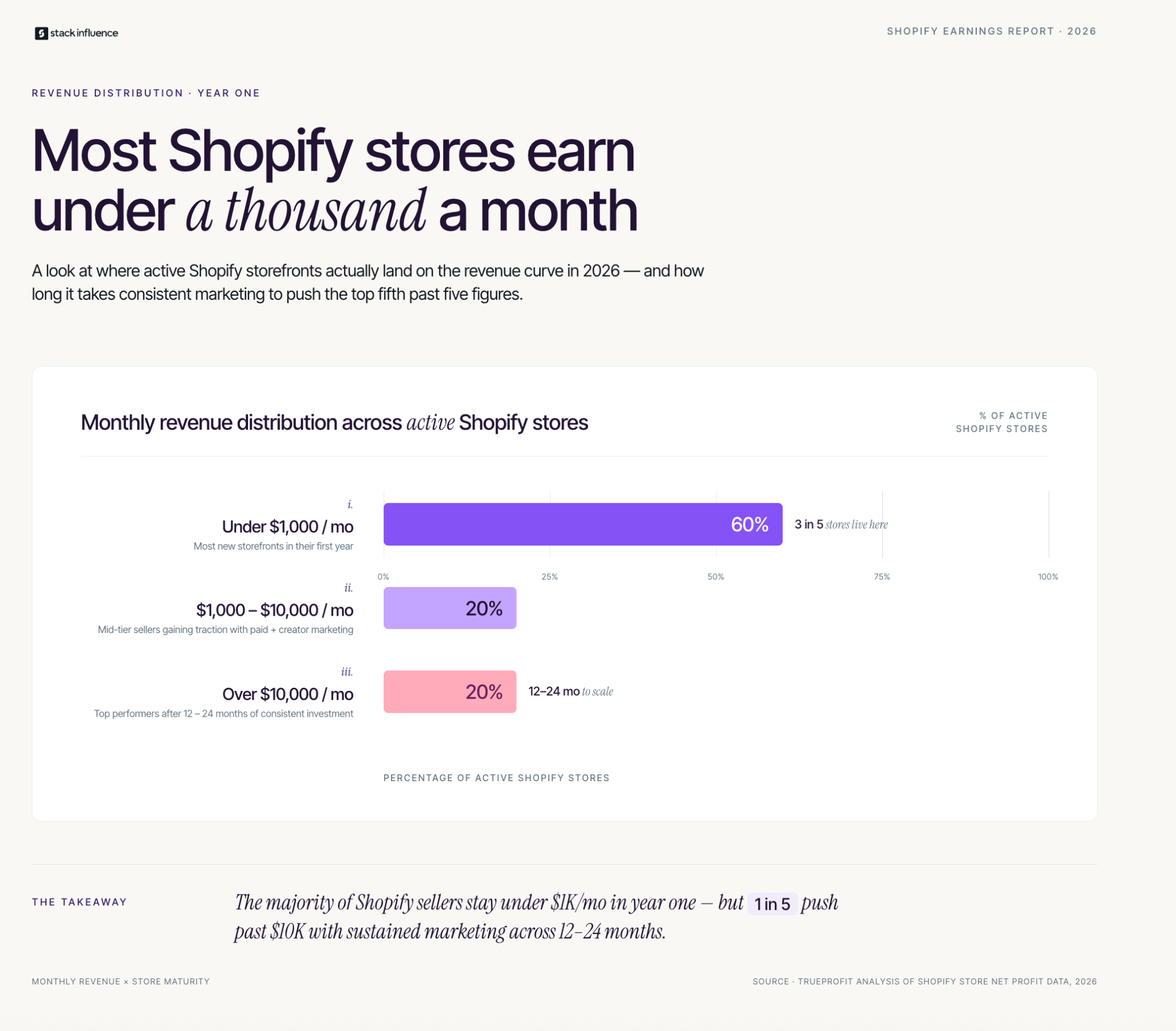
The earnings reality is polarized. Roughly 60% of new Shopify stores earn under $1,000 per month in their first year, while the top 20% scale past $10,000 per month after consistent investment in marketing and conversion optimization. The gap between those two groups is rarely product quality or pricing. It is traffic quality and the ability to convert that traffic into repeat buyers.
Customer acquisition costs across DTC brands have risen 222% over the past eight years, which makes traffic diversification a financial necessity rather than a growth strategy. Sellers who rely entirely on paid social are working against a rising structural headwind. Understanding the current landscape means accepting that reality and building a revenue model that does not depend on any single channel.
Social commerce in the US is projected to surpass $100 billion in 2026, with creator-led channels driving a growing share of that volume. Sellers who treat influencer and UGC marketing as a future experiment rather than a present-tense channel are already behind the brands that started building creator programs 12 months ago.
Making money on Shopify requires three things working in parallel: a product with real margin, a traffic source that scales, and a storefront that converts visitors at a consistent rate. Most sellers understand the first requirement but underestimate the second and third. A good Shopify conversion rate sits between 2.5% and 3.5%, with top performers hitting 4.7% and above, according to Craftberry's 2026 conversion benchmark analysis. Stores converting below 1% are not a traffic problem. They are a trust and relevance problem.
The seven primary ways to make money on Shopify are:
Each model has a different CAC ceiling, margin profile, and growth trajectory. The model that scales is the one that matches your product type, margin structure, and capacity to generate traffic without relying on a single expensive channel. Most sellers who plateau are not in the wrong business model. They are in the right model with the wrong traffic strategy.
Most Shopify guides position paid advertising on Meta and Google as the default traffic strategy and then quietly acknowledge that it is expensive. That framing understates the structural problem. CAC has risen more than 222% over eight years, and that figure does not reflect a bad campaign. It reflects a structural shift in how attention is priced online.
The sellers outperforming their peers in 2026 are not necessarily spending more on ads. They are diversifying traffic sources so that creator-generated content, organic SEO, and email each carry meaningful weight alongside paid channels. Three in four online consumers report purchasing a product based on an influencer recommendation, which means creator-led traffic is not an alternative to demand. It is a direct channel for it.
The math shifts when you factor in content reuse. A paid ad campaign produces impressions. A product seeding campaign with micro influencers produces both traffic and reusable creative assets. Those UGC assets repurposed as ad creative generate 4x higher click-through rates than brand-produced content, which means the creator investment pays dividends across multiple channels simultaneously.
Sellers who recognize this shift stop treating influencer marketing as a brand awareness budget line and start treating it as a cost-of-goods item that comes with content attached. That mental shift is what separates brands building compounding traffic from brands buying traffic one click at a time. The hidden cost of staying on paid-only acquisition is not just CAC. It is the content library you are not building while your competitors are.
The Shopify Revenue Ladder is a four-tier progression model that helps sellers identify where they are in their growth arc and what to prioritize next. Unlike a linear checklist, the Shopify Revenue Ladder acknowledges that the tactics that work at $1,000 per month often break at $20,000 per month, and scaling requires a deliberate shift in approach at each tier. Understanding which rung you are on prevents the most common scaling mistake: using Tier 4 tactics when you are still solving Tier 1 problems.
The four tiers of the Shopify Revenue Ladder are:
The Shopify Revenue Ladder works because it forces sellers to think in stages rather than tactics. Most sellers jump from Tier 1 directly to paid ads without ever building the content foundation that makes those ads efficient. The brands moving fastest through the Shopify Revenue Ladder invest in creator relationships early, because that investment pays compounding returns at every subsequent tier.
At Tier 3, the operational question becomes execution volume. Running product seeding campaigns with 20 or more creators manually is time-intensive and prone to fulfillment gaps. For sellers at this stage, platforms like Stack Influence handle automated product seeding, creator matching, brief delivery, social post verification, and UGC collection in a single workflow. That operational leverage allows lean teams to run Tier 3 campaigns without adding headcount, which is exactly what the Shopify Revenue Ladder requires for efficient stage progression.
Influencer marketing's role in Shopify revenue generation has evolved from a brand awareness play into a direct-response and content-production channel. The global influencer marketing industry reached $32.55 billion in 2025, with DTC brands driving a significant share of that spend because of the dual output: traffic and reusable creative. For Shopify sellers, the math works because micro influencers generate both outputs at a unit cost that paid channels cannot match.
The mechanics work as follows. A product seeding campaign sends inventory to 20 to 100 micro influencers in exchange for social posts. Those posts drive direct traffic to your Shopify store. The UGC they produce gets pulled into your product pages, email campaigns, and paid social creative. Each piece of content continues working long after the original post. Unlike a paid ad that stops generating value when the budget runs out, a creator post and its derivative assets generate value across multiple cycles.
Across campaigns managed on the Stack Influence platform, Shopify sellers in the beauty and personal care category consistently see UGC reuse rates above 60%, meaning more than half of the creator content produced is usable across paid ads, product listings, and email without additional editing. In general lifestyle categories, that reuse rate averages closer to 40%. The gap matters because higher reuse rates translate directly into lower blended content production costs over time.
The strategic implication for sellers trying to make money on Shopify is that influencer campaigns should be evaluated not just on attributed sales from the original post but on the total asset value generated. A campaign producing 30 usable video assets, 15 of which outperform studio creative in paid social, is generating ongoing revenue that does not appear in a single UTM report. Understanding Shopify influencer marketing as a content production investment, not just a traffic purchase, changes how you budget and what metrics you prioritize.

Creator content does not automatically convert once it drives a visitor to your Shopify store. The bridge between influencer-driven traffic and actual revenue is store readiness. The Creator-Ready Store Audit is a six-item checklist sellers should complete before running any influencer or product seeding campaign. Applying the Creator-Ready Store Audit before launch prevents the most common failure mode: sending engaged, warm traffic to a store that is not built to capture it.
The Creator-Ready Store Audit covers six critical areas:
Data from Stack Influence's micro influencer campaigns suggests that Shopify brands deploying creator UGC directly onto product detail pages within two weeks of campaign delivery see measurably stronger add-to-cart rates than brands who let that content sit unused in a shared folder. The content is highest-impact when it is deployed fresh and aligned to the current traffic source visiting the store.
The UGC collection workflow is only as effective as the store receiving the traffic. Sellers who have completed the Creator-Ready Store Audit convert influencer traffic at rates closer to the 3.5% to 4.7% top-performer range. Sellers who skip this step often see strong engagement metrics from creator content paired with weak on-site conversion, which leads them to incorrectly conclude that influencer marketing does not work for their brand.
Measuring how influencer and product seeding campaigns contribute to Shopify revenue requires a layered attribution model. Last-click attribution inside Shopify Analytics systematically undercounts creator impact because it credits the final touchpoint, not the intent touchpoint. A customer might see a creator's post on Tuesday, visit and leave without buying, receive a retargeting ad on Thursday, and convert on Friday. Shopify Analytics credits the Thursday ad. The creator post that built the initial purchase intent gets no credit at all.
The Shopify Creator Attribution Stack is a three-layer model that gives sellers a more complete picture:
Based on Stack Influence's work with eCommerce brands, sellers who implement all three attribution layers consistently find that creator-driven revenue is 1.5 to 2.5 times higher than what their last-click reports show. That discrepancy changes budget allocation decisions and makes the case for ongoing creator investment in internal reporting.
Amazon sellers running dual-channel operations should also note that influencer traffic sent to a Shopify storefront and cross-promoted to an Amazon listing qualifies for the Amazon Brand Referral Bonus, which credits back 10% or more of the sale price on traffic driven by external sources. That bonus effectively subsidizes the cost of creator campaigns for brands selling across both channels. The measurement infrastructure should be built before campaigns launch, not after, so that sellers have clean data to optimize against from the first shipment.
The path to making money on Shopify in 2026 is not a single channel or a single product category. It is a staged progression from proof of concept through compounding traffic, and the brands scaling fastest are those that invest in creator-driven content early enough for it to compound. The Shopify Revenue Ladder gives sellers the framework to identify their current stage and make deliberate choices about what to build next, rather than defaulting to ad spend when growth stalls.
For DTC sellers ready to move beyond paid-ad dependency, the next step is identifying which of the seven revenue models aligns with your margin structure, and then building the creator and UGC infrastructure that makes each model more efficient over time. Whether you are seeding 10 creators or 100, the operational systems you build at Tier 2 become the growth engine at Tier 4. Start with the Creator-Ready Store Audit, build your attribution stack before your first campaign ships, and treat every piece of creator content as a long-duration asset for your store.
One in five online orders gets sent back. That statistic alone should change how every eCommerce seller thinks about the purchase experience, not just the post-purchase one. With U.S. retail returns totaling $849.9 billion in 2025, the cost is no longer a rounding error on a P&L statement. For Amazon sellers, Shopify brands, and DTC operators, strong ecommerce returns management is the difference between a business that scales and one that bleeds margin at every shipment. This guide lays out the strategies, frameworks, and measurement tools your brand needs to protect profitability while keeping customers coming back.

Ecommerce returns management is the operational and strategic system a brand uses to receive, process, analyze, and prevent customer returns. It covers the full reverse logistics chain, from the moment a customer initiates a return request to the moment that product is restocked, liquidated, or disposed of. But the most advanced sellers understand that returns management begins long before the return label is printed.
The most actionable definition extends upstream. Returns management includes any deliberate decision that reduces return probability before the purchase, from how products are photographed to how size is communicated to how creators demonstrate use context. It also includes downstream decisions: how quickly refunds are issued, whether exchanges are incentivized over cash refunds, and how return data feeds future listing and inventory improvements.
For Amazon FBA sellers specifically, returns management carries an additional layer of financial complexity. Since Amazon introduced returns processing fees for high-return ASINs in June 2024, sellers whose products exceed the category return rate threshold face per-unit charges ranging from $0.50 to $2.00. A single underperforming ASIN at volume can erase months of margin gain. That reality has shifted the conversation from "how do we handle returns" to "how do we prevent them."
For Shopify and DTC brands, the stakes are similar. Returns erode not just the sale value but the customer acquisition cost, the shipping spend, and the restock labor. Effective ecommerce returns management connects prevention, processing, and profit protection into one coordinated system.
The returns problem has grown faster than most sellers anticipated. Online return rates now average approximately 20.8%, roughly two to three times the brick-and-mortar rate of 8.72%. Within categories like apparel and footwear, rates climb significantly higher. For Amazon sellers in saturated product categories, a high return rate is both a margin drain and an algorithmic liability.
Three structural forces are driving this growth:
The financial anatomy of a single return tells the full story. Processing costs between $10 and $65 per item depending on category and complexity, according to Eightx's 2026 analysis, which includes reverse logistics, labor, restocking, and write-offs. Reverse logistics alone can represent 20 to 30% of the original product value, and only 48% of returned items are resold at full price. At scale, those figures define the margin floor for any eCommerce operation.
The good news is that the cause of most returns is addressable. Sizing, fit, and color issues drive 45% of all retail returns, and product description mismatches account for another 14%. Both are listing-side problems, which means they are within the seller's control.
The Returns Maturity Ladder is a three-tier progression model that helps eCommerce sellers identify where they currently operate and what actions move them to the next stage. Most brands default to the first tier and stay there indefinitely, absorbing costs that could have been prevented with deliberate investment.
Moving from Tier 1 to Tier 2 on the Returns Maturity Ladder requires process investment. Moving from Tier 2 to Tier 3 requires a different kind of asset: content that closes the expectation gap before the customer clicks "buy." Data from Stack Influence's work with eCommerce brands shows that Amazon sellers who brief creators to demonstrate size scale, real-world use context, and honest product limitations consistently generate listing content that produces fewer "item not as described" return tags than brands relying only on studio photography.
Sellers at Tier 3 of the Returns Maturity Ladder also use the Listing Readiness Audit before any new ASIN launch. This secondary checklist helps teams verify return risk has been addressed in the listing before traffic is driven to it:
Running the Listing Readiness Audit on every new ASIN before launch is one of the lowest-cost, highest-leverage actions a Tier 2 seller can take to move toward Tier 3.
The expectation gap is the single largest driver of preventable returns. When a customer receives a product that looks, fits, or functions differently than what the listing implied, a return is almost certain. Professional brand photography optimizes for aspirational appeal rather than accurate representation. Creator-generated UGC addresses this gap by showing products in real environments, on real people, with honest context about fit, scale, and texture.
The evidence is consistent. Bazaarvoice research shows that GANT achieved a 5% reduction in return rates after implementing a UGC program that gathered reviews specifically targeting size and fit information. Social Native's data shows that 39% of shoppers say they frequently return items because the product description doesn't match what they received, a problem that UGC-rich listings directly address. Visual UGC sourced from social media can also increase conversions by 150% and average order value by 15%, according to Bazaarvoice's platform research, which means the content investment works in both directions.
For Amazon sellers, the channel adds an important dimension. The Amazon Influencer Program allows approved creators to post shoppable content that can appear on Amazon product detail pages. When a micro influencer in the relevant product niche posts an honest unboxing or use demonstration, that content narrows the buyer's uncertainty before purchase and reduces returns driven by surprise or misaligned expectations.
Stack Influence's internal campaign data shows that Amazon brands sourcing creator-generated video content through automated product seeding campaigns and placing that content in their A+ listings see measurably lower rates of "not as described" return tags compared to brands relying solely on brand-produced photography. The mechanism is direct: real creators using real products in real settings set buyer expectations more accurately than optimized studio content. A sustainable approach to ecommerce returns management starts with what the customer sees before checkout, not what happens after the package arrives.
DTC brands running on Shopify solutions can apply the same logic across their full funnel. Embedding UGC for eCommerce across product pages, email flows, and retargeting ads creates a consistent, honest representation of the product at every touchpoint where a purchase decision is forming. When customers arrive at checkout with accurate expectations, the return rate falls.
Standard guidance on ecommerce returns focuses almost entirely on the post-purchase experience: faster refunds, better packaging, clearer policies, and smoother reverse logistics. That advice is not wrong, but it addresses the symptom rather than the underlying cause. The blind spot is that most brands optimize the return process without asking why returns are happening at a rate that no amount of logistics efficiency can fix.
The real problem is that eCommerce brands treat returns as an operations challenge when they are primarily a content and communication challenge. When a product is returned because of sizing, color, or unmet expectations, no amount of prepaid label automation solves the upstream cause. The fix lives in the listing, the creator content, the size guide, and the review signal. Brands that move ecommerce returns management responsibility toward their product and content teams find a much larger leverage point than those who keep it in operations.
There is a related blind spot on the Amazon side. Sellers often focus on their overall account return rate without drilling down to ASIN-level return reasons. A single listing with consistently vague photography can drag the entire account's performance metrics down while the seller applies broad policy changes that don't address the actual culprit. Amazon's enhanced Return Insights dashboard gives FBA sellers exactly the data they need to identify which specific ASINs are generating excess returns and why. Most sellers are not using it.
The third blind spot is return fraud, which brands either ignore entirely or over-correct for in ways that hurt legitimate customers. According to NRF and Happy Returns data, 9% of all 2025 returns were classified as fraudulent, and return fraud costs retailers over $100 billion per year. Implementing blanket restrictive policies to combat fraud alienates the 91% of legitimate customers and raises cart abandonment rates. Loop Returns' 2026 benchmark report found that 65.2% of merchants now charge return fees on at least some return outcomes, with an average fee of $9.04, suggesting the industry is moving toward selective fee structures rather than blanket restrictions.
Most brands track one metric: return rate. That is necessary but not sufficient. A comprehensive measurement framework for ecommerce returns management needs to capture prevention, processing efficiency, revenue retention, and attribution accuracy simultaneously.
A useful metric stack for DTC and Amazon sellers includes:

For Amazon sellers, two additional attribution tools deserve focused attention. Amazon Attribution allows sellers to tag off-platform traffic sources, which means a brand running influencer campaigns can connect external traffic to conversion and post-purchase behavior, including returns. Brands using Amazon Attribution consistently can identify whether traffic from a specific creator or channel generates higher return rates, which signals a listing-expectation mismatch for that audience segment.
The Amazon Brand Referral Bonus reduces referral fees on sales driven by external traffic, effectively lowering the net cost of influencer-driven purchases. However, the bonus only applies to completed, non-returned sales, which means brands driving high-volume influencer traffic with unoptimized listings may be generating returns that negate the bonus entirely. Stack Influence has observed that sellers who combine Amazon Attribution tagging with creator-briefed listing content produce external traffic that converts and stays converted, rather than converting and returning. Connecting return rate data to traffic source by ASIN is the Tier 3 measurement move that most sellers never make.
For Shopify brands and DTC sellers not on Amazon, the measurement priority shifts slightly. Track return rate by acquisition channel to identify whether paid social, influencer-driven traffic, or organic search customers return at different rates. Micro influencer promotions targeted at niche audiences that closely match the product's actual user profile consistently show lower return rates in cohort analysis than broad-reach campaigns, because the buyer's context already aligns with the product use case before purchase.
Ecommerce returns management is not a back-office function. It is a front-line strategic decision that begins with every product photo, every creator brief, and every listing update. The brands scaling profitably in 2026 are those that have moved from Reactive to Predictive on the Returns Maturity Ladder, using return data to improve listings, UGC to close expectation gaps, and attribution tools to connect return behavior to its upstream causes. For Amazon sellers, that means monitoring ASIN-level return rates, using the FBA Return Insights dashboard, and building a creator content library that shows products accurately in real-world contexts. For Shopify and DTC brands, it means treating the listing and content ecosystem as the first line of return prevention. Start with the Listing Readiness Audit on your highest-return ASINs and build a UGC-first content strategy around closing the expectation gaps your current photography leaves open.
The bigcommerce vs shopify decision is harder now because sellers are no longer choosing only a storefront. They are choosing the operating layer that will govern B2B pricing, creator traffic, Amazon measurement, content reuse, and expansion into new channels. Creator ad spend is still rising, and shoppers increasingly expect product pages to include real customer photos and videos, which raises the cost of picking a platform that is easy to launch but expensive to scale.
For eCommerce sellers and influencers, the smarter question is not which brand wins the loudest comparison page. It is which system keeps margin, workflow, and attribution readable as your catalog, channel mix, and content program get more complex. This guide breaks the choice down with a practical decision sequence, a measurement model, and a switching-cost lens that most platform comparisons skip.

The fastest way to answer bigcommerce vs shopify is to stop comparing feature lists in isolation. The better move is to run each platform through the same operating test, which is what the Store-Fit Sequence is for.
The Store-Fit Sequence works because it forces a seller to compare architecture against real workflow pressure. That means catalog structure, payment economics, channel mix, and measurement setup all get weighed before a migration becomes expensive.
Run the Store-Fit Sequence against the next two years of your business, not the last two months. Sellers who do that usually discover that the wrong platform is rarely unusable on day one, but it becomes painfully obvious when they add B2B rules, marketplace traffic, or creator-led growth.
At a practical level, bigcommerce vs shopify is a comparison between two different philosophies of commerce infrastructure. One leans harder into built-in operational depth and open integrations, while the other leans harder into speed, ecosystem leverage, and merchant-friendly extensibility.
That distinction matters because most sellers do not fail on homepage design. They fail when catalog logic, payment rules, content operations, and attribution start colliding across DTC, wholesale, and Amazon. If your roadmap already includes those layers, the comparison is less about appearance and more about operating model.
If your broader growth plan also includes Amazon, the companion Stack Influence guide to is useful because it frames your storefront as part of a wider channel system rather than a stand-alone site. That is the right mental model for modern DTC brands that split demand capture across site, marketplace, and creator-led traffic.
BigCommerce becomes the stronger option when the commerce problem is operational before it is creative. That usually means multiple storefronts, regional complexity, heavier B2B requirements, or a payment stack that cannot be forced into one preferred processor.
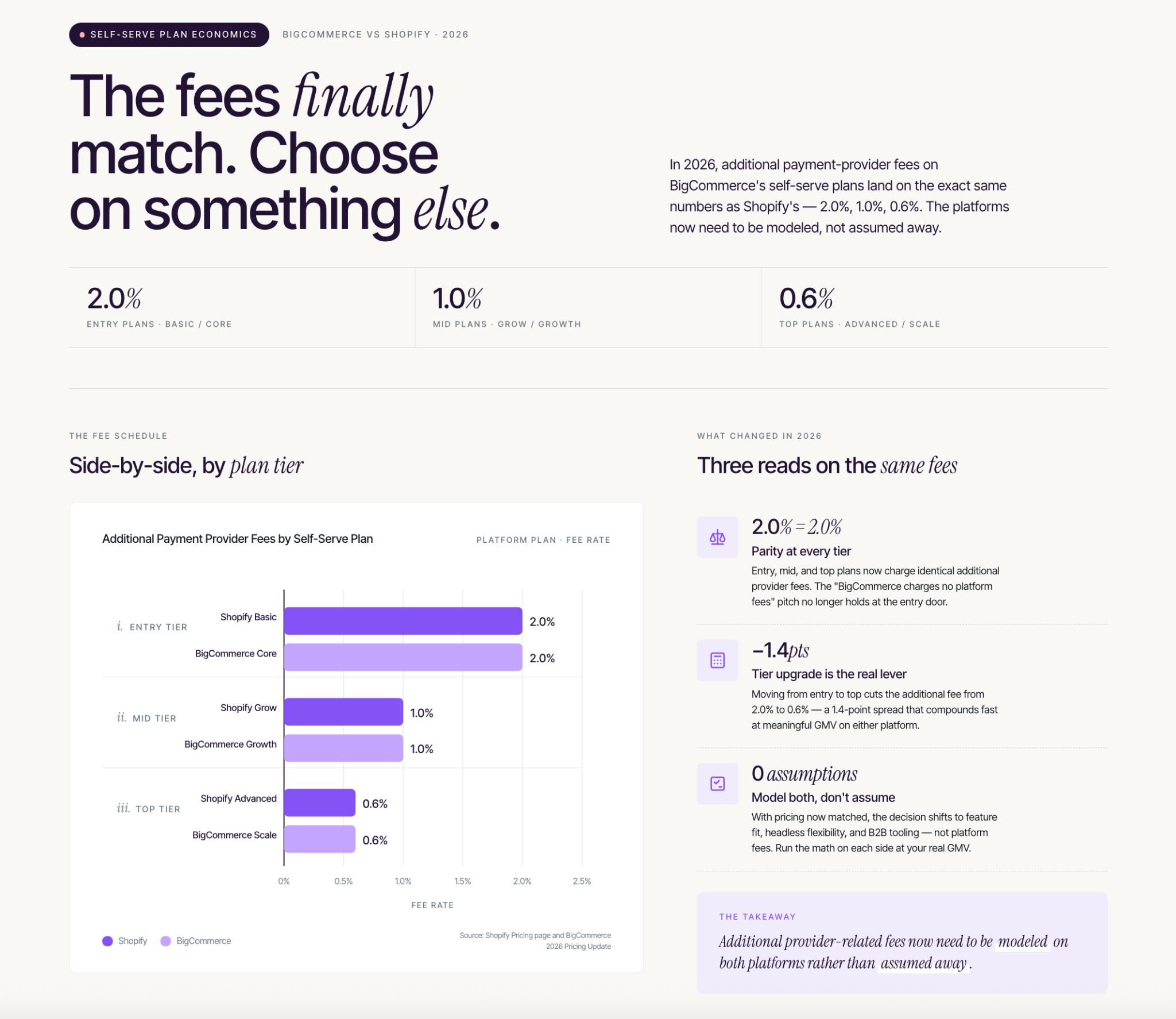
The live comparison is especially important in 2026 because legacy “no extra fee” assumptions are no longer enough. As of May 7, 2026, BigCommerce’s live pricing page still shows Standard, Plus, and Pro at $39, $105, and $399 per month, but the company’s posted pricing update says self-service plans will move to Core, Growth, and Scale and apply Open Payment Provider fees after June 1, 2026.
This is also where Amazon-oriented brands should think beyond checkout alone. If your DTC site supports product education while Amazon FBA handles part of fulfillment or trust-driven conversion, the related Stack Influence page on [Amazon solutions](https://stackinfluence.com/marketplace-solutions/amazon?utm_source=chatgpt.com) is a useful reminder that your commerce stack has to coordinate paid traffic, creator traffic, and marketplace revenue at the same time.
BigCommerce is not automatically the better enterprise answer. It is the better answer when complexity is native to your business, not when complexity is aspirational. If your store is still a fairly straightforward DTC catalog, BigCommerce can feel heavier before its advantages start paying you back.
Shopify usually wins when the priority is fast execution across merchandising, campaigns, and content operations. That advantage comes from software abundance and a store model that lets small and mid-market teams move quickly without treating every change like a systems project.
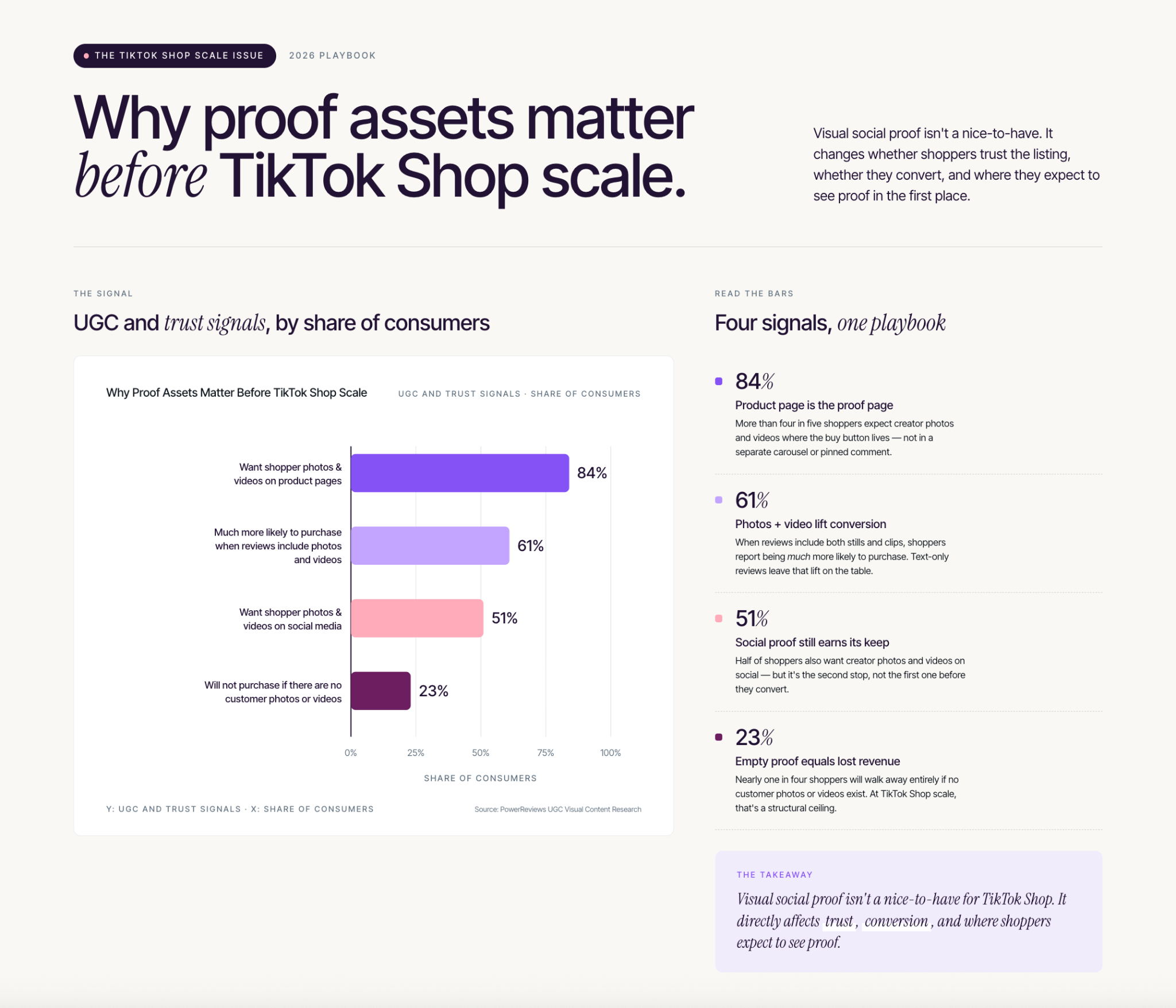
That speed matters more than many comparison pages admit because modern growth depends on constant asset testing. The [PowerReviews visual UGC report](https://www.powerreviews.com/research/ugc-visual-content-shopper-behavior-survey/?utm_source=chatgpt.com) shows 61% of shoppers are much more likely to buy when reviews include photos and videos, and 23% will not purchase if user-generated imagery is missing.
This is where Stack Influence’s content lens matters. Based on Stack Influence’s work with eCommerce brands, creators who deliver one in-use product shot and one honest verdict clip tend to earn about 18% more repeat invitations than creators who submit only a polished hero image, which is another way of saying useful variation beats cosmetic polish.
If that is your growth style, the Stack Influence pages on , , and are relevant because they all point in the same direction: the store that wins is the one that can turn creator assets into PDP updates, ad variations, and channel-specific content without operations slowing down the feedback loop.
Shopify’s tradeoff is that speed can hide complexity instead of removing it. App volume is powerful, but it also means operators need a real policy for stack sprawl, recurring fees, and who owns each integration once the store matures.
Most sellers under-measure platform fit because they only compare subscription cost and checkout output. That misses the parts of commerce that now drive margin, especially creator-sourced traffic, Amazon sellers, and reusable content assets that keep earning after the original post.
The better model is a tiered signal system that tracks sales, attribution, and asset reuse together. That is what the Revenue Signal Stack is built to do.
Use the Revenue Signal Stack to separate immediate revenue from supporting signals. A platform that looks cheaper on paper can become more expensive if it muddies attribution or slows the reuse of creator content across PDPs, email, and marketplace surfaces.
Amazon also gives creators a direct commerce surface. Its help documentation says the Amazon Influencer Program gives qualifying creators their own presence on Amazon plus a vanity URL, which is why brands should treat creator traffic and storefront traffic as measurable commerce signals rather than vague awareness.
Layer Three tracks whether creator content becomes an asset library or dies as a one-post campaign. Count approval rate, speed to deploy, PDP usage, email reuse, paid social reuse, retailer syndication, and marketplace deployment as real value drivers, not vanity extras.
Data from Stack Influence’s micro influencer campaigns suggests that campaigns tagged before product ships produce cleaner reporting than campaigns that add tracking after content is already live, which matches Amazon’s own logic that attribution works best when channel structure is clear before distribution begins. If your team needs a practical companion, Stack Influence’s guide to shows how to connect platform revenue, creator cost, and Amazon-oriented measurement into one operating view.
Most platform guides talk as if the risk lives inside plan pricing. In practice, platform regret usually starts with the switching cost curve, which is the moment when creative workflow, catalog logic, and channel reporting become so entangled that a “better” platform is still too painful to adopt.
That hidden cost is rising because creator commerce is no longer a side channel. Influencer marketing remains a large and growing budget line, which means every lost month of messy attribution or delayed content reuse carries a bigger opportunity cost than it did a few years ago.
Across campaigns managed on the Stack Influence platform, brands that deploy approved creator assets to Amazon product pages or Storefront destinations within 14 days of approval reportedly see first attributable orders about 19% sooner than teams that leave those assets sitting in a backlog. That is a switching-cost lesson in disguise, because the expensive part is often not making content. It is failing to operationalize it fast enough.
This is why rights and reuse planning belong in the platform conversation before launch. The Stack Influence guide to is useful here because it treats creator assets as business infrastructure, not social decoration. Sellers who understand that earlier usually make a better bigcommerce vs shopify choice because they stop choosing for launch week and start choosing for operational compounding.
The right bigcommerce vs shopify answer depends on whether your business is constrained by complexity or constrained by speed. If you run a lean DTC catalog and grow through fast iterations, Shopify is often the cleaner path. If your roadmap already includes multi-storefront expansion, deeper B2B rules, segmented buyer experiences, or more demanding payment flexibility, BigCommerce can prevent a more painful migration later.
Use the Store-Fit Sequence, validate your payment economics, and measure with the Revenue Signal Stack before you move. The platform that wins is the one that keeps your catalog, creator workflow, and attribution readable as you grow, so every new campaign adds leverage instead of operational drag.
Most social plans fail for eCommerce sellers and influencers because they organize posts, not revenue paths. A busy calendar can still leave you with weak creator briefs, untracked traffic, and content that fades after 24 hours. A strong social media marketing plan template fixes that by turning every campaign into a repeatable system for discovery, proof, and conversion.
This guide shows you how to build that system around creator content, micro influencers, UGC reuse, and clean attribution for Amazon, Shopify, and DTC workflows. You will leave with a template you can hand to a lean social team, a founder, or a creator partner without losing strategic clarity. The advantage is simple: faster execution, better asset reuse, and clearer proof of revenue.

Social planning now sits much closer to commerce than it did even two years ago. When IAB projects U.S. creator ad spend will hit $37 billion in 2025 and EMARKETER says U.S. social commerce sales will pass $100 billion in 2026, a modern plan has to connect content, creators, and checkout instead of stopping at publishing dates.
Behavior shifted too. In HubSpot's 2025 social trends research, 84% of marketers said consumers will search for brands on social this year, and 69% said more shopping will happen directly on social than on brand websites or third-party marketplaces. For Amazon sellers, Shopify brands, and creators chasing repeat brand deals, the old idea of social as a side channel is too small.
A usable template therefore needs four control points:
This is the first gap most generic guides miss. They explain how to plan posts, but not how a TikTok demo becomes a paid ad, an Amazon listing visual, a product detail page video, and an email asset in the same quarter. For eCommerce brands, that downstream reuse is where a template starts protecting margin instead of just organizing work.
Influencers feel the same pressure from the other side. Clearer briefs, approval rules, and landing-page logic make brand partnerships easier to execute and easier to renew. A template is not paperwork; it is the operating agreement between the brand goal and the creator workflow.
A social media marketing plan template is a repeatable document that translates strategy into decisions a team can execute this month. It tells you what you are trying to achieve, who the content is for, what gets published, where traffic goes, and how success is measured. For eCommerce sellers, it should also define how creator content supports Amazon listings, Shopify conversion, or long-term creator partnerships.
That makes a template different from a strategy. Strategy is the why and the business position; the template is the fill-in-the-blank structure you use every week or campaign. If you work with UGC for eCommerce or Amazon influencer marketing, the template should remove guesswork before a post ever goes live.
At minimum, the template should include:
Once those fields exist, a small team can repeat the same planning rhythm across launches, promotions, and evergreen campaigns. That is especially helpful for Amazon sellers and DTC brands that need consistency across social feeds, storefronts, and marketplace pages. It also gives influencers a cleaner way to shape deliverables for brand ambassadors, brand sponsorships, and repeat creator partnerships.
The easiest way to build the template is to treat it like a pre-flight audit, not a brainstorm sheet. Start with the non-negotiables that determine whether a post can create value after publishing, especially if you rely on micro influencers, nano influencers, or UGC creators. That is the job of the Seller-Ready Social Plan Checklist.
Keep the Seller-Ready Social Plan Checklist short on purpose. In HubSpot's 2025 report, 76% of marketers said authentic, low-production videos outperform highly produced content, which is a useful reminder that the best template reduces friction instead of adding polish. More fields do not make a plan more strategic if they slow sourcing, approvals, or publishing.
Creator selection belongs inside the template, not in a separate influencer spreadsheet. HypeAuditor's 2025 data shows nano-influencers make up 87.7% of TikTok creators and post the highest engagement rate at 10.3%, while Traackr's 2025 consumer study found 53% of consumers are at least somewhat likely to buy a product recommended by an influencer they follow. That combination is why niche fit matters more than headline reach for many eCommerce brands and for brands looking for influencers who can actually persuade.
Workflow ownership matters just as much as creative direction. If your team needs help handling creator sourcing or shipping, automated product seeding can reduce manual coordination, and a broader guide on how to create an influencer marketing strategy in 2026 can keep creator work tied to campaign goals. Based on Stack Influence's work with eCommerce brands, briefs capped at three required talking points average about 68% on-time creator submission, versus roughly 55% when creators receive six or more required talking points.
The Seller-Ready Social Plan Checklist becomes even more valuable when campaigns cross Amazon and Shopify. It forces the team to decide what content gets created, where it lands, and who owns tracking before creators publish. That discipline protects both growing brands and influencers who want repeat work instead of one-off chaos.
Most templates still start with platform columns: Instagram, TikTok, YouTube, Pinterest, Facebook. That feels organized, but it pushes teams to create channel-specific filler instead of reusable proof. For eCommerce, the more durable unit is the asset, because a strong creator demo can live in a reel, a paid ad, an Amazon listing, a product page gallery, and an email flow.
That logic matches shopper behavior. When Bazaarvoice found that 87% of surveyed shoppers trust user-generated content more than branded content, and nearly 46% of younger shoppers say short-form video is the most influential format for social purchases, the smart plan starts with proof, not with the platform logo. When trust and proof drive the click, the template should prioritize what the customer needs to see, not just where the post gets published.
Asset-first planning changes the template in four ways:
This is where many influencer campaigns quietly leak value. A creator may publish a solid UGC video, but the brand never adapts it for paid social, Amazon images, or site banners. A content syndication workflow fixes that by treating every approved asset as a reusable library, not a one-time social event, and the operational details become much clearer when teams understand how to use content syndication in 2026.
Stack Influence has observed that listings that add creator UGC see about 29% higher listing conversions. That helps explain why product seeding works best when tied to clear influencer product seeding strategies, not sporadic gifting or vague asks from an influencer marketing agency. Asset-first planning is not less creative; it is what lets creativity compound across influencer campaigns, UGC video, and commerce pages.
Channels still matter, but only after the asset is defined. Different networks are better at discovery, research, community, or conversion handoff, so your template needs a rule for matching format to job. The Reach Versus Reuse Matrix keeps that choice practical.
On one axis is reach, the chance content exposes new buyers. On the other is reuse, the chance the asset stays useful after the post window. Plotting ideas this way prevents you from overinvesting in attention that cannot be recycled.
The matrix also clarifies roles for influencers. Traackr reports that Facebook and TikTok rank highest for purchasing, while YouTube ranks first for product research, which means creators can be assigned different jobs inside the same campaign. A shopper may discover on TikTok, validate on YouTube, then convert on Amazon or Shopify, so the template should assign each asset a job in the path.

For Amazon sellers, an Amazon influencer marketing plan often works best when creator posts point to a tracked listing or a curated storefront page that can hold several recommendations. For DTC brands, the same matrix can route high-reuse assets into PDPs, retargeting, or email while keeping trend content in a smaller test budget. Influencers can use the Reach Versus Reuse Matrix in their media kits to position themselves as content partners, not just reach rentals.
Measurement fails when teams ask one KPI to do every job. Views cannot stand in for quality, clicks cannot explain conversion friction, and sales alone cannot tell you which asset actually helped. The Revenue Proof Stack solves that by separating signal quality from business value.
Amazon makes this easier if you set up the plumbing early. Amazon Attribution can measure off-Amazon performance across search, social, display, video, email, and influencer traffic, and Amazon says those reports include a 14-day attribution window with both engagement and conversion metrics. Brand Referral Bonus then returns an average 10% bonus on qualifying sales from non-Amazon marketing, so accurate tagging can improve both reporting and margin.
There are still blind spots. A creator video may raise branded search, improve product-page trust, or influence a second session that the tag does not fully explain. That is why the Revenue Proof Stack keeps asset quality and margin in separate layers instead of pretending last-touch data captures the whole buyer journey.
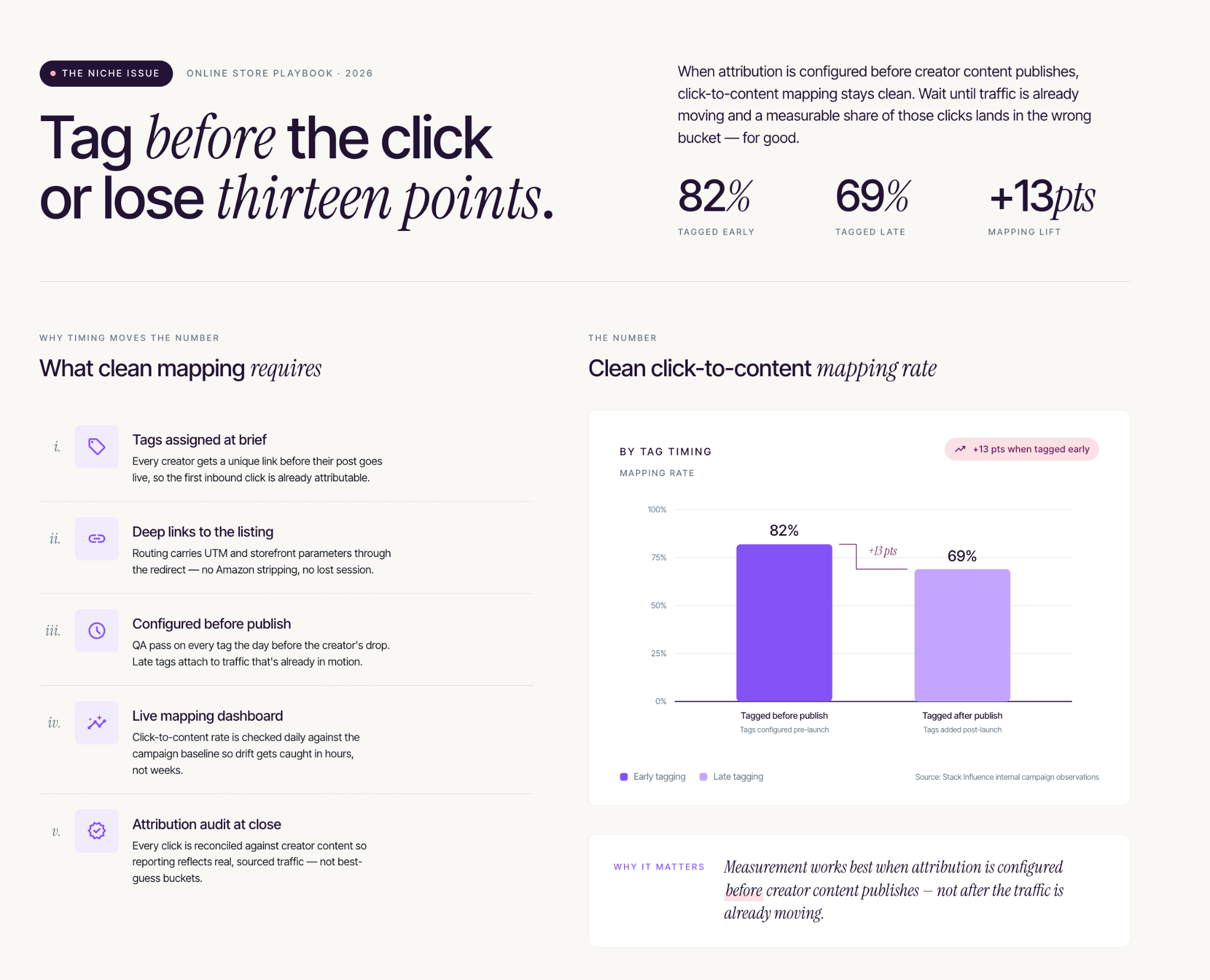
Across campaigns managed on the Stack Influence platform, Amazon brands that assign Attribution tags before creators publish capture about 82% clean click-to-content mapping, compared with roughly 69% when tags are added after content goes live. If your team needs a process template, the Amazon Attribution guide is a useful operational reference, and this is exactly where Stack Influence becomes practical: it connects creator workflow, link hygiene, and reporting discipline in the same motion.
A good social media marketing plan template should survive the mess of real execution. It should tell your team what to create, which creators fit, where traffic goes, what gets reused, and how revenue is proven. If it cannot do that, it is a calendar, not a plan.
Start with this 90-day cadence:
For eCommerce sellers, that process can sharpen Shopify influencer marketing, Amazon FBA launches, and creator partnerships without adding unnecessary complexity. For influencers, it creates clearer briefs, stronger deliverables, and more repeat brand deals. Build the template once, adapt it quarterly, and let each campaign leave behind assets, data, and proof you can compound.
Most lists of ideas for online store success stop at inspiration and never reach economics. For eCommerce sellers, that is the dangerous part, because a store idea only works when it can attract demand, earn trust, and convert profitably across the channels you actually sell on.
This guide shows how to choose a niche that fits modern shopper behavior, how to validate it before inventory gets expensive, and how to measure whether the concept can support DTC growth, Amazon storefront traffic, or both. If you sell on Shopify, Amazon, or a hybrid stack, the goal is not more ideas. It is fewer bad bets.

A good online store idea in the current market is one that matches how shoppers already research and buy. The Quarterly Retail E-Commerce Sales report shows U.S. ecommerce sales reached $1.2337 trillion in 2025 and accounted for 16.4% of total retail sales, while Salsify's 2025 consumer research shows shoppers now move fluidly across search, marketplaces, stores, and mobile moments instead of following a clean linear funnel.
That matters because discovery is no longer confined to Google or a marketplace search box. HubSpot's 2025 Social Trends Report found that 84% of marketers believe consumers will search for brands on social media this year, and 25% of consumers say they bought products directly from social media in the past three months.
A good store idea usually has four traits:
In practice, that means you are not choosing a hobby or a trend label. You are choosing a proof system. The stronger the idea, the easier it is to create trust across channels, which matters even more when Salsify's 2025 consumer research reports that 87% of shoppers will pay more for a product from a brand they trust.
Before you commit to a category, judge whether the idea can survive the channels you plan to use. A serious how to become an Amazon seller plan looks different from a Shopify influencer marketing workflow, but both depend on products that creators can explain quickly and shoppers can verify fast.
This is where operational testing becomes more valuable than brainstorming. The Stack Influence platform and its automated product seeding workflow are built around creator matching, creator purchases, post verification, and reusable UGC, which makes them useful when you need to test whether a niche can reliably generate authentic demos without turning your team into a manual outreach department.
Use this quick validation screen before you buy deeper inventory:
If you sell on Amazon, route early traffic to a focused PDP or an Amazon storefront only when the offer is tight enough to convert. Amazon's free advertising guide notes that brands can create a Store on Amazon for free, while a structured Amazon creator campaign workflow gives sellers a way to pressure-test whether a category can win with external traffic before doubling down on Amazon FBA volume.
If you sell DTC, the same logic applies. A playbook for influencer seeding for eCommerce is less about chasing impressions and more about forcing a product idea through real buyer behavior, real content creation, and real landing-page friction while the stakes are still low.
The Four Rules of Viable Store Ideas are a better filter than any trend roundup because they account for how discovery and proof now work. That filter is more relevant every year, since IAB's Creator Economy Ad Spend & Strategy Report says U.S. creator ad spend is projected to reach $37 billion in 2025, up 26% year over year, and 48% of creator ad buyers now consider creators a must-buy channel.
Rule Two is easier to underestimate than Rule One. Data from Stack Influence's micro influencer campaigns suggests that category-specific creator cohorts clear content approval at roughly 72%, versus about 54% for broad lifestyle cohorts, which is why niche fit usually beats broad trend appeal when you want reliable content production.
Rule Three and Rule Four determine whether demand can compound instead of reset. PowerReviews' guide to ratings and reviews reports that 74% of consumers want at least 25 reviews before feeling comfortable buying, while Bazaarvoice's Video Commerce 2025 says 84% of consumers are convinced to buy after watching a brand video. A viable store idea is one that can keep producing fresh reviews and fresh demonstrations without custom production every week.
When the Four Rules of Viable Store Ideas point in the same direction, your short list gets much smaller. The strongest categories are not always the flashiest. They are the ones that align with multi-channel shopping, creator-led discovery, and the need for visible proof across product pages, video, and customer reviews.
A practical short list for eCommerce sellers looks like this:
What ties these ideas together is content reuse. Across campaigns managed on the Stack Influence platform, creator content reused across ads and commerce surfaces can drive up to 4x ad conversions, which is why ideas with strong demo potential tend to outperform categories that rely on static aesthetics or abstract branding.
That reuse matters on both sides of the business. DTC brands can place creator assets on Shopify PDPs and collections, while Amazon sellers can carry the same learning into Store modules, product detail page creative, and off-platform traffic campaigns once the content is rights-cleared and consistent with the offer.
Most guides imply the best ideas for online store launches are the most original ideas in the room. That is usually backwards. PowerReviews' guide to ratings and reviews shows 88% of consumers regularly consider how recent reviews are, and 77% ideally want reviews from within the previous three months, which means the winner is often the category that can keep generating proof, not the one that sounds most surprising on launch day.
That makes one-hit novelty expensive. Products with weak repeat use cases and little demonstration value force you to buy attention again and again, while products tied to routines, maintenance, comparison, or replenishment can keep earning social proof in the same way shoppers now browse and buy across search, social, and ambient mobile moments.
If you want a quicker way to avoid the wrong niche, stop doing these things:
The contrarian truth is that the best store ideas are often a little boring in the best possible way. They win because they are easy to explain, easy to trust, and easy to restock, which is exactly what modern shoppers reward when they compare products across content, reviews, and channels.
Measurement is what turns a store concept into an investment decision. Amazon Attribution is a free measurement solution for eligible sellers that tracks how non-Amazon channels such as search, social, video, email, and affiliate or influencer campaigns drive on-Amazon behavior, and the Brand Referral Bonus program lets U.S. seller brand owners earn a bonus averaging 10% on qualifying sales driven by measured non-Amazon marketing.
To keep reporting honest, use a four-tier model called the Proof-to-Profit Stack. If your team needs setup help, Stack Influence's Amazon Attribution guide and Amazon marketing services guide are useful operational references because they connect creative, tagging, channel mix, and margin thinking before launch.
The Proof-to-Profit Stack looks like this:
Amazon's complete guide to Amazon Attribution says sellers should create one ad group per strategy, tactic, or creative, and it uses a 14-day last-touch attribution model. That matters because a product idea cannot be evaluated properly if every creator, angle, and landing path gets collapsed into one messy tag.
From Stack Influence's experience running attribution-ready seeding campaigns, Amazon brands that assign Attribution tags before creators publish capture about 82% clean click-to-content mapping, compared with roughly 69% when tags are added after content goes live. In simple terms, measurement is not cleanup work. It is launch work.
Once the signal is clean, judge the idea with economic discipline. A category that drives clicks but cannot recover creator cost, discount pressure, Amazon referral fee pressure, and fulfillment cost is not a winning idea for an online store. It is just an interesting source of traffic.
Most articles about ideas for online store planning help you brainstorm. Serious eCommerce sellers need a stricter outcome than inspiration. They need a category that can earn trust repeatedly, survive cross-channel measurement, and give the business room to scale without rebuilding the offer every quarter.
Use the Four Rules of Viable Store Ideas to narrow the field, pressure-test the winner with the Proof-to-Profit Stack, and move faster only when the niche shows repeat demand, content fit, and clean economics. That approach gives DTC brands and Amazon sellers a better path to stronger launches, smarter inventory decisions, and store growth that compounds.
Most new TikTok Shop sellers do not lose because registration is hard. They lose because they treat setup as the finish line, even though the real work starts when a product has to earn trust, survive fulfillment, and prove margin inside a channel that EMARKETER’s 2026 social commerce forecast says will push TikTok Shop to $23.41 billion in US ecommerce sales this year.
If you are an eCommerce seller figuring out how to start a TikTok Shop, the goal is not just to go live. It is to build a shop that can turn discovery into sales, sales into reusable proof, and proof into repeatable growth on a platform where shopper research increasingly happens inside the same app as checkout.

TikTok Shop is no longer a side experiment for ambitious sellers. EMARKETER’s 2026 social commerce forecast says 51% of US social buyers will shop on TikTok this year, and TikTok’s 2025 Black Friday and Cyber Monday update says the platform generated more than $500 million in sales over that four-day period while attracting nearly 50% more US shoppers than the prior year’s BFCM campaign.
The bigger reason to care is how shoppers behave on the platform. In TikTok’s search and discovery research, 61% of users say they discover new brands and products there, and one in two say they use TikTok to research or learn more about new products or brands.
That changes what a good launch looks like on TikTok Shop.
For eCommerce sellers, that means how to start a TikTok Shop is really a question of channel design. You are not opening another catalog page. You are building a commerce loop where creative, trust, and logistics have to work together from day one.
A fast-growing channel also punishes sloppy launches faster than older marketplaces. When traffic, comments, and creator mentions arrive at the same time, weak inventory controls or confusing pricing become visible immediately, which is why restraint on the first launch wave is usually a competitive advantage, not a limitation.
TikTok Shop is TikTok’s in-app commerce system that lets shoppers discover products through videos, live sessions, search, and storefronts, then complete checkout without leaving the platform. It matters because it blends merchandising and media into one experience, which is different from the slower browse-first logic many sellers know from traditional ecommerce sites.
The basic setup is straightforward, but the details matter. TikTok’s seller registration guide says your personal and financial information must match your official documents, and the Shopify Help Center’s TikTok Shop setup instructions show how sellers can connect TikTok Shop through Shopify if they already run part of their business there.
Before you publish your first listing, make sure these launch pieces are in place.
This is also where many sellers choose the wrong first product. According to Salsify’s 2025 consumer research, 87% of shoppers will pay more for a product from a brand they trust, which makes trust-heavy, easy-to-demonstrate products better first candidates than items that need a long education cycle before the value clicks.
TikTok Shop is also not the best first move for every SKU. Hard-to-explain products, products with thin margins, or anything likely to create high return volume can struggle early because social commerce compresses discovery and checkout into a shorter window, leaving less room for patient education.
A useful way to pressure test readiness is a secondary tool I call the Cart-Ready Checklist. Ask five questions before launch: Is the hero SKU easy to demo, is margin healthy after discounts and fees, is fulfillment stable, does the page have real proof assets, and can you track where sales are coming from? If the answer is no to two or more, do not call the shop ready yet.
The best way to think about how to start a TikTok Shop is through the Three-Tier Shop Launch Ladder. This model keeps sellers from scaling too early by forcing them to earn the next stage through proof, not optimism.
Across campaigns managed on the Stack Influence platform, lean seller teams usually control first-wave spend better when they focus creator output on one hero SKU instead of briefing a whole catalog at once. On its pricing page, Stack Influence says brands pay about $30 per completed post on average and save roughly 175 hours per month, while its automated product seeding workflow is built around paying after verified posts so sellers are not front-loading cost into unconfirmed creator activity.
The Cart-Ready Checklist becomes practical here. A seller should be able to answer what the product does in one sentence, show it in use within a few seconds, explain why it is worth the price without a long discount ladder, and fulfill it without operational drama, because PowerReviews research on purchase behavior found 61% of consumers are much more likely to buy when reviews include photos and videos.
That narrow first wave matters because proof assets move conversion, not just reach. When a page has believable product visuals and buyer-like explanations, sellers learn faster, revise smarter, and avoid wasting traffic on a listing that still feels unfinished.
Older TikTok Shop guides age quickly because the platform keeps changing how commerce should be run. Since GMV Max became the default and only supported campaign type for new TikTok Shop Ads in July 2025, any guide that treats older shop ad formats as the default playbook is already behind.
Measurement changed too. In TikTok’s latest automation and attribution update, the company said advertisers can now use third-party optimization starting with Google Analytics, and that more than one in four TikTok-attributed conversions happen after a user views an ad and then goes directly to the site the same day.
Three 2026 rules matter most for new sellers.
Stack Influence has observed that the bigger 2026 advantage comes from reuse speed, not just creator volume. On the company’s TikTok Spark Ads page, Stack Influence says creator-led Spark Ads can deliver a 134% higher video completion rate and a 69% higher conversion rate than standard in-feed ads, while its content syndication workflow frames the next step as moving winning creator assets into ads, listings, websites, and email instead of letting them die as one-post wins.
That is the blind spot in many setup articles. Registration gets the storefront live, but the 2026 operating advantage comes from faster asset testing, cleaner attribution, and quicker movement from organic proof to paid distribution.
The cleanest way to measure a new store is with a layered model I call the Commerce Signal Stack. GMV is useful, but GMV alone can hide weak margins, rising refund rates, creative fatigue, or off-platform spillover that never shows up in a last-click report.
Use the Commerce Signal Stack to keep each layer separate.
The reason this layered view matters is that TikTok often assists a sale before it receives clean last-click credit. TikTok’s automation update says early third-party optimization tests showed an average 54% increase in conversions and a 27% decrease in cost per action in Google Analytics, while TikTok’s media mix modeling guide argues that the platform’s actual contribution is often understated by last-click models.
If you also run marketplace creator programs, the Stack Influence Amazon Influencers guide is a useful internal companion because it clarifies the difference between storefront-driven creator commerce and asset-driven UGC programs. The point is not to merge TikTok Shop and Amazon into one metric bucket. It is to understand which channel captured the order and which channel created the demand.
If you also sell on Amazon, keep TikTok Shop performance separate from marketplace spillover. Amazon says Amazon Attribution is a free measurement tool for tracking the on-Amazon impact of non-Amazon channels, and Amazon’s Brand Referral Bonus materials say eligible sellers can earn an average credit worth 10% of qualifying sales measured through those Attribution tags.
Do not blend everything into one dashboard and call it done. Keep direct TikTok Shop sales, website sales, and Amazon spillover in separate views, then compare them only after fees, discounts, and content costs are accounted for.
You do not need a large creator program on day one, but you do need a plan for proof. PowerReviews data on where shoppers want UGC says 84% of consumers want shopper photos and videos directly on product pages, and 51% want to see that same kind of material on social media too.
Use each creator lever for a different job.
There is also a sequencing issue with creator work. Do not bring in micro influencers, UGC creators, or product seeding just because it sounds like social commerce best practice. Bring them in when the listing can actually convert the attention they create, otherwise you are paying to expose friction.
Based on Stack Influence’s work with eCommerce brands, the asset often outlives the original post. On the company’s content syndication page, Stack Influence says creator UGC reused across ads, listings, and email can reduce cost per click by up to 50% and raise conversions up to 4X, which is why the right creator program should be evaluated like an asset engine, not only like a reach play.
This matters even more because trust is still the gating factor in social commerce. Salsify’s consumer research says 87% of shoppers will pay more for products from brands they trust, so the sellers who win on TikTok Shop combine authentic-looking proof with channel discipline instead of treating creator content like random top-of-funnel noise.
U.S. creator ad spend is projected to reach $37 billion in 2025, while shoppers increasingly expect free and fast delivery. That combination is brutal for eCommerce sellers because demand can rise faster than operations can absorb it. Top ecommerce fulfillment companies now influence conversion, repeat purchase behavior, and how efficiently a brand can scale Amazon and DTC traffic. This guide shows eCommerce sellers how to choose the right partner, which providers stand out, and how to measure fulfillment as a growth system instead of a back-office cost.
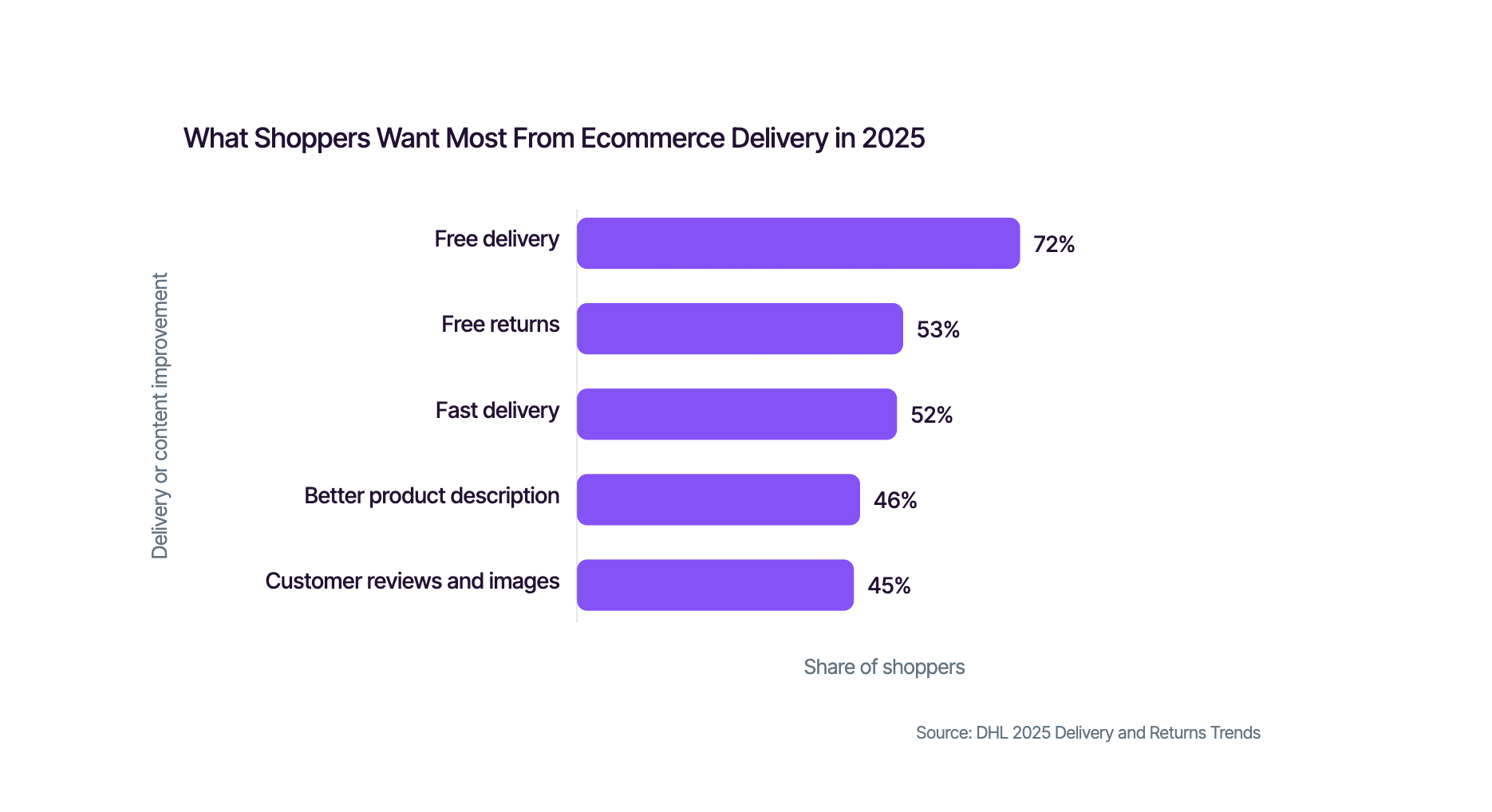
In the IAB 2025 Creator Economy Ad Spend & Strategy Report, creator ad spend is projected to hit $37 billion in 2025, and DHL's 2025 Delivery and Returns Trends shows that 72% of shoppers want free delivery, 53% want free returns, and 52% want fast delivery. Fulfillment now shapes both margin and conversion before a package leaves the dock.
The pressure is growing because demand no longer comes from one place. A brand might sell through Shopify, Amazon FBA, retail marketplaces, and creator campaigns in the same month. When those programs spike at different times, a weak warehouse setup creates stockouts, split shipments, and expensive manual work, and younger shoppers are especially unforgiving when delivery breaks down.
If customers expect low-friction shipping, tighter delivery windows, and strong product page trust signals, fulfillment affects profitability before the item is even packed. That is why sophisticated operators now treat logistics, merchandising, and content publishing as one connected system.
Returns are where hidden margin often disappears. If a provider misses restock windows or cannot give customers clear updates, you lose sellable inventory, extend refund cycles, and make every future launch harder to forecast.
An ecommerce fulfillment company is a third party that receives inventory, stores it, syncs orders from your selling channels, picks and packs items, ships them, manages tracking, and often handles returns. Official provider pages from ShipBob and Ryder both frame fulfillment as an ongoing execution system rather than simple storage space.
That distinction matters because many sellers still confuse warehousing with fulfillment. A warehouse stores product. A fulfillment partner stores product and then executes the customer promise that follows checkout, which becomes more important when you are planning a brand seeding strategy for Amazon or working from an Amazon product launch playbook that can create uneven demand.
Warehousing is about static storage. Fulfillment is about flow. Once orders move every day, scanning accuracy, routing logic, packing quality, carrier selection, and exception handling matter more than the monthly storage line on a quote.
Outsourcing usually makes sense when founder-led fulfillment starts distracting from merchandising and growth. It also makes sense when you need multi-node shipping, retail prep, subscription kitting, or stronger returns handling than an in-house team can manage consistently.
Most roundups overrate network size and underrate operational fit. That is a real problem because PowerReviews data on user-generated visuals shows 91% of consumers are more likely to buy when reviews include customer photos and videos, while the Amazon Influencer Program gives creators storefronts and vanity URLs that can turn content into a direct sales path. Fulfillment has to be built for the demand pattern you create, not just the average day on your order history.
Most guides also skip the reality of creator operations. If you run product seeding, Shopify influencer marketing, or off-Amazon traffic to a Storefront, your warehouse has to support replacement requests, tight shipping windows, and bursts of attention from creators your team found through guides like how to get an Amazon storefront and find Amazon influencers and their storefronts. Shoppers do not separate content quality from operational quality, and product page trust rises or falls on both.
A lightweight skincare brand with high purchase frequency should optimize for branded packaging, distributed inventory, and refill-friendly economics. A seller moving home fitness equipment should optimize for damage prevention, dimensional handling, and guarantees that protect margin when one bad shipment can erase the profit from several good ones.
Based on Stack Influence's work with eCommerce brands, creator gifting programs that lock the SKU list, shipping window, and brief before launch tend to reduce reship and exception handling by about 15% compared with ad hoc gifting. That is one reason automated product seeding is operationally different from one-off gifting.
They do if you sell on Amazon or DTC and expect creators to drive traffic right away. A creator who posts to an Amazon storefront or points followers to a seeded launch can compress demand into a short window, and the resulting spike will expose weak inventory placement quickly.
That is why product seeding belongs in the same planning conversation as replenishment, safety stock, and order routing. Brands using structured workflows like Amazon influencer seeding have a better chance of matching outbound volume to a real operational plan instead of reacting after posts go live.
To compare providers consistently, use the SHIFT Framework. Score each category from 1 to 5, then total the result out of 25.
A score of 22 or higher in the SHIFT Framework usually means a provider deserves a serious pilot. A score in the middle teens often means the provider is solid in general but wrong for your current stage.
Use the SHIFT Framework before demos and again after pricing comes in. Sellers often overweight a low pick fee and underweight what poor routing, inaccurate returns processing, or slow support will do to lifetime value, especially when demand is tied to programs like Amazon influencer marketing solutions.
There is no universal winner, which is why seller fit matters more than brand recognition. The seven companies below stand out because each solves a different fulfillment problem well. Use your SHIFT score, not a generic popularity contest, to decide which one belongs on your shortlist.
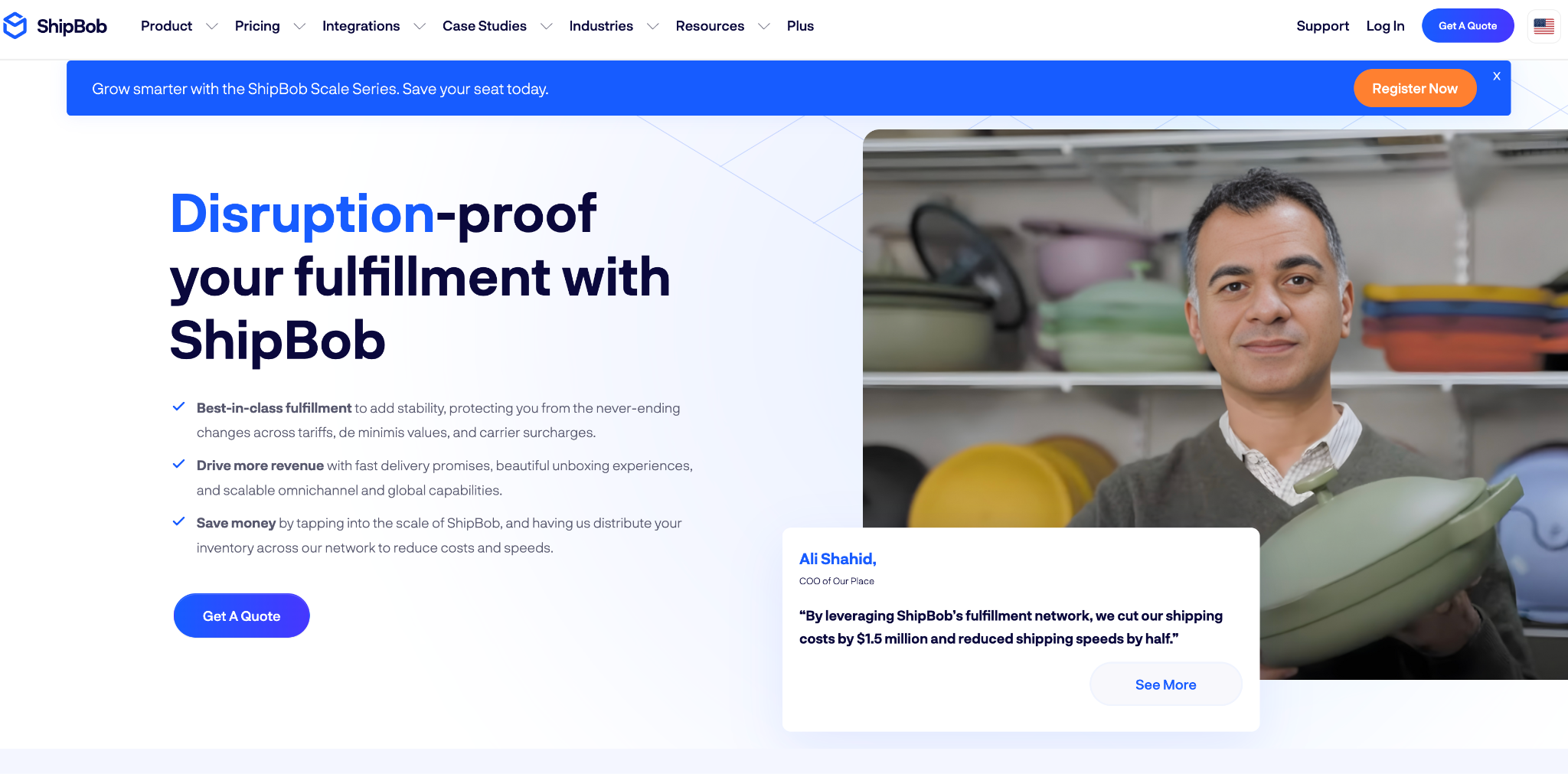
ShipBob is an end-to-end fulfillment provider built for DTC and omnichannel brands that need distributed inventory and strong software support. Its network spans more than 60 fulfillment centers, and it reports 99.97% order accuracy with 99.6% of orders shipping on time within SLA.
ShipBob is best for brands with national demand that want two-day shipping, branded unboxing, and inventory distribution across multiple nodes. It is a less natural fit for very low-volume sellers or operators with unusual handling requirements, because its value comes from steady volume, network design, and a fee model that includes implementation, receiving, storage, and per-order execution.
Amazon Multi-Channel Fulfillment is Amazon’s service for off-marketplace orders. It lets sellers use Amazon’s connected network across 11 countries, offers two- and three-business-day delivery options, and supports more than 100 integrations with ecommerce and back-end systems.
It is the strongest fit for Amazon sellers who already hold inventory in FBA and want to fulfill Shopify, TikTok Shop, Walmart, or other off-Amazon orders from the same pool of stock. The tradeoff is flexibility: MCF is excellent for speed and predictable pricing, but less ideal when a brand wants highly customized kitting, branded packaging control, or a service-heavy exception workflow.
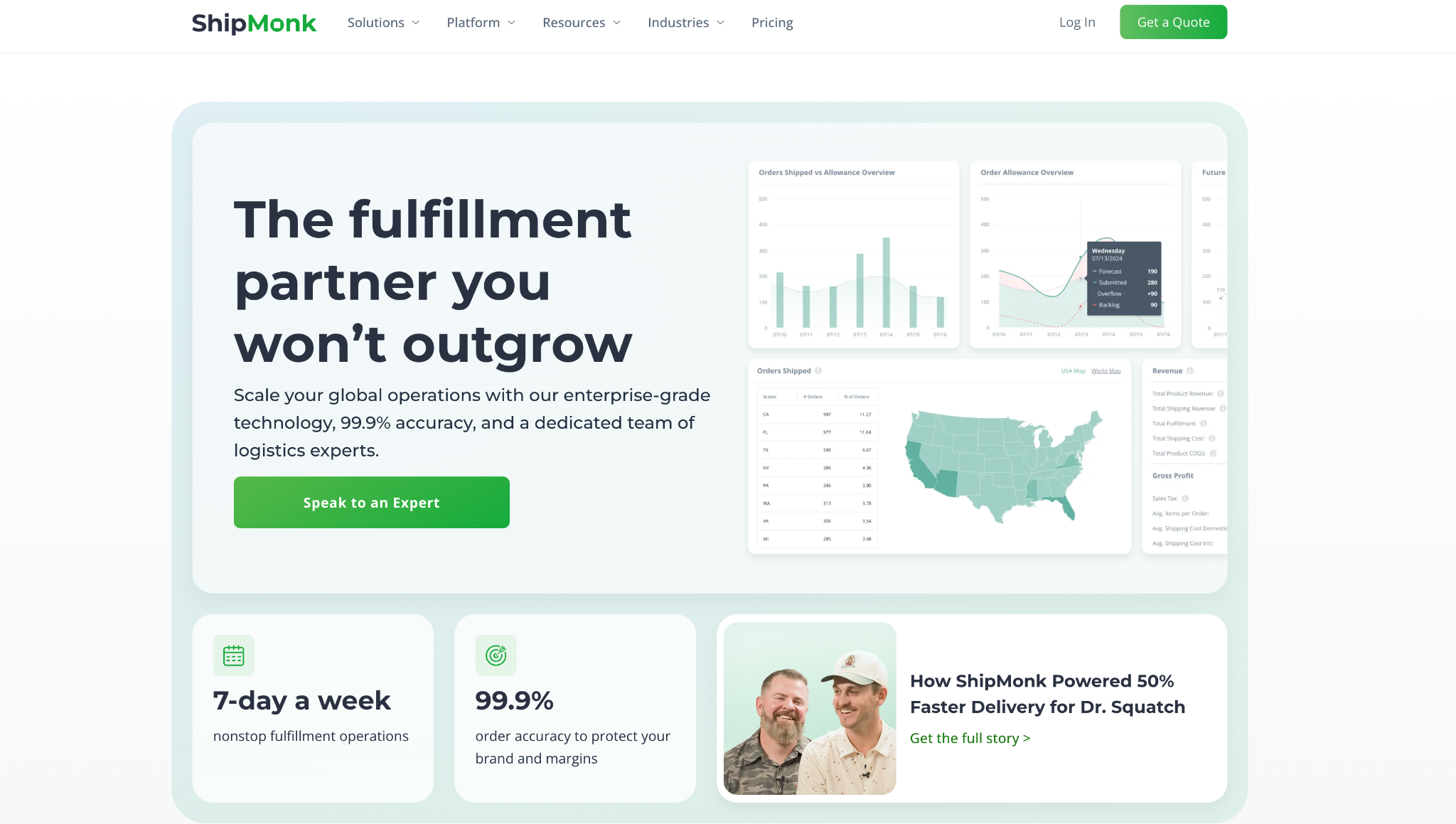
ShipMonk is a global fulfillment provider that combines proprietary software with an owned operational network. It has 12 owned and operated fulfillment centers, and in 2026 it opened a 406,000-square-foot Louisville facility designed specifically for apparel brands.
ShipMonk is a strong choice for apparel, wellness, and subscription-heavy brands that need returns discipline, SKU complexity handling, and operational visibility. Its limitation is that it can be more platform-heavy than a seller with a very simple parcel-only workflow needs, so the real payoff comes when complexity is high enough to justify that depth.
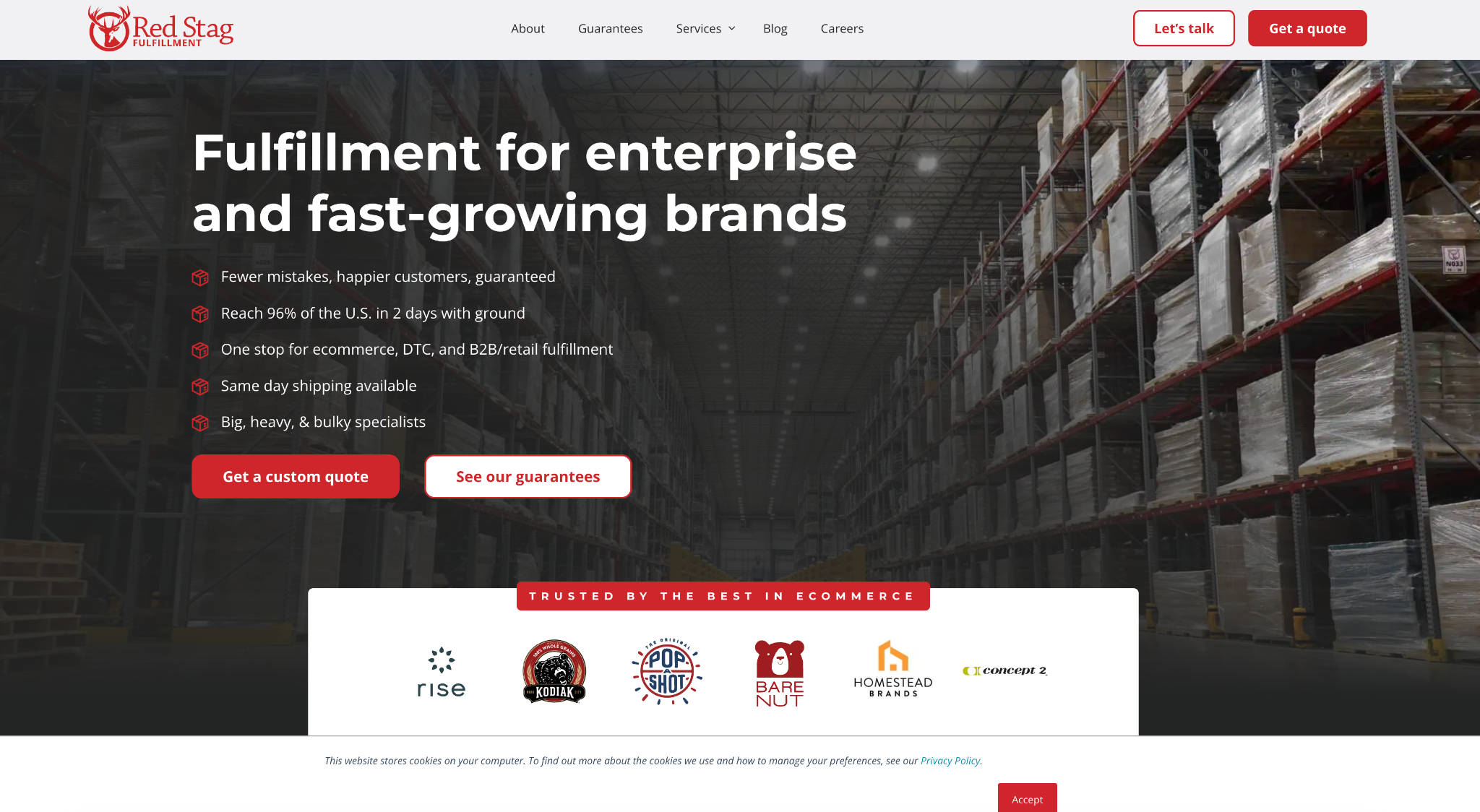
Red Stag Fulfillment is a specialized 3PL known for handling big, heavy, bulky, or high-value products. Its differentiator is a guarantee structure built around shrinkage, pick accuracy, and dock-to-stock speed, plus a two-node network positioned to reach 96% of U.S. addresses in two days by ground.
Red Stag is the best fit for brands shipping awkward, expensive, or damage-prone items where one error can erase the profit on several good orders. It is not the first place to look if your catalog is lightweight and built around ultra-low-cost small parcel economics, because the company’s advantage is specialized handling rather than generalized low-cost fulfillment.

Ryder brings a broader logistics footprint than a typical ecommerce 3PL. For ecommerce specifically, it operates more than 20 omnichannel facilities across seven gateway markets with over 10 million square feet, and its RyderShip platform acts as a control tower for orders, inventory, and shipping.
Ryder is best for brands that need DTC plus B2B retail compliance, transportation coordination, or port-to-door orchestration in one relationship. Smaller brands may find Ryder more sophisticated than they need, while larger sellers will value the ability to combine fulfillment with transportation and omnichannel execution.
Stord sits at the software-and-operations end of the market rather than the quote-and-warehouse end. It reports 99.9% fulfillment order accuracy, supports 11 key nodes with 99% U.S. coverage in under two days, and layers a broader integrated partner network on top for specialized needs.
Stord is a strong fit for high-volume omnichannel brands that want network design, order management logic, and more visibility than a standard 3PL relationship provides. It can be overbuilt for sellers that only need a simple one-warehouse setup, because its real strength is orchestration across many moving parts.

eFulfillment Service is a long-running 3PL aimed at sellers who need affordability and flexibility more than a giant network. The company positions itself as a pay-as-you-go option with no setup fees, no minimum order requirements, no long-term contracts, and real-time access to inventory and order reporting.
This makes eFulfillment Service a smart choice for startups, emerging DTC brands, or subscription businesses that want to outsource without committing to high monthly minimums. The limitation is scale sophistication: early-stage sellers will like the flexibility, but enterprise operators may need more advanced network depth or automation than eFS is built to provide.
If you want a faster shortlist, use these matches.
Most sellers stop at cost per order, which leaves too much money unaccounted for. Fulfillment ROI should connect operating metrics to conversion, margin, and attributable revenue, especially for Amazon sellers using outside traffic and programs tied to Amazon Attribution and the Amazon Brand Referral Bonus.
A better model is the Revenue Signal Stack. It gives you three layers of measurement so you do not mistake cheap fulfillment for profitable fulfillment.
Tier 1 tells you whether the warehouse is doing the job it was hired to do. Tier 2 tells you whether those warehouse outcomes improve shopper behavior and margin. Tier 3 tells you whether fulfillment is helping you capture demand you created elsewhere, including creator campaigns.
Across campaigns managed on the Stack Influence platform, brands that assign attribution tags before creator briefs go live tend to capture about 21% more attributable orders than teams that add tracking after content starts publishing. That result matters because measurement discipline is often decided upstream, before the first creator post, not downstream in a dashboard.
Amazon Attribution gives brands a free way to measure how non-Amazon media drives on-Amazon actions, including traffic from creators, affiliates, search, social, email, and other channels. Brand Referral Bonus adds a second layer by returning an average bonus of about 10% on qualifying sales, but the traffic must carry valid Amazon Attribution tags to qualify.
Data from Stack Influence's micro influencer campaigns suggests that brands that deploy approved creator assets to Amazon product pages or Storefront destinations within 14 days of approval tend to see first attributable orders about 19% sooner than teams that leave the content in a backlog. That speed matters because Salsify's 2025 consumer research found that 70% of shoppers have returned an item due to incorrect product content, which means fulfillment, content reuse, and workflows like Amazon influencer marketing solutions need to be planned together.
Choosing from the top ecommerce fulfillment companies is not about chasing the biggest network. It is about finding the provider that protects your margin, supports your channel mix, and can absorb the kind of demand your brand is actually creating.
Start with the SHIFT Framework, shortlist providers based on your real SKU and channel complexity, and then pressure-test each one against the Revenue Signal Stack. eCommerce sellers that do that work upfront will make better decisions, avoid expensive migrations, and build a fulfillment system that supports growth instead of chasing it.
A store platform choice looks simple until growth turns it into an operating model decision. eCommerce sellers evaluating woocommerce vs shopify are not only choosing themes and checkout flows. They are choosing how much infrastructure they want to own, how quickly they need to launch, and how easily their team can turn content, traffic, and attribution into repeatable revenue.
This guide breaks the decision down for DTC brands, Amazon sellers, and hybrid teams that need both a branded site and marketplace momentum. You will see where WooCommerce wins, where Shopify wins, and how to evaluate the tradeoff through cost, conversion, SEO, and measurement instead of brand loyalty.
Market share does not settle the argument, but it does reveal the shape of the market. W3Techs reports that WooCommerce is used by 8.4% of all websites versus Shopify’s 5.2%. Yet among the top one million sites, Shopify reaches 14.4% while WooCommerce sits at 8.7%. That split suggests WooCommerce leads broad adoption while Shopify is disproportionately strong in higher-traffic environments.
The pressure on platform choice is higher now because content systems influence revenue more directly than they used to. In Influencer Marketing Hub’s 2026 benchmark report, 87.49% of respondents said influencer budgets are increasing, and PowerReviews found that 84% of shoppers want customer photos and videos directly on product pages. Store architecture now affects how fast brands can publish trust signals, not just how fast they can launch a cart.
Use this lens before you compare feature lists.
That is why simplistic platform comparisons age badly. Sellers should judge woocommerce vs shopify by the work their team must do next, not by whichever homepage demo feels cleaner. For DTC brands and Amazon storefront operators, the winning stack is the one that makes growth easier to repeat.
The most practical difference is responsibility. With WooCommerce pricing, the core platform is free, there is no revenue share, hosting is self-selected, and merchants add extensions as needed. With Shopify pricing, the model is subscription-led, with annual entry points starting at $29 per month for Basic, $79 for Grow, and $299 for Advanced, plus payment and ecosystem costs depending on how the store is configured.
In plain language, WooCommerce gives sellers more direct control over the stack, while Shopify gives sellers more convenience from the stack. That means WooCommerce is often stronger when the business needs custom architecture, while Shopify is often stronger when the business needs predictable execution and fewer technical decisions. Shopify’s comparison page frames that tradeoff around total cost, operating simplicity, and checkout performance.
That difference usually shows up in four places.
For many sellers, the real question is not which platform is “best.” It is which problems they want the platform to solve for them, and which problems they are prepared to solve themselves. That framing produces a much better decision than comparing headline features in isolation.
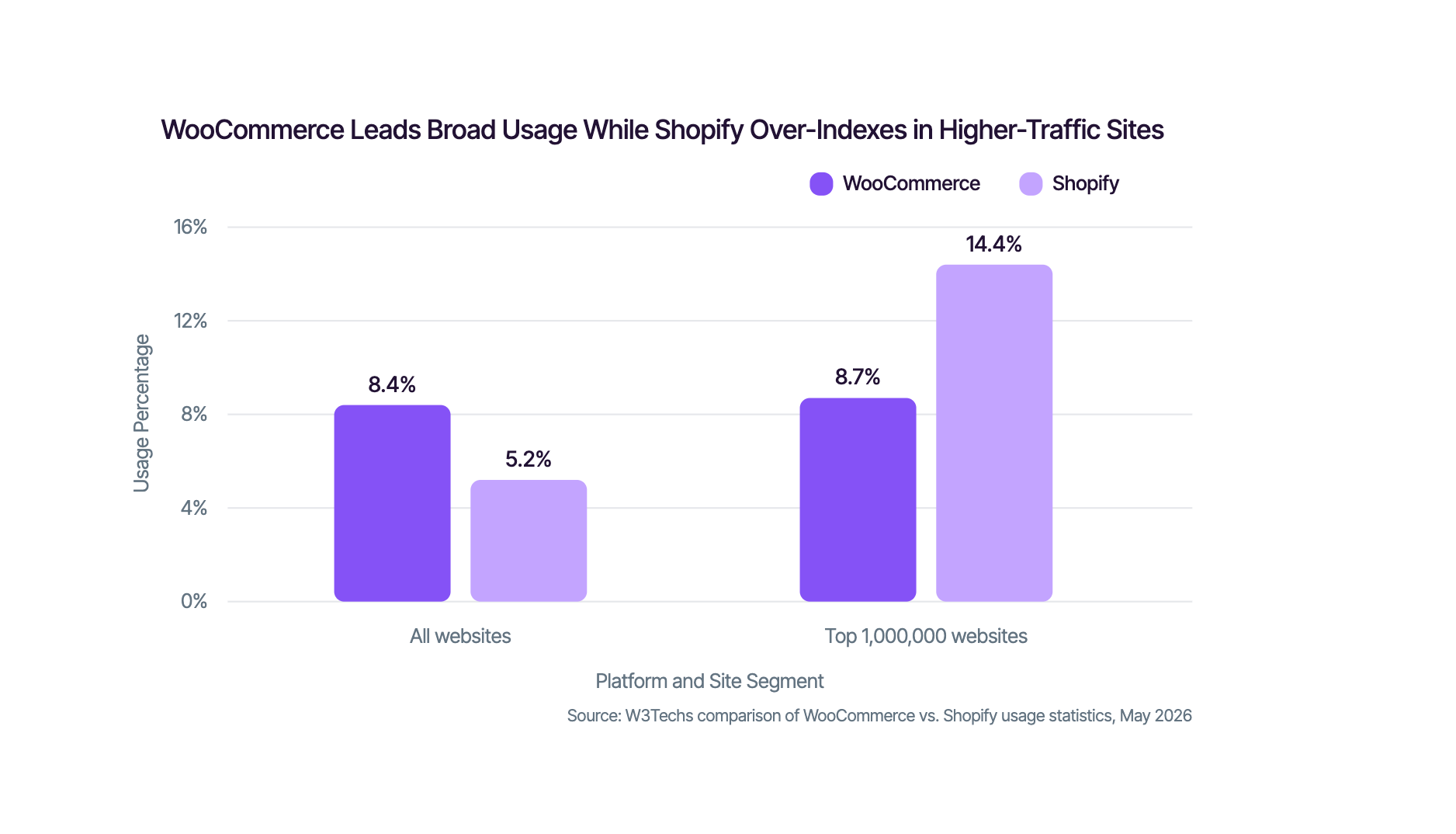
The Build-Convert-Compound Path is the fastest way to compare woocommerce vs shopify without getting trapped in brand talking points. It evaluates each platform at three moments of value creation: building the store, converting the shopper, and compounding growth after the first purchase.
The Build-Convert-Compound Path matters because the cheapest launch is not always the cheapest year. Shopify argues on its official comparison page that its average total cost of ownership is lower, while WooCommerce argues that merchants save by avoiding platform revenue share and buying only what they need. Both claims can be directionally true depending on whether your next bottleneck is software spend or operator time.
This is where content changes the equation. PowerReviews found that 91% of consumers are more likely to buy when reviews include photos and videos. Based on Stack Influence’s work with eCommerce brands, that value compounds fastest when creator output reaches product pages and marketplace assets quickly. In Aunt Fannie’s customer story, 189 creator promotions generated 62 organic product testimonials, a 33% testimonial conversion rate.
That compounding layer is the part most platform guides underweight. A store does not simply host product pages. It determines how fast your team can publish fresh social proof, test new merchandising blocks, and move UGC from social feeds into a buying surface that actually converts.
Most sellers do not need more metrics. They need a cleaner hierarchy. The Four-Signal Measurement Stack solves this by separating native store performance, click-path validation, marketplace attribution, and margin recovery into one working model.
This stack matters most for Amazon FBA brands and hybrid operators. If you only measure site sessions, you undercount creator traffic that closes on Amazon. If you only measure Amazon sales, you miss how much your DTC site, email list, and content are doing to qualify demand before purchase. Amazon’s own guidance makes the split clear: Attribution is the measurement layer, while Brand Referral Bonus is the financial recovery layer.
That is also why platform choice can look better or worse than it really is. A weak result can come from bad tags, a slow PDP update cycle, or sending the wrong audience to the wrong destination. If you want a practical internal explainer for this distinction, Stack Influence’s guide on Amazon marketing services is useful because it separates Amazon Attribution from Amazon Brand Referral Bonus in operational terms.
The Build-Convert-Compound Path becomes easier once you anchor it to business model. DTC brands usually need a branded site that can publish content quickly, support merchandising tests, and convert mobile traffic well. Amazon sellers often need a site for education, email capture, and traffic control, but they may still want final conversion to happen on Amazon when Prime trust, reviews, and category rank matter more than standalone site margin.
Here is the simplest fit guidance.
Data from Stack Influence’s micro influencer campaigns suggests that reuse across destinations is where value compounds fastest. In Lenny & Larry’s customer story, monthly Amazon unit sales grew from 1,024 to more than 11,000 over a 12-month creator program. For Amazon sellers, the DTC site often functions as the education layer while Amazon remains the trust-and-conversion layer.
That is why the best answer for DTC brands and Amazon sellers can differ even when they sell the same product. The platform should match the shortest path between your current team capability and your next revenue milestone, not someone else’s software preference.

The hidden cost in woocommerce vs shopify is usually not the monthly fee. It is the coordination tax that appears after launch through merchandising edits, analytics cleanup, plugin or app governance, creator asset handling, and marketplace reporting. Sellers feel that cost only after traffic starts arriving and more people need to touch the stack.
On Shopify, the hidden tax often appears in ecosystem dependency and the work required to keep app logic, checkout needs, and reporting clean. On WooCommerce, it often shows up in development oversight, hosting performance, and the ongoing effort required to keep a customized stack stable. Shopify’s own comparison page argues that WooCommerce carries higher operating burden, while WooCommerce argues that merchants save by keeping more cost decisions under their own control.
You can usually spot the tax early.
Across campaigns managed on the Stack Influence platform, the bottleneck often shifts from creator sourcing to operational throughput very quickly. Stack Influence’s Amazon growth workflow and pricing page point to the same reality: once creators are producing usable content, sellers need a stack that can publish, tag, and measure that output fast. Those pages highlight 340,000 vetted creators, 175 hours saved per month, 4x ad conversions, and an average $30 fee per completed post.
That is the hidden economics lens most platform guides leave out. A platform decision is also a content operations decision. If your business depends on rapid UGC deployment, creator-led traffic, and clean attribution, the best platform is the one that lowers total decision load after launch, not the one that only looks cheapest before work begins.
WooCommerce vs Shopify is not really a debate about features. It is a debate about how your team wants to allocate control, speed, and operating burden as revenue grows. If you want managed infrastructure and faster day-to-day execution, Shopify is often the stronger default. If you want deeper ownership and a store that bends around your business instead of the reverse, WooCommerce is often the better long-term fit.
For eCommerce sellers, the best answer is the platform that shortens the path from traffic to revenue and from content to conversion. Make the decision against your next 12 months of work, not your next two weeks of setup, and you will choose a stack that supports growth instead of interrupting it.
Influencers do not lose repeat partnerships because they lack creativity. They lose them because their reporting feels vague, late, or disconnected from what a brand actually bought. A strong social media analytics report template closes that gap by showing not just what a post did, but what the campaign produced, what the audience did next, and what a brand should test next.
If you are an influencer trying to win better renewals, higher-value UGC work, or longer creator partnerships, your report is part of the pitch. This guide explains the structure, metrics, and measurement logic that help content creators tell a brand-ready story after every campaign.
Influencer marketing is bigger, more performance-focused, and less patient than it was even a year ago. Influencer Marketing Hub's 2026 benchmark report says 65.9% of marketers expect campaign payback within one month, including 48.4% within two weeks, so creators who report clearly can look more valuable than creators who simply post and disappear.
That urgency matters for influencers because brands now buy many outputs at once. A sponsored post can drive awareness, feed a paid ad, inform a Shopify influencer marketing test, or support an Amazon listing with fresh UGC. Aspire's State of Influencer Marketing 2025 notes the market could reach $47.8 billion by 2027, which means more budget is moving into creator partnerships and more scrutiny is following it.
Before you build a template, keep the reporting stakes simple:
Social teams themselves feel this pressure. In Sprout Social's 2025 Impact of Social Media report, only 44% of marketing leaders rated their teams as expert at measuring social's business impact. Creators who organize clean results are simply easier to champion inside a marketing team.
A social media analytics report template is a repeatable document that helps influencers summarize campaign goals, audience fit, content performance, action signals, and next-step recommendations in the same structure every time. For creators, that matters because brand managers compare your report against paid social dashboards, agency recaps, affiliate snapshots, and internal scorecards, not against another creator's caption.
A creator version should also be narrower than a generic brand report. Instead of trying to summarize an entire channel, it should explain what this collaboration delivered, how the audience responded, and why the content matters to future influencer campaigns. If you work in niches where micro influencers and nano influencers win on trust and specificity, that context belongs in the story you tell.
A useful template usually includes these blocks:
Native platform data should shape those blocks. Instagram says its insights help creators review follower trends and content performance, its post insights remain available for up to two years, and reels insights cover both organic and boosted content. That makes a template practical because creators can pull consistent numbers after the campaign window ends, even when brands ask for a recap later.
The easiest way to make your template useful is to follow the Creator-Ready Reporting Checklist. This checklist keeps you focused on the six things a buyer can actually use in a renewal, content licensing, or performance review conversation. It also prevents the most common reporting mistake, which is sending a pile of screenshots with no narrative.
Start with the Creator-Ready Reporting Checklist each time you close a campaign:

This is also where process matters. Stack Influence's UGC platform is built around full usage rights, creator management, and content syndication, which is a useful reminder that brands often buy reusable assets, not only public social activity. Across campaigns managed on the Stack Influence platform, creator content reused across ads and commerce surfaces can drive up to 4x ad conversions, so your report should always show what can be repurposed after the post goes live.
From Stack Influence's experience running eCommerce creator programs, the strongest reports separate content output from audience response because a brand may judge success through both. If you delivered a clean unboxing, a short UGC video, and product demo stills, that output can matter even when the first post's reach was only modest. That same logic appears in automated product seeding, where deliverable tracking and file handoff matter almost as much as impressions.
The Creator-Ready Reporting Checklist works especially well for content creators serving commerce brands. When reports show both public performance and reusable asset value, you become easier to brief, easier to measure, and easier to rebook. That is a major advantage when buyers review multiple creators inside influencer marketing platforms, agency rosters, or simple spreadsheet shortlists.
Follower growth and post likes look impressive, but they often tell an incomplete story. A brand buying creator content wants evidence that the audience cared enough to pause, save, share, click, or remember the product, and those signals do not always move in lockstep with headline engagement.
That matters even more on platforms where discovery behavior leads directly into research. TikTok's discovery research says 61% of users discover new brands and products there, one in two use it to research products or brands, and 91% of users inspired by search on TikTok follow through on the action. An influencer report that stops at views may miss the behavior that matters most.
If you want to avoid vanity-metric reporting, focus on these signals instead:
Market data supports that shift. HubSpot's 2026 marketing statistics say Instagram is the most-used social platform among marketers and the most-cited platform for ROI, while TikTok is used by 57% of marketers and ranked by 32% as a consistently high-ROI platform. That means influencers should report the metrics brands use to compare channels, not only the numbers creators like to celebrate.
Stack Influence has observed that asset value often rescues campaigns that look average in public. On its UGC product page, the platform highlights creator-led programs that can deliver 3x website engagement and a 90% higher purchase rate when authentic content is reused across commerce touchpoints. That is why a report should include a short asset appendix, not just a screenshot collage from your analytics tab.
Influencers should measure ROI with a tiered model, not a single number. The Three-Layer Signal Stack keeps reporting clean by separating attention, intent, and revenue so a creator can explain performance even when the brand only shares partial data.
Use the Three-Layer Signal Stack anytime a campaign crosses social, affiliate, and marketplace channels:
Visibility is the proof that your content earned attention from the right audience. At this layer, report reach, impressions, views, profile visits, and follower quality, but tie each number back to the campaign goal. If the campaign aimed at awareness, visibility deserves more space than revenue.
Intent shows whether attention turned into active consideration. This layer includes saves, shares, comments with product questions, link clicks, landing-page sessions, add-to-cart behavior, and coupon code use. Intent is often the most persuasive layer for nano influencers and micro influencers because it shows depth, not just scale.
Revenue is the cleanest layer, but it is not always available to creators. When brands share it, add attributed sales, affiliate commissions, repeat orders, or marketplace conversions. When they do not, explain which intent signals point toward commercial value and why the next brief should be built around them.
The Amazon layer deserves special handling because off-platform creator traffic is harder to measure than on-platform engagement. Amazon Attribution is a free measurement tool for non-Amazon channels, including social and influencer campaigns, and Amazon says its attribution methodology uses a 14-day last-touch model. If a brand sells through Amazon, ask whether they can generate tagged links before your post goes live, not after.
Creators should also understand how the economics change for the brand. Amazon's Brand Referral Bonus gives brands an average 10% bonus on qualifying sales from external traffic, so a creator who can document Amazon-driven clicks or purchases becomes easier to justify on the next budget review. This matters for Amazon influencers, affiliate creators, and any influencer marketing agency or micro influencer agency working around marketplace growth.
Measurement still gets messy because social data is fragmented. Instagram, TikTok, affiliate dashboards, Shopify analytics, and Amazon reports all use different windows, definitions, and levels of access, so your template should state the source of every metric and the reporting window used. If the brand cannot share sales data, the Three-Layer Signal Stack lets you show value through intent and asset quality instead of pretending unavailable revenue exists.
Based on Stack Influence's work with eCommerce brands, cleaner workflow data also changes how brands evaluate creators. Its pricing page says centralizing creator management can save brands about 175 hours per month, which helps explain why organized reporting, deliverable status, and file handoff are often as persuasive as a strong engagement rate. For influencers, easier ops can be part of ROI.
Better reporting turns into better renewals when it helps a buyer make the next decision quickly. Most brands do not need a longer report. They need a sharper report that tells them what worked, what assets they now own, and what to test in the next brief.
That is where commerce-minded creators pull ahead. PowerReviews research finds that 99.5% of shoppers seek user-generated visual content before purchase, nearly 87% always or regularly seek it out, and conversion lifts 163.6% when shoppers interact with user-generated photos or videos. If your report shows that you created reusable proof, not just temporary reach, you are speaking the language of growth teams.
Use this renewal structure at the end of your report:
This is also why creators benefit from understanding how brands scale content internally. Stack Influence's public creator resources, including its creator community, guide on how to start UGC content creation, article on how to become a content creator in 2026, and breakdown of micro-influencers and UGC in eCommerce, all point to the same operational truth: brands want creators who can deliver content, communicate clearly, and improve over time.
Visual proof strengthens that case. Bazaarvoice's research says 85% of consumers turn to visual UGC over branded content when making purchase decisions, and 77% are more likely to buy a product they found through UGC. A report that combines performance data with UGC delivery is not extra admin work. It is part of the sale.

Use your final slide, page, or email to make the next step obvious:
A great social media analytics report template helps influencers do more than recap a post. It helps them prove audience fit, surface buying signals, package UGC clearly, and recommend the next move with confidence. If you want better creator partnerships, stronger renewals, and more leverage in influencer campaigns, build your reporting system with the same care you give your content.
One of the costliest mistakes in the creator economy is waiting until you look bigger to act like a business. Many influencers assume serious brand deals begin at 10,000 followers, so they delay outreach, pricing, and portfolio building until some future milestone arrives.
Nano influencer marketing rewards a different skill set. It favors niche trust, credible product experience, and useful content brands can reuse across product pages, ads, and social campaigns. This guide shows influencers how to package a small audience into a stronger offer, measure value beyond likes, and build creator partnerships that repeat.
Nano influencer marketing centers on creators with very small but very responsive communities, usually under 10,000 followers. In HubSpot's 2024 Consumer Trends Report, 62% of influencers who inspired a purchase had fewer than 10,000 followers, while HypeAuditor's 2025 industry report found nano influencers make up 87.7% of TikTok creators and post the tier's highest engagement at 10.3%; on Instagram, HypeAuditor's engagement benchmarks place nano creators around 4% to 5%, above larger tiers.
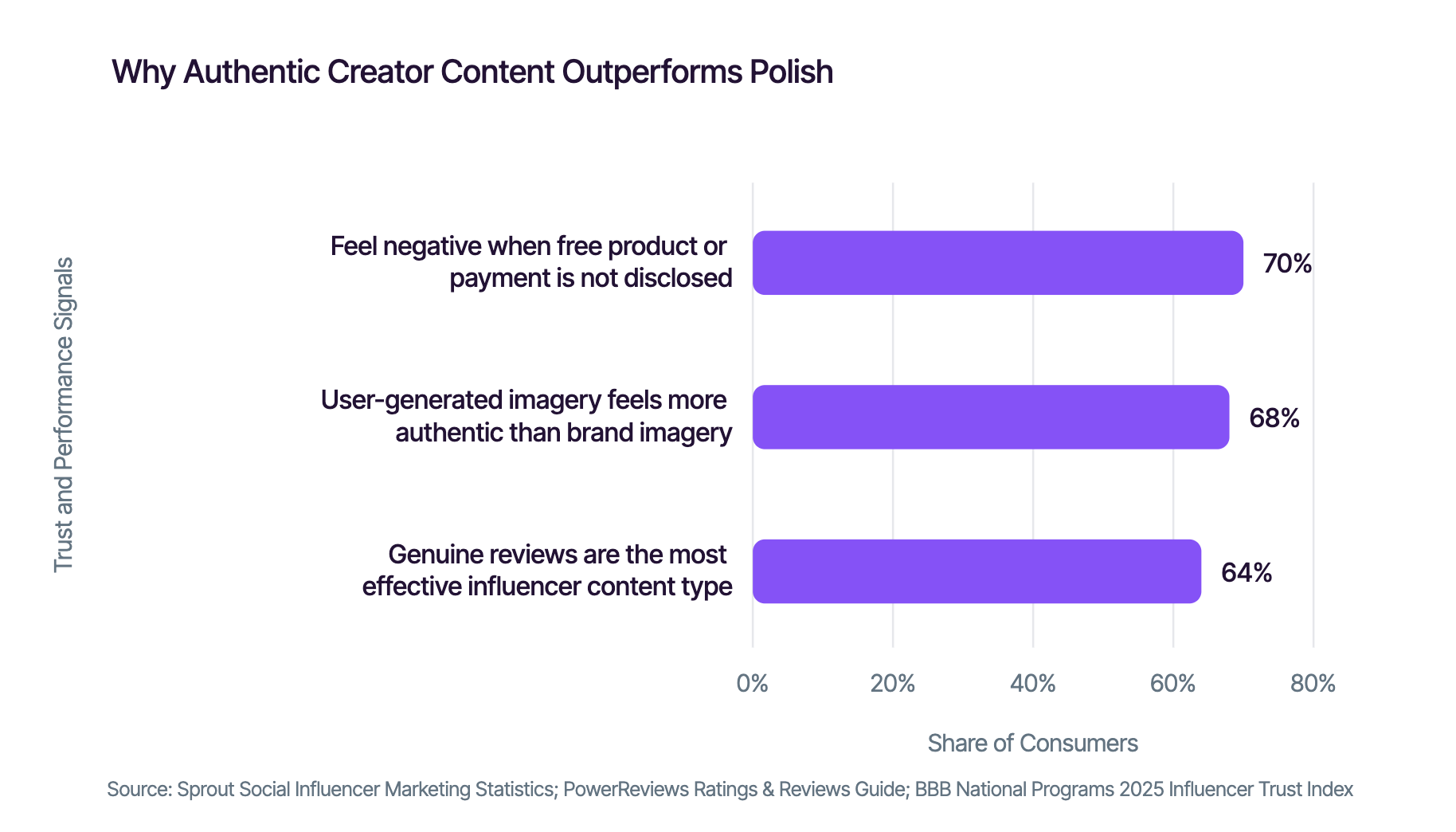
For influencers, that matters because the business value of a small audience is different from the value of a big one. Micro influencers often sell reach within a niche. Nano influencers more often sell closeness, comment quality, honest product context, and faster community feedback. If you want to see how brands already frame opportunities for smaller creators, browsing a structured creator community makes that reality easier to spot.
Nano influencer marketing usually shows up in a few repeatable formats:
That shift is happening inside a larger market change. IAB's 2025 Creator Economy report says U.S. creator ad spend is projected to reach $37 billion in 2025, with nearly half of buyers calling creators a must-buy channel. For influencers, that means smaller accounts are not competing for scraps anymore. They are competing in a market that increasingly rewards usable creator output and measurable results.
Brands do not buy follower count alone. They buy fit, low-friction collaboration, believable product use, and content that can influence someone to click, comment, save, or purchase. That is why Sprout Social's latest influencer marketing data shows 64% of consumers say genuine reviews are the most effective influencer content type, while PowerReviews reports 68% of shoppers view user-generated imagery as more authentic than brand-created imagery.
The fastest way to act on that is to focus on five practical moves:
That is where a simple secondary tool helps. Use The Brand-Ready Five before every pitch: niche signal, audience snapshot, three best content samples, one clear offer, and one reporting promise. If your message includes all five, you already look more useful than most beginner creators who lead with vanity metrics and hope the brand fills in the blanks.
Based on Stack Influence's work with eCommerce brands, creators who deliver one in-use product shot and one honest verdict clip tend to earn about 18% more repeat invitations than creators who submit only a single polished hero image. That fits the broader market logic: shoppers trust realism, and brands need enough variation to reuse creator output across different placements. If you want to sharpen that offer, Stack Influence's guides on how to get PR as a micro influencer, the difference between UGC creators and content creators, and influencer compensation models are useful ways to tighten your pitch.
The key is to sell a workflow, not a wish. A nano influencer who can explain what they make, how fast they deliver, and what the brand receives will outperform a larger creator who only says their audience is engaged. That is true whether you source deals through direct outreach, influencer marketing platforms, a micro influencer agency, or recurring brand ambassador programs. If you are still refining your monetization mix, Stack Influence's breakdown of how influencers make money is a helpful reality check.
The primary framework for this article is The Trust-to-Proof Matrix. It maps your creator business on two axes: audience trust and commercial proof. Audience trust means comment quality, repeat viewers, DMs, and whether followers treat you like a credible peer. Commercial proof means usable assets, clean deliverables, link clicks, coupon use, past partnerships, and evidence that brands got something valuable back.
Most nano influencers get stuck because they overinvest in one axis and ignore the other. Some creators build a warm, highly engaged community but never package that trust into a strong offer. Others assemble beautiful portfolios but feel interchangeable because their audience connection is shallow. The Trust-to-Proof Matrix helps you see which problem you actually need to solve next.
Use The Trust-to-Proof Matrix like this:
Across campaigns managed on the Stack Influence platform, briefs that ask for three to five must-have shots instead of paragraph-long scripts generate roughly 21% more on-time creator submissions. For influencers, that is an important signal. Brands do not always want more control. Often, they want a creator who can take a simple brief, keep it authentic, and still deliver files that fit a real campaign. Exploring a managed creator campaign process or reviewing the kinds of outcomes highlighted on Stack Influence's creator benefits page can help smaller creators understand what brands expect from that balance.
If your position in The Trust-to-Proof Matrix is trust-heavy, focus on packaging. If it is proof-heavy, focus on community habits like replying,Story context, and recurring content series. If it is low on both axes, pitch less and publish more. The creators who move fastest through the matrix are usually the ones who treat every small collaboration like the start of a case study, not a one-off freebie.
If you want repeat brand deals, stop sending brands only likes and views. The creator economy is growing faster, but measurement is still one of its biggest weak spots, which is why IAB highlights better measurement and tools as one of the category's biggest opportunity areas. Nano influencers who can explain ROI clearly become easier to justify, easier to rebook, and easier to scale.
Use this named measurement model after every campaign: The Four-Layer Proof Stack. It prevents you from overreporting vanity metrics and underreporting the things a brand actually values.
Start with the top-of-funnel signals that show whether the creative earned interest. That includes reach, views, watch time, saves, shares, profile visits, and comment quality. Attention is not the finish line, but it tells a brand whether the hook and format worked.
Next, report what people actually did. That means link taps, code redemptions, DM replies, email captures, affiliate clicks, or landing-page visits. If a brand gave you a coupon or tagged URL, Layer Two is where your post starts turning into business evidence.
This is the layer most creators underreport. Count approved deliverables, raw files, edit options, testimonial clips, stills, hooks that held attention, and whether the brand reused the content later. That matters because PowerReviews found a 163.6% lift in conversion when shoppers interact with user-generated images or video on a product page, while Dash Social says creator partnerships generate 6x more engagement than branded content.
Afterlife is what happens after the post goes live. Did the brand ask for more content, whitelist your asset, renew the deal, or pull you into a larger ambassador program? If you work with marketplace sellers, ask whether they use Amazon Attribution and whether your traffic qualifies for the Brand Referral Bonus workflow described by Amazon Ads. Those tools help sellers measure what your off-platform content did on Amazon, and the bonus averages 10% of eligible product sales driven by non-Amazon marketing.
When you send a recap, include a few things every time:
Stack Influence has observed that creators who deliver approved assets within seven days of receiving product see repeat bookings about 27% higher than slower-turn creators, largely because brands can reuse the content while launch windows are still active. That is especially relevant in product seeding environments where timing, logistics, and content collection all affect campaign value. If you want to understand how that workflow looks from the brand side, Stack Influence's page on automated product seeding and its creator FAQ make the operational expectations easier to understand.

The old creator advice says grow first, monetize later. That made more sense when influencer campaigns were mostly sponsored posts bought for broad visibility. It makes less sense in a market where creator spend is rising fast, measurement matters more, and shoppers respond best to believable reviews and real visual proof. In other words, reach still matters, but reach without trust or asset value is weaker than many influencers think.
What brands are often buying now is more specific than many creators realize:
That logic is reinforced by the data. Sprout Social says 64% of consumers find genuine reviews the most effective influencer content type, and PowerReviews reports 68% of shoppers see user-generated imagery as more authentic than brand visuals. On top of that, Dash Social found creator partnerships drive 6x more engagement than branded content, which is a strong reminder that creators are not just distribution channels. They are performance assets.
Trust also breaks faster than many nano creators realize. In the BBB National Programs 2025 Influencer Trust Index, 70% of consumers said they would feel negative toward an influencer who got paid or received free product and did not disclose it. For nano influencers, that should feel empowering, not limiting. You do not need to play bigger than you are. You need to be clearer, more honest, and more useful than the average pitch in a brand's inbox.
So stop waiting to look larger before you act like a partner. The better move is to become easier to trust, easier to brief, easier to measure, and easier to reuse. That is how nano influencer marketing turns a small audience into a serious commercial advantage.
Nano influencer marketing works best when influencers stop apologizing for size and start packaging trust, proof, and reporting. Brands are spending more in the creator economy, but they still need creators who can translate a small audience into clear action, strong UGC, and repeatable outcomes. The influencers who build that system early usually outgrow the creators who chase vanity milestones first.
Keep your next move simple:
Do that consistently, and nano influencer marketing stops feeling like a starter phase. It becomes the operating system that helps influencers win better brand deals, stronger UGC opportunities, and longer creator partnerships.
Reselling on Amazon looks simple until the math gets real. For eCommerce sellers, learning how to resell on Amazon is less about finding a cheap product and more about protecting contribution margin while fees, approvals, and price pressure keep moving.
This guide explains where resale still works, how to screen inventory before you buy it, what changed in 2026, and when creator traffic can improve your economics instead of inflating your costs. If you already sell through marketplaces, DTC brands, or a mix of Amazon FBA and direct channels, the goal is to build a repeatable system instead of chasing one lucky flip.
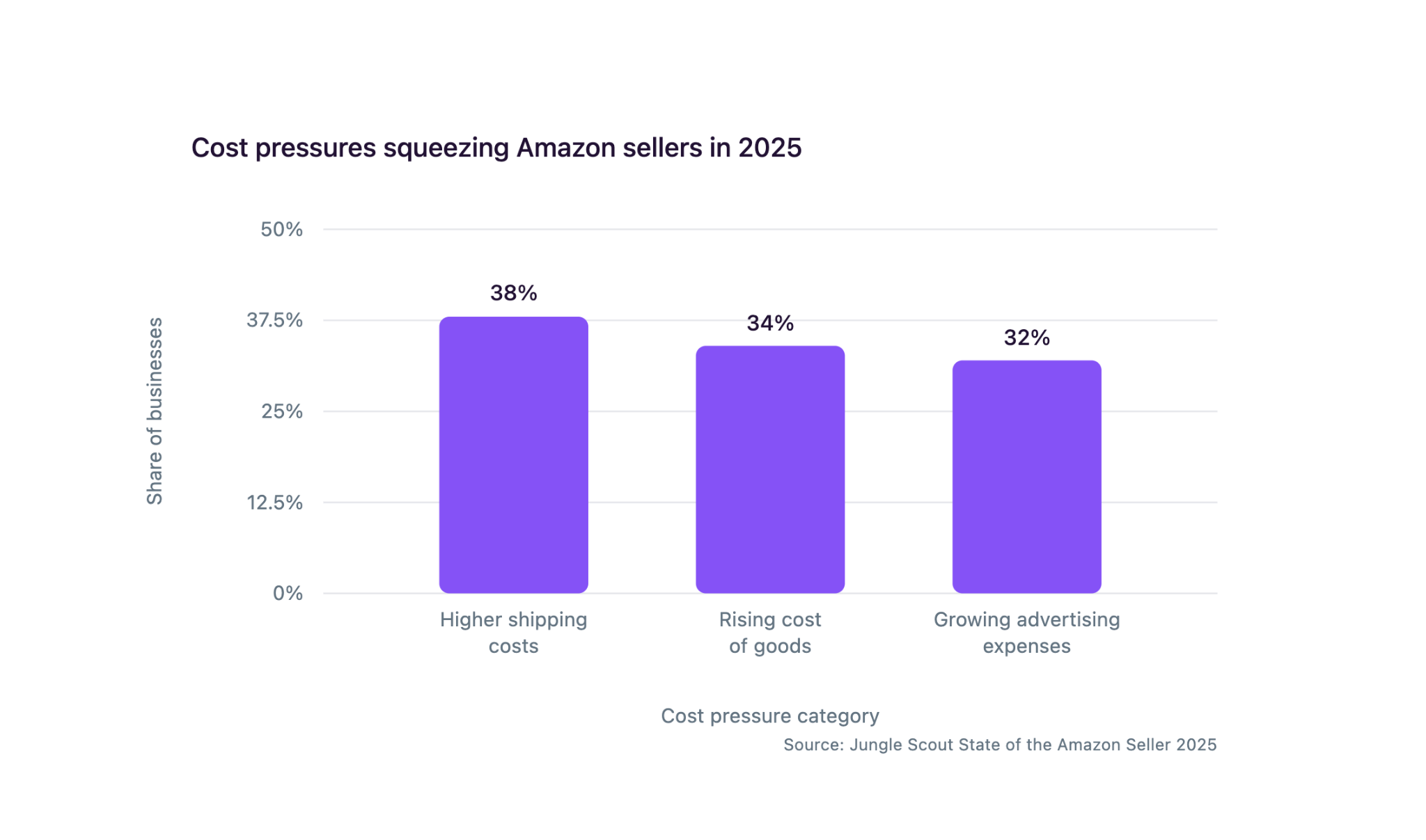
Amazon resale is still viable, but the margin for sloppy execution is getting thinner. In Jungle Scout’s State of the Amazon Seller 2025, 38% of businesses cited higher shipping costs as a top challenge, 34% pointed to rising cost of goods, and 32% flagged advertising expense, while Amazon’s own seller FAQ still says a Professional account costs $39.99 per month plus referral fees that vary by category.
Three realities define the current environment:
Amazon is also widening the gap between sellers who merely list products and sellers who control brand assets. On the public Amazon Brand Registry page, Amazon says enrolled brands can get 10% back on their first $50,000 in branded sales and then 5% back through the first year until they reach $1,000,000. Pure resellers can still win, but the marketplace is rewarding catalog ownership, listing control, and measurable external traffic more aggressively than before.
Amazon reselling means selling authentic goods you did not manufacture, usually by matching an existing catalog page and competing on price, fulfillment, condition, or service. The legal baseline comes from the Department of Justice’s summary of the first-sale doctrine, which says a lawful purchaser can generally sell or otherwise dispose of that particular copy, but Amazon can still impose category, condition, and approval rules inside its marketplace.
In practice, Amazon reselling works best in three situations:
Amazon’s public condition guidelines show why this matters. Amazon says New condition should be like buying the item fresh off a store shelf in factory packaging, and some products must be sold as New to qualify for the Featured Offer. If your packaging, accessories, or grading do not match the listing expectation, your modeled gross margin can disappear into returns, complaints, and suppressed conversion.
The difference between hobby resale and durable resale is process. The Amazon Resale Margin Ladder is a simple four-tier model that helps eCommerce sellers move from speculative inventory buys to repeatable margin.
The Amazon Resale Margin Ladder has four tiers:
The Amazon Resale Margin Ladder works because each tier solves a different risk. Scout protects you from bad math. Validate protects you from bad assumptions. Systemize protects you from operational drift. Compound, the top of the Amazon Resale Margin Ladder, is where you earn the right to layer on external demand and content leverage.
If you want an extra planning reference, this deeper margin breakdown of Amazon selling costs is useful because it frames fees as a contribution-margin problem rather than a bookkeeping detail. That mindset is the whole point of the Amazon Resale Margin Ladder.
Most resale losses happen before a listing ever goes live. The Buy Box Readiness Checklist is designed to stop those mistakes at the sourcing stage. If a product misses two or three of these checks, you are usually looking at a fragile offer instead of a scalable one.
Run every SKU through this checklist:
This checklist keeps you from confusing one-off opportunity with repeatable profit. A clearance find is not a business if you cannot restock it. A wholesale account is not enough if price discipline is weak. Even a good ASIN can become a bad bet when packaging or condition mismatches create return rates you did not model.
Yes, and the change is more structural than many guides admit. Amazon’s 2026 U.S. fee summary says FBA fees rose by an average of $0.08 per unit sold, while Amazon Ads also rolled out a shopping-signal enhanced view attribution model for certain Store ad placements on January 1, 2026. That combination means both cost assumptions and reporting assumptions need to be updated.
Three 2026 shifts matter most:
That last shift is easy to underestimate. In Bazaarvoice’s research, 47% of consumers said they trust customer testimonials and peer reviews when shopping on social media, and 39% said purchase confidence rises with review volume. For Amazon sellers, that means trust now comes from a stack of signals: reviews, clear conditioning, better visuals, creator proof, and cleaner merchandising.
If you want a practical companion to this shift, this guide to Amazon Marketing Services is useful because it connects traffic strategy to listing economics instead of treating ads as a separate problem.
Most sellers can see orders, but many cannot explain which outside activity created them or whether that activity improved net profit. The Off-Platform Revenue Stack is a simple measurement model for solving that blind spot.
The Off-Platform Revenue Stack has four layers:
Amazon calls Amazon Attribution a free analytics and measurement solution for non-Amazon channels such as search, social, display, video, email, and affiliate or influencer campaigns. Amazon also says Attribution reporting uses a 14-day window and includes metrics like clicks, detailed page views, add-to-cart, purchases, units sold, product sales, and new-to-brand.
The margin layer matters just as much as the traffic layer. On the public Brand Referral Bonus page, Amazon says the bonus averages 10% of qualifying sales driven by non-Amazon marketing and is earned through Amazon Attribution-tagged campaigns. That is why attribution on Amazon is not just about knowing what happened. It is also about recovering part of the fee structure when the traffic qualifies.
Across campaigns managed on the Stack Influence platform, the company publicly reports a 2x average revenue boost and 4x average BSR growth on its Amazon influencer marketing workflow page. Based on Stack Influence’s work with eCommerce brands, reporting also gets cleaner when each creator asset or path carries its own Attribution tag before seeding starts, which mirrors Amazon’s own guidance to create separate tags at the tactic and creative level.
There is one more trap worth avoiding. If you only watch a single ASIN, you can miss halo behavior across the rest of the catalog. Amazon’s Attribution guide says product reports can include both promoted products and brand-halo products, which is why Store destinations often deserve their own reporting lane.

Creator traffic expands margin only when it does more than create impressions. It has to improve conversion, generate reusable assets, or unlock measurable external demand that compounds across Amazon and DTC channels.
Use creator traffic when these conditions are true:
This matters because creator marketing is now a serious media category. IAB says in its 2025 creator economy ad spend update that U.S. creator ad spend was projected to reach $37 billion in 2025, up 26% year over year. Sprout Social also reports that 86% of consumers make an influencer-inspired purchase at least once per year.
Creators are particularly useful when they keep shoppers inside Amazon’s conversion path. Amazon says the Amazon Influencer Program gives creators their own customizable Amazon presence and a vanity URL, which is why creator-operated Amazon storefronts can work well for Amazon influencers and affiliate partners who already know how to move ready-to-buy audiences.
From Stack Influence’s experience running product seeding campaigns, verified-post reimbursement protects the economics of testing. Its public product seeding model says brands save 40% of inventory and about $150 per creator on average because reimbursement happens only after verified social posts go live. Stack Influence has also observed that sellers get more usable merchandising assets when briefs ask for clear in-use shots and benefit proof, which is why its UGC workflow emphasizes reusable photos, videos, and testimonials across listings and ads.
That cross-channel asset value is where many eCommerce sellers still underinvest. If you already sell through Shopify, the best version of Shopify creator programs is often the one that reuses the same creator asset pool for Amazon and DTC brands instead of funding two disconnected influencer campaigns. The limitation is simple: none of this fixes a weak SKU, weak margin, or weak compliance. It only amplifies a product that already earned the right to scale.
Creators also bring one compliance rule that sellers should not ignore. The FTC says its Endorsement Guides were updated in June 2023 to reflect how advertisers use social media and reviews, which means material relationships still need clear disclosure in influencer campaigns.
How to resell on Amazon becomes much more predictable when you treat it as a system instead of a sourcing scavenger hunt.
If you are deciding what to do next, focus on three priorities:
For eCommerce sellers, that approach creates something more durable than a one-time spread. It creates repeatability, cleaner cash flow, and a stronger foundation for growth across Amazon sellers, Amazon FBA, DTC brands, and the channels that support them.