
The latest info on influencer marketing trends, micro influencer news, and the world of social media

Most people who start posting on TikTok are not thinking about a career. They are thinking about a video. But the creators who build sustainable income from the platform are the ones who eventually stop treating it as a hobby and start treating it as a business with job functions, income streams, and professional development requirements. TikTok careers in 2026 take more forms than most guides acknowledge, from the direct creator monetization paths most people imagine to the brand-side, agency-side, and platform-side professional roles that the TikTok ecosystem has created. This guide covers every category of TikTok career available to content creators and creator-economy professionals in 2026, what each path realistically pays, and how to build the professional infrastructure that makes a TikTok-adjacent career durable rather than dependent on algorithm luck.
The [creator economy](INTERNAL: creator economy career guide 2026) has matured considerably from its early "anyone can go viral and get rich" framing. Professional creators in 2026 operate in a more sophisticated ecosystem where platform-native pay is one small component of a larger income architecture, brand partnerships are increasingly structured and performance-tracked, and the supporting professional infrastructure, talent management, creator operations, and influencer marketing strategy, has grown into a genuine employment sector.
According to Goldman Sachs research, the creator economy is projected to approach $480 billion by 2027, generating income for professional creators as well as the agencies, platforms, and brands that work with them. That scale has created a professional layer around TikTok that did not exist five years ago and is now large enough to support careers at multiple points in the ecosystem.
Three macro forces shaping TikTok careers in 2026:
Understanding the full landscape of TikTok-adjacent careers prevents creators from assuming the only viable path is growing a massive personal following. The ecosystem has diversified significantly, and many of the most financially stable TikTok careers in 2026 do not require a personal audience at all.
The TikTok Career Roadmap organizes available career paths into four tracks based on the primary skill set and business model each requires:
The TikTok Career Roadmap is useful because it clarifies that a creator who wants to build a career in this space has genuine optionality. They are not choosing between "going viral or giving up." They are choosing which of four professionally viable tracks fits their skills, risk tolerance, and income timeline.
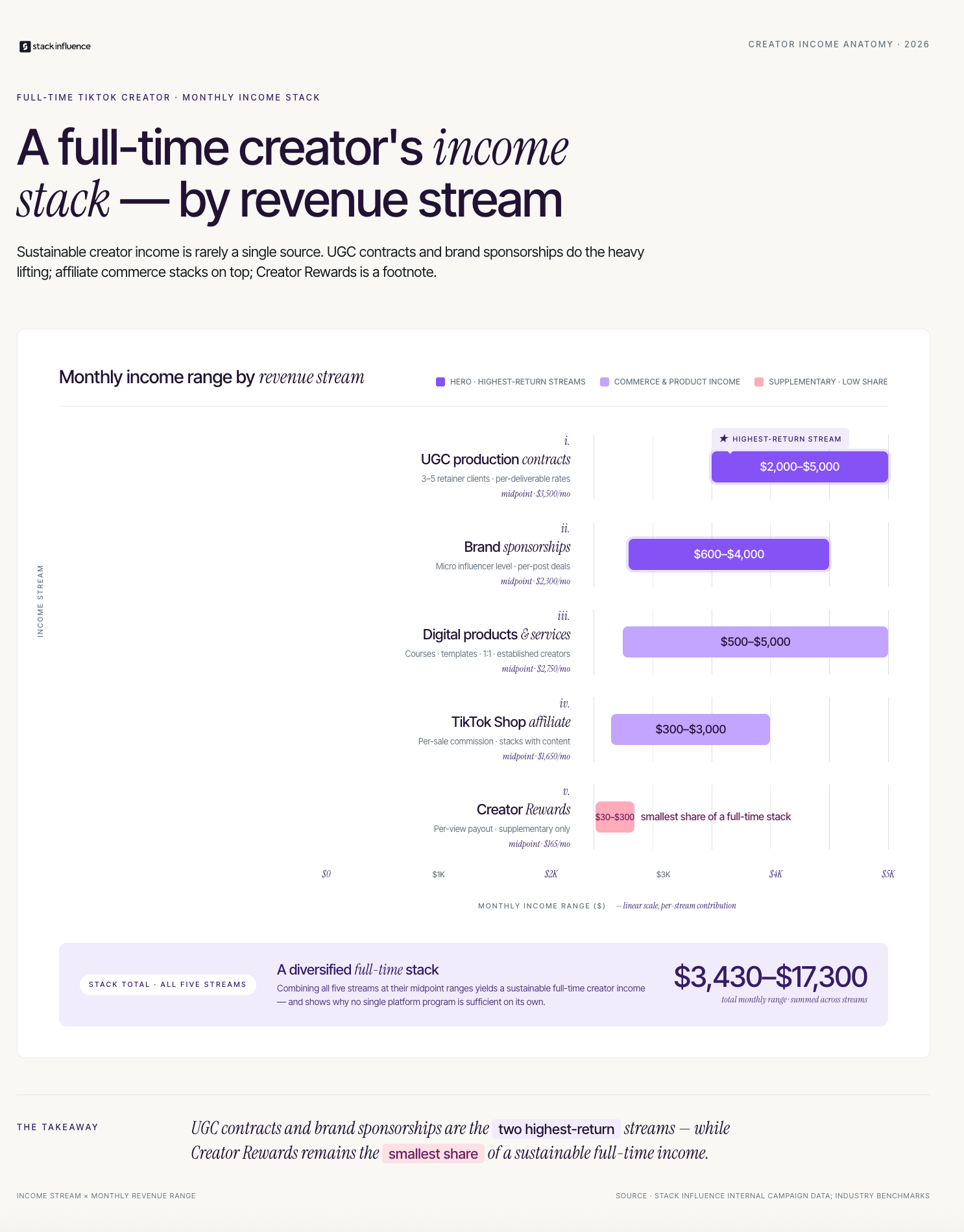
Track 1 of the TikTok Career Roadmap, building income directly from content creation, is the most aspirational and the most misunderstood. The creators who achieve full-time income through this path in 2026 almost never do it through a single income stream, and they almost never do it by chasing follower growth as the primary strategy. They do it by building a diversified income portfolio that generates meaningful revenue at a relatively modest audience size.
A creator with 15,000 highly engaged TikTok followers in a specific niche can realistically earn $3,000 to $6,000 per month from a combination of brand deals, TikTok Shop affiliate commissions, and UGC production contracts. That income does not require millions of followers. It requires niche clarity, professional positioning, and three to five active income streams operating simultaneously.
The practical income architecture for a full-time TikTok creator career:
Stack Influence's internal campaign data shows that [nano influencers](INTERNAL: nano influencer full-time income strategy) who activated all three of the first income streams on this list within their first six months reached a combined monthly income of $2,000 to $4,000 on average, with TikTok Shop affiliates and UGC contracts contributing more than Creator Rewards in every case. The platform-native pay is the smallest piece of a viable creator income at any realistic follower count.
The assumption that TikTok careers require a personal following overlooks a significant and growing professional sector. Every creator who runs a serious content business needs support functions that are themselves career paths. Every brand running creator campaigns needs professionals who understand the ecosystem from the inside. These behind-the-scenes TikTok careers are in many cases more financially stable and accessible than the creator path itself.
The most in-demand behind-the-camera TikTok career categories in 2026:
According to LinkedIn's emerging jobs data, influencer marketing and creator economy roles have been among the fastest-growing professional categories in marketing, with demand continuing to grow as brand investment in creator channels expands. Professionals with direct platform experience and measurable campaign results are commanding premium salaries over those with only traditional marketing backgrounds.
Most creators have no systematic way of evaluating whether their TikTok career is actually advancing or whether they are generating activity without building toward professional sustainability. The Creator Business Scorecard is a four-dimension measurement framework that tracks career progress across the variables that matter for long-term income stability.
The four dimensions of the Creator Business Scorecard:
Based on Stack Influence's work with [content creators](INTERNAL: content creator career progression guide) building professional income, creators who review their Creator Business Scorecard quarterly and address their lowest-scoring dimension as a focused improvement project increase their total annual income by an average of 30 to 45% within 12 months. The scorecard converts vague career ambition into specific actionable priorities.
Most content about TikTok careers either focuses exclusively on the viral creator path, treating follower count as the primary variable, or it lists job opportunities at TikTok's corporate offices without addressing the far larger ecosystem of creator-adjacent careers available outside the company itself. Both framings miss the most important insight: a TikTok career is not a single destination. It is a collection of professional skills and relationships that can be monetized in multiple directions simultaneously.
The most financially stable TikTok professionals in 2026 often have hybrid careers that combine personal creator income with professional roles in the ecosystem. A creator who also consults for brands on their TikTok strategy has income that comes from two directions simultaneously: their own content and their advisory work. A UGC producer who also manages a small roster of other creators earns from both production and management. These hybrid models are what actually sustain TikTok careers long-term through algorithm changes and platform disruptions.
Three things most TikTok career guides leave out:
Across campaigns managed on the Stack Influence platform, [micro influencers](INTERNAL: micro influencer career development through brand campaigns) who complete five or more platform campaigns within their first year build a brand partnership portfolio that qualifies them for higher-value direct brand deals at a measurably faster rate than creators who approach brand relationships on an ad-hoc basis, because the documented campaign history functions as professional experience rather than just a follower metric.
TikTok careers in 2026 are genuine professional paths, but they reward creators who treat them as businesses rather than side projects waiting to scale. The TikTok Career Roadmap gives you the full landscape of viable paths, including both the creator monetization tracks and the behind-the-camera professional roles that most guides do not address. The Creator Business Scorecard gives you the measurement infrastructure to track whether your career is advancing in the dimensions that matter for long-term income stability. And the hybrid career model, combining personal creator income with professional ecosystem roles, gives you the structural resilience that no single income stream or follower count milestone can provide on its own.
If you are ready to build the brand partnership history that accelerates your creator career, Stack Influence connects content creators and micro influencers with eCommerce brands running product campaigns across TikTok and every major platform.
Audio is not decoration on TikTok. It is infrastructure. The popular TikTok songs of 2026 are not just background music for your videos; they are distribution signals the algorithm actively uses to categorize, group, and push your content to audiences who are already engaging with that sound. Creators who understand how to find trending audio at the right moment, select sounds that match their niche's engagement patterns, and build their posting workflow around audio timing consistently outperform creators who choose music based on what they personally like. This guide covers what is trending on TikTok audio in 2026, why the audio landscape has shifted significantly from previous years, how to identify the right sounds before they peak, and how to turn your audio strategy into a measurable growth and brand partnership asset.
Key Takeaways
A single video from a mid-tier influencer with strong aesthetic consistency can launch a song more effectively than traditional marketing campaigns. Labels have adapted accordingly, with many now monitoring trending audio daily and reaching out to creators before a song even hits streaming platforms. Some artists are strategically holding back full releases, choosing instead to let the TikTok version build anticipation and cultural relevance first.
This shift means the music discovery pipeline has inverted. In previous decades, a song reached radio, then streaming, then social media. In 2026, a sound surfaces on TikTok first, creators build video culture around a 15-second clip, and streaming numbers follow weeks later. Instead of albums or even singles, many listeners now experience songs first as 15-second fragments that later reveal their full emotional weight. The platform has trained a generation to fall in love with music in micro-moments.
Three forces shaping the popular TikTok song landscape in 2026:
According to Metricool's weekly TikTok trending songs tracker, the most consistently viral sounds share three characteristics: a strong emotional hook within the first three seconds, a beat pattern that lends itself to natural video cut points, and a lyrical or melodic phrase that viewers can respond to or parody in their own content.
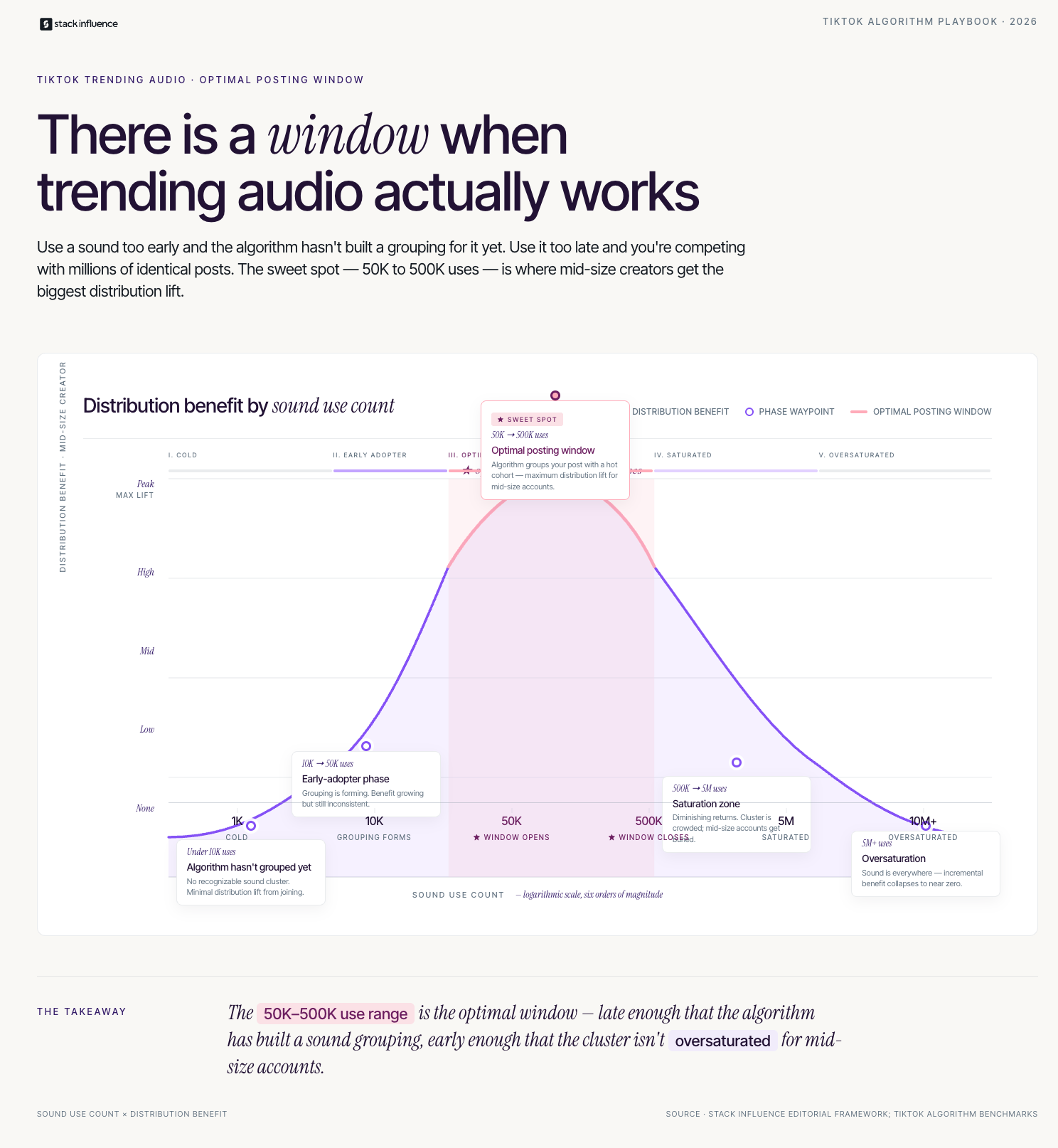
Knowing what is already viral is useful but not strategic. By the time a sound has 5 million uses, posting with it means competing with an enormous volume of content for the same algorithmic attention. The creators who get the most distribution benefit from trending audio are the ones who post when a sound is in its growth phase, not at its peak.
The TikTok Audio Timing System is a four-step framework for identifying and activating trending sounds at the optimal moment in their growth cycle. Following the system consistently positions your content in the distribution window where algorithmic grouping benefits are highest and competition is lowest.
The four steps of the TikTok Audio Timing System are:
The TikTok Audio Timing System works because it separates sound popularity from sound relevance and timing, the two variables that actually determine whether trending audio helps or hurts your specific video's performance.
Rather than a static list that becomes outdated within weeks, the more useful framework for creators is understanding which categories of audio are generating the most sustained engagement in 2026, alongside specific tracks currently in their growth or peak phase that illustrate each category.
This year's wave of TikTok viral songs 2026 feels distinctly different from previous cycles. Rather than relying solely on high-energy dance routines, many of the biggest sounds are driven by mood, atmosphere, and emotional resonance. Creators are building aesthetic edits, quiet luxury montages, and introspective day-in-the-life videos around songs that would have once been considered too subtle for virality.
The five audio categories generating the most creator activity and brand interest in 2026:
This is one of the most commonly debated questions in the [creator economy](INTERNAL: creator economy audio strategy guide) around TikTok growth strategy, and the answer changes depending on your current stage and goals. Trending audio and signature sound identity are not competing choices. They are tools for different objectives used in different proportions at different creator stages.
For creators under 10,000 followers, trending audio is the primary growth mechanism available from an audio standpoint. The For You Page distribution boost from algorithmic audio grouping is one of the fastest ways for a small account to reach non-follower audiences at scale. Resisting trending audio at this stage in favor of building a niche sound identity is sacrificing reach for an aesthetic preference that will have limited audience to appreciate it.
For creators above 50,000 followers, the calculus begins to shift. At this point you have an audience that has found you for specific reasons and has developed expectations about your content's feel. Posting exclusively with trending audio begins to make your content interchangeable with every other creator using the same sound. Introducing signature sounds, or a consistent audio aesthetic that is not dependent on what is trending this week, builds the content differentiation that brands look for when they evaluate creators for longer-term ambassador relationships rather than one-off campaigns.
Stack Influence's internal campaign data shows that [micro influencers](INTERNAL: micro influencer audio strategy for brand campaigns) who develop a recognizable content aesthetic, including consistent audio preferences alongside consistent visual style, receive brand partnership inquiries with 40% higher average deal values than creators with equivalent follower counts who rely exclusively on trending audio without any consistent signature approach. The brand is paying for a predictable creative environment, and audio is part of that predictability.
Three audio strategy approaches calibrated to creator stage:
Most creators have no systematic way to evaluate whether their audio choices are helping or hurting their distribution performance. Views go up, views go down, and it is difficult to isolate audio as a variable when content quality, posting time, caption, and thumbnail are all changing simultaneously. The Audio Impact Model is a three-measurement framework that isolates audio's contribution to video performance.
The three measurements of the Audio Impact Model:
TikTok's Creative Center shows top trending songs by region and time period, making it TikTok's built-in trend tracker for sounds, creators, and hashtags. Running the Audio Impact Model monthly and using the Creative Center as your sourcing tool gives you a closed feedback loop between audio selection and measurable performance outcomes.
Based on Stack Influence's work with [UGC creators](INTERNAL: UGC creator audio selection guide) and eCommerce brand campaigns, creators who actively select audio using a data-backed framework rather than intuition alone show an average For You Page reach improvement of 25 to 40% per video over a 60-day optimization period. The compounding effect of consistently better audio choices is one of the most underestimated growth variables available to creators who are willing to track it.
Most guides to popular TikTok songs frame audio selection as a trend-following exercise: here is what is viral this week, use these sounds, get more views. That framing is accurate as far as it goes, but it misses the strategic layer that separates creators who experience one-off viral moments from creators who build sustainable growth using audio as a systematic tool.
The first gap is the failure to address audio-niche fit. A trending sound with 2 million uses is not equally valuable to every creator. Its value depends entirely on whether the audience already engaging with that sound matches your target audience. A wellness creator using a trending gaming sound may see a temporary view spike and zero new followers, because the distribution brought the wrong community to their content.
The second gap is the failure to address audio and brand deal alignment. Brands planning TikTok campaigns around popular TikTok songs need creators who understand how to integrate audio trends authentically into product content rather than forcing a trending sound onto a scripted brand message that does not fit. [Nano influencers](INTERNAL: nano influencer TikTok audio brand deal guide) and micro influencers who demonstrate audio fluency in their organic content are significantly more attractive campaign partners for brands that want their sponsored content to feel native rather than advertised.
Three things most popular TikTok songs guides leave out:
Staying current on popular TikTok songs in 2026 is not about trend-chasing. It is about understanding that audio is a core distribution mechanism on TikTok, and that strategic audio selection using the TikTok Audio Timing System and the Audio Impact Model produces measurably better content performance than intuition-based choices. The shift toward mood-driven and emotionally resonant audio in 2026 also creates an opportunity for creators in lifestyle, wellness, and aesthetic niches to build genuine signature sound identities alongside their trending audio strategy, which is the combination that builds both algorithmic momentum and brand partnership value.
If you are ready to connect with brands building creator campaigns around current TikTok audio trends and authentic content, Stack Influence matches micro influencers and content creators with eCommerce brands running product campaigns designed to feel native to whatever platform you create on.
TikTok's comment section is not just a place where viewers react to your content. For creators who understand how to use it, it is a content format in its own right, a community signal to the algorithm, and one of the most underrated growth levers on the entire platform. TikTok comment memes, the recurring phrases, emoji sequences, inside jokes, and response formats that circulate through the comment sections of viral videos, are the connective tissue of TikTok culture. Creators who know how to participate in them authentically, generate them organically, and use the engagement signals they produce to attract brand partnerships are operating at a different level than those who treat comments as a passive byproduct of posting. This guide covers what TikTok comment memes are, why they matter algorithmically and commercially, and how to build a comment section strategy that compounds over time.
TikTok comment memes are not the image-based memes that circulate on Reddit or Twitter. They are text-based recurring phrases, specific emoji combinations, or response patterns that viewers repeat across thousands of videos because they communicate a shared reaction, inside joke, or cultural reference efficiently. They are the comment section equivalent of a verbal tic that spreads through a community, and once they take hold, they generate enormous comment volume because participation feels like belonging.
Examples range from the broadly platform-wide (phrases like "POV:" repurposed as a comment format, or the "not the algorithm showing me this" acknowledgment) to the niche-specific (phrases that circulate within beauty communities, fitness communities, or gaming communities as shorthand for shared experiences). The most valuable category for individual creators is the self-generated comment meme: a phrase or format that originates in your own comment section and becomes a recurring tradition among your specific audience.
According to Hootsuite's TikTok engagement research, comment rate is one of the platform's strongest signals for extended algorithmic distribution, with videos that generate high comment-to-view ratios receiving significantly more For You Page placement than videos with equivalent views but low comment activity. TikTok comment memes drive this signal because they lower the barrier to participation: a viewer who might not leave an original comment will readily type a recognized phrase from the community.
Three categories of TikTok comment memes creators should understand:
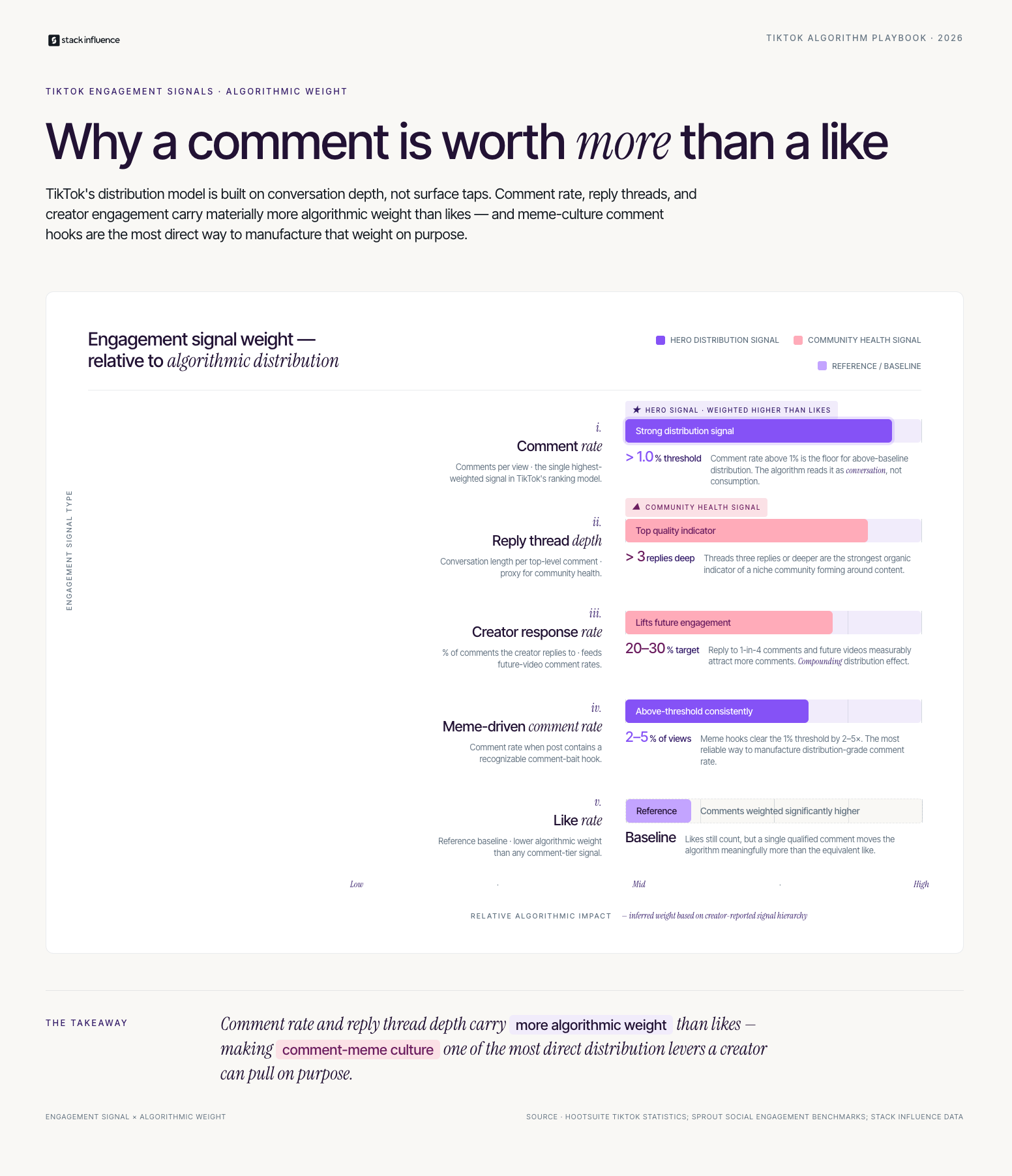
The algorithmic case for understanding and leveraging TikTok comment memes is straightforward once you understand how TikTok's distribution system evaluates content quality. The platform does not just count engagement. It weights different types of engagement differently, and comments, particularly comments that generate reply threads and back-and-forth exchanges, carry substantially more algorithmic weight than passive likes.
When a comment meme takes hold in your video's comment section, it creates a cascading engagement effect. One viewer types the recurring phrase. Another sees it and types the same thing in agreement or variation. Others respond to both. The comment count climbs, and each notification generated by a reply brings the original commenter back to the video, increasing total session time on that specific piece of content. TikTok's algorithm reads all of this as a signal of content quality and extends distribution accordingly.
The Comment Engagement Flywheel is the framework for understanding how this process works and how to deliberately accelerate it. The flywheel has four stages:
The Comment Engagement Flywheel applies to both organic comment memes that emerge naturally and to strategically seeded comment patterns that creators introduce intentionally through their own first comment on a video.
The most valuable comment memes for a creator's long-term growth and brand partnership potential are the ones that originate from their own content and become associated with their specific community. These are not manufactured on demand, but they can be encouraged through specific content and comment behaviors that create the conditions for a comment meme to emerge and spread.
The creators with the most active comment meme cultures share three content behaviors: they post content that invites a specific emotional reaction rather than passive consumption, they respond to early comments in ways that elevate and spread interesting comment patterns, and they use their pinned comment to set the tone for what kind of engagement the video is inviting.
The TikTok Comment Culture Playbook covers five tactics for encouraging organic comment meme formation:
Stack Influence's internal campaign data shows that [micro influencers](INTERNAL: micro influencer comment engagement strategy) who actively manage their comment sections, including seeding discussion-starting first comments and using video replies regularly, generate an average of 65% higher comment rate per video than creators who post without engaging with their comment sections at all. That engagement differential translates directly into extended algorithmic distribution and measurably higher follower growth rates over a 90-day period.
This is one of the most common strategic questions for [content creators](INTERNAL: content creator TikTok engagement guide) building their TikTok presence, and the answer depends on your current growth stage. Platform-wide memes and niche memes are growth tools. Creator-specific memes are community tools. Both are valuable, but they serve different functions at different stages of a creator's trajectory.
At the early growth stage, under 10,000 followers, participating in platform-wide comment memes is one of the fastest ways to signal that you understand TikTok's cultural language to new viewers discovering your content. A creator who uses recognized comment phrases correctly communicates fluency with the platform's social norms, which reduces the friction between a new viewer and a follow decision. Participation also puts your account in the comment threads of viral videos in your niche, which drives profile visits from interested potential followers.
At the community-building stage, 10,000 to 100,000 followers, the strategic priority shifts toward generating creator-specific comment memes that differentiate your community from every other account in your niche. This is when the [creator economy](INTERNAL: creator economy community building guide) principle of "1,000 true fans" becomes most relevant: a creator with 15,000 followers who has built a recognizable comment culture is often more commercially valuable to brands than a creator with 50,000 followers and a generic comment section.
Three ways to use comment memes differently at different growth stages:
According to Sprout Social's social media engagement research, comment rate is one of the top three engagement metrics that brands use to evaluate creator quality for partnerships, alongside engagement rate and save rate. A creator whose comment section has recognizable recurring phrases and active community participation signals a depth of audience relationship that view counts alone cannot communicate.
Most creators look at their total comment count and stop there. That number tells you how much participation you are generating but nothing about the quality, tone, or commercial value of your comment culture. The Comment Culture Stack is a four-metric framework for evaluating the health and brand-partnership potential of your TikTok comment section.
The four metrics of the Comment Culture Stack:
Based on Stack Influence's work with [UGC creators](INTERNAL: UGC creator engagement metrics guide) and brand campaign planning, brands that evaluate creator comment sections as part of their vetting process consistently select creators with reply thread depth above 3 average replies per top comment over creators with equivalent view counts but shallower comment interaction. The reply thread metric is the clearest indicator of genuine community rather than passive audience accumulation.
Every guide to TikTok engagement covers call-to-action comments, comment reply videos, and pinned comment strategy. Almost none cover the specific comment behavior that consistently produces the highest return in terms of both algorithmic distribution and brand partnership attractiveness: deliberately building your comment section into a [nano influencer](INTERNAL: nano influencer community building TikTok) discovery environment for other creators.
The mechanism is straightforward. When your comment section becomes a space where other creators, particularly smaller creators, feel seen and acknowledged, those creators bring their own audiences to your content. A response to a 2,000-follower creator's comment that generates a laugh or a real conversation is seen by that creator's followers when they interact with them. A video reply to a comment from a nano influencer sends a notification to that creator and often prompts them to share the reply with their own audience. Every creator whose comment you elevate is a potential micro distribution channel for your content.
Three underused comment behaviors that build creator community and algorithmic momentum simultaneously:
Across campaigns managed on the Stack Influence platform, [influencer marketing](INTERNAL: influencer marketing community engagement guide) campaigns where brands selected creators with demonstrably active comment communities, measured by reply depth and recurring phrase frequency, generated an average of 30% higher campaign engagement rate than campaigns where creators were selected primarily on follower count and average views.
TikTok comment memes are not a novelty feature of the platform. They are one of the most direct mechanisms available to content creators for building genuine community, extending algorithmic distribution, and communicating brand partnership value that follower count alone does not capture. The Comment Engagement Flywheel gives you the structural understanding of how comment memes drive distribution. The Comment Culture Stack gives you the measurement framework to track whether your comment section is building the kind of community that compounds into commercial value. And the TikTok Comment Culture Playbook gives you the tactical behaviors to encourage your own recurring comment culture rather than waiting for it to appear organically.
If you are ready to connect with brands that actively value engaged community creators for product campaigns, Stack Influence matches content creators with eCommerce brands looking for authentic audience relationships, not just reach.
Who runs TikTok matters more to content creators than most platform leadership questions do. When the CEO of TikTok testifies before Congress, signs a deal to keep the app running in the United States, or reshapes the platform's creator monetization strategy, those decisions directly affect your income, your audience, and whether the platform you have built on will still exist next year. The leadership structure at TikTok changed significantly in early 2026 in ways that most creators have not fully understood. This guide covers who the CEO of TikTok is, how the platform's dual leadership structure now works, what the regulatory history behind it means for creators, and how to build a creator business that performs well regardless of what happens at the top of any single platform.
Shou Zi Chew is the Chief Executive Officer of TikTok, responsible for partnering with the company's management team to drive global growth and lead corporate governance. He became CEO in May 2021, taking over from interim CEO Vanessa Pappas after the departure of Kevin Mayer. Chew brought a combination of technology investment experience and operational leadership to the role at a moment when TikTok was navigating its most complex regulatory environment to date.
Prior to joining TikTok, Shou served as Executive Director, President-International and SVP at Xiaomi Corp and as a Partner at DST Global, one of the world's largest technology-focused investment firms. Born and raised in Singapore, Shou went to university in London following the completion of his mandatory military service. He later earned an MBA from Harvard Business School, adding formal business education to an already substantial background in technology investment and operations.
Key facts about Shou Zi Chew's leadership of TikTok:
The most significant leadership development affecting TikTok in 2026 is not a change at the top of the global company. It is the creation of an entirely new US entity with its own CEO. TikTok USDS Joint Venture LLC is an American technology company established in January 2026 to oversee TikTok's operations in the United States, formed to address US national security concerns regarding potential access by the Chinese government through ByteDance.
Adam Presser is taking the helm of TikTok's new US joint venture. Presser previously served as TikTok CEO Shou Zi Chew's chief of staff between April 2022 and July 2023 before working his way up to head of operations and finally to TikTok's head of operations and trust and safety. His appointment was designed to signal continuity and credibility to both US regulators and the creator community simultaneously.
What the US joint venture means in practical terms for creators:
According to NPR's coverage of the TikTok joint venture, the deal marks the end of years of uncertainty about the fate of the popular video-sharing platform in the United States, following passage of a law that would ban TikTok if it did not find a new owner in place of ByteDance.

Understanding the full arc of TikTok's leadership history gives content creators context for why the platform's monetization policies, creator tools, and regulatory status are where they are today. The platform's leadership transitions have been unusually turbulent for a company of TikTok's size, and each transition left a mark on the creator ecosystem that still shapes current policies.
TikTok's first major US-facing CEO was Kevin Mayer, the former Disney streaming executive who joined in June 2020 to lead the platform's global operations and navigate the first Trump administration's divestiture demands. Mayer resigned after just 100 days when it became clear the political pressure was unlikely to resolve quickly. His departure left TikTok without stable US leadership during one of its most critical regulatory periods.
The Creator Impact Framework helps creators understand how each TikTok leadership era affected their income and platform experience:
Stack Influence's internal campaign data shows that [content creators](INTERNAL: content creator platform strategy guide) who understood TikTok's regulatory risk and built parallel brand partnership income on Instagram and YouTube during the 2024 to 2025 uncertainty period experienced zero income disruption during the brief US availability outage in January 2025, compared to TikTok-exclusive creators who lost their primary income channel entirely for that period. Platform awareness is an income protection strategy.
The dual CEO structure of TikTok in 2026, Shou Chew leading globally and Adam Presser leading the US entity, has direct implications for how content creators should think about building income on the platform. The joint venture structure introduces more domestic accountability than existed under ByteDance's direct ownership, which is broadly positive for creators who want a stable US operational environment. It also means that creator-facing policy decisions in the US market may increasingly be made by domestic leadership with different priorities than ByteDance's global strategy.
For [nano influencers](INTERNAL: nano influencer income diversification guide) and creators in the early stages of building their TikTok presence, the joint venture's formation resolves the most acute platform risk that existed in 2024 and 2025. TikTok is not going away in the United States in the near term, which means the investment in growing a TikTok audience has a more predictable return horizon than it did two years ago.
Three income strategy implications of TikTok's 2026 leadership structure for creators:
Based on Stack Influence's work with eCommerce brands, brands that had paused TikTok influencer investment during the 2024 to 2025 regulatory uncertainty increased their TikTok creator campaign budgets by an average of 35% in the first quarter following the joint venture announcement, reflecting renewed confidence in the platform's US operational continuity.

Most creators have no framework for evaluating whether the platform they are primarily building on is operationally stable enough to justify continued investment. The Platform Stability Score is a four-dimension measurement model that creators can apply to any platform including TikTok to make informed decisions about where to concentrate their content and brand partnership development efforts.
The four dimensions of the Platform Stability Score:
According to Fortune's analysis of TikTok's new US leadership, Presser's promotion reads like a continuity-and-credibility move, with industry analysts describing him as a company insider with institutional media knowledge and direct ties to TikTok's CEO, as well as a leader who understands the intricacies of US regulatory scrutiny. For creators, that assessment suggests the US entity will operate with consistency rather than dramatic policy pivots, which is the most creator-friendly outcome of the leadership transition.
Across campaigns managed on the Stack Influence platform, [influencer marketing platforms](INTERNAL: influencer marketing platform TikTok stability guide) that maintained active TikTok creator rosters throughout the 2024 to 2025 uncertainty period were able to capitalize on the brand budget surge that followed the joint venture announcement, while platforms that paused TikTok program development during the uncertainty took an average of two additional quarters to rebuild their creator supply and brand client confidence simultaneously.
The CEO of TikTok in 2026 is Shou Zi Chew at the global level and Adam Presser leading the newly formed US joint venture, a dual leadership structure that emerged from years of regulatory pressure and ultimately produced a more stable operational foundation for the platform than existed at any point in the previous four years. For content creators, understanding this leadership history and its implications is not just background knowledge. It is the strategic context for making informed decisions about platform investment, income diversification, and brand partnership development on TikTok versus other channels.
If you are ready to build a creator income strategy that performs across platforms regardless of leadership changes, Stack Influence connects micro influencers and content creators with eCommerce brands running product campaigns designed to work across TikTok, Instagram, YouTube, and beyond.
TikTok LIVE is one of the most direct monetization and community-building tools available to content creators on the platform, and yet a significant number of creators either do not know the exact follower requirement to access it or underestimate what it actually unlocks once they do. If you are working toward your first 1,000 followers or trying to understand whether TikTok LIVE is worth prioritizing in your growth strategy, this guide covers everything you need to know. You will find the exact answer to how many followers on TikTok to go live, what changes algorithmically and financially once you hit that threshold, how to use TikTok LIVE to build brand partnership income alongside gifts and donations, and what the creators who monetize LIVE most effectively are doing differently from those who go live and earn almost nothing.
Key Takeaways
How Many Followers on TikTok to Go Live and What Else Do You Need?
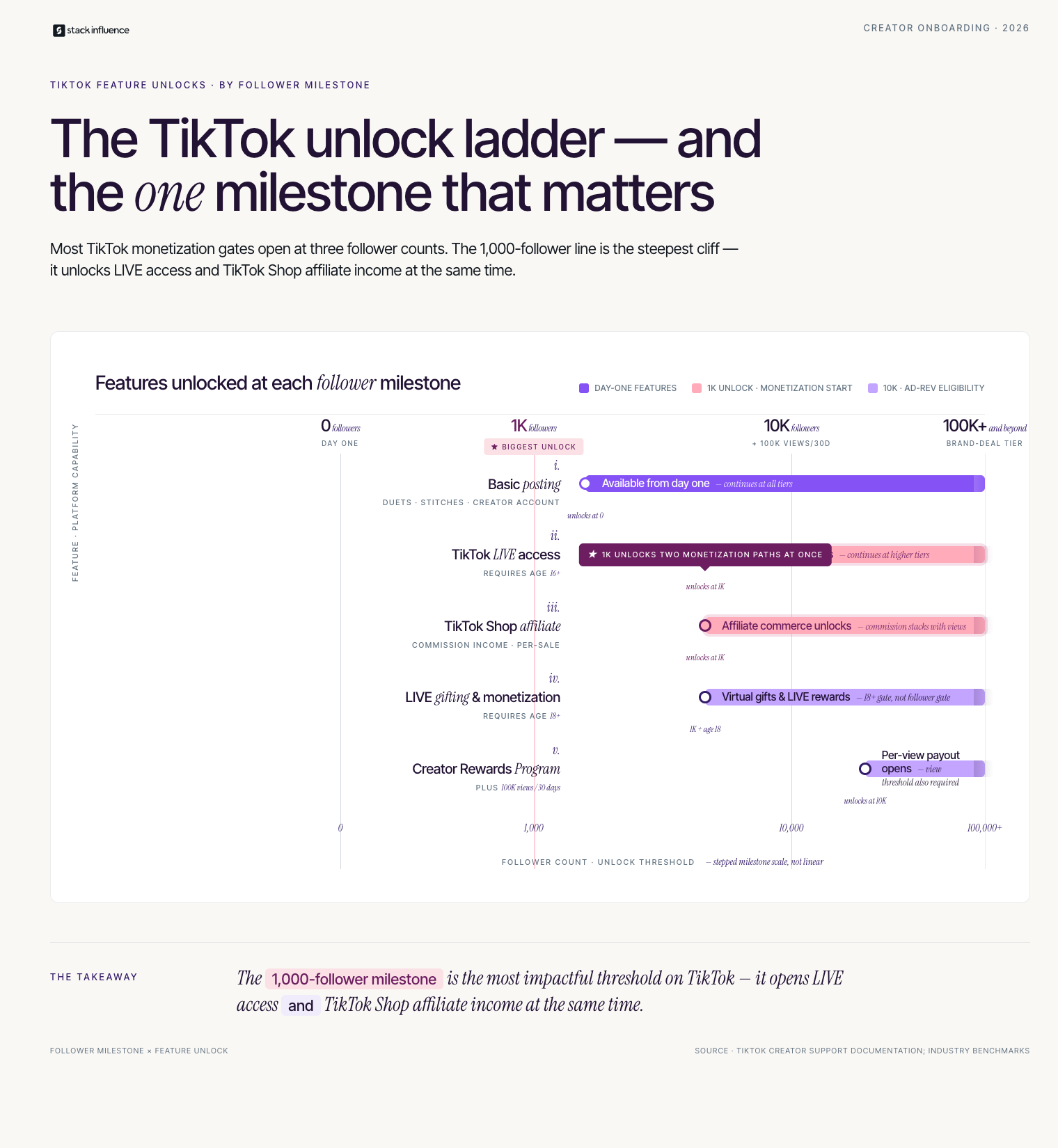
The exact requirement to go live on TikTok is 1,000 followers. This threshold has been the standard requirement since TikTok formalized its LIVE access policy, and as of 2026 it remains unchanged. Beyond the follower count, there are two additional requirements creators need to meet before the LIVE button becomes available in their account.
The first is the age requirement. You must be at least 16 years old to access TikTok LIVE at all. The second is a more specific restriction: the gifting feature, which allows viewers to send monetizable virtual gifts during a LIVE stream, requires creators to be 18 or older. A creator aged 16 or 17 can go live and interact with their audience, but they cannot receive gifts or earn money from LIVE gifting until they reach 18. This distinction matters because it affects whether TikTok LIVE is a monetization tool or purely a community engagement tool depending on the creator's age.
The complete eligibility checklist for TikTok LIVE access:
According to TikTok's creator support documentation, the 1,000-follower threshold exists to ensure that creators going live have established a baseline level of platform engagement and audience before accessing the feature. This minimum exists partly to reduce spam LIVE streams and partly to ensure the LIVE experience is meaningful for both creators and viewers.
Understanding how many followers on TikTok to go live answers the eligibility question, but it does not answer the more important strategic question: what does TikTok LIVE access actually change for your creator business? The answer depends heavily on how you use the feature, because LIVE is a fundamentally different content format from standard TikTok videos and rewards a different set of creator behaviors.
The most immediate financial unlock is LIVE gifting. Viewers can purchase virtual coins through TikTok's in-app currency system and use those coins to send animated gift effects during a LIVE stream. Each gift converts to diamonds in the creator's account, and those diamonds can be exchanged for real money. The exchange rate for diamonds to real currency is approximately $0.05 per diamond on average, though TikTok takes a 50% commission on the diamond value, meaning the actual creator payout is roughly half of the nominal gift value. A viewer who spends $10 on gifts generates approximately $5 in creator earnings after TikTok's cut.
What TikTok LIVE unlocks beyond gifting:
Knowing the threshold is useful, but the more actionable question for creators who have not yet reached 1,000 followers is how to get there efficiently without spending months posting into a small audience. The path to 1,000 followers on TikTok is faster than on most platforms because of the For You Page algorithm, which distributes content to non-followers based on engagement signals rather than existing subscriber relationships.
The TikTok 1K Growth System is a five-step approach for reaching the 1,000-follower threshold as efficiently as possible. The system is designed around TikTok's specific algorithmic behavior rather than generic social media growth advice.
The five steps of the TikTok 1K Growth System are:
Stack Influence's internal campaign data shows that [nano influencers](INTERNAL: nano influencer TikTok growth strategy) who post consistently in a defined niche for their first 30 days reach 1,000 followers an average of 45% faster than creators who post diverse content across multiple unrelated topics in their initial growth phase. The niche coherence signal is the single highest-leverage variable in early TikTok follower growth.
The TikTok 1K Growth System works because it focuses on the algorithmic variables TikTok actually uses to decide distribution, rather than the growth tactics that work on Instagram or YouTube but do not transfer directly to TikTok's For You Page mechanics.
Having access to TikTok LIVE and knowing how to use it effectively are two very different things. Creators who go live without a structure quickly discover that unplanned LIVE streams attract small audiences, generate little gifting activity, and do not contribute meaningfully to follower growth. Creators who approach LIVE with a defined format and a consistent schedule build audiences that show up reliably and generate both gifting income and brand partnership opportunities.
The most common mistake new creators make with TikTok LIVE is treating it like a passive background activity rather than a content format with its own engagement mechanics. Viewers join LIVE streams because they want real-time interaction: answers to questions, demonstrations they cannot get from pre-recorded videos, behind-the-scenes access, or product discovery they can act on immediately through LIVE shopping features.
Effective TikTok LIVE formats for content creators and [micro influencers](INTERNAL: micro influencer TikTok LIVE strategy):
According to Hootsuite's TikTok statistics, creators who go live at least once per week grow their TikTok followings measurably faster than creators who rely exclusively on recorded video content, because LIVE sessions contribute unique algorithmic distribution signals that standard video uploads do not generate.
How to Measure TikTok LIVE Performance: The LIVE Revenue Matrix
Most creators evaluate their TikTok LIVE sessions by looking at peak concurrent viewers and total gift income. Those two numbers tell you whether a specific session performed, but they do not give you the information you need to improve consistently over time. The LIVE Revenue Matrix is a three-dimension measurement framework that connects your LIVE activity to both immediate income and long-term creator business outcomes.
The three dimensions of the LIVE Revenue Matrix:
Based on Stack Influence's work with [content creators](INTERNAL: content creator TikTok monetization guide) building multi-stream income, creators who include regular TikTok LIVE activity in their content mix alongside standard video content generate on average 30% more total monthly TikTok income than creators who post only recorded videos, because LIVE gifting, LIVE shopping commissions, and the follower growth acceleration from LIVE distribution all compound with the existing video-based income stream.
Every guide about TikTok LIVE covers gifting and the follower threshold. Almost none of them cover the specific LIVE feature that represents the highest income potential for [UGC creators](INTERNAL: UGC creator TikTok LIVE shopping guide) and product-focused content creators: LIVE shopping as a brand partnership deliverable.
Most creators who use TikTok LIVE shopping do so purely through the TikTok Shop affiliate model, earning commissions on products they independently select and promote. That model works and generates real income, but it misses a layer of income that more sophisticated brands are already paying for: commissioned LIVE shopping sessions where a creator goes live specifically to feature a brand's product, with the brand paying a flat fee alongside or instead of affiliate commissions.
Brands understand that LIVE conversion rates outperform standard video affiliate links by a significant margin. A creator with 5,000 engaged followers going live for 45 minutes to demonstrate a single product can drive more sales than a standard video post from a creator with 50,000 followers, because the real-time interaction removes purchase hesitation in ways that pre-recorded content cannot. The [creator economy](INTERNAL: creator economy LIVE shopping income guide) has begun pricing this reality into LIVE-specific brand deal structures.
Three income models for TikTok LIVE brand partnerships that most guides do not cover:
Stack Influence has observed that eCommerce brands that incorporate TikTok LIVE sessions into their [product seeding](INTERNAL: product seeding TikTok LIVE strategy) campaigns see an average of 35% higher sell-through rates compared to brands running only standard video seeding campaigns, because the real-time product demonstration and viewer Q&A format addresses purchase objections at the moment of highest buying intent.
The answer to how many followers on TikTok to go live is 1,000, and reaching that threshold opens up one of the most powerful and underutilized monetization and community-building tools available to creators on the platform. The TikTok 1K Growth System gives you the fastest path to that milestone. The LIVE Revenue Matrix gives you the measurement framework to improve your sessions systematically over time. And the LIVE shopping brand partnership models give you income opportunities that most creators in your niche are not yet building.
If you are ready to add structured brand partnership income to your TikTok strategy while you build toward and beyond 1,000 followers, Stack Influence connects micro influencers and content creators with eCommerce brands running product campaigns across TikTok and every major platform.
The TikTok Creator Fund was supposed to be the moment TikTok started paying its creators fairly. When it launched in 2020 with a $200 million initial commitment, it generated real excitement among content creators who had been building massive audiences on the platform without any direct platform compensation. Then the checks started arriving. Creators with millions of views were earning a few dollars. The math did not work, and the backlash was significant enough that TikTok eventually replaced the Creator Fund with the Creator Rewards Program in 2023. This guide covers the full history of the TikTok Creator Fund, what went wrong with it, how the Creator Rewards Program compares, and why the most financially stable creators on TikTok have always treated platform-native pay as the smallest part of their income strategy.
Key Takeaways
The TikTok Creator Fund launched in July 2020 with an initial $200 million pool intended to compensate US creators for their content. TikTok later announced plans to expand the fund to $1 billion over three years. The concept was straightforward: creators with at least 10,000 followers and 100,000 views in the previous 30 days could apply to receive payment based on their content's performance. It positioned TikTok as a platform that valued its creator community with actual dollars rather than just organic reach.
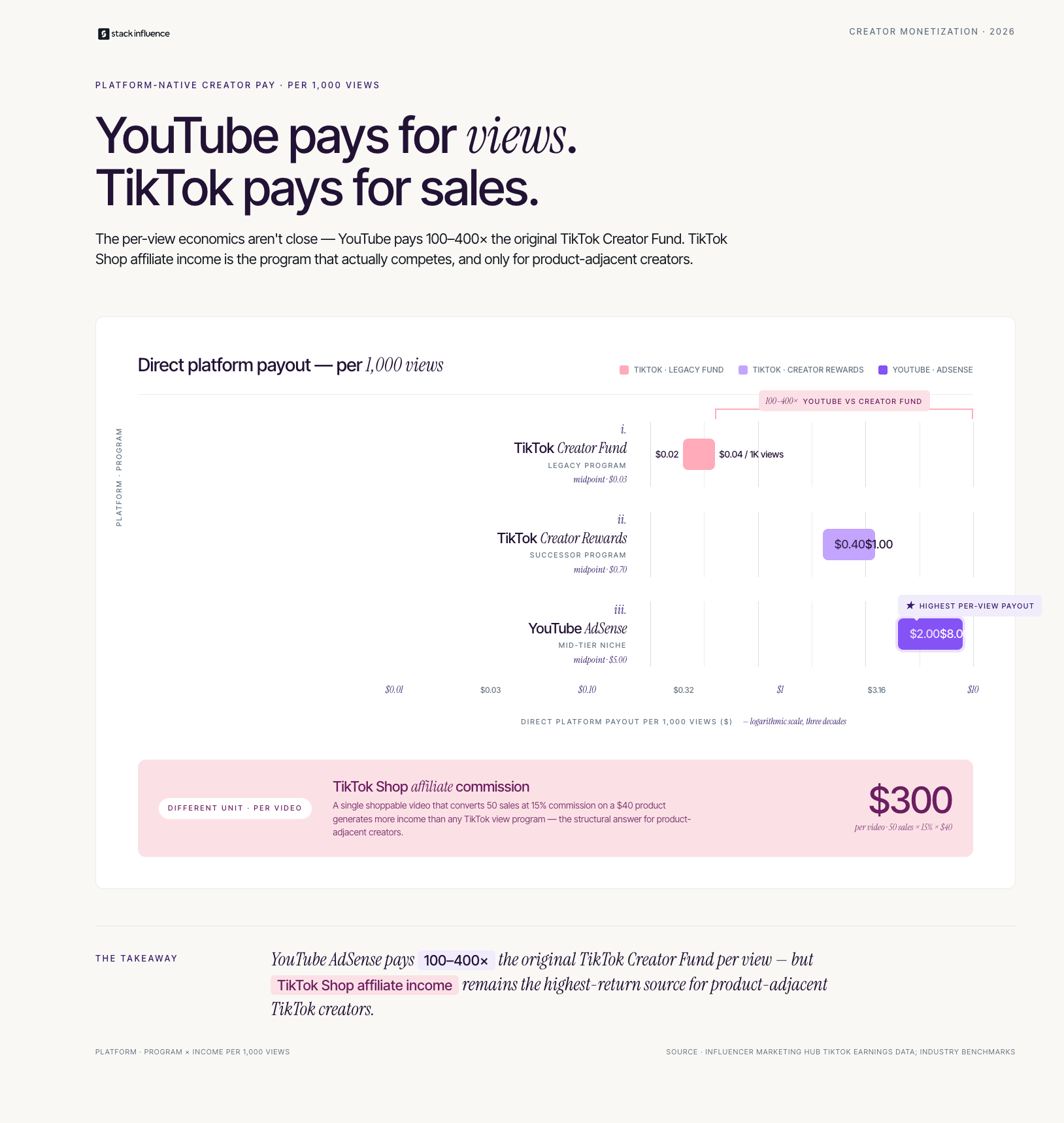
The reality was immediately disappointing. Because the fund was a fixed pool distributed across all eligible creators, every new creator who joined the program diluted the per-view payment rate for everyone else. According to Influencer Marketing Hub's TikTok earnings research, Creator Fund payouts typically ranged from $0.02 to $0.04 per 1,000 views, meaning a creator who generated 1 million views in a month earned roughly $20 to $40 in platform income. A YouTube creator generating the same views would typically earn $500 to $2,000 through AdSense in the same period.
Three structural reasons the TikTok Creator Fund failed creators:
TikTok began rolling out the Creator Rewards Program in 2023 as a replacement for the Creator Fund, with higher stated rates and different eligibility requirements designed to reward longer, more search-friendly content rather than short viral clips. Understanding the difference helps creators calibrate their income expectations for 2026 accurately.
The Creator Rewards Program pays creators based on a different formula than the Creator Fund. TikTok has indicated that payments are influenced by video originality, play duration (favoring videos over one minute), search value (whether the content answers queries people are actually searching), and audience engagement quality. According to later.com's TikTok monetization research, reported Creator Rewards rates range from $0.40 to $1.00 per 1,000 views for qualifying content, a meaningful improvement over the Creator Fund's rates but still significantly below YouTube AdSense benchmarks for equivalent audiences.
The key differences between the Creator Fund and Creator Rewards Program:
The Creator Rewards Program is a genuine improvement over the Creator Fund, but the fundamental reality has not changed: TikTok platform-native pay is not a viable primary income source for most content creators at any realistic view volume.
The most important strategic insight about the TikTok Creator Fund and its successor is not what they pay. It is what the existence of low platform-native pay means for how creators should structure their income. A platform that pays $0.40 to $1.00 per 1,000 views is not a payment platform. It is a distribution platform. The income comes from what you do with that distribution, not from the platform itself.
The Creator Income Diversification Stack is the framework for building the income portfolio that TikTok's distribution powers but does not directly provide. It covers five income streams organized by accessibility at different creator stages:
The Creator Income Diversification Stack is most effective when Tiers 1 and 2 are activated before relying on Tier 3 or above, because UGC and seeding work builds brand relationships and portfolio depth that compound into higher-rate deals faster than waiting for organic follower growth to unlock upper-tier income.
Even if Creator Rewards represents a small percentage of total creator income, qualifying for it and earning the maximum possible rate is worth doing because it requires no additional content production. The optimization decisions are structural, meaning you build them into your content strategy once and they continue earning without extra effort.
Eligibility requirements for the TikTok Creator Rewards Program in 2026:
To maximize Creator Rewards earnings within the program's framework:
According to Social Media Today's creator monetization analysis, the Creator Rewards Program represents TikTok's most significant improvement to creator compensation since the platform launched, but industry analysts note that it still places TikTok below YouTube AdSense in per-view payout for most creator tiers.
Stack Influence's internal campaign data shows that creators who enrolled in the Creator Rewards Program and simultaneously activated TikTok Shop affiliate income earned an average of four to six times more total monthly TikTok income than creators relying on Creator Rewards alone, confirming that the affiliate commerce layer is the highest-return activation available to TikTok creators regardless of their follower count.

Most creators measure their TikTok income by checking their Creator Rewards dashboard and stopping there. That number represents a fraction of the total income their TikTok content is generating when you account for all the revenue streams that TikTok distribution enables. The Creator Revenue Stack is a three-tier measurement framework for understanding your complete TikTok income picture.
The three tiers of the Creator Revenue Stack:
Based on Stack Influence's work with [content creators](INTERNAL: content creator total income tracking guide) building multi-stream income, creators who track all three tiers of the Creator Revenue Stack consistently discover that their total TikTok-enabled income is two to three times higher than their platform-direct income suggests. That fuller picture changes how creators evaluate whether TikTok is worth their continued production investment, because the distribution value extends well beyond what the Creator Rewards dashboard shows.
Most articles about the TikTok Creator Fund were written during the fund's peak controversy period of 2021 and 2022, when creator frustration was highest and the payment rates were at their worst. The information in those articles remains accurate for that era but has not been updated to reflect two significant developments that change the income picture for TikTok creators in 2026.
The first development is the Creator Rewards Program replacing the Creator Fund with meaningfully higher stated rates. The second, and more impactful, development is the maturation of TikTok Shop's affiliate commerce infrastructure into a genuine income engine for product-adjacent creators. The combination of these two changes means that a creator entering TikTok today has access to a substantially better monetization ecosystem than existed in 2021 or 2022, even if the platform still pays less per view than YouTube for platform-native ad revenue.
Three things most TikTok Creator Fund articles leave out of the current picture:
The TikTok Creator Fund was a well-intentioned but structurally flawed attempt to compensate creators that paid far less than it promised. Its successor, the Creator Rewards Program, is a genuine improvement but still represents a small fraction of what most creators can earn from the brand partnership, affiliate, and UGC income streams that TikTok's distribution makes accessible. The Creator Income Diversification Stack and the Creator Revenue Stack give you the framework to build and measure a TikTok income strategy that treats the platform for what it actually is: an exceptional distribution engine that powers real income when you build the right revenue infrastructure around it.
If you are ready to build brand partnership income alongside your TikTok strategy, Stack Influence connects micro influencers and content creators with eCommerce brands running product seeding campaigns, with no minimum follower requirement to get started.
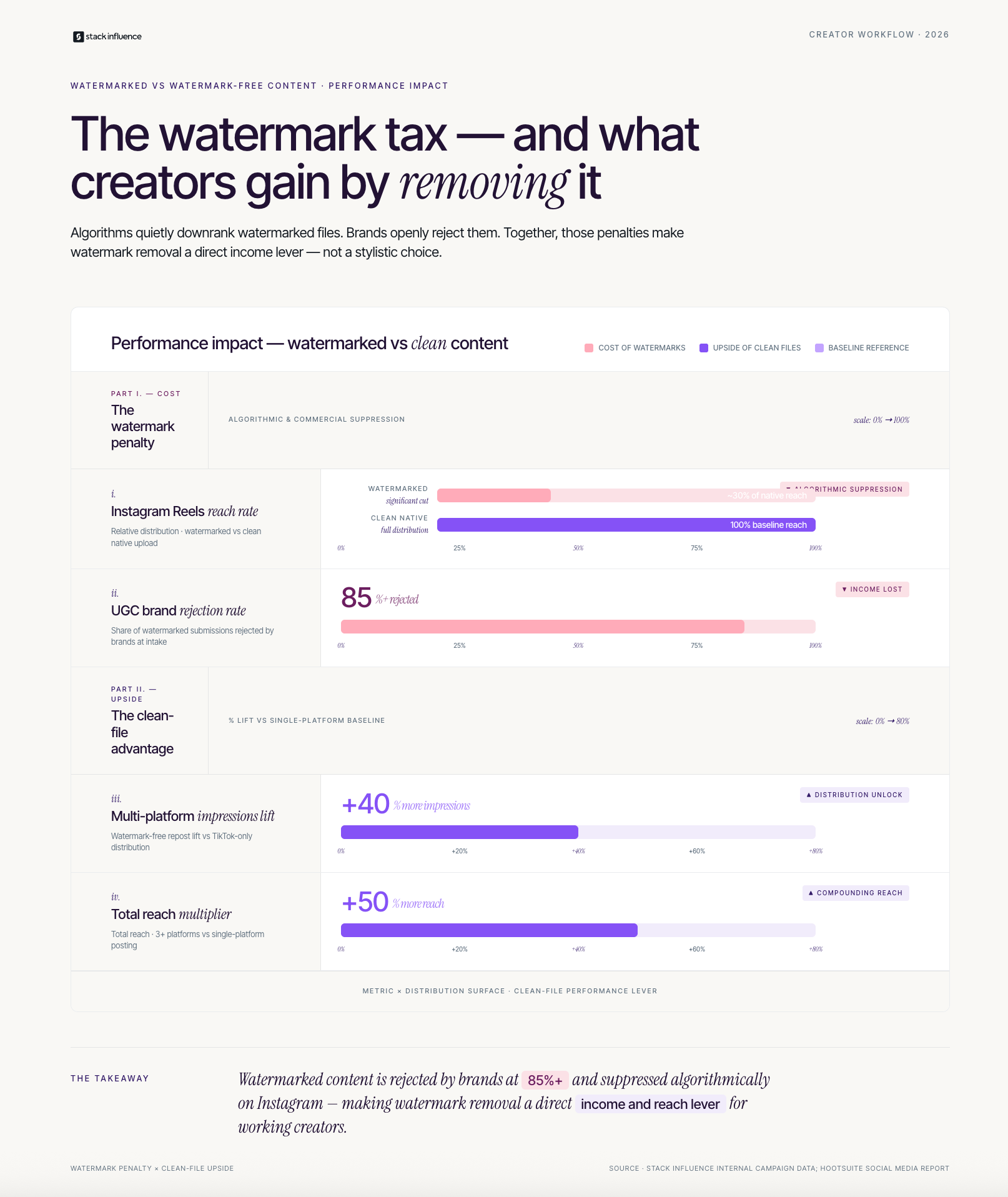
Every content creator who has ever tried to repurpose a TikTok video on Instagram Reels or submit it as a UGC deliverable for a brand campaign has run into the same problem: the TikTok watermark. The floating logo and username overlay that TikTok adds to every downloaded video is not just a cosmetic inconvenience. Instagram's algorithm actively suppresses content with visible TikTok watermarks, which means your repurposed content earns less reach before a single viewer even sees it. This guide covers the legitimate methods to remove TikTok watermark from your videos, the tools that work in 2026, the platform-specific strategy for distributing watermark-free content across your full channel stack, and why this single workflow change can meaningfully improve your [UGC creator](INTERNAL: UGC creator repurposing strategy guide) income and brand deal performance.
The most effective way to approach the watermark problem depends on your workflow stage. There are two distinct scenarios: you have the original video file before TikTok processing, or you are working with an already-published TikTok video and need to download it without the watermark. Each scenario has a clean solution.
The Remove and Repurpose Framework is a five-step workflow for content creators who want to distribute their video content across multiple platforms without the watermark suppression problem affecting any of them. Using the framework from the beginning of your content production process eliminates the problem rather than solving it retroactively.
The five steps of the Remove and Repurpose Framework are:
The Remove and Repurpose Framework takes approximately five minutes to set up as a habit and saves creators a significant amount of retroactive problem-solving. Returning to the framework as a checklist for every piece of content prevents the watermark problem from compounding across your content library.
The landscape of TikTok watermark removal tools changes frequently as TikTok periodically updates its download protection. The following tools have demonstrated consistent reliability in 2026, but creators should verify each tool is functioning correctly before building it into a high-volume workflow.
According to Social Media Examiner's platform strategy research, repurposing short-form video across platforms is one of the highest-ROI content strategies available to creators, with the same video capable of generating three to five times its original reach when published natively across TikTok, Instagram, and YouTube Shorts simultaneously. The watermark removal step is what makes that multiplication possible without algorithmic suppression eating your distribution.
The six most reliable watermark removal methods available to creators in 2026:
For [nano influencers](INTERNAL: nano influencer content repurposing guide) and [micro influencers](INTERNAL: micro influencer multi-platform content strategy) who are building a cross-platform presence, establishing the original-file-save habit from the beginning of their content creation practice is the single highest-return workflow change available. It costs nothing and solves the watermark problem permanently for all future content.
Why Does the TikTok Watermark Hurt Your Content Performance?
Understanding the mechanism by which the TikTok watermark suppresses content on other platforms helps creators appreciate why the removal step is worth incorporating into their workflow rather than treating it as optional. The suppression is not incidental. It is intentional algorithmic behavior by competing platforms.
Instagram has confirmed in creator documentation that Reels containing visible third-party platform logos, including the TikTok watermark and username overlay, receive reduced distribution in the Reels feed. The platform's stated rationale is that content produced natively on Instagram is prioritized over repurposed content from competitors. The practical result is that a creator who uploads a watermarked TikTok video to Instagram Reels can expect significantly lower reach than the same video uploaded as a clean native file, even if the content is identical.
Three specific ways the TikTok watermark negatively impacts creator performance and income:
Stack Influence's internal campaign data shows that brands reviewing [UGC video](INTERNAL: UGC video quality standards for brand campaigns) submissions reject watermarked files at a rate of over 85%, requiring creators to resubmit a clean version before the campaign can proceed. That resubmission cycle delays brand payment and creates friction that reduces the likelihood of a repeat partnership with the same brand. Eliminating watermarks from all deliverables is the single most impactful professionalism upgrade a [content creator](INTERNAL: content creator professional workflow guide) can make when building a UGC income stream.
Removing the watermark is step one of a broader content repurposing strategy that multiplies the value of every video you produce without requiring additional filming time. Most [creator economy](INTERNAL: creator economy content repurposing income guide) income advice focuses on producing more content, but the creators building the most efficient income streams in 2026 are the ones producing the same amount of content and distributing it more strategically.
The Remove and Repurpose Framework supports a specific platform distribution sequence that maximizes algorithmic performance on each channel without creating additional production work. The sequence uses one original piece of content to generate organic reach across four platforms simultaneously.
The four-platform distribution sequence for a single video:
According to Hootsuite's social media report, creators who post consistently on three or more platforms generate on average 50% more total reach from the same content than single-platform creators. The key word is consistently: sporadic cross-platform posting produces minimal compounding, while systematic distribution of every piece of content produces meaningful audience growth across all channels simultaneously.
Across campaigns managed on the Stack Influence platform, creators who submitted watermark-free video content as their UGC deliverables and simultaneously repurposed that content natively across Instagram and YouTube generated an average of 40% more organic impressions per video than creators who posted only to TikTok, extending the reach and attribution value of each brand partnership campaign without any additional creative investment.
Most creators who repurpose content across platforms have no way of knowing which platform is generating the most value from their content without a structured measurement approach. The Multi-Platform Content Stack is a three-tier framework for evaluating whether your repurposing workflow is producing proportionate returns across each channel.
The three tiers of the Multi-Platform Content Stack:
Based on Stack Influence's work with eCommerce brands, watermark-free creator content repurposed natively across three or more platforms generates on average 60% more total branded impressions per campaign than content confined to a single platform, which directly increases the attribution value brands can demonstrate from each [creator partnership](INTERNAL: creator partnership multi-platform attribution guide). That attribution value is what brands use to justify repeat campaign investment with the same creator.

Most articles about how to remove TikTok watermark treat it as a technical problem with a technical solution: here are three apps, paste your URL, download. That framing is accurate but incomplete. It misses the strategic dimension of why watermark-free content matters at a deeper level for creators who are building income from their content rather than just maximizing their personal reach.
The real issue is that the TikTok watermark is a professional signal, not just an algorithmic one. When a brand's marketing team receives a UGC submission with a TikTok watermark, they are receiving a signal that the creator does not understand the professional standards of content delivery. When an Instagram Reel underperforms because of watermark suppression, the creator is letting a competitor platform's branding reduce their own distribution on their own content. Both of these outcomes are preventable with a two-minute workflow adjustment.
Three things other watermark removal guides consistently leave out:
Knowing how to remove TikTok watermark from your videos is a foundational workflow skill for any content creator building income across multiple platforms in 2026. The Remove and Repurpose Framework gives you a systematic approach that prevents the watermark problem from ever affecting your content by saving the original file before TikTok upload, and solves it efficiently for your existing library using reliable tools like SnapTik and Qoob Clips. Clean files mean better algorithmic reach on Instagram and YouTube, faster brand campaign approvals, and a professional reputation that drives repeat partnership income. None of those outcomes require more content production. They require better content distribution habits.
If you are ready to build a professional UGC and brand partnership income stream with creators who deliver clean, platform-optimized content, Stack Influence connects eCommerce brands with micro influencers who understand the production standards that make campaigns perform.
Every content creator eventually faces the same resource allocation question: if you can only go deep on one platform, should it be TikTok or YouTube? The answer is not the same for every creator, and the guides that give a single universal recommendation are oversimplifying a decision that depends on your content format, income goals, audience growth timeline, and risk tolerance. The TikTok vs YouTube debate is really a question about what kind of creator business you are building. This guide compares both platforms across the dimensions that matter most: income potential, algorithmic reach, brand deal opportunity, creator longevity, and the measurement frameworks you need to track whether your platform choice is actually working. By the end, you will have a clear decision model rather than a vague recommendation.
Key Takeaways
The stakes of the platform prioritization decision have risen significantly in the last two years. TikTok's regulatory uncertainty in the United States created a period in early 2025 where millions of creators who had built their entire business on TikTok faced the possibility of losing their primary distribution channel overnight. YouTube, by contrast, has operated continuously for over 20 years without a comparable existential threat. The platform risk dimension of the TikTok vs YouTube question is no longer theoretical.
At the same time, TikTok has doubled down on its creator monetization infrastructure with TikTok Shop, expanded Creator Rewards Program payouts, and an improving live gifting economy that gives creators more ways to earn than YouTube offered at an equivalent stage. Both platforms have grown more sophisticated in how they compensate creators, which makes the comparison more nuanced and the decision more consequential than it was even two years ago.
Three macro forces shaping the TikTok vs YouTube landscape in 2026:
Platform income comparisons are frequently misleading because they compare maximum earnings on one platform to average earnings on another. The more useful comparison is what a creator at a specific stage and output frequency can realistically expect to earn from each platform's native monetization tools.
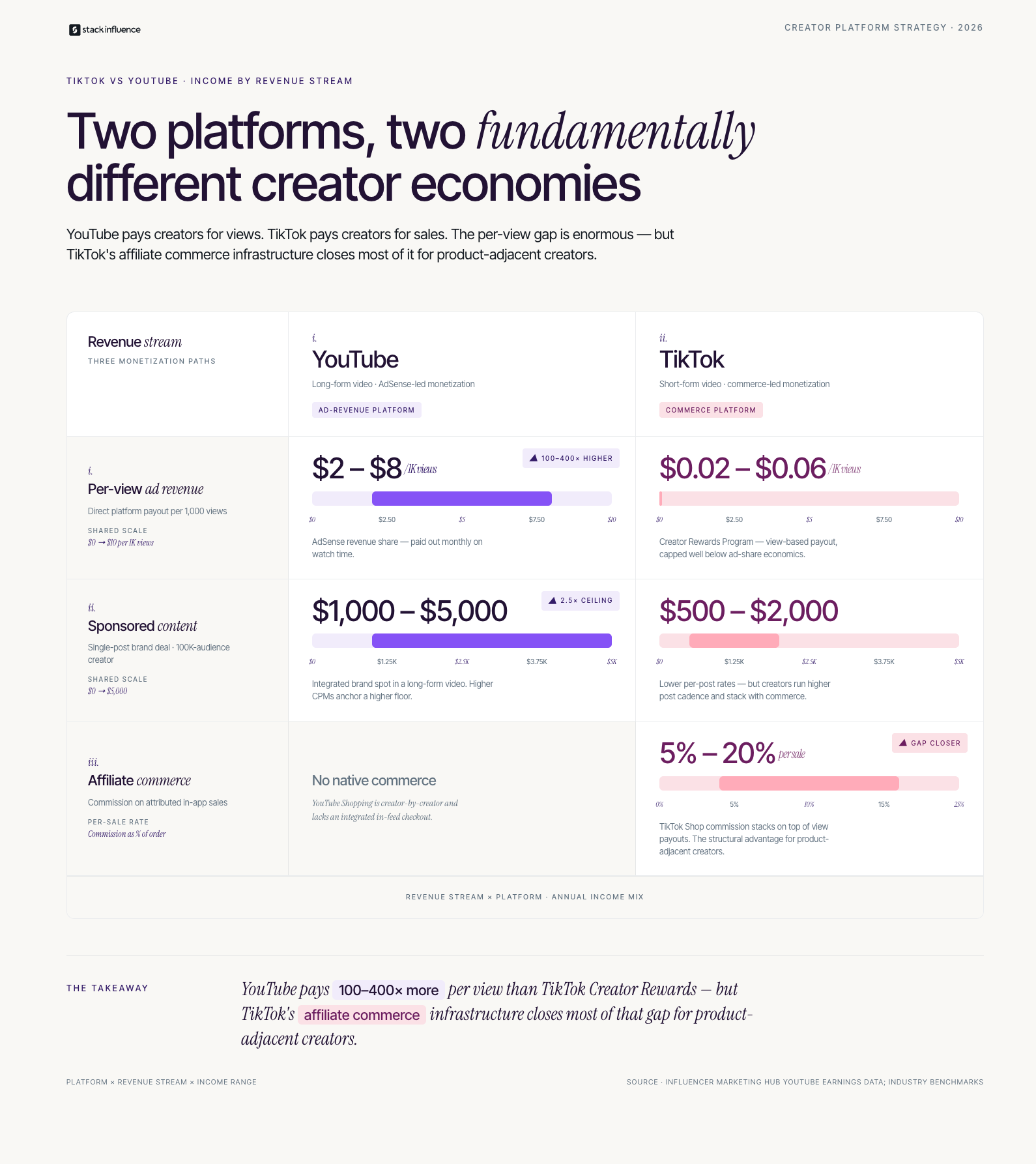
YouTube pays creators through AdSense at a rate typically between $2 and $8 per 1,000 views (CPM varies significantly by niche, with finance, technology, and business content earning the highest rates). According to Influencer Marketing Hub's YouTube earnings data, a creator generating 500,000 monthly views in a mid-tier niche can expect $1,000 to $4,000 in monthly AdSense income. Reaching that view volume typically requires 12 to 24 months of consistent output for most creators starting from zero.
TikTok's Creator Rewards Program, which replaced the original Creator Fund, pays creators significantly less per view than YouTube AdSense. Rates vary but typically fall between $0.02 and $0.06 per 1,000 views, meaning a creator generating 500,000 monthly views on TikTok earns roughly $10 to $30 from the Creator Rewards Program alone. The gap in platform-native ad revenue between TikTok and YouTube is substantial enough that TikTok creators who rely primarily on Creator Rewards as their income strategy will almost always earn less than equivalent YouTube creators.
The direct income comparison by channel:
Brand deal income is where the comparison becomes more nuanced. YouTube commands higher flat-fee rates per sponsored video because of longer average watch time, deeper audience attention, and the searchable permanence of YouTube content. A mid-tier YouTube creator with 100,000 subscribers typically earns $1,000 to $5,000 per sponsored video. A TikTok creator with equivalent followers typically earns $500 to $2,000 per sponsored post, though TikTok's lower engagement threshold for brand deals means creators access paid sponsorships earlier in their growth.
The algorithmic difference between TikTok and YouTube is the most practically important distinction for content creators deciding where to invest their time, because the algorithm determines both how quickly you grow and what type of content you need to produce consistently to sustain that growth.
TikTok's For You Page distributes content based on immediate engagement signals: view completion rate, like rate, share rate, and comment engagement within the first few hours of posting. A creator with 500 followers can reach 500,000 people with a single video if the engagement signals in the first two hours are strong enough. This is TikTok's most powerful creator advantage: it removes the follower count barrier to reach that YouTube's subscription model imposes. According to Hootsuite's social media statistics, TikTok users open the app an average of 19 times per day, with average sessions of 10 minutes or more, creating significant daily impression opportunities for creator content.
YouTube's algorithm distributes content primarily through search results and homepage recommendations based on click-through rate, watch time, and viewer satisfaction signals measured through post-video surveys. A YouTube video has a much longer distribution tail than a TikTok video: a well-optimized YouTube video continues generating views through search for months or years after upload, while most TikTok videos complete their distribution cycle within 72 hours of posting.
The Platform Algorithm Comparison covers six dimensions:
For [micro influencers](INTERNAL: micro influencer brand deal platform comparison) evaluating where to focus their brand partnership development, the platform decision directly affects what types of deals are available, at what follower counts, and with what rate expectations.
TikTok's lower follower thresholds for brand engagement make it the faster path to first paid brand deal for most creators. [Nano influencers](INTERNAL: nano influencer TikTok brand partnership guide) with 1,000 to 10,000 followers can access TikTok Shop affiliate deals and product seeding campaigns immediately, generating real income from brand relationships before their YouTube channel has enough content or subscribers to attract brand interest. The [creator economy](INTERNAL: creator economy platform income guide) on TikTok has also normalized very small creator collaboration, with brands that work with micro influencers running high-volume seeding programs specifically designed for TikTok's smaller creator tier.
YouTube's brand deal advantages are strongest for established creators in high-value niches. A 50,000-subscriber YouTube channel in personal finance, tech, or fitness can command significantly higher per-video sponsored rates than a TikTok account with equivalent followers because YouTube's longer content format allows deeper product integration, more detailed demonstrations, and longer audience exposure per sponsored mention.
Three platform-specific brand deal dynamics creators need to know:
Stack Influence's internal campaign data shows that [content creators](INTERNAL: content creator brand deal income guide) who maintain active profiles on both TikTok and YouTube receive 55% more inbound brand partnership inquiries than creators active on only one platform, because brands running multichannel campaigns prefer to consolidate creator relationships rather than source separately for each platform.

Most creators evaluate platform performance by follower count and view numbers, neither of which directly measures the health of a creator business. The Platform ROI Stack is a three-tier measurement framework that connects your platform activity to actual financial outcomes and helps you make evidence-based decisions about where to invest your production time.
The three tiers of the Platform ROI Stack:
According to Sprout Social's creator benchmark data, engagement rate for video content on YouTube averages 1.63% while TikTok averages 2.65% for equivalent account sizes. Knowing these benchmarks lets creators contextualize their own performance data rather than evaluating it in a vacuum.
Across campaigns managed on the Stack Influence platform, creators who track Tier 3 income efficiency monthly and compare it across platforms reallocate their production time within 90 days toward the platform generating the highest effective hourly rate, which produces an average 25 to 35% income increase within two production cycles without increasing total content output.
Most comparison guides treat this as a binary choice and optimize their recommendation for audience growth speed alone, because growth metrics are measurable and satisfying to compare. What they consistently underweight is the long-term asset value difference between a YouTube channel and a TikTok following, which is the more financially consequential dimension of the decision for creators building businesses rather than just audiences.
A YouTube channel is a compounding asset. Every video you upload continues generating views, subscribers, and AdSense revenue for years after publication. A well-optimized video in a durable niche generates more revenue in year three than it did in week one. A TikTok following is a real-time attention asset. The views and engagement exist while you are actively posting. The moment you stop posting, your distribution drops to near zero within weeks. TikTok content does not have the search-driven long tail that YouTube content does.
Three things most TikTok vs YouTube comparison guides leave out of the decision framework:
Conclusion
The TikTok vs YouTube question does not have a single right answer, but it does have a right framework. TikTok offers faster audience growth, lower brand deal entry thresholds, and a native commerce infrastructure through TikTok Shop. YouTube offers higher per-view income, deeper audience relationships, compounding content assets, and lower platform risk. The Platform ROI Stack gives you the measurement discipline to evaluate which platform is actually producing returns for your specific situation. And the repurposing model gives you the operational path to stop treating the TikTok vs YouTube decision as a forced choice and start building a creator business with durable assets on both.
If you are ready to add brand partnership income to your creator strategy regardless of which platform you prioritize, Stack Influence connects micro influencers and content creators with eCommerce brands running product seeding campaigns across TikTok, YouTube, Instagram, and beyond.
Few trends in the modern creator economy have had the staying power of the clean girl aesthetic. It peaked on TikTok in 2022, absorbed cultural criticism, evolved through multiple iterations, and in 2026 has matured into something quieter, more refined, and more sophisticated than its original form. For content creators, understanding where this aesthetic actually came from, what cultural threads it pulls together, and why it keeps resurfacing is not just interesting background. It is the strategic foundation for creating content that feels authentic rather than trend-chasing, attracts the right brand partnerships, and builds the kind of niche authority that the algorithm consistently rewards. This guide covers the full arc of the clean girl aesthetic from its roots to its current form, and exactly how creators can implement its themes to grow.
Where Did the Clean Girl Aesthetic Actually Come From?
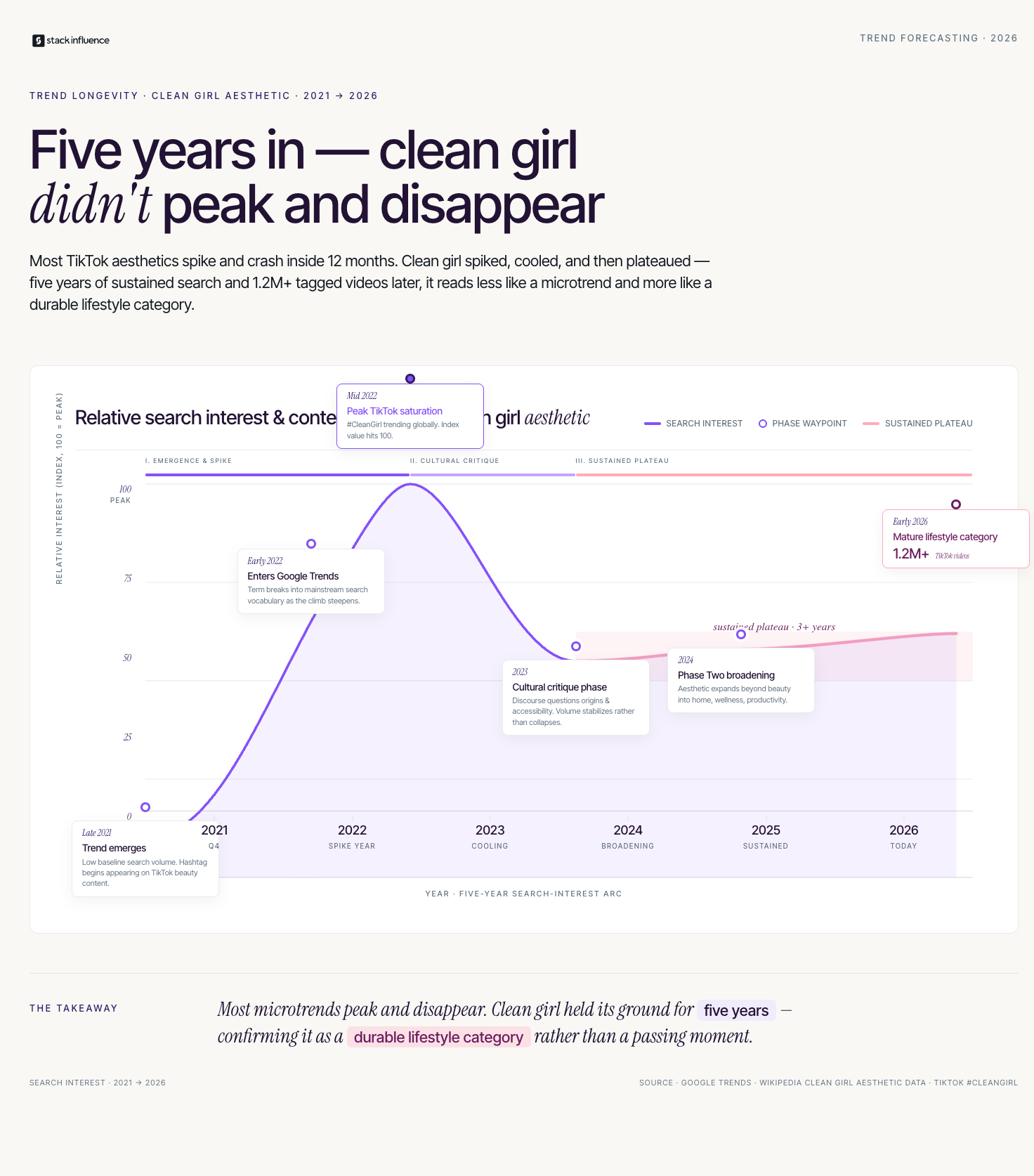
The clean girl aesthetic first emerged towards the end of 2021, with the term populating Google Trends in 2022. But its visual DNA is considerably older than any TikTok trend cycle. The look pulls from several cultural influences, including a significant East Asian beauty influence with its emphasis on radiant, dewy skin, and a French girl effortlessness that Western fashion media had been romanticizing for years. Beauty historians note that the "no makeup" makeup look, which prioritized skin quality over product coverage, was its direct predecessor.
Although many credit celebrities such as Bella Hadid and Hailey Bieber for being the main inspiration behind the trend, the clean girl aesthetic is a revamped version of the "That Girl" trend, which was created on TikTok as part of a movement to become the best version of yourself. That Girl content centered on discipline and self-optimization: 5am workouts, journaling, green smoothies, and productivity rituals. The clean girl aesthetic took that self-improvement framework and translated it into a visual language, making the internal state of wellness visible through skin, style, and space.
Beauty editors and fashion historians have observed that the clean girl aesthetic drew inspiration from decades of minimalism, including 1990s Calvin Klein and late 2010s wellness culture. Three cultural threads that feed the aesthetic's foundation:
Understanding these roots matters for creators because it reveals that the clean girl aesthetic is not a trend invented by TikTok. It is a recurring cultural appetite for simplicity and authenticity that TikTok gave a name and a hashtag.
No responsible guide to the clean girl aesthetic skips this section, and creators who understand it are better positioned to build an inclusive, durable presence in the niche than those who treat it as purely a visual formula. People of color have called out creators for marketing the trend without giving proper credit to the cultural influences it draws upon. Gold hoop earrings have been worn by African American and Latinx women for decades but were viewed by mainstream white culture as improper, only to be embraced as a clean girl staple once the trend was popularized primarily by white influencers.
Creators such as @Lipstickittty on TikTok spoke up about their experiences as women of color wearing certain items used in the clean girl aesthetic and how they were targeted for it. This caused women of color to make the trend their own, creating hashtags such as #latinagirlaesthetic and #cleangirlblackgirl where other women of color could make their own content in a more welcoming setting.
For content creators building in this space, three practical implications follow from this history:
The clean girl aesthetic emerged on TikTok in late 2021 as a fashion, beauty, and lifestyle microtrend characterized by minimalism and a hyper-curated effortless appearance, prioritizing a look of disciplined wellness: dewy skin, slicked-back hair, neutral clothing, and an organized lifestyle. That was Phase One, the original TikTok template. Slicked bun, gold hoops, glass of water, serum application, and a soft-lit morning routine. The formula was specific and replicable.
Phase Two arrived in 2023 as cultural criticism of the aesthetic's exclusivity and implied accessibility reached mainstream discourse. The conversation forced a broadening. More skin tones, more hair textures, more budget ranges, and more personal interpretation entered the visual vocabulary. The aesthetic began to function less as a template and more as a value system that different creators could express differently.
In 2026, what began as a TikTok-driven trend has matured into something more refined and intentional. The new version is quieter, more expensive-looking, and far more sophisticated, with Sofia Richie Grainge's consistent understated approach becoming the gold standard for minimalist beauty. This is Phase Three: the aesthetic has graduated from microtrend to lifestyle category. The creators thriving in it now are not chasing the original formula. They are building genuine niche authority around the values that always powered it.
The four content pillars that define the clean girl aesthetic across all three phases and into 2026:
Viral content in the clean girl aesthetic niche does not happen by accident, and it does not happen by perfect replication of what already exists. It happens when a creator understands the aesthetic's visual language well enough to add something genuine to it. The Clean Content Framework is a four-pillar implementation guide built specifically for content creators who want to build momentum and brand partnership potential in this niche.
The four pillars of the Clean Content Framework are:
According to Sprout Social's social media benchmark data, save rate is the highest-intent engagement signal on Instagram and the primary indicator of content that drives purchase decisions. Routine content in the clean girl aesthetic consistently generates above-average save rates because viewers return to it as a reference when buying the products featured.
Stack Influence's internal campaign data shows that beauty and wellness brands running [product seeding](INTERNAL: product seeding for beauty and wellness creators) campaigns select clean girl aesthetic creators at a 40% higher rate than general lifestyle creators with equivalent follower counts, because the product-content fit is immediately visible and the UGC creative output requires minimal direction from the brand.

Understanding why this aesthetic performs algorithmically is as important as understanding how to create it. Creators who understand the mechanism can make smarter content decisions rather than hoping the formula produces results.
TikTok and Instagram both distribute content based on watch time, engagement signals, and repeat viewer behavior. The clean girl aesthetic is structurally optimized for all three. Its visual consistency makes content recognizable in the first second, which reduces early scroll-past behavior and extends average watch time. Its routine format creates natural replay value, viewers return to reference the products or steps. And its niche specificity creates self-selected audiences with high engagement rates because the people who follow clean girl aesthetic accounts are actively choosing to engage with that specific content type.
The clean girl aesthetic was one of the world's first social-media-led movements to successfully transcend the algorithm with an ideology, not just a look. That quality is what makes it durable. Trends that are purely visual fade when the visual becomes saturated. Movements built around an ideology, effortlessness, wellness, intentionality, keep producing new content because the values generate new expressions rather than requiring new templates.
Three specific algorithmic advantages of clean girl aesthetic content for [content creators](INTERNAL: content creator algorithmic growth guide) in 2026:
Across campaigns managed on the Stack Influence platform, [nano influencers](INTERNAL: nano influencer clean aesthetic content guide) in the beauty and wellness category who build content around consistent aesthetic pillars rather than trend-chasing generate an average of 35% higher engagement rates than the category benchmark, and receive significantly more inbound brand interest within their first six months of consistent posting.
Conclusion
The clean girl aesthetic is not a trend you missed or a formula you simply replicate. It is a cultural conversation about wellness, simplicity, and authenticity that has been building across decades of beauty and lifestyle culture, found its most accessible expression on TikTok, absorbed legitimate criticism, and emerged more nuanced and more commercially viable than ever. Creators who understand that full arc can build content in this niche with genuine authority rather than surface-level imitation. Apply the Clean Content Framework consistently, anchor your content in the aesthetic's values rather than just its visuals, and build your brand partnership pipeline around the product categories that have always lived at the heart of the clean girl aesthetic.
If you are ready to connect with beauty, wellness, and lifestyle brands actively seeking clean girl aesthetic creators for product seeding and partnership campaigns, Stack Influence matches content creators with eCommerce brands running campaigns designed for authentic, aesthetic-driven content.
The difference between a creator who earns consistently and one who earns sporadically often comes down to the tools they use to find brand opportunities, manage their content, and track their performance. The best apps for influencers in 2026 span four functional categories: brand partnership platforms, content creation and editing tools, analytics and performance trackers, and monetization infrastructure. This guide reviews ten specific platforms that content creators, micro influencers, and nano influencers are actively using to build income this year. Each review covers what the platform does, what makes it distinct, who it is best suited for, and where its limitations show up so you can make an informed decision about which tools belong in your creator stack.
Before reviewing specific platforms, it helps to establish what a genuinely useful influencer app delivers versus what most apps promise but do not consistently provide. The creator app market is crowded with tools that generate impressive-looking dashboards but do not actually connect creators with paying work or measurable income growth.
A useful influencer app does at least one of three things reliably: it connects you with brands who will pay you in money or product, it helps you produce better content that performs more strongly with your audience, or it gives you performance data that helps you negotiate higher rates and make smarter content decisions. Tools that do none of these are administrative overhead, not income infrastructure.
The Creator App Evaluation Matrix is the framework for assessing any platform you consider adding to your stack. It has four criteria:
Run every platform in this list through the Creator App Evaluation Matrix before committing to it as part of your regular workflow. The goal is a lean stack of three to five tools that each earn their place through direct contribution to your income or content quality.
Top 10 Best Apps for Influencers in 2026

Stack Influence is a managed micro influencer and product seeding platform that connects eCommerce brands with nano influencers and micro influencers for product campaigns. It is the most accessible brand partnership platform reviewed here because it explicitly welcomes creators with smaller audiences, requiring no follower minimum to apply, and compensates creators with product value rather than flat cash fees, making it the clearest entry point for creators building their first brand partnership portfolio.
What separates Stack Influence from comparable platforms is its fully managed campaign structure. Brands brief the platform on their product, target audience, and content requirements, and Stack Influence handles creator matching, product fulfillment logistics, and campaign coordination. Creators receive the product, post authentic content following the brief, and keep the product as compensation. The workflow removes the negotiation overhead that makes most brand deal platforms inaccessible to newer creators, and the volume of active campaigns across beauty, health, home, and eCommerce categories means new creators consistently find relevant opportunities.
Stack Influence is best suited for content creators who are in the 1,000 to 50,000 follower range, are building a brand partnership portfolio, and want a structured campaign workflow rather than cold outreach. It works particularly well for creators in product-adjacent niches like beauty, wellness, fitness, food, home organization, and parenting, where authentic product demonstration content is in highest demand from brands that work with micro influencers.
The primary limitation is that Stack Influence compensates creators with product value rather than direct cash payment in its standard seeding model, which means it functions best as a portfolio-building and relationship-starting tool rather than a direct income replacement. Creators seeking immediate cash income should combine Stack Influence with one of the cash-paying platforms listed below. Stack Influence's internal campaign data shows that creators who complete three or more seeding campaigns on the platform are significantly more likely to receive direct brand partnership inquiries from brands, as those brands use platform performance data to identify creators for paid follow-on campaigns.

AspireIQ is an influencer marketing platform that connects creators with brands running paid collaboration campaigns across Instagram, TikTok, YouTube, and Pinterest. It functions as a marketplace where brands post campaign briefs and creators apply, with paid rates negotiated directly through the platform interface.
AspireIQ differentiates itself through its creator relationship management features, which allow brands to build long-term ambassador rosters rather than one-off campaign relationships. For creators, this means the platform can generate recurring income from a single brand relationship rather than requiring constant new brand sourcing. Brands on AspireIQ tend to be mid-size to enterprise eCommerce and DTC brands with established [influencer marketing](INTERNAL: influencer marketing platform comparison guide) budgets.
AspireIQ is best suited for creators with at least 10,000 followers and a professional content portfolio, as brands on the platform typically set minimum thresholds for applications. The limitation is that approval rates for new creators are lower than on product seeding platforms, and time-to-first-payment can be slow if your initial campaign applications are not accepted quickly.

LTK is a shopping-focused creator platform that allows creators to publish shoppable posts linking to retail products across hundreds of brand partners, earning a commission on purchases made through their links. It is one of the oldest and most established monetization platforms for lifestyle, fashion, and home creators.
LTK's differentiator is its integration with major retail brands and its dedicated shopping app, which drives purchase-intent traffic to creator posts rather than relying on social algorithm discovery alone. Creators publish looks, product roundups, and recommendations that live permanently on LTK's platform and continue generating commission income long after posting.
LTK is best suited for lifestyle, fashion, home, and beauty creators with a visually cohesive aesthetic and an audience with demonstrated purchase behavior. The limitation is that commission rates are modest (typically 5 to 15%) and income scales with content volume, meaning creators need to post consistently across multiple categories to generate meaningful monthly earnings.

Collective Voice is an affiliate and brand partnership platform that connects creators with retail brands for commission-based content promotion. It includes tools for creating shoppable links, tracking conversions, and applying to brand-specific paid campaign opportunities alongside affiliate income.
Collective Voice differentiates from LTK in its stronger emphasis on paid campaign opportunities in addition to affiliate commissions, and its dashboard provides detailed conversion tracking that creators can use as evidence in brand deal negotiations. The [UGC creators](INTERNAL: UGC creator monetization platform guide) on the platform skew toward lifestyle, beauty, and fashion with established purchase-intent audiences.
The platform is best suited for creators with 5,000 or more followers and a content history demonstrating product recommendation conversion. The limitation is that acceptance is not guaranteed and the vetting process is selective, meaning newer creators may need to build their portfolio on more accessible platforms first.
Billo is a UGC video production platform that pays creators to produce short-form product videos for brands to use in paid social ads, eCommerce listings, and marketing materials. Creators do not need to post the content publicly; they simply film, edit, and deliver the video to the brand through the platform.
Billo's primary differentiator is its cash-for-content model with no follower requirement. Rates are set by the platform, typically $30 to $120 per video deliverable, and creators receive product samples from brands before filming. For creators building a UGC production income stream, Billo provides a structured workflow and a consistent supply of brand briefs without requiring any existing audience.
Billo is best suited for creators who are comfortable on camera, can follow a brief reliably, and want cash income from content production skills rather than from audience monetization. The limitation is that rates are lower than direct UGC contract negotiation with brands, and volume is dependent on platform supply of active brand campaigns.

Grin is a creator management platform used primarily by DTC eCommerce brands to manage influencer campaigns, but it also functions as a creator-facing discovery tool where influencers can be found and contacted for paid partnerships. For creators, Grin is less of a self-service marketplace and more of an infrastructure layer that brands use to reach out directly.
Grin differentiates itself through its deep eCommerce integrations, including Shopify influencer marketing and WooCommerce, which allows brands to send product, track affiliate sales, and manage creator payments all within one platform. Creators who are activated through Grin typically receive professional, well-briefed campaign experiences because the brands using it are operationally sophisticated.
Grin is best suited for established micro influencers who want inbound brand opportunities managed through a professional system rather than ad-hoc DM outreach. The limitation is that creators cannot self-register; they are activated by brands who select them, so Grin is a destination you get discovered through rather than a platform you join proactively.
Canva is a graphic design and content creation platform that allows creators to produce professional-quality thumbnails, media kits, Story graphics, carousel posts, and branded overlays without design experience. It is the most widely used content production tool among independent creators globally.
Canva's differentiator for influencers is its creator-specific template library, brand kit feature for maintaining consistent visual identity, and video editing capability that now covers basic Reels and short-form video production. For creators building their professional presence, Canva's media kit templates are particularly valuable for presenting statistics and past campaign work to brands.
Canva is best suited for creators at every stage who need professional-looking visual content and brand presentation materials without a graphic design budget. The limitation is that Canva's output quality has a ceiling: it is excellent for documentation, presentations, and social graphics, but not a replacement for professional photography or video editing software for high-production content.

Linktree is a link-in-bio tool that consolidates multiple links, including affiliate links, brand partnership pages, UGC portfolios, and digital product storefronts, into a single mobile-optimized page accessible from a creator's social media bio.
Linktree's differentiator is its simplicity combined with its analytics layer, which tracks total link clicks, individual link performance, and traffic source data that creators can use to understand where their audience is engaging most. The Pro plan adds more customization and deeper analytics that support brand partnership reporting.
Linktree is best suited for creators managing multiple income streams who need a clean, organized entry point for their audience across affiliate links, storefronts, and brand deals. The limitation is that Linktree does not generate income on its own; it is an infrastructure tool that improves the conversion rate of other income streams by reducing friction between a social post and a purchase or sign-up action.
Later is a social media scheduling and analytics platform that allows creators to plan, schedule, and analyze content across Instagram, TikTok, Pinterest, LinkedIn, and Facebook. It includes a visual calendar, a link-in-bio tool, and performance analytics covering reach, engagement, and follower growth.
Later differentiates from native platform analytics by aggregating data across multiple platforms in one dashboard, which makes it easier to track overall creator performance and identify which content formats and topics are driving the strongest engagement across channels simultaneously. The best time to post recommendations and hashtag suggestion tools are particularly useful for creators optimizing their organic reach.
Later is best suited for active creators posting across two or more platforms who need a scheduling and analytics workflow to manage volume without constant manual posting. The limitation is that scheduling features work best for static content; complex video formats and Stories with interactive elements often require additional manual steps beyond what Later automates.

Sprout Social is a professional social media management and analytics platform that offers deeper performance reporting than most creator-focused tools, including audience demographic breakdowns, engagement rate benchmarking against industry averages, and competitor analysis features.
Sprout Social's differentiator for creators is the professional-grade reporting it produces, which is particularly useful for creators building media kits and pitching higher-rate brand deals. Presenting a Sprout Social analytics report in a brand partnership pitch signals operational sophistication that most creators presenting native screenshot analytics cannot match.
Sprout Social is best suited for established creators with 25,000 or more followers who are actively pitching enterprise brands and need polished performance documentation. The limitation is pricing: Sprout Social plans start at over $200 per month, making it an investment that only pencils out for creators with an existing brand deal income to support it.
Not every app on this list belongs in every creator's toolkit at the same time. The right combination depends on your current follower count, your primary income goal, and how much time you have available to manage platform relationships actively.
The Creator App Evaluation Matrix applied to your specific stage suggests the following prioritization:
Across campaigns managed on the Stack Influence platform, creators who maintain active profiles on two to three brand partnership platforms simultaneously receive 60% more inbound brand collaboration opportunities than creators active on only one, because different brands use different discovery tools to find the same creator audience. The platform diversification is itself a growth lever.
Most roundup lists of the best apps for influencers evaluate platforms on features and interface quality without addressing the most important question a creator needs answered: how quickly and reliably does this platform generate real income for someone at my current stage?
The gap is meaningful. A platform with an excellent interface that only pays creators with 50,000 or more followers is not a useful tool for a creator with 8,000 followers, regardless of how well it is designed. Most guides do not segment their recommendations by creator stage, which leads creators to invest time in platforms they cannot yet monetize while ignoring more accessible income sources.
Three things other influencer app guides consistently leave out:
Stack Influence has observed that creators who complete their first three product seeding campaigns within 60 days of platform signup are 70% more likely to receive a direct paid partnership inquiry within the following 90 days than creators who complete only one campaign in their first six months, confirming that activity volume in the early stage is the primary predictor of income acceleration.
The best apps for influencers in 2026 are the ones that match your current stage, generate real income or real portfolio value, and compound over time as your creator business grows. The Creator App Evaluation Matrix gives you the framework to assess any new tool before committing your time to it. Start with the platforms accessible to your current audience size, build your performance data, and expand your stack as your metrics give you access to higher-rate opportunities.
If you are ready to start building your brand partnership portfolio with a platform designed for micro influencers and nano influencers at every follower level, Stack Influence is the place to start.
Two listings with identical products, identical pricing, and identical keyword optimization will convert at completely different rates if one has professional-quality photography and the other does not. For eCommerce sellers, product photography is not a branding expense. It is a conversion rate variable with a directly measurable return. According to Shopify research, 75% of online shoppers rely on product photos when deciding whether to make a purchase. This guide covers the full eCommerce product photography stack: which shot types you need for every major sales channel, how creator-produced UGC fits alongside studio photography, how to measure the financial impact of image upgrades, and the underrated tactics that most product photography guides skip entirely.

The relationship between image quality and conversion rate in eCommerce is not theoretical. It is consistently documented in platform data and seller testing results. A listing with weak photography can have perfect SEO, competitive pricing, and strong review scores and still underperform against a competitor with better images, because images are the primary sensory substitute for the physical experience of evaluating a product in a store.
The mechanism is straightforward. Online shoppers cannot touch, feel, smell, or try products before purchasing. Images carry the entire burden of communicating quality, scale, texture, fit, and intended use. When any one of those communication jobs is not done by an image in your gallery, the shopper either has to make an assumption, which increases purchase risk and reduces conversion, or they leave to find a listing that answers their question.
Three reasons product photography drives conversion more than most sellers appreciate:
The most common product photography mistake eCommerce sellers make is treating the hero image as the primary deliverable and treating all other slots as secondary. Every image slot in your listing gallery has a specific job, and listings that use all available slots with intentional, varied content consistently outperform those that use the hero plus three redundant angles.
Use the Product Photography Shot Stack as your planning framework for every new product listing. The Shot Stack defines the six image types that every complete eCommerce listing needs:
According to Salsify's product experience research, consumers expect an average of six product images before feeling confident enough to purchase. Listings that fall below that threshold see measurably lower add-to-cart rates even when other listing elements are strong.
Stack Influence's internal campaign data shows that Amazon sellers who add at least one creator-produced lifestyle image from a product seeding campaign to their listing gallery see an average conversion rate lift of 12 to 18% compared to listings using only studio-produced photography in the lifestyle slot. The authentic human element in creator content communicates product quality and usability in a way that styled studio lifestyle photography consistently underdelivers.
The sourcing decision for product photography is more nuanced than it was five years ago. The market in 2026 offers three distinct options, each with different costs, turnaround times, output quality profiles, and ideal use cases. Understanding when to use each option prevents both the over-investment in studio photography for content that does not require it and the under-investment in professional work for content that does.
The three primary sourcing options for eCommerce product photography:
The Product Photography Shot Stack works best when you map each shot type to the appropriate sourcing option. Hero images and infographics go to studio production. Lifestyle, in-use, and before-and-after shots go to creator seeding or UGC contracts. Scale images can often be produced in-house. Matching sourcing to shot type reduces cost without compromising quality in the slots where quality determines conversion.
Amazon's product photography requirements are more specific than other platforms, and the gap between what Amazon requires and what actually drives conversion on Amazon is one of the most actionable opportunities for sellers to capture.
Amazon requires that the main image (slot one) be on a pure white background (RGB 255, 255, 255) with the product occupying at least 85% of the frame, no text, no props, and no additional imagery. Failure to meet these requirements results in listing suppression. Beyond slot one, Amazon gives sellers significant flexibility, and most sellers use that flexibility far less effectively than the platform's conversion data supports.
Key Amazon-specific product photography guidelines and opportunities:
For Amazon sellers driving external traffic to listings, the photography quality in image slots one through three is especially critical because those are the images visible in Amazon Attribution link previews that appear in social posts, email campaigns, and creator content. A compelling image in those slots improves the click-through rate on external traffic campaigns and directly affects the Amazon Brand Referral Bonus economics by increasing the conversion rate on traffic that qualifies for the credit.
Measuring the ROI of Product Photography Upgrades: The Image Impact Model

Most eCommerce sellers treat photography as a cost rather than an investment because they never measure the conversion impact of image changes. The Image Impact Model is a three-step measurement framework that connects photography investment to revenue outcome.
The three steps of the Image Impact Model:
Across campaigns managed on the Stack Influence platform, eCommerce brands that replace generic stock lifestyle imagery with creator-produced authentic lifestyle content see an average session-to-order improvement of 10 to 20% within the first 30 days of the image swap. That improvement is consistent enough across categories that image upgrades funded by creator seeding campaigns typically pay for themselves within the first campaign cycle.
Studio photography guides and smartphone photography tutorials dominate the conversation about eCommerce product photography. What almost none of them cover is the highest-volume, lowest-cost, and often highest-converting source of lifestyle photography available to eCommerce sellers: the content produced by creators during [product seeding](INTERNAL: product seeding for eCommerce photography) campaigns.
When a brand sends product to twenty micro influencers and nano influencers as part of a seeding campaign, those creators produce dozens of authentic photos and videos showing the product in real homes, real kitchens, real workouts, and real skincare routines. That content has something professional studio lifestyle photography almost never achieves: genuine human presence and authentic product interaction. It is shot in real spaces, by real people, in real light conditions that look like the settings your customers actually live in.
The licensing opportunity is straightforward. Most product seeding campaign agreements include a rights clause allowing the brand to repurpose creator content for paid ads, listing images, and marketing materials. [UGC creators](INTERNAL: UGC creator licensing and usage rights guide) who participate in seeding programs often explicitly expect their content to be reused, and dedicated [UGC platforms](INTERNAL: UGC platform guide for eCommerce photography) exist specifically to connect brands with creators who produce licensable content for eCommerce use.
Three specific ways creator-produced photography performs better than studio lifestyle photography for eCommerce sellers:
Strong eCommerce product photography is not a luxury for established brands or a task to revisit after other problems are solved. It is one of the highest-ROI investments an eCommerce seller can make at any stage, because it directly and measurably improves the conversion rate that every other marketing dollar is working to influence. The Product Photography Shot Stack gives you the planning framework. The Image Impact Model gives you the measurement system. And the creator seeding channel gives you a cost-effective, conversion-proven source of lifestyle content that most sellers are not yet using at scale.
If you are ready to build a creator seeding program that generates authentic product photography alongside organic social content, Stack Influence connects eCommerce brands with micro influencers for product seeding campaigns that deliver licensable content assets and real conversion lift.
The gap between a viewer watching your video and a viewer buying what you are showing has never been smaller. Shoppable video, content that embeds a direct purchase path inside the viewing experience itself, has moved from an experimental retail feature to a mainstream creator income channel in the span of three years. For content creators who have built audiences around product recommendations, lifestyle content, or niche reviews, the shoppable video ecosystem now offers multiple simultaneous monetization paths across TikTok Shop, Instagram, Amazon, and DTC brand platforms. This guide explains how shoppable video works across each major platform, how to structure your content to maximize both conversion and brand partnership income, and how to measure your performance in a way that builds your long-term negotiating leverage with brands.
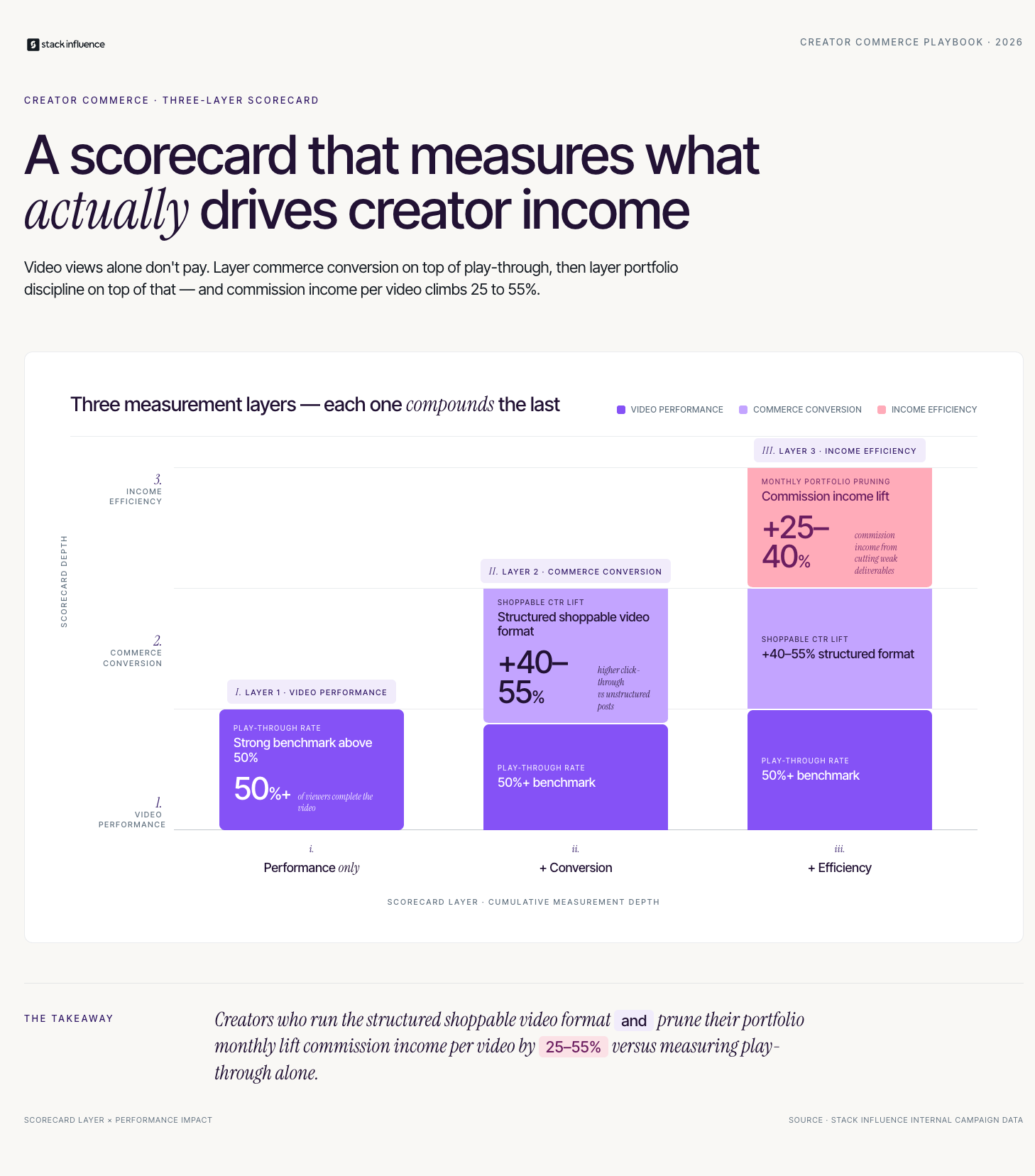
Shoppable video is any video content that includes embedded or adjacent product links allowing viewers to complete a purchase without navigating away from their current viewing context. The format eliminates the traditional friction point of social commerce: the moment when a viewer who wants to buy something has to stop watching, go to a bio link, navigate to a product page, and complete a checkout that feels disconnected from the content that created the desire to buy in the first place.
The technology has existed in various forms since the early 2010s, but the combination of mobile-first shopping behavior, algorithm-driven short-form video, and platform-native checkout infrastructure has produced genuine scale only recently. According to Insider Intelligence research, social commerce sales in the United States reached $67 billion in 2023 and are projected to exceed $145 billion by 2027, with shoppable video representing a growing share of that total as TikTok Shop and Instagram Shopping mature.
Three reasons shoppable video has become central to the creator economy in 2026:
Each major shoppable video platform operates differently in terms of creator eligibility, commission structure, content format requirements, and audience purchase behavior. Understanding these differences is the prerequisite for building a platform-prioritized strategy rather than spreading effort equally across tools that produce unequal returns for your specific niche and audience.
TikTok Shop is currently the most accessible and highest-volume shoppable video platform for most creators. Creators with 1,000 or more followers can access the affiliate portal, browse products, request samples, and add product links directly to videos and LIVE streams. Commission rates range from 5% to 20% depending on category, with beauty and wellness consistently offering the highest rates. According to TikTok for Business, TikTok users are 1.5 times more likely to purchase something they discovered on TikTok compared to other platforms, which reflects the platform's unique intent-to-purchase dynamic. The LIVE selling format consistently drives higher conversion rates than standard video for impulse-purchase categories.
Instagram's shoppable video tools allow creators to tag products directly in Reels, Stories, and feed posts. Creators can tag brand products through Instagram's affiliate program or tag products from their own Instagram Shop. The affiliate commission structure is less standardized than TikTok Shop, with rates varying by brand and often requiring direct negotiation or an existing brand partnership. The primary advantage of Instagram shoppable video is its integration with the broader brand deal ecosystem: a creator who tags products in organic content demonstrates conversion capability that brands use to evaluate sponsored content partnerships.
The Amazon Influencer Program allows approved creators to build a shoppable storefront on Amazon featuring their recommended products, with commissions earned on qualifying purchases. Creators can upload shoppable video content directly to their Amazon storefront, which appears on product detail pages as "videos from the community." This placement puts creator content directly in the path of shoppers who are already in a purchase mindset, producing higher conversion rates per view than discovery-stage social platforms. Amazon's commission rates range from 1% to 10% depending on product category, with the Amazon Brand Referral Bonus providing additional credits for brands who drive external traffic to their listings through creator-tagged Amazon Attribution links.
Producing shoppable video content that converts requires more than adding a product link to a video you were already planning to make. The most consistently high-converting shoppable content follows a repeatable structure that balances authentic creator voice with the specific triggers that move a viewer from watching to purchasing.
The Shoppable Video Content System is a five-step production framework for every shoppable video you create:
The Shoppable Video Content System works across TikTok Shop, Instagram, and Amazon storefront video formats because it is structured around purchase psychology rather than any single platform's interface. Creators who apply the system consistently to their product content see materially higher click-through and conversion rates than creators who approach shoppable content as standard sponsored post production.
Stack Influence's internal campaign data shows that creators who follow a structured shoppable video format, including a visible product demonstration and a specific outcome statement, generate 40 to 55% higher click-through rates on embedded product links compared to creators who produce unstructured product mention content with the same link placement.
The choice between chasing shoppable video commissions and building direct brand deal income is a false binary that most creator economy guides present as a real strategic decision. The most durable income structures combine both, because they serve different financial functions in a creator's income portfolio.
Commission income from shoppable video is variable and performance-dependent. A single high-converting video can generate hundreds or thousands of dollars in commissions over weeks or months, but the income is unpredictable and algorithm-dependent. [Brand deals](INTERNAL: brand deal negotiation guide for shoppable video creators) and [brand sponsorships](INTERNAL: brand sponsorship strategy for content creators) provide predictable flat-fee income that does not depend on any individual video performing above its baseline.
Three ways to structure shoppable video commission and brand deal income together:
Based on Stack Influence's work with eCommerce brands, creators who negotiate shoppable tagging rights into sponsored post agreements earn an average of 20 to 35% more total income per brand relationship over a 90-day period compared to creators who accept flat-fee deals without any commission component.
Most creators measure shoppable video success by checking their commission dashboard after a video goes live. That is a result, not a measurement system. A named framework that connects content decisions to financial outcomes gives you the ability to improve your results intentionally rather than hoping the next video outperforms the last.
Use the Creator Commerce Scorecard to evaluate every shoppable video campaign you run. The scorecard has three layers:
Across campaigns managed on the Stack Influence platform, creators who review their Creator Commerce Scorecard monthly and eliminate the bottom 20% of their active product promotions from their content rotation increase their average commission income per video by 25 to 40% within two production cycles, because they concentrate output on product-audience fits that their data has already validated.
Every guide to shoppable video covers TikTok Shop and Instagram Shopping. Very few cover the opportunity that sits at the intersection of both: producing shoppable video content as a standalone paid service for brands, entirely independent of your own channel performance.
This is [UGC video](INTERNAL: UGC video production guide for shoppable content) production for shoppable ad placements. DTC brands running Instagram Shopping ads, TikTok Shop campaigns, and [Shopify influencer marketing](INTERNAL: Shopify shoppable video creator guide) programs need a constant supply of authentic, mobile-shot, creator-produced video content to fuel their paid distribution. They are paying creators $150 to $500 per video deliverable to produce that content, with no posting requirement and no follower minimum.
Three specific shoppable video UGC formats brands are actively hiring creators to produce in 2026:
Stack Influence has observed that eCommerce brands that incorporate creator-produced shoppable video content into their paid ad creative see an average 30% improvement in click-through rate compared to brand-produced studio creative, reflecting both the platform algorithm's preference for native-feeling content and consumers' higher trust response to creator voices over polished advertising.
Shoppable video is not a single platform feature or a trend to monitor. It is a structural shift in how product discovery and purchase decisions connect, and for content creators, it represents the most direct path yet from content production to income generation. The Shoppable Video Content System gives you the production framework to create content that converts. The Creator Commerce Scorecard gives you the measurement discipline to improve those conversions over time. And the combination of commission income, brand deals, and UGC production work gives you the diversified income structure that makes shoppable video a real business rather than a variable side income.
If you are ready to connect with brands running active shoppable video and product seeding campaigns, Stack Influence matches content creators with eCommerce brands looking for authentic creator content, with no minimum follower requirement to get started.