




A store platform choice looks simple until growth turns it into an operating model decision. eCommerce sellers evaluating woocommerce vs shopify are not only choosing themes and checkout flows. They are choosing how much infrastructure they want to own, how quickly they need to launch, and how easily their team can turn content, traffic, and attribution into repeatable revenue.
This guide breaks the decision down for DTC brands, Amazon sellers, and hybrid teams that need both a branded site and marketplace momentum. You will see where WooCommerce wins, where Shopify wins, and how to evaluate the tradeoff through cost, conversion, SEO, and measurement instead of brand loyalty.
Key Takeaways
- WooCommerce usually wins on ownership, flexibility, and custom store architecture, especially for brands that already run WordPress or need unusual merchandising logic.
- Shopify usually wins on launch speed, checkout performance, and operational simplicity for lean teams that want core commerce infrastructure handled for them.
- The best choice is rarely about software alone because UGC, Amazon traffic, SEO, and reporting often create the real long-term cost.
- Amazon-heavy and hybrid brands need a measurement plan first so storefront traffic, Amazon Attribution, and Brand Referral Bonus work together instead of producing fragmented ROI data.
2026 Commerce Platform Tradeoffs For Growth-Focused Sellers
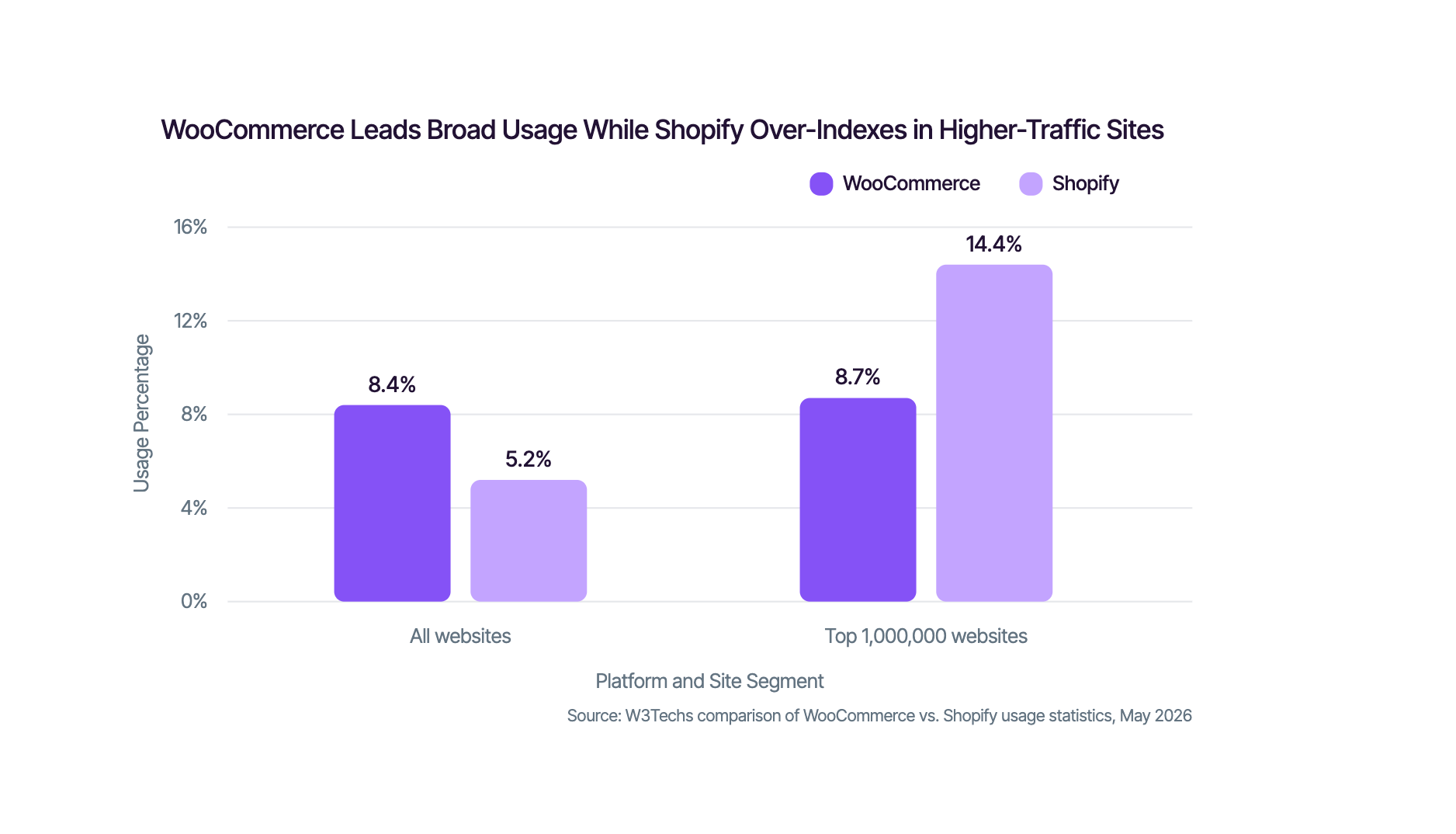
Market share does not settle the argument, but it does reveal the shape of the market. W3Techs reports that WooCommerce is used by 8.4% of all websites versus Shopify’s 5.2%. Yet among the top one million sites, Shopify reaches 14.4% while WooCommerce sits at 8.7%. That split suggests WooCommerce leads broad adoption while Shopify is disproportionately strong in higher-traffic environments.
The pressure on platform choice is higher now because content systems influence revenue more directly than they used to. In Influencer Marketing Hub’s 2026 benchmark report, 87.49% of respondents said influencer budgets are increasing, and PowerReviews found that 84% of shoppers want customer photos and videos directly on product pages. Store architecture now affects how fast brands can publish trust signals, not just how fast they can launch a cart.
Use this lens before you compare feature lists.
- Market Share Is Not Fit: Both platforms scale, but they scale differently based on traffic profile, team structure, and operating model.
- Checkout Gaps Compound: Even a modest conversion edge becomes meaningful once paid traffic, creator traffic, and repeat purchases stack together.
- Content Is Now Infrastructure: If your team depends on reviews, testimonials, and creator media, the platform decision affects conversion velocity.
- Measurement Has Become Strategic: Hybrid brands need one reporting logic across DTC traffic and Amazon outcomes.
That is why simplistic platform comparisons age badly. Sellers should judge woocommerce vs shopify by the work their team must do next, not by whichever homepage demo feels cleaner. For DTC brands and Amazon storefront operators, the winning stack is the one that makes growth easier to repeat.
What Is The Real Difference In WooCommerce Vs Shopify?
The most practical difference is responsibility. With WooCommerce pricing, the core platform is free, there is no revenue share, hosting is self-selected, and merchants add extensions as needed. With Shopify pricing, the model is subscription-led, with annual entry points starting at $29 per month for Basic, $79 for Grow, and $299 for Advanced, plus payment and ecosystem costs depending on how the store is configured.
In plain language, WooCommerce gives sellers more direct control over the stack, while Shopify gives sellers more convenience from the stack. That means WooCommerce is often stronger when the business needs custom architecture, while Shopify is often stronger when the business needs predictable execution and fewer technical decisions. Shopify’s comparison page frames that tradeoff around total cost, operating simplicity, and checkout performance.
That difference usually shows up in four places.
- Ownership: WooCommerce gives deeper control over code, hosting, and data structure.
- Speed: Shopify is usually faster for non-technical teams to launch and maintain.
- Extensibility: WooCommerce bends further around custom requirements, especially for content-heavy brands.
- Operational Load: Shopify centralizes more of the routine commerce work, while WooCommerce asks merchants to make more stack decisions themselves.
For many sellers, the real question is not which platform is “best.” It is which problems they want the platform to solve for them, and which problems they are prepared to solve themselves. That framing produces a much better decision than comparing headline features in isolation.
Inside The Build-Convert-Compound Path
The Build-Convert-Compound Path is the fastest way to compare woocommerce vs shopify without getting trapped in brand talking points. It evaluates each platform at three moments of value creation: building the store, converting the shopper, and compounding growth after the first purchase.
- Build: Judge how fast your team can launch, edit, and expand the store. Shopify usually leads for lean teams because the platform is hosted and unified, while WooCommerce leads when custom workflows, WordPress depth, or unusual business rules matter more than out-of-box convenience.
- Convert: Judge how much friction exists between intent and checkout. On Shopify’s comparison page, Shopify cites an average checkout conversion lead over WooCommerce, while Woo stores can close the gap only when hosting, caching, payment setup, and theme performance are managed well.
- Compound: Judge how well the store turns traffic and content into a reusable growth engine. WooCommerce often has the advantage for brands that want deeper editorial control, while Shopify usually makes compounding easier for operators who value speed and platform-supported workflows.
The Build-Convert-Compound Path matters because the cheapest launch is not always the cheapest year. Shopify argues on its official comparison page that its average total cost of ownership is lower, while WooCommerce argues that merchants save by avoiding platform revenue share and buying only what they need. Both claims can be directionally true depending on whether your next bottleneck is software spend or operator time.
This is where content changes the equation. PowerReviews found that 91% of consumers are more likely to buy when reviews include photos and videos. Based on Stack Influence’s work with eCommerce brands, that value compounds fastest when creator output reaches product pages and marketplace assets quickly. In Aunt Fannie’s customer story, 189 creator promotions generated 62 organic product testimonials, a 33% testimonial conversion rate.
That compounding layer is the part most platform guides underweight. A store does not simply host product pages. It determines how fast your team can publish fresh social proof, test new merchandising blocks, and move UGC from social feeds into a buying surface that actually converts.
How Should You Measure ROI Across Storefronts And Marketplaces?
Most sellers do not need more metrics. They need a cleaner hierarchy. The Four-Signal Measurement Stack solves this by separating native store performance, click-path validation, marketplace attribution, and margin recovery into one working model.
- Signal One, Native Store Revenue: Start with store-native revenue reporting and a disciplined campaign naming system. WooCommerce Analytics now offers last-touch order attribution by channel, source, device, and campaign, which is a useful model even for teams running part of their business elsewhere.
- Signal Two, Click-Path Validation: Use consistent UTM logic, tested landing pages, and one source of truth for campaign naming. This is the layer that keeps creator traffic, paid social traffic, and email traffic from becoming incomparable.
- Signal Three, Marketplace Recovery: If you send traffic to Amazon, use Amazon Attribution. Amazon describes it as a free measurement solution and reports a 14-day attribution window across off-Amazon channels.
- Signal Four, Margin Recovery: If that Amazon traffic is eligible, add Brand Referral Bonus. Amazon says it averages a 10% bonus on qualifying sales, which can materially improve economics for Amazon sellers.
This stack matters most for Amazon FBA brands and hybrid operators. If you only measure site sessions, you undercount creator traffic that closes on Amazon. If you only measure Amazon sales, you miss how much your DTC site, email list, and content are doing to qualify demand before purchase. Amazon’s own guidance makes the split clear: Attribution is the measurement layer, while Brand Referral Bonus is the financial recovery layer.
That is also why platform choice can look better or worse than it really is. A weak result can come from bad tags, a slow PDP update cycle, or sending the wrong audience to the wrong destination. If you want a practical internal explainer for this distinction, Stack Influence’s guide on Amazon marketing services is useful because it separates Amazon Attribution from Amazon Brand Referral Bonus in operational terms.
Where Does Each Platform Fit For DTC Brands, Amazon Sellers, And Hybrid Teams?
The Build-Convert-Compound Path becomes easier once you anchor it to business model. DTC brands usually need a branded site that can publish content quickly, support merchandising tests, and convert mobile traffic well. Amazon sellers often need a site for education, email capture, and traffic control, but they may still want final conversion to happen on Amazon when Prime trust, reviews, and category rank matter more than standalone site margin.
Here is the simplest fit guidance.
- Choose Shopify First If you run a lean DTC team that wants faster launch, easier admin, multi-channel selling, and less platform maintenance. The same logic applies if you plan to pair the store with Shopify traffic plays, email, and creator campaigns without adding engineering overhead.
- Choose WooCommerce First If your growth model depends on deeper content architecture, unusual product logic, custom bundles, or tighter control over hosting and data flows.
- Stay Hybrid If you are an Amazon-first brand that still needs a DTC site for storytelling and list growth. In that case, your real decision is less about platform ideology and more about how the site supports your Amazon storefront and a measurable Amazon-ready seeding strategy.
Data from Stack Influence’s micro influencer campaigns suggests that reuse across destinations is where value compounds fastest. In Lenny & Larry’s customer story, monthly Amazon unit sales grew from 1,024 to more than 11,000 over a 12-month creator program. For Amazon sellers, the DTC site often functions as the education layer while Amazon remains the trust-and-conversion layer.
That is why the best answer for DTC brands and Amazon sellers can differ even when they sell the same product. The platform should match the shortest path between your current team capability and your next revenue milestone, not someone else’s software preference.
Why The Hidden Ops Tax Shows Up After Launch

The hidden cost in woocommerce vs shopify is usually not the monthly fee. It is the coordination tax that appears after launch through merchandising edits, analytics cleanup, plugin or app governance, creator asset handling, and marketplace reporting. Sellers feel that cost only after traffic starts arriving and more people need to touch the stack.
On Shopify, the hidden tax often appears in ecosystem dependency and the work required to keep app logic, checkout needs, and reporting clean. On WooCommerce, it often shows up in development oversight, hosting performance, and the ongoing effort required to keep a customized stack stable. Shopify’s own comparison page argues that WooCommerce carries higher operating burden, while WooCommerce argues that merchants save by keeping more cost decisions under their own control.
You can usually spot the tax early.
- Week Two Tax: Tagging, campaign naming, and destination mapping drift apart.
- Month Two Tax: UGC and creator files exist, but no one owns placement across PDPs, collection pages, and Amazon assets.
- Quarter Two Tax: Technical debt or process debt starts slowing launches, promotions, and reporting.
Across campaigns managed on the Stack Influence platform, the bottleneck often shifts from creator sourcing to operational throughput very quickly. Stack Influence’s Amazon growth workflow and pricing page point to the same reality: once creators are producing usable content, sellers need a stack that can publish, tag, and measure that output fast. Those pages highlight 340,000 vetted creators, 175 hours saved per month, 4x ad conversions, and an average $30 fee per completed post.
That is the hidden economics lens most platform guides leave out. A platform decision is also a content operations decision. If your business depends on rapid UGC deployment, creator-led traffic, and clean attribution, the best platform is the one that lowers total decision load after launch, not the one that only looks cheapest before work begins.
Choose The Platform That Matches Your Next Stage
WooCommerce vs Shopify is not really a debate about features. It is a debate about how your team wants to allocate control, speed, and operating burden as revenue grows. If you want managed infrastructure and faster day-to-day execution, Shopify is often the stronger default. If you want deeper ownership and a store that bends around your business instead of the reverse, WooCommerce is often the better long-term fit.
For eCommerce sellers, the best answer is the platform that shortens the path from traffic to revenue and from content to conversion. Make the decision against your next 12 months of work, not your next two weeks of setup, and you will choose a stack that supports growth instead of interrupting it.