




Every eCommerce seller feels the same pressure: paid ad costs keep climbing while ROAS keeps slipping. 48% of eCommerce brands say rising ad costs are their biggest challenge , and many are discovering that the channels they've always relied on are no longer pulling their weight. Advertising social media is not simply about buying impressions anymore. In 2026, it is about combining paid placements, organic creator content, and UGC into a system that compounds over time. This article gives you a concrete, operational strategy for doing exactly that.
Key Takeaways
- Social media advertising is now a $317 billion global market, but raw spend no longer guarantees results without the right creative and measurement infrastructure.
- Creator-generated and UGC-style ads consistently outperform polished brand creative on Meta and TikTok, often delivering dramatically higher conversion rates at lower cost.
- The 5-Step Social Ad Momentum Sequence gives eCommerce sellers a structured path from channel selection to content recycling.
- Amazon sellers can close the attribution gap by combining Amazon Attribution tags with the Amazon Brand Referral Bonus to measure and reduce the net cost of external social traffic.
- Micro-influencer product seeding produces both social proof and reusable paid creative in a single campaign, making it one of the most capital-efficient inputs to your social ad stack.
What Is Advertising Social Media for eCommerce Sellers?
Advertising social media, in the eCommerce context, is the practice of using paid placements, creator partnerships, and native content formats across platforms like Meta, TikTok, Instagram, and Pinterest to drive product discovery, traffic, and direct purchases. It encompasses everything from Meta Advantage+ Shopping campaigns and TikTok Spark Ads to micro-influencer product seeding and UGC-driven creative. Unlike traditional digital advertising, which prioritizes audience size and bid strategy, effective social advertising in 2026 is primarily a creative and trust problem.
Total spend on social media advertising is projected to reach $317.33 billion in 2026 , and yet the sellers capturing disproportionate share of that value are not the ones spending most. They are the ones feeding their ad accounts the creative that platforms actually reward. TikTok ads featuring creators convert 3.2x better than brand-produced ads , and the same pattern holds across Meta, where native-feeling content consistently earns lower CPMs. The strategic shift for eCommerce sellers is from "how much to spend" to "what to feed the algorithm."
Social advertising also sits at the intersection of two powerful trends running simultaneously. As of 2026, there are 117.1 million social media buyers in the United States, equivalent to 33.5% of the country's population . At the same time, consumers are increasingly turning to social media platforms for product discovery over traditional search engines . For eCommerce sellers, that combination means social is both where your buyers live and where purchase decisions increasingly begin.
The 5-Step Social Ad Momentum Sequence
The 5-Step Social Ad Momentum Sequence is the operational framework at the core of a sustainable social advertising strategy. It treats social advertising as a compound system rather than a series of one-off campaigns. Each step builds on the last, so that creative assets, audience data, and attribution insights accumulate into a durable growth engine. Reference this sequence whenever you are evaluating which part of your social advertising program to prioritize or fix.
The five steps are:
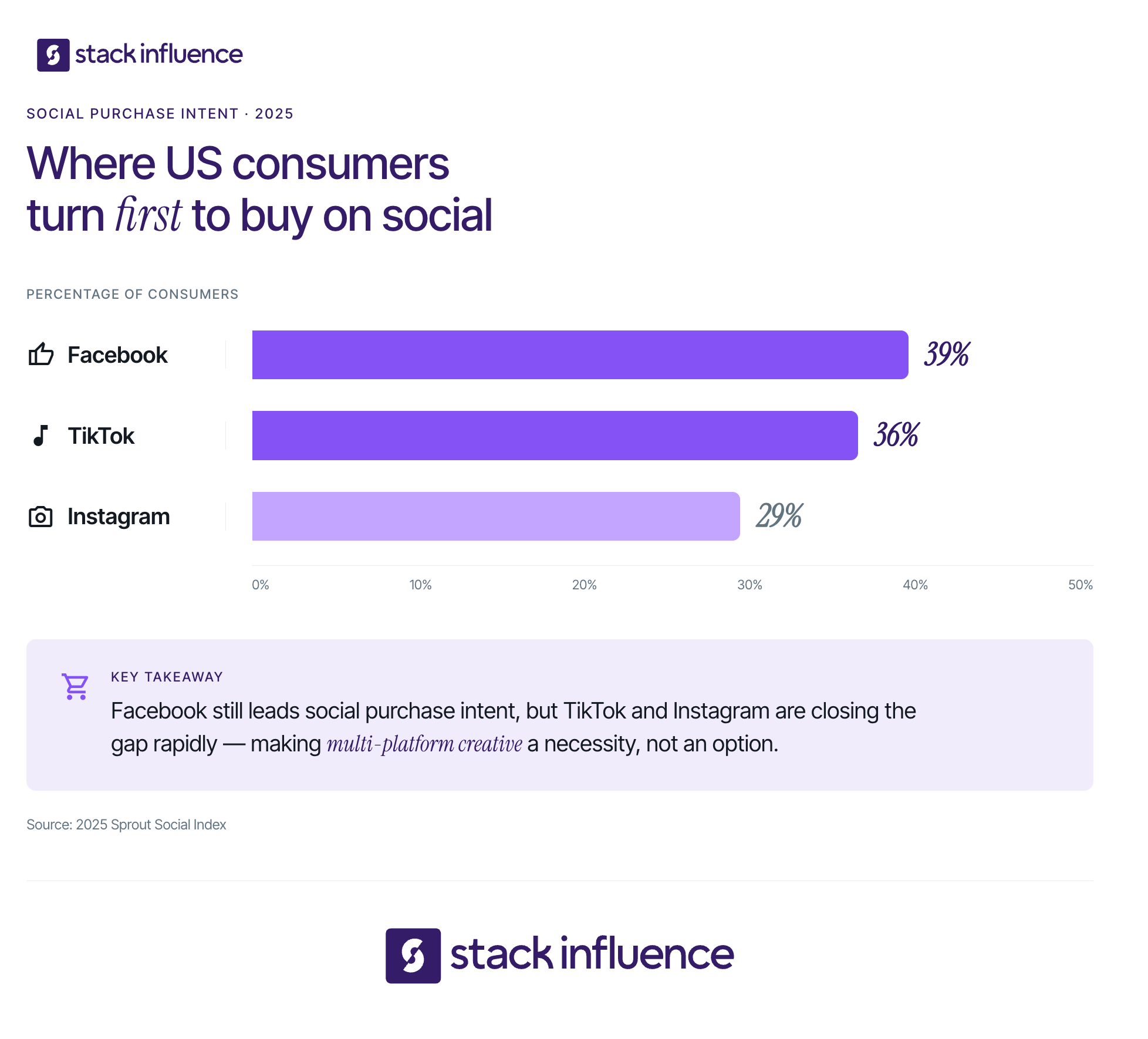
- Step 1: Platform-Audience Alignment. Choose your primary platform based on where your buyers actually convert, not where impressions are cheapest. According to the 2025 Sprout Social Index, 39% of consumers turn to Facebook first when ready to purchase on social media, with TikTok following at 36% and Instagram at 29%.
- Step 2: Creative Seeding. Build your creative library through micro-influencer product seeding before scaling paid spend. Creator-generated assets function as both social proof and paid creative inputs, eliminating the need for expensive studio production.
- Step 3: Native Ad Activation. Run your best creator content as paid ads using platform-native formats: Spark Ads on TikTok, whitelisted posts on Meta, and Promoted Pins on Pinterest. Native-style ads earn higher CTR and lower CPMs than clearly branded creative.
- Step 4: Attribution Tagging. Implement channel-specific tracking across every placement. For Amazon sellers, Amazon Attribution is a free advertising and analytics measurement solution that provides insight into the on-Amazon impact of your marketing strategies across non-Amazon channels including search, social, display, video, and email.
- Step 5: Creative Recycling. Rotate top-performing UGC across product detail pages, email sequences, and retargeting campaigns. Assets that convert in paid social often perform even better in lower-funnel placements because the audience is already warmed.
The Sequence works because it eliminates the two most common failure modes in social advertising: creative starvation (running the same four assets until CTR collapses) and attribution blindness (spending without knowing which channels and creatives are driving actual purchases). Return to this framework after every campaign cycle to diagnose where momentum is stalling.
Why Does Creator Content Outperform Traditional Social Ads?
Creator and UGC content outperforms traditional brand-produced ads on social platforms because it matches how users already consume content on those platforms. A polished studio ad triggers immediate pattern recognition as advertising, which causes users to scroll past it. A creator's unboxing video or honest product review feels like organic content, which earns attention before the audience registers it as a promotion.
The performance gap is substantial and well-documented. UGC posts drove 10.38x higher conversion rates compared to non-UGC posts in Q3 2025, according to Emplifi's 2025 research. That is not a marginal edge, and it explains why the highest-performing brands in 2026 are treating creator content as their primary paid social creative rather than a supplement to studio production. The cost math reinforces the shift as well: UGC averages $100 to $500 per video compared to $200 to $25,000 or more for influencer posts, and UGC runs 30 to 80% less than influencer content while often delivering stronger conversion performance.
For eCommerce sellers, the practical implication is that the micro-influencer product seeding model produces two assets from one investment: an organic social post that builds trust with the creator's audience, and a UGC video you own and can run as paid creative indefinitely. That dual output is the economic case for seeding before scaling ad spend.
Here is what separates top-performing creative in 2026:
- Platform-native format. Vertical video shot in the creator's real environment, not a white-background studio.
- Hook-first structure. The first three seconds address a specific problem or curiosity, not a brand logo.
- Authentic voice. The creator speaks in their own words, not a scripted tagline.
- Specific claim. A concrete result ("I saw a difference in three days") outperforms a vague sentiment ("I love this product").
- Visible product use. Showing the product in context converts better than showing the packaging.
74% of brands are moving budget into creator programs in 2026 as their core strategy , measured by the same standards as paid media: customer acquisition cost, average order value, and ROAS. The shift is not experimental anymore.
Where Should Amazon Sellers Focus Their Social Advertising Efforts?
Amazon sellers should focus social advertising on channels that produce both external traffic and measurable Amazon conversion data, then use that data to qualify where additional budget earns a positive return. The two platforms that most consistently deliver this combination in 2026 are Meta and TikTok, with Instagram Reels and TikTok Spark Ads as the primary ad formats for driving clicks to Amazon listings.
The attribution layer is what separates a profitable Amazon social strategy from a guessing game. Advertisers that optimized their non-Amazon media using Amazon Attribution insights experienced an average 18% increase in new-to-brand sales, according to an Amazon internal study. That lift comes from being able to see which social placements are actually driving detail page views, add-to-cart events, and completed purchases on Amazon, rather than relying on platform-reported click data alone.
Amazon sellers should also pair attribution tracking with the Amazon Brand Referral Bonus program. Amazon rewards brand-registered sellers with a bonus, typically averaging around 10% of attributed sales, when external traffic they drive converts to a purchase. That bonus is applied as a credit against referral fees, which effectively reduces the net cost of your social advertising. When you stack Amazon Attribution tagging with the Brand Referral Bonus, every social ad click that converts on Amazon becomes meaningfully cheaper than its sticker cost.
Key steps for Amazon sellers building an attribution-ready social setup:
- Enroll in Amazon Brand Registry to access Attribution and the Brand Referral Bonus.
- Create one Attribution tag per channel and per creative variant, so you can compare TikTok vs. Instagram vs. Facebook performance at the SKU level.
- Use a consistent naming convention (Platform_Product_CampaignDate) across all tags for clean reporting.
- Recognize that external traffic from social media tends to arrive with lower purchase intent than Amazon search traffic, so ensure your listing has strong images, complete bullet points, and A+ Content before scaling social spend.
- Pull weekly Attribution reports and identify which placements are generating the highest purchase rate, not just the highest click volume.
Turning Creator Campaigns into a Sustainable Social Ad Stack
A verified Stack Influence case study for Blueland, a plastic-free home essentials brand, illustrates how product seeding and social advertising can compound together. During a 3-month campaign, average monthly unit sales increased 4.7x from 542 to 2,562, and the campaign included 211 promotions, 247K social impressions, 11K engagements, and a 13x ROI. Blueland also started ranking for 927 new keywords during the campaign, including reaching page 1 for "foaming hand soap," a keyword with 26K monthly searches. That keyword lift is a direct byproduct of the external traffic signal created by the social campaign, which demonstrates how micro-influencer campaigns generate value beyond their immediate impression count.
The operational logic behind this approach follows the 5-Step Social Ad Momentum Sequence: seed with creators, collect UGC, activate the best assets in paid placements, tag everything with Attribution, and recycle winners into new placements. Stack Influence's gifted-first, product-seeding model means brands only pay for completed posts, which eliminates the budget waste of creators who drop off before delivering. That structure also produces a consistent volume of fresh creative assets, which is the fuel that keeps the Sequence running without creative fatigue.
Scaling this type of program requires a network of creators matched to your product category. Stack Influence's roughly 600,000 vetted creators, approximately 78% female, give eCommerce sellers access to a scalable creator pool without the manual work of outreach, contracting, and compliance tracking.
Measuring Social Advertising ROI: The Three-Tier Attribution Stack
How Should eCommerce Sellers Measure Social Media Advertising ROI?
ECommerce sellers should measure social advertising ROI using a three-tier stack that separates platform-level engagement data, channel-level conversion data, and business-level outcomes. Tracking only top-of-funnel metrics like impressions and reach produces a misleading picture of what is actually working, while focusing only on last-click conversion misses the upstream content that influenced the purchase. The three tiers work together to give a complete view.
The Three-Tier Attribution Stack is the secondary decision tool for sellers who are already running campaigns but struggling to justify or optimize their social ad budget. Apply it to your reporting setup before the next campaign cycle.
Tier 1: Platform Signal Metrics (Measure Weekly)
- Impressions and reach by format and placement.
- Video view-through rate (target 25% for TikTok, 15% for Meta Reels).
- Cost per click and cost per thousand impressions by ad set.
- Creative engagement rate to identify which assets are winning attention.
Tier 2: Channel Conversion Metrics (Measure Per Campaign)
- Amazon Attribution clicks, detail page views, add-to-cart events, and attributed purchases per channel.
- ROAS by channel and by creative variant, calculated as attributed sales divided by ad spend.
- New-to-brand purchase rate to measure audience expansion vs. repeat buyers.
- Brand Referral Bonus credits earned as a proxy for qualified external traffic.
Tier 3: Business Outcome Metrics (Measure Monthly)
- Best Seller Rank movement in category, measured before, during, and after campaigns.
- New keyword rankings generated during the campaign period (use Helium 10 or Jungle Scout).
- Blended customer acquisition cost across all channels combined.
- Organic review velocity during active campaign periods.
According to the 2025 Impact of Social Media Report, 68% of marketing leaders look at engagement to define social ROI , but engagement alone does not pay for inventory. The Three-Tier Attribution Stack moves sellers past vanity metrics toward the business outcomes that justify budget. Only 30% of marketers think they can accurately measure social media ROI , which means building even a basic three-tier system gives most sellers a significant competitive edge over rivals still running on gut feel.
For Shopify sellers, UTM parameters layered onto Amazon Attribution tags allow you to track social traffic to both your Shopify storefront and your Amazon listings simultaneously, giving you a cross-channel view within a single reporting setup.

Common Social Advertising Mistakes That Erode eCommerce ROAS
This section addresses the most operationally damaging errors eCommerce sellers make in social advertising, because most guides focus on tactics without naming the specific failure modes that quietly drain budgets.
Mistake 1: Scaling Ad Spend Before Testing Creative
Most sellers treat creative testing as something you do after you find a winning audience. In 2026, creative is the primary variable. Video ads generate 42% higher ROAS than image ads , but within video, the hook, format, and authenticity level matter more than production quality. Test at least three creative variations per campaign before increasing budget.
Mistake 2: Ignoring the Listing Readiness Problem
Social traffic arrives with lower purchase intent than marketplace search traffic. If your Amazon listing has weak images, sparse bullets, or fewer than 15 reviews, external social traffic will click through and not convert. The Attribution dashboard will show high detail page views and low purchase rates, which signals a listing problem, not a traffic problem. Fix the listing before scaling the ad.
Mistake 3: Treating UGC and Influencer Marketing as the Same Thing
These are different tools with different functions. Both involve real people creating content about your product, but UGC is a content asset you own and can deploy across paid ads, email, product pages, and social indefinitely, while influencer marketing is audience access you rent for a window of time. Conflating them leads to misaligned briefs, wrong metrics, and budget allocated to the wrong objective.
Mistake 4: Running Only Cold Traffic Campaigns
Retargeting is consistently one of the highest-ROAS placements available, yet many eCommerce sellers allocate almost all social budget to cold audience prospecting. Retargeting ads produce 5 to 10x higher ROAS than cold traffic. A 70/30 prospecting-to-retargeting split is a reasonable starting point, with the ratio shifting toward retargeting as your pixel audience grows.
Mistake 5: Neglecting the Brand Referral Bonus Activation
Many Amazon Brand Registry sellers run social ads to their listings but never implement Attribution tags, which means they forfeit the Brand Referral Bonus on every qualifying external conversion. That oversight effectively makes every social ad 10% more expensive than it needs to be.
Mistake 6: Measuring Only Last-Click Attribution
Social platforms contribute to purchases that complete days later on Amazon or Shopify. Amazon credits a sale to your attribution tag if the shopper clicks the link and completes a purchase within 14 days, which means conversions do not always happen on the first visit. Sellers who evaluate social campaigns on same-session conversion rates consistently undervalue the channel.
How to Maintain Creative Freshness Without Burning Budget
Does Creative Fatigue Actually Kill Social Ad Performance?
Creative fatigue kills social ad performance faster in 2026 than in any previous year because algorithmic feeds now expose audiences to the same ad at much higher frequency within a shorter window. Engagement rate drop-off is the most reliable early signal: when a previously strong ad's engagement rate falls below 50% of its launch-week benchmark, it is fatiguing. Rotating new creative before that threshold prevents the CPM spike that follows fatigue.
The solution is not more budget for creative production. It is a systematic creative pipeline tied to your influencer marketing campaigns. A traditional photo or video shoot with an agency can cost $50,000 and yield 10 to 15 usable assets, while a micro-influencer campaign of the same budget might yield 200 or more pieces of authentic UGC, which can be repurposed across ads, emails, and product pages. That volume advantage is the structural answer to creative fatigue: you always have new assets ready to rotate before performance degrades.
Practical creative rotation steps within the 5-Step Social Ad Momentum Sequence:
- Run each new asset for 7 to 14 days before evaluating performance.
- Retire any asset whose engagement rate has declined more than 40% from its peak.
- Brief the next creator batch on the specific hooks and formats that performed best, not on replicating the exact creative.
- For Instagram Reels ads specifically, native-style video that mimics organic Reels content consistently outperforms repurposed ads from other formats, with 15 to 40% higher click-through rate when creative feels native.
- Use top-performing paid social assets on product detail pages and in post-purchase email flows to extend asset life beyond the ad account.
Conclusion
Advertising social media in 2026 rewards sellers who treat it as an operating system, not a line item. The 5-Step Social Ad Momentum Sequence gives you a structured path from platform selection to creative recycling, and the Three-Tier Attribution Stack ensures you are measuring outcomes that actually connect to business performance rather than vanity metrics. The common mistakes section identifies the six operational errors most likely to be draining your ROAS right now.
The underlying principle is that creator content and UGC are the fuel, attribution infrastructure is the steering wheel, and consistent creative rotation is what keeps the engine from stalling. If you are an eCommerce or Amazon seller ready to build a creator-driven social advertising program at scale, explore Stack Influence's product seeding model to see how a gifted-first campaign can seed your paid social creative pipeline while simultaneously building organic social proof and Amazon ranking momentum.