




Most content creators already know that polished ads are losing ground. What fewer understand is exactly why that shift is happening, how fast it is accelerating, and what it means for the brand deals and creator partnerships available to them right now. The debate between UGC vs traditional advertising is not theoretical anymore. It has real consequences for which creators brands hire, how much they pay, and how long those relationships last. This guide breaks down the structural differences between the two approaches, gives you a named framework for understanding where your content fits, and shows you how to measure and communicate your value to any brand.
Key Takeaways
- UGC consistently outperforms traditional advertising on engagement, conversion rate, and cost-per-click, making authentic creator content a premium asset for eCommerce and DTC brands.
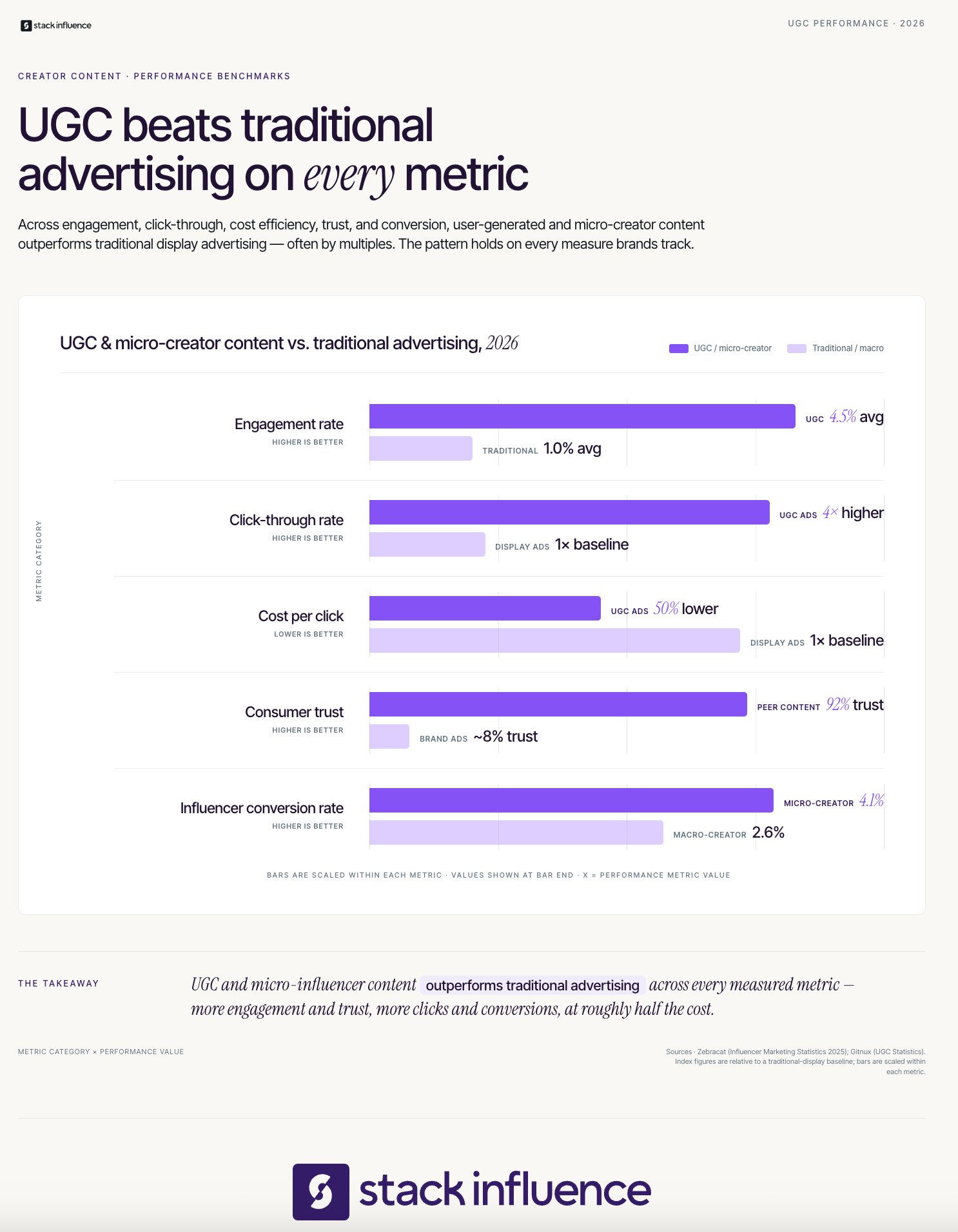
- The trust gap between peer-created content and branded messaging is growing: 92% of consumers trust recommendations from other people over traditional brand advertising.
- Micro influencers and nano influencers deliver higher ROI per dollar than macro creators, making them the first choice for brands looking to scale creator partnerships cost-effectively.
- Amazon sellers and Amazon FBA brands are increasingly using the Amazon Influencer Program, Amazon Attribution, and the Amazon Brand Referral Bonus to measure and reward the external traffic that UGC creators drive.
- Creators who understand the Signal-to-Content Framework can position themselves as strategic assets, not just content vendors, when pitching influencer campaigns to brands.
How Content Creators Can Rethink Their Role in Brand Marketing
The creator economy has a positioning problem. Many content creators still pitch themselves as distribution channels, quoting follower counts and reach numbers to prospective brand partners. That framing made sense when broadcast reach was the dominant metric in marketing. It does not reflect how DTC brands and Amazon sellers actually evaluate creator performance today.
Brands looking for influencers in 2026 are primarily sourcing two things: trust signals and reusable assets. A trust signal is any piece of content that a genuine person created about a product without it looking like an ad. A reusable asset is a photo, video clip, or testimonial that the brand can repurpose across paid social, product pages, email, and even their Amazon storefront. Once brands start collecting customer-generated photos, videos, and testimonials, tools like UGCify can help organize and display that content on WooCommerce product pages through shoppable galleries, making it easier to turn authentic customer experiences into conversion-focused social proof.
The shift toward UGC video and authentic short-form content is not a trend to wait out. It is a structural change in how influencer marketing operates at the campaign level. Creators who adapt their pitch around content quality, usage rights, and conversion outcomes will consistently win more brand deals than those still selling audience size alone.
Here is what to start doing differently right away:
- Lead with content deliverables, not follower count. Brands want to know what you will produce and whether they can use it in ads.
- Offer usage rights proactively. Making it easy for brands to repurpose your content extends the value of a single collaboration significantly.
- Show engagement data, not just impressions. A 5% engagement rate on 15,000 followers is more compelling to most eCommerce buyers than 500,000 impressions with 0.3% engagement.
- Ask about attribution goals. Brands running Amazon Attribution campaigns want to know you understand that your link drives measurable traffic, not just views.
Nano influencers who specialize in a single category, such as home organization, skincare, or fitness supplements, are particularly well-positioned. Their audiences are small but precise, and precision is what drives conversion for niche product categories.
What Is UGC vs Traditional Advertising?
User-generated content (UGC) is any content created by a real person about a product, service, or brand, whether that person is a paying customer, a gifted reviewer, or a professional UGC creator hired specifically to produce authentic-style assets. Traditional advertising is brand-controlled content produced through agencies or in-house teams, designed to broadcast a message to a mass audience through paid media placements like TV spots, banner ads, or paid search.
The practical difference comes down to origin and perception. Traditional ads are recognized as brand messaging, which means consumers apply a credibility discount automatically. UGC carries no such discount because it appears to originate from someone with no commercial motive, or at least a less obvious one. That credibility gap is the entire economic engine behind influencer marketing platforms and UGC platforms.
According to Fortune Business Insights, the global UGC platform market is projected to grow from $8.48 billion in 2026 to $64.31 billion by 2034, registering a CAGR of 28.8%. That projection is not driven by novelty. It reflects brands reallocating budget from channels that are losing consumer trust toward formats that hold it.
For creators, understanding this definition at a structural level matters because it determines where you sit in a brand's content strategy. You are not replacing a TV commercial. You are providing the trust layer that a TV commercial cannot manufacture, and that distinction is worth a premium to the right brand partners.
Here are the key content types that fall into each category:
- Traditional advertising: TV commercials, display banners, radio spots, out-of-home placements, branded social media posts produced by an agency creative team.
- UGC: Organic product reviews, unboxing videos, creator-produced short-form content, customer testimonials, try-on hauls, tutorial-style demos filmed in real environments.
- Hybrid formats: Creator content that a brand whitelists for paid promotion, known as Meta Partnership Ads or TikTok Spark Ads, which carry the creator's handle but run as paid placements.
The hybrid category is where the majority of high-growth eCommerce spend is flowing right now, because it combines the targeting precision of paid advertising with the trust signals of authentic creator content.
The Signal-to-Content Framework
The Signal-to-Content Framework is the primary decision model for understanding where any piece of content falls on the UGC-to-advertising spectrum, and more importantly, how to maximize the strategic value of what you create. It maps every content deliverable against two variables: authenticity signal strength and commercial reusability. Creators who consistently score high on both dimensions command the best brand deals and the longest-lasting creator partnerships.
The framework has four quadrants, described as a bulleted decision model rather than a table:
- High Signal, High Reusability (Tier 1 Assets): Raw, unscripted demo videos filmed in real settings, honest reviews with visible product in use, before-and-after content with genuine reactions. These are the most valuable assets because brands can run them in paid ads while retaining the authentic feel that makes UGC outperform traditional creative.
- High Signal, Low Reusability (Tier 2 Assets): Organic social posts that perform well for awareness but are too platform-native or time-sensitive to repurpose in ads or on product pages. Valuable for reach metrics but limited asset life.
- Low Signal, High Reusability (Tier 3 Assets): Professionally styled creator content that looks polished and branded. Highly reusable but loses the peer-content credibility that drives conversion. Closer to traditional advertising than UGC.
- Low Signal, Low Reusability (Tier 4 Assets): Generic sponsored posts with obvious ad copy. Performs poorly in organic algorithms and offers little to brands as reusable creative. Avoid building your portfolio around this quadrant.
Research from Zebracat shows that micro-influencer campaigns achieve conversion rates of 4.1%, compared with 2.6% for macro-influencer campaigns, and that 61% of brands report higher ROI from micro-influencers than macro-influencers. The Signal-to-Content Framework explains why. Micro influencers naturally produce Tier 1 and Tier 2 assets because their content style is rooted in genuine category interest, not broadcast performance.
According to Sociallypowerful, nano influencers have engagement rates of 6 to 9%, while micro influencers' engagement rates range around 3 to 5%, and brands using influencer marketing are 2.3 times more likely to meet their campaign goals than those relying only on traditional ads. The engagement premium on smaller creator tiers is not a coincidence. It is the direct output of higher signal strength in the content those creators produce.
Stack Influence's internal campaign data shows that in beauty and personal care categories, micro influencers consistently deliver UGC reuse rates above 60%, compared to roughly 40% in general lifestyle categories. This difference maps precisely onto Tier 1 vs Tier 2 Signal-to-Content placement: category-specific creators produce content that brands can actually deploy in paid channels, which is why those partnerships generate repeat business rather than one-off brand deals.
When pitching a brand, walk through the Signal-to-Content Framework explicitly. Explain which tier their current content strategy is operating in, and show how your approach delivers Tier 1 assets that can run in their ad library. That conversation positions you as a strategic partner, not a platform vendor.
How Amazon Sellers and DTC Brands Are Evaluating UGC Creators
DTC brands and Amazon sellers evaluate creator partnerships differently from traditional advertisers, and understanding those differences will help you tailor your pitch for maximum effectiveness. Traditional advertisers measure brand reach and frequency. eCommerce brands measure traffic quality, conversion rate, and the revenue tied to a specific link.
For Amazon sellers running influencer campaigns, the measurement infrastructure is now sophisticated enough to trace individual creator traffic directly to product sales. Amazon Attribution is a free tagging tool that uses a 14-day last-touch model, allowing sellers to see exactly how much revenue a creator's link generated. The Amazon Brand Referral Bonus stacks on top of that attribution, averaging 10% back to the seller on product sales driven by off-Amazon traffic. The result is that a seller's effective cost to acquire a customer through a creator link is meaningfully lower than through paid search.
According to Carbon6's UGC strategy guide, the Amazon Influencer Program is specifically designed to create shoppable content directly on Amazon's platform, and Amazon says the Brand Referral Bonus averages 10% of product sales driven by eligible non-Amazon efforts, including purchases made within a 14-day attribution window. For creators who want to participate, building and optimizing an Amazon storefront through the Amazon Influencer Program is one of the most direct ways to demonstrate measurable sales attribution to brands.
Shopify influencer marketing operates similarly. DTC brands using Shopify can issue unique discount codes or affiliate links to individual creators, producing clean revenue attribution that does not exist in traditional advertising. Across campaigns managed on the Stack Influence platform, eCommerce brands that use creator-specific attribution links alongside product seeding programs see 25 to 35% more repeat creator activations, because the data gives them confidence to reinvest in relationships that are clearly moving revenue.
Here is what Amazon FBA sellers and DTC brands are looking for when evaluating a UGC creator:
- Demonstrated conversion ability: Past campaign performance with affiliate links, discount code redemption rates, or Amazon Attribution data.
- Category relevance: Niche-specific audiences that match the product's target customer closely.
- Content reusability: Whether the creator's output can be repurposed for sponsored brand video ads, Meta Partnership Ads, or product detail pages.
- Compliance awareness: Understanding of FTC disclosure requirements and Amazon's own content policies.
Creators who can speak fluently to all four of these criteria during a brand pitch are operating in a different tier than those who can only discuss followers and reach.
Why the Trust Gap Is Wider Than Most Brands Realize
There is a widely held belief in the creator economy that any influencer with a large following represents better value for a brand than a smaller creator, simply because more eyes on the content means more potential customers. That belief is not supported by the data, and the trust dynamics behind UGC vs traditional advertising explain exactly why.
A Nielsen Global Trust in Advertising study found that 92% of consumers trust peer recommendations over branded content, while Edelman's 2025 Trust Barometer found that 80% of consumers now look to peers rather than brand experts as the gold standard for accurate brand information. The trust advantage that UGC holds over traditional advertising does not scale linearly with follower count. A creator with 12,000 highly engaged followers in a specific niche often produces stronger trust signals than a macro-influencer with one million loosely affiliated followers across many categories.
The contrarian implication here is specific: brands that have been measuring influencer campaign success by total impressions are optimizing for a proxy metric that has a weak relationship to actual purchase intent. The alternative is to measure trust signal strength directly, using engagement rate as a proxy for audience responsiveness, and conversion rate as the downstream confirmation. Creators can help brands make this shift by proactively sharing both metrics in their pitch materials.
This is an actionable change you can make immediately. Pull the engagement rate and any available conversion data from your last three branded posts. Present those numbers before your reach statistics in every future pitch deck or creator brief. That reordering signals that you understand how eCommerce brands think, and it shifts the conversation from "how many people saw this?" to "how many people acted?"
From Stack Influence's experience running product seeding campaigns at scale, brands that shift their creator selection criteria from follower count to engagement-to-conversion alignment consistently see stronger return on ad spend during the first 60 days of a new influencer campaign. The trust gap only generates revenue when the creator's audience is genuinely predisposed to buy the product in question.
Measuring What Actually Matters: The UGC Performance Stack
Most articles about UGC performance list generic KPIs like impressions, reach, and engagement rate without explaining how those metrics connect to business outcomes for the brand. The UGC Performance Stack is a named metric model designed to give creators and brands a shared vocabulary for evaluating campaign performance across the full funnel.
The UGC Performance Stack has four layers, each building on the previous one:
- Layer 1: Signal Quality Score. Engagement rate divided by follower count, benchmarked against category averages. This is the upstream measure of how much the creator's audience actually responds to content rather than passively viewing it.
- Layer 2: Content Reuse Rate. The percentage of a creator's deliverables that a brand can repurpose in paid channels without reshooting. High reuse rate indicates Tier 1 Signal-to-Content placement and directly reduces brand content production costs.
- Layer 3: Attribution Conversion Rate. Revenue or orders generated per unique creator link click, measured via UTM tags, Amazon Attribution, or Shopify discount codes. This is the metric Amazon FBA brands use to decide whether to renew a creator relationship.
- Layer 4: Brand Referral Bonus Recovery. Exclusive to Amazon sellers. This measures how much of the campaign cost is recovered through the Brand Referral Bonus averaging 10% back on off-Amazon traffic. It changes the effective CAC calculation substantially.
As reported by Billo, Forrester research shows 68% of consumers identify UGC as the most authentic content format, up from 60% the previous year, while UGC registers as 9.8x more authentic than influencer content. That authenticity premium is not automatic. It depends on content that scores high on Layer 1 of the UGC Performance Stack, meaning the audience engages because they trust the creator's voice, not because the brand paid to boost the post.
According to Carbon6's UGC strategy guide, the Amazon Influencer Program is specifically designed to create shoppable content directly on Amazon's platform, and Amazon says the Brand Referral Bonus averages 10% of product sales driven by eligible non-Amazon efforts, including purchases made within a 14-day attribution window. Amazon influencers who understand Layer 4 of the UGC Performance Stack can use this data to show a seller their true cost of customer acquisition, which is a compelling argument for increasing creator fees.
Use the UGC Performance Stack as a reporting template at the end of every brand collaboration. Send the brand a one-page summary covering all four layers, even if some numbers are estimated. Brands that receive structured post-campaign data from creators are more likely to convert those relationships into long-term ambassador programs rather than one-off projects.
The Creator's Opportunity Inside the UGC Shift

The growth of UGC as a marketing category is not just good news for brands. It is a structural opportunity for content creators who position themselves correctly inside the creator economy. The key is understanding that the demand for UGC creators is not the same as the demand for influencers in the traditional sense.
Data from Zebracat's influencer marketing research shows UGC-based ads achieve 4x higher click-through rates and a 50% reduction in cost-per-click compared to traditional digital ads. That performance gap is what is driving brands to hire dedicated UGC creators, sometimes with no social following at all, specifically to produce content for their ad libraries. If you have the filming, editing, and storytelling skills to produce Tier 1 signal-content, your follower count is essentially irrelevant for this type of work.
There are now two distinct career paths inside the creator economy related to UGC. The first is the traditional influencer path: build an audience, charge for access to that audience through sponsored posts and brand sponsorships. The second is the UGC creator path: produce high-converting authentic content as a deliverable, charge for the content itself and the usage rights, and maintain a portfolio of UGC work that demonstrates conversion performance rather than reach.
The UGC Performance Stack applies differently across both paths:
- Influencer path creators should focus on Layers 1 and 3: demonstrating signal quality and attribution conversion rate to brands that want both distribution and trust.
- Pure UGC creator path creators should focus on Layers 2 and 4: demonstrating reuse rate and understanding how their content fits into a brand's paid media stack including Amazon Attribution and Brand Referral Bonus recovery.
Product seeding, a campaign structure where brands send free product in exchange for content, is one of the most accessible entry points into creator partnerships for early-stage creators. It requires no paid sponsorship negotiation, and it generates the portfolio content you need to demonstrate Tier 1 Signal-to-Content capability to future paying brands. Micro influencer agency networks and platforms that specialize in automated product seeding make it straightforward to participate in these campaigns at volume.
The second framework every creator should know is the Content Asset Ladder, a secondary named framework that organizes your deliverables by commercial value to the brand.
The Content Asset Ladder:
- Rung 1: Social post only. Standard organic post. Limited brand value beyond reach and engagement.
- Rung 2: Social post plus raw files. Creator provides the unedited video or photo files so the brand can recut, caption, and reformat for different placements.
- Rung 3: Rung 2 plus usage rights. Creator grants the brand permission to run the content as a paid ad under their handle or the brand's handle for a defined time period.
- Rung 4: Rung 3 plus platform whitelisting. Creator authorizes Meta Partnership Ads or TikTok Spark Ads, giving the brand full targeting control while the content runs under the creator's name.
- Rung 5: Rung 4 plus Amazon-native content. Creator produces content formatted for Amazon product pages, Creator Connections, or shoppable storefronts, and provides attribution data.
Every time you move a brand client from Rung 1 to a higher rung of the Content Asset Ladder, your fee should reflect that additional commercial value. Brands that understand the UGC Performance Stack will recognize this immediately and accept the pricing.
The brands that work with micro influencers consistently, rather than relying on one-time macro campaigns, are building sustainable content libraries through relationships like these. As a creator, every long-term brand ambassador relationship you build is not just recurring income. It is a case study in the Content Asset Ladder that makes your next pitch stronger.
Conclusion
The debate about UGC vs traditional advertising has essentially been settled by consumer behavior. Trust lives in peer content, conversion lives in authentic formats, and the ROI data consistently favors creator-driven content over broadcast advertising for eCommerce applications. What remains unsettled for most creators is how to translate this shift into better-paying, longer-lasting brand partnerships.
The Signal-to-Content Framework and the UGC Performance Stack give you two concrete tools to use in every campaign conversation. Apply the Signal-to-Content Framework to understand what tier your content operates in and how to move toward Tier 1. Apply the UGC Performance Stack to measure and report campaign outcomes in a language that DTC brands and Amazon sellers actually care about. Use the Content Asset Ladder to structure your deliverable packages so that every collaboration can grow in value over time.
The creator economy is not slowing down. Brands are committing more of their marketing budgets to creator-driven content every year, and the standards for what constitutes high-quality UGC are rising with that investment. Creators who understand the structural mechanics of UGC vs traditional advertising are the ones who will be invited into that increasing spend rather than watching it flow to someone else.