




The loudest advice circulating in creator communities right now tells you to chase open rates, post on a rigid schedule, and treat your Substack like a funnel. That framing misses the most important strategic shift happening in 2026: content creators who treat Substack as a standalone publishing tool are leaving serious money on the table. Creators who treat it as an audience ownership engine — one that feeds brand partnerships, UGC opportunities, and direct revenue — are building businesses that compound.
The gap between those two approaches is not about effort. It is about understanding what the platform actually rewards, and what the numbers say about where creator income is concentrated. This article gives you the strategic framework, the right metrics, and a clear-eyed view of the common misconceptions that keep most creators stuck below their earning potential.
Key Takeaways
- Substack for creators is most valuable as an owned-audience asset that complements social media, not replaces it.
- A niche-specific Substack converts free subscribers to paid at 4% to 10%, versus 1% to 2% for broad-topic publications.
- Open rate is the most overused metric on Substack; paid subscriber growth rate and revenue per subscriber are the metrics that actually predict income.
- Creators with a Substack can use their subscriber list as a credibility signal when pitching brand partnerships and brand sponsorship deals.
- The Creator Newsletter Launch Checklist and the Subscriber Value Tiers model give you a repeatable system for building and monetizing your audience.
What Is Substack for Creators?
Substack is a subscription-based publishing platform that allows content creators to publish newsletters, audio, and video directly to subscriber inboxes and earn money through paid subscriptions, brand deals, and digital products. Unlike algorithmic social media platforms, Substack delivers your content directly to opted-in readers with no feed competition. Writers retain ownership of their subscriber list and all content, which is a structural advantage that no social platform offers.
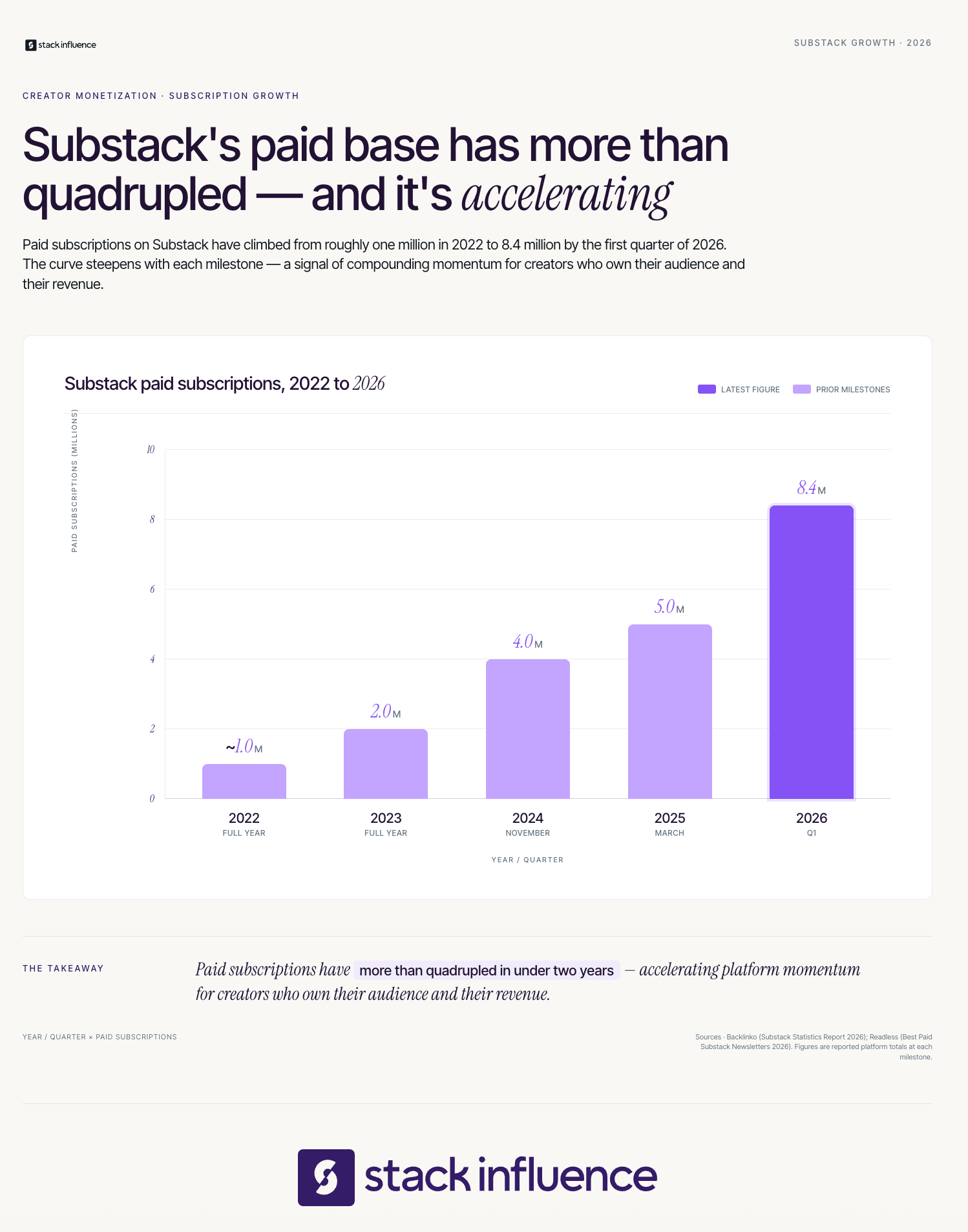
Bestwriting's 2026 Substack statistics report that nearly 100,000 publications earn money globally on Substack as of April 2026, up from 50,000 in May 2025. That doubling happened in under a year, signaling that monetization on the platform is accelerating sharply. According to Backlinko's Substack statistics report, the platform has more than 5 million paid subscriptions, a figure that has more than doubled since 2024.
The creator economy context matters here. The platform sits inside a broader ecosystem where UGC creators, micro influencers, and nano influencers are diversifying income across social media, product seeding campaigns, brand partnerships, and now newsletter businesses. Substack is not a replacement for those revenue streams. It is the anchor asset that makes all of them more valuable by giving you a direct, owned channel to your most engaged audience.
Here is why the platform is specifically powerful for creators rather than just journalists:
- Owned distribution: Your subscriber list belongs to you, not the algorithm, making it portable and durable across platform changes.
- Multi-format content: Substack supports text posts, audio, video, and live sessions, which means UGC video and short-form content assets can be repurposed natively.
- Direct monetization: Paid tiers, one-time payments, and founding member plans all create recurring revenue without requiring brand deals.
- Discovery via Notes: Substack's Notes feature functions like a short-form social feed, giving smaller creators a discovery surface that rewards consistency.
- Credibility signal: A newsletter with an engaged subscriber base makes you a stronger candidate when brands looking for influencers evaluate pitches.
For creators serious about building sustainable income from influencer campaigns, Substack gives you the one asset that influencer marketing platforms, brand ambassadors programs, and UGC platforms cannot provide on their own: a direct line to your most loyal audience that you control entirely.
The Creator Newsletter Launch Checklist: Your Pre-Publish Audit
Before publishing your first issue or before your next growth push, every creator should run through the Creator Newsletter Launch Checklist. This is the primary framework for this article, and it is specifically designed to prevent the most common errors that cause Substack newsletters to stall in the first 90 days. Return to this checklist any time you add a new content format, change your niche focus, or launch a paid tier.
The Creator Newsletter Launch Checklist has six items:
- Niche clarity audit: Can you explain your publication's topic and target reader in one sentence? If not, your conversion rates will suffer. Niche publications convert at 4% to 10%; general publications convert at 1% to 2%.
- Subscriber promise definition: Write your welcome email before you launch. The welcome email is your highest-traffic moment and sets the expectation that determines long-term retention.
- Content cadence commitment: Commit to a frequency you can sustain for 90 days without external pressure. Inconsistency is the single largest predictor of subscriber churn in the first quarter.
- Paid tier positioning: Decide what paid subscribers get that free subscribers do not. This should be one clear, specific deliverable — not a vague "exclusive content" promise.
- Notes activation: Set up your Substack Notes profile and commit to posting at least three times per week before your subscriber base is large enough to rely on Recommendations.
- Monetization milestone map: Define the subscriber count at which you will activate a paid tier, reach out for brand deals, and launch your first digital product. Creators who set these milestones before launch hit them faster than those who decide reactively.
Bestwriting's 2026 Substack statistics show that email open rates on Substack average 44%, roughly twice the industry standard. That number is the platform's most compelling structural advantage, but it is only valuable if you have subscribers who opted in because of a clear value promise. A high open rate on a vague newsletter produces clicks but rarely converts to paid subscribers or brand deals. Run the Creator Newsletter Launch Checklist before you scale your audience acquisition efforts.
Stack Influence's internal campaign data shows that creators who build their Substack around a single defined audience persona and pair it with micro influencer content campaigns consistently acquire paid subscribers at lower cost-per-subscriber than those running general-interest newsletters with no defined niche. The specificity of the niche is the variable that drives both paid conversion rates and the quality of the brand sponsorship inquiries the creator receives.
Turning Your Substack Audience Into Brand Partnership Leverage
Most guides treat Substack as a monetization tool in isolation, coaching creators to focus entirely on paid subscription growth. The underrated play in 2026 is using your Substack audience as a credibility and targeting signal when pitching brand deals, brand ambassadors programs, and influencer campaigns. A newsletter with 3,000 highly engaged subscribers in a specific niche is more persuasive to a brand than 30,000 social followers with diffuse interests.
According to the InboxReads sixth annual State of Newsletters report via ppc.land, 77% of newsletters indicated interest in sponsorships and advertising partnerships in 2025, up from 72% the prior year. That figure reflects the direction of creator monetization as a whole: brand deals and newsletter sponsorships are converging. Brands looking for influencers with owned-audience reach are beginning to evaluate newsletter metrics alongside social media metrics when selecting partners.
Data from Lumanu's 2025 influencer compensation report shows that micro influencers brought home an average of $38,500 in 2025, with brand partnerships accounting for $500 to $2,000 per post. A creator who supplements social-media-based brand deals with newsletter sponsorship revenue can meaningfully close the income gap between micro and mid-tier creator earnings without needing to grow their social following at all.
From Stack Influence's experience running micro influencer campaigns across consumer eCommerce brands, creators who arrive to a brand partnership pitch with documented newsletter metrics — open rate, subscriber count, niche demographic breakdown — close deals at higher rates and command premium rates compared to creators presenting social metrics alone. The newsletter is the proof-of-audience document that brand deal negotiations have historically lacked.
Here is how to position your Substack as a partnership asset:
- Audience demographics slide: Export your Substack subscriber data and prepare a one-page breakdown of your subscriber demographics, engagement rate, and top-performing content categories to include in brand pitch decks.
- Sponsored section rate card: Set a separate rate for newsletter sponsorships — a sponsored section in a Substack newsletter with 5,000 engaged subscribers can command $500 to $2,500 per issue depending on niche.
- Cross-platform bundle offer: Package your Substack sponsorship alongside your social media deliverables as a bundle, giving brands a multi-touchpoint campaign for a single negotiation. This is especially effective for Shopify influencer marketing campaigns where brands want owned-channel traffic.
- Case study archiving: Save subscriber response data from past sponsored issues so you can present click-through rates and reply volume as evidence of audience engagement quality.
- Brand alignment filter: Only accept newsletter sponsorships that align with your niche. Off-niche sponsorships reduce subscriber trust and hurt your conversion rate on future paid tier offers.
For creators participating in product seeding campaigns, a Substack newsletter gives you a second distribution surface to write longer-form reviews and drive brand attribution that goes beyond a single social post. Brands running influencer marketing platforms increasingly value this kind of deep-content amplification because it produces indexable, searchable content that continues driving traffic long after the original post fades.
The Subscriber Value Tiers: A Model for Sustainable Newsletter Growth
The secondary framework for this article is the Subscriber Value Tiers, a tiered model that maps your audience based on engagement depth and monetization potential. Unlike follower count metrics on social platforms, Substack gives you behavioral data that makes this segmentation possible and actionable. Reference the Subscriber Value Tiers whenever you are evaluating whether to prioritize subscriber acquisition, paid conversion, or brand deal development.
The Subscriber Value Tiers are structured as three distinct segments:
- Tier 1 (Paying Subscribers): These are your highest-value audience members and the engine of your recurring revenue. They have opted in twice — once to your list and once to your paid tier — signaling strong trust and niche alignment. Your paid tier content, community features, and direct communication investment should concentrate here. The retention rate of this segment is your most important business metric.
- Tier 2 (Engaged Free Subscribers): These readers open consistently, click links, reply to emails, and engage with Notes but have not yet upgraded. They are your highest conversion candidates and the group most likely to respond to limited-time upgrade offers, founding member pricing, or exclusive access events. Track this segment by click rate rather than open rate.
- Tier 3 (Passive Subscribers): These subscribers opened once or twice and have since gone quiet. They reduce your deliverability quality if too numerous and should be subject to re-engagement campaigns every 90 days. Creators who clean inactive subscribers quarterly from Tier 3 consistently see better open rates and higher paid conversion from their remaining active list.
The Subscriber Value Tiers model works because it replaces vanity subscriber count benchmarking with a segmentation lens that maps directly to revenue actions. Most creators celebrate raw subscriber growth without asking which tier those subscribers belong to. A newsletter adding 200 Tier 3 subscribers per month is growing slower than one adding 40 Tier 1 subscribers per month, even if the headline number looks better. Apply the Subscriber Value Tiers model when you design your content calendar, your upgrade sequences, and your brand partnership pitch materials.
Across campaigns managed on the Stack Influence platform, creators who maintain a healthy Tier 1 to Tier 2 ratio — with at least 1 paid subscriber for every 20 engaged free subscribers — generate significantly stronger brand partnership inquiry rates than those who optimize purely for total subscriber volume. The ratio matters because brands evaluating creators for ambassador and affiliate programs increasingly request engagement data, not just reach data. A smaller, highly tiered audience outperforms a larger undifferentiated one consistently.
How to Measure What Actually Matters on Substack

Most creators track open rate as their primary newsletter metric. That habit produces misleading data and slow optimization decisions. The correct measurement approach for Substack for creators in 2026 requires a defined model that separates vanity signals from revenue signals. This section introduces the Creator Revenue Metric Stack, your named measurement model for Substack performance.
The Creator Revenue Metric Stack has four components:
- Paid Subscriber Growth Rate (PSGR): The month-over-month percentage increase in paying subscribers. This is your leading revenue indicator and the number that determines whether your monetization strategy is working. A PSGR above 5% monthly signals healthy momentum.
- Revenue Per Subscriber (RPS): Total monthly subscription revenue divided by total active subscriber count. RPS exposes whether you are converting at the right price point for your niche. Niche publications in finance and technology regularly achieve RPS multiples well above the platform average.
- Click-to-Upgrade Rate (CTU): The percentage of Tier 2 engaged free subscribers who click a paid upgrade prompt. This metric tells you whether your upgrade copy, your timing, or your paid value proposition needs adjustment — long before revenue data shows a problem.
- Sponsor Click-Through Rate (SCTR): The percentage of recipients who click a sponsored link in a given issue. This is the metric brands will request when evaluating your newsletter for brand deal renewals. Track it from your first sponsored issue and include it in your rate card.
According to Beehiiv's State of Paid Newsletters 2026, paid subscription revenue on newsletter platforms hit $19 million in 2025, up 138% from 2024, driven by niche creators delivering specialized expertise. The operational insight from that data is that niche outperforms scale. A creator with 2,000 subscribers in a high-value niche who tracks RPS and SCTR will make faster, better monetization decisions than a creator with 20,000 subscribers who tracks only open rate.
The Creator Revenue Metric Stack complements the Subscriber Value Tiers model by giving you action-triggering numbers for each tier. When PSGR stalls, investigate your Tier 2 to Tier 1 upgrade flow. When RPS drops, audit your paid tier value proposition. When SCTR falls below your baseline, evaluate whether the sponsoring brand is genuinely aligned with your niche. These four metrics together tell the complete story of your Substack business health.
For creators who also run UGC campaigns or participate in influencer marketing campaigns, the Creator Revenue Metric Stack is also a reporting tool. Documenting your SCTR gives you a third-party verifiable benchmark that demonstrates newsletter performance to brand partners. It is the Substack equivalent of a social media engagement rate card, and it belongs in every creator's media kit by 2026.
What Should Creators Actually Prioritize on Substack?
As reported by ALM Corp's Substack digital marketing guide, Substack publications deliver a 45% open rate in a channel where 21% is considered average. Most guides use this statistic as a celebration. The smarter strategic move is to use it as a benchmark pressure point: if your publication is running below 35%, your niche positioning or content consistency has a problem that no posting schedule hack will fix.
The most common mistake creators make is treating Substack as a second priority — posting on social media first and syndicating content to their newsletter as an afterthought. That approach inverts the revenue logic. Your Substack subscribers are your highest-value audience because they have chosen to receive your content directly. They deserve original, first-priority content, not repurposed social captions. Creators who write for their newsletter first and repurpose to social consistently see higher paid conversion rates and more repeat brand deal inquiries.
The second most common mistake is launching a paid tier too early without a clear paid value proposition. According to Bestwriting's statistics report, 40% of Substack publications are free-only, and many of those creators have not yet identified what their paid subscribers would specifically receive that justifies the monthly cost. Launching a paid tier before that answer is clear produces low conversion rates and high churn — both of which damage your Creator Revenue Metric Stack scores.
Here is the priority sequence for creators at different stages:
- Months 1 to 3: Focus exclusively on niche clarity, consistent publishing, and Notes engagement to build the Tier 2 engaged free subscriber base.
- Months 4 to 6: Define your paid value proposition, set your upgrade sequence, and launch your paid tier with a founding member offer at a discounted rate.
- Months 7 to 12: Build your first media kit using your Creator Revenue Metric Stack metrics and begin pitching newsletter sponsorships to brands that work with micro influencers and niche content creators.
- Year 2 and beyond: Layer in digital products, cross-newsletter partnerships, and multi-platform brand bundles that treat your Substack as the anchor asset.
For creators interested in building influencer-brand partnerships at scale, the Substack audience is a force multiplier — not a standalone income source. The creators extracting the most value from the platform in 2026 are those who use it to deepen audience relationships that make every other revenue stream more productive. That is the strategic truth that most Substack guides fail to name directly.
Conclusion
Substack for creators is not a monetization shortcut. It is an audience ownership asset that, when built with niche clarity and measured with the right metrics, compounds in value faster than any algorithmic platform. The Creator Newsletter Launch Checklist, the Subscriber Value Tiers model, and the Creator Revenue Metric Stack give you a complete operational system for building, segmenting, and monetizing your newsletter in 2026.
Creators who commit to the platform with a defined niche, a realistic monetization sequence, and the habit of tracking Paid Subscriber Growth Rate and Revenue Per Subscriber alongside brand partnership metrics will find that Substack functions as the connective tissue between their social presence and their business income. The open rate is the invitation. What you do with the attention your subscribers give you is the strategy. Focus there first, and the revenue will follow.