




You spent hours building a post, filming a UGC video, or writing a brand deal recap, and it still sits on page four of Google. The culprit is often not the topic you chose but how you handled keywords inside the copy. Keyword stuffing is one of the most persistent and misunderstood traps in the creator economy, and it costs creators real organic visibility every week. This guide will show you exactly what it is, why it still triggers algorithmic penalties in 2026, and how to build a smarter content system that ranks without sacrificing your authentic voice.
Key Takeaways
- Keyword stuffing is a confirmed negative ranking factor that causes Google to demote or de-index pages, regardless of content quality in other areas.
- Google's AI systems, including BERT, now evaluate language context and intent, making repetitive keyword use both ineffective and actively harmful.
- A keyword density of 1 to 3 percent is a broadly cited safe range, but natural readability is a stronger practical guide than any fixed percentage.
- The antidote to keyword stuffing is not fewer keywords but smarter, topic-cluster-driven content that satisfies search intent holistically.
- Creators who produce UGC, run influencer campaigns, or manage brand partnerships benefit directly from learning SEO hygiene, because readable content converts at higher rates.
Why Keyword Stuffing Still Quietly Kills Creator Content
Many content creators assume keyword stuffing is an old problem solved by experience. In reality, it shows up constantly in captions, product review posts, and blog write-ups produced under deadline pressure. The behavior is often accidental: you repeat a phrase because it feels safer, or you mirror what a brand brief asks for, and suddenly your keyword density has crossed into spam territory. Understanding why this matters specifically for creators requires looking at how Google now processes and ranks content.
As confirmed by Search Engine Journal, keyword stuffing is a confirmed negative ranking factor, and attempting to manipulate search rankings with repeated uses of words or phrases will only cause a site to rank lower in Google's search results. That means a review post stuffed with a product name twelve times in 800 words does active damage, not just no good. The penalty is algorithmic and automatic in most cases, meaning there is no human review step and no second chance without a full content revision.
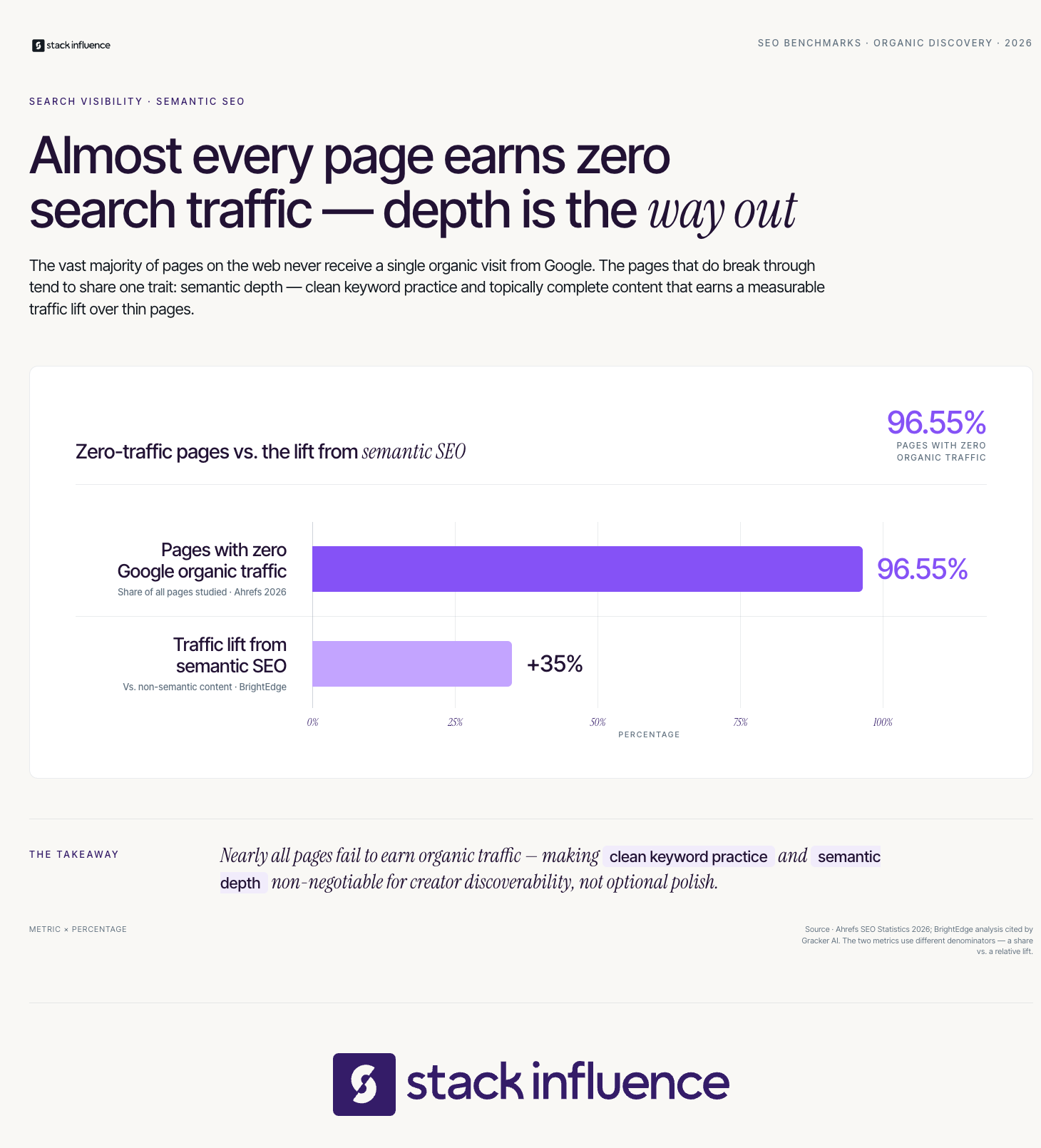
According to Ahrefs' 2026 SEO statistics, 96.55% of all pages get zero organic search traffic from Google, making every on-page decision, including keyword density, critically important to discoverability. Creators competing for organic reach are already operating in a brutally crowded field. Adding a spam signal like keyword stuffing on top of that challenge compounds the discoverability problem at exactly the wrong moment.
Here is why the problem persists despite being well-documented:
- Deadline pressure: Fast-turnaround content for brand deals often lacks the editing pass that catches over-repetition.
- Misunderstood briefs: Some brand briefs instruct creators to use a phrase a set number of times, which can push density above safe thresholds.
- Caption habits: Short-form captions with heavy hashtag blocks create dense keyword clusters that social platforms, and Google's crawlers, can flag.
- AI-assisted drafting: AI writing tools sometimes repeat core phrases across paragraphs when creators do not edit the output critically before publishing.
The fix is not to avoid keywords entirely. It is to apply a systematic process that keeps density in check while satisfying search intent with genuine depth.
What Is Keyword Stuffing?
Keyword stuffing is the practice of overloading a piece of content with a targeted keyword or phrase so frequently, or in such unnatural patterns, that it disrupts readability and signals manipulation to search engines. It can happen in visible body copy or in hidden elements like alt text, meta descriptions, and image file names. Both forms carry the same risk of algorithmic penalization.
According to Google's official spam policies, keyword stuffing refers to "filling a web page with keywords or numbers in an attempt to manipulate rankings in Google Search results." The policy explicitly identifies examples such as blocks of text listing cities or regions a page wants to rank for, and unnatural repetition of the same words or phrases throughout a page. These examples map directly to habits that show up in eCommerce product reviews and UGC video descriptions created for DTC brands.
There are two primary forms that creators should know:
- Visible stuffing: The same keyword or phrase appears so frequently in body copy that reading the content aloud sounds robotic or unnatural.
- Hidden stuffing: Keywords are embedded in page elements invisible to the reader, including white-on-white text, alt text overloading, or keyword-dense meta tags with no narrative function.
Both forms are detectable by Google's current spam systems. Hidden stuffing tends to draw harsher penalties because it signals intentional manipulation rather than accidental over-optimization. For creators publishing blog posts, YouTube descriptions, or product landing pages as part of creator partnerships, understanding both forms is the first line of defense.
The SIGNAL Principle Set: A Creator's Framework for Clean Keyword Use
The primary framework for avoiding keyword stuffing while maintaining strong SEO is the SIGNAL Principle Set. This is a Named Principle Set with five rules designed specifically for content creators working across formats including long-form blog posts, short-form video descriptions, and UGC captions. Reference the SIGNAL Principle Set whenever you are writing, editing, or reviewing any piece of content before it goes live.
The five named rules of the SIGNAL Principle Set are:
- Spread: Distribute your primary keyword across the content at natural intervals rather than concentrating it in the first three paragraphs. A well-spread keyword appears in the title, one early paragraph, one or two body sections, and the conclusion.
- Intent match: Every keyword placement should serve the reader's question, not the ranking goal. If removing the keyword from a sentence makes the sentence clearer, the keyword placement was probably serving the ranking goal, not the reader.
- Ground in synonyms: Use semantically related terms and synonyms throughout the piece to signal topical depth without repeating the exact phrase. Google's BERT algorithm reads synonym clusters as proof of subject-matter coverage.
- Naturalize the density: Aim for a keyword density of 1 to 3 percent for primary keywords as a rough guide, but prioritize reading the content aloud. If you sound like a robot, the density is too high regardless of the percentage.
- Audit the hidden zones: Before publishing, check alt text, image file names, meta descriptions, and heading tags separately. Keyword clusters in these hidden areas are invisible to readers but not to crawlers.
- Layer with topic clusters: Rather than repeating one keyword, build content that covers the broader topic at depth. According to Search Engine Land's guide to topic clusters, content grouped into clusters drives about 30% more organic traffic and holds rankings 2.5x longer than standalone pieces.
The SIGNAL Principle Set applies equally to blog posts written for brand deals, YouTube video descriptions, and long-form captions accompanying product seeding campaigns. Apply all five rules before any content leaves your drafts folder.
Data from Stack Influence's micro influencer campaigns suggests that creators who receive brand briefs with specific keyword guidance and then apply a natural readability edit before publishing consistently generate stronger organic discovery metrics on their review content than those who follow briefs verbatim without any SEO hygiene check.
The Contrarian Truth About Keyword Density Scores
Here is the belief that most creator SEO guides reinforce: hitting a specific keyword density percentage is the goal, and any number under 3 percent is safe. This is imprecise enough to be misleading.
According to Rankability's 2026 keyword density research, data shows a trend of decreasing average keyword density in higher-ranking search segments, suggesting that pages with a more moderate use of keywords tend to rank higher. The implication is not that you should chase a lower density number. The implication is that density is a symptom of content quality, not a dial you can tune independently. High-ranking pages are not achieving their rankings by targeting 1.2 percent density. They are writing naturally for humans, and the density falls into an acceptable range as a byproduct.
The specific belief to challenge: "I should calculate my keyword density and adjust it until it hits the green zone in my SEO plugin."
The alternative behavior: write until the content fully answers the search query, then run a single scan for obvious over-repetition. Replace two or three instances of the exact phrase with semantically related terms. Stop there. The metric you should actually track is whether the content answers the search intent completely, because that is what the SIGNAL Principle Set's Intent Match rule is designed to reinforce.
Research cited by Gracker AI shows that websites adopting semantic SEO strategies saw a 35% increase in organic traffic compared to those that did not, according to a BrightEdge analysis. Semantic SEO means covering a topic with breadth and depth using natural language, not fixating on exact-match repetition. This week, open your last three published pieces and read them aloud. Count how many times you say the same exact phrase. If you pass four repetitions in any 500-word section, replace two of them with a descriptive synonym or a related phrase. That single edit is more impactful than any density percentage tweak.
How Content Creators Should Apply the SIGNAL Framework in Practice

The SIGNAL Principle Set gives you the rules. This section gives you the repeatable process for applying them. Across campaigns managed on the Stack Influence platform, creators who follow a structured pre-publish keyword review produce content that earns measurably longer average session durations from readers arriving via organic search, compared to creators who write without any SEO framework in place.
The practical application workflow follows four steps:
- Write the full draft without counting keywords. Focus entirely on answering the reader's question or telling the story the brand deal requires.
- Run a quick readability test by reading two random paragraphs aloud. Flag any sentence where the primary keyword appears more than once.
- Apply the SIGNAL Principle Set's Synonym Grounding rule by swapping every third or fourth exact keyword match with a related phrase or descriptive term.
- Audit the hidden zones: check alt text, meta description, and any headings separately from body copy.
UGC video descriptions deserve their own note here. Creators often ignore description copy on YouTube and TikTok entirely, or paste in a keyword list as a substitute for a real description. A keyword-stuffed description does not serve viewers and signals manipulation to crawlers. Write your descriptions as a two-to-three sentence summary of what the video covers, then add two or three naturally placed keyword phrases. The result will outperform a keyword block every time.
Whop's 2026 UGC statistics report found that UGC on product pages increased conversion rates by up to 200%, highlighting how creator content designed for humans, not algorithms, delivers the most commercial value. That data point is the clearest argument for writing naturally. When UGC content reads like authentic recommendation rather than a keyword list, it converts. When it reads like stuffed copy, it does neither the ranking nor the conversion job well.
For creators building their own blogs or review sites as part of a micro influencer or nano influencer content strategy, the same workflow applies. The SIGNAL Principle Set is format-agnostic. Apply it to a 300-word caption or a 3,000-word product review with the same systematic approach.
The Creator's Keyword Audit Checklist
The secondary framework in this guide is the Creator's Keyword Audit Checklist. This is a Named Checklist with seven audit items designed to be run on any piece of content before publishing. Unlike the SIGNAL Principle Set, which is a writing philosophy, the Creator's Keyword Audit Checklist is a point-in-time verification tool. Use both frameworks together: write with SIGNAL, verify with the Checklist.
Run the Creator's Keyword Audit Checklist on every piece of content before it goes live:
- Primary keyword in title? The exact phrase or a natural variant should appear in the headline without being forced.
- Primary keyword in first 100 words? Early placement signals relevance to crawlers without requiring repetition later in the piece.
- Keyword density in acceptable range? Read aloud first. Then check with an SEO tool if you are still unsure. Flag anything above four percent.
- Synonyms and related terms present? At least three semantically related phrases should appear naturally across the full piece.
- Hidden zone audit complete? Alt text, file names, meta description, and headings checked individually.
- No consecutive keyword repetition? The same exact phrase should not appear twice in the same paragraph unless unavoidable for clarity.
- Topic fully answered? The strongest protection against keyword stuffing is content that genuinely covers the subject. If the reader still has unanswered questions after finishing, the content is not complete enough to rank well regardless of keyword handling.
Stack Influence's internal campaign data shows that brand partners whose product review briefs include a keyword audit checklist step before creator submission see fewer content revisions related to over-optimization and generate stronger average engagement rates on organic landing pages tied to those reviews.
Applying the Creator's Keyword Audit Checklist is particularly valuable for creators managing multiple brand deals simultaneously. Under that workload, systematic checklists prevent the rushed decisions that lead to keyword stuffing in the first place. Pair it with the SIGNAL Principle Set and you have a complete quality control system for any content format in the creator economy.
Measuring the SEO Health of Your Creator Content
Tracking whether your keyword strategy is working requires a named measurement model. The Creator SEO Health Stack is a four-component model for assessing the quality and organic performance of creator content over time. Reference the Creator SEO Health Stack monthly rather than post-by-post, since SEO signals accumulate across a content archive rather than within individual pieces.
The four components of the Creator SEO Health Stack are:
- Organic click-through rate (CTR): The percentage of searchers who see your content in results and click through. A rising CTR signals that your title and meta description are compelling and relevant, not overstuffed with keywords that read awkwardly.
- Average time on page: This metric reveals whether readers who arrive via search find the content useful. Keyword-stuffed copy drives high bounce rates and low time-on-page because the reading experience is poor. If time on page is falling while traffic is stable, over-optimization is often the cause.
- Keyword ranking range: Rather than tracking one primary keyword, monitor the total number of keywords a piece ranks for. Semantically rich content that avoids stuffing typically ranks for dozens of related phrases, not just the one you targeted.
- Organic discovery rate for UGC content: For creators who publish UGC video content or embed creator content on eCommerce pages, this tracks the percentage of page visitors who arrived via organic search versus direct or paid traffic. A rising organic discovery rate confirms that clean keyword practice is building cumulative discoverability over time.
From Stack Influence's experience running product seeding campaigns for eCommerce brands, sellers who integrate creator-produced review content into product pages using clean, naturally written descriptions see measurably better organic traffic to those pages over a 90-day window than brands repurposing keyword-heavy promotional copy from ad campaigns.
Use the Creator SEO Health Stack alongside both frameworks from this guide. The SIGNAL Principle Set governs how you write. The Creator's Keyword Audit Checklist governs your pre-publish review. The Creator SEO Health Stack governs how you measure and improve over time. Together, these three tools give you a complete, repeatable system for producing content that ranks without ever slipping into keyword stuffing.
For creators working with influencer marketing platforms or exploring influencer marketing agency partnerships, applying SEO hygiene to your content archive also strengthens your media kit. Brands looking for influencers increasingly evaluate organic reach alongside social metrics, and a content portfolio that ranks well on search signals professional-grade quality.
Conclusion
Keyword stuffing is not an advanced SEO problem. It is a fundamental content quality problem that happens to have algorithmic consequences. For influencers and content creators building sustainable careers in the creator economy, the ability to produce readable, search-friendly content is a competitive differentiator, not just a technical checkbox. The SIGNAL Principle Set gives you the writing philosophy. The Creator's Keyword Audit Checklist gives you the verification process. The Creator SEO Health Stack gives you the measurement model. Apply all three, stay honest with your density, and write first for the human reading your post. The rankings follow the quality, not the keyword count.