




Most Amazon sellers obsess over direct competitors sharing a Buy Box. But the threats eating into your revenue in 2026 are coming from somewhere else entirely. Amazon indirect competitors are platforms and channels that do not list against your products head-to-head, yet pull your potential buyers away before they ever search on Amazon. Understanding this distinction and building a strategy around it is one of the highest-leverage moves an eCommerce seller can make right now.
Key Takeaways
- Amazon indirect competitors are platforms that capture buyer attention and spending outside of Amazon's ecosystem without directly selling the same product on the same listing.
- TikTok Shop, Walmart eCommerce, and social commerce channels are the three most urgent indirect competitive forces reshaping where shoppers discover and buy products.
- Amazon sellers can use tools like Amazon Attribution and the Amazon Brand Referral Bonus to turn off-platform traffic into measurable margin improvements.
- UGC and micro-influencer content created outside Amazon can simultaneously drive off-Amazon discovery and feed Amazon storefront conversions.
- A structured competitive response using both a channel prioritization sequence and a readiness checklist gives sellers a repeatable framework rather than a reactive one.
How Amazon Sellers Should Think About This Threat First
Most Amazon FBA sellers frame competitive threats as other listings. A competitor is the brand two rows below you in search results, running a lower price or a better main image. This is the wrong frame for indirect competition. Indirect competitors are not fighting you for the Buy Box. They are fighting you for the buyer's attention, trust, and wallet before the buyer ever opens Amazon.
The practical implication is that no amount of Amazon PPC optimization defends against this threat. A shopper who discovers a product on TikTok Shop and buys it there never appears in your keyword data. Understanding indirect competition requires shifting your focus from in-platform metrics to full-funnel consumer behavior.
Here is what makes this category of competition particularly difficult for Amazon-first sellers:
- Discovery happens off-platform, so Amazon search volume and ranking data give no early warning signals.
- Loyalty forms around creator relationships and social context, not around product listings.
- Price comparison often never happens, because buyers purchase in the moment of content discovery.
- The channels driving this behavior are growing faster than Amazon in several key consumer segments.
Sellers who wait until indirect competition shows up in their own unit velocity declines are already behind. The right time to build a response is before the impact is visible in Seller Central.
What Are Amazon Indirect Competitors?
An Amazon indirect competitor is any platform, channel, or marketplace that competes for consumer purchasing dollars in the same product categories as Amazon, without appearing on Amazon's own marketplace. The definition has three components: same buyer, same need, different destination. A DTC brand's own website is an indirect competitor. So is a major retailer's eCommerce channel. So is a social commerce platform where content and checkout are merged into a single experience.
The indirect category is important for Amazon sellers because it represents the portion of market demand that Amazon's own algorithms cannot capture for you. No amount of listing optimization or Sponsored Products budget recovers a sale that happened somewhere else entirely.
There are three tiers of indirect competition in the current landscape:
- Platform competitors are full eCommerce marketplaces that function like Amazon but attract different shopper behaviors. Walmart's eCommerce platform is the clearest example.
- Discovery competitors are channels where buying intent forms before a marketplace is even opened. TikTok Shop, Instagram Shopping, and YouTube Shopping all fit this model.
- Direct-to-consumer competitors are brand-owned destinations, often DTC brands, that use creator content to pull buyers to proprietary checkout flows rather than Amazon storefronts.
Each tier requires a different strategic response, and understanding which tier is most active in your category is the first decision point in the framework introduced later in this article.
The Indirect Competitor Landscape: Where Buyers Are Going in 2026
The scale of the shift away from Amazon-first discovery is now quantifiable. According to eMarketer's social commerce forecast, US social commerce sales reached $87.02 billion in 2025, up 21.5% year over year, with TikTok Shop alone commanding 18.2% of that total. This is not an emerging trend. This is a functioning alternative buying channel at scale.
Stack Influence has observed that eCommerce brands running creator-led campaigns across TikTok and Instagram simultaneously see a 25 to 35% uplift in new customer acquisition compared to brands running Amazon-only traffic strategies, with discovery content consistently outperforming paid search in new-to-brand reach within beauty and home categories.
Walmart's trajectory adds another layer to this picture. According to Digital Commerce 360's Amazon vs. Walmart analysis, Walmart's eCommerce share grew from 4.4% in 2017 to a projected 10.6% in 2024, while Amazon's grew from 36.4% to 39.7% over the same period. Walmart is not catching Amazon overall, but it is capturing a specific type of buyer: price-sensitive, grocery-oriented, and increasingly comfortable with Walmart's digital interface.
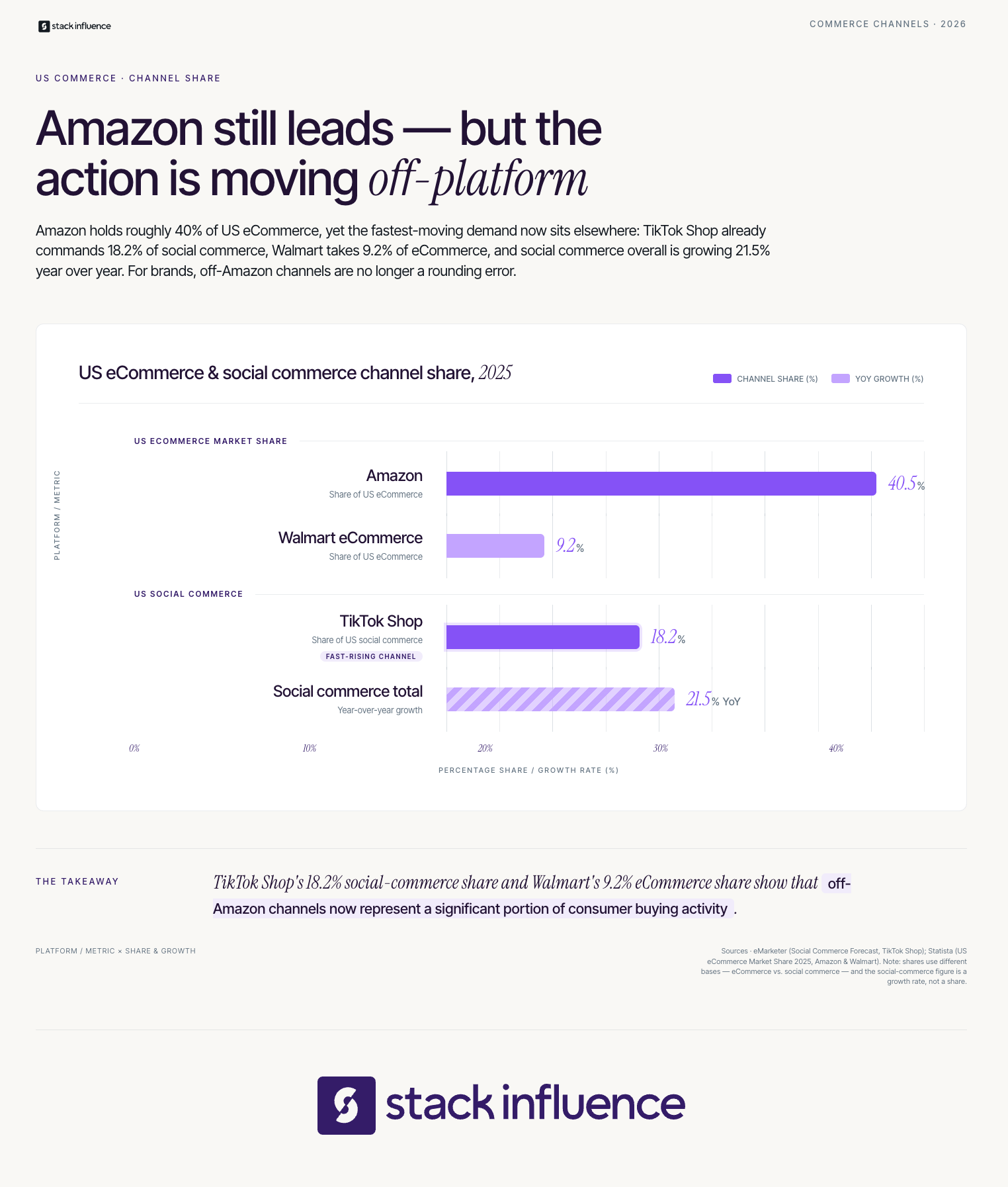
Here is what the 2026 indirect competitive landscape looks like by channel:
- TikTok Shop: $15.82 billion in US eCommerce sales in 2025, with a conversion rate of 4.7% versus 1.9% across other social platforms. Discovery-to-checkout happens inside a single app.
- Walmart eCommerce: Grocery-led market share of 26.9% in digital grocery, well ahead of Amazon's 18.5% in that category, according to Insider Intelligence data via Grocery Dive.
- Instagram and Facebook Shopping: Still commanding roughly 75% of non-TikTok social commerce volume, per eMarketer, with creator-led discovery driving significant product awareness.
- DTC brand channels: Increasingly powered by UGC and micro-influencer content, pulling brand-loyal buyers away from Amazon entirely for repeat purchases.
The UGC angle deserves special attention here. According to Emplifi's Q3 2025 Social Media Benchmarks report, social media posts featuring user-generated content drove 10.38 times higher conversion rates compared to non-UGC posts. This stat explains exactly why indirect competitors built on creator content are so effective: they are not just capturing attention, they are converting at rates that outperform traditional advertising by an order of magnitude.
The Channel Priority Sequence: A Framework for Responding
The primary framework for Amazon sellers facing indirect competition is the Channel Priority Sequence (CPS), a five-step process that moves sellers from awareness of the threat to active revenue capture from off-platform channels. The CPS is designed to be executed in order because each step builds on the intelligence and infrastructure from the previous one.
Step 1: Category Audit Identify which indirect competitor channels are most active in your specific product category. TikTok Shop dominates beauty and personal care. Walmart leads in grocery and household essentials. Instagram Shopping is strongest in fashion and lifestyle. Your category determines which threat is most urgent.
Step 2: Buyer Behavior Mapping Map where your target buyer spends time before searching on Amazon. Run a 30-day audit of creator content in your category on TikTok, Instagram Reels, and YouTube Shorts. Note which products are being featured, which creators are driving engagement, and whether those products are routing to Amazon or competitor destinations.
Step 3: Creator Channel Activation Activate micro-influencer product seeding to place your product in front of creators who already have audience trust in your category. The goal at this step is content creation and discovery, not immediate conversion. Partnering with Amazon influencers who can bridge social discovery to Amazon purchase is the highest-efficiency move here.
Step 4: Attribution Infrastructure Set up Amazon Attribution before driving any off-platform traffic. Amazon Attribution is a free measurement tool that allows sellers to create unique tracking links for external campaigns and tie off-Amazon clicks to Amazon purchases within a 14-day attribution window. Without this step, all off-platform revenue is invisible in your Seller Central data.
Step 5: Brand Referral Bonus Enrollment Enroll in the Amazon Brand Referral Bonus program, which according to Amazon's official Brand Referral Bonus documentation, pays sellers an average 10% bonus on qualifying sales driven by non-Amazon marketing. This bonus is applied as a referral fee credit, directly improving margins on every attributed sale from external channels.
The Channel Priority Sequence is not a one-time exercise. Sellers should run through steps 1 and 2 on a quarterly basis as the indirect competitor landscape shifts, and revisit steps 3 through 5 whenever entering a new product category or seasonal push.
Should You Compete on TikTok Shop or Route Traffic to Amazon?
This is the most operationally significant decision in the entire indirect competitor response, and most guides avoid giving a direct answer. The correct answer depends on three variables: your product's AOV, your fulfillment capacity, and your content supply chain. Let the Channel Priority Sequence from the previous section inform which option fits your situation first.
For sellers with products under $40, TikTok Shop's impulse-purchase dynamic and 4.7% conversion rate make native selling worth testing. For sellers with products above $60, Amazon's checkout trust and Prime delivery expectation make routing traffic to Amazon via Attribution links the higher-converting path. For sellers in both ranges, the Amazon Influencer Program offers a middle path: creators build Amazon storefronts where their audience can purchase directly, combining social discovery with Amazon's fulfillment infrastructure.
From Stack Influence's experience running product seeding campaigns across beauty, home, and wellness categories, brands that route micro-influencer traffic through Amazon Attribution links rather than DTC channels convert at 15 to 22% higher rates on the Amazon destination, because Prime members complete checkout faster and with less friction than on brand-owned sites.
Here are the decision factors that determine which routing is right for your brand:
- Route to Amazon if: Your product has Prime eligibility, your ASP is above $40, and your Amazon storefront has strong visual branding and review depth.
- Sell natively on TikTok Shop if: Your product has a strong visual or demo angle, your ASP is under $40, and you can fulfill quickly from your own warehouse or 3PL.
- Run both simultaneously if: You have the creator content supply chain to run independent campaigns per channel, and you can track attribution separately for each destination.
- Prioritize DTC if: You are a brand with significant repeat purchase potential and want to build owned customer data through email capture before sending buyers to any marketplace.
The Amazon Influencer Program is the cleanest bridge between social commerce and Amazon. Amazon influencers create shoppable storefronts on Amazon.com that function like curated social feeds, and buyers who click through from a creator's TikTok or Instagram content can purchase directly on Amazon without the friction of navigating a full search results page.
The Off-Platform Readiness Checklist
The secondary framework in this article is the Off-Platform Readiness Checklist (OPRC), a seven-item audit that sellers should complete before investing budget in any off-platform channel. Unlike the Channel Priority Sequence, which is a linear process, the OPRC is a yes/no diagnostic. Every "no" answer is a gap that must be closed before external traffic will convert efficiently.
Use the OPRC as follows:
- Amazon Attribution setup complete? If no, stop. Every off-platform sale is invisible until Attribution is live and all tracking links are generated.
- Brand Referral Bonus enrollment confirmed? If no, you are leaving a 10% fee credit on every external sale. Enrollment takes 15 minutes in Seller Central.
- Amazon storefront published and branded? An Amazon storefront is the landing destination for external traffic. Without a polished storefront, external clicks land on a generic listing page that loses conversions.
- UGC library with at least 5 assets in active use? Off-platform channels run on creator content. Sellers without a UGC library cannot scale creator activation efficiently.
- Creator brief finalized with Attribution link instructions? Every creator needs a pre-built Amazon Attribution link specific to their campaign. Including this in the brief removes a step that commonly causes tracking failures.
- 14-day attribution window aligned with campaign flight dates? Sales attributed to external traffic count for 14 days after the click. Campaign flights should run long enough to capture the full window.
- Storefront reviewed for mobile experience? The majority of creator-driven traffic arrives on mobile. If the storefront is not optimized for mobile browsing, conversion rates drop sharply.
The Off-Platform Readiness Checklist should be run against every new channel, every new creator partnership, and every seasonal campaign launch. It takes under ten minutes to audit and prevents the most common reasons external traffic campaigns fail to show up as revenue in Seller Central.
Measuring What Actually Matters: The External Traffic Metric Stack
Amazon FBA sellers accustomed to measuring ACoS and ROAS inside Seller Central need a different measurement model when dealing with indirect competitors and off-platform traffic. The External Traffic Metric Stack (ETMS) is a four-component model built specifically for the indirect competitor context.
The four components of the ETMS are:
- Attributed Revenue Per Creator (ARPC): Total Amazon sales attributed via Attribution links divided by the number of active creators in the campaign. This is the primary efficiency metric for influencer seeding campaigns.
- Net Referral Fee Rate: Standard referral fee percentage minus the Brand Referral Bonus credit percentage. This is the true cost of selling after Amazon's incentive is applied to external traffic.
- New-to-Brand Conversion Rate: Percentage of attributed sales from buyers who have no prior purchase history with your brand on Amazon. This metric captures the customer acquisition value of off-platform channels.
- 14-Day Attribution Lift: Difference in total sales velocity during the 14-day attribution window versus the baseline period before a creator campaign launched. This isolates the incremental revenue impact.
Across campaigns managed on the Stack Influence platform, eCommerce brands that track all four components of the External Traffic Metric Stack make attribution budget decisions 40% faster than brands tracking only ACoS, because the ETMS surfaces which creators and which channels are actually driving attributed revenue rather than just impressions.
According to Hector AI's analysis of 380 brand accounts, brands using Amazon Attribution alongside structured external traffic campaigns reduced their effective net referral fees by an average of 9.4%, a meaningful margin improvement that compounds significantly across high-volume campaigns.
The ETMS should be reviewed weekly during active creator campaigns and monthly as a portfolio-level audit. The most important single number in the model is the Net Referral Fee Rate, because it reveals whether the Brand Referral Bonus is functioning correctly and at what scale it needs to reach to justify increasing creator spend.
A Genuinely Overlooked Strategy: Turning Indirect Competitors Into Traffic Sources

Here is the angle that most Amazon indirect competitor guides miss entirely. TikTok Shop, Instagram Shopping, and Walmart's marketplace are not just threats. They are high-intent traffic environments where buyers are already in a purchasing mindset, and sellers who participate in those environments on purpose can route a portion of that intent back to Amazon.
This is not a theoretical position. According to ringly.io's TikTok Shop statistics report, 97% of US TikTok Shop shoppers also shopped on Amazon in the past year. These are not separate buyer populations. They are the same buyers using multiple channels. A creator who posts on TikTok Shop can also link to an Amazon storefront in their bio or video description. A seller who participates in Walmart's marketplace gains access to a buyer demographic that increasingly overlaps with Amazon's core Prime base.
The practical playbook for turning indirect competitor platforms into traffic sources involves three moves:
- Creator content syndication: Work with micro-influencers across multiple platforms and brief them to include both a TikTok Shop affiliate link and an Amazon storefront link in their content. Track each destination with separate Attribution tags to compare conversion rates.
- Amazon storefront as brand hub: Build an Amazon storefront that functions as the permanent landing destination from all external creator content. The storefront should include UGC, video content, and product story sections that mirror the social content buyers have already seen.
- Influencer-to-email bridge: Route DTC channel traffic from creator content through an email capture step before checkout. This builds a first-party audience that can be reactivated for both Amazon-driven and DTC campaigns, reducing dependence on any single channel.
Stack Influence's internal campaign data shows that Amazon sellers who deploy creator content across at least two off-platform channels while maintaining a structured Amazon storefront as the conversion destination see 30 to 45% higher total attributed revenue over a 90-day campaign window compared to sellers using single-channel creator strategies.
The Amazon Influencer Program is the most underused lever in this strategy. Amazon influencers earn commissions on storefront sales, which means their incentive is to drive qualified traffic to Amazon. Sellers who activate micro-influencer promotions on platforms where indirect competitors are strong get the benefit of both social discovery and Amazon's conversion infrastructure in a single campaign structure.
Conclusion
Amazon indirect competitors are no longer a future threat to monitor. TikTok Shop crossed $15.82 billion in US sales in 2025, Walmart's eCommerce share has more than doubled since 2017, and social commerce as a whole is on track to surpass $100 billion in 2026. For Amazon sellers, the question is no longer whether these channels are significant but how fast to build a structured response.
The Channel Priority Sequence and the Off-Platform Readiness Checklist give sellers a starting point that is practical, sequential, and measurable. The External Traffic Metric Stack provides the measurement model that makes off-platform investment legible alongside Seller Central data. And the Brand Referral Bonus, paired with Amazon Attribution, means that driving external traffic to Amazon is not a cost center but a margin improvement tool available to every Brand Registry seller today.
The sellers who treat amazon indirect competitors as a source of strategic intelligence, and a source of off-platform traffic they can redirect, will be the ones gaining market share in categories where everyone else is watching rankings fall and wondering why.