




Seller Fulfilled Prime can give Amazon sellers Prime visibility without sending every unit into Amazon FBA, but it also transfers the Prime delivery promise to the seller’s own fulfillment operation. That tradeoff makes SFP less of a shipping setting and more of an operating system for inventory, labor, carriers, customer promises, and demand planning.
For ecommerce brands, the key question is not simply whether the Prime badge could help. It is whether each SKU can support fast, free delivery at a reliable contribution margin. This guide explains the 2026 requirements, trial, costs, FBA comparison, readiness framework, measurement model, and the often-overlooked connection between marketing volume and fulfillment risk.
Key Takeaways
- Seller Fulfilled Prime lets qualified merchant-fulfilled offers display Prime branding after the seller passes Amazon’s trial and maintains program standards.
- Amazon increased several delivery-speed thresholds on July 6, 2026, making customer-facing delivery promises a central compliance issue.
- SFP economics should be modeled by SKU, package size, warehouse, and destination zone, not with one blended shipping average.
- A seller should enter the trial only when promise coverage, weekend operations, carrier resilience, capacity controls, unit economics, and monitoring are all ready.
- Advertising, Amazon influencers, seasonal deals, and creator campaigns can create demand spikes that overwhelm an otherwise compliant fulfillment system.
What Is Seller Fulfilled Prime?
Seller Fulfilled Prime is an Amazon program that lets qualified sellers display the Prime badge on products they store, pick, pack, and ship through their own operation or a third-party fulfillment partner. Sellers must pass a trial and continually meet Amazon’s delivery-speed, tracking, cancellation, and customer-experience standards.
Amazon’s official Seller Fulfilled Prime program page explains that sellers can choose enrolled products, storage facilities, integrated carriers, and packaging while retaining control of fulfillment. Amazon handles post-order customer service, returns, refunds, and adjustments for SFP items, while the seller handles pre-order buyer questions.
SFP is best understood as a qualified version of Fulfilled by Merchant. Standard FBM gives the seller control over inventory and shipping, but it does not automatically add Prime branding. The Amazon FBA versus FBM guide provides a broader comparison of those fulfillment models.
What Changed for Seller Fulfilled Prime in 2026?
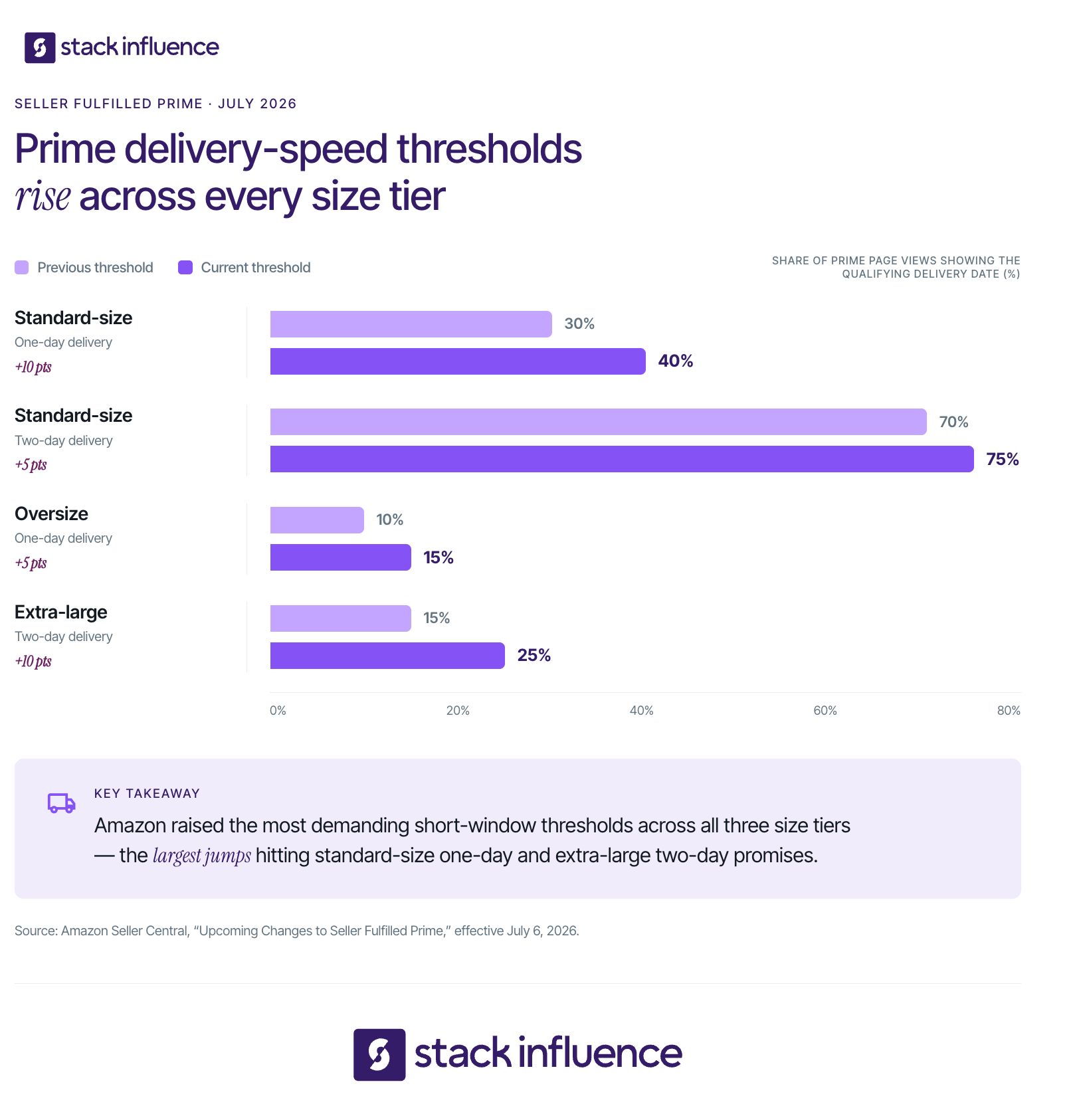
Seller Fulfilled Prime became more demanding on July 6, 2026, when Amazon increased several delivery-speed thresholds. The current rules measure the percentage of Prime customer page views that display qualifying delivery dates, not the percentage of orders ultimately delivered within those windows. Sellers therefore must manage both displayed promises and actual delivery performance.
Current minimum delivery-speed requirements are evaluated by product size tier:
- Standard-size: At least 40% of Prime customer page views must show delivery within one day, 75% within two days, and 90% within five days.
- Oversize: At least 15% must show delivery within one day, 45% within two days, and 80% within five days.
- Extra large: At least 25% must show delivery within two days and 60% within five days. There is no one-day threshold for this tier.
The July update raised standard-size one-day coverage from 30% to 40%, standard-size two-day coverage from 70% to 75%, oversize one-day coverage from 10% to 15%, and extra-large two-day coverage from 15% to 25%. Amazon’s upcoming Seller Fulfilled Prime changes also describe a zip-code-level delivery-promise tool planned for September 2026.
Amazon is temporarily excluding weekend page views from speed-metric evaluation from May 31 through October 17, 2026. That transition does not remove the program’s weekend fulfillment obligations, so sellers should not treat it as permission to pause weekend operations.
A seller can ship accepted orders on time yet miss the speed requirement if too many shoppers see slower dates before ordering. Templates, cutoffs, inventory location, and carrier coverage all influence the displayed promise.
What Are the Seller Fulfilled Prime Requirements?
Seller Fulfilled Prime enrollment has three stages: prequalification, a monitored trial, and ongoing compliance. A Professional selling account and domestic United States default ship-from address are required. Amazon then evaluates recent merchant-fulfilled performance, trial volume, delivery promises, tracking, cancellations, and continued weekly performance.
Prequalification
Amazon’s current SFP trial and enrollment requirements state that sellers must meet the following criteria during the preceding 90 days:
- Ship at least 100 seller-fulfilled packages.
- Keep the cancellation rate below 2.5%.
- Maintain a valid tracking rate above 95%.
- Keep the late shipment rate below 4%.
- Use a Professional selling account and a domestic United States default shipping address.
Newer sellers should build a stable FBM record first. The guide to becoming an Amazon seller in 2026 places fulfillment choice within broader marketplace readiness and unit economics.
Trial Requirements
Amazon’s public program page describes the SFP trial as 30 days. During the trial, enrolled offers do not display the Prime badge. The seller must ship at least 100 Prime trial packages and meet the applicable speed and performance thresholds.
The core trial and enrollment performance thresholds include:
- On-time delivery of at least 93.5%.
- Valid tracking of at least 99%.
- Seller-initiated cancellation of no more than 0.5%.
- Delivery-speed compliance for the relevant size tier.
Treat the trial as an audit, not a learning period. Carrier mappings, weekend staffing, cutoffs, exception handling, inventory accuracy, and capacity limits should work before the first tracked week. Amazon currently limits sellers to three trial attempts per calendar year.
Ongoing Enrollment
Amazon reviews SFP performance weekly. Repeated failure can disable Prime offers and lead to disenrollment, while the seller’s performance dashboard and business reports identify the requirements causing the problem. Amazon also lets sellers cap daily same-day, one-day, and two-day Prime order volume according to dependable warehouse capacity.
How Does Seller Fulfilled Prime Work?
Seller Fulfilled Prime works by combining merchant-controlled fulfillment with Amazon-controlled Prime eligibility and customer-facing delivery promises. The seller chooses eligible SKUs and fulfillment locations, configures Prime shipping coverage, passes the trial without displaying the badge, and then maintains weekly standards after Prime branding becomes active.
A practical workflow is:
- Build merchant-fulfilled history: Meet the 90-day prequalification metrics.
- Model eligible SKUs: Choose products whose margins and inventory positions support Prime delivery.
- Configure coverage: Set accurate regions, cutoffs, weekends, carriers, and size-tier templates.
- Run the trial: Meet the required volume, speed, and quality thresholds.
- Activate Prime offers: The badge appears after the trial is passed.
- Control and monitor: Review performance weekly and cap daily Prime orders before capacity strains.
Sellers can use Amazon Buy Shipping to purchase labels, compare integrated carrier services, automate tracking confirmation, and access certain account-health protections when eligibility conditions are met. Amazon also allows sellers to connect supported carrier accounts and use their own negotiated rates.
How Much Does Seller Fulfilled Prime Cost?
Seller Fulfilled Prime does not have one universal per-order program price. Amazon’s public page lists the Professional plan at $39.99 per month plus normal selling fees, while the seller pays its own warehousing, labor, packaging, postage, surcharges, returns, software, and exception costs. The real answer depends on each SKU and delivery zone.
Amazon’s selling plan pricing should be separated from the fulfillment economics. Amazon announced a 2% SFP fee in 2023 but withdrew it before implementation, and the current public SFP page does not list that fee. Reuters reported the reversal.
Use the SFP Cost Stack to calculate contribution margin for every candidate SKU:
- Marketplace costs: Referral fees, selling-plan allocation, refunds, and category charges.
- Product costs: Cost of goods, inbound freight, duties, prep, and carrying cost.
- Pick-and-pack costs: Labor, 3PL charges, packaging, labels, and materials.
- Transportation costs: Postage, surcharges, dimensional weight, remote zones, and weekend services.
- Exception costs: Reships, claims, concessions, returns processing, and manual support.
- Capacity costs: Overtime, temporary labor, backup carriers, and peak inventory positioning.
The basic SKU equation is:
SFP contribution margin = selling price minus referral fees, product cost, pick-and-pack cost, packaging, outbound shipping, return reserve, and allocated operating costs.
Do not use one nationwide shipping average. Model local, regional, and long-distance scenarios because a profitable nearby order can become unprofitable when a distant destination requires premium service. This is one reason order fulfillment can break ecommerce growth while topline sales are rising.
How Does Seller Fulfilled Prime Compare With Amazon FBA?
Seller Fulfilled Prime and Amazon FBA can both produce Prime-eligible offers, but they assign operational responsibility differently. With FBA, inventory enters Amazon’s network and Amazon performs fulfillment. With SFP, the seller or its fulfillment partner controls inventory and shipping while meeting Amazon’s Prime standards. Many brands use both by SKU.
Amazon’s official FBA and FBM comparison confirms that sellers can combine fulfillment methods across eligible products. The right comparison is therefore not “SFP or FBA for the entire catalog.” It is “which method creates the strongest service level and contribution margin for this SKU?”
- Operational control: SFP preserves control over storage, packing, inventory allocation, and outbound execution. FBA outsources those functions to Amazon.
- Prime eligibility: FBA inventory is generally Prime eligible through Amazon’s network. SFP inventory receives Prime branding only after qualification and continued compliance.
- Cost structure: FBA uses Amazon’s fulfillment and storage fee structure. SFP replaces those costs with the seller’s warehouse, labor, packaging, carrier, and risk costs.
- Inventory flexibility: SFP can suit products already positioned in a DTC or wholesale network. FBA can simplify high-volume Amazon fulfillment but requires inventory placement inside Amazon’s system.
- Customer service: Amazon handles post-order support and returns for both FBA and SFP, although the seller still owns the physical SFP fulfillment operation.
A hybrid model can place fast-moving standard-size products in FBA and use SFP for oversized, customized, seasonal, fragile, or multichannel inventory when Prime economics work.
The Prime Promise Readiness Model
The Prime Promise Readiness Model is a six-gate framework for deciding whether a SKU should enter Seller Fulfilled Prime. Do not begin the trial with a red gate. Yellow gates require documented mitigation, while green gates have been proven through live merchant-fulfilled orders.
1. Promise Coverage
Measure likely delivery dates by destination and size tier. A fast warehouse can still fail if its location, carrier map, or cutoffs do not create enough qualifying page views.
2. Operating Cadence
Document cutoffs, weekend picking, pickups, holidays, staffing, and backups. The process must work during ordinary and peak shifts without depending on one experienced employee.
3. Carrier Resilience
Use more than one viable service where possible. Track first scans, transit consistency, zone coverage, pricing, and claims. Resilience requires an alternative that can preserve the promise during disruption.
4. Capacity Control
Set a verified daily ceiling by shift and package type. Use Prime order controls before the warehouse reaches its maximum, accepting only the volume that can be fulfilled reliably.
5. Unit Economics
Run the SFP Cost Stack for normal, distant-zone, return, and peak-labor scenarios. A SKU passes only if the business is comfortable with the downside case, not merely the blended average.
6. Monitoring Discipline
Assign owners for page-view speed, delivery, tracking, cancellations, shipping cost, inventory exceptions, and order caps. Dashboard access without a response process is not monitoring.
Before registration, run a four-week shadow trial using the intended SKUs, cutoffs, staffing, carriers, and weekend schedule. Compare displayed promises, actual delivery, cost per order, and exception rates against the live SFP requirements. This exposes structural problems before the Prime badge and enrollment are at risk.
Marketing Can Break the Prime Promise
The most overlooked SFP risk is successful demand generation. A seller may pass at ordinary volume, then miss cutoffs when a promotion, email, paid campaign, or creator post causes a spike. Marketing and fulfillment need one shared capacity calendar.
Amazon sellers using the Amazon Influencer Program or trying to find Amazon influencers and their storefronts should forecast hourly order concentration, not just total sales. A storefront feature or coordinated posts can compress demand into a few hours.
Stack Influence is designed around gifted-first product seeding, vetted micro-influencer activation, campaign coordination, UGC generation, and completed-post accountability. For an SFP seller, the practical use case is pacing creator activations against inventory, warehouse throughput, carrier pickups, and Prime order limits instead of treating marketing and fulfillment as separate plans.
This also matters for DTC brands running Shopify influencer marketing. Campaigns may draw from shared Shopify, FBA, and SFP inventory, so set channel safety stock and routing rules before content goes live.
The safest release pattern is controlled waves. Start with a small creator cohort, observe hourly order arrival and shipping cost, then release the next group only if capacity remains green. Stack Influence’s Amazon influencer marketing workflow is particularly practical when a brand wants product seeding, creator coordination, and completed content managed as a connected campaign.
The Seller Fulfilled Prime Measurement Stack

Measure Seller Fulfilled Prime as a chain from eligibility to economics to commercial outcomes. Sales can hide deteriorating service, while perfect shipping metrics can hide unprofitable transportation. Separate leading indicators from outcome metrics.
Layer 1: Eligibility Metrics
Review these daily and weekly:
- Delivery-speed page-view compliance by size tier.
- On-time delivery rate.
- Valid tracking rate.
- Seller-initiated cancellation rate.
- Prime offers at risk, disabled, or reinstated.
These are leading indicators because a decline can threaten future Prime availability before revenue visibly changes.
Layer 2: Operating Economics
Track shipping cost, labor, premium-service usage, first-scan failures, exceptions, returns, and contribution margin. Segment by SKU, warehouse, carrier, service, and destination because blended averages conceal damaging orders.
Layer 3: Commercial Outcomes
Measure sessions, conversion rate, Featured Offer share, units, revenue, cancellation-adjusted sales, and contribution profit. Amazon says Prime branding can improve the likelihood of becoming the Featured Offer and gaining visibility, but a seller’s before-and-after results still do not prove that SFP alone caused a commercial change.
Use a four-week pre-period and post-period when seasonality is stable. Compare enrolled SKUs with similar non-enrolled products and annotate price, promotion, advertising, stockout, review, and competitor changes instead of attributing every movement to the badge.
Layer 4: External Demand Attribution
Eligible brand-registered Professional sellers can use Amazon Attribution to measure non-Amazon search, social, display, video, and email activity. The reporting includes clicks, detail-page views, add-to-cart activity, purchases, units, sales, and new-to-brand metrics within Amazon’s stated attribution window.
The Amazon Attribution and Brand Referral Bonus guide explains how the tools connect. Amazon’s Brand Referral Bonus can credit an average of roughly 10% of qualifying attributed sales against referral fees, with rates varying by category. Configure tags by channel or creator to pace demand against capacity.
Is Seller Fulfilled Prime Worth It?
Seller Fulfilled Prime is worth evaluating when a seller already has dependable merchant fulfillment, advantageous carrier rates, suitable inventory locations, and SKUs whose margins can absorb Prime-level delivery. It is less about avoiding FBA and more about using the seller’s own network where that network creates a better operational and economic result.
SFP is especially practical when:
- The business already fulfills Amazon, Shopify, wholesale, or retail orders from shared inventory.
- Oversized, customized, fragile, seasonal, or specialized products are expensive or awkward to place in FBA.
- The seller has reliable weekend operations and more than one carrier option.
- SKU-level shipping economics remain profitable across realistic destination zones.
- The team can monitor performance and reduce Prime order volume before service deteriorates.
A seller should delay enrollment when the model depends on optimistic postage estimates, one critical employee, one fragile carrier service, inaccurate inventory, or untested weekend processes. The Prime Promise Readiness Model should show six green gates before the trial begins.
Seller Fulfilled Prime Is a SKU-Level Decision
Seller Fulfilled Prime is not simply a way to add a badge to merchant-fulfilled listings. It is a commitment to make and keep a Prime delivery promise while protecting contribution margin. The best next step is to model candidate SKUs, run a four-week shadow trial, and enroll only the products whose coverage, operations, carrier resilience, capacity, economics, and monitoring are ready.
Once the fulfillment system is stable, connect marketing calendars to inventory and daily Prime capacity. That turns SFP from a risky badge chase into a controlled ecommerce growth capability.