




Reselling on Amazon looks simple until the math gets real. For eCommerce sellers, learning how to resell on Amazon is less about finding a cheap product and more about protecting contribution margin while fees, approvals, and price pressure keep moving.
This guide explains where resale still works, how to screen inventory before you buy it, what changed in 2026, and when creator traffic can improve your economics instead of inflating your costs. If you already sell through marketplaces, DTC brands, or a mix of Amazon FBA and direct channels, the goal is to build a repeatable system instead of chasing one lucky flip.
Key Takeaways
- The best Amazon resale businesses are built on unit economics, not bargain hunting.
- Winning SKUs survive fees, condition rules, replenishment risk, and pricing pressure before they ever go live.
- Amazon Attribution and the Amazon Brand Referral Bonus matter when you control a registered brand or a trackable external traffic workflow.
- Creator traffic helps most when it also produces reusable social proof and UGC that can lift listing conversion.
The 2026 Amazon Resale Landscape for eCommerce Sellers
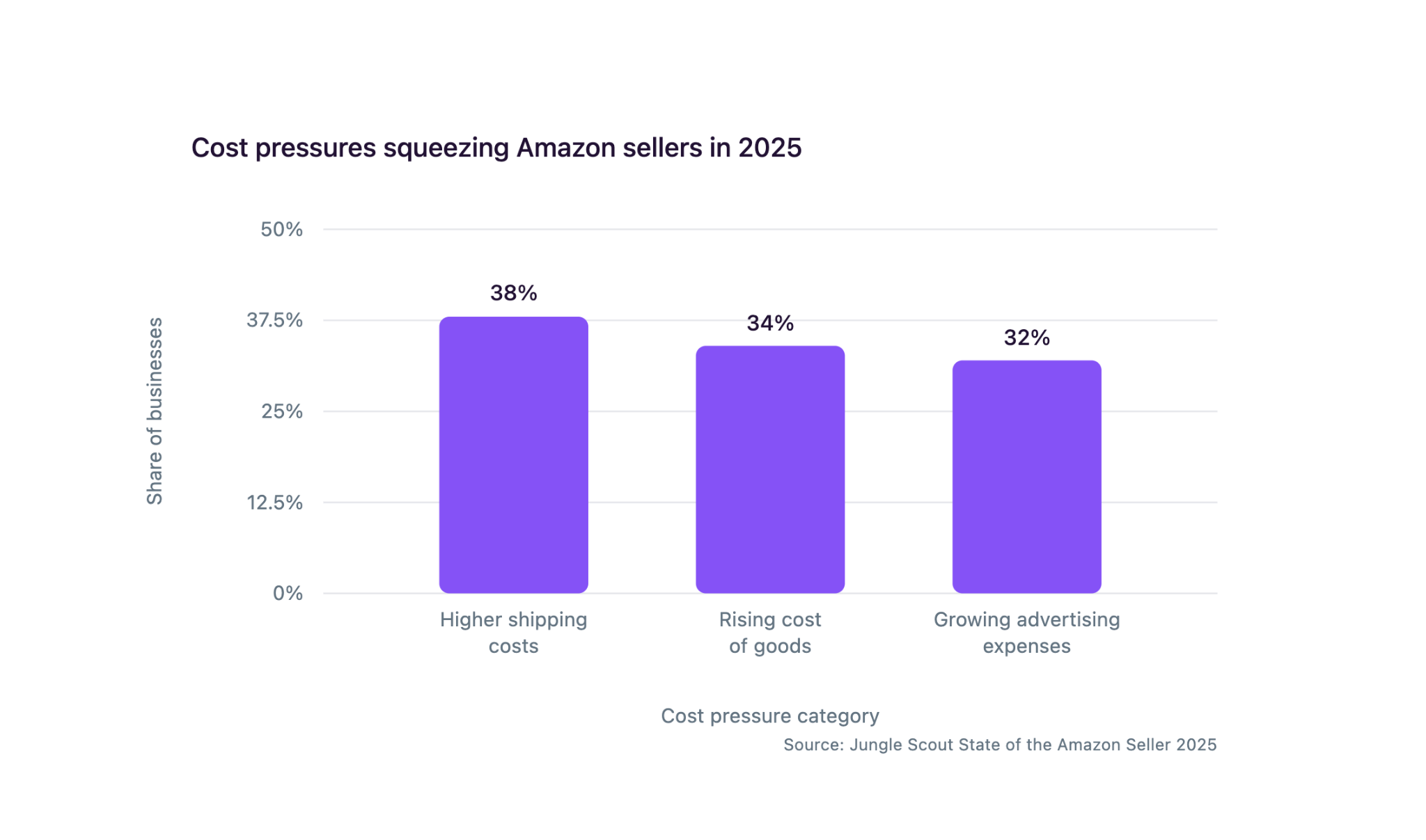
Amazon resale is still viable, but the margin for sloppy execution is getting thinner. In Jungle Scout’s State of the Amazon Seller 2025, 38% of businesses cited higher shipping costs as a top challenge, 34% pointed to rising cost of goods, and 32% flagged advertising expense, while Amazon’s own seller FAQ still says a Professional account costs $39.99 per month plus referral fees that vary by category.
Three realities define the current environment:
- Cost stacking: Shipping, cost of goods, referral fees, and ad expense now hit the same ASIN at once.
- Control gaps: Brands with stronger listing control and merchandising access have more ways to defend margin.
- Visibility inflation: More sellers are competing for the same demand, so weak listings and thin spreads break faster.
Amazon is also widening the gap between sellers who merely list products and sellers who control brand assets. On the public Amazon Brand Registry page, Amazon says enrolled brands can get 10% back on their first $50,000 in branded sales and then 5% back through the first year until they reach $1,000,000. Pure resellers can still win, but the marketplace is rewarding catalog ownership, listing control, and measurable external traffic more aggressively than before.
What Is Amazon Reselling, and When Does It Work?
Amazon reselling means selling authentic goods you did not manufacture, usually by matching an existing catalog page and competing on price, fulfillment, condition, or service. The legal baseline comes from the Department of Justice’s summary of the first-sale doctrine, which says a lawful purchaser can generally sell or otherwise dispose of that particular copy, but Amazon can still impose category, condition, and approval rules inside its marketplace.
In practice, Amazon reselling works best in three situations:
- Authorized wholesale: Best when you have invoices, repeat supply, and a brand or distributor relationship.
- Arbitrage: Best when you can exploit temporary gaps, knowing replenishment may be inconsistent.
- Condition-based resale: Best when you can grade products honestly and avoid avoidable returns.
Amazon’s public condition guidelines show why this matters. Amazon says New condition should be like buying the item fresh off a store shelf in factory packaging, and some products must be sold as New to qualify for the Featured Offer. If your packaging, accessories, or grading do not match the listing expectation, your modeled gross margin can disappear into returns, complaints, and suppressed conversion.
How to Resell on Amazon With the Amazon Resale Margin Ladder
The difference between hobby resale and durable resale is process. The Amazon Resale Margin Ladder is a simple four-tier model that helps eCommerce sellers move from speculative inventory buys to repeatable margin.
The Amazon Resale Margin Ladder has four tiers:
- Scout: Use Amazon’s fee estimator before you buy. If the item cannot survive fees and likely returns on paper, do not source it.
- Validate: Test small quantities first and compare modeled margin with real margin after prep, shipping, and price changes.
- Systemize: Once the SKU proves itself, tighten supply, reorder timing, prep workflow, and fulfillment method.
- Compound: Only after the offer is stable should you add pricing, traffic, content, or promotional layers.
The Amazon Resale Margin Ladder works because each tier solves a different risk. Scout protects you from bad math. Validate protects you from bad assumptions. Systemize protects you from operational drift. Compound, the top of the Amazon Resale Margin Ladder, is where you earn the right to layer on external demand and content leverage.
If you want an extra planning reference, this deeper margin breakdown of Amazon selling costs is useful because it frames fees as a contribution-margin problem rather than a bookkeeping detail. That mindset is the whole point of the Amazon Resale Margin Ladder.
When Does Inventory Pass the Buy Box Readiness Checklist?
Most resale losses happen before a listing ever goes live. The Buy Box Readiness Checklist is designed to stop those mistakes at the sourcing stage. If a product misses two or three of these checks, you are usually looking at a fragile offer instead of a scalable one.
Run every SKU through this checklist:
- Approval path: Can you sell this brand or category today with the documentation you already have.
- True landed margin: Have you included referral fees, shipping, prep, returns, and likely repricing.
- Condition fit: Does the product honestly qualify for the condition label you plan to use.
- Replenishment depth: Can you buy this item again at roughly the same cost if it works.
- Featured Offer chance: Can your price, fulfillment speed, and condition compete.
- Complaint risk: Is the item likely to trigger authenticity, damage, or packaging issues.
This checklist keeps you from confusing one-off opportunity with repeatable profit. A clearance find is not a business if you cannot restock it. A wholesale account is not enough if price discipline is weak. Even a good ASIN can become a bad bet when packaging or condition mismatches create return rates you did not model.
Did 2026 Change the Math for Amazon Resellers?
Yes, and the change is more structural than many guides admit. Amazon’s 2026 U.S. fee summary says FBA fees rose by an average of $0.08 per unit sold, while Amazon Ads also rolled out a shopping-signal enhanced view attribution model for certain Store ad placements on January 1, 2026. That combination means both cost assumptions and reporting assumptions need to be updated.
Three 2026 shifts matter most:
- Thin spreads are more fragile: Small unit fee increases matter when you are already competing in crowded offers.
- Measurement is more nuanced: Click-based reporting stayed the same, but some view-based reporting changed.
- Trust needs more proof: Buyers are leaning harder on visible evidence before they convert.
That last shift is easy to underestimate. In Bazaarvoice’s research, 47% of consumers said they trust customer testimonials and peer reviews when shopping on social media, and 39% said purchase confidence rises with review volume. For Amazon sellers, that means trust now comes from a stack of signals: reviews, clear conditioning, better visuals, creator proof, and cleaner merchandising.
If you want a practical companion to this shift, this guide to Amazon Marketing Services is useful because it connects traffic strategy to listing economics instead of treating ads as a separate problem.
Which Metrics Belong in the Off-Platform Revenue Stack?
Most sellers can see orders, but many cannot explain which outside activity created them or whether that activity improved net profit. The Off-Platform Revenue Stack is a simple measurement model for solving that blind spot.
The Off-Platform Revenue Stack has four layers:
- Traffic Quality: Clicks, click-through rate, spend, creator links, and source-level volume.
- Marketplace Intent: Detail page views, Store visits, and add-to-cart behavior.
- Conversion Depth: Purchases, units sold, product sales, and new-to-brand results.
- Margin Recovery: Brand Referral Bonus credits, returns, and contribution margin after Amazon fees.
Amazon calls Amazon Attribution a free analytics and measurement solution for non-Amazon channels such as search, social, display, video, email, and affiliate or influencer campaigns. Amazon also says Attribution reporting uses a 14-day window and includes metrics like clicks, detailed page views, add-to-cart, purchases, units sold, product sales, and new-to-brand.
The margin layer matters just as much as the traffic layer. On the public Brand Referral Bonus page, Amazon says the bonus averages 10% of qualifying sales driven by non-Amazon marketing and is earned through Amazon Attribution-tagged campaigns. That is why attribution on Amazon is not just about knowing what happened. It is also about recovering part of the fee structure when the traffic qualifies.
Across campaigns managed on the Stack Influence platform, the company publicly reports a 2x average revenue boost and 4x average BSR growth on its Amazon influencer marketing workflow page. Based on Stack Influence’s work with eCommerce brands, reporting also gets cleaner when each creator asset or path carries its own Attribution tag before seeding starts, which mirrors Amazon’s own guidance to create separate tags at the tactic and creative level.
There is one more trap worth avoiding. If you only watch a single ASIN, you can miss halo behavior across the rest of the catalog. Amazon’s Attribution guide says product reports can include both promoted products and brand-halo products, which is why Store destinations often deserve their own reporting lane.
Where Can Creator Traffic Expand Margin?

Creator traffic expands margin only when it does more than create impressions. It has to improve conversion, generate reusable assets, or unlock measurable external demand that compounds across Amazon and DTC channels.
Use creator traffic when these conditions are true:
- The ASIN is already viable: Do not use creators to rescue broken unit economics.
- The content has second-life value: You can reuse it in listings, ads, email, or your Amazon storefront.
- Every path is tagged: External traffic without measurement is just noise.
- Audience fit is commercial: The creator’s audience matches likely buyers, not just passive viewers.
This matters because creator marketing is now a serious media category. IAB says in its 2025 creator economy ad spend update that U.S. creator ad spend was projected to reach $37 billion in 2025, up 26% year over year. Sprout Social also reports that 86% of consumers make an influencer-inspired purchase at least once per year.
Creators are particularly useful when they keep shoppers inside Amazon’s conversion path. Amazon says the Amazon Influencer Program gives creators their own customizable Amazon presence and a vanity URL, which is why creator-operated Amazon storefronts can work well for Amazon influencers and affiliate partners who already know how to move ready-to-buy audiences.
From Stack Influence’s experience running product seeding campaigns, verified-post reimbursement protects the economics of testing. Its public product seeding model says brands save 40% of inventory and about $150 per creator on average because reimbursement happens only after verified social posts go live. Stack Influence has also observed that sellers get more usable merchandising assets when briefs ask for clear in-use shots and benefit proof, which is why its UGC workflow emphasizes reusable photos, videos, and testimonials across listings and ads.
That cross-channel asset value is where many eCommerce sellers still underinvest. If you already sell through Shopify, the best version of Shopify creator programs is often the one that reuses the same creator asset pool for Amazon and DTC brands instead of funding two disconnected influencer campaigns. The limitation is simple: none of this fixes a weak SKU, weak margin, or weak compliance. It only amplifies a product that already earned the right to scale.
Creators also bring one compliance rule that sellers should not ignore. The FTC says its Endorsement Guides were updated in June 2023 to reflect how advertisers use social media and reviews, which means material relationships still need clear disclosure in influencer campaigns.
Closing the Loop on How to Resell on Amazon
How to resell on Amazon becomes much more predictable when you treat it as a system instead of a sourcing scavenger hunt.
If you are deciding what to do next, focus on three priorities:
- Pick inventory that clears the Buy Box Readiness Checklist before you commit capital.
- Climb the Amazon Resale Margin Ladder one tier at a time instead of jumping from sourcing to scale.
- Add creator traffic only after your margin and measurement workflow are already in place.
For eCommerce sellers, that approach creates something more durable than a one-time spread. It creates repeatability, cleaner cash flow, and a stronger foundation for growth across Amazon sellers, Amazon FBA, DTC brands, and the channels that support them.