




Brands are quietly shifting their paid media dollars. Creator marketing budgets surged 171% year-over-year, and nearly two-thirds of that increase came directly from paid and digital advertising budgets — meaning the agency world is now knocking on creators' doors. If you are a content creator, understanding how a paid advertising agency works is no longer optional. It is the difference between being a one-time post vendor and a strategic partner who commands higher rates, longer contracts, and more creative control.
Key Takeaways
- A paid advertising agency manages media spend across platforms like Meta, Google, and TikTok, and your UGC can directly reduce their clients' cost-per-click.
- Creators who understand agency workflows can negotiate usage rights, whitelisting deals, and brand ambassador agreements instead of one-off posts.
- The Creator-First Agency Audit (introduced below) gives you a checklist to evaluate whether an agency partnership will actually benefit your business.
- Influencer content fed into paid placements can cut CPA by 25 to 50%, making your deliverables far more valuable than their organic reach suggests.
- Measurement fluency — knowing what ROAS, CPM, and attributed revenue mean — is the fastest way to elevate your creator pitch to agency media buyers.
What Is a Paid Advertising Agency?
A paid advertising agency is a company hired by brands to plan, buy, and optimize media placements across channels including Meta Ads, Google Search, TikTok Ads, and Amazon Advertising. These agencies control the media budget, set targeting parameters, write or source creative assets, and report performance to their clients. For influencer campaigns and UGC video, many agencies now act as the bridge between a brand's ad account and a creator's content library.
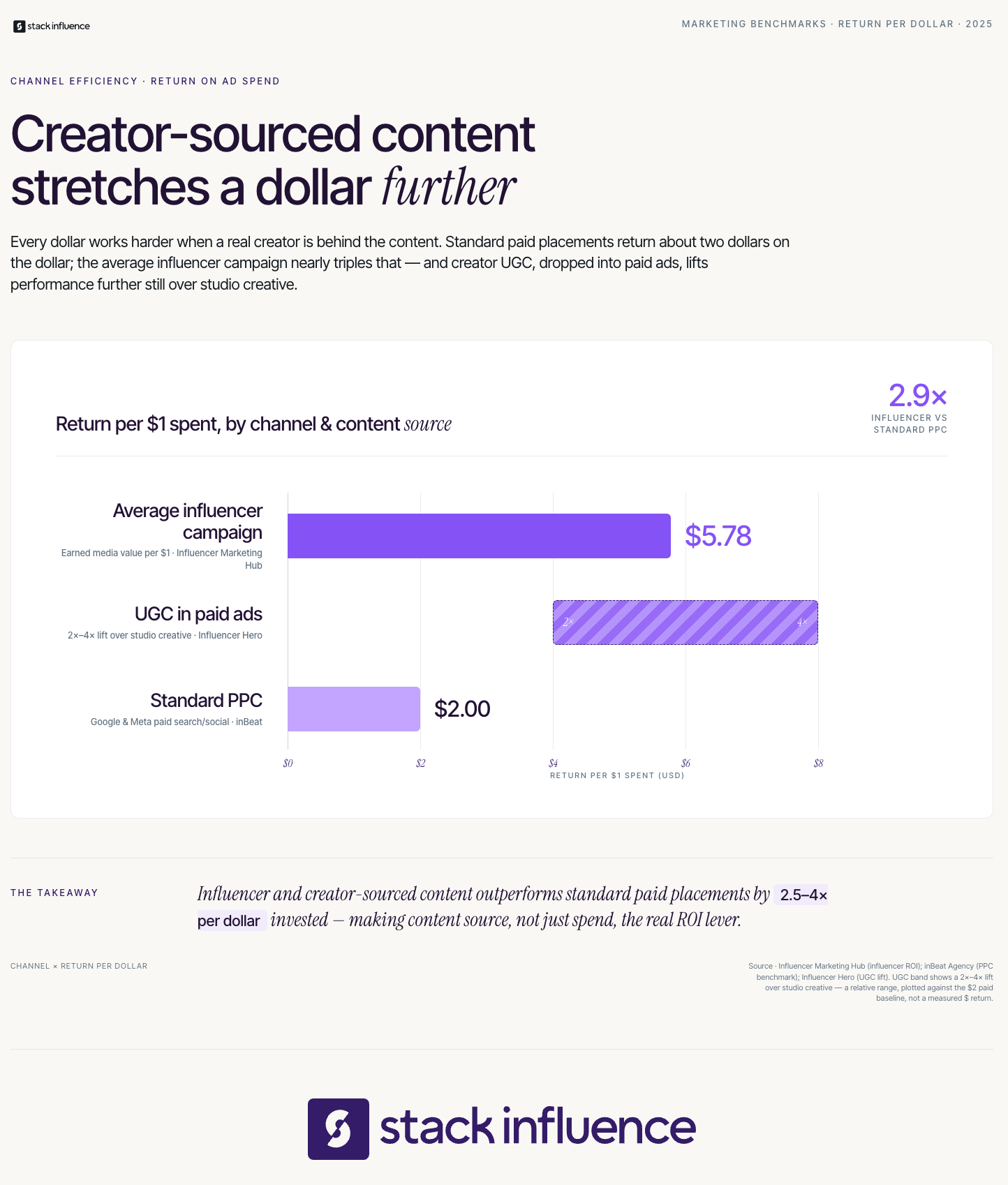
The economics explain why agencies are increasingly creator-focused. PPC returns roughly $2 for every $1 spent, while influencer marketing delivers $5.78 per dollar — a performance gap that collapses when creator content is used inside paid placements rather than kept in organic silos. Influencer marketing is often considered one of the most cost-effective digital channels, often returning $5.78 for every dollar spent, with many brands reporting strong returns particularly when working with micro and nano influencers.
Here is what agencies typically manage on behalf of their brand clients:
- Budget allocation: Deciding how much to spend on each platform and campaign objective each week.
- Creative sourcing: Acquiring or producing video and image assets, increasingly from UGC creators and content creators instead of studios.
- Audience targeting: Building and testing audience segments, lookalike pools, and retargeting lists.
- Performance optimization: Adjusting bids, creative rotations, and campaign structures based on real-time data.
- Attribution reporting: Connecting ad spend back to downstream revenue using tools like Amazon Attribution or platform-native pixels.
Stack Influence has observed that ecommerce brands running influencer campaigns alongside paid placements consistently see stronger blended ROAS in the first 90 days than brands running paid media alone, particularly when micro influencer content is briefed for ad reuse from the start. Understanding how agencies use that content is the first step toward pricing it correctly.
How Do Creators Fit Into an Agency's Workflow?
Most content creators think of agencies as intermediaries who handle brand deals. In reality, a paid advertising agency is often the entity controlling the creative budget and the ad account, which means your content can be amplified far beyond your organic reach — if the agency has the rights and the brief alignment to do it.
Strategic deployment tactics amplify savings when integrating creator assets into paid media, with influencer whitelisting currently outperforming basic social media ads by 20 to 50%. Whitelisting is the arrangement where an agency runs ads from your social handle rather than from the brand's account, preserving your social proof while giving the client full audience targeting control. This is why understanding creator partnerships at the agency level unlocks deal structures that most creators never access.
The Paid-to-Creator Maturity Model (introduced in the next section) maps exactly where most creators sit in this workflow and where the highest-value opportunities live. The practical entry points for creators in an agency context include:
- UGC-only deals: You film content without posting it; the agency deploys it as paid creative across Meta, TikTok Spark Ads, or display networks.
- Whitelisting or allowlisting agreements: You grant temporary ad access to your account; the agency runs paid ads using your handle and content.
- Brand ambassador programs: Long-term arrangements where your content feeds both organic posts and a continuous paid creative pipeline.
- Product seeding with usage rights: You receive product seeding from a DTC brand, create content, and the agency licenses the best-performing assets for paid campaigns.
The performance gap between authentic creator material and highly produced studio assets continues to widen, with 69% of marketers reporting that influencer-generated content performs strictly better than brand-directed alternatives. That data point is your pitch. Agencies need what you produce, and the ones who understand performance metrics are willing to pay for usage rights, not just organic posts.
The Paid-to-Creator Maturity Model
The Paid-to-Creator Maturity Model is a tiered framework that helps creators understand their current position in the agency ecosystem and the steps needed to move toward higher-value placements. Most creators operate at Tier 1 without realizing tiers 2 through 4 exist.
Tier 1 — Organic Only: You post branded content to your feed or stories, the brand receives organic reach, and the deal ends there. Compensation is typically a flat fee or free product seeding. Agencies rarely interact with creators at this level directly.
Tier 2 — Paid Amplification: A brand or its agency boosts your post using paid spend, extending reach to audiences beyond your followers. You may or may not receive additional compensation. This is the most common entry point where agencies start paying attention to creator performance data.
Tier 3 — Whitelisting and UGC Licensing: The agency runs paid ads from your handle (whitelisting) or licenses your raw video files as creative assets in its ad account. Usage rights fees apply here, and this tier represents the biggest jump in creator earning potential. Rates for whitelisted posts can be 2 to 3 times higher than standard sponsored post rates.
Tier 4 — Always-On Creative Partnership: You become a recurring creative supplier for the agency's client. The agency briefs you like a production vendor, integrates your content into A/B testing cycles, and measures your creative against cost-per-acquisition targets. This is the brand ambassador or retained content creator model at its most structured.
Most influencer marketing platforms help creators surface from Tier 1 to Tier 2. Moving from Tier 2 to Tier 4 requires understanding how agencies measure creative performance, which is exactly what the measurement section below covers.
The Creator-First Agency Audit
The Creator-First Agency Audit is a named checklist framework designed to help you evaluate any agency partnership opportunity before signing. Running this audit prevents under-pricing your content, surrendering usage rights inadvertently, and partnering with agencies whose client verticals will not benefit from your audience.
A critical 2025 data point from Aspire reveals a 42% year-over-year decrease in average influencer CPM, dropping to just $2.68, signaling growing cost efficiency that allows brands to reach significantly larger audiences per dollar spent. That compression makes your content more attractive to agencies as paid creative — but it also means volume and rights terms matter more than ever.
According to Sociallyin's 2026 influencer marketing data, a 2025 Aspire report reveals a 42% year-over-year decrease in average influencer CPM, dropping to just $2.68, making creator-sourced impressions cost-competitive with, or cheaper than, paid social placements.
Run the following eight-item audit on every agency opportunity:
- Usage rights: Does the contract specify exactly where, on which platforms, and for how long the agency can use your content? If "paid amplification" is mentioned without a time limit, negotiate a 90-day cap with renewal terms.
- Whitelisting scope: Are they requesting access to your ad account or just your content files? Account access requires explicit written consent and should be paired with spending caps.
- Attribution tracking: How will the agency track conversions tied to your creative specifically? If they cannot explain their attribution model, your performance data will be invisible and your value undocumented.
- Platform alignment: Does the agency's primary channel match your strongest platform? A creator whose audience lives on TikTok should think carefully before taking a whitelisting deal for a Google Display campaign.
- Creative brief quality: A brief under 200 words with a clear call-to-action tends to produce better, faster content than a five-page deck. If the brief is vague or prohibitively restrictive, the creative output will suffer.
- Exclusivity windows: Does the contract lock you out of competing brands in your niche? Exclusivity has a price and a duration — both must be stated clearly.
- Payment structure: One-time flat fee, performance-based, or usage-fee model? Usage-fee models (paying per quarter of the year the content runs) align your incentives with the agency's performance goals.
- Renewal and exit terms: Can the agency extend the campaign without renegotiating? A 30-day written notice clause protects you from indefinite content usage.
Running the Creator-First Agency Audit before any deal protects your rates, your content, and your long-term relationship with the brand. Agencies that push back hard on basic transparency checks are often the ones whose attribution data would expose poor ROI anyway.
How Does Influencer Content Power Paid Ads?
The shift from organic-only creator deals to paid-integrated creator partnerships is one of the most significant changes in the creator economy in 2026. Understanding it mechanically — not just conceptually — is what separates creators who scale to high-value brand partnerships from those who stay stuck at one-off post rates.
According to Meta case studies, UGC-style video ads outperform traditional creative by up to 38% in CTR and reduce CPA by 25 to 50%. That performance advantage is not abstract. It means that an agency running your video as a paid ad will spend less per customer acquisition than they would spend on a studio-produced spot. When you understand this, you can articulate your content's economic value directly to media buyers, not just to social media managers.
UGC ads achieve 4x higher click-through rates and 50% lower cost-per-click compared to traditional brand ads. For an ecommerce brand spending $50,000 per month on Meta Ads, cutting CPC by 50% through creator-sourced creative is the equivalent of doubling their effective ad budget. That is a budget-level argument, not a vanity metric argument, and it lands very differently in a paid advertising agency conversation.
Data from Stack Influence's experience running product seeding campaigns for ecommerce brands shows that creators who receive a clear paid-media brief alongside the organic brief deliver assets with stronger hook rates, because they intuitively frame the content around a viewer decision rather than a scroll-stopping moment alone. This distinction makes those assets far more reusable across the full paid creative cycle.
Here is how the content-to-paid-ad pipeline typically works:
- Step 1: Creator receives a product seeding package or a paid brief with usage rights included.
- Step 2: Creator films UGC video or UGC video content in a native, low-production style optimized for the first three seconds.
- Step 3: Agency receives raw files, edits hooks, adds captions (85% of viewers watch with sound off), and splits assets into 15-second prospecting and 30-second retargeting versions.
- Step 4: Agency deploys assets in A/B tests across Meta partnership ads, TikTok Spark Ads, or Amazon Sponsored content, tracking CTR, thumb-stop rate, and CPA.
- Step 5: Winning creatives receive additional spend; creator is invited to produce more variations or moves into a retainer arrangement.
Knowing this pipeline means you can brief yourself more effectively, deliver files that skip the editing bottleneck, and position yourself as someone who understands performance — not just aesthetics. That positioning is worth real money in agency conversations.
What Does Good Measurement Look Like?
Attribution is the single most contested topic in the paid advertising agency world, and it is the area where most creators have the least fluency. Fixing that gap is one of the fastest ways to elevate your pitch from "social media creator" to "performance creative partner."
Measurement remains a structural constraint rather than a solved problem, with measuring ROI and attribution complexity together accounting for 15.84% of all reported challenges in creator campaigns — a figure that reveals how much opportunity exists for creators who speak the attribution language agencies use every day.
The Creator Attribution Stack is a named metric model with four labeled components you should understand before any agency conversation:
- CTR (Click-Through Rate): The percentage of people who see an ad and click it. UGC content reliably lifts CTR versus studio creative. Your benchmark is 1.5 to 2.5% on Meta video for healthy performance.
- CPA (Cost Per Acquisition): The total ad spend divided by the number of conversions. When your creative reduces CPA, the agency's client saves money at scale. This is the number agencies defend to their clients in every monthly report.
- ROAS (Return on Ad Spend): Revenue generated divided by ad spend. A 3x ROAS means every $1 in ads returned $3 in revenue. The average ecommerce ROAS across platforms is 3.2x , but campaigns using creator content often exceed this benchmark, especially for DTC brands.
- Amazon Attribution / Brand Referral Bonus: For Amazon sellers and Amazon FBA brands, Amazon Attribution is a tracking tool that measures which external traffic sources — including influencer posts and paid amplification — drive conversions on Amazon product pages. The Amazon Brand Referral Bonus then rewards brands with a credit (averaging 10%) when external traffic sources directly contribute to a sale. Creators who understand this flow can make a specific, dollar-quantified case for why their content creates attributable revenue on the Amazon Influencer Program or through an Amazon storefront.
Across campaigns managed on the Stack Influence platform, ecommerce brands that brief creators with explicit Amazon Attribution link requirements see an average of 2.3x more trackable conversions per campaign than brands using standard UTM links alone, because the attribution window captures downstream purchase behavior more completely.
Using the Creator Attribution Stack in a pitch means replacing vague engagement claims with statements like: "My last whitelisted campaign for a skincare brand achieved a 1.9% CTR on Meta, reduced the brand's CPA from $28 to $19, and generated a 4.1x ROAS over the six-week flight." That sentence gets a media buyer's attention immediately.
The Hidden Cost Brands Pay When They Ignore Creators

Here is the genuinely novel angle most paid advertising guides miss: the creative refresh problem. It is not about whether to use a paid advertising agency. It is about where the agency gets its creative, and what that creative actually costs at scale.
CPC costs rose 12.88% annually in 2025 following 10% increases in 2024, with more businesses entering digital advertising and driving up auction costs without proportional demand increases. Agencies respond to rising media costs in one of two ways: optimize targeting (limited upside) or refresh creative (higher upside). Creative refresh is the actual lever, and it requires a continuous supply of new assets.
A $2,000 studio ad that does not work costs the same as 10 to 20 UGC videos you can test simultaneously, with the market average for UGC content sitting at approximately $198 per deliverable. That math is why agencies are not just open to creator content — they need it operationally. According to CreatorIQ's 2025 State of Creator Marketing Report, global brand investment in creator partnerships jumped 171% year-over-year, and nearly two-thirds of this budget increase came directly from paid media, with marketers reallocating funds from traditional digital ads into influencer-led campaigns.
The practical implication for creators is this: position your content as a creative supply chain, not a single post. Nano influencers and micro influencers who offer three to five asset variations per campaign — different hooks, different product angles, different calls-to-action — are infinitely more useful to a performance-focused agency than a creator who delivers one polished final cut. Here is what a creative supply chain offer looks like in practice:
- Deliverable set: 1 hero video (30-45 seconds) plus 2 hook variations (first-three-second alternate cuts) plus 1 product close-up b-roll package.
- Rights: Full paid media usage across Meta, TikTok, and YouTube for 90 days with renewal option.
- Format: Delivered as raw files and a caption-ready export with text overlays.
- Pricing: Flat fee for creation plus a monthly usage fee if the campaign extends beyond 90 days.
This structure aligns your incentives with the agency's need for volume testing and their client's need for continuously fresh creative. That alignment is the real business case for working with — and getting retained by — a paid advertising agency.
Building Long-Term Brand Partnerships Through Agency Relationships
The creator economy increasingly rewards creators who convert single campaigns into ongoing brand partnerships. Agencies are the access point to those long-term deals because they sit between the brand and the creative brief. Understanding how to navigate influencer campaigns at the agency level is covered in depth across influencer marketing case studies and 2026 influencer marketing predictions that outline where creator-brand relationships are heading.
Around 47% of marketers prefer long-term partnerships to one-off posts, a clear trend toward retainer-style arrangements. For creators, this represents a structural shift in how agencies are briefing and paying for content. The move from transactional to relational is built on three things: performance data, creative reliability, and business fluency.
Brands looking for influencers increasingly rely on their agency to recommend retained creators based on demonstrated CPA and ROAS performance across previous campaigns. This is where your attribution tracking history becomes a competitive advantage. Creators who can show a media buyer documented performance from prior campaigns — not just engagement screenshots but cost-per-click and ROAS outcomes — get shortlisted for long-term brand sponsorship deals that never appear on public influencer marketing platforms.
For ecommerce brands specifically, especially Shopify influencer marketing and Amazon sellers leveraging the Amazon Influencer Program, agencies look for creators who understand how Shopify attribution flows differ from Amazon Attribution tracking. A micro influencer who can explain the difference between a last-click attribution model and a 14-day Amazon lookback window is not just a creator — they are a performance marketing asset.
Several resources can help you develop this fluency. How influencer seeding works for ecommerce explains the product seeding process from brief to asset delivery. Niche micro influencers breaks down how niche positioning makes your content more valuable to performance-focused agencies. And how to land an Instagram sponsorship covers the outreach tactics that work specifically when agencies are involved in the brand deal.
Stack Influence's internal campaign data shows that creators who include documented paid media performance in their initial pitch to a new brand or agency convert to paid retainer arrangements at nearly twice the rate of creators who present only organic engagement metrics, because paid performance speaks directly to the KPI language agencies use internally.
The path from a single UGC deal to a quarterly retained creator partnership runs directly through agency relationships. About 60% of businesses run influencer programs in-house while about 40% use agencies , which means the agency-managed segment represents a significant pool of higher-budget, performance-oriented brand deals that most creators do not actively pursue. Positioning yourself as a performance creative partner — using the Creator-First Agency Audit and the Creator Attribution Stack — is how you access that pool.
You can explore how to become a micro influencer and the micro influencer platform overview for tools that connect you to the right brand and agency partnerships at scale. For brands and creators interested in seeing how UGC platforms and content syndication fit into an agency-managed paid strategy, those resources map the full creative pipeline from activation to amplification. If you are ready to explore how Meta partnership ads and TikTok Spark Ads work at the campaign level, those pages explain the technical mechanics of whitelisted paid placements from a creator's perspective.
Conclusion
Working with a paid advertising agency as a creator is not about fitting into a brand's media plan. It is about understanding that media plan well enough to position your content as its most cost-efficient fuel. The frameworks in this article — the Creator-First Agency Audit, the Paid-to-Creator Maturity Model, and the Creator Attribution Stack — give you a practical language for every agency conversation you will have. Use them to negotiate usage rights, price your deliverables correctly, and convert one-time campaigns into the kind of long-term brand deals that define a sustainable career in the creator economy. When you understand the economics of a paid advertising agency, you stop being a line item in a creative budget and start being a strategic partner in a performance marketing operation.