




Most new TikTok Shop sellers do not lose because registration is hard. They lose because they treat setup as the finish line, even though the real work starts when a product has to earn trust, survive fulfillment, and prove margin inside a channel that EMARKETER’s 2026 social commerce forecast says will push TikTok Shop to $23.41 billion in US ecommerce sales this year.
If you are an eCommerce seller figuring out how to start a TikTok Shop, the goal is not just to go live. It is to build a shop that can turn discovery into sales, sales into reusable proof, and proof into repeatable growth on a platform where shopper research increasingly happens inside the same app as checkout.
Key Takeaways
- Registration gets you access, but product fit, fulfillment, and proof determine whether a TikTok Shop can scale.
- Start with one hero SKU and one clean content angle before you expand into bundles, variants, or a full catalog.
- User-generated content matters twice on TikTok Shop: first for trust during discovery, then again when you reuse it on product pages and in ads.
- Measure performance in layers, not just GMV, so you can see revenue, efficiency, content reuse, and cross-channel lift.
2026 TikTok Shop Trends For eCommerce Sellers
TikTok Shop is no longer a side experiment for ambitious sellers. EMARKETER’s 2026 social commerce forecast says 51% of US social buyers will shop on TikTok this year, and TikTok’s 2025 Black Friday and Cyber Monday update says the platform generated more than $500 million in sales over that four-day period while attracting nearly 50% more US shoppers than the prior year’s BFCM campaign.
The bigger reason to care is how shoppers behave on the platform. In TikTok’s search and discovery research, 61% of users say they discover new brands and products there, and one in two say they use TikTok to research or learn more about new products or brands.
That changes what a good launch looks like on TikTok Shop.
- Discovery Comes First: Shoppers often see the story before they see the listing, which means your hook, creator fit, and comment section matter early.
- Research Happens In Public: Buyers compare products through videos, comments, and search behavior, not just through polished listing copy.
- Checkout Is Compressed: Once a shopper is convinced, native commerce shortens the path to purchase and reduces drop-off.
- Operations Become Visible Fast: Shipping delays, weak listings, or confusing offers get exposed quickly because demand forms in real time.
For eCommerce sellers, that means how to start a TikTok Shop is really a question of channel design. You are not opening another catalog page. You are building a commerce loop where creative, trust, and logistics have to work together from day one.
A fast-growing channel also punishes sloppy launches faster than older marketplaces. When traffic, comments, and creator mentions arrive at the same time, weak inventory controls or confusing pricing become visible immediately, which is why restraint on the first launch wave is usually a competitive advantage, not a limitation.
What Is TikTok Shop And Why Does It Matter For Sellers?
TikTok Shop is TikTok’s in-app commerce system that lets shoppers discover products through videos, live sessions, search, and storefronts, then complete checkout without leaving the platform. It matters because it blends merchandising and media into one experience, which is different from the slower browse-first logic many sellers know from traditional ecommerce sites.
The basic setup is straightforward, but the details matter. TikTok’s seller registration guide says your personal and financial information must match your official documents, and the Shopify Help Center’s TikTok Shop setup instructions show how sellers can connect TikTok Shop through Shopify if they already run part of their business there.
Before you publish your first listing, make sure these launch pieces are in place.
- Identity And Banking: Your legal business details, tax details, and payout information need to match your submitted documents.
- Product Page Clarity: Your title, price, imagery, and offer need to make sense in seconds because TikTok traffic arrives with short attention spans.
- Shipping And Returns: Inventory sync, delivery expectations, and a workable return flow matter before the first content spike, not after it.
- Catalog Discipline: A small, clear first assortment is easier to manage than a broad catalog full of weak offers.
- Channel Connection: If your brand already runs on Shopify, syncing operations early reduces duplicate work and inventory mistakes.
This is also where many sellers choose the wrong first product. According to Salsify’s 2025 consumer research, 87% of shoppers will pay more for a product from a brand they trust, which makes trust-heavy, easy-to-demonstrate products better first candidates than items that need a long education cycle before the value clicks.
TikTok Shop is also not the best first move for every SKU. Hard-to-explain products, products with thin margins, or anything likely to create high return volume can struggle early because social commerce compresses discovery and checkout into a shorter window, leaving less room for patient education.
A useful way to pressure test readiness is a secondary tool I call the Cart-Ready Checklist. Ask five questions before launch: Is the hero SKU easy to demo, is margin healthy after discounts and fees, is fulfillment stable, does the page have real proof assets, and can you track where sales are coming from? If the answer is no to two or more, do not call the shop ready yet.
How To Start A TikTok Shop With The Three-Tier Shop Launch Ladder
The best way to think about how to start a TikTok Shop is through the Three-Tier Shop Launch Ladder. This model keeps sellers from scaling too early by forcing them to earn the next stage through proof, not optimism.
- Tier One: Build The Base. Register the account, verify documents, connect inventory, set shipping and returns, and choose one hero SKU. If you plan to advertise, TikTok’s Video Shopping Ads best practices recommend 3 to 5 creatives per ad group and at least 7 days of runtime, so the asset pipeline has to exist before budget goes live.
- Tier Two: Prove The Offer. Use the first wave to learn what angle converts, what objections show up in comments, and whether the page resolves them. This is where product demos, customer-like explanations, and creator proof usually outperform abstract branding because buyers need believable evidence fast.
- Tier Three: Compound The Winners. Only after content, conversion, and fulfillment are stable should you expand budgets, add more SKUs, test live commerce, or move into paid amplification. The Three-Tier Shop Launch Ladder works because it protects a new seller from scaling confusion instead of scaling what already works.
Across campaigns managed on the Stack Influence platform, lean seller teams usually control first-wave spend better when they focus creator output on one hero SKU instead of briefing a whole catalog at once. On its pricing page, Stack Influence says brands pay about $30 per completed post on average and save roughly 175 hours per month, while its automated product seeding workflow is built around paying after verified posts so sellers are not front-loading cost into unconfirmed creator activity.
The Cart-Ready Checklist becomes practical here. A seller should be able to answer what the product does in one sentence, show it in use within a few seconds, explain why it is worth the price without a long discount ladder, and fulfill it without operational drama, because PowerReviews research on purchase behavior found 61% of consumers are much more likely to buy when reviews include photos and videos.
That narrow first wave matters because proof assets move conversion, not just reach. When a page has believable product visuals and buyer-like explanations, sellers learn faster, revise smarter, and avoid wasting traffic on a listing that still feels unfinished.
Do Older TikTok Shop Tactics Still Work In 2026?
Older TikTok Shop guides age quickly because the platform keeps changing how commerce should be run. Since GMV Max became the default and only supported campaign type for new TikTok Shop Ads in July 2025, any guide that treats older shop ad formats as the default playbook is already behind.
Measurement changed too. In TikTok’s latest automation and attribution update, the company said advertisers can now use third-party optimization starting with Google Analytics, and that more than one in four TikTok-attributed conversions happen after a user views an ad and then goes directly to the site the same day.
Three 2026 rules matter most for new sellers.
- Build Creative Depth Before You Scale Budget: New stores should launch with multiple creatives, not one hero ad, because the platform needs options to learn.
- Treat Search As A Commerce Surface: TikTok is not only feed discovery anymore. Search, comments, and creator-led queries now help buyers validate products before they purchase.
- Move Winning Assets Fast: The gap between an organic post and monetized distribution is shrinking, so good content should quickly travel into listings, ads, and other owned channels.
Stack Influence has observed that the bigger 2026 advantage comes from reuse speed, not just creator volume. On the company’s TikTok Spark Ads page, Stack Influence says creator-led Spark Ads can deliver a 134% higher video completion rate and a 69% higher conversion rate than standard in-feed ads, while its content syndication workflow frames the next step as moving winning creator assets into ads, listings, websites, and email instead of letting them die as one-post wins.
That is the blind spot in many setup articles. Registration gets the storefront live, but the 2026 operating advantage comes from faster asset testing, cleaner attribution, and quicker movement from organic proof to paid distribution.
Should You Measure TikTok Shop ROI By GMV Alone?
The cleanest way to measure a new store is with a layered model I call the Commerce Signal Stack. GMV is useful, but GMV alone can hide weak margins, rising refund rates, creative fatigue, or off-platform spillover that never shows up in a last-click report.
Use the Commerce Signal Stack to keep each layer separate.
- Layer One: Revenue Signals. Track orders, GMV, average order value, contribution margin by SKU, refund rate, and repeat purchase rate so you know whether sales are profitable and durable.
- Layer Two: Efficiency Signals. Watch CPA, ROAS, creator cost per sale, and learning status. TikTok’s live shopping budget guidance says it takes about 40 conversions per TikTok Shop to exit the learning phase, which helps sellers size budgets more realistically.
- Layer Three: Asset Signals. Measure cost per usable video, content approval rate, Spark Ad win rate, PDP reuse rate, and the time from asset approval to revenue impact.
The reason this layered view matters is that TikTok often assists a sale before it receives clean last-click credit. TikTok’s automation update says early third-party optimization tests showed an average 54% increase in conversions and a 27% decrease in cost per action in Google Analytics, while TikTok’s media mix modeling guide argues that the platform’s actual contribution is often understated by last-click models.
If you also run marketplace creator programs, the Stack Influence Amazon Influencers guide is a useful internal companion because it clarifies the difference between storefront-driven creator commerce and asset-driven UGC programs. The point is not to merge TikTok Shop and Amazon into one metric bucket. It is to understand which channel captured the order and which channel created the demand.
If you also sell on Amazon, keep TikTok Shop performance separate from marketplace spillover. Amazon says Amazon Attribution is a free measurement tool for tracking the on-Amazon impact of non-Amazon channels, and Amazon’s Brand Referral Bonus materials say eligible sellers can earn an average credit worth 10% of qualifying sales measured through those Attribution tags.
Do not blend everything into one dashboard and call it done. Keep direct TikTok Shop sales, website sales, and Amazon spillover in separate views, then compare them only after fees, discounts, and content costs are accounted for.
When Should Sellers Add Micro Influencers, UGC, And Spark Ads?
You do not need a large creator program on day one, but you do need a plan for proof. PowerReviews data on where shoppers want UGC says 84% of consumers want shopper photos and videos directly on product pages, and 51% want to see that same kind of material on social media too.
Use each creator lever for a different job.
- Micro Influencers: Best when you need believable demos and niche trust from smaller, focused communities, which is why the Stack Influence micro-influencers glossary is useful for defining fit before you recruit.
- UGC Creators: Best when the main value is the asset, not the creator’s reach, a distinction the Stack Influence UGC creator guide explains clearly.
- Spark Ads: Best when an organic post already proved its hook and you want to scale without losing social proof, which is the use case highlighted across Stack Influence’s TikTok influencer marketing solutions.
- Managed Seeding: Best when a lean team needs content volume without turning launch week into a shipping project, which is where Stack Influence’s user-generated content for eCommerce and Shopify influencer marketing solutions fit into a repeatable workflow.
There is also a sequencing issue with creator work. Do not bring in micro influencers, UGC creators, or product seeding just because it sounds like social commerce best practice. Bring them in when the listing can actually convert the attention they create, otherwise you are paying to expose friction.
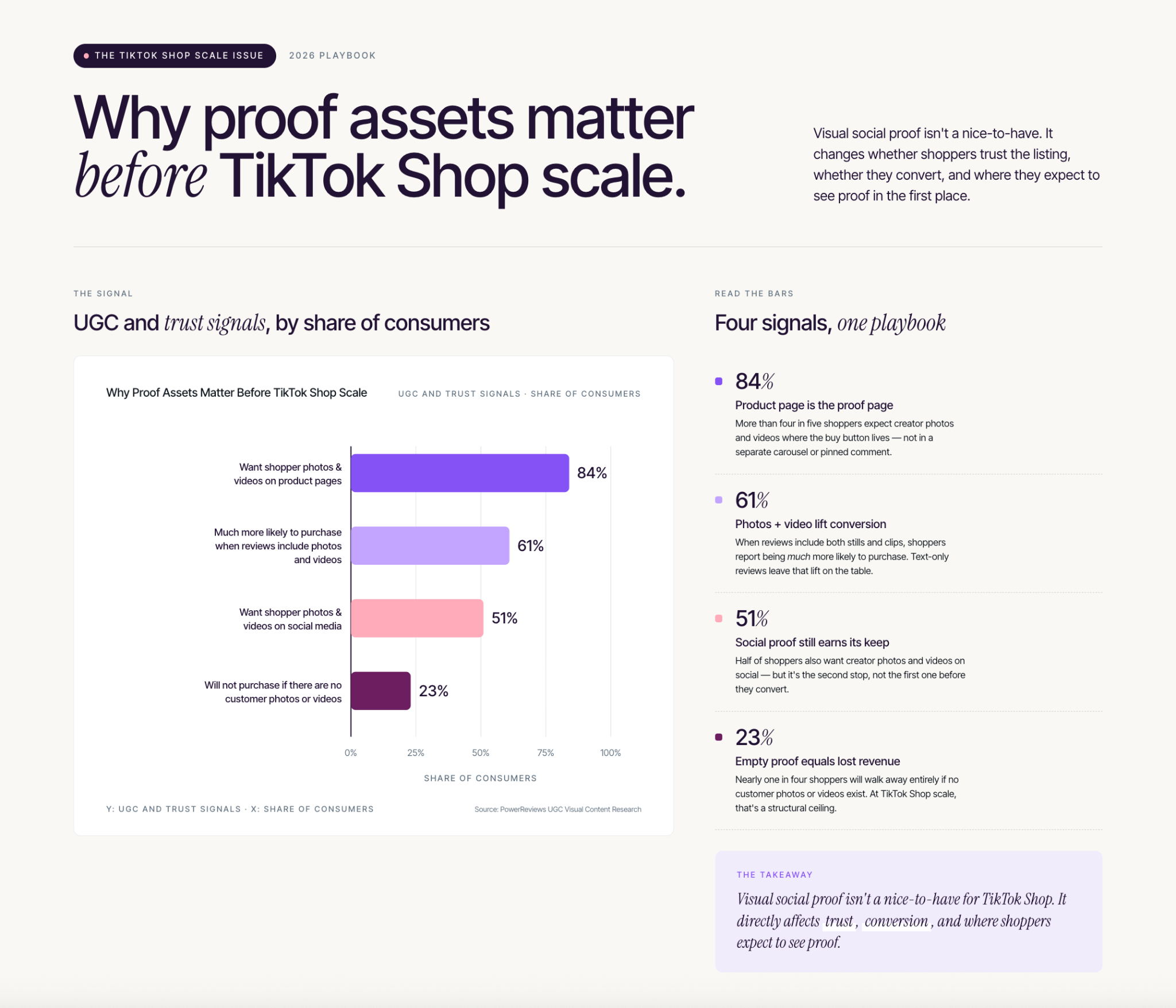
Based on Stack Influence’s work with eCommerce brands, the asset often outlives the original post. On the company’s content syndication page, Stack Influence says creator UGC reused across ads, listings, and email can reduce cost per click by up to 50% and raise conversions up to 4X, which is why the right creator program should be evaluated like an asset engine, not only like a reach play.
This matters even more because trust is still the gating factor in social commerce. Salsify’s consumer research says 87% of shoppers will pay more for products from brands they trust, so the sellers who win on TikTok Shop combine authentic-looking proof with channel discipline instead of treating creator content like random top-of-funnel noise.