



The Creator Economy Has a TikTok Problem Nobody Talks About
Most guides on how to make a TikTok focus on the wrong things. They cover filters, trending sounds, and how often to post, but skip the structural decisions that actually determine whether a video gets distributed or disappears. TikTok was the largest creator platform in ClickAnalytic's Creator Economy Report 2026, with 15.8 million creators analyzed, representing 67% of all creators studied in the report. With that level of competition, winging it is no longer a viable strategy. This guide breaks down exactly how to make a TikTok that the algorithm pushes, audiences finish, and brands want to attach to.
Key Takeaways
- Hook quality in the first three seconds determines algorithmic distribution more than any other single factor.
- Tiered content strategy (defined in the CRAFT Tiers framework below) matches video format to viewer intent, not just trending audio.
- Discoverability through TikTok SEO keeps videos surfacing in search results weeks after publishing, compounding your organic reach.
- Micro influencers and nano influencers with highly targeted content attract the brand partnerships and creator partnerships that drive sustainable income.
- Measuring the right metrics using the Creator Measurement Stack, not just views, is what separates creators who grow from creators who plateau.
Why TikTok's Scale Changes Everything for Content Creators in 2026
TikTok has around 1.9 billion monthly active users, with approximately 23 million TikTok videos uploaded to the app every day. That volume means no single piece of content succeeds purely by accident. The For You Page is not a lottery; it is a distribution system that rewards specific structural signals inside each video. Understanding those signals before you hit record is the difference between a post that earns 300 views and one that earns 300,000.
Users spend an average of 1 hour and 37 minutes per day on TikTok, highlighting the strong appeal of short-form video. That time-on-platform number gives content creators an unusual advantage: viewers are primed to keep watching if the content earns continued attention. The challenge is not getting someone to open TikTok; it is making a video that wins every three-second micro-decision viewers make while scrolling.
This context matters for creators at every stage. Whether you are a nano influencer with 2,000 followers or a mid-tier creator targeting brand sponsorship, the platform mechanics are the same. The inputs that drive reach, brand deals, and creator economy income all trace back to what happens in your video before the first three seconds are up.
What Is a TikTok (and Why Does It Actually Work)?
TikTok is a short-form video platform where content is discovered primarily through an algorithm-driven feed called the For You Page, not through follower subscriptions. People publish entertaining, educational, and promotional clips, while viewers explore personalized feeds filled with recommended content, with the discovery-driven format helping creators and brands reach a diverse user base without needing a massive following.
According to the 2026 Social Media Content Strategy Report, 55% of Gen Z users engage with brand content on TikTok at least once per day, with another 30% engaging at least once per week. That behavioral pattern is why brands looking for influencers prioritize TikTok presence when evaluating creator partnerships. A video that performs well is not just content; it is a live proof-of-concept for a creator's ability to drive attention for a product.
TikTok's algorithm plays a massive role in how content gets seen, tracking user behavior like likes, comments, shares, and watch time to figure out what people enjoy, then recommending videos based on those patterns, pushing content with strong engagement to broader audiences even if the creator has few followers. This means a creator posting their very first video has a genuine shot at reaching a targeted audience, provided the video gives the algorithm the right signals.
The CRAFT Tiers: A Framework for Making Every TikTok Intentional
The CRAFT Tiers are a three-level content approach that matches the structure of your video to its specific goal. The three tiers are Discovery, Depth, and Drive, and each one calls for different creative choices. Most creators collapse these into a single undifferentiated approach, which is why their content performs inconsistently.
Tier 1: Discovery videos are short, hook-driven, and built for the For You Page. Their single job is to pull in a first-time viewer who has never heard of you. They typically run 15 to 34 seconds, lead with a visual or verbal surprise, and deliver one clear payoff by the end.
Tier 2: Depth videos build on an established hook topic and serve viewers who already know your content style. These run 45 to 90 seconds, include more context or instruction, and work well for educational content, tutorials, and UGC video formats that brands reuse.
Tier 3: Drive videos are conversion-oriented. They include a clear call to action, link to a product, service, or brand partnership, and are designed for audiences already primed to act. This is where creator economy monetization happens.
Here is how to apply the CRAFT Tiers to a weekly posting plan:
- Discovery slot: Post one Tier 1 video early in the week to capture algorithm testing with a fresh audience pool.
- Depth slot: Post one Tier 2 video mid-week that expands on a topic you have already introduced.
- Drive slot: Post one Tier 3 video toward the end of the week when your established viewers are most engaged.
- Reuse signal: Use TikTok analytics to identify which Tier 1 video drove the most profile visits, then create a Tier 2 follow-up on that exact topic.
Stack Influence's internal campaign data shows that micro influencers who structure their posting calendar around content tiers rather than a single format generate 35 to 45% higher profile-visit-to-follower conversion rates, which directly improves the inbound rate of unsolicited brand outreach.
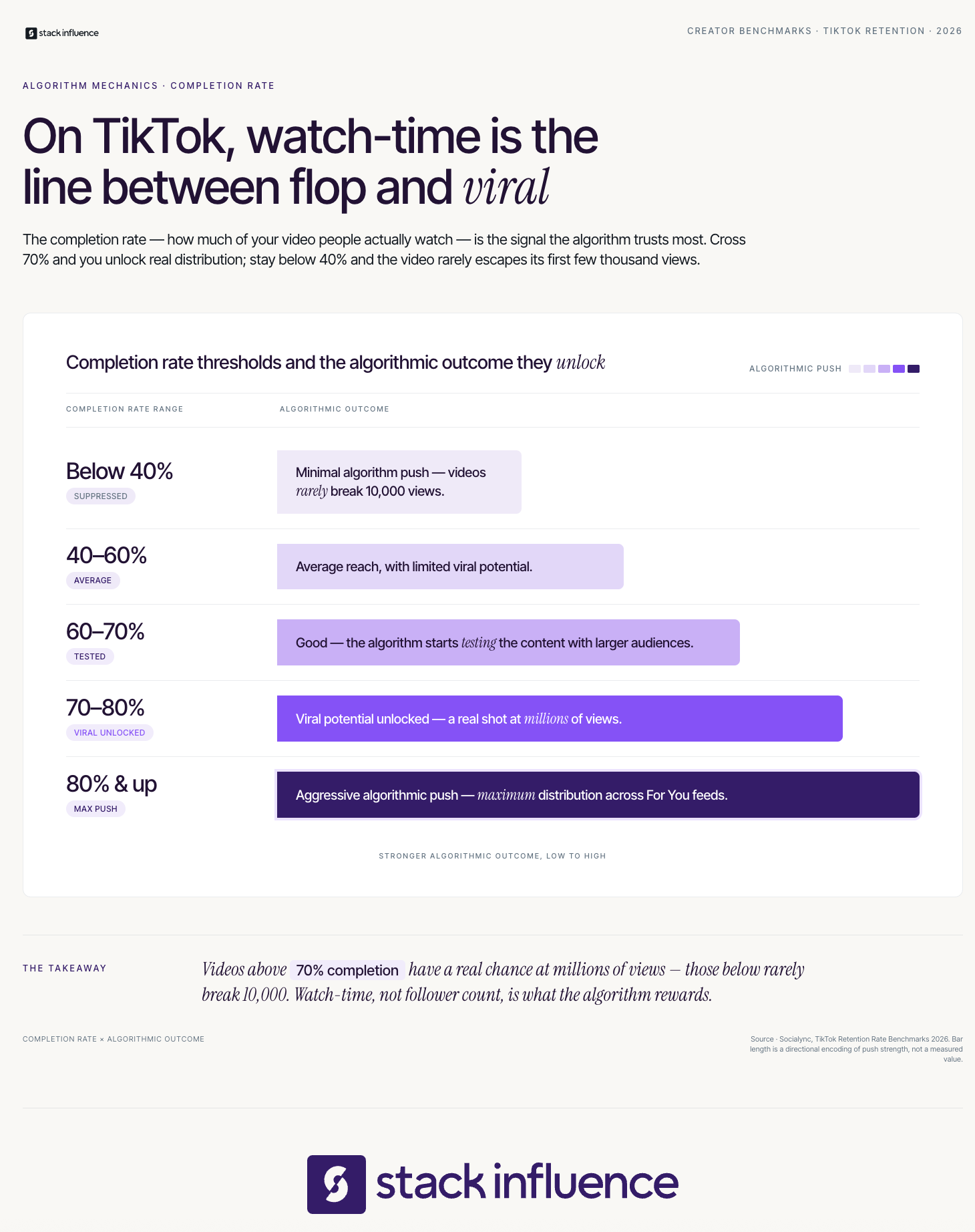
Retention rate is the primary metric TikTok's algorithm uses to determine distribution, making it more important than views, likes, or follower count for long-term growth, with the optimal video length sitting at 21 to 34 seconds for maximum completion rate. The CRAFT Tiers work because they force you to choose the right length for the right purpose, rather than defaulting to one format for every post.
Data from OpusClip's TikTok length and retention research shows that if you see a sharp drop in the first 3 seconds, your hook isn't compelling enough, with strong hooks maintaining 80% to 90% of viewers through the first 3 seconds, then gradually declining. Discovery-tier videos must treat the hook as a non-negotiable structural element, not an afterthought.
How Do You Actually Shoot a TikTok That Gets Watched?
Knowing which CRAFT Tier you are working in tells you what to do in production. Execution is where most creators lose their leverage because they focus on aesthetic choices while ignoring structural ones. Before you record, confirm three things: your hook phrasing (verbal or visual), your video length target, and your one-sentence payoff.
The production process for a Discovery-tier video follows this sequence:
- Write the hook first. Draft your opening line or visual action before setting up the camera. The hook should create curiosity or promise a specific outcome.
- Frame vertically from the start. TikToks filmed in vertical format perform 61% better than horizontal alternatives. Use 9:16 framing for every video.
- Record in natural or consistent artificial light. Bright lighting improves watch time by 19%. A ring light or a window is sufficient.
- Speak or move immediately. Dead air in the first second is a scroll trigger. Open mid-action or mid-sentence.
- Add on-screen text that mirrors your spoken hook. Using on-screen text boosts reach by 29% , and it keeps viewers engaged if they are watching without sound.
- Keep b-roll or camera cuts frequent. Pattern interrupts every 3 to 5 seconds, including text overlays, B-roll, and camera changes, maintain attention and prevent the static viewing experience that causes drop-offs.
- Close with a loop cue or rewatch prompt. The last two seconds should naturally invite a rewatch, which sends a strong algorithmic signal.
From Stack Influence's experience running UGC-focused influencer campaigns, creators who follow a written production brief before recording, rather than improvising on-camera, deliver usable content 40% faster and require fewer revision rounds. This matters for UGC creators and UGC platforms because turnaround speed directly affects campaign pacing.
In 2026, you need a 70% or higher completion rate to trigger viral distribution, with videos below that threshold rarely breaking 10,000 views, while videos above it having a real chance at millions. Every production decision should be evaluated against whether it helps or hurts that 70% target.
The Pre-Post Checklist: Publish and Optimize Every Video for Discoverability
Publishing is not the end of the process; it is where many creators leave half their reach on the table. The Pre-Post Checklist is a five-item audit you run before tapping "Post" on every video. Reference this framework every time, not just for major content pushes.
- Caption keywords: Include your primary topic keyword in the first 150 characters of your caption. TikTok's algorithm is always watching, listening, and reading, and once a video starts ranking in search, it can live in TikTok's search results for weeks or even months, unlike the fast-moving For You Page.
- Hashtags (3 to 5 only): Research and platform guidance consistently support using 3 to 5 targeted hashtags rather than 20 to 30 generic ones, with a small number of highly specific hashtags sending a clear topical signal.
- Spoken keywords: Make sure you say your topic keyword out loud in the video. TikTok transcribes audio and uses it for search categorization.
- On-screen text alignment: Confirm that your text overlays reinforce your caption keywords, not just describe what is on-screen visually.
- Posting time check: Videos posted between 6 and 9 PM gain 23% more views , though you should verify this against your own analytics dashboard for your specific audience timezone.
According to Sprout Social's Q2 2025 Pulse Survey, Gen Z social media consumers now turn to searching on social media before searching on Google and traditional search engines. This makes the Pre-Post Checklist a long-term asset-building tool, not just a distribution tactic. Videos that are properly optimized at publish can generate search traffic months after posting. According to EmbedSocial's TikTok SEO research, once a video starts ranking in search, it can live in TikTok's search results for weeks or even months, unlike content on the fast-moving For You Page.
Apply the Pre-Post Checklist to every video, including the Tier 3 Drive content that links to brand partnerships or product pages. Search-optimized Drive content that lands in front of intent-driven viewers converts at a higher rate than the same content surfaced randomly on the For You Page.
The Underrated Tactic Most Creators Skip: Treating Your TikTok as a UGC Portfolio
Most guides on how to make a TikTok treat the platform as a pure audience-growth vehicle. The underrated tactic that changes a creator's income trajectory is treating every TikTok you make as a live portfolio piece for UGC creators and brand partnerships. These two objectives are not in conflict; they are the same system with different outputs.
The highest engagement rates are among the smallest TikTok creators, with accounts below the 100,000-follower mark averaging 7.50%. Brands know this, which is why product seeding and influencer campaigns have shifted dramatically toward micro influencers and nano influencers. When a creator's TikTok library demonstrates consistent structure, hook quality, and niche authority, they become an obvious candidate for brand ambassadors programs without cold-pitching.
In 2025, TikTok's average engagement rate reached about 3.7%. Nano and micro influencers consistently beat this average, which is precisely the data point brands reference when justifying campaigns run through a micro influencer agency or influencer marketing platform. The creator's TikTok library is their pitch deck.
Here is the underrated tactic applied practically. Structure two of your three weekly videos around a clear niche so that any brand scrolling your profile immediately understands your audience and your category. Creator-made ads perform better than brand ads, with Spark Ads getting up to 142% more engagement and 43% higher conversions. Brands running influencer campaigns are therefore actively looking for creators whose organic content already functions like a quality ad. Across campaigns managed on the Stack Influence platform, nano influencers who post consistent niche-anchored content rather than broad lifestyle videos receive inbound brand outreach at nearly twice the rate of creators with similar follower counts but scattered topics.
Creators who want to explore TikTok Spark Ads partnerships or automated product seeding opportunities should understand that brands evaluate their TikTok library before making contact. The videos you post today are discovery assets for both the algorithm and for brands looking for influencers. You can explore how influencer seeding works for eCommerce brands to understand what brands are specifically looking for when they review creator content.
This is the same reason UGC platforms have grown so quickly inside the creator economy: brands that work with micro influencers are not just buying reach; they are buying content assets they can repurpose across paid and organic channels. Your ability to make a clean, well-structured TikTok is the core skill that powers every income stream in the creator economy.
The Creator Measurement Stack: What Should You Actually Track?

Most creators track views and follower count. Both are vanity metrics in isolation. The Creator Measurement Stack is a four-component model that gives you the data signals needed to improve video performance and demonstrate value to brands considering a brand sponsorship or brand deal.
Component 1: Three-Second Retention Rate. This is the percentage of viewers still watching at the three-second mark. Analysis from OpusClip's hook formula research found that videos with strong three-second retention rates above 65% receive 4 to 7 times more impressions than videos that lose viewers immediately. Pull this from TikTok Studio's audience retention graph after every post.
Component 2: Full Completion Rate. This is average watch time divided by total video length. In 2026, you need 70% or higher completion rate to trigger viral distribution. Target this for every Discovery-tier and Depth-tier video in the CRAFT Tiers framework.
Component 3: Profile Visit Rate. This is the number of viewers who tapped your profile after watching. A high profile-visit rate signals that a video drove genuine interest, not just passive consumption. This metric predicts follower growth more reliably than likes do.
Component 4: Save and Share Rate. Saves indicate that a viewer found the content genuinely useful. Shares indicate they found it worth spreading. Both send stronger algorithmic signals than likes, and both are data points brands expect to see in a media kit when evaluating creator partnerships.
Reference the Creator Measurement Stack in your content review every week. After each video, log all four components in a simple spreadsheet. Patterns will emerge across your CRAFT Tiers: Discovery videos will tend to have higher three-second retention and lower save rates; Drive videos will show the opposite. Adjust accordingly.
Should You Try to Go Viral, or Should You Build Consistent Authority?
This is the question most new content creators get wrong. The instinct is to chase viral moments because that is what social media culture celebrates. The data tells a different story about what actually builds a sustainable creator business.
In 2025, educational content such as STEM, finance, and personal development is one of the fastest-growing categories on TikTok, experiencing 40% year-over-year growth. Educational and niche authority content does not always go viral in the traditional sense. It does, however, build the kind of engaged, trust-based audience that brands are actively willing to pay for.
TikTok genuinely favors creative, engaging, original content and has no regard for follower counts when deciding to push content, meaning follower counts would mean nothing to the TikTok algorithm without strong content quality. This is counterintuitive for new creators who assume that reaching 10,000 followers first is the prerequisite for growth. In reality, niche authority compounds faster than viral attempts in the long run.
For micro influencers especially, consistent authority content creates a media kit that writes itself. Every brand considering a brand deal can scroll your last 30 videos and immediately understand your audience, niche, and content quality. That predictability is what converts a brand's interest into a signed partnership. Creators who want to understand the broader opportunity can explore 2026 influencer marketing predictions and the top UGC platforms for creators to see where the creator economy is moving.
Data from Stack Influence's micro influencer campaigns suggests that creators who maintain a consistent niche for at least 90 days before pitching brand deals close partnerships at a significantly higher rate than those who pitch immediately after a one-off viral video. Brand partnership decision-makers look at the full library, not the peak.
Consider pairing your TikTok strategy with a deeper understanding of how to land a brand sponsorship on Instagram, since many brand deals today are multi-platform. Exploring niche micro influencer strategies can also help you develop the consistent content identity that makes your TikTok portfolio readable at a glance.
How to Make a TikTok That Opens Doors in the Creator Economy
Learning how to make a TikTok is ultimately an exercise in learning how systems work: the algorithm, viewer psychology, and the creator economy infrastructure. The CRAFT Tiers give you a structure for every video type. The Pre-Post Checklist ensures you never leave discoverability to chance. The Creator Measurement Stack tells you what is actually working, so you can double down on the right signals instead of chasing metrics that do not convert to growth or income.
The creator economy rewards creators who treat every video as a deliberate product, not a spontaneous moment. Start with the framework, practice the hook, publish with intention, and measure what matters. Every consistent, niche-anchored TikTok you post is an asset that works for your audience growth, your discoverability in search, and your attractiveness to brands that want exactly what you create. That compounding return is what separates creators who last from creators who burn out chasing the next viral moment.