




Customer acquisition costs on Meta and Google have risen more than 222% over the past eight years, and eCommerce sellers are feeling that pressure in their margins every single month. Shopify powers more than 4.5 million stores worldwide, but the difference between sellers who profit and those who plateau is not the platform. It is the revenue model they choose and how deliberately they build it. This guide breaks down the seven most scalable ways to make money on Shopify, including the influencer and creator-driven approaches that are pulling DTC brands away from paid ad dependency in 2026.
Key Takeaways
- Making money on Shopify depends on revenue model selection, traffic strategy, and how efficiently you convert that traffic into buyers. Platform access alone does not determine profitability.
- The Shopify Revenue Ladder is a four-tier framework that helps sellers move from first sale to compounding growth without defaulting to expensive ad spend at every stage.
- Influencer marketing and product seeding have become structural alternatives to paid ads for DTC brands facing rising CAC, not just brand awareness tactics.
- UGC from micro influencers functions as a dual asset: it drives initial traffic and then converts that traffic when placed on product pages and in paid creative.
- Measuring creator-driven Shopify revenue requires a layered attribution model, not just last-click tracking in native analytics.
The Shopify Revenue Landscape in 2026
The global DTC market is projected to reach $319.57 billion in 2026, and Shopify sits at the center of that expansion. Shopify controls roughly 32% of the eCommerce platform market, making it the dominant infrastructure layer for independent brands. That scale creates both opportunity and competition. More sellers means more noise, and the brands cutting through treat their Shopify store as a sales engine, not just a product catalog.
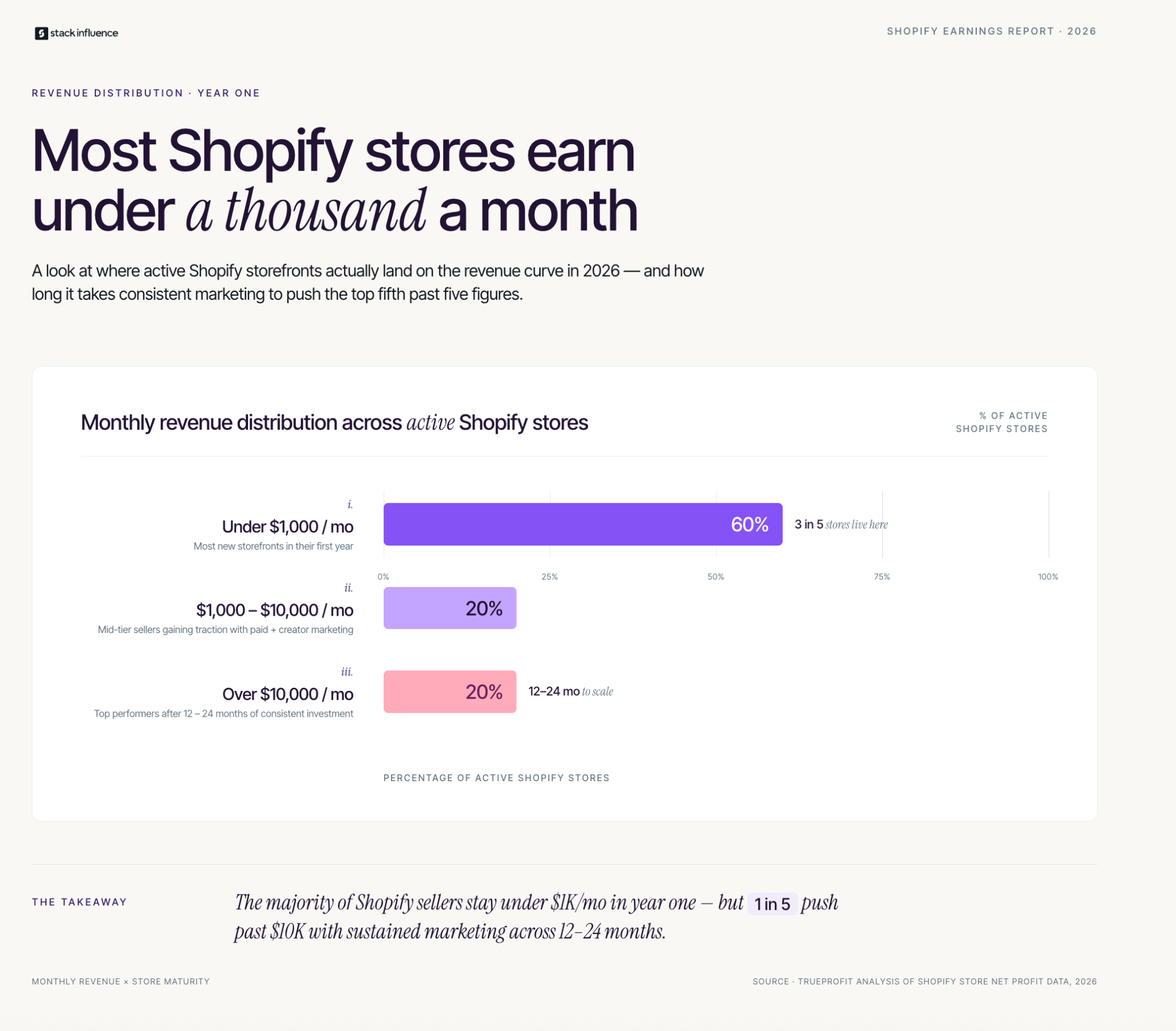
The earnings reality is polarized. Roughly 60% of new Shopify stores earn under $1,000 per month in their first year, while the top 20% scale past $10,000 per month after consistent investment in marketing and conversion optimization. The gap between those two groups is rarely product quality or pricing. It is traffic quality and the ability to convert that traffic into repeat buyers.
Customer acquisition costs across DTC brands have risen 222% over the past eight years, which makes traffic diversification a financial necessity rather than a growth strategy. Sellers who rely entirely on paid social are working against a rising structural headwind. Understanding the current landscape means accepting that reality and building a revenue model that does not depend on any single channel.
Social commerce in the US is projected to surpass $100 billion in 2026, with creator-led channels driving a growing share of that volume. Sellers who treat influencer and UGC marketing as a future experiment rather than a present-tense channel are already behind the brands that started building creator programs 12 months ago.
What Does It Actually Take to Make Money on Shopify?
Making money on Shopify requires three things working in parallel: a product with real margin, a traffic source that scales, and a storefront that converts visitors at a consistent rate. Most sellers understand the first requirement but underestimate the second and third. A good Shopify conversion rate sits between 2.5% and 3.5%, with top performers hitting 4.7% and above, according to Craftberry's 2026 conversion benchmark analysis. Stores converting below 1% are not a traffic problem. They are a trust and relevance problem.
The seven primary ways to make money on Shopify are:
- Physical product stores: Selling branded or sourced products with full control over pricing, positioning, and customer experience.
- Dropshipping: Listing third-party products without holding inventory, with the supplier shipping directly to customers on each order.
- Print on demand: Selling custom-designed products fulfilled by a third party, with no upfront inventory cost or minimum order requirements.
- Digital products: Selling downloadable assets like templates, guides, presets, or courses with near-100% profit margins per unit.
- Subscriptions: Building recurring revenue through replenishment products or curated boxes tied to a consistent billing cycle.
- Affiliate and creator programs: Generating revenue by enabling influencers or ambassadors to earn commissions on traffic they refer to your store.
- Service offerings: Using Shopify as a booking and payment front end for freelance, consulting, or coaching services.
Each model has a different CAC ceiling, margin profile, and growth trajectory. The model that scales is the one that matches your product type, margin structure, and capacity to generate traffic without relying on a single expensive channel. Most sellers who plateau are not in the wrong business model. They are in the right model with the wrong traffic strategy.
Why Paid Ads Alone Will Not Sustain Your Shopify Store
Most Shopify guides position paid advertising on Meta and Google as the default traffic strategy and then quietly acknowledge that it is expensive. That framing understates the structural problem. CAC has risen more than 222% over eight years, and that figure does not reflect a bad campaign. It reflects a structural shift in how attention is priced online.
The sellers outperforming their peers in 2026 are not necessarily spending more on ads. They are diversifying traffic sources so that creator-generated content, organic SEO, and email each carry meaningful weight alongside paid channels. Three in four online consumers report purchasing a product based on an influencer recommendation, which means creator-led traffic is not an alternative to demand. It is a direct channel for it.
The math shifts when you factor in content reuse. A paid ad campaign produces impressions. A product seeding campaign with micro influencers produces both traffic and reusable creative assets. Those UGC assets repurposed as ad creative generate 4x higher click-through rates than brand-produced content, which means the creator investment pays dividends across multiple channels simultaneously.
Sellers who recognize this shift stop treating influencer marketing as a brand awareness budget line and start treating it as a cost-of-goods item that comes with content attached. That mental shift is what separates brands building compounding traffic from brands buying traffic one click at a time. The hidden cost of staying on paid-only acquisition is not just CAC. It is the content library you are not building while your competitors are.
The Shopify Revenue Ladder: Four Stages of Scalable Growth
The Shopify Revenue Ladder is a four-tier progression model that helps sellers identify where they are in their growth arc and what to prioritize next. Unlike a linear checklist, the Shopify Revenue Ladder acknowledges that the tactics that work at $1,000 per month often break at $20,000 per month, and scaling requires a deliberate shift in approach at each tier. Understanding which rung you are on prevents the most common scaling mistake: using Tier 4 tactics when you are still solving Tier 1 problems.
The four tiers of the Shopify Revenue Ladder are:
- Tier 1: Launch. Secure your first 50 orders using organic social, personal network promotion, and small-batch product seeding with 5 to 10 creators. The goal is proof of purchase intent, not volume. Validate the product before scaling traffic spend.
- Tier 2: Drive. Layer in paid social with small test budgets, build your email list, and run your first structured product seeding campaign to generate UGC assets you can use in ads and on product pages. Build your attribution infrastructure now.
- Tier 3: Amplify. Scale creator campaigns with a repeatable workflow. Feed UGC into paid creative. Place creator content on Shopify product pages to improve conversion rates. Activate top-performing creators into an ambassador and affiliate program.
- Tier 4: Compound. Creator content becomes a permanent production pipeline. Ambassador and affiliate programs generate ongoing traffic without proportional ad spend increases. Content syndication across Shopify, email, Amazon, and paid social creates a self-reinforcing growth cycle.
The Shopify Revenue Ladder works because it forces sellers to think in stages rather than tactics. Most sellers jump from Tier 1 directly to paid ads without ever building the content foundation that makes those ads efficient. The brands moving fastest through the Shopify Revenue Ladder invest in creator relationships early, because that investment pays compounding returns at every subsequent tier.
At Tier 3, the operational question becomes execution volume. Running product seeding campaigns with 20 or more creators manually is time-intensive and prone to fulfillment gaps. For sellers at this stage, platforms like Stack Influence handle automated product seeding, creator matching, brief delivery, social post verification, and UGC collection in a single workflow. That operational leverage allows lean teams to run Tier 3 campaigns without adding headcount, which is exactly what the Shopify Revenue Ladder requires for efficient stage progression.
How Influencer Marketing Generates Compounding Revenue on Shopify
Influencer marketing's role in Shopify revenue generation has evolved from a brand awareness play into a direct-response and content-production channel. The global influencer marketing industry reached $32.55 billion in 2025, with DTC brands driving a significant share of that spend because of the dual output: traffic and reusable creative. For Shopify sellers, the math works because micro influencers generate both outputs at a unit cost that paid channels cannot match.
The mechanics work as follows. A product seeding campaign sends inventory to 20 to 100 micro influencers in exchange for social posts. Those posts drive direct traffic to your Shopify store. The UGC they produce gets pulled into your product pages, email campaigns, and paid social creative. Each piece of content continues working long after the original post. Unlike a paid ad that stops generating value when the budget runs out, a creator post and its derivative assets generate value across multiple cycles.
Across campaigns managed on the Stack Influence platform, Shopify sellers in the beauty and personal care category consistently see UGC reuse rates above 60%, meaning more than half of the creator content produced is usable across paid ads, product listings, and email without additional editing. In general lifestyle categories, that reuse rate averages closer to 40%. The gap matters because higher reuse rates translate directly into lower blended content production costs over time.
The strategic implication for sellers trying to make money on Shopify is that influencer campaigns should be evaluated not just on attributed sales from the original post but on the total asset value generated. A campaign producing 30 usable video assets, 15 of which outperform studio creative in paid social, is generating ongoing revenue that does not appear in a single UTM report. Understanding Shopify influencer marketing as a content production investment, not just a traffic purchase, changes how you budget and what metrics you prioritize.
Turning Creator UGC Into a Shopify Sales Machine

Creator content does not automatically convert once it drives a visitor to your Shopify store. The bridge between influencer-driven traffic and actual revenue is store readiness. The Creator-Ready Store Audit is a six-item checklist sellers should complete before running any influencer or product seeding campaign. Applying the Creator-Ready Store Audit before launch prevents the most common failure mode: sending engaged, warm traffic to a store that is not built to capture it.
The Creator-Ready Store Audit covers six critical areas:
- Social proof visibility: UGC imagery, review counts, and star ratings visible above the fold on mobile product pages before a visitor has to scroll.
- Mobile load speed: Product pages loading in under three seconds on mobile, where the majority of influencer-driven traffic arrives from social platforms.
- PDP UGC placement: At least one creator image or video embedded on each hero product page to validate authenticity for new visitors arriving without prior brand familiarity.
- UTM structure: Attribution links built and tested before products ship to creators, so every traffic source is trackable from campaign day one.
- Email capture flow: A pop-up or embedded form capturing email addresses from visitors who do not convert on first visit, preserving the CAC investment for future nurture.
- Inventory buffer: A reserved inventory allocation for creator seeding so fulfillment for paying customers is not disrupted during campaign windows.
Data from Stack Influence's micro influencer campaigns suggests that Shopify brands deploying creator UGC directly onto product detail pages within two weeks of campaign delivery see measurably stronger add-to-cart rates than brands who let that content sit unused in a shared folder. The content is highest-impact when it is deployed fresh and aligned to the current traffic source visiting the store.
The UGC collection workflow is only as effective as the store receiving the traffic. Sellers who have completed the Creator-Ready Store Audit convert influencer traffic at rates closer to the 3.5% to 4.7% top-performer range. Sellers who skip this step often see strong engagement metrics from creator content paired with weak on-site conversion, which leads them to incorrectly conclude that influencer marketing does not work for their brand.
Where to Measure Creator-Driven Revenue on Shopify
Measuring how influencer and product seeding campaigns contribute to Shopify revenue requires a layered attribution model. Last-click attribution inside Shopify Analytics systematically undercounts creator impact because it credits the final touchpoint, not the intent touchpoint. A customer might see a creator's post on Tuesday, visit and leave without buying, receive a retargeting ad on Thursday, and convert on Friday. Shopify Analytics credits the Thursday ad. The creator post that built the initial purchase intent gets no credit at all.
The Shopify Creator Attribution Stack is a three-layer model that gives sellers a more complete picture:
- Layer 1: Direct attribution. Unique discount codes and UTM-tagged links per creator capture sales traceable to a specific post or creator. This is the most commonly tracked metric and the easiest to report, but it undercounts full creator impact by 40% to 60% in most campaigns.
- Layer 2: Assisted attribution. Google Analytics 4 tracks full customer journeys, including sessions that started from a creator post but converted through a different channel. Comparing GA4 assisted conversion data to Shopify last-click data reveals the true contribution of creator-generated traffic.
- Layer 3: Content asset value. UGC repurposed into paid social creative should be tracked with its own performance labels. When a creator's video outperforms brand-produced creative by 30% on click-through rate, that performance delta is direct revenue impact from the original seeding investment.
Based on Stack Influence's work with eCommerce brands, sellers who implement all three attribution layers consistently find that creator-driven revenue is 1.5 to 2.5 times higher than what their last-click reports show. That discrepancy changes budget allocation decisions and makes the case for ongoing creator investment in internal reporting.
Amazon sellers running dual-channel operations should also note that influencer traffic sent to a Shopify storefront and cross-promoted to an Amazon listing qualifies for the Amazon Brand Referral Bonus, which credits back 10% or more of the sale price on traffic driven by external sources. That bonus effectively subsidizes the cost of creator campaigns for brands selling across both channels. The measurement infrastructure should be built before campaigns launch, not after, so that sellers have clean data to optimize against from the first shipment.
Conclusion
The path to making money on Shopify in 2026 is not a single channel or a single product category. It is a staged progression from proof of concept through compounding traffic, and the brands scaling fastest are those that invest in creator-driven content early enough for it to compound. The Shopify Revenue Ladder gives sellers the framework to identify their current stage and make deliberate choices about what to build next, rather than defaulting to ad spend when growth stalls.
For DTC sellers ready to move beyond paid-ad dependency, the next step is identifying which of the seven revenue models aligns with your margin structure, and then building the creator and UGC infrastructure that makes each model more efficient over time. Whether you are seeding 10 creators or 100, the operational systems you build at Tier 2 become the growth engine at Tier 4. Start with the Creator-Ready Store Audit, build your attribution stack before your first campaign ships, and treat every piece of creator content as a long-duration asset for your store.