




The influencer marketing industry has crossed $32 billion globally in 2026, and the biggest budget shift inside that number is moving away from one-off sponsored posts toward ongoing ambassador relationships. For content creators, that means the question is no longer just "how do I land a brand deal?" but rather "how do I become a brand ambassador who earns recurring income and builds compounding partnerships?" This guide answers both questions with a framework designed for the current market, where engagement outranks follower count and long-term trust outranks one-time reach.
Key Takeaways
- Brand ambassador roles differ from sponsored posts in one critical way: they are relationship-based, not campaign-based, which changes how you pitch and how you get paid.
- The Creator Progression Tiers model shows exactly where you are in the ambassador readiness journey and what to do next to advance.
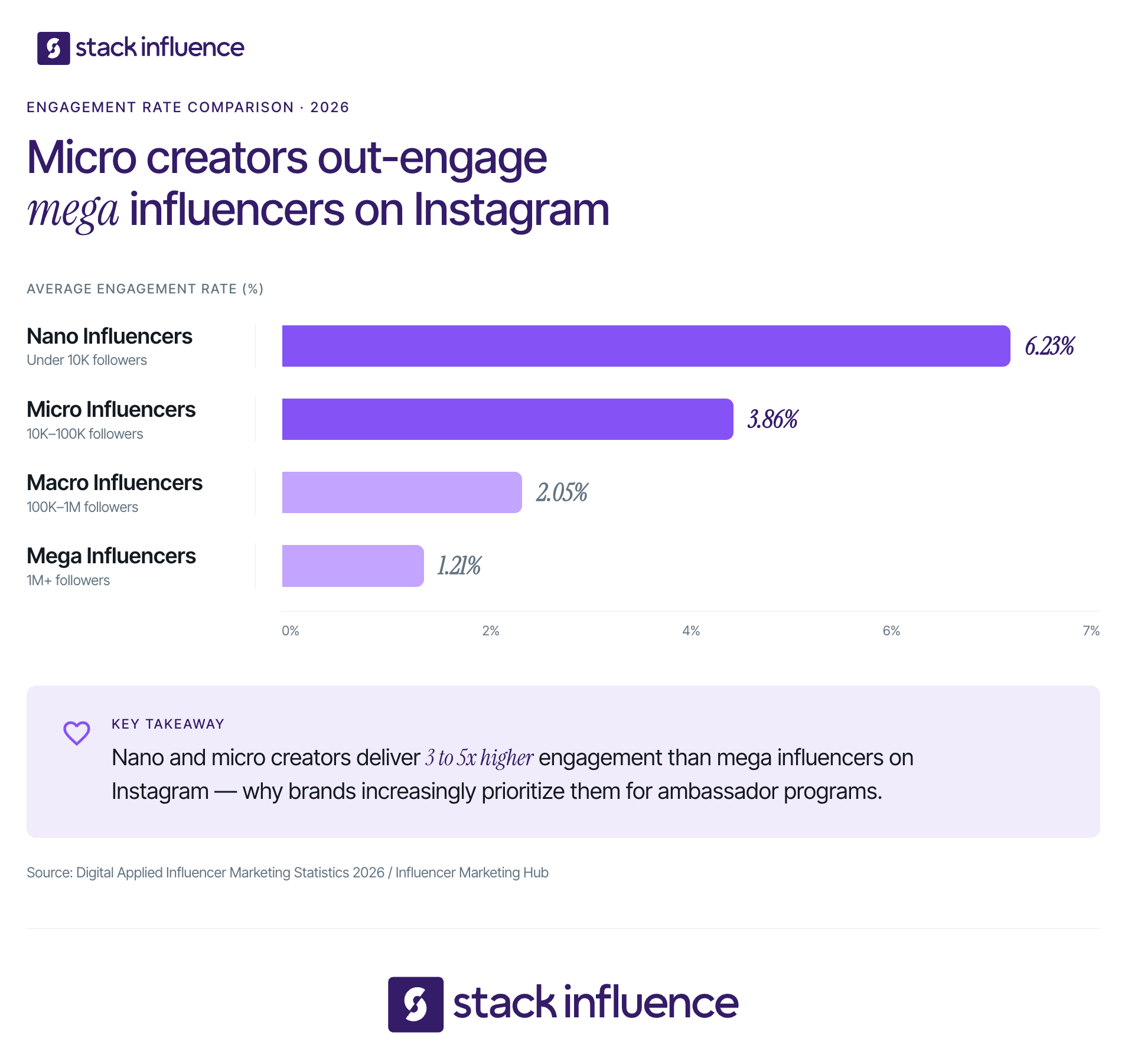
- Micro and nano creators hold a structural engagement advantage over larger accounts, making them highly attractive to brands in 2026.
- Compensation in ambassador programs combines product gifting, affiliate commissions, and flat fees, and understanding how to negotiate each piece significantly increases your earning potential.
- FTC disclosure is mandatory for all ambassador partnerships, including gifted-product arrangements, and using the wrong language puts both you and the brand at legal risk.
The 2026 Ambassador Opportunity Is Bigger Than You Think
The ambassador opportunity is larger and more accessible in 2026 than at any previous point in the creator economy's history. Brands are not just running more campaigns; they are restructuring how they fund them. According to Aspire's 2026 State of Influencer Marketing report, 74% of marketers plan to actively increase their influencer marketing budgets, and much of that increase is flowing toward long-term creator relationships rather than one-time activations.
The preference shift is dramatic at every budget tier. Data from Digital Applied's 2026 influencer statistics shows micro-influencers generate an average engagement rate of 3.86% compared to 1.21% for mega-influencers, at 60% lower cost per post. That performance gap makes micro and nano creators the most commercially efficient ambassador candidates available to brands today.
What brands are looking for has also changed. According to industry research cited across the Influencer Marketing Hub's 2026 Benchmark Report, the shift toward nano and micro-creator partnerships has accelerated, with brands prioritizing engagement quality and audience trust over raw follower count. The creators winning long-term ambassador deals in 2026 are not necessarily the ones with the biggest accounts. They are the ones who behave like reliable business partners.
Understanding this context is the first step to positioning yourself correctly. The rest of this article gives you the tools to do exactly that.
What Is a Brand Ambassador?
A brand ambassador is a creator who represents a company on an ongoing basis, promoting its products through authentic content, community engagement, and consistent visibility across social channels. Unlike a one-off sponsored post, a brand ambassador role is built on a long-term relationship, usually lasting three to twelve months or longer, with recurring content, early product access, and performance-based incentives that align the creator's output with the brand's growth goals.
The distinction matters because it changes how you approach everything: your pitch, your content strategy, and your compensation negotiation. A sponsorship is transactional. An ambassador relationship is operational. According to industry guidance from GRIN's brand ambassador program analysis, ambassador programs typically last 3 to 12 months or longer, with creators expected to deliver consistent content, maintain posting cadence, and produce work that can be repurposed across brand channels.
Brands also draw a clear line between ambassadors and one-time influencers. The ambassador has to deliver repeatedly, without missing deadlines, drifting off-message, or becoming difficult to manage. That operational reliability is what justifies a multi-month contract, and it is the standard you are competing against when you pitch for a role.
The Creator Progression Tiers: A Framework for Ambassador Readiness
The single most useful lens for evaluating your ambassador readiness is the Creator Progression Tiers model, an original framework that maps where every creator sits on the path from first collaboration to long-term brand partnership. Unlike follower tiers or engagement benchmarks, the Creator Progression Tiers framework organizes your positioning by the commercial depth of your relationships, not the size of your audience.
The Creator Progression Tiers framework has three levels:
- Tier 1: The Content Producer. You create content and occasionally receive gifted products or one-off paid posts. Your brand relationships are transactional and campaign-specific. The defining signal at Tier 1 is that most deals are one-off with no repeat engagement from the brand side.
- Tier 2: The Trusted Creator. You have completed multiple collaborations and have performance data to show: engagement rates, link click-throughs, promo code redemptions, and content reuse by brands. Brands return to you for second and third cycles because you reduce their briefing overhead and deliver on-brand content faster.
- Tier 3: The Brand Collaborator. You co-create campaigns, contribute to brand feedback loops, appear in paid amplification formats, and carry real equity in how a brand story is told over time. Ambassador programs and multi-cycle contracts live at this tier. The defining signal is that brands treat you as a strategic partner, not a vendor.
The Creator Progression Tiers framework is not about follower count. It is about the depth of trust you maintain and the commercial outcomes you reliably produce. Most creators underestimate how quickly they can move from Tier 1 to Tier 2 with the right documentation habits, and how much that movement changes the quality of deals they are offered.
Use this framework as a diagnostic: where do your current brand relationships sit? If most are one-off, you are a Tier 1 creator working toward Tier 2. The actions in the following sections are designed to accelerate that progression.
7 Things That Make Micro Creators Strong Brand Ambassadors
The seven factors below are what brands consistently look for when evaluating ambassador candidates. They are not about follower count. They are operational and relational qualities that predict whether a creator will deliver commercial value over a sustained period.
Here is what separates creators who land long-term ambassador deals from those who cycle through one-off posts:
- Niche specificity. A creator who speaks clearly to one audience segment makes it easy for a brand to evaluate fit. General lifestyle accounts are harder to match because the audience is diffuse. The narrower and more defined your content focus, the more valuable you are to brands targeting that niche.
- Engagement rate over reach. According to Sprout Social's 2025 Influencer Marketing Report, 65% of influencers prefer joining strategy conversations early and understand performance measurement by engagement metrics. Brands in 2026 prioritize creators whose audiences actually interact, comment, save, and click.
- Content reusability. Brands increasingly want content they can repurpose across their own channels, ads, and product pages. Creators who deliver raw footage alongside final edits, and who offer usage rights proactively, are selected for repeat partnerships at significantly higher rates.
- Posting consistency. An ambassador who cannot maintain a content cadence creates operational friction for the brand's campaign calendar. A documented history of consistent posting is a trust signal before any pitch conversation begins.
- Commercial maturity. Understanding briefs, approvals, deadlines, and performance reporting signals that you can be trusted with a long-term partnership. Brands avoid creators who need excessive hand-holding on deliverables.
- Genuine product alignment. Brands evaluating ambassador candidates check whether you already use and genuinely interact with products in their category. Ambassadors who behave like real customers rather than hired promotion machines produce content that converts better and retains audience trust longer.
- Transparent performance data. The creators who advance fastest bring their own numbers to every conversation. Screenshot your engagement rates, promo code redemptions, Story swipe-up rates, and affiliate link clicks. This data separates you from every other creator pitching without proof.
These seven factors map directly to the Creator Progression Tiers framework. Tier 1 creators typically demonstrate two or three of them inconsistently. Tier 2 creators demonstrate five or six consistently. Tier 3 brand collaborators demonstrate all seven and use their data proactively in pitch conversations.
How to Be a Brand Ambassador: Finding and Pitching Opportunities
Finding opportunities requires knowing where ambassador programs actually live and how to position yourself for each channel. The three main pathways are creator-brand matching platforms, direct program applications, and personalized cold outreach.
Matching platforms are the most efficient starting point in 2026. On platforms like Stack Influence, creators can access product-seeding campaigns that serve a dual function: they generate real collaboration experience and portfolio proof while sometimes converting into longer-term ambassador arrangements. Stack Influence's creator opportunities page uses a gifted-first, product-seeding model where creators receive products, post authentic content, and build a portfolio of completed brand collaborations without needing a large existing audience. That portfolio becomes the foundation of your Tier 2 positioning when you approach brands for ambassador deals.
Direct program applications work well in fitness, beauty, wellness, and lifestyle categories where brands run formal, open-enrollment ambassador programs. The key is to apply with a polished media kit that includes your niche, platform metrics, audience demographics, and past collaboration examples. Canva offers free customizable media kit templates as a starting point, and the kit should be no longer than two pages.
Personalized outreach is effective when you have a genuine brand relationship to reference. Generic copy-paste pitches are ignored, but a message that opens with a specific product you have used, names a piece of content you have already created around that category, and proposes a clear deliverable structure has a real chance of landing a response. The pitch should feel like the beginning of a business conversation, not a fan letter.
What Changed About Brand Ambassador Programs in 2026
The ambassador market in 2026 looks structurally different from how it operated even two years ago, and three specific shifts matter most for creators trying to secure and retain long-term partnerships.
Long-term deals replaced one-off posts as the dominant structure. According to Aspire's State of Influencer Marketing 2026 report, 63% of creators now prefer long-term partnerships over any other type of campaign structure. Brands noticed that shift and accelerated their move toward multi-cycle contracts because returning creators require far less briefing overhead and deliver better on-brand content faster. From Stack Influence's experience running product seeding campaigns at scale, brands that convert product gifting recipients into repeat partners see 3x higher content output per dollar spent compared to brands running isolated single-activation campaigns.
Content rights became a primary deal factor. Brands now evaluate ambassador candidates partly on whether they will grant reuse rights for ads, product pages, and owned channels. Creators who proactively offer usage rights alongside standard deliverables are selected for repeat partnerships at roughly twice the rate of those who provide post-only deliverables, reflecting the growing brand demand for reusable content assets.
FTC enforcement became more aggressive. According to IQFluence's FTC compliance analysis for 2026, the FTC is now focused on how disclosure holds up in fast-moving formats like Reels, TikTok videos, and livestreams, and ongoing ambassador deals are now treated as material connections that require disclosure on every piece of brand-related content. The FTC's official guidance makes clear that terms like "thanks," "collab," "sp," or "ambassador" alone do not satisfy disclosure requirements. Use "Ad," "Sponsored," or "Paid partnership" in the first two lines of every caption. Gifted products count as pay under these rules, so disclosure applies even when no cash changes hands.
How to Negotiate Ambassador Compensation
Ambassador compensation has more structure than most creators realize, and knowing the components gives you real leverage in negotiations. Most ambassador deals combine at least two of these three elements: free product, affiliate commissions, and flat fees.
Here is how to approach each:
- Product gifting. Product seeding is the most common entry point, especially for Tier 1 to Tier 2 transitions. The value lies not only in the product itself but in the portfolio piece and performance data each collaboration generates. Treat every gifted collaboration as a proof-of-work asset.
- Affiliate commissions. Commission-based structures typically range from 10% to 35% depending on the brand and category. These structures reward performance and create income that scales with your audience's purchasing behavior, not your follower count.
- Flat fees. Typical micro-influencer brand deal rates in 2026 range from $250 to $3,000 per post, depending on platform and content format, according to research cited in Stack Influence's creator income guides. Video content on TikTok commands premium rates relative to static posts.
When you move into a formal ambassador negotiation, always clarify four specific terms before signing anything: the number of deliverables per cycle, usage rights and whether the brand intends to run your content as a paid ad, exclusivity scope (which prevents you from working with competitors and should carry a meaningful rate premium), and the contract term length. A 30-day, 60-day, or 90-day initial term is standard; avoid open-ended arrangements without renewal clauses.
The Pre-Deal Negotiation Checklist is your secondary decision tool here, covering the five items you must confirm before any ambassador agreement is finalized:
- Deliverable clarity: Number of posts, format, and platform are defined in writing.
- Usage rights scope: Whether content can be used in paid advertising and for how long.
- Exclusivity terms: Which competitor categories are restricted, and by how much is the rate adjusted.
- Payment timeline: Net-30 or Net-60 payment terms are standard; confirm before signing.
- Disclosure language: Verify the exact wording the brand requires, because both you and the brand share FTC liability for non-compliant disclosures.
How Should You Measure Your Performance as a Brand Ambassador?

You should measure your ambassador performance across three distinct metric layers: reach metrics, engagement metrics, and conversion metrics. Relying only on reach data (impressions, views, follower growth) keeps you at Tier 1. Moving to Tier 2 and Tier 3 requires tracking the downstream signals that brands actually buy: engagement rate, link click-throughs, promo code redemptions, and affiliate-driven sales.
The Ambassador Performance Metric Stack is a three-layer measurement model specifically designed for creators building toward long-term brand partnerships:
- Layer 1: Visibility Signals. Reach, impressions, Story views, and follower growth. These are the numbers every creator tracks but the ones that matter least to brands evaluating conversion potential. Report them as context, not as your primary value proof.
- Layer 2: Trust Signals. Engagement rate (likes, comments, saves, shares divided by reach), comment quality, and audience response sentiment. These metrics demonstrate that your audience is real and interactive. An analysis by the Influencer Marketing Factory cited in Nowadays Media's 2026 engagement rate benchmarks shows the median engagement rate across all TikTok creator tiers in 2026 is approximately 8%, with nano creators averaging 9% to 15%. Knowing your platform benchmarks allows you to contextualize your rate for brand partners.
- Layer 3: Conversion Signals. Promo code redemption rates, affiliate link clicks, swipe-up rates, and measurable traffic spikes tied to your post dates. These are the metrics that move you from Tier 2 to Tier 3 in the Creator Progression Tiers framework. Screenshot and document them after every campaign, then include them in every future pitch.
Use the Ambassador Performance Metric Stack consistently for at least two to three campaigns before pitching for ambassador roles. By that point, you will have enough Layer 2 and Layer 3 data to demonstrate commercial value with specificity rather than potential.
The Conclusion: Building an Ambassador Career That Compounds
Learning how to be a brand ambassador in 2026 is ultimately about building a business around trust, documentation, and repeatable value delivery. The Creator Progression Tiers framework gives you a clear map: Tier 1 creators complete collaborations and collect proof, Tier 2 creators use that proof to secure returning partnerships, and Tier 3 brand collaborators co-create campaigns and earn multi-cycle contracts with real strategic weight.
The market conditions are favorable. More than seven in ten brands now favor working with micro and mid-tier creators, and long-term ambassador programs are the fastest-growing deal structure inside that shift. The creators capturing those deals are not waiting for brands to find them. They are building portfolios, tracking performance data, and pitching with specificity.
If you are ready to start building your portfolio through real campaign experience, the Stack Influence creator community offers a practical entry point where you can access product-seeding campaigns, complete collaborations, and build the proof that Tier 2 and Tier 3 ambassador pitches require.