




Platform creator funds were supposed to democratize income for content creators. In practice, they have become one of the most expensive illusions in the creator economy. A creator with 500,000 views might check their Creator Fund payout and find $14.80 in earnings. That is the TikTok Creator Fund in 2026, not a typo. The math has never worked for creators building real businesses, and the structural problem is only getting worse.
The fundamental flaw of fixed-pool creator fund models is that the fund has a fixed size while the number of eligible creators and total views keeps growing, meaning per-view payouts actually decline over time as the pool of participants expands. Understanding this dynamic is the first step toward building an income model that does not depend on platform goodwill. This guide maps seven proven creator fund alternatives that content creators at every follower count can activate in 2026.
Key Takeaways
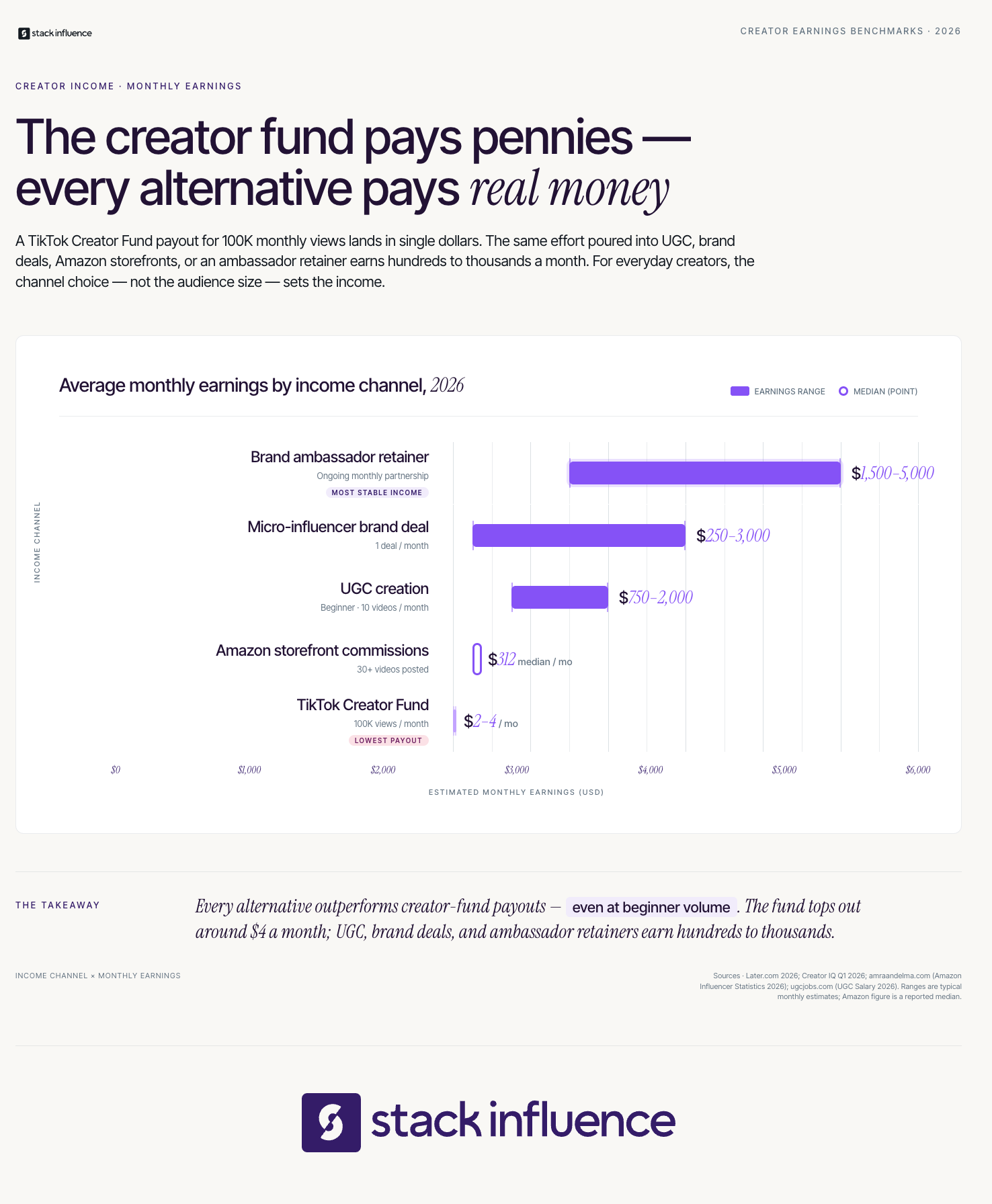
- Platform creator funds pay as little as $0.02 to $0.04 per 1,000 views under legacy structures, far below what brand deals and UGC work generate
- The 7-step PACE Income Architecture gives creators a systematic order for building revenue outside creator fund dependency
- Micro and nano influencers consistently outperform larger accounts on engagement rate and brand ROI, making them ideal candidates for paid brand partnerships
- UGC creation offers the lowest barrier to entry because income is based on content quality, not follower count
- The Amazon Influencer Program creates passive commission income that compounds as a creator's video library grows
- Measurement using the Creator Revenue Scorecard identifies which income channel to scale first
What Are Creator Fund Alternatives?
Creator fund alternatives are income channels that content creators use instead of, or in addition to, platform-native payment pools like TikTok's Creator Fund or Instagram's bonus programs. As of 2026, the creator economy is valued at $234 billion and is expected to surpass $528 billion by 2030 , meaning the opportunity landscape for creators has expanded far beyond anything a platform fund can capture.
According to Influencer Marketing Hub's 2025 creator earnings report, the highest-earning TikTok creators derive less than 20% of their total income from platform funding programs, with brand deals, affiliate marketing, and owned products generating the majority of creator revenue. This is not a niche finding. It reflects a structural reality that most creator fund guides fail to address: the fund is a discovery mechanism, not a business model.
The seven categories of creator fund alternatives covered in this guide are:
- Brand sponsorships and paid partnerships: Direct deals with brands looking for influencers to promote their products
- UGC creation for brands: Producing authentic video content for brand ads without requiring a large following
- Affiliate and commission programs: Earning a percentage on purchases made through trackable links
- Amazon Influencer Program: Building a commission-generating storefront with shoppable product videos
- Product seeding and ambassador programs: Receiving products and long-term brand relationships in exchange for ongoing content
- Digital products and licensing: Selling creator knowledge, templates, and content usage rights
- Influencer marketing platform deals: Accessing structured brand campaigns through influencer marketing platforms that connect brands and creators at scale
Each of these channels operates independently of platform algorithm decisions and pays based on value delivered, not views accumulated.
How Most Creators Should Build Their Revenue Stack
The primary framework for this guide is the PACE Income Architecture, a numbered seven-step sequence that tells creators exactly which income channel to activate first, second, and so on, based on follower count, content format, and time investment. Most creator guides treat revenue streams as interchangeable. The PACE Income Architecture treats them as sequential because early-stage creators who try to run five channels simultaneously generate mediocre results across all of them.
The PACE Income Architecture stands for: Platform-independent channels first, Active income before passive, Commission-based income as the bridge, and Equity-building channels last. Here is the sequence:
- UGC creation: Start here because it requires zero followers and pays immediately based on content quality alone
- Product seeding and gifted partnerships: Accept free products from brands to build portfolio content and testimonials
- Affiliate links and commission programs: Layer these onto existing content once you have audience trust established
- Amazon Influencer Program storefront: Build a video library of product reviews that generate passive commission income over time
- Micro brand sponsorships: Pitch to brands directly using your engagement data once you have proof of content performance
- Influencer marketing platform campaigns: Apply to structured brand campaigns on micro influencer platforms that offer predictable campaign structures
- Digital products and licensing: Package your creator knowledge once you have an audience asking you how you work
The PACE Income Architecture is designed to be sequential but not rigid. A creator with an existing audience of 30,000 followers can enter at Step 4 or 5. A brand-new creator with no following should start at Step 1.
Brand partnerships continue to dominate the creator income landscape, with 82% of creators expecting them as a top revenue stream in 2026.
According to Later data, 54% of creators are also interested in pursuing affiliate marketing, while 42% see real potential in UGC licensing. The PACE Income Architecture reflects these priorities, placing high-converting active income channels at the front of the sequence.
How Micro and Nano Influencers Win More Brand Deals
One of the biggest misconceptions in creator fund conversations is that brand sponsorships are reserved for creators with hundreds of thousands of followers. According to 2026 research, 73% of brands favor working with micro and mid-tier creators, micro-influencers achieve 3.86% engagement on Instagram versus just 1.21% for mega-influencers, and brands earn an average of $5.78 for every dollar spent on influencer marketing.
Typical micro-influencer brand deal rates in 2026 range from $250 to $3,000 per post, depending on the platform and content format, with video content for TikTok and Instagram Reels commanding the highest prices due to greater production effort and higher engagement potential. This is the category where the PACE Income Architecture shifts from entry-level income to scalable income.
Across campaigns managed on the Stack Influence platform, micro-influencers in the beauty and personal care category who pitch brands with documented engagement rates above 5% close their first sponsored deal an average of 40% faster than those who pitch on follower count alone. The data consistently shows that brands looking for nano influencers prioritize audience quality over audience size.
Here is what a winning brand deal pitch package includes:
- Engagement rate documentation: Screenshot from your platform analytics showing 90-day average engagement, not just follower count
- Niche audience proof: Demographics screenshot showing your audience's age, location, and gender split
- Content samples: Three to five pieces of your best-performing content in the category relevant to the brand
- Rate card: A clear one-pager with pricing by deliverable type including Reels, TikToks, Stories, and UGC-only options
- Social proof: Any past brand partnerships, gifted collaborations, or product seeding outcomes
According to the Influencer Marketing Hub's 2026 Benchmark Report, 73% of brands now favor working with micro and mid-tier creators over celebrity partnerships, and the brands increasing budgets by the largest margins are prioritizing creator authenticity over raw reach. This structural shift makes 2026 the strongest environment in history for micro influencers pitching brand partnerships directly.
UGC Platforms, Product Seeding, and the Entry Income Strategy
UGC creation is the single best entry point in the PACE Income Architecture because it decouples income from follower count entirely. In the US alone, spending on UGC content is expected to exceed $10 billion in 2025, up 11% from the prior year, and since 2021 spending on UGC has grown by 100%. The demand is structural, not cyclical.
Stack Influence's internal campaign data shows that UGC creators who begin with product seeding campaigns before pursuing paid brand deals build conversion-proven portfolios in an average of 60 to 90 days, compared to creators who start by pitching cold with no portfolio evidence.
UGC creator rates range from $75 to $200 per video for beginners up to $500 to $1,500 or more per video for experienced creators. As a creator builds a portfolio of brand-approved content, rates can increase without requiring any follower growth. As of 2025, 93% of marketers who used UGC said it outperformed traditional branded content.
UGC platforms worth activating as part of the entry strategy include:
- Collabstr: An open marketplace where creators set their own rates and brands browse by niche and content type
- Billo: A structured platform where brands post briefs and creators apply to produce short video content
- UGC platforms with eCommerce integration: Platforms connecting UGC creators directly to brands running Shopify influencer marketing or Amazon campaigns
Product seeding is a related but distinct strategy. In a product seeding arrangement, a brand sends a creator free product in exchange for authentic content, without requiring payment or performance guarantees. This is the lowest-risk entry into brand partnerships and creates content assets that serve as proof of competency when pitching paid deals. Brands that work with micro influencers through seeding programs frequently convert those relationships into paid ambassador arrangements over three to six months.
The Amazon Influencer Program as a Passive Income Layer
The Amazon Influencer Program is one of the most underutilized creator fund alternatives available to content creators in 2026. Unlike standard affiliate marketing where a creator must drive external traffic to Amazon, the program allows approved creators to upload video reviews directly to product detail pages, earning commissions when shoppers who are already on Amazon watch the video and purchase.
Data from Creator IQ's Q1 2026 State of Creator Commerce report revealed that micro-influencers operating Amazon storefronts saw a median monthly commission income increase of 22% year-over-year, with the average micro-creator now earning $312 per month in pure affiliate commissions, driven largely by increased storefront traffic from Reels and TikTok integrations.
Research from TokPortal's 2026 monetization breakdown shows that a creator with 500,000 focused followers can command $3,000 to $15,000 per dedicated brand video, while the Creator Rewards Program still averages just $0.40 to $1.00 RPM for most creators. This comparison illustrates why the PACE Income Architecture places Amazon commissions and brand deals ahead of any platform fund reliance.
From Stack Influence's experience running Amazon seller influencer campaigns, creators who upload a minimum of 30 product review videos to their Amazon storefront before promoting it externally see significantly higher per-video commission yields than those who promote an underpopulated storefront, because Amazon's internal recommendation system favors storefronts with higher content density.
Setting up an Amazon storefront as a creator involves three practical steps:
- Apply through the Amazon Influencer Program: Eligibility is based on engagement quality, not follower count; Instagram, YouTube, TikTok, and Facebook accounts all qualify
- Build a product review video library: Focus on products in a specific niche category to increase relevance signals within Amazon's algorithm
- Add Amazon Attribution links to external content: When promoting Amazon products externally on social media, using Amazon Attribution links allows creators to track which social content drives Amazon conversions, enabling data-informed content decisions
The Amazon Influencer Program also functions as an entry point for Amazon FBA sellers and brands looking for creators to generate onsite UGC video, creating a natural pipeline between UGC work and affiliate income.
What Most Creator Income Guides Get Wrong About Engagement
Here is the contrarian position most guides avoid: engagement rate is not the metric that converts brand deals into revenue. Most creator guides tell micro influencers to obsess over their engagement rate because it is the primary signal brands use. That is partially true, but it misses a critical distinction.
Multiple creators have reported that Creator Fund RPMs drop as their accounts get bigger because more views means the same fixed pot of money gets split more ways. The same dilution logic applies to engagement rate when it is treated as the endpoint rather than the entry point of a pitch conversation. A 6% engagement rate earns you the meeting. It does not close the deal.
Brand deals account for 68.8 to 70% of total creator income, making brand-creator relationships the primary monetization pathway. The specific alternative metric that converts brand deal conversations into signed contracts is documented conversion evidence. This means showing a brand exactly what happened when you recommended a product, which products you drove clicks to, and ideally what the purchase behavior looked like downstream.
The secondary framework for this guide is the Creator Revenue Scorecard, a named checklist that creators should complete before pitching any brand deal or applying to any influencer marketing campaign. The Creator Revenue Scorecard has five components:
- Conversion proof: At least one documented example of audience purchasing behavior after a product recommendation
- Category authority: Content history in a specific product category, not a general lifestyle channel
- Audience location concentration: At least 60% of your audience located in markets where the brand sells
- Content longevity: Evidence that your content generates views and clicks beyond the first 48 hours after posting
- Rate justification: A clear explanation of your pricing relative to your engagement rate and conversion data
Using the Creator Revenue Scorecard before every pitch removes the guesswork from brand deal pricing and positions creators as performance-oriented partners rather than attention renters.
How to Measure Which Creator Fund Alternative Is Actually Working
Tracking income across multiple creator fund alternatives requires a different measurement model than tracking platform fund earnings. Platform funds give you a dashboard. Multi-channel creator income requires a framework.
The named measurement model for this guide is the Creator Revenue Yield Stack, with four labeled components:
- Income per hour: Divide total revenue from each channel by the time spent creating and managing content for that channel. This identifies which alternative is actually most efficient, not just highest-grossing in raw dollars.
- Content reuse rate: Track what percentage of content created for one channel gets repurposed or licensed by a brand for paid ad use. According to Aspire data, 77% of marketers now actively repurpose creator content within their paid social campaigns to maximize reach. Creators who price usage rights separately from creation fees earn 30 to 50% more per project.
- Conversion attribution: For affiliate and Amazon income, track which specific content pieces generate the most commission activity. This data directly informs which products and formats to prioritize in future content.
- Compounding value score: Assign a score of 1 to 3 to each income channel based on whether it builds long-term asset value. A brand deal pays once. An Amazon storefront video pays every month it remains live. A licensed UGC video generates usage fee income without additional content creation work.
Influencer marketing platforms that provide campaign-level reporting can significantly reduce the manual work involved in building the Creator Revenue Yield Stack. Brands managing influencer campaigns at scale increasingly expect creators to arrive at campaign conversations with their own performance data already organized.
Stack Influence has observed that micro influencers who track income per hour across at least three revenue channels are significantly more likely to successfully negotiate a rate increase on their second brand deal, because they enter the negotiation with documented ROI evidence rather than follower count comparisons.
When applying the PACE Income Architecture alongside the Creator Revenue Yield Stack, creators can identify which stage of the sequence is generating the best income-per-hour return and choose to deepen that channel before moving to the next step, rather than spreading effort across all seven levels simultaneously.
Building Toward Long-Term Brand Partnerships and Ambassador Programs

The highest-income tier of creator fund alternatives is not a single deal but a recurring relationship. Brand ambassadors and long-term brand partnerships represent the most efficient income structure in the PACE Income Architecture because they provide predictable monthly income without requiring constant outreach.
In 2026 planning, the creator mix is moving in a clear direction: brands are expanding nano and micro creator usage far more aggressively than they are expanding macro or celebrity work, with the highest net growth intent sitting at the smallest tiers. This trend creates a meaningful opportunity for micro influencers who can demonstrate consistency and brand alignment to secure long-term ambassador arrangements.
The Creator Revenue Scorecard, applied across six to twelve months of campaign data, becomes the primary pitch document for ambassador conversations. A creator who can show a brand three months of consistent content performance, documented conversion activity, and audience growth in a relevant category is presenting a fundamentally different value proposition than a creator who simply shows their follower count and engagement average.
Brands that work with micro influencers through long-term ambassador structures typically pay monthly retainer fees that range from $1,500 to $5,000 per month for ongoing content deliverables, usage rights, and exclusivity. Monthly retainers in the $1,500 to $5,000 range provide stable income and often work out to higher effective per-video rates than one-off projects. This is the compounding value score in action within the Creator Revenue Yield Stack.
Creators ready to pursue ambassador relationships should prioritize brands that operate in their specific niche, have an existing influencer marketing infrastructure, and actively recruit through brands looking for influencers through structured programs rather than ad hoc outreach. The more systematically a brand manages its creator relationships, the more predictable the income stream becomes for the creator participating in it.
Conclusion
Creator fund alternatives are not backup plans for when platform income disappoints. They are the primary income architecture that sustainable creator businesses are built on in 2026. The PACE Income Architecture gives content creators a clear sequence for activating revenue channels that compound over time, starting with UGC creation and moving toward long-term brand partnerships and ambassador programs. The Creator Revenue Scorecard and Creator Revenue Yield Stack give creators the measurement tools to prove their value and negotiate from data rather than from desperation. For any content creator currently treating a creator fund payout as meaningful income, the shift starts with a single question: which of these seven creator fund alternatives can you activate this week, with the audience and content you already have?