




Video is no longer a nice-to-have for eCommerce sellers. Shoppers who watch a product video before purchasing convert at dramatically higher rates, stay on page longer, and return less often. Yet most sellers still treat video as a creative expense rather than a revenue channel. This guide breaks down six specific video commerce tactics you can deploy to turn passive viewers into paying customers, whether you sell on Shopify, Amazon, or both. After coordinating product seeding campaigns at scale, Stack Influence's data shows that brands using video at multiple funnel stages consistently outperform those using it only at the top of the funnel.
Key Takeaways
- Video commerce collapses the gap between product discovery and purchase by letting shoppers buy directly within or immediately after a video experience.
- Shoppable video, UGC video, and live commerce each serve a different stage of the buyer journey and should be deployed together, not as standalone experiments.
- The PACE Framework (Place, Activate, Calibrate, Expand) gives sellers a repeatable system to build video commerce from a single product page outward.
- Micro influencers and nano influencers are the most cost-efficient source of authentic UGC video, delivering engagement rates that outperform macro creator content.
- Amazon sellers can use video alongside Amazon Attribution and the Amazon Brand Referral Bonus to track and monetize external video traffic with measurable ROI.
- Measuring revenue per session, not just view count, is the metric shift that separates sellers who profit from video from those who simply produce it.
How to Build a Video Commerce Strategy That Converts
Most sellers approach video commerce backwards. They produce a polished brand video, publish it once, and wait for the views to roll in. The problem is that a video nobody interacts with is just expensive wallpaper. A real video commerce strategy maps each video type to a specific buyer action.
Start by matching your video format to your funnel stage:
- Discovery videos (short-form UGC, TikTok-native clips, Instagram Reels) belong at the top of the funnel to generate awareness and product curiosity.
- Consideration videos (demos, how-to content, comparison reviews) belong on product detail pages where shoppers are actively evaluating.
- Conversion videos (shoppable videos with embedded buy buttons, live commerce events) belong at the point of purchase to eliminate friction.
- Retention videos (unboxing, tutorials, community content) belong in post-purchase email and social retargeting flows.
The goal is to ensure a shopper can encounter your brand through video, deepen their interest through video, and complete a purchase through video without ever needing to seek out additional information elsewhere. This is the core principle of the PACE Framework introduced later in this article. Stack Influence's integration into this approach is straightforward: brands using micro influencer promotions to fuel the discovery and consideration stages spend far less on paid acquisition because creator video content does the heavy lifting across all four stages simultaneously.
What Is Video Commerce?
Video commerce is the practice of embedding purchasing capability directly into video content, or using video as the primary driver of the path to purchase. It is broader than simply adding product links to a YouTube description. Video commerce encompasses shoppable videos with in-player buy buttons, live commerce events where hosts sell in real time, short-form social commerce on TikTok Shop, and UGC video deployed on product pages to reduce buyer hesitation.
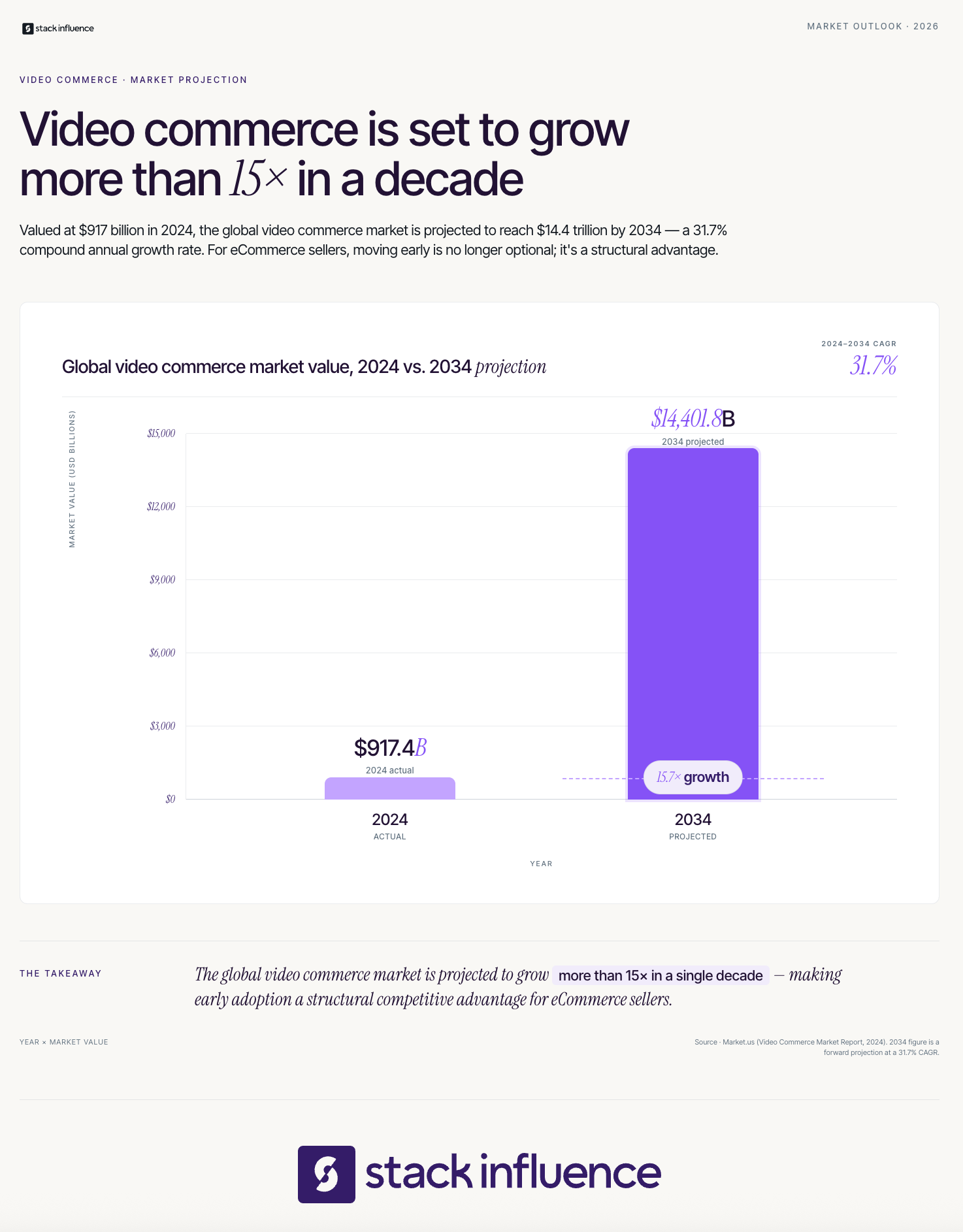
According to market research from Market.us, the global video commerce market is projected to grow from USD 917.4 billion in 2024 to USD 14,401.8 billion by 2034, a CAGR of 31.7%. That growth rate is not driven by a single platform or format. It reflects a structural shift in how consumers prefer to encounter and evaluate products. The key formats within video commerce include:
- Shoppable video: Pre-recorded video with interactive product tags and checkout embedded in the player.
- Live commerce: Real-time selling via livestream, with hosts demonstrating products and viewers purchasing during the broadcast.
- UGC video: Authentic customer or creator content deployed on product pages, social ads, or email to build trust and drive conversion.
- Short-form social commerce: Platform-native content (TikTok Shop videos, Instagram Reels with shopping tags) that delivers discovery and purchase in a single session.
Understanding these four formats is the foundation for applying the PACE Framework, which gives each format a specific role in your revenue strategy.
The PACE Framework
The PACE Framework is a branded four-stage system designed to help eCommerce sellers build a scalable video commerce operation. PACE stands for Place, Activate, Calibrate, and Expand. Each stage has a specific deliverable, and the framework is designed to be used sequentially before any budget is increased.
Data from Whatmore's controlled A/B tests across 200,000+ sessions shows that visitors who engage with a shoppable video convert at a median rate 125% higher than those who do not. The reason most sellers never unlock that lift is that they skip straight to production without completing the first two PACE stages.
Here is how each stage of the PACE Framework works:
- P — Place: Identify the three highest-traffic pages on your store and add a single shoppable video widget to each. This is your baseline test. Do not launch across the full catalog until you have data from these three pages.
- A — Activate: Seed products with micro influencers or nano influencers to generate a library of authentic UGC video. Aim for ten to fifteen creator clips per hero SKU before moving to the next stage.
- C — Calibrate: Run a 30-day performance review. Measure conversion rate lift on pages with video versus without. Identify which video format (UGC, demo, shoppable) delivers the highest add-to-cart rate for your specific product category.
- E — Expand: Scale the winning format across the rest of your catalog. Repurpose top-performing creator content as paid social ads and on-site video using a content syndication workflow.
According to Firework's performance data, 84% of consumers report being convinced to purchase a product after watching a brand's video, and viewers engaged with shoppable videos show a 9x increase in purchase intent. That kind of intent signal only activates when the video content feels credible, which is why the Activate stage of the PACE Framework specifically calls for creator-generated rather than brand-produced content.
A 2026 benchmark study from ReelTok found that shoppable videos outperform static images in driving conversions by 25% to 80%, while keeping users engaged for an average of 1 minute and 34 seconds per session. When you apply the PACE Framework systematically, those numbers become achievable benchmarks rather than outliers.
Building Your Video Asset Engine
The most common bottleneck in video commerce is not strategy or platform. It is content volume. A seller who wants to run shoppable video on fifty product pages needs a reliable, repeatable source of video content that does not require a film crew for every SKU. The solution is a structured asset engine, built using the Video Source Audit.
The Video Source Audit is the secondary framework in this guide. It is a five-point checklist that helps sellers identify and organize every source of video content already available to them before spending a dollar on new production.
According to published marketing research, 81% of ecommerce marketers say UGC has a greater impact than professional product photography. The implication is significant: your most powerful video assets may already exist in your customers' hands.
Here is how to run the Video Source Audit:
- Source 1 — Existing creator content: Pull all TikTok, Instagram, and YouTube content tagged with your brand or product. Audit for usage rights and format fit for on-site deployment.
- Source 2 — Product seeding campaigns: Activate automated product seeding with micro influencers in your product category to generate a fresh batch of UGC video within 30 days of launch.
- Source 3 — Customer submissions: Add a video review prompt to your post-purchase email sequence. Offer a small incentive (discount, loyalty points) in exchange for a 15-to-30 second usage video.
- Source 4 — Owned brand footage: Review internal product shoots, trade show demos, and behind-the-scenes clips that can be reformatted as vertical video with minimal editing using a Clideo AI editor. This makes it easier to resize, trim, and prepare content for platforms like TikTok, Instagram Reels, and YouTube Shorts.
- Source 5 — Paid UGC creators: For gaps in high-priority SKUs, commission UGC creators for targeted production at a fraction of traditional production costs.
Research compiled by loop.fans shows that UGC-enabled product pages generate 161% higher overall conversion rates than pages without UGC, and for a business doing $1M in monthly revenue, this can represent the difference between $1M and $3.7M driven entirely by content customers created.
The Video Source Audit should be completed before the PACE Framework's Activate stage begins. Running the audit first prevents redundant production spend and ensures your Calibrate stage has a diverse enough mix of video types to produce statistically meaningful results.
From Stack Influence's experience running product seeding campaigns for eCommerce brands, micro influencer campaigns in the health, beauty, and home categories generate an average of 12 to 18 usable UGC video clips per 10 seeded units, giving sellers a ready-made library that can populate shoppable video widgets, paid social ads, and Amazon listing galleries within a single campaign cycle.
Where Should Amazon Sellers Focus Their Video Commerce Efforts?
Amazon sellers have a specific video commerce opportunity that DTC brands often overlook. Amazon's algorithm rewards listings that include video with better placement, higher organic rank, and improved conversion rate on the product detail page. The three surfaces where video creates measurable lift for Amazon sellers are the main listing video slot, Amazon Posts, and the Amazon Influencer Program storefront.
Marketplaces like Amazon increasingly favor listings with video through better placement and higher conversion rates, and sellers without video lose visibility and sales to competitors who invest in video content. The combination of the Amazon Brand Referral Bonus and Amazon Attribution means that external video traffic driven by creator content can earn sellers a credit of 10% on attributed sales, directly reducing customer acquisition cost.
Here are the three Amazon video commerce tactics that create the most measurable lift:
- Listing video: A 30-to-90 second demonstration video in the main listing image carousel is the highest-impact single change an Amazon seller can make. It answers purchase objections without requiring a shopper to read bullet points.
- Amazon Posts: Free short-form video content distributed to category shoppers. Posts do not require a production budget beyond what you already own from your UGC seeding campaigns.
- Amazon Influencer storefronts: Partnering with creators who maintain an Amazon storefront gives your products a permanent video recommendation that lives outside the cost-per-click ad model.
Charm.io's data shows U.S. TikTok Shop monthly GMV grew from $15.1 million in July 2023 to $1.1 billion in July 2025, and global GMV since launch has passed $70 billion. For Amazon FBA sellers, this growth signals that video-first discovery on social platforms now drives halo demand back to Amazon listings. Brands that coordinate TikTok Shop creator activity with Amazon Attribution can measure exactly how much external video traffic converts to marketplace sales through the 14-day Amazon Attribution lookback window.
Across campaigns managed on the Stack Influence platform, Amazon sellers who pair product seeding with Amazon Attribution tracking consistently see a 15% to 25% lift in branded search volume within 60 days of campaign launch, a signal that video commerce on social platforms creates measurable demand that flows directly back to their Amazon listings.
Measuring Video Commerce: The RAVEL Metric Model
Most sellers track view count and engagement rate for their video content. Both metrics are directionally useful but operationally insufficient. The RAVEL Metric Model is a five-component measurement framework designed specifically for eCommerce video commerce, focused entirely on revenue outcomes rather than vanity signals.
RAVEL stands for: Revenue per Session, Add-to-Cart Rate, View-to-Click Rate, Engagement Depth, and Lift Attribution. Each component connects directly to a stage of the purchase funnel.
- Revenue per Session (RPS): The total revenue generated divided by total sessions that included a video interaction. This is your primary KPI and the number that tells you whether video is working as a commerce tool or just a content asset.
- Add-to-Cart Rate (ATR): The percentage of video viewers who add a product to cart during or within 60 seconds of a video session. This measures friction elimination.
- View-to-Click Rate (VCR): The percentage of viewers who click a shoppable tag or CTA within a video. This measures whether your video format and placement are creating action.
- Engagement Depth (ED): Average percentage of video watched before abandonment. Completion above 75% correlates strongly with purchase intent.
- Lift Attribution (LA): The delta in conversion rate, add-to-cart rate, or revenue per visitor between pages with video and matched pages without. This is how you prove video's contribution in isolation.
According to published data, TikTok Shop's US GMV reached approximately $13.2 billion in 2025, up 87% year over year, with pre-recorded creator videos driving about two-thirds of all platform sales. That last data point matters for how you design the RAVEL model for social commerce specifically. On TikTok Shop and similar platforms, VCR and Lift Attribution are most easily tracked through creator affiliate links and platform analytics, while RPS requires a unified reporting layer across channels.
Stack Influence's internal campaign data shows that eCommerce brands who implement the RAVEL Metric Model within the first 30 days of a video commerce launch make optimization decisions 40% faster than brands who wait to establish measurement after scaling, because they catch low-performing video placements before compounding spend on them.
To apply the RAVEL Metric Model, set up your analytics before you publish a single video. Track RAVEL components at the SKU level, not just the page level, so you can identify which specific products benefit most from video and prioritize the PACE Framework's Expand stage accordingly. Use the model name as a shared reference in team reporting so that every stakeholder uses the same five metrics to evaluate performance.
What Most Sellers Get Wrong About Video Commerce

The most commonly held belief in eCommerce video strategy is that production quality determines conversion rate. Sellers spend significant budget on cinematic product videos, assuming that polish equals persuasion. The data contradicts this assumption directly.
According to SellersCommerce, 78% of people say they would most like to learn about a product by watching a short video, compared to just 9% who prefer text-based articles, an 8.6x preference gap that makes the case for video overwhelming. But the format people prefer is not brand-produced advertising. It is authentic, creator-native content that mirrors how they already consume video on TikTok, Instagram, and YouTube.
Edelman's 2025 Trust Barometer found that 80% of consumers now look to peers rather than brand experts as the gold standard for accurate brand information, and Forrester research shows 68% of consumers identify UGC as the most authentic content format, up from 60% the previous year. This creates a direct challenge for sellers who invest heavily in studio-quality brand videos: they are optimizing for a production standard that consumers actively discount.
The specific belief to abandon is this: "A better-looking video will convert better." The alternative, supported by the data, is: "A more believable video will convert better." Here is what that shift looks like in practice:
- Replace one polished product video on a high-traffic product page with a creator-filmed UGC clip and run the RAVEL Lift Attribution metric for 30 days.
- Prioritize vertical, mobile-optimized video formats over widescreen productions. Research shows that vertical videos generate a 130% higher engagement rate compared to horizontal videos.
- Measure Engagement Depth (from the RAVEL model) to confirm whether viewers actually watch the content, not just whether it loads.
- Source creator content through niche micro influencer partnerships in your exact product category. Category-specific creators produce videos that feel like peer recommendations, not ads.
The actionable step this week is a direct swap on your top product page. Take down one brand-produced video and replace it with a UGC clip from a creator in your category. Track add-to-cart rate for 30 days using the RAVEL model. The data will tell you whether the contrarian position is correct for your specific audience.
Data from Stack Influence's micro influencer campaigns suggests that brands who prioritize UGC video over branded production for their on-site video content see, on average, 20% to 35% higher engagement depth scores compared to polished brand videos on the same product pages, because shoppers are trained by social platforms to trust the creator format over the commercial format.
Conclusion
Video commerce is not a single tactic. It is a system that connects content, creator partnerships, platform placement, and revenue measurement into a unified growth engine. The six tactics covered in this guide, ranging from funnel-stage mapping through the PACE Framework to asset sourcing with the Video Source Audit and performance tracking with the RAVEL Metric Model, give eCommerce sellers a complete, repeatable operating model.
The opportunity is significant regardless of whether you sell on Shopify, through Amazon FBA, or direct to consumers through your own site. Sellers who treat video commerce as an integrated revenue strategy rather than a content project will consistently outperform those who treat it as a creative exercise. Apply the PACE Framework to your top three product pages this week, run the Video Source Audit to find the content you already have, and implement the RAVEL Metric Model before you publish a single video. The sellers who measure first and scale second are the ones who sustain the gains.