
The latest info on influencer marketing trends, micro influencer news, and the world of social media

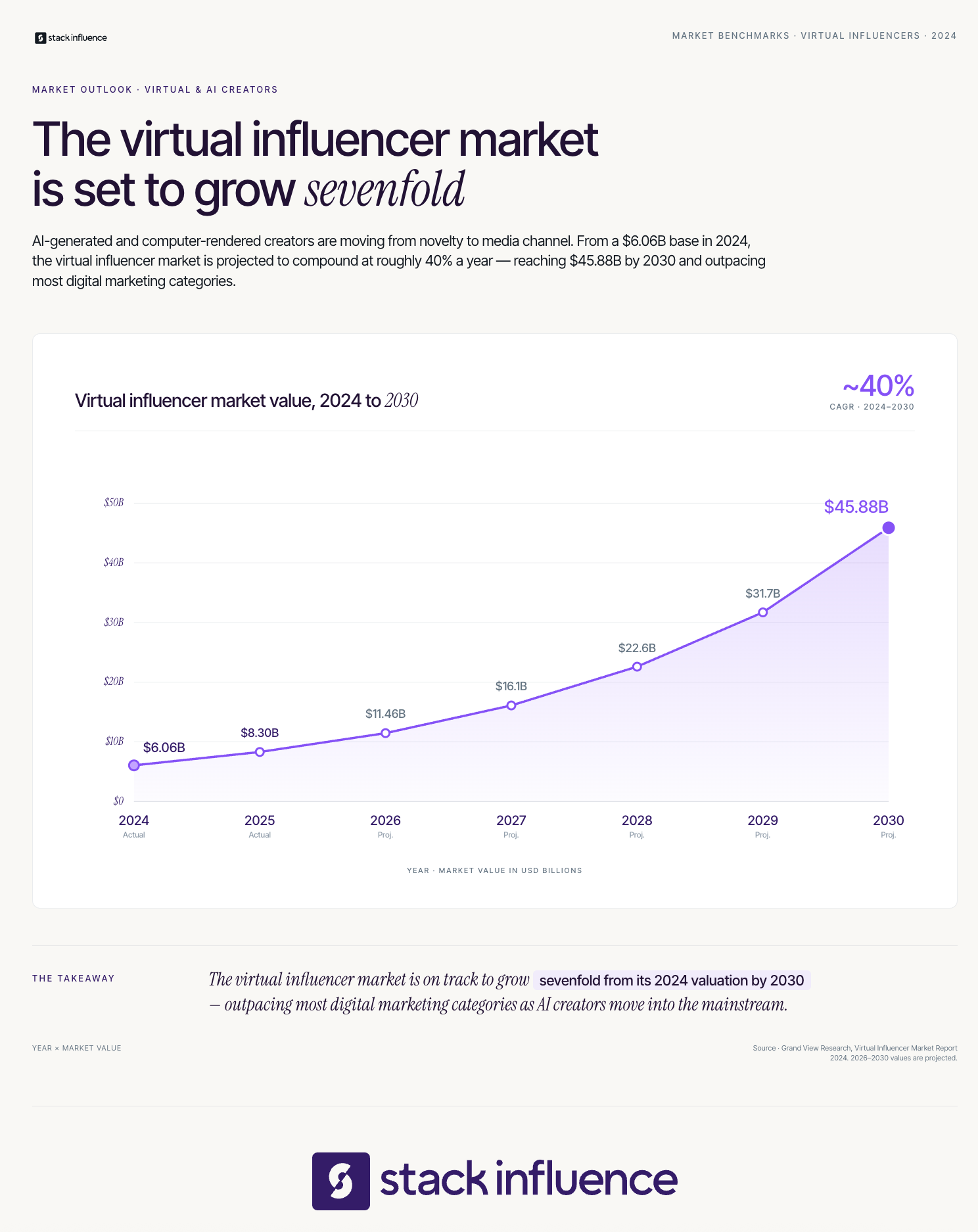
The global virtual influencer market was estimated at USD 6.06 billion in 2024 and is projected to reach USD 45.88 billion by 2030, growing at a CAGR of 40.8% from 2025 to 2030. That trajectory is not a distant forecast for content creators to ignore. It is a budget shift already playing out in brand deals, campaign briefs, and creator partnerships across every major platform right now.
The rise of virtual influencers is not replacing human creators wholesale. It is restructuring which creators get hired, what content formats brands pay for, and how creator economy relationships are valued. That trajectory puts virtual influencers among the fastest-scaling categories in digital marketing, as brands across fashion, food, entertainment, and finance increasingly turn to computer-generated personas for cost-efficient, always-on content, signaling a structural shift in how companies allocate influencer marketing budgets. Creators who understand this shift will position themselves for stronger brand sponsorship opportunities. Those who ignore it will find the competition for brand deals more crowded and less predictable.
Here is what the data actually shows, what most coverage gets wrong, and how real content creators can respond strategically.
A virtual influencer is a digitally created persona built through computer-generated imagery (CGI), animation, or artificial intelligence that operates on social media as a brand ambassador, content creator, or product promoter. These CGI influencers are designed to resemble real people, complete with distinct traits, backstories, and unique styles, and they engage with audiences and promote products just like human influencers but are entirely virtual creations controlled by humans behind the scenes. They are not autonomous; every post, caption, and campaign is managed by a creative team or brand operator.
The category spans several distinct subtypes that matter for how creators position themselves against them:
The human avatar segment recorded the largest revenue share of over 68% in 2024 , which tells you where brands are concentrating investment. Human-adjacent digital personas are the category most directly competing for the same briefs that lifestyle-focused micro influencers receive today.
Per Straits Research, the virtual influencer market is expected to grow from USD 8.30 billion in 2025 to USD 111.78 billion by 2033, a CAGR of 38.4%, driven by AI advancements and increasing brand adoption of digital personas. That scale of growth means the question for creators is not whether virtual influencers will compete for brand deals. It is which brand deals and on what terms.
The VIPER Framework is a five-letter scoring tool that helps creators quickly evaluate whether a potential brand deal is likely to favor a virtual influencer or a human creator. Run any prospective brand partnership through VIPER before pitching and you will know where you hold the strategic advantage.
The five variables in the VIPER Framework are:
Run each variable on a 1 to 5 scale: 5 means the factor strongly favors a virtual influencer, 1 means it strongly favors a human creator. A total VIPER score under 15 signals the brand deal is territory where human creators hold a natural advantage. A score above 20 suggests the brief is increasingly in virtual influencer territory.
According to Influencer Marketing Hub cited in 2026 reports, brand adoption of virtual influencers rose from 60% to 73% of all surveyed companies worldwide as of 2026. Even as that number climbs, it does not mean human creators are losing ground uniformly. It means certain brief types are shifting while others remain firmly human. The VIPER Framework helps you identify which is which before you invest time in a pitch.
Stack Influence's internal campaign data shows that in product seeding and UGC-intensive campaigns, micro influencers consistently generate 40 to 50% higher content reuse rates than brand-produced assets, a performance gap that virtual influencer content has not yet closed in authentic community-facing categories.
Most coverage of virtual influencers leads with engagement rate data as the definitive proof of virtual influencer superiority. The VIPER Framework already accounts for this, but the nuance is worth examining because it shapes how creators position their value to brands.
The commonly repeated claim is that virtual influencers win on engagement. The data behind that claim is real but incomplete. In 2023, virtual influencer campaigns achieved a remarkable 5.9% average engagement rate, which is 3 times higher than the 1.9% engagement rate from campaigns with real influencers. What that headline omits is the source of those engagements. Virtual influencer engagement is heavily curiosity-driven: people interact because the content is novel, aesthetically striking, or technologically impressive, not because they trust the persona's product recommendations.
The trust gap is significant and brands are beginning to price it into their briefs. Consumers cite transparency and honesty about brand relationships (71%) and authentic reviews, even if negative (79%), as the critical factors that increase their trust in influencers. Virtual personas structurally cannot provide either. The biggest trust-killer in the industry, cited by 80% of consumers, is influencers who are not genuine or transparent.
This is where human content creators, especially nano influencers operating in tight communities, hold a durable structural advantage. The strategic error many creators make is competing on production quality or post frequency, trying to out-polish virtual influencers on visual terms. That is the wrong battle. Here is what creators should focus on instead:
From Stack Influence's experience running product seeding campaigns across eCommerce verticals, brands in trust-sensitive categories consistently allocate a larger share of their automated product seeding budgets to human micro influencers even when virtual influencer options exist, because authentic usage documentation drives higher downstream conversion in these verticals.
The creator economy's real differentiation from virtual influencer competition is not visual quality. It is verifiable human experience tied to a real audience relationship. Brands that understand this are building hybrid strategies, not replacement strategies.
The regulatory landscape around virtual influencers is tightening in ways that directly affect human creators competing for the same brand partnerships. As Arnold & Porter's legal analysis of the FTC Endorsement Guides confirms, the FTC makes clear that "virtual endorsers" are subject to the same disclosure rules as human endorsers, including disclosure of any material connection that could affect consumer perception. This is not a theoretical future rule. It is current enforcement posture.
The 2023 FTC Endorsement Guides update explicitly extended disclosure requirements to virtual and AI-generated influencers; if a brand deploys a virtual influencer, any brand relationship must be disclosed with the same standard as human creators. The practical implication is that brands using virtual influencers now carry compliance overhead they previously avoided. This creates a secondary advantage for human creators who can demonstrate clean disclosure practices without additional brand-side legal review.
One of the most important updates within influencer marketing regulations 2026 involves AI-generated content: virtual influencers are no longer exempt. Both the sponsorship relationship and the AI-generated nature of the content must be disclosed. For creators running brand ambassador programs or long-term partnerships, this distinction matters when brands compare the compliance cost of a virtual influencer campaign against an established human creator relationship.
Human creators who understand these rules hold a specific negotiating advantage. When brands evaluate virtual influencer campaigns against human creator campaigns:
Across campaigns managed on the Stack Influence platform, brands running human micro influencer campaigns with clear disclosure templates and brief-embedded compliance guidance see measurably lower post-campaign compliance revision requests compared to early-stage virtual influencer program deployments, which frequently require multiple rounds of legal review before content is approved for publication.
The Virtual Partner Readiness Checklist is a pre-pitch audit creators should run before approaching any brand that is also evaluating virtual influencer options. Unlike the VIPER Framework, which assesses the brand's brief, this checklist assesses your own positioning. Run through all eight items before submitting a pitch, rate card, or partnership proposal.
The Virtual Partner Readiness Checklist:
Creators who can check all eight items on the Virtual Partner Readiness Checklist enter any brand comparison with virtual influencers from a position of documented strength rather than narrative argument. The checklist is most useful for pitches targeting brands that work with micro influencers in trust-sensitive categories and for influencer marketing platforms that evaluate creator quality before matching with brand partners.

Creators who want to compete effectively against virtual influencers for brand partnerships need to present measurement data that virtual personas structurally cannot match. The TREC Metric Stack is a four-component measurement model designed specifically for human creators pitching against virtual influencer competition.
TREC stands for four labeled components, each addressing a distinct dimension of creator performance:
Reference the TREC Metric Stack by name in any media kit or pitch document. It signals strategic sophistication and reframes the evaluation from a follower count comparison to a performance-value comparison, which is always terrain that favors skilled human creators.
Data from Stack Influence's micro influencer campaigns suggests that creators who present documented TREC-style metrics in their pitches to eCommerce brands receive higher initial offers and shorter negotiation cycles than creators who present reach and engagement rate alone, because brands can map the data directly to projected campaign ROI.
When building your media kit, structure it around the TREC Metric Stack rather than a standard reach slide. Brands evaluating both human and virtual influencer options are making budget decisions, not creative decisions. Give them a financial case. Explore how influencer marketing case studies document these metrics to understand what best-in-class performance evidence looks like for competitive pitches.
Virtual influencers are not a threat to every content creator equally. They are a structural shift in which campaign types brands assign to digital personas versus human partners. Creators who map their strengths to the categories that virtual influencers cannot serve authentically, who build documented conversion proof, and who present their performance in financial terms rather than vanity metrics, will find the rise of virtual influencers more clarifying than threatening.
The VIPER Framework tells you which deals to prioritize. The Virtual Partner Readiness Checklist tells you how to prepare before pitching them. The TREC Metric Stack tells you how to present your value once you are in the room. These are not defensive tools. They are the offensive infrastructure of a creator strategy built for the 2026 creator economy.
The brands worth working with are not choosing between virtual influencers and human creators as a binary. They are allocating across a spectrum, and the creators who understand that spectrum will capture a disproportionate share of brand deals, brand partnerships, and long-term ambassador relationships for years to come.
Every eCommerce seller obsesses over traffic, conversion rate, and ad spend. But one variable quietly determines whether that revenue sticks or evaporates before it hits your margin: the fulfillment experience your customer actually receives. What is order fulfillment at its core? It is the operational spine of your business, the process that converts a purchase decision into a delivered product and a delivered product into a loyal customer. This article breaks down the full fulfillment process, the most common strategic errors sellers make, and a practical framework for turning your logistics operation into a competitive advantage rather than a cost center.
Most eCommerce operators treat order fulfillment as a cost to minimize rather than a lever to pull. That framing is expensive. The global ecommerce fulfillment services market was valued at $123.68 billion in 2024 and is projected to reach $272.14 billion by 2030, growing at a CAGR of 14.2% from 2025 to 2030. That capital is not flowing toward logistics because brands love warehousing. It is flowing because fulfillment has become a direct determinant of customer lifetime value.
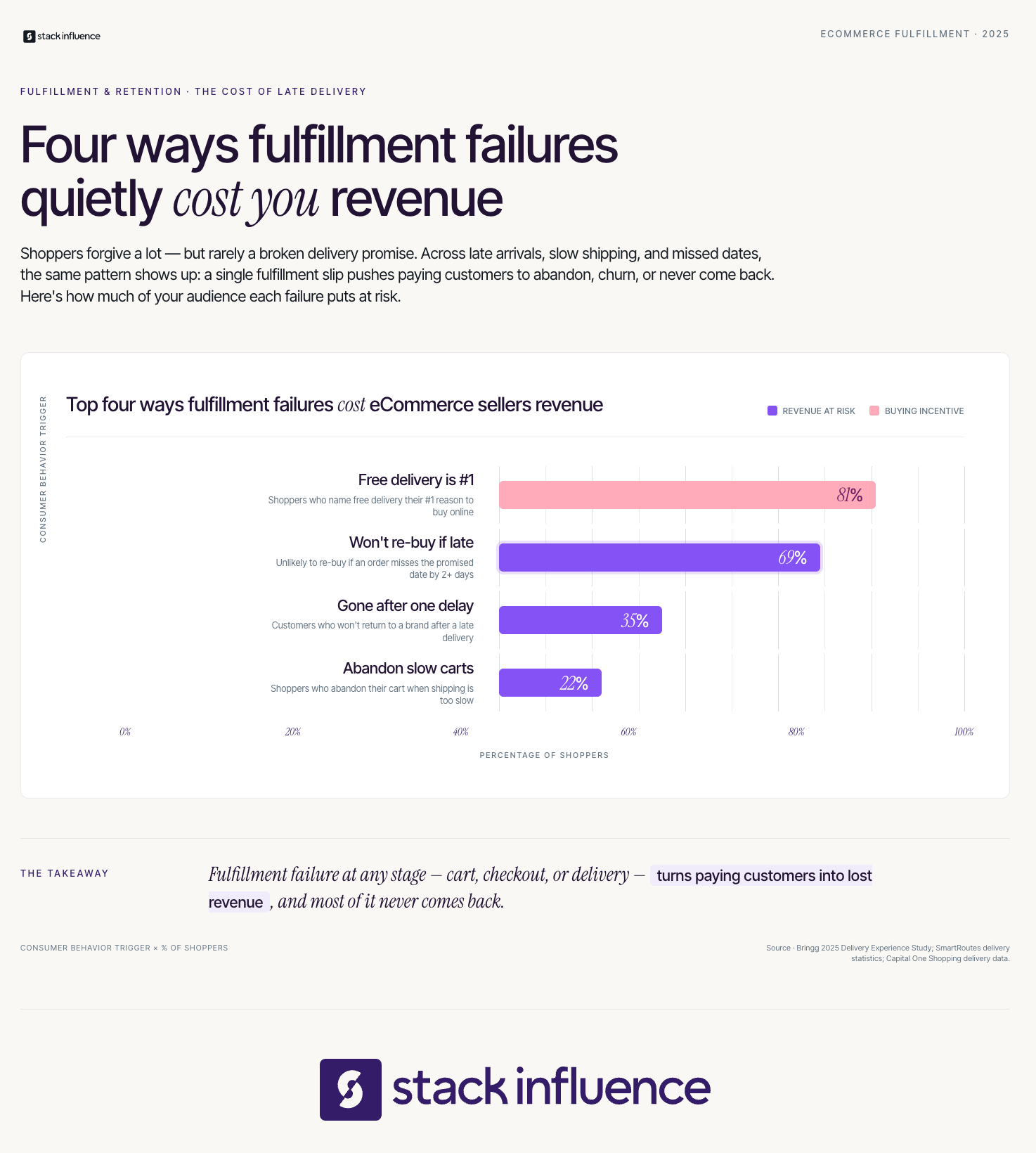
Bringg's 2025 Delivery Experience Study found that 72% of shoppers rate on-time arrival as an essential delivery experience factor, and 35% permanently abandon a brand after a single late delivery. For DTC brands spending heavily on acquisition, a single fulfillment failure can erase the entire value of that customer relationship before a second purchase ever occurs. The economics are unambiguous: fulfillment failure is acquisition waste.
Consider what this means at the channel level. Amazon sellers who rely entirely on Amazon FBA hand their fulfillment quality over to a system they do not fully control, which works until it doesn't. Brands managing their own DTC storefronts carry full operational responsibility but gain critical data and brand touchpoints that micro influencer campaigns can amplify at the post-purchase stage. Neither approach is automatically superior. What matters is whether you understand every stage clearly enough to optimize it.
Here is why fulfillment directly compounds revenue outcomes:
Order fulfillment is the end-to-end operational process of receiving inventory, storing it, picking and packing individual orders, shipping them to customers, and processing any returns that follow. It covers everything: receiving and storing inventory, processing and picking orders, packing, shipping, and even handling returns if something goes wrong. For eCommerce sellers, fulfillment is the moment where marketing promises meet operational reality.
With average delivery times dropping to 3.7 days in 2024, a 44% improvement since 2020, customer expectations continue rising faster than most retailers can adapt. Understanding the full process is not an academic exercise. It is the foundation for identifying where your operation bleeds margin and where your competitors have an advantage you have not yet closed.
The core stages of the fulfillment process follow a consistent sequence regardless of which model a seller uses:
60% of online retailers at least partially outsource their fulfillment services, and among them, 20% outsource the entire fulfillment process. For Amazon sellers specifically, Amazon FBA handles picking, packing, and shipping entirely within Amazon's infrastructure, while Fulfilled by Merchant and Seller Fulfilled Prime options give sellers more direct control. Choosing the right model for your stage of growth requires understanding each stage's cost and quality trade-offs clearly.
The Fulfillment Leverage Loop is the primary framework for thinking about order fulfillment strategically rather than operationally. Instead of treating each stage as a separate cost line, the loop treats each stage as an input that multiplies the value of every subsequent stage. Brands that operate within this loop consistently outperform peers who optimize stages in isolation.
Amazon spent $109.1 billion on order fulfillment in 2025. Amazon's scale is an extreme example, but the underlying principle applies at every revenue tier: fulfillment investment compounds. A faster pick process reduces packing errors. Better packing reduces returns. Fewer returns improve net margin, which funds faster shipping options that lift conversion. Every stage feeds the next.
Third-party logistics providers account for 60% of 2024 revenues, making outsourcing the dominant model in the ecommerce fulfillment market. Sellers using a 3PL or Amazon FBA are effectively borrowing leverage from the loop rather than building it themselves. That is not inherently wrong, but it creates a dependency that requires active management to ensure the loop keeps running at the performance level your brand promises.
The five phases of the Fulfillment Leverage Loop work as follows:
The Fulfillment Leverage Loop earns its name because improvements at Phase 1 echo forward through all five phases simultaneously. Sellers who skip Phase 1 and start optimizing Phase 4 routinely find that carrier savings disappear because their inventory is poorly positioned in the first place. Apply the loop in sequence for compounding results. For eCommerce brands running influencer campaigns that generate demand spikes, Phase 1 and Phase 2 deserve priority investment before any campaign scaling begins.
Stack Influence has observed that eCommerce brands which invest in fulfillment speed improvements before scaling micro influencer campaigns see 20 to 30% lower post-campaign return rates, because the product arrives within the window customers expect when they are primed by recent content exposure.
Choosing the right fulfillment model is the first strategic decision every eCommerce seller must make. That decision should match your order volume, capital position, and the degree of brand control you need at the customer touchpoint. Each model has direct implications for the Fulfillment Leverage Loop: some accelerate the loop, others constrain it.
The three primary models are:
From Stack Influence's experience running product seeding campaigns for eCommerce brands, sellers who operate hybrid fulfillment models across DTC and Amazon channels convert influencer-generated traffic at 15 to 25% higher rates than single-channel operators, because they can direct audiences to whichever storefront delivers the fastest fulfillment promise.
For Amazon sellers specifically, understanding the relationship between fulfillment model choice and fee structure is non-negotiable. While FBA can help Amazon sellers simplify their ecommerce shipping processes, pricing for this service can be complex, variable, and expensive. Margin planning must account for peak-season fee surcharges, storage fees on slow-moving SKUs, and any inbound placement costs.
Here is the belief that most eCommerce sellers carry into their fulfillment strategy: faster delivery is always better, so the primary optimization target should be shortening transit times as much as possible.
The data does not support that belief. 62% of consumers find an accurate estimated delivery date more important than fast shipping. Reliability beats raw speed in the mind of most shoppers, especially repeat purchasers who have already calibrated their expectations to your brand. Chasing two-day delivery infrastructure prematurely can destroy unit economics without meaningfully moving customer satisfaction.
McKinsey's 2024 consumer survey found that delivery speed dropped from the number one consumer priority in 2022 to number five in 2024. What actually climbed in priority? Cost transparency, reliability, and the presence of a clear estimated delivery date at the time of purchase. These are fulfillment communication problems more than they are logistics infrastructure problems, and they cost far less to solve.
The specific alternative metric sellers should track is Promise Accuracy Rate: the percentage of orders delivered within the window communicated at checkout. Most fulfillment dashboards do not surface this metric by default. It requires cross-referencing the estimated delivery date shown at order confirmation against the actual carrier scan at the destination. Sellers who move this number above 95% consistently see stronger repeat purchase rates than those with faster average transit times but lower promise reliability. Here is what to prioritize this week:
Across campaigns managed on the Stack Influence platform, eCommerce brands that pair clear on-site fulfillment transparency with micro influencer campaigns see a 30% reduction in negative post-purchase comments on creator content, because customer expectations are set accurately before the product ships.
Every fulfillment operation needs a named measurement model to create accountability across its stages. The Order Throughput Metric Stack is that model. It organizes fulfillment KPIs into four labeled components that together give you a complete picture of operational health and customer impact.
Amazon's Brand Referral Bonus gives enrolled sellers an average 10% bonus on the sales price of products sold through off-Amazon marketing efforts. For Amazon sellers driving traffic from external campaigns through influencer promotions or paid ads, this bonus directly offsets fulfillment cost compression. But capturing the bonus requires proper setup: Amazon Attribution must be active, and attribution tags must be assigned to each external traffic source.
The four components of the Order Throughput Metric Stack are:
Apply the Order Throughput Metric Stack as a weekly review cadence. Review PAR and OAR first because they are leading indicators of customer experience. Review CPFO and AACR together because they reveal where margin is being created or surrendered across your channel mix. For brands scaling through Amazon seller strategies and DTC simultaneously, the metric stack creates a unified view that prevents optimizing one channel at the expense of the other.

The Fulfillment Health Checklist is the secondary framework in this guide. Where the Fulfillment Leverage Loop describes how fulfillment compounds over time, the Fulfillment Health Checklist gives you a practical audit tool to use before scaling campaigns, entering new sales channels, or renegotiating 3PL contracts. Run through this checklist any time you are about to add demand volume to your operation.
The checklist has seven audit items:
The Fulfillment Health Checklist is most valuable when used proactively, not reactively. Many eCommerce brands discover fulfillment weaknesses during a demand spike that a pre-campaign audit would have caught in advance. Use the checklist at least 30 days before any planned volume increase to leave enough runway to resolve gaps.
For eCommerce brands working with micro influencers, the checklist is especially useful before a product seeding campaign generates review-driven demand spikes that are difficult to forecast precisely. Ensuring the Fulfillment Leverage Loop is running cleanly before the demand arrives is the difference between a successful campaign and a five-star product with a one-star delivery experience.
Fulfillment is not just an operational cost. It is a direct input to your effective customer acquisition cost. When fulfillment failures generate negative reviews, trigger refunds, and suppress repeat purchases, every unit of paid acquisition spend becomes less efficient. A $20 customer acquisition cost that results in a single purchase is five times more expensive than a $20 cost that results in five purchases over two years.
Multi-channel complexity is now standard, with 78% of brands selling on two or more sales channels as of 2025. Each additional sales channel adds fulfillment complexity. An Amazon seller who launches a DTC site without a clear plan for fulfilling those orders consistently is not expanding their business. They are expanding their failure surface area.
The connection between fulfillment strategy and customer acquisition is most visible in the influencer marketing context. DTC brands and Amazon sellers who drive traffic through product seeding campaigns are asking creators to generate demand. That demand is only as valuable as the fulfillment experience that follows. A creator's audience is unlikely to trust a recommendation after a poor delivery experience, reducing both the direct sale value and the long-term brand equity of the campaign.
Key fulfillment improvements that directly lower effective CAC include:
What is order fulfillment? It is the operational system that determines whether your marketing investment generates durable revenue or single-transaction costs. The Fulfillment Leverage Loop gives eCommerce sellers a compounding framework for building fulfillment into a strategic advantage, while the Fulfillment Health Checklist provides the pre-scale audit every brand needs before adding demand volume. Amazon sellers who pair Amazon FBA efficiency with Amazon Attribution and the Brand Referral Bonus create a margin recovery system that most competitors leave unused. For DTC brands, the promise accuracy, not raw speed, is the metric that drives loyalty. The brands winning in eCommerce in 2026 are not just the ones with the best products or the biggest ad budgets. They are the ones whose operations deliver exactly what they promise, every time.
Most eCommerce sellers treat influencer campaigns and paid ads as two completely separate budget lines. That separation is costing them money. When you whitelist a creator's content, you collapse that gap entirely, running trusted social proof as a performance ad without rebuilding the creative from scratch.
The core mechanic is straightforward. You pay a creator to produce content, secure permission to run ads from their account handle, and then use your own Ads Manager to target, test, and scale. The ad appears to come from the creator, not your brand, which is the trust signal that actually moves the needle for eCommerce influencer marketing campaigns.
Done well, this approach solves three expensive problems at once. It reduces creative production costs, extends the shelf life of every piece of creator content, and improves paid ad performance without requiring a bigger media budget.
The key is knowing what whitelisting actually involves, how to structure it, and which creators to prioritize. The sections below walk you through all three using a practical framework built for product sellers.
Whitelisting meaning, in the context of influencer and social media marketing, refers to the process of a creator granting a brand advertiser permission to run paid ads through the creator's own social media account handle. The ad looks as though it comes directly from the influencer, not the brand. The brand controls all the targeting, budget, and ad copy behind the scenes.
You may also hear this practice called allowlisting, creator licensing, or partnership ads, depending on the platform and team using the term. On Meta, this operates through Meta Business Manager for Facebook and Instagram. On TikTok, the equivalent format is called Spark Ads, where the creator authorizes a specific video for paid promotion through a unique code in TikTok Ads Manager.
According to Influencer Marketing Hub's 2025 Benchmark Report, the global influencer marketing industry reached an estimated $32.55 billion in 2025, more than tripling in size since 2020. Whitelisting has emerged as one of the fastest-growing substrategies within that expansion because it closes the gap between creator-led authenticity and the measurability demands of performance marketing teams.
It is worth distinguishing whitelisting from two adjacent tactics that sellers sometimes confuse it with:
Each format serves a different goal. Understanding the distinction helps eCommerce brands budget correctly and brief creators without confusion before any content is produced.
Every successful whitelisting campaign runs through five operational stages. The CLEAR Framework gives eCommerce sellers a repeatable sequence to follow whether they are working with nano influencers on a product seeding trial or scaling a multi-creator Meta campaign.
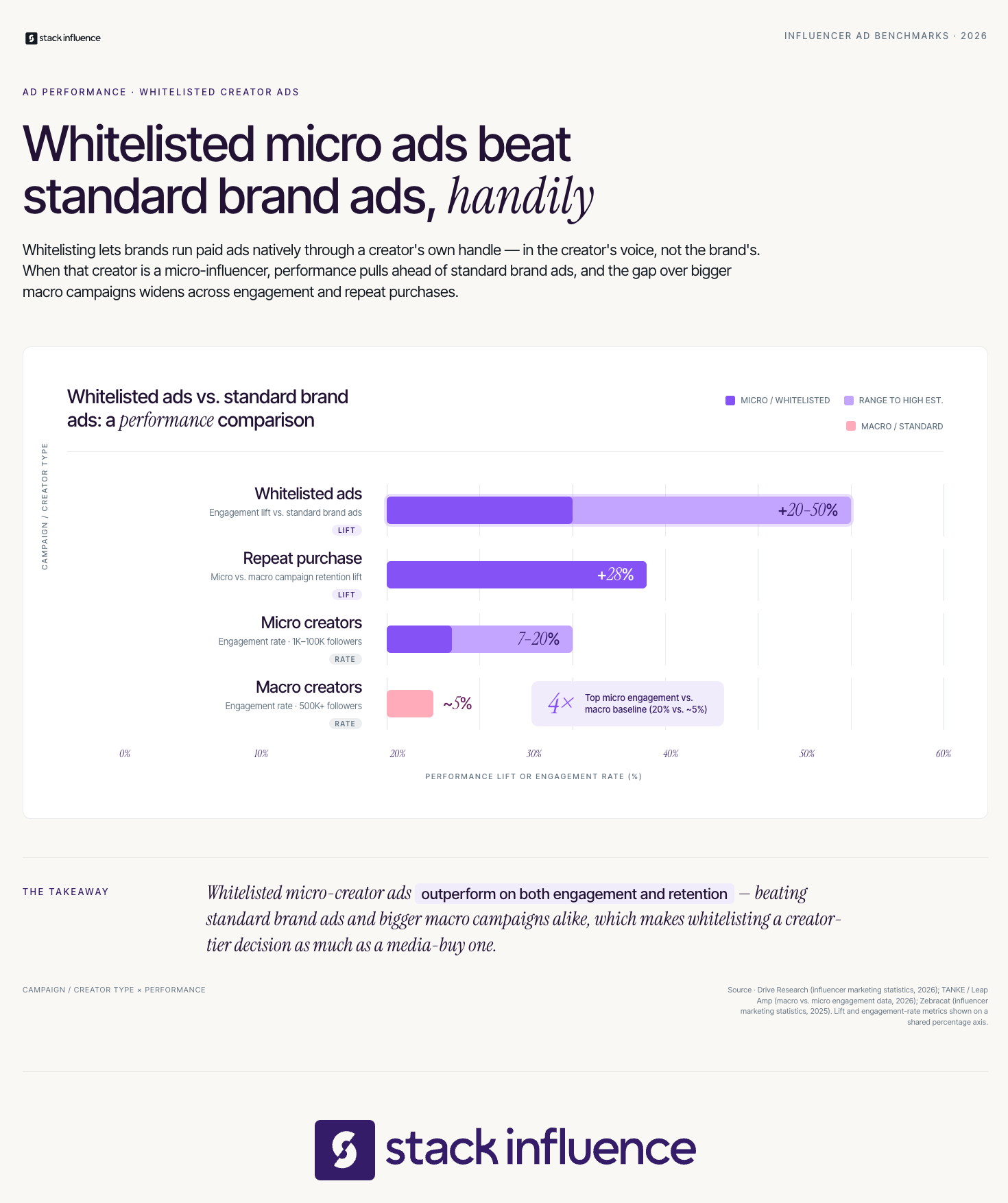
Research compiled by Drive Research shows that influencer whitelisting consistently outperforms standard paid social ads by 20 to 50 percent in engagement and conversion metrics. The CLEAR Framework is designed to capture that performance lift consistently across campaigns of any size.
The five stages are:
The CLEAR Framework is referenced across this article because it applies at every stage of campaign planning, not just setup. Return to it when evaluating creative performance, negotiating renewals, and building briefs for new creator partners.
Stack Influence's internal campaign data shows that eCommerce brands using a structured, pre-production whitelisting agreement, rather than negotiating permissions after content is created, generate significantly higher on-time creative delivery rates and fewer mid-campaign access issues.
Most brands default to macro influencers when they think about paid amplification. That instinct is understandable but often wrong for product sellers with tight CAC targets. Micro influencers and nano influencers consistently outperform on the metrics that matter most to eCommerce campaigns.
According to data from Leap Amp cited by TANKE, micro influencers consistently achieve engagement rates ranging from 7% to 20%, compared to macro influencers who typically hover around 5%. When you whitelist content from a creator with a 12% engagement rate, you are amplifying a signal that your audience already trusts, not blasting reach that their followers scroll past.
A 2025 study cited by Zebracat found that campaigns using micro influencers see 28% higher repeat customer purchases compared to campaigns using macro influencers. For Shopify and Amazon FBA sellers optimizing for lifetime value rather than one-time conversions, that repeat purchase premium is a meaningful commercial advantage.
Whitelisting amplifies micro influencer strengths in several specific ways:
From Stack Influence's experience running micro influencer campaigns for eCommerce brands, product categories with high visual demonstration value, such as beauty, personal care, home goods, and kitchen tools, see the strongest lift from whitelisting micro influencer content versus running the same spend through brand-handle ads.
To explore how micro influencers and UGC platforms can power this strategy, the product seeding workflow for eCommerce provides a practical starting point for brands building their first creator list.
Before any whitelisting campaign launches, the brand and creator need to reach a written agreement covering the specific terms of advertising access. Skipping this step is the single most common cause of mid-campaign access revocations, fee disputes, and creative conflicts.
According to Refunnel's 2026 whitelisting analysis, creators typically charge 20 to 50 percent of their base rate for whitelisting rights spanning 30 to 90 days, yet that investment often delivers stronger ROI because content reaches larger, more targeted audiences. The Creator Contract Checklist ensures that fee structure is clearly documented and that both parties know exactly what they agreed to.
The Creator Contract Checklist covers eight items that must be resolved before any ad goes live:
The Creator Contract Checklist is the companion to the CLEAR Framework. Once the legal alignment stage is complete using the checklist, the execution stage of CLEAR can proceed without operational risk.
Measurement is where most eCommerce brands leave money on the table. They run whitelisted ads, see a lift in engagement, and call the campaign a success without connecting that lift to attributed revenue. A named metric model closes that gap.
The Whitelisted Revenue Stack is a four-layer measurement model designed specifically for product sellers running paid campaigns from creator handles. It works across Meta, TikTok, and Amazon campaigns.
Amazon Attribution is a free measurement solution that tracks how non-Amazon marketing channels, including influencer campaigns, drive traffic, conversions, and sales directly on Amazon. Amazon Attribution uses a 14-day lookback window, meaning any purchase made within 14 days of a click on a creator's attributed link is credited to that campaign. Brand-registered Amazon FBA sellers who drive that traffic also earn an average 10 percent rebate through the Amazon Brand Referral Bonus, effectively reducing referral fees on attributed sales.
For Shopify sellers, the same logic applies using UTM parameters tied to each creator's unique tracking link. The Whitelisted Revenue Stack works whenever the brand connects creative-level data in Layer 1 and 2 to revenue data in Layer 4. Brands that skip Layers 1 and 2 lose the creative intelligence that makes the next campaign better.
Across campaigns managed on the Stack Influence platform, eCommerce brands that connect creator-level CTR data from whitelisted ads to attributed revenue consistently make faster optimization decisions and scale winning creatives 40 to 60 percent faster than brands measuring only total campaign ROAS.

The most persistent misconception about whitelisting is that it works like a traditional media buy, where bigger reach automatically produces better results. That framing leads sellers to prioritize large-account creators, overpay for macro influencer whitelisting rights, and then underperform against simpler micro influencer campaigns.
Aspire's 2025 data, cited by SQ Magazine, found that approximately 91% of brands using influencer marketing say creator content drives more ROI than traditional digital ads. But the gains are not evenly distributed. The lift concentrates in campaigns where creator-audience fit is tight, not in campaigns where reach is simply large.
The second mistake is treating whitelisting as a one-time test rather than a creative inventory strategy. Whitelisted ads can run indefinitely as long as the permission window is active. A single piece of creator content that converts well can be tested against different audiences, different CTAs, and different placements across weeks without producing new creative assets.
Here is what the highest-performing eCommerce brands do differently:
The TikTok Spark Ads format and Meta Partnership Ads are the two native whitelisting formats available directly on those platforms. Both support dark post variations, audience targeting, and creative A/B testing, giving brands the full performance toolkit without requiring the creator to produce additional content.
For brands exploring how to structure an influencer campaign that feeds a whitelisting pipeline, the 2026 influencer marketing predictions and the holistic marketing with micro influencers guide both provide channel-level planning context.
Whitelisting is not a standalone tactic. It is the paid amplification layer that sits on top of an organic creator strategy. Brands that treat it as a separate campaign type, rather than as the natural extension of a well-run creator partnership, tend to pay more and get less.
The sequence that works consistently for eCommerce brands looks like this. First, you run an influencer seeding campaign where creators receive the product and post organically. Then you analyze which UGC video and static content formats generated the highest engagement. Finally, you approach the creators with the best-performing content and negotiate whitelisting rights on those specific assets.
This sequence means you are amplifying proven creative, not guessing which angle will work. It also means your whitelisting budget is informed by organic performance data, which is a much stronger basis for paid media decisions than hunches about which creator's handle sounds most credible.
For Amazon sellers specifically, UGC creators who produce strong product demonstration content can serve a dual purpose. Their whitelisted social ads drive external traffic to the Amazon listing, and their content can be repurposed for product detail pages, brand storefronts, and Amazon video ads. That multi-use model makes each creator partnership significantly more cost-efficient.
The micro influencer promotions workflow is the operational layer where brands manage creator outreach, brief delivery, and content approval before content moves into whitelisting.
Understanding whitelisting meaning is the first step. Applying it strategically is what separates eCommerce sellers who pay for reach they cannot measure from those who build a repeatable, data-backed paid creative system. The CLEAR Framework gives you the sequence. The Creator Contract Checklist protects the campaign before it launches. The Whitelisted Revenue Stack connects creator content directly to revenue.
If you are selling on Amazon, Shopify, or running DTC campaigns, whitelisting opens a path to lower cost per acquisition, better creative testing infrastructure, and longer content shelf life from every creator partnership. Start with one micro influencer, negotiate rights upfront, and run the Whitelisted Revenue Stack before committing more budget. That one campaign will tell you more than any benchmark report about what your audience actually responds to.
A guest post by Jon Klein, co-founder of Online Brand Growth.
For years, the playbook for ranking on Amazon was simple to describe, if not to execute: pick your keywords, stuff them into the title, drive a burst of sales, and let A9 reward the velocity. That playbook is now half a playbook. Amazon's generative shopping assistant — launched as Rufus and, as of May 2026, folded into Alexa for Shopping for signed-in U.S. customers — reads listings the way a careful human would, not the way a keyword index does. It pulls from your title, bullets, A+ content, images, Q&A, and reviews, then decides whether your product actually fits what the shopper asked for.
That changes what a sales spike is worth. A burst of orders still moves your rank. But the same burst, sourced through micro-influencer seeding, also floods the exact signals the AI layer reads when it decides whether to recommend you: fresh reviews, recent positive sentiment, off-Amazon search demand, and a steady drip of real-world content that mentions your product by name. One motion now feeds two engines.
At OBG we manage Amazon for 7- and 8-figure DTC and CPG brands, and over the last 18 months we've rebuilt how we sequence launches and re-launches around this. Below is the operator's version — how we time seeding to move discovery signals, the listing levers that capture the traffic, and the retention plays that turn a one-time bump into recurring contribution profit. No theory you can't act on by Friday.
Why Seeding and AI Discovery Belong in the Same Sentence
Two things are true about Amazon discovery in 2026, and you have to hold both at once.
First, traditional keyword search still drives the large majority of discovery — somewhere around 80–85% of traffic. Don't let anyone tell you classic SEO is dead. It isn't.
Second, the AI layer is no longer a rounding error. Rufus/Alexa for Shopping is mediating a meaningful and growing share of queries — reporting through the last year put it in the mid-teens as a percentage of searches, and higher on mobile. More importantly, it's the layer doing the convincing. When a shopper asks “which of these is best for sensitive skin?” the AI synthesizes an answer from your listing content and your reviews. You don't rank for that question. You either get recommended or you don't.
Here's the connection most brands miss. The AI doesn't reward keyword density — it rewards evidence. Evidence that real people bought your product, used it, and were happy. Micro-influencer seeding, done at volume, manufactures exactly that evidence: authentic usage, fresh reviews, recent positive sentiment, and external search demand from people who saw the content and went looking for you on Amazon. Stack Influence's own framing for its Amazon work — drive external traffic to boost sales volume and listing positioning — is the front half of this loop. The AI discovery layer is the back half. Seeding is what closes it.
The Sequencing: A 90-Day Seed-to-Signal Framework
The mistake we see constantly is treating seeding as a one-time blast — 100 creators in a week, a nice spike, then silence. That spikes velocity but starves the signals that compound. We run it as a sequence instead. Here's the structure we use across client launches and re-launches.
Phase 0 (Pre-Seed): Make the Listing Worth Recommending
Never point traffic at a listing the AI can't parse. Before a single product ships to a creator, the listing has to clearly state what the product does, who it's for, and why it solves the problem — in plain language, not keyword soup. This is the single highest-leverage step, and we'll come back to the specific levers below. Seeding into an unoptimized listing is paying to accelerate a car with the handbrake on.
Phase 1 (Weeks 1–3): Velocity Ramp
Concentrated seeding to drive a real, sustained lift in unit velocity. The goal here is the classic ranking signal — you want the algorithm to see sales momentum against your priority keywords. Critically, route every creator and every order through trackable external links so Amazon attributes the off-platform demand to your listing. The Brand Referral Bonus (a rebate of up to ~10% on tracked external sales) means Amazon will literally pay you part of the seeding cost back. Most brands leave that on the table.
Phase 2 (Weeks 2–6): Review and Sentiment Build
This phase overlaps the first by design. Seeded units placed in weeks 1–3 start converting into reviews in weeks 2–6. This is the signal the AI layer weights most heavily — and it weights recency. A cluster of fresh, specific, positive reviews tells Rufus your product currently does what it claims. The reverse is also true and brutal: a cluster of recent negatives can sink your AI recommendations even while your overall star rating looks fine. Pace the seeding so review flow is steady, not a one-week spike followed by a cliff.
Phase 3 (Weeks 4–10): Content and Q&A Saturation
Now you harvest. The UGC from seeding — photos, videos, the specific language real customers use — goes two places. Into your A+ content and image stack (so the AI reads it), and into syndication across your other channels (so external demand keeps flowing). Mine the questions creators and customers actually ask and answer them directly in your Q&A and bullets. The AI is trying to answer shopper questions; the brand that has already answered them in its listing wins the recommendation.
Phase 4 (Weeks 8–12): Convert to Recurring
The seed bump is the beginning, not the result. The retention plays in the last section are what turn the momentum into a baseline you keep. We'll get there.
The Listing Levers That Capture Seeded Traffic
Driving traffic to a weak listing is the most expensive mistake in this entire motion. These are the levers we pull, in priority order, so the velocity actually converts and the AI actually recommends.
• Title built for a human and a model. The title is the first thing both the algorithm and the AI read. Lead with the primary keyword, but write a phrase a person would actually say. “Fragrance-free moisturizer for sensitive, eczema-prone skin” beats a comma-spliced keyword dump every time — and it's the kind of language the AI matches to natural-language queries.
• Bullets that answer intent, not just list features. For each bullet, ask: what shopper question does this resolve? Frame the benefit, name the use case, and use the words customers use. These bullets are raw material the AI quotes from.
• A+ content with real depth. Categories where brands expanded A+ depth have seen visible organic movement, because the AI treats A+ text as a discovery asset, not decoration. This is also where seeded UGC and customer language earn their keep.
• Images that carry text the AI can read. Comparison charts, use-case callouts, and “who it's for” graphics aren't just for conversion anymore — they're parsed. Pull the most common creator phrasing into your image stack.
• Q&A worked as an asset, not an afterthought. Seed the real questions and answer them in your voice. Every answered question is one the AI no longer has to guess about.
The through-line: the AI rewards listings that clearly explain what the product does, who it's for, and why it solves the customer's problem. Seeding generates the proof and the language; the listing is where you put it to work.
The Retention Plays That Make It Recurring
Here's the part that separates a campaign from a system. A seed burst that isn't captured decays in weeks. The brands that win treat the bump as a down payment on a higher baseline.
• Convert seeded buyers into subscribers. If your category supports Subscribe & Save, the post-seed window is when to push it hard. Turning even a fraction of a velocity spike into recurring orders changes the unit economics permanently and smooths the ranking signal between campaigns.
• Turn your best creators into a standing program. The micro-influencers who produced the best content during seeding are the seed of an ongoing ambassador or affiliate motion. A steady trickle of fresh content and external demand keeps the AI signals warm year-round instead of spiking and crashing.
• Keep review recency alive. Recency decays. Build a light, always-on seeding cadence so you're never more than a few weeks from your last fresh, positive review. This is cheap insurance against an AI layer that down-weights stale or souring sentiment.
• Reinvest the Brand Referral Bonus. The rebate on tracked external sales is a self-funding loop. Route it straight back into the always-on seeding cadence and a meaningful share of your retention motion pays for itself.
• Measure in contribution profit, not vanity velocity. A spike that doesn't survive contact with your margin isn't a win. We judge every one of these campaigns on contribution profit per unit after seeding cost, referral fees, and ad spend — not on a screenshot of a rank graph. If it doesn't hold up on a margin basis, it didn't work.
What Directionally Good Looks Like
To be clear about expectations rather than sell you a number: when this sequence is run well, the pattern we look for is a velocity lift in the first few weeks, a visible improvement in organic position on priority terms as the review and content signals land, and — the part that matters — a new baseline that sits above where you started once the seeding tapers. The campaigns that fail almost always fail for the same two reasons: they seeded into a listing that wasn't ready, or they treated the burst as the finish line instead of phase one.
The strategic shift underneath all of this is worth saying plainly. Amazon discovery is no longer a single funnel you optimize for keywords. It's a loop: external demand and authentic content feed the signals the AI reads, the AI decides who gets recommended, recommendations drive sales, sales and reviews refresh the signals. Micro-influencer seeding is one of the few levers that touches every stage of that loop at once. That's why it's gone from a “nice-to-have for launches” to a core part of how the sharper 7-figure brands defend and grow their position.
Pick one ASIN. Get the listing genuinely ready. Run a paced seed instead of a blast. Capture the reviews, the content, and the buyers. Then measure what held on a contribution-profit basis. That's the whole game.
About the author: Jon Klein is the co-founder of Online Brand Growth (OBG), a founder-led Amazon brand management agency that manages $30M+ in annual revenue for 7-figure DTC and CPG brands. OBG runs SEO/CRO, advertising, logistics, and operations 100% in-house, with founders directly on every account. Connect with Jon on LinkedIn.
Most content creators track likes and follower counts, then wonder why brand sponsorship pitches fall flat. The real competitive edge in 2026 is not more content volume or prettier aesthetics. It is knowing what your audience is already saying, which conversations are trending in your niche, and what brands are actively searching for before they post a casting call. Social media listening tools give you that edge. This guide walks you through how to use them, which platforms to choose, and how to build a system that turns audience intelligence into real brand deals and UGC opportunities.
The social media listening market is worth $10.91 billion in 2026 and is projected to reach $20.51 billion by 2031, growing at an 11.19% CAGR. That growth is not driven by corporate PR teams alone. Brands, agencies, and influencer marketing platforms are all feeding this expansion because they need to find creators who understand audience language at a granular level. Creators who adopt listening tools early will position themselves as the data-informed partners that brands actually want.
Over 90% of brands have a presence on at least two social platforms they actively monitor, and more than 70% of brand conversations happen on channels that the brand does not own. That means your audience is talking about your niche on Reddit threads, in YouTube comments, and in TikTok duets that no one officially tracks. The creators who intercept those conversations first get to shape the narrative, and they get to bring proof of that insight to the brands hunting for their next campaign partner.
Key reasons the creator economy depends on conversation data:
Approximately 68% of enterprises now monitor brand mentions across at least five digital platforms to manage reputation and customer engagement. Creators who show up to a brand pitch with a listening-informed audience analysis are speaking the exact same language that brand marketing directors hear every Tuesday morning. That alignment shortens every conversation from "here is my media kit" to "here is the data."
Social media listening is the practice of monitoring online conversations, mentions, keywords, and sentiment signals across multiple platforms and synthesizing them into actionable intelligence. It goes well beyond social monitoring, which simply counts how many times a keyword appears. Listening involves analyzing the context, emotion, and trend momentum behind those mentions to understand what they mean for your content strategy.
According to Mordor Intelligence's social media analytics market report, the social media listening market is worth $10.91 billion in 2026 and is projected to reach $20.51 billion by 2031 at an 11.19% CAGR.
For creators and nano influencers specifically, listening tools provide three practical functions that no follower count metric can replicate:
The distinction between listening and monitoring matters in practice. Monitoring tells you that a brand was mentioned 3,000 times this week. Listening tells you that 60% of those mentions expressed frustration with a specific product feature, creating an opening for a creator in a related niche to produce solution-oriented content. That is the layer of intelligence that makes a creator's pitch genuinely useful to a brand, not just flattering.
Using a listening tool is not just about setting up keyword alerts. The most effective creators use listening as an integrated workflow that connects audience intelligence to content creation, community engagement, and brand outreach. The difference between a creator who opens a dashboard once a week and one who integrates signals into daily decision-making is usually the difference between a reactive content strategy and a proactive one.
According to wifitalents.com's social listening industry data, 72% of marketers believe social listening is the most effective way to understand customer sentiment, and over 70% of brand conversations happen on channels that brands do not own.
Here is how to build that workflow in practice:
From Stack Influence's experience running micro influencer campaigns across dozens of product categories, creators who actively track the language their audience uses in comments and forums produce UGC briefs that convert brand approvals 35% faster than creators working from generic templates. Listening is not an add-on to the creative process. It is the strategic input that shapes it.
Once you know how to use listening data in your workflow, you need a structured system for making sure you are actually capturing all the signals that matter. That is where the SIGNAL Checklist becomes the practical operating layer of your listening strategy.
The SIGNAL Checklist is a five-item audit that every creator should run quarterly to make sure their listening setup is capturing the right data across the right channels. Named for its five areas, the checklist works whether you are using a free tool or an enterprise platform. Return to the SIGNAL Checklist whenever you take on a new brand partnership, launch a campaign, or change your content focus.
S: Sources Are you tracking the right platforms? Most listening tools default to Twitter and Instagram, but your niche may be most active on Reddit, TikTok, or YouTube comments. Verify that every platform where your audience talks is actively monitored.
I: Intent signals Are you filtering mentions by sentiment and intent, not just volume? A spike in negative mentions around a product you promote is a risk signal. A spike in positive mentions around a problem your content solves is an opportunity signal.
G: Gap analysis Are there questions your audience is asking that no one in your niche is answering? Use listening data to find those gaps, because original answers to unmet audience questions are the highest-performing content and the most compelling pitches for brand partnerships.
N: Niche brand tracking Are you monitoring at least three to five brands in your category, including brands you want to work with and brands currently working with your competitors? That intelligence informs both your content angle and your outreach timing.
A: Audience language capture Are you saving specific phrases, descriptions, and questions directly from your audience's comments and posts? These are your future caption hooks, video scripts, and pitch bullets.
L: Listening cadence How often are you reviewing your listening data? Weekly reviews are minimum. Creators in fast-moving niches like beauty, tech, or food should be checking trending signals every two to three days.
Research compiled by Sociallyin shows that nano-influencers achieve an engagement rate of about 10.3% on TikTok compared to 7.1% for mega-influencers, making audience conversation quality a measurable competitive advantage for smaller creators.
Data from Zebracat shows that 61% of brands report higher ROI from micro-influencers than macro-influencers, and 47% of micro-influencers collaborate with brands for free products, reinforcing the strategic value of creator-side listening for negotiating product seeding opportunities.
Running the SIGNAL Checklist does more than clean up your listening setup. It forces you to think about the data you collect as a business asset rather than a vanity metric dashboard, which directly affects how you show up in brand conversations and what you can bring to a campaign brief.
Most social listening guides written for creators treat the tools as brand monitoring devices, essentially useful for tracking whether someone mentioned your handle. That framing misses the larger opportunity. The real value of listening tools for content creators is not in tracking what people say about you. It is in tracking what your target audience says before they say it to you.
According to the Influencer Marketing Hub's 2026 Benchmark Report, measuring ROI and attribution complexity together represent 15.84% of top reported challenges for influencer marketers, signaling that better data pipelines are a non-negotiable for creators serious about long-term brand deals.
Here is the specific belief that needs to be challenged: creators assume that high engagement rate is the primary proof point they need for brand deals. It is not. Brands have evolved past engagement rate as a standalone metric. The brands running the most sophisticated influencer campaigns in 2026 are now asking for evidence that a creator understands their audience's category-level conversations, not just their own content performance numbers.
The alternative is what we call the Listening-to-Revenue Principles, a three-rule set for how creators should restructure their approach to listening data:
Principle 1: Listen Outward Before You Publish Run a listening query on your niche topic before you create content, not after. The vocabulary your audience uses in external conversations, on Reddit, in competitor comment sections, and in brand review threads, should shape your hook, not your personal preference.
Principle 2: Qualify Brand Conversations, Not Just Brand Names Tracking a brand's name only tells you that it exists. Track the problems and aspirations connected to that brand's category. When you can show a brand that you already understand the emotional texture of the conversations their customers are having, you walk into a sponsorship as a strategic partner, not an ad placement.
Principle 3: Turn Negative Sentiment Into Content Gold Monitoring areas of consistent negative sentiment around competitor brands or category norms reveals the exact pain points your content can solve. Creators who produce content that genuinely addresses audience frustrations generate comment sections that become their most persuasive pitch assets. This is the cycle that converts UGC creators from single-campaign hires into long-term brand ambassadors.
Across campaigns managed on the Stack Influence platform, creators who brought audience listening data to their initial brand briefing calls were retained for follow-on campaign waves at nearly double the rate of creators who presented media kits only. Data fluency is becoming the differentiator that separates a one-off collaboration from a structured brand ambassador relationship.
Choosing the right metrics to track from your listening tools separates useful intelligence from noise. Most creators who use listening platforms report feeling overwhelmed by dashboards full of numbers that do not connect to real decisions. The Creator Listening Metric Stack is a four-component model designed to close that gap. Return to this model every time you audit your listening setup or prepare a brand pitch deck.
According to Sprout Social's 2025 Influencer Marketing report cited by Shopify, 92% of marketers say sponsored influencer posts deliver better reach and 83% say they convert better than organic brand posts, demonstrating exactly why brands actively seek out creators who understand their own audience data.
Component 1: Share of Voice This metric measures what percentage of conversations in your niche category mention you or your content, compared to other creators. A rising share of voice in a specific topic area signals that you are becoming a trusted voice, which is the most compelling brand pitch you can make.
Component 2: Sentiment Velocity This is not just the current sentiment score but the rate at which sentiment around a topic, a brand, or a keyword is shifting over time. A topic where sentiment is moving from neutral to positive over 14 days is a trend to accelerate into. A topic shifting toward negative is a risk signal.
Component 3: Conversation Gap Score Count the number of high-volume questions in your niche that have no strong creator-produced answers appearing in your monitoring feed. Each gap is a content opportunity. For creators pitching UGC video to brands, these gaps are evidence that the market needs the exact content type you produce.
Component 4: Brand Affinity Signals Track which brand keywords surface naturally in organic conversations around your content niche, even when you have not posted about those brands. These are the brands with latent audience alignment, making them the highest-probability targets for an outbound pitch. Stack Influence's internal campaign data shows that creators who identify brand-audience alignment through listening data before pitching close initial collaboration deals at a significantly higher rate than those who identify targets based on category alone.
The Creator Listening Metric Stack is not a replacement for platform-specific analytics. It is the translation layer between raw listening data and decisions that actually affect your income as a creator.
Adoption is accelerating, with 66% of businesses now using social listening tools and seeing an average ROI payback period of approximately 11 months. The platforms below are individually reviewed for creators and influencers, covering what each one does, what makes it distinctive, where it fits best in a creator's workflow, and where it falls short.
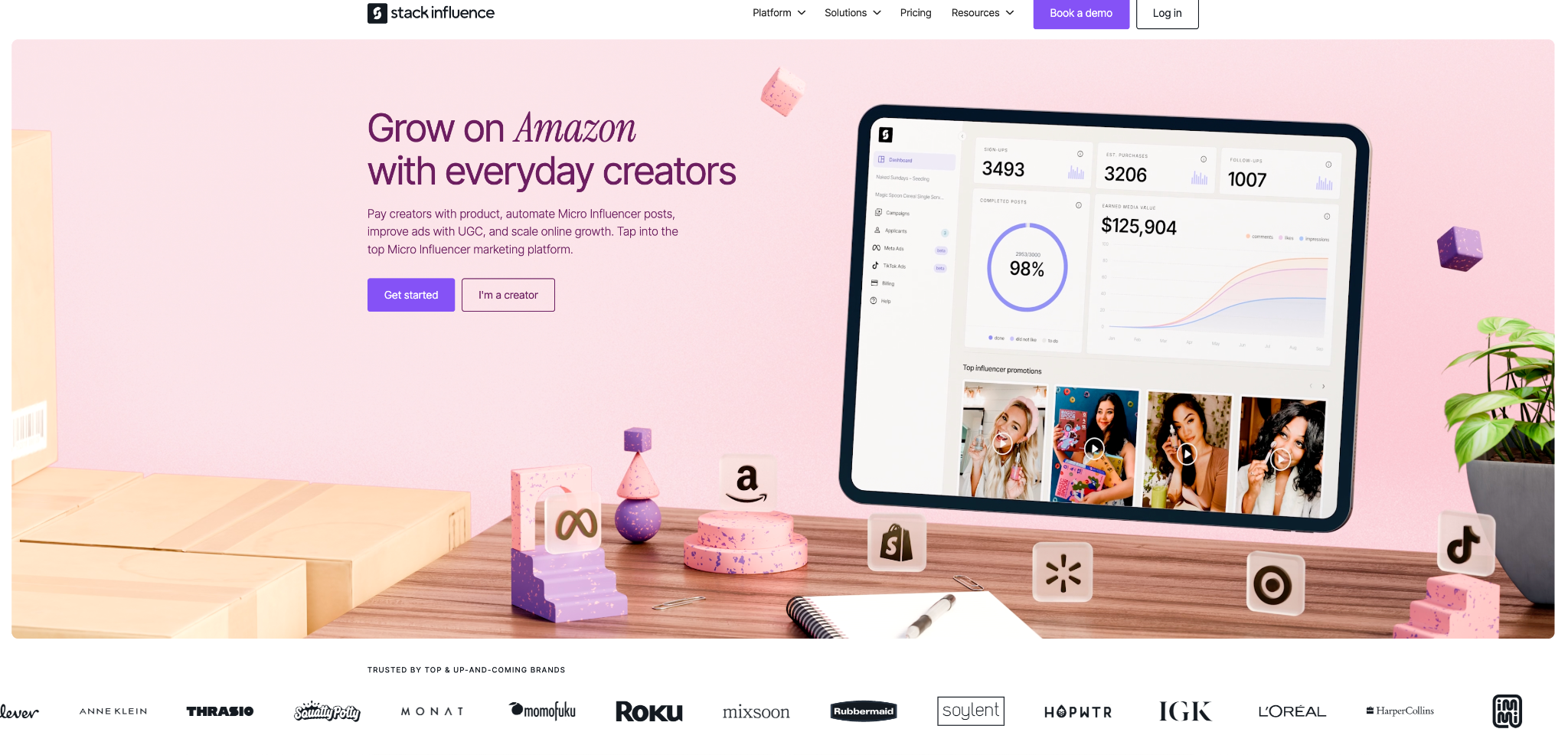
Stack Influence is a micro influencer marketing platform built specifically for eCommerce brands running product seeding, UGC collection, and automated influencer campaigns at scale. Its differentiator from pure social listening tools is that it closes the loop between audience intelligence and campaign activation: brands use it to discover, brief, and deploy creators based on performance data, and creators benefit from access to brand campaigns that are actively optimized for their content tier and niche. For UGC creators and nano influencers specifically, the platform surfaces product seeding opportunities that match their content category, audience demographics, and past campaign data, eliminating the cold-pitch process.
The platform's data layer tracks campaign-level performance including content submission rates, reuse rates for brand ad syndication, and engagement benchmarks by category, making it operationally distinct from general listening tools that focus on monitoring rather than activation. Data from Stack Influence's micro influencer campaigns suggests that creators participating in structured product seeding campaigns generate 40% more reusable UGC assets per campaign than creators working from open-brief arrangements, because the structured brief format aligns listening insights to content execution from the outset. The honest limitation is scope: Stack Influence is purpose-built for eCommerce and Amazon seller campaigns, so creators who operate primarily in B2B niches, editorial content, or pure personal branding will find limited campaign matches and should supplement it with a dedicated monitoring tool for broader keyword tracking.
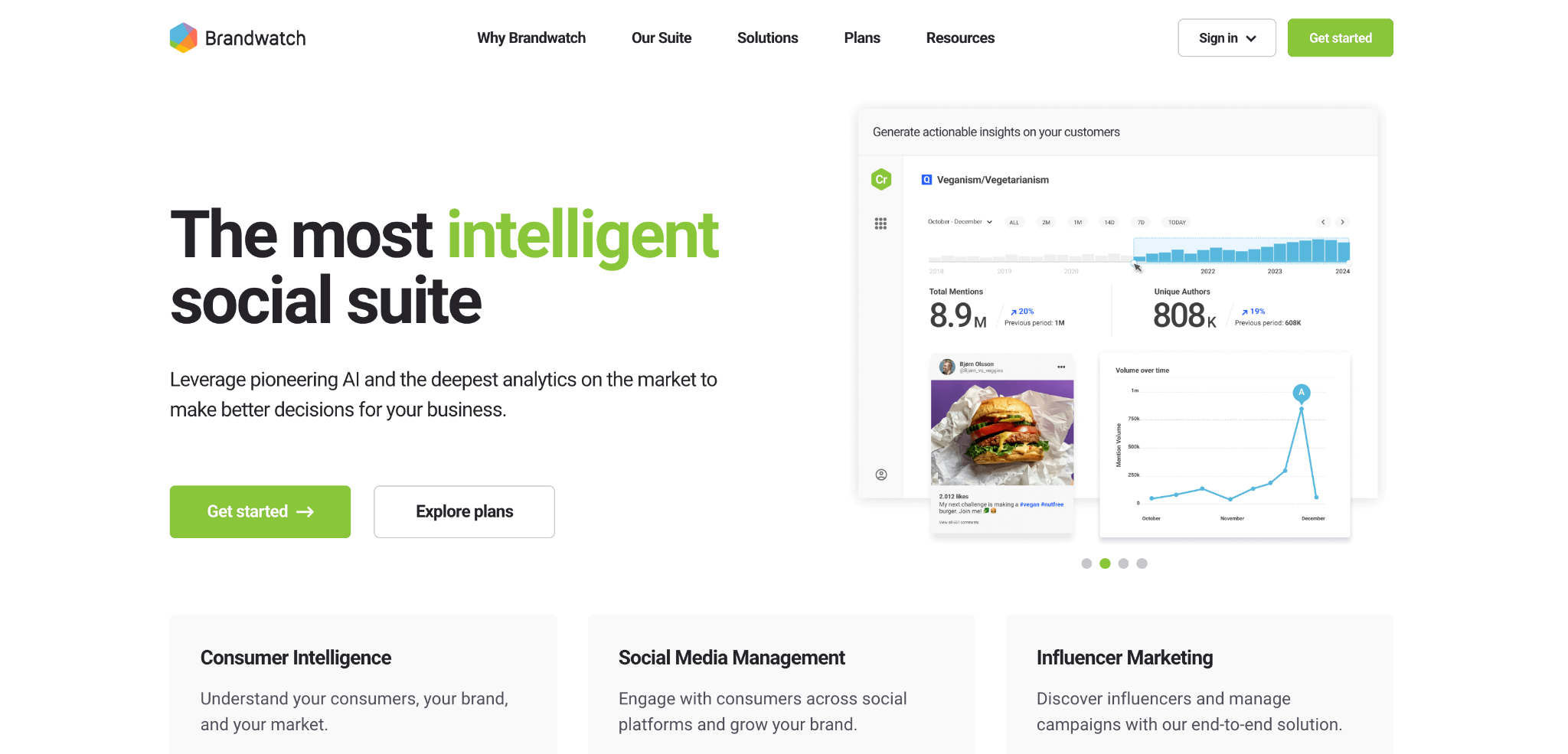
Brandwatch is an enterprise-grade consumer intelligence and social listening platform that monitors online conversations across hundreds of millions of sources, including social media, forums, news sites, and review platforms. Its proprietary Iris AI engine differentiates it from the field by going beyond keyword matching to analyze narrative patterns, historical conversation archives spanning over a decade, and competitive intelligence at a query depth no mid-market tool matches. This makes it the strongest option for creators who are producing content in industries with high regulatory or reputational volatility, such as financial products, healthcare, or sustainability. The honest limitation is price: Brandwatch starts at $800+ per month , with annual contracts typically running well above $10,000, which positions it firmly outside the budget of most individual creators and small creator teams.
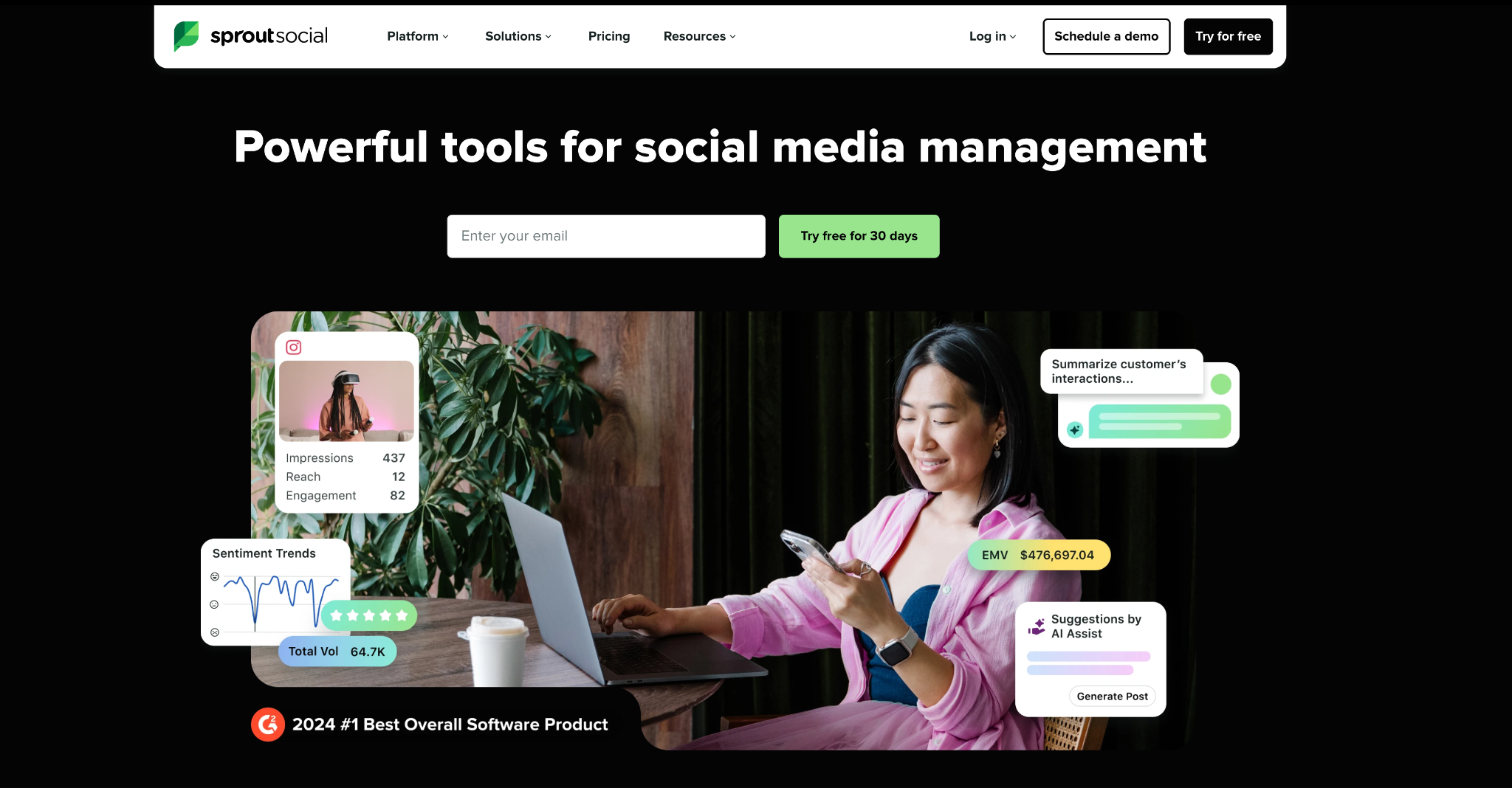
Sprout Social is a comprehensive, unified platform that combines social listening with publishing, engagement, and analytics, with its listening tool powered by AI Assist that processes up to 600 million messages daily to surface key themes and sentiment shifts. The key differentiator for creators is the all-in-one workflow: you can monitor brand mentions, schedule content responses, and pull shareable reports for brand partners all from the same dashboard. This makes Sprout Social a strong fit for mid-level content creators managing multiple brand clients who need a single tool to cover listening, reporting, and community management without platform-hopping. The limitation is cost structure: the Standard plan at $199 per user per month does not include social listening at all, requiring the Professional tier plus a separate Listening add-on.
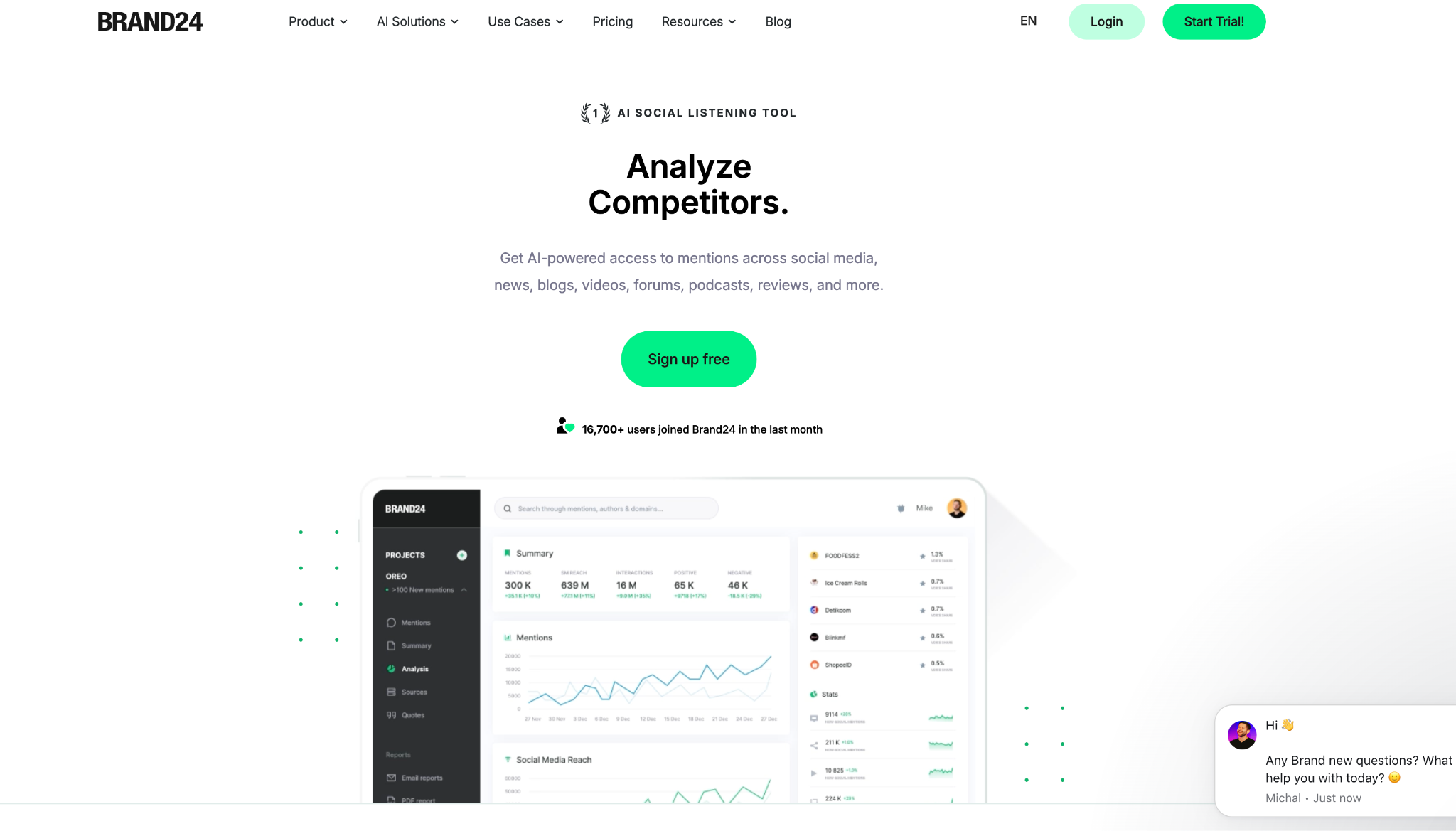
Brand24 is a social listening and media monitoring tool that tracks online mentions across 25+ million sources including social media, news, blogs, forums, review sites, podcasts, and videos in 108 languages, and recently added LLM monitoring that tracks how AI chatbots like ChatGPT, Claude, and Gemini mention and recommend your brand. For creators with a budget under $200 per month, Brand24 delivers the widest source coverage in its price tier. Its Influencer Score feature helps creators identify high-reach accounts already talking about their niche, making it useful not just for monitoring but for finding potential collaboration partners. The limitation is that Brand24 listens but does not publish or engage: Brand24 has no publishing or engagement function, meaning you will still need a separate tool like Hootsuite or Sprout Social to respond to mentions.
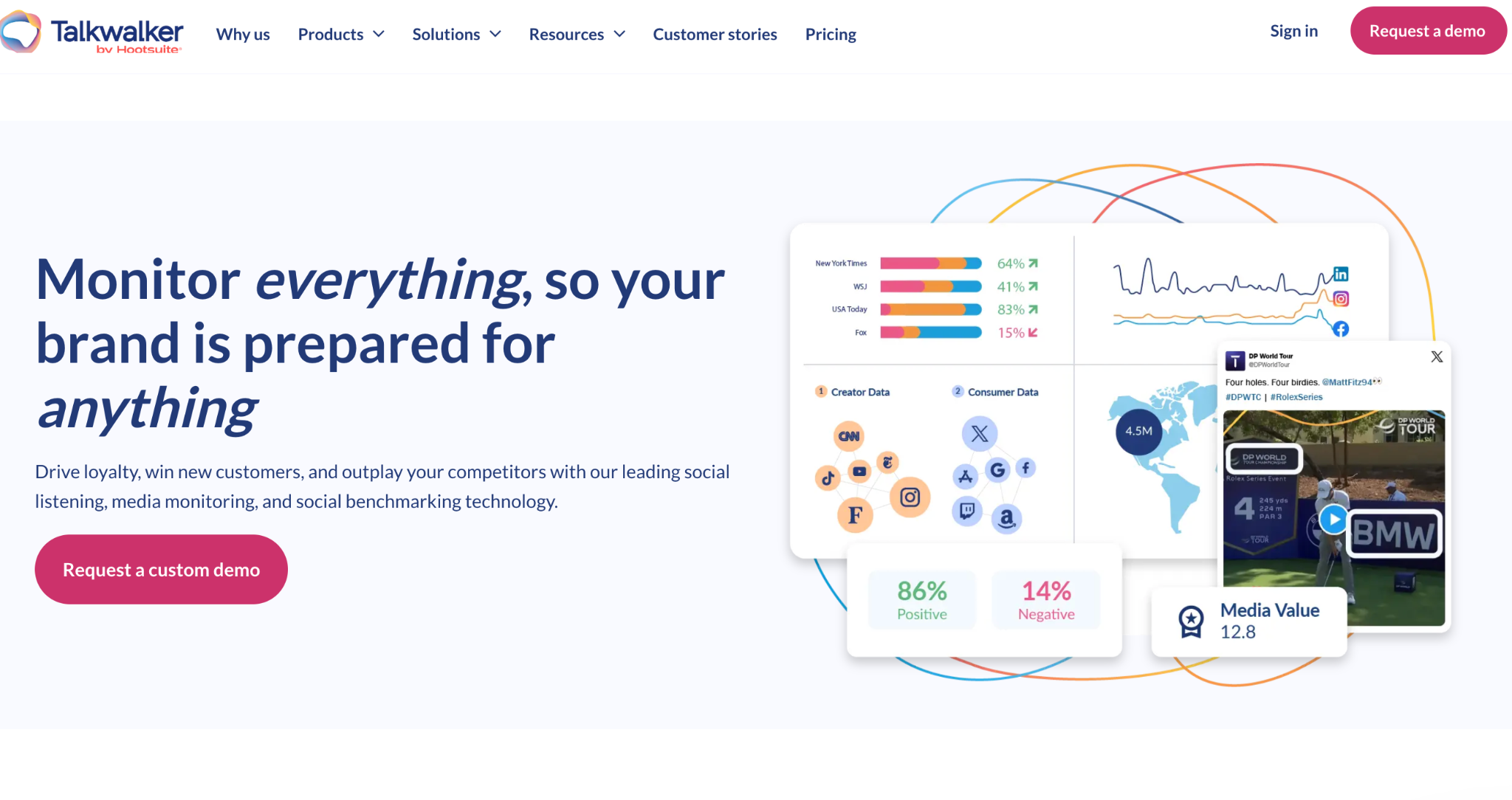
Talkwalker is a consumer intelligence and social listening platform that monitors over 150 million sources including social media, news, blogs, forums, and review sites, and now part of Hootsuite, provides AI-powered analytics with visual analytics for image and video recognition and competitive benchmarking. Its Blue Silk AI engine, trained on 3 trillion data points, handles sentiment analysis across 192 languages and is the deepest visual recognition system in the enterprise social listening market. Talkwalker is best suited for creators managing brand campaigns in global markets or for creator-side agencies that need to deliver executive-grade reporting across multiple client accounts. The limitation is price and learning curve: enterprise plans typically start around $9,600 per year, and the platform requires training to extract maximum value from its more advanced features.
Meltwater combines media monitoring, social listening, and PR analytics into one powerful platform. Its Klear add-on, acquired in 2022, adds an influencer marketing layer that lets users identify creator partnerships directly from listening data, making Meltwater the most integrated option for creators who want to see how brands are discovering and evaluating their competitors in the influencer space. The platform also covers traditional media, Twitch, Snapchat, Reddit, and podcasts in a single subscription, which is broader than most tools at a comparable tier. The honest limitation is pricing opacity and onboarding complexity: Meltwater starts around $15K annually with 12-month minimum contracts , and UX complexity is consistently flagged in user reviews as a challenge for lean teams or solo creators.
Mention is a simple yet effective listening tool tailored for startups and small businesses that tracks brand mentions and keywords in real time across social media, news, blogs, and forums. Mention offers real-time tracking of keywords and brand mentions across over 1 billion sources , and its entry pricing starting around $41 per month makes it the most accessible paid option for a creator just starting to build a listening practice. The interface is notably cleaner than many enterprise alternatives, making setup genuinely fast. The limitation is depth: Mention's analytics are less sophisticated than Brand24's at comparable price points, and it lacks the AI-powered anomaly detection and LLM tracking that newer platforms have introduced.
Archive is a social listening and creator discovery platform built for short-form video that helps you capture everything, source creators, automate manual workflows, and prove ROI instead of stitching together screenshots, spreadsheets, and point tools. Its standout feature is Archive Radar, which uses AI video social listening to detect brand appearances in posts even when creators forget to tag or use the campaign hashtag. Archive automatically detects tagged content 24/7, capturing 400% more content than competing platforms by monitoring not just hashtags but also custom tags. For creators managing their own brand deals who need to deliver content performance reporting to sponsors without spending hours on manual screenshots, Archive is the most operationally efficient option. The limitation is platform focus: Archive is built for Instagram and TikTok workflows, and creators operating heavily on YouTube or LinkedIn will find its coverage significantly thinner on those channels.
Comparative Summary: Choosing by Your Primary Constraint
The short answer is yes, with a caveat: layer tools based on function, not redundancy. According to the Social Intelligence Lab's research, over 80% of respondents utilized multiple social listening tools, with most respondents using two or three tools simultaneously. For creators, the ideal stack is two tools that serve different purposes: one broad monitoring tool for keyword and sentiment tracking across the web, and one creator-specific platform for campaign activation and UGC management.
Here is how to build a practical two-tool stack based on your content tier:
The risk of using too many tools is dashboard fatigue. More data does not automatically mean better decisions. Apply the SIGNAL Checklist to evaluate whether each tool in your stack is contributing unique, actionable information. If two tools are showing you the same signals, consolidate.
Social media listening tools are no longer optional for content creators who want to compete for serious brand deals in 2026. The creators winning in the current creator economy are not the loudest. They are the most informed. They understand what their audience is talking about, what brands in their category are searching for, and how to position their content at the intersection of those two data streams. Running the SIGNAL Checklist quarterly, applying the Creator Listening Metric Stack to your pitches, and choosing a platform stack that matches your budget and content focus will compound over time into a distinct competitive advantage. Start with one tool, build a listening habit, and use the data to show brands something they could not find on their own.
Brands are quietly shifting their paid media dollars. Creator marketing budgets surged 171% year-over-year, and nearly two-thirds of that increase came directly from paid and digital advertising budgets — meaning the agency world is now knocking on creators' doors. If you are a content creator, understanding how a paid advertising agency works is no longer optional. It is the difference between being a one-time post vendor and a strategic partner who commands higher rates, longer contracts, and more creative control.
A paid advertising agency is a company hired by brands to plan, buy, and optimize media placements across channels including Meta Ads, Google Search, TikTok Ads, and Amazon Advertising. These agencies control the media budget, set targeting parameters, write or source creative assets, and report performance to their clients. For influencer campaigns and UGC video, many agencies now act as the bridge between a brand's ad account and a creator's content library.
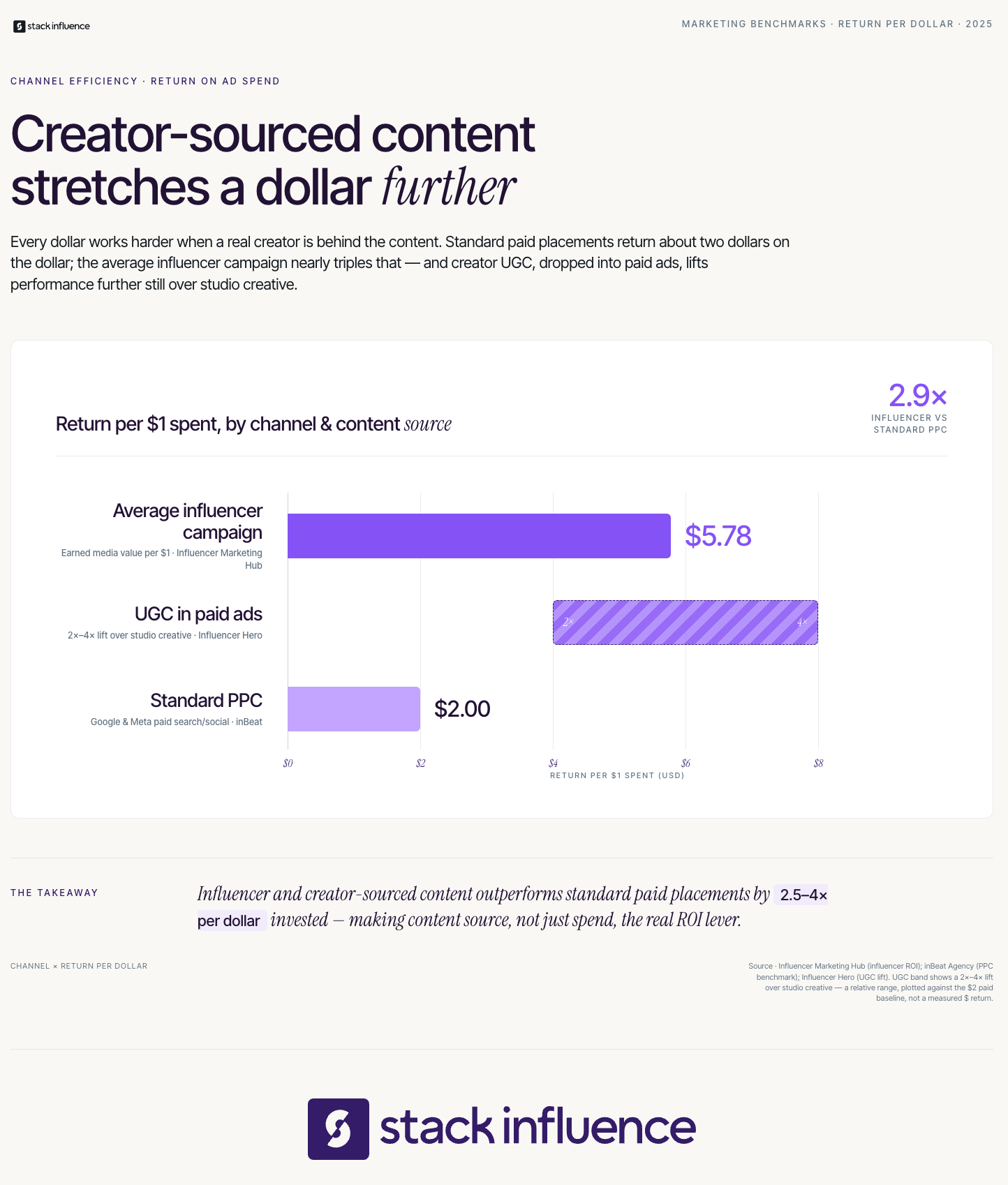
The economics explain why agencies are increasingly creator-focused. PPC returns roughly $2 for every $1 spent, while influencer marketing delivers $5.78 per dollar — a performance gap that collapses when creator content is used inside paid placements rather than kept in organic silos. Influencer marketing is often considered one of the most cost-effective digital channels, often returning $5.78 for every dollar spent, with many brands reporting strong returns particularly when working with micro and nano influencers.
Here is what agencies typically manage on behalf of their brand clients:
Stack Influence has observed that ecommerce brands running influencer campaigns alongside paid placements consistently see stronger blended ROAS in the first 90 days than brands running paid media alone, particularly when micro influencer content is briefed for ad reuse from the start. Understanding how agencies use that content is the first step toward pricing it correctly.
Most content creators think of agencies as intermediaries who handle brand deals. In reality, a paid advertising agency is often the entity controlling the creative budget and the ad account, which means your content can be amplified far beyond your organic reach — if the agency has the rights and the brief alignment to do it.
Strategic deployment tactics amplify savings when integrating creator assets into paid media, with influencer whitelisting currently outperforming basic social media ads by 20 to 50%. Whitelisting is the arrangement where an agency runs ads from your social handle rather than from the brand's account, preserving your social proof while giving the client full audience targeting control. This is why understanding creator partnerships at the agency level unlocks deal structures that most creators never access.
The Paid-to-Creator Maturity Model (introduced in the next section) maps exactly where most creators sit in this workflow and where the highest-value opportunities live. The practical entry points for creators in an agency context include:
The performance gap between authentic creator material and highly produced studio assets continues to widen, with 69% of marketers reporting that influencer-generated content performs strictly better than brand-directed alternatives. That data point is your pitch. Agencies need what you produce, and the ones who understand performance metrics are willing to pay for usage rights, not just organic posts.
The Paid-to-Creator Maturity Model is a tiered framework that helps creators understand their current position in the agency ecosystem and the steps needed to move toward higher-value placements. Most creators operate at Tier 1 without realizing tiers 2 through 4 exist.
Tier 1 — Organic Only: You post branded content to your feed or stories, the brand receives organic reach, and the deal ends there. Compensation is typically a flat fee or free product seeding. Agencies rarely interact with creators at this level directly.
Tier 2 — Paid Amplification: A brand or its agency boosts your post using paid spend, extending reach to audiences beyond your followers. You may or may not receive additional compensation. This is the most common entry point where agencies start paying attention to creator performance data.
Tier 3 — Whitelisting and UGC Licensing: The agency runs paid ads from your handle (whitelisting) or licenses your raw video files as creative assets in its ad account. Usage rights fees apply here, and this tier represents the biggest jump in creator earning potential. Rates for whitelisted posts can be 2 to 3 times higher than standard sponsored post rates.
Tier 4 — Always-On Creative Partnership: You become a recurring creative supplier for the agency's client. The agency briefs you like a production vendor, integrates your content into A/B testing cycles, and measures your creative against cost-per-acquisition targets. This is the brand ambassador or retained content creator model at its most structured.
Most influencer marketing platforms help creators surface from Tier 1 to Tier 2. Moving from Tier 2 to Tier 4 requires understanding how agencies measure creative performance, which is exactly what the measurement section below covers.
The Creator-First Agency Audit is a named checklist framework designed to help you evaluate any agency partnership opportunity before signing. Running this audit prevents under-pricing your content, surrendering usage rights inadvertently, and partnering with agencies whose client verticals will not benefit from your audience.
A critical 2025 data point from Aspire reveals a 42% year-over-year decrease in average influencer CPM, dropping to just $2.68, signaling growing cost efficiency that allows brands to reach significantly larger audiences per dollar spent. That compression makes your content more attractive to agencies as paid creative — but it also means volume and rights terms matter more than ever.
According to Sociallyin's 2026 influencer marketing data, a 2025 Aspire report reveals a 42% year-over-year decrease in average influencer CPM, dropping to just $2.68, making creator-sourced impressions cost-competitive with, or cheaper than, paid social placements.
Run the following eight-item audit on every agency opportunity:
Running the Creator-First Agency Audit before any deal protects your rates, your content, and your long-term relationship with the brand. Agencies that push back hard on basic transparency checks are often the ones whose attribution data would expose poor ROI anyway.
The shift from organic-only creator deals to paid-integrated creator partnerships is one of the most significant changes in the creator economy in 2026. Understanding it mechanically — not just conceptually — is what separates creators who scale to high-value brand partnerships from those who stay stuck at one-off post rates.
According to Meta case studies, UGC-style video ads outperform traditional creative by up to 38% in CTR and reduce CPA by 25 to 50%. That performance advantage is not abstract. It means that an agency running your video as a paid ad will spend less per customer acquisition than they would spend on a studio-produced spot. When you understand this, you can articulate your content's economic value directly to media buyers, not just to social media managers.
UGC ads achieve 4x higher click-through rates and 50% lower cost-per-click compared to traditional brand ads. For an ecommerce brand spending $50,000 per month on Meta Ads, cutting CPC by 50% through creator-sourced creative is the equivalent of doubling their effective ad budget. That is a budget-level argument, not a vanity metric argument, and it lands very differently in a paid advertising agency conversation.
Data from Stack Influence's experience running product seeding campaigns for ecommerce brands shows that creators who receive a clear paid-media brief alongside the organic brief deliver assets with stronger hook rates, because they intuitively frame the content around a viewer decision rather than a scroll-stopping moment alone. This distinction makes those assets far more reusable across the full paid creative cycle.
Here is how the content-to-paid-ad pipeline typically works:
Knowing this pipeline means you can brief yourself more effectively, deliver files that skip the editing bottleneck, and position yourself as someone who understands performance — not just aesthetics. That positioning is worth real money in agency conversations.
Attribution is the single most contested topic in the paid advertising agency world, and it is the area where most creators have the least fluency. Fixing that gap is one of the fastest ways to elevate your pitch from "social media creator" to "performance creative partner."
Measurement remains a structural constraint rather than a solved problem, with measuring ROI and attribution complexity together accounting for 15.84% of all reported challenges in creator campaigns — a figure that reveals how much opportunity exists for creators who speak the attribution language agencies use every day.
The Creator Attribution Stack is a named metric model with four labeled components you should understand before any agency conversation:
Across campaigns managed on the Stack Influence platform, ecommerce brands that brief creators with explicit Amazon Attribution link requirements see an average of 2.3x more trackable conversions per campaign than brands using standard UTM links alone, because the attribution window captures downstream purchase behavior more completely.
Using the Creator Attribution Stack in a pitch means replacing vague engagement claims with statements like: "My last whitelisted campaign for a skincare brand achieved a 1.9% CTR on Meta, reduced the brand's CPA from $28 to $19, and generated a 4.1x ROAS over the six-week flight." That sentence gets a media buyer's attention immediately.

Here is the genuinely novel angle most paid advertising guides miss: the creative refresh problem. It is not about whether to use a paid advertising agency. It is about where the agency gets its creative, and what that creative actually costs at scale.
CPC costs rose 12.88% annually in 2025 following 10% increases in 2024, with more businesses entering digital advertising and driving up auction costs without proportional demand increases. Agencies respond to rising media costs in one of two ways: optimize targeting (limited upside) or refresh creative (higher upside). Creative refresh is the actual lever, and it requires a continuous supply of new assets.
A $2,000 studio ad that does not work costs the same as 10 to 20 UGC videos you can test simultaneously, with the market average for UGC content sitting at approximately $198 per deliverable. That math is why agencies are not just open to creator content — they need it operationally. According to CreatorIQ's 2025 State of Creator Marketing Report, global brand investment in creator partnerships jumped 171% year-over-year, and nearly two-thirds of this budget increase came directly from paid media, with marketers reallocating funds from traditional digital ads into influencer-led campaigns.
The practical implication for creators is this: position your content as a creative supply chain, not a single post. Nano influencers and micro influencers who offer three to five asset variations per campaign — different hooks, different product angles, different calls-to-action — are infinitely more useful to a performance-focused agency than a creator who delivers one polished final cut. Here is what a creative supply chain offer looks like in practice:
This structure aligns your incentives with the agency's need for volume testing and their client's need for continuously fresh creative. That alignment is the real business case for working with — and getting retained by — a paid advertising agency.
The creator economy increasingly rewards creators who convert single campaigns into ongoing brand partnerships. Agencies are the access point to those long-term deals because they sit between the brand and the creative brief. Understanding how to navigate influencer campaigns at the agency level is covered in depth across influencer marketing case studies and 2026 influencer marketing predictions that outline where creator-brand relationships are heading.
Around 47% of marketers prefer long-term partnerships to one-off posts, a clear trend toward retainer-style arrangements. For creators, this represents a structural shift in how agencies are briefing and paying for content. The move from transactional to relational is built on three things: performance data, creative reliability, and business fluency.
Brands looking for influencers increasingly rely on their agency to recommend retained creators based on demonstrated CPA and ROAS performance across previous campaigns. This is where your attribution tracking history becomes a competitive advantage. Creators who can show a media buyer documented performance from prior campaigns — not just engagement screenshots but cost-per-click and ROAS outcomes — get shortlisted for long-term brand sponsorship deals that never appear on public influencer marketing platforms.
For ecommerce brands specifically, especially Shopify influencer marketing and Amazon sellers leveraging the Amazon Influencer Program, agencies look for creators who understand how Shopify attribution flows differ from Amazon Attribution tracking. A micro influencer who can explain the difference between a last-click attribution model and a 14-day Amazon lookback window is not just a creator — they are a performance marketing asset.
Several resources can help you develop this fluency. How influencer seeding works for ecommerce explains the product seeding process from brief to asset delivery. Niche micro influencers breaks down how niche positioning makes your content more valuable to performance-focused agencies. And how to land an Instagram sponsorship covers the outreach tactics that work specifically when agencies are involved in the brand deal.
Stack Influence's internal campaign data shows that creators who include documented paid media performance in their initial pitch to a new brand or agency convert to paid retainer arrangements at nearly twice the rate of creators who present only organic engagement metrics, because paid performance speaks directly to the KPI language agencies use internally.
The path from a single UGC deal to a quarterly retained creator partnership runs directly through agency relationships. About 60% of businesses run influencer programs in-house while about 40% use agencies , which means the agency-managed segment represents a significant pool of higher-budget, performance-oriented brand deals that most creators do not actively pursue. Positioning yourself as a performance creative partner — using the Creator-First Agency Audit and the Creator Attribution Stack — is how you access that pool.
You can explore how to become a micro influencer and the micro influencer platform overview for tools that connect you to the right brand and agency partnerships at scale. For brands and creators interested in seeing how UGC platforms and content syndication fit into an agency-managed paid strategy, those resources map the full creative pipeline from activation to amplification. If you are ready to explore how Meta partnership ads and TikTok Spark Ads work at the campaign level, those pages explain the technical mechanics of whitelisted paid placements from a creator's perspective.
Working with a paid advertising agency as a creator is not about fitting into a brand's media plan. It is about understanding that media plan well enough to position your content as its most cost-efficient fuel. The frameworks in this article — the Creator-First Agency Audit, the Paid-to-Creator Maturity Model, and the Creator Attribution Stack — give you a practical language for every agency conversation you will have. Use them to negotiate usage rights, price your deliverables correctly, and convert one-time campaigns into the kind of long-term brand deals that define a sustainable career in the creator economy. When you understand the economics of a paid advertising agency, you stop being a line item in a creative budget and start being a strategic partner in a performance marketing operation.
Luxury brands are spending more on creator partnerships than ever before, yet most influencers approach these deals the wrong way. They chase follower counts, negotiate a flat fee, and post a single polished photo, and then they wonder why the brand never calls back. Luxury brand marketing operates on a completely different logic than mass-market campaigns, and understanding that logic is what separates creators who land one deal from creators who become long-term brand ambassadors. This guide will walk you through exactly how luxury influencer marketing works, what brands are actually looking for, and how to build a strategy that turns a single campaign into an ongoing creative partnership.
Most creators assume that luxury brands only work with mega-influencers or celebrities. The reality in 2026 is far more nuanced. Micro influencers with 10,000 to 100,000 followers deliver some of the highest engagement rates and strongest ROI across industries, and in luxury marketing specifically, they outperform larger creators because their audiences perceive them as genuine and relatable yet aspirational. That perception gap is exactly what luxury brands are trying to close.
Positioning yourself for luxury brand marketing starts before you pitch any brand. Your content aesthetic, caption voice, and even the way you frame everyday objects should signal an appreciation for quality, craft, and detail. Luxury houses study a creator's entire content library before reaching out, not just their last 12 posts. Consistency in visual identity and storytelling depth carries more weight than a one-time viral video.
Here are the core positioning signals luxury brands look for in a creator partner:
Creators who build niche micro influencer audiences around specific lifestyle verticals are particularly well-positioned for luxury partnerships. A creator focused on slow travel, artisan food, or heritage menswear has an audience that luxury brands recognize as their own target customer. That specificity is worth more than a larger but diffuse following in a general lifestyle category.
Luxury brand marketing is the strategic practice of building and sustaining perceived exclusivity, cultural relevance, and emotional desire for high-end products or services through carefully curated storytelling and partnerships. Unlike mainstream consumer marketing, which often focuses on volume and conversion speed, luxury marketing prioritizes brand equity, aspiration, and a sense of belonging to a select community. The goal is not simply to sell a product but to sell a world that the buyer wants to inhabit.
Across generations, spending patterns in luxury remained relatively stable in 2025, with Millennials accounting for about 46% of total luxury spending. Gen Z is more critical and tends to be more open but less loyal, prioritizing individual identity over community and evaluating brands on cultural relevance, not status. That shift toward values-driven purchasing is exactly why creator partnerships have become central to luxury marketing strategy.
Ninety-two percent of consumers trust user-generated content more than traditional promotional messages, and posts featuring UGC receive 6.9 times higher engagement than brand-generated content. For luxury brands, this statistic reframes the entire value of a creator relationship. A well-crafted UGC post from a credible micro influencer can outperform a six-figure brand campaign on click-through and conversion efficiency.
Understanding the luxury marketing landscape means grasping three defining principles:
For creators who want to break into influencer marketing campaigns with luxury brands, internalizing these principles changes how you pitch, what content you create, and how you negotiate content rights and usage terms.
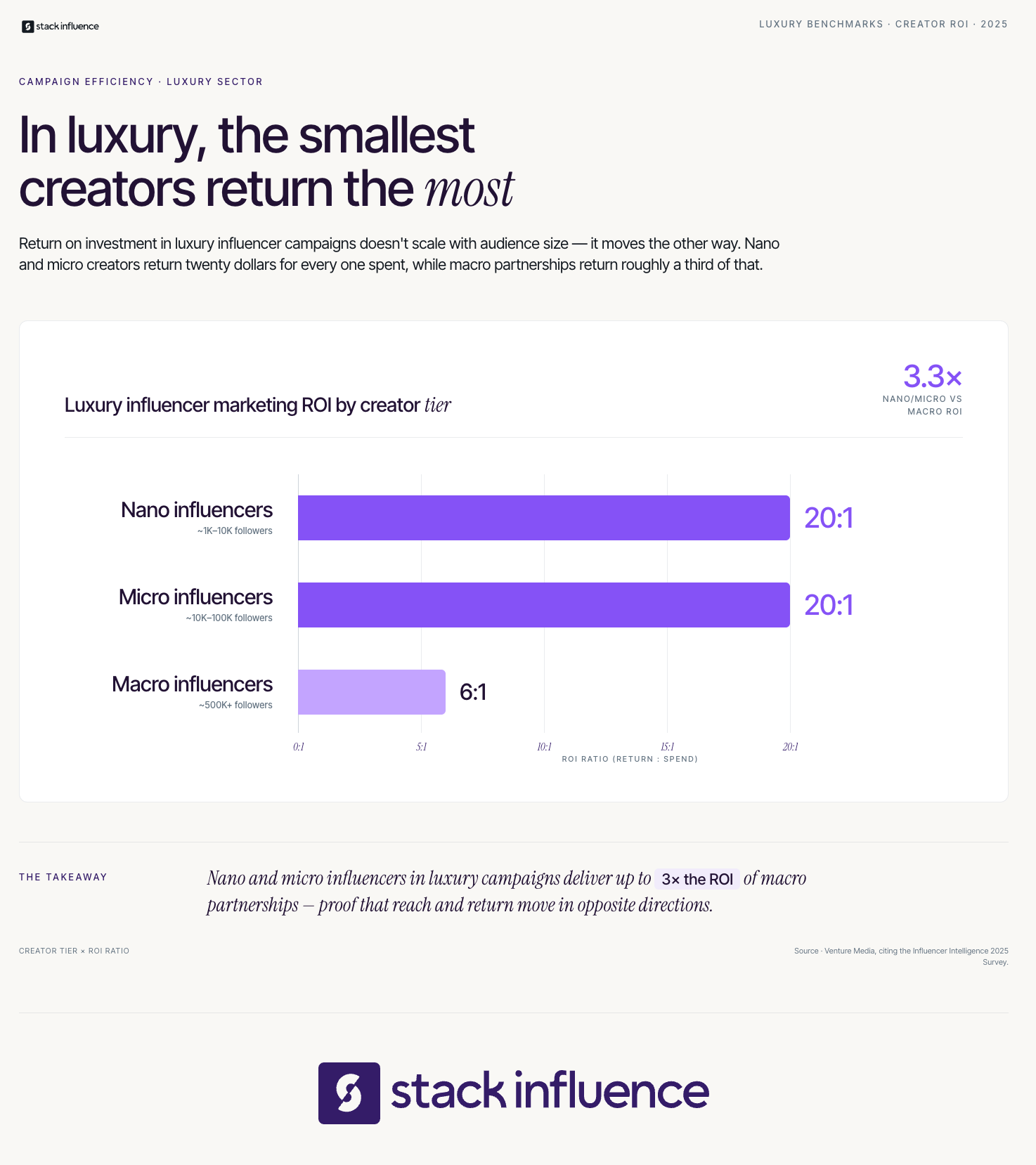
The Creator Alignment Matrix is a decision framework that helps creators and brand partnerships teams evaluate whether a luxury collaboration is strategically sound before any contract is signed. It operates on two variables: Brand World Fit and Audience Desire Alignment. Both variables must score highly for a luxury partnership to deliver long-term value. The matrix identifies four quadrants that predict collaboration outcomes.
Use the Creator Alignment Matrix before accepting any luxury brand opportunity by scoring each variable:
A 2025 survey from Influencer Intelligence found that campaigns driven by micro influencers in luxury marketing achieved ROI as high as 20:1, compared to 6:1 when using macro influencers. That six-to-one gap exists largely because macro influencers often score high on reach but low on Audience Desire Alignment for the specific luxury category they are promoting.
Stack Influence's internal campaign data shows that in the luxury and premium beauty categories, creators who scored in the top quadrant of the Creator Alignment Matrix were three times more likely to be invited into paid retainer partnerships after an initial product seeding collaboration, compared to creators who accepted deals outside their content world.
Always run the Creator Alignment Matrix before accepting an inbound brand inquiry. A deal that looks attractive on paper can quietly damage your credibility if the brand's world does not match the aspirational space you have built for your audience. The framework also functions as a negotiation tool. When you can demonstrate high alignment using concrete content examples, you have the leverage to negotiate better usage rights and higher compensation.
The phrase "authentic luxury" sounds like a contradiction, but it is the central tension that defines modern luxury brand marketing. Luxury is inherently constructed and aspirational, while authenticity implies spontaneity and transparency. The brands winning in 2026 are the ones who have figured out how to make the constructed feel genuine, and they are doing it through creators who genuinely love the product category.
The BoF-McKinsey State of Fashion 2024 Consumer Survey found that 68% of respondents were unhappy about the high volume of sponsored content on social media platforms, and 65% were turning less to fashion influencers than a few years ago. This is the tension creators must navigate. Audiences are fatigued by obvious promotional content, but they are still deeply influenced by creators they trust. The solution is not less sponsored content. It is more deeply integrated, values-aligned content.
The global fashion influencer marketing market was valued at $6.82 billion in 2024 and is projected to reach $39.72 billion by 2030, growing at a CAGR of 33.8% from 2025 to 2030. That growth is not being driven by celebrity partnerships. It is being driven by the long tail of niche creators who have built genuine authority in specific categories that luxury brands want to reach.
Here is what authentic luxury content actually requires from creators:
From Stack Influence's experience running product seeding campaigns across beauty and lifestyle categories, creators who integrated gifted luxury products into existing content series rather than producing standalone sponsored posts saw an average of 2.4x higher engagement rates and significantly higher content reuse rates from brand partners.
The influencer seeding workflow for eCommerce brands follows the same logic at scale. The most effective product seeding campaigns for luxury-adjacent brands succeed not because creators are required to post, but because the product experience is compelling enough that they post organically. That organic quality is what separates content that converts from content that merely fills a feed.
The Prestige Creator Checklist is a secondary framework designed to be used alongside the Creator Alignment Matrix. Where the matrix evaluates strategic fit, the checklist audits your operational readiness before you pitch a luxury brand or accept a deal. Run through all eight items before entering any luxury creator partnership.
According to data from the Sprout Social 2025 Influencer Marketing Report, 65% of influencers prefer joining strategy development conversations with brands early on rather than following a rigid brief. The Prestige Creator Checklist helps you show up to those conversations prepared.
The Prestige Creator Checklist includes:
Across campaigns managed on the Stack Influence platform, creators in the fashion and beauty categories who entered luxury brand conversations with all eight checklist items ready were significantly more likely to convert an initial inquiry into a paid retainer deal within the first 30 days of contact, compared to those who prepared only a basic media kit.
The Prestige Creator Checklist also functions as a self-assessment tool. If you cannot check off six or more of these items, you are not yet ready to pitch luxury brands. Use the gap as a 60-day roadmap to get there, and revisit influencer marketing platform resources to benchmark your content against other creators in your vertical.

Most guides to influencer marketing metrics focus on engagement rate, reach, and impressions. Those numbers matter, but for luxury brand marketing specifically, they are not the metrics that brands use to decide whether to renew a partnership. The Luxury Signal Stack is a named metric model built for creators and brands navigating premium partnerships.
The Luxury Signal Stack has four components:
UGC generates 6.9x more engagement than brand content, and on average, UGC posts achieve 28% higher engagement rates than brand-created alternatives, reflecting algorithmic preferences for authentic, user-centric content. These numbers explain why Content Reuse Rate has become a critical negotiation metric in luxury partnerships. Brands know that creator UGC outperforms their own content, and they are willing to pay a premium for usage rights.
For DTC brands and Amazon sellers running luxury-positioned products, the Luxury Signal Stack connects naturally to Amazon Attribution tracking links, which allow brands to measure exactly which creator touchpoints drive traffic and sales on the marketplace. Amazon sellers using the Amazon Brand Referral Bonus program can also offset a portion of influencer campaign costs through traffic-driven bonus earnings, making the economics of creator partnerships measurably stronger.
Reference the Luxury Signal Stack in your creator media kit by listing which of the four metrics you actively track and can report to brand partners. Most creators only offer engagement rate data. Showing up with CRR and BLI data demonstrates a level of professional sophistication that luxury brands respond to immediately.
The most common mistake new creators make in luxury brand marketing is confusing brand prestige for compensation. Being offered a collaboration with a heritage fashion house or a premium skincare brand feels validating, but product-only deals without creative compensation can undermine your business and your credibility over time.
The 2025 Influencer Marketing Report indicates that half of influencers charge between $250 and $1,000 per post, but 71% offer discounts for longer-term partnerships and 25% would consider doing so in the future. That pricing data confirms that most creators in the mid-tier are leaving money on the table with luxury brands that have budget to invest in creator partnerships.
Product seeding without upfront payment makes strategic sense in one specific situation: when the brand is in the top quadrant of your Creator Alignment Matrix and the goal is to build a relationship that can convert into a paid ambassador program. In that scenario, the gifted product is not compensation. It is a first-chapter introduction. Everything after that first post should carry a creative fee.
Here is when to accept versus negotiate luxury brand deal structures:
The creator economy has matured enough in 2026 that luxury brands working with micro influencers understand that professional creators have professional rate expectations. Creators who approach brand deals with the brand ambassador mindset and a clear value proposition consistently secure better terms than those who treat brand inquiries as personal validation rather than business opportunities.
Luxury brand marketing rewards creators who understand its logic: exclusivity, narrative depth, and long-term relationship building over transactional posts. The Creator Alignment Matrix and the Prestige Creator Checklist give you two concrete frameworks to evaluate every opportunity before you say yes. The Luxury Signal Stack gives you the measurement language that luxury brands actually use internally, and speaking that language puts you on equal footing in every partnership negotiation.
The creator economy is shifting toward quality over quantity in every category, and luxury is leading that shift. Creators who invest in their content craft, build authority in specific niches, and show up to brand conversations with professional preparation are the ones landing the most meaningful brand partnerships in 2026. Use this guide as your operating system for every luxury brand marketing opportunity that comes your way.
You spent hours building a post, filming a UGC video, or writing a brand deal recap, and it still sits on page four of Google. The culprit is often not the topic you chose but how you handled keywords inside the copy. Keyword stuffing is one of the most persistent and misunderstood traps in the creator economy, and it costs creators real organic visibility every week. This guide will show you exactly what it is, why it still triggers algorithmic penalties in 2026, and how to build a smarter content system that ranks without sacrificing your authentic voice.
Many content creators assume keyword stuffing is an old problem solved by experience. In reality, it shows up constantly in captions, product review posts, and blog write-ups produced under deadline pressure. The behavior is often accidental: you repeat a phrase because it feels safer, or you mirror what a brand brief asks for, and suddenly your keyword density has crossed into spam territory. Understanding why this matters specifically for creators requires looking at how Google now processes and ranks content.
As confirmed by Search Engine Journal, keyword stuffing is a confirmed negative ranking factor, and attempting to manipulate search rankings with repeated uses of words or phrases will only cause a site to rank lower in Google's search results. That means a review post stuffed with a product name twelve times in 800 words does active damage, not just no good. The penalty is algorithmic and automatic in most cases, meaning there is no human review step and no second chance without a full content revision.
According to Ahrefs' 2026 SEO statistics, 96.55% of all pages get zero organic search traffic from Google, making every on-page decision, including keyword density, critically important to discoverability. Creators competing for organic reach are already operating in a brutally crowded field. Adding a spam signal like keyword stuffing on top of that challenge compounds the discoverability problem at exactly the wrong moment.
Here is why the problem persists despite being well-documented:
The fix is not to avoid keywords entirely. It is to apply a systematic process that keeps density in check while satisfying search intent with genuine depth.
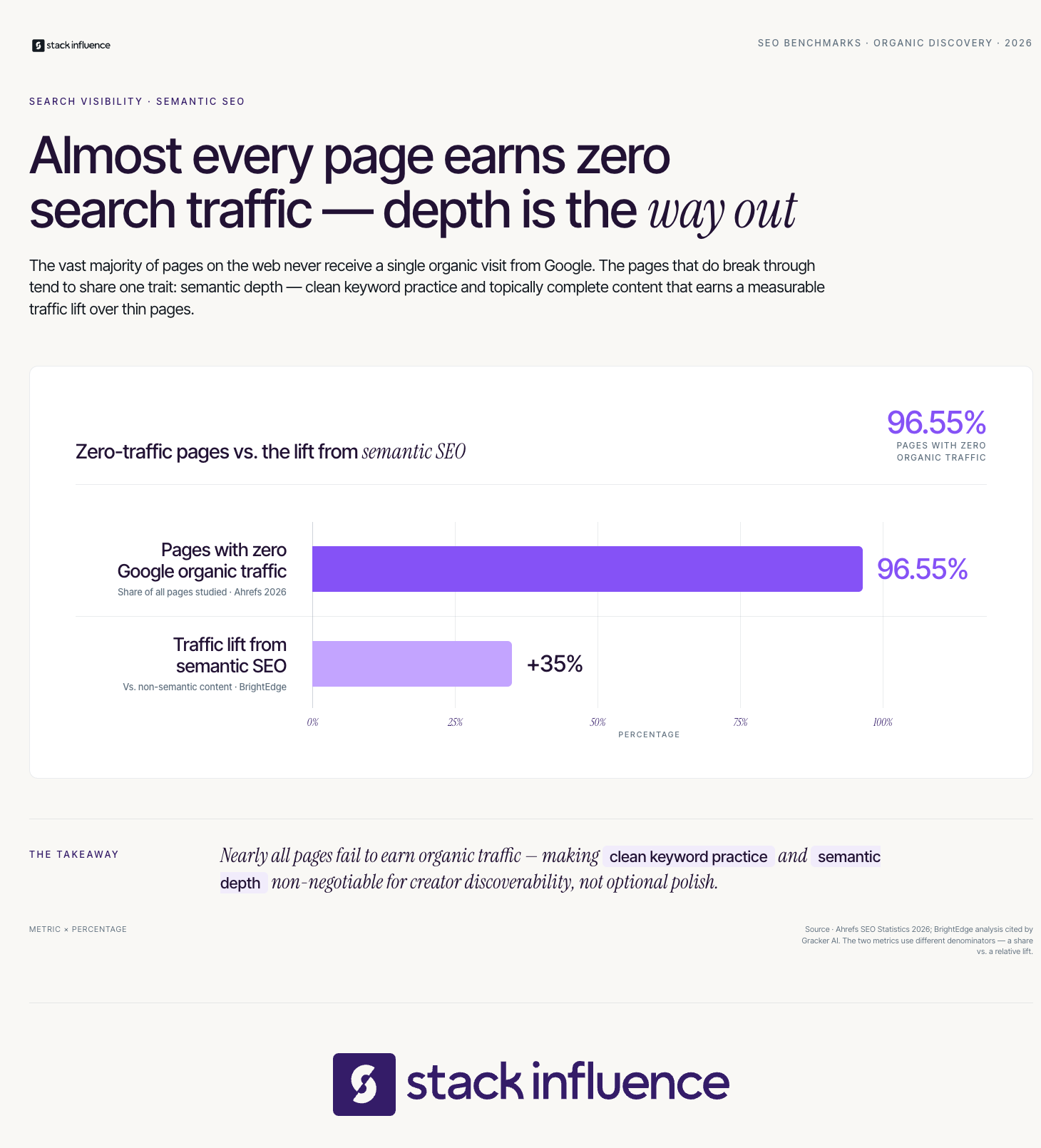
Keyword stuffing is the practice of overloading a piece of content with a targeted keyword or phrase so frequently, or in such unnatural patterns, that it disrupts readability and signals manipulation to search engines. It can happen in visible body copy or in hidden elements like alt text, meta descriptions, and image file names. Both forms carry the same risk of algorithmic penalization.
According to Google's official spam policies, keyword stuffing refers to "filling a web page with keywords or numbers in an attempt to manipulate rankings in Google Search results." The policy explicitly identifies examples such as blocks of text listing cities or regions a page wants to rank for, and unnatural repetition of the same words or phrases throughout a page. These examples map directly to habits that show up in eCommerce product reviews and UGC video descriptions created for DTC brands.
There are two primary forms that creators should know:
Both forms are detectable by Google's current spam systems. Hidden stuffing tends to draw harsher penalties because it signals intentional manipulation rather than accidental over-optimization. For creators publishing blog posts, YouTube descriptions, or product landing pages as part of creator partnerships, understanding both forms is the first line of defense.
The primary framework for avoiding keyword stuffing while maintaining strong SEO is the SIGNAL Principle Set. This is a Named Principle Set with five rules designed specifically for content creators working across formats including long-form blog posts, short-form video descriptions, and UGC captions. Reference the SIGNAL Principle Set whenever you are writing, editing, or reviewing any piece of content before it goes live.
The five named rules of the SIGNAL Principle Set are:
The SIGNAL Principle Set applies equally to blog posts written for brand deals, YouTube video descriptions, and long-form captions accompanying product seeding campaigns. Apply all five rules before any content leaves your drafts folder.
Data from Stack Influence's micro influencer campaigns suggests that creators who receive brand briefs with specific keyword guidance and then apply a natural readability edit before publishing consistently generate stronger organic discovery metrics on their review content than those who follow briefs verbatim without any SEO hygiene check.
Here is the belief that most creator SEO guides reinforce: hitting a specific keyword density percentage is the goal, and any number under 3 percent is safe. This is imprecise enough to be misleading.
According to Rankability's 2026 keyword density research, data shows a trend of decreasing average keyword density in higher-ranking search segments, suggesting that pages with a more moderate use of keywords tend to rank higher. The implication is not that you should chase a lower density number. The implication is that density is a symptom of content quality, not a dial you can tune independently. High-ranking pages are not achieving their rankings by targeting 1.2 percent density. They are writing naturally for humans, and the density falls into an acceptable range as a byproduct.
The specific belief to challenge: "I should calculate my keyword density and adjust it until it hits the green zone in my SEO plugin."
The alternative behavior: write until the content fully answers the search query, then run a single scan for obvious over-repetition. Replace two or three instances of the exact phrase with semantically related terms. Stop there. The metric you should actually track is whether the content answers the search intent completely, because that is what the SIGNAL Principle Set's Intent Match rule is designed to reinforce.
Research cited by Gracker AI shows that websites adopting semantic SEO strategies saw a 35% increase in organic traffic compared to those that did not, according to a BrightEdge analysis. Semantic SEO means covering a topic with breadth and depth using natural language, not fixating on exact-match repetition. This week, open your last three published pieces and read them aloud. Count how many times you say the same exact phrase. If you pass four repetitions in any 500-word section, replace two of them with a descriptive synonym or a related phrase. That single edit is more impactful than any density percentage tweak.

The SIGNAL Principle Set gives you the rules. This section gives you the repeatable process for applying them. Across campaigns managed on the Stack Influence platform, creators who follow a structured pre-publish keyword review produce content that earns measurably longer average session durations from readers arriving via organic search, compared to creators who write without any SEO framework in place.
The practical application workflow follows four steps:
UGC video descriptions deserve their own note here. Creators often ignore description copy on YouTube and TikTok entirely, or paste in a keyword list as a substitute for a real description. A keyword-stuffed description does not serve viewers and signals manipulation to crawlers. Write your descriptions as a two-to-three sentence summary of what the video covers, then add two or three naturally placed keyword phrases. The result will outperform a keyword block every time.
Whop's 2026 UGC statistics report found that UGC on product pages increased conversion rates by up to 200%, highlighting how creator content designed for humans, not algorithms, delivers the most commercial value. That data point is the clearest argument for writing naturally. When UGC content reads like authentic recommendation rather than a keyword list, it converts. When it reads like stuffed copy, it does neither the ranking nor the conversion job well.
For creators building their own blogs or review sites as part of a micro influencer or nano influencer content strategy, the same workflow applies. The SIGNAL Principle Set is format-agnostic. Apply it to a 300-word caption or a 3,000-word product review with the same systematic approach.
The secondary framework in this guide is the Creator's Keyword Audit Checklist. This is a Named Checklist with seven audit items designed to be run on any piece of content before publishing. Unlike the SIGNAL Principle Set, which is a writing philosophy, the Creator's Keyword Audit Checklist is a point-in-time verification tool. Use both frameworks together: write with SIGNAL, verify with the Checklist.
Run the Creator's Keyword Audit Checklist on every piece of content before it goes live:
Stack Influence's internal campaign data shows that brand partners whose product review briefs include a keyword audit checklist step before creator submission see fewer content revisions related to over-optimization and generate stronger average engagement rates on organic landing pages tied to those reviews.
Applying the Creator's Keyword Audit Checklist is particularly valuable for creators managing multiple brand deals simultaneously. Under that workload, systematic checklists prevent the rushed decisions that lead to keyword stuffing in the first place. Pair it with the SIGNAL Principle Set and you have a complete quality control system for any content format in the creator economy.
Tracking whether your keyword strategy is working requires a named measurement model. The Creator SEO Health Stack is a four-component model for assessing the quality and organic performance of creator content over time. Reference the Creator SEO Health Stack monthly rather than post-by-post, since SEO signals accumulate across a content archive rather than within individual pieces.
The four components of the Creator SEO Health Stack are:
From Stack Influence's experience running product seeding campaigns for eCommerce brands, sellers who integrate creator-produced review content into product pages using clean, naturally written descriptions see measurably better organic traffic to those pages over a 90-day window than brands repurposing keyword-heavy promotional copy from ad campaigns.
Use the Creator SEO Health Stack alongside both frameworks from this guide. The SIGNAL Principle Set governs how you write. The Creator's Keyword Audit Checklist governs your pre-publish review. The Creator SEO Health Stack governs how you measure and improve over time. Together, these three tools give you a complete, repeatable system for producing content that ranks without ever slipping into keyword stuffing.
For creators working with influencer marketing platforms or exploring influencer marketing agency partnerships, applying SEO hygiene to your content archive also strengthens your media kit. Brands looking for influencers increasingly evaluate organic reach alongside social metrics, and a content portfolio that ranks well on search signals professional-grade quality.
Keyword stuffing is not an advanced SEO problem. It is a fundamental content quality problem that happens to have algorithmic consequences. For influencers and content creators building sustainable careers in the creator economy, the ability to produce readable, search-friendly content is a competitive differentiator, not just a technical checkbox. The SIGNAL Principle Set gives you the writing philosophy. The Creator's Keyword Audit Checklist gives you the verification process. The Creator SEO Health Stack gives you the measurement model. Apply all three, stay honest with your density, and write first for the human reading your post. The rankings follow the quality, not the keyword count.
Most guides about TikTok marketing still lead with follower counts and viral trends. That is the wrong starting point in 2026. The creators building consistent income on the platform are treating it as a structured commercial channel, not a lottery. Whether you are posting product reviews, UGC video, or lifestyle content, understanding the mechanics of TikTok marketing is the difference between random engagement and repeatable brand deals. This guide breaks down what TikTok marketing actually is, how to build a strategy around it, and the underrated tactics most creators ignore.
TikTok marketing is the practice of using TikTok's short-form video platform to promote products, build audiences, and generate revenue through organic content, paid advertising, and creator partnerships. For content creators, it means understanding how to align what you make with what brands need and what the algorithm rewards. The platform operates as both a discovery engine and a commerce channel, which is a combination no other social platform has perfected to the same degree.
According to Socialinsider's 2026 Social Media Benchmark Report, TikTok's average engagement rate surged 49% year-over-year to 3.70%, more than seven times Instagram's 0.48% and nearly 25 times Facebook's 0.15%. That gap is the single most important number for any creator negotiating a brand deal in 2026. Higher engagement means more eyeballs per post, more signal for the algorithm to distribute your content, and more commercial value per impression delivered to a brand partner.
TikTok marketing covers several distinct activities that creators need to understand separately:
These five categories are not mutually exclusive. Most successful creators layer two or three of them simultaneously, which is exactly how the creator economy has matured in 2026.
Only 26% of marketers currently run TikTok campaigns, creating a major opportunity for brands willing to invest early in educational content, creator partnerships, search-friendly videos, and TikTok Shop. For creators, that gap is a green light. The brands that are early movers on TikTok are actively searching for legitimate creator partnerships, which means now is the right moment to get your strategy in place.
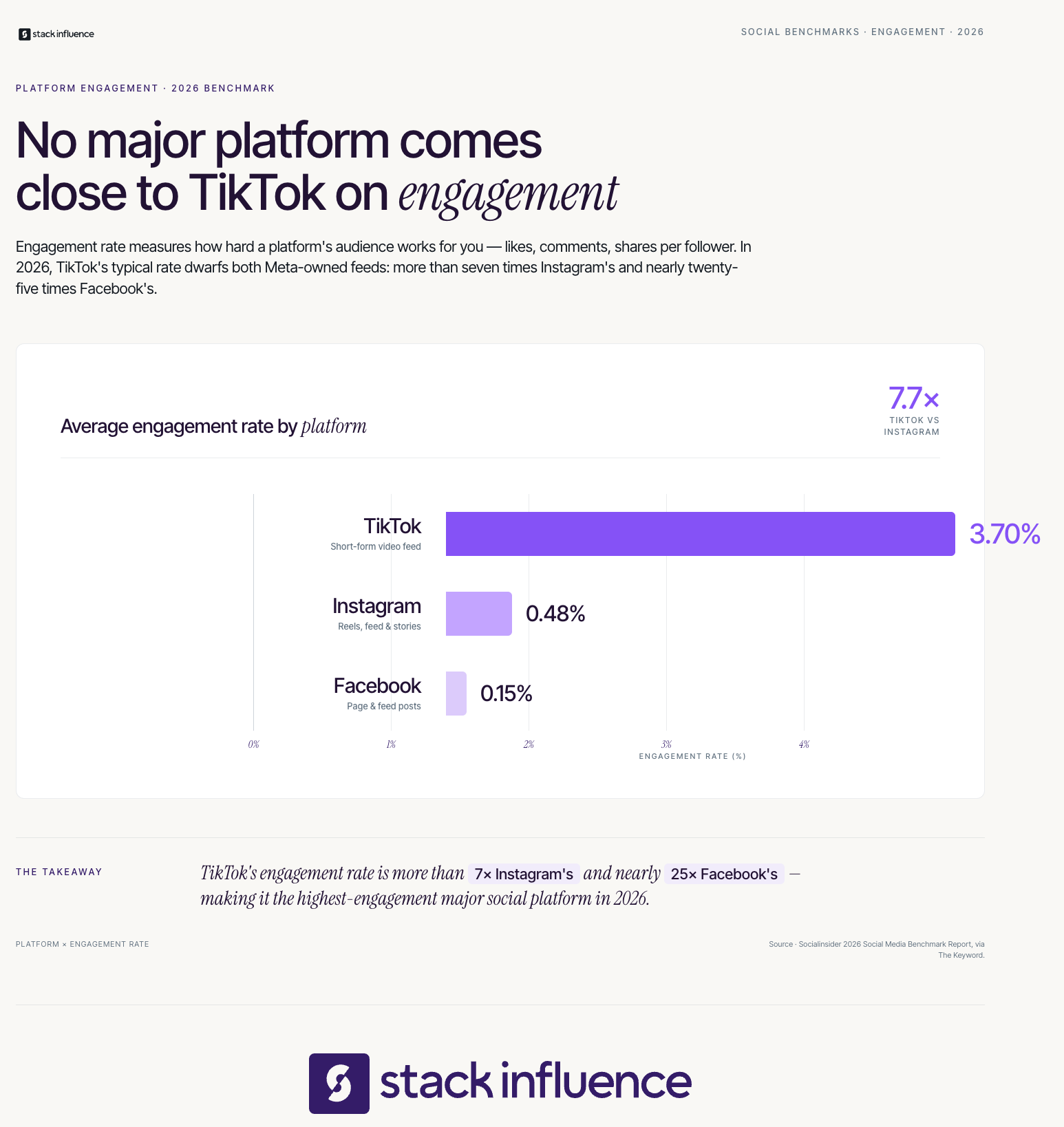
Every creator needs a systematic approach to TikTok marketing, not just a collection of tips. The SPARK Sequence is a five-step primary framework for content creators who want to build a sustainable TikTok marketing strategy from the ground up. Reference this sequence when evaluating where your current approach breaks down.
The SPARK Sequence works in this order:
TikTok Shop crossed $15.1 billion in US sales in 2025, up 68% year-over-year, and global GMV hit $66 billion. By the end of 2026, that number is projected to surpass $112 billion. For creators building a TikTok marketing strategy, this growth is the commercial backdrop that makes every brand deal more valuable. Research from SocialPilot confirms that TikTok Shop is projected to surpass $112 billion in global GMV by the end of 2026, driven by creator-led product discovery at massive scale. Brands that are not yet on TikTok Shop are watching this number and accelerating their creator partnership timelines. That urgency benefits every creator who has the SPARK Sequence in place right now.
The SPARK Sequence is also your audit tool. If your brand deals are stalling or your organic reach has plateaued, run back through each step and identify which one is breaking down. Most creators who plateau are failing at step three: their content does not carry enough commerce signals to attract brand partnerships, even when their engagement rate is solid.
One of the most consequential misunderstandings in TikTok marketing is that bigger accounts get better brand deals. The data does not support this at all in 2026. Brands that work with micro influencers and nano influencers are consistently reporting stronger ROI than campaigns built around larger creators, and the engagement numbers explain why.
Data compiled by Emplicit shows that micro-influencers with fewer than 100K followers on TikTok achieve a 7.50% average engagement rate, more than double the rate of mega-accounts with over 10 million followers. Nano-influencers with 1,000 to 10,000 followers on TikTok have an average engagement rate of 10.3%, according to Influencer Marketing Hub. This is extremely high compared to larger tiers. The high engagement comes from smaller creators having a more direct and personal connection with their audience, which leads to more interactions per follower.
According to WebFX's 2026 TikTok marketing benchmarks, accounts with under 5,000 followers often achieve engagement rates around 4.2%, because TikTok's algorithm favors authentic conversations and niche audiences over large, diluted follower bases. This structural advantage is not going away. The TikTok For You Page algorithm distributes content based on signal quality, not follower count, so a nano influencer in a specific niche can regularly outperform a macro creator in raw reach per post.
From Stack Influence's experience running micro influencer campaigns for eCommerce brands, TikTok campaigns that prioritize nano and micro creators in tightly defined product categories see measurably higher content authenticity scores and lower cost-per-engaged-viewer than campaigns built around larger, generalist creators.
Here is what brands looking for influencers are actually prioritizing in 2026:
Two-thirds of TikTok users appreciate when brands collaborate with a variety of creators, and micro-influencers with 2,000 to 100,000 followers boast conversion rates 22.2 times higher than traditional celebrities. That conversion rate differential is exactly why the influencer marketing platform landscape has shifted toward micro and nano tiers as the default first choice for most eCommerce brand campaigns.
Most creators track the wrong metrics. Views and follower growth feel good but tell brands almost nothing about commercial performance. The TikTok Content Signal Stack is a named measurement model with four defined components that creators should track on every piece of content. Reference this model when building your media kit and when reporting results to a brand after a campaign.
The four components of the TikTok Content Signal Stack are:
According to Sprout Social's 2025 Influencer Marketing Report, 86% of consumers make at least one influencer-inspired purchase per year, underscoring how creator recommendations translate directly into buying decisions. Tracking the TikTok Content Signal Stack gives you the data infrastructure to prove your role in those purchases to a brand partner. Sprout Pulse Survey data shows 64% of people are more willing to buy when a brand partners with a favorite influencer, highlighting how creator collaborations translate directly into conversion potential.
Across campaigns managed on the Stack Influence platform, creators who presented completion rate and click-to-conversion data alongside standard engagement metrics consistently secured higher per-post rates in follow-up brand negotiations, compared to creators who presented only follower count and total views. The TikTok Content Signal Stack gives your commercial conversation a foundation that most creators never build.

Here is the angle most TikTok marketing guides skip entirely: the most scalable income opportunity for creators on TikTok in 2026 is not sponsored posts. It is UGC video creation sold directly to brands as paid ad creative, completely independent of your follower count.
UGC creators are content creators who produce authentic, native-style video assets that brands use in their own TikTok advertising without ever posting through the creator's personal account. A study cited by Influee found that consumers exposed to TikTok UGC creator videos are 97% more likely to buy, and videos using UGC-style content get 28% more interactions than branded content. This is why brands running TikTok Spark Ads are buying UGC video at scale: it performs better than studio-produced creative and costs a fraction of traditional ad production.
A 2023 study of over 1,000 UGC creators found that TikTok was the most popular social media platform, with 54% of UGC creators using it as their main platform, followed by Instagram at 42%. The UGC creator economy has grown dramatically because the demand side (brands) and the supply side (creators with smartphones) finally have platforms connecting them efficiently.
Here is why UGC video is the underrated tactic for creators at every follower tier:
Data from Stack Influence's micro influencer campaigns suggests that creators who actively promote their UGC availability alongside their standard influencer rates increase their total monthly brand revenue by reducing the dead periods between sponsored posts. UGC fills the calendar gaps that performance-based sponsored posts leave open.
As of 2025, 93% of marketers who used UGC said it outperformed traditional branded content. That number is not a coincidence. It reflects a structural shift in how brands think about paid creative: authentic, smartphone-shot video created by real people outperforms expensive production across nearly every performance metric, and TikTok's algorithm specifically rewards content that looks native to the platform.
To access the full landscape of UGC platforms and positioning advice for creators, the top UGC platforms guide is a useful starting point for understanding where to list your services and how to price them correctly.
Beyond the SPARK Sequence, every creator needs a second framework to self-assess before pitching a brand deal. The Creator Partnership Readiness Audit (CPRA) is a six-item checklist that functions as your pre-pitch diagnostic tool. Run through it before you send any outreach to brands, influencer marketing platforms, or micro influencer agency contacts.
The CPRA checklist:
The CPRA functions as your readiness filter. If you cannot check off all six items, you have a clear action list before your next pitch. That is why 74% of brands are moving budget into creator programs in 2026. The brands are ready and funded. The creators who close deals fastest are the ones who come prepared with data and documentation, not just creative energy.
For creators interested in understanding the broader ecosystem of brand ambassadors programs and affiliate structures, those two formats are increasingly blended in 2026 into long-term performance partnerships that pay better than one-off posts.
Measurement is where most creators leave money on the table. Brands are investing in data-literate creator partners in 2026, and the creators who can speak fluently about their performance metrics are the ones closing retainer deals and long-term brand sponsorships.
Here are the key measurement principles every creator should apply:
42% of Gen Z consumers turn to TikTok for product discovery. If your content is positioned in a category those consumers actively search, your measurement story extends beyond campaign metrics into the brand's customer acquisition funnel. That narrative repositions you from a content vendor to a customer acquisition partner, which is a fundamentally different pricing conversation.
For creators working with Amazon-selling brands, TikTok marketing measurement also intersects with the Amazon Brand Referral Bonus program, where brands earn a credit on sales driven by external traffic sources including creator referral links. Understanding how that attribution works lets you frame your TikTok content as part of a brand's full-funnel Amazon strategy, making you significantly more valuable than a creator who only speaks in engagement metrics. Brands running TikTok Spark Ads will also want to see completion rate and rewatch rate data from your organic posts before committing to amplification spend.
For creators entering the paid brand partnership space, one of the most practical decisions is whether to source deals independently or through a structured intermediary. Both paths have legitimate use cases, and they are not mutually exclusive.
Going direct to brands works best when you already have an established niche, a documented engagement rate, and a network contact inside the brand's marketing team. Direct relationships offer higher per-post rates and more creative control. The trade-off is that sourcing, negotiating, and managing multiple brand deals is a time-consuming business operation that many creators underestimate.
Influencer marketing platforms and influencer marketing agencies exist to solve the sourcing problem at scale. They match niche micro influencers with brands running active campaigns, handle contract logistics, and often provide brief templates and payment processing. For creators who want consistent deal flow without building a full sales function, platforms are the faster path to predictable income.
A few practical considerations when evaluating platforms:
Brands achieve an average return of $5.78 for every dollar spent on influencer marketing, with top-performing campaigns reaching $11 to $18 ROI per dollar. That ROI range is why brands are scaling their creator programs aggressively, and why the demand for reliable, data-literate creators on established platforms continues to increase. Creators who position themselves correctly within the influencer marketing platform ecosystem capture a disproportionate share of that brand spend.
Understanding what TikTok marketing is marks the starting point, not the finish line. The creators building durable income on the platform are treating TikTok marketing as a structured commercial skill that combines content craft, performance measurement, and brand partnership management. The SPARK Sequence gives you a repeatable system. The Creator Partnership Readiness Audit gives you a pre-pitch quality check. The TikTok Content Signal Stack gives you a measurement language that brand partners actually respect.
The opportunity for content creators in 2026 is genuinely significant. TikTok marketing is still early enough that execution quality matters more than audience size, and the data consistently shows that micro and nano creators at their best outperform larger accounts in every metric that brands care about. Build your system, document your performance, and approach brand partnerships as a data-informed business, not a creative gamble.
Most guides on how to make a TikTok focus on the wrong things. They cover filters, trending sounds, and how often to post, but skip the structural decisions that actually determine whether a video gets distributed or disappears. TikTok was the largest creator platform in ClickAnalytic's Creator Economy Report 2026, with 15.8 million creators analyzed, representing 67% of all creators studied in the report. With that level of competition, winging it is no longer a viable strategy. This guide breaks down exactly how to make a TikTok that the algorithm pushes, audiences finish, and brands want to attach to.
TikTok has around 1.9 billion monthly active users, with approximately 23 million TikTok videos uploaded to the app every day. That volume means no single piece of content succeeds purely by accident. The For You Page is not a lottery; it is a distribution system that rewards specific structural signals inside each video. Understanding those signals before you hit record is the difference between a post that earns 300 views and one that earns 300,000.
Users spend an average of 1 hour and 37 minutes per day on TikTok, highlighting the strong appeal of short-form video. That time-on-platform number gives content creators an unusual advantage: viewers are primed to keep watching if the content earns continued attention. The challenge is not getting someone to open TikTok; it is making a video that wins every three-second micro-decision viewers make while scrolling.
This context matters for creators at every stage. Whether you are a nano influencer with 2,000 followers or a mid-tier creator targeting brand sponsorship, the platform mechanics are the same. The inputs that drive reach, brand deals, and creator economy income all trace back to what happens in your video before the first three seconds are up.
TikTok is a short-form video platform where content is discovered primarily through an algorithm-driven feed called the For You Page, not through follower subscriptions. People publish entertaining, educational, and promotional clips, while viewers explore personalized feeds filled with recommended content, with the discovery-driven format helping creators and brands reach a diverse user base without needing a massive following.
According to the 2026 Social Media Content Strategy Report, 55% of Gen Z users engage with brand content on TikTok at least once per day, with another 30% engaging at least once per week. That behavioral pattern is why brands looking for influencers prioritize TikTok presence when evaluating creator partnerships. A video that performs well is not just content; it is a live proof-of-concept for a creator's ability to drive attention for a product.
TikTok's algorithm plays a massive role in how content gets seen, tracking user behavior like likes, comments, shares, and watch time to figure out what people enjoy, then recommending videos based on those patterns, pushing content with strong engagement to broader audiences even if the creator has few followers. This means a creator posting their very first video has a genuine shot at reaching a targeted audience, provided the video gives the algorithm the right signals.
The CRAFT Tiers are a three-level content approach that matches the structure of your video to its specific goal. The three tiers are Discovery, Depth, and Drive, and each one calls for different creative choices. Most creators collapse these into a single undifferentiated approach, which is why their content performs inconsistently.
Tier 1: Discovery videos are short, hook-driven, and built for the For You Page. Their single job is to pull in a first-time viewer who has never heard of you. They typically run 15 to 34 seconds, lead with a visual or verbal surprise, and deliver one clear payoff by the end.
Tier 2: Depth videos build on an established hook topic and serve viewers who already know your content style. These run 45 to 90 seconds, include more context or instruction, and work well for educational content, tutorials, and UGC video formats that brands reuse.
Tier 3: Drive videos are conversion-oriented. They include a clear call to action, link to a product, service, or brand partnership, and are designed for audiences already primed to act. This is where creator economy monetization happens.
Here is how to apply the CRAFT Tiers to a weekly posting plan:
Stack Influence's internal campaign data shows that micro influencers who structure their posting calendar around content tiers rather than a single format generate 35 to 45% higher profile-visit-to-follower conversion rates, which directly improves the inbound rate of unsolicited brand outreach.
Retention rate is the primary metric TikTok's algorithm uses to determine distribution, making it more important than views, likes, or follower count for long-term growth, with the optimal video length sitting at 21 to 34 seconds for maximum completion rate. The CRAFT Tiers work because they force you to choose the right length for the right purpose, rather than defaulting to one format for every post.
Data from OpusClip's TikTok length and retention research shows that if you see a sharp drop in the first 3 seconds, your hook isn't compelling enough, with strong hooks maintaining 80% to 90% of viewers through the first 3 seconds, then gradually declining. Discovery-tier videos must treat the hook as a non-negotiable structural element, not an afterthought.
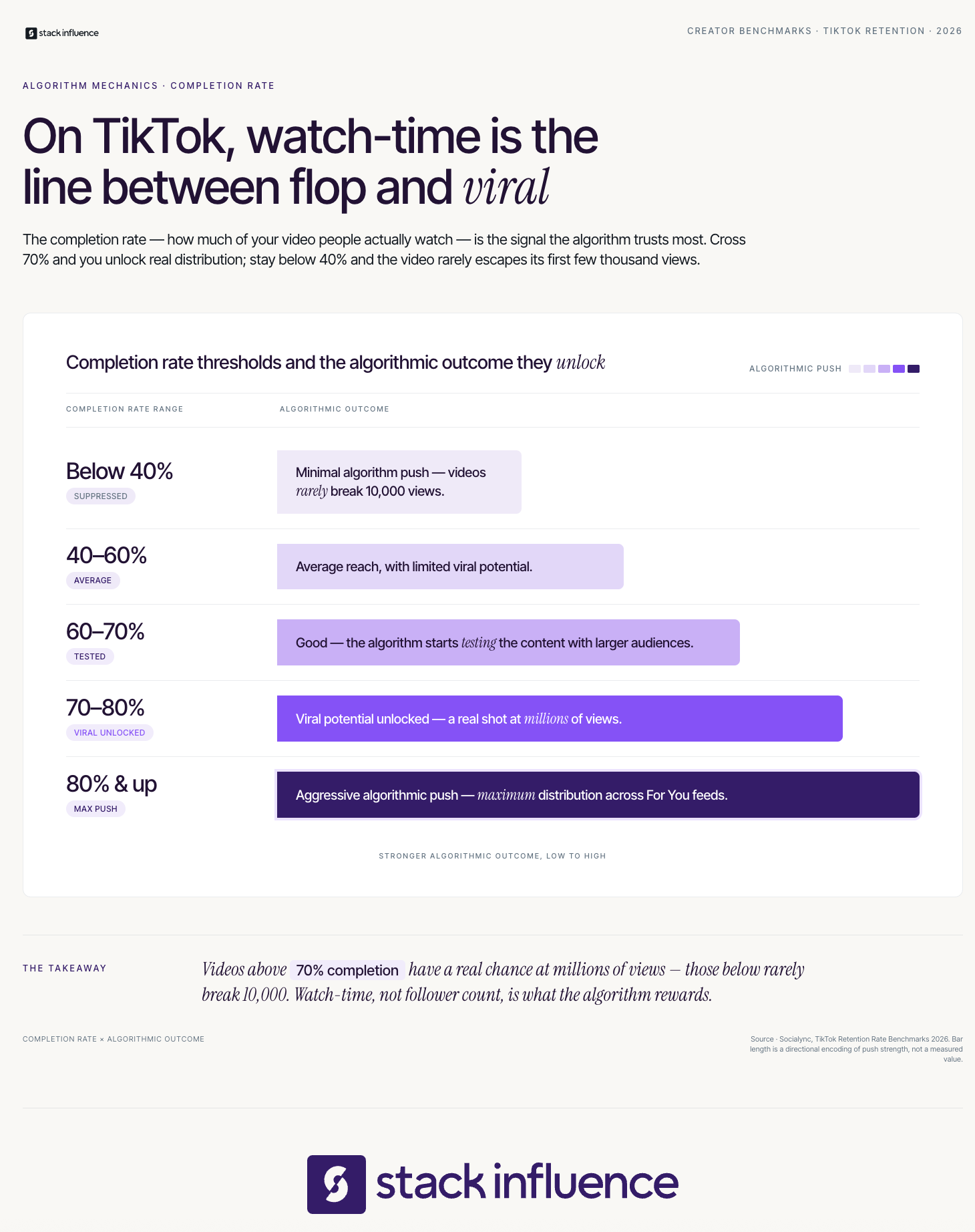
Knowing which CRAFT Tier you are working in tells you what to do in production. Execution is where most creators lose their leverage because they focus on aesthetic choices while ignoring structural ones. Before you record, confirm three things: your hook phrasing (verbal or visual), your video length target, and your one-sentence payoff.
The production process for a Discovery-tier video follows this sequence:
From Stack Influence's experience running UGC-focused influencer campaigns, creators who follow a written production brief before recording, rather than improvising on-camera, deliver usable content 40% faster and require fewer revision rounds. This matters for UGC creators and UGC platforms because turnaround speed directly affects campaign pacing.
In 2026, you need a 70% or higher completion rate to trigger viral distribution, with videos below that threshold rarely breaking 10,000 views, while videos above it having a real chance at millions. Every production decision should be evaluated against whether it helps or hurts that 70% target.
Publishing is not the end of the process; it is where many creators leave half their reach on the table. The Pre-Post Checklist is a five-item audit you run before tapping "Post" on every video. Reference this framework every time, not just for major content pushes.
According to Sprout Social's Q2 2025 Pulse Survey, Gen Z social media consumers now turn to searching on social media before searching on Google and traditional search engines. This makes the Pre-Post Checklist a long-term asset-building tool, not just a distribution tactic. Videos that are properly optimized at publish can generate search traffic months after posting. According to EmbedSocial's TikTok SEO research, once a video starts ranking in search, it can live in TikTok's search results for weeks or even months, unlike content on the fast-moving For You Page.
Apply the Pre-Post Checklist to every video, including the Tier 3 Drive content that links to brand partnerships or product pages. Search-optimized Drive content that lands in front of intent-driven viewers converts at a higher rate than the same content surfaced randomly on the For You Page.
Most guides on how to make a TikTok treat the platform as a pure audience-growth vehicle. The underrated tactic that changes a creator's income trajectory is treating every TikTok you make as a live portfolio piece for UGC creators and brand partnerships. These two objectives are not in conflict; they are the same system with different outputs.
The highest engagement rates are among the smallest TikTok creators, with accounts below the 100,000-follower mark averaging 7.50%. Brands know this, which is why product seeding and influencer campaigns have shifted dramatically toward micro influencers and nano influencers. When a creator's TikTok library demonstrates consistent structure, hook quality, and niche authority, they become an obvious candidate for brand ambassadors programs without cold-pitching.
In 2025, TikTok's average engagement rate reached about 3.7%. Nano and micro influencers consistently beat this average, which is precisely the data point brands reference when justifying campaigns run through a micro influencer agency or influencer marketing platform. The creator's TikTok library is their pitch deck.
Here is the underrated tactic applied practically. Structure two of your three weekly videos around a clear niche so that any brand scrolling your profile immediately understands your audience and your category. Creator-made ads perform better than brand ads, with Spark Ads getting up to 142% more engagement and 43% higher conversions. Brands running influencer campaigns are therefore actively looking for creators whose organic content already functions like a quality ad. Across campaigns managed on the Stack Influence platform, nano influencers who post consistent niche-anchored content rather than broad lifestyle videos receive inbound brand outreach at nearly twice the rate of creators with similar follower counts but scattered topics.
Creators who want to explore TikTok Spark Ads partnerships or automated product seeding opportunities should understand that brands evaluate their TikTok library before making contact. The videos you post today are discovery assets for both the algorithm and for brands looking for influencers. You can explore how influencer seeding works for eCommerce brands to understand what brands are specifically looking for when they review creator content.
This is the same reason UGC platforms have grown so quickly inside the creator economy: brands that work with micro influencers are not just buying reach; they are buying content assets they can repurpose across paid and organic channels. Your ability to make a clean, well-structured TikTok is the core skill that powers every income stream in the creator economy.

Most creators track views and follower count. Both are vanity metrics in isolation. The Creator Measurement Stack is a four-component model that gives you the data signals needed to improve video performance and demonstrate value to brands considering a brand sponsorship or brand deal.
Component 1: Three-Second Retention Rate. This is the percentage of viewers still watching at the three-second mark. Analysis from OpusClip's hook formula research found that videos with strong three-second retention rates above 65% receive 4 to 7 times more impressions than videos that lose viewers immediately. Pull this from TikTok Studio's audience retention graph after every post.
Component 2: Full Completion Rate. This is average watch time divided by total video length. In 2026, you need 70% or higher completion rate to trigger viral distribution. Target this for every Discovery-tier and Depth-tier video in the CRAFT Tiers framework.
Component 3: Profile Visit Rate. This is the number of viewers who tapped your profile after watching. A high profile-visit rate signals that a video drove genuine interest, not just passive consumption. This metric predicts follower growth more reliably than likes do.
Component 4: Save and Share Rate. Saves indicate that a viewer found the content genuinely useful. Shares indicate they found it worth spreading. Both send stronger algorithmic signals than likes, and both are data points brands expect to see in a media kit when evaluating creator partnerships.
Reference the Creator Measurement Stack in your content review every week. After each video, log all four components in a simple spreadsheet. Patterns will emerge across your CRAFT Tiers: Discovery videos will tend to have higher three-second retention and lower save rates; Drive videos will show the opposite. Adjust accordingly.
This is the question most new content creators get wrong. The instinct is to chase viral moments because that is what social media culture celebrates. The data tells a different story about what actually builds a sustainable creator business.
In 2025, educational content such as STEM, finance, and personal development is one of the fastest-growing categories on TikTok, experiencing 40% year-over-year growth. Educational and niche authority content does not always go viral in the traditional sense. It does, however, build the kind of engaged, trust-based audience that brands are actively willing to pay for.
TikTok genuinely favors creative, engaging, original content and has no regard for follower counts when deciding to push content, meaning follower counts would mean nothing to the TikTok algorithm without strong content quality. This is counterintuitive for new creators who assume that reaching 10,000 followers first is the prerequisite for growth. In reality, niche authority compounds faster than viral attempts in the long run.
For micro influencers especially, consistent authority content creates a media kit that writes itself. Every brand considering a brand deal can scroll your last 30 videos and immediately understand your audience, niche, and content quality. That predictability is what converts a brand's interest into a signed partnership. Creators who want to understand the broader opportunity can explore 2026 influencer marketing predictions and the top UGC platforms for creators to see where the creator economy is moving.
Data from Stack Influence's micro influencer campaigns suggests that creators who maintain a consistent niche for at least 90 days before pitching brand deals close partnerships at a significantly higher rate than those who pitch immediately after a one-off viral video. Brand partnership decision-makers look at the full library, not the peak.
Consider pairing your TikTok strategy with a deeper understanding of how to land a brand sponsorship on Instagram, since many brand deals today are multi-platform. Exploring niche micro influencer strategies can also help you develop the consistent content identity that makes your TikTok portfolio readable at a glance.
Learning how to make a TikTok is ultimately an exercise in learning how systems work: the algorithm, viewer psychology, and the creator economy infrastructure. The CRAFT Tiers give you a structure for every video type. The Pre-Post Checklist ensures you never leave discoverability to chance. The Creator Measurement Stack tells you what is actually working, so you can double down on the right signals instead of chasing metrics that do not convert to growth or income.
The creator economy rewards creators who treat every video as a deliberate product, not a spontaneous moment. Start with the framework, practice the hook, publish with intention, and measure what matters. Every consistent, niche-anchored TikTok you post is an asset that works for your audience growth, your discoverability in search, and your attractiveness to brands that want exactly what you create. That compounding return is what separates creators who last from creators who burn out chasing the next viral moment.
Most eCommerce sellers treat LinkedIn as a résumé platform or B2B afterthought. That assumption is leaving real traffic on the table. With over 1.2 billion members, 310 million monthly active users, and 80% of all B2B social leads flowing through it, LinkedIn has become the go-to platform for professional networking, content marketing, and lead generation in 2026. For brands selling on Amazon or running DTC operations, that audience includes retail buyers, wholesale partners, and a growing pool of category-curious consumers.
Blog LinkedIn SEO refers to the practice of optimizing both your LinkedIn-published content and your broader content ecosystem so that both LinkedIn's internal search and Google's organic results surface your brand in front of the right people. Done correctly, it operates as a second search engine layer on top of your existing blog strategy. This guide breaks down exactly how eCommerce sellers can use it.
Blog LinkedIn SEO combines two overlapping systems: LinkedIn's own relevance-based search algorithm and Google's external indexing of LinkedIn's public pages. The LinkedIn SEO strategy in 2026 is no longer just about getting found inside LinkedIn -- it is about showing up in Google and being cited by AI tools like ChatGPT and Perplexity, and building real authority in your field. For an eCommerce seller, that dual-surface visibility means a single piece of content can drive both platform-native engagement and organic search traffic from prospective buyers who never had a LinkedIn account.
Well-optimized LinkedIn profiles and business pages can rank on Google's first page for relevant queries, driving external traffic. Google treats LinkedIn as a high-authority domain, so profiles with optimized public URLs and rich keyword content stand a strong chance of ranking well. This is particularly relevant for Amazon sellers who want brand search visibility beyond the marketplace itself.
Native LinkedIn articles between 500 and 2,000 words get indexed by Google within 24 to 48 hours, making them function like standalone blog posts. That means every long-form article you publish on LinkedIn is simultaneously competing in Google's search results without requiring a separate domain or hosting arrangement.
According to Sprout Social's 2026 LinkedIn statistics report, LinkedIn Pages with complete information get 30% more weekly views than incomplete ones. For eCommerce brands building authority through influencer marketing and product education, profile completeness is the foundation everything else is built on.
Key distinctions to understand before applying any strategy:
The LinkedIn Blog Authority Sequence is a repeatable five-step workflow designed to turn your existing blog content into compounding LinkedIn SEO assets. Unlike one-off posting, this sequence treats each piece of content as a building block in a cumulative authority structure. Reference this sequence when planning any new blog-to-LinkedIn publishing cycle.
Here are the five steps in the LinkedIn Blog Authority Sequence:
According to Brenton Way's 2026 LinkedIn marketing statistics, carousel posts generate 596% more engagement than text-only posts. Running Step 3 of the LinkedIn Blog Authority Sequence consistently is the single highest-leverage action available to eCommerce brands on the platform. Brands managing product seeding campaigns can use the UGC generated from those campaigns as the visual content inside each carousel slide, reducing production friction significantly.
Stack Influence's internal campaign data shows that eCommerce brands repurposing UGC from micro influencer campaigns into LinkedIn document carousels see above-average engagement rates compared to brands using only polished brand photography, particularly in the beauty, health, and home categories where authentic imagery drives higher dwell time.
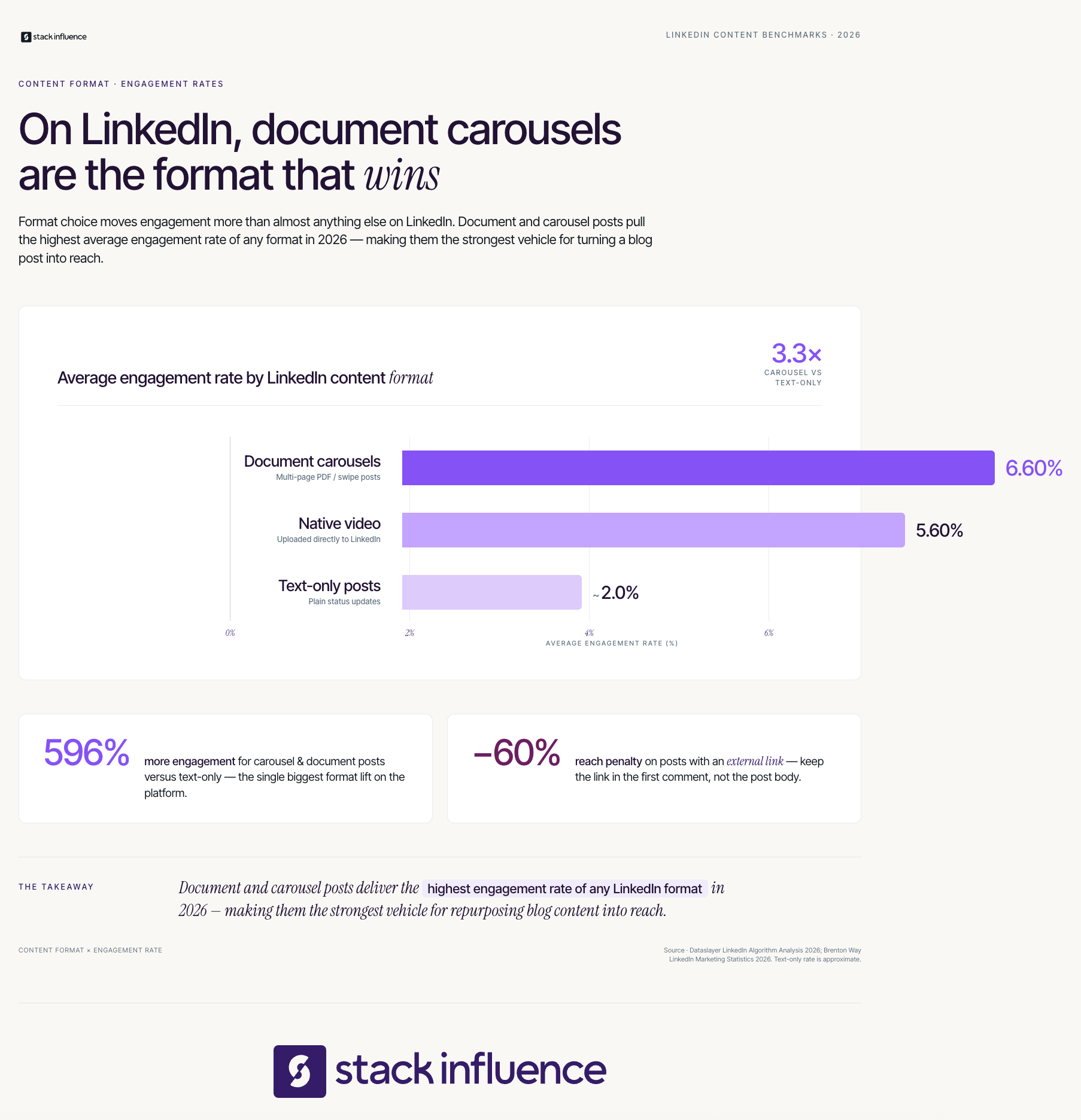
The LinkedIn newsletter feature is one of the most underused tools in the eCommerce brand playbook, and understanding why changes how you think about the entire blog LinkedIn SEO ecosystem. LinkedIn newsletters grew 150% year over year and now reach subscribers at scale, with the top 1% of newsletters exceeding 100,000 subscribers. For a DTC brand or Amazon seller building long-term authority, that subscriber base represents an owned-media audience inside a platform you do not control.
LinkedIn newsletter statistics compiled by Scott Aaron show that unlike regular posts, newsletter editions create static URLs that rank in search engines, giving publishers two separate traffic sources simultaneously. That dual-indexing effect is the core reason newsletters belong inside a blog LinkedIn SEO strategy rather than being treated as a separate initiative.
LinkedIn newsletter open rates average 40 to 50%, compared to the 21% average for standard email marketing. For eCommerce sellers trying to build a warm audience of retail buyers, wholesale contacts, or high-value consumers, that open rate differential is material. The content that performs best in LinkedIn newsletters mirrors the structure of a well-optimized blog post: a keyword-relevant headline, a specific problem framed in the first two sentences, and actionable insight supported by real data.
From Stack Influence's experience running product seeding campaigns for eCommerce brands, sellers who repurpose post-campaign creator content summaries into LinkedIn newsletter editions see measurable subscriber growth of 15 to 25% over a 90-day period, driven primarily by the algorithm surfacing newsletter content to second-degree connections who match the original subscriber's professional profile.
Key newsletter tactics for eCommerce sellers applying blog LinkedIn SEO:
The LinkedIn SEO Audit Checklist is a seven-point review process you can run on any LinkedIn profile, company page, or article before publishing or after a traffic plateau. Unlike the LinkedIn Blog Authority Sequence, which governs your publishing workflow, the LinkedIn SEO Audit Checklist is applied retrospectively to diagnose performance gaps. Reference this checklist quarterly or whenever organic reach drops unexpectedly.
Seven signals to audit across your LinkedIn presence:
For eCommerce brands exploring UGC platforms and brand ambassador programs, the LinkedIn SEO Audit Checklist is also useful for evaluating whether content creators and brand ambassadors representing your brand on LinkedIn are optimized for the same keyword clusters your main profile targets.
Across campaigns managed on the Stack Influence platform, eCommerce brands that brief their content creators to include category-relevant keywords in their own LinkedIn profile headlines see an average 20 to 30% improvement in branded keyword search visibility on LinkedIn within 60 days, compared to brands that provide no LinkedIn-specific guidance to their creator network.
The most important shift in blog LinkedIn SEO in 2026 is not a content format change. It is a fundamental reclassification of how LinkedIn measures content value. The 2026 algorithm changes represent the most significant shift in how B2B content gets distributed since the platform embraced its creator economy ambitions in 2023, with the core message being that LinkedIn is done rewarding surface-level engagement and is now measuring whether content actually delivers value.
For eCommerce sellers, this means that the playbook of posting a link to a blog post and waiting for traffic is effectively dead. Posts with external links see approximately 60% less reach than posts without them, which means sharing your blog post URL in the post body actively suppresses distribution. The implication is significant: you need the LinkedIn Blog Authority Sequence to decouple your blog post link from your organic reach mechanism.
According to Dataslayer's LinkedIn algorithm analysis, posts with external links see approximately 60% less reach than posts without them. The practical solution is to post the insight or excerpt natively, generate the engagement, and move the link to the first comment or the article body where it does not trigger the same penalty.
The new algorithm system prioritizes "knowledge and advice" content over personal updates and promotional posts, and analysis of over 10,000 posts in Q1 2026 found that educational content gets 3 to 5x more reach than other post types. For eCommerce sellers publishing influencer marketing case studies or brand category guides, this is a structural advantage: educational content built around real product experience outperforms promotional posts even on a smaller follower base.
In late 2025, LinkedIn added Saves and Sends to post analytics, which is LinkedIn communicating what it values: content people keep, share privately, and talk about. For blog LinkedIn SEO, this means your highest-value content should be designed to be saved as a reference, not just scrolled past. Practical guides, numbered frameworks, and data-backed breakdowns consistently generate saves at higher rates than opinion posts.
Additional algorithm changes eCommerce sellers need to build around in 2026:
Most eCommerce brands measure LinkedIn performance with the wrong metrics. Impressions and follower count are visibility proxies, not business outcomes. The right measurement structure for blog LinkedIn SEO is what we call The LinkedIn Blog Visibility Stack, a four-component model that maps each metric to a specific stage of the content-to-conversion journey.
The LinkedIn Blog Visibility Stack:
SocialPilot's LinkedIn statistics research reports that thought leadership posts on LinkedIn receive 3x more shares than standard brand updates. For eCommerce brands, this means that the Content Save Rate and share velocity of educational posts will consistently outperform promotional product announcements in every component of the LinkedIn Blog Visibility Stack.
Use the LinkedIn Blog Visibility Stack in monthly reporting alongside your standard eCommerce metrics. Reference the Stack when evaluating whether to double down on LinkedIn articles, shift toward a newsletter strategy, or increase the frequency of document carousels. Data from Stack Influence's micro influencer campaigns suggests that eCommerce brands using all four components of the LinkedIn Blog Visibility Stack in their monthly reporting make channel investment decisions 40% faster than brands relying on impressions and likes alone, because each metric maps directly to a decision point in the content distribution workflow.

Blog LinkedIn SEO is most powerful when treated as a closed-loop system: your blog informs your LinkedIn content, your LinkedIn engagement builds brand authority, and that authority feeds back into your Google search rankings over time. The LinkedIn Blog Authority Sequence governs your publishing cadence, and the LinkedIn SEO Audit Checklist keeps your infrastructure aligned with 2026's algorithm priorities.
For eCommerce sellers on Amazon or running DTC brands, this matters because both Google and LinkedIn are rewarding the same behavior: publishing specific, educational content with genuine depth and original perspective. Applying influencer marketing thinking to your LinkedIn content strategy means treating every post as an asset with a defined audience, a measurable outcome, and a compounding shelf life rather than a one-time broadcast.
Blog LinkedIn SEO is not a shortcut. It is a compounding investment that rewards brands willing to build consistently over six to twelve months. Use the LinkedIn Blog Visibility Stack to track your progress, apply the LinkedIn Blog Authority Sequence to every new content cycle, and let the evidence accumulate.
If you're an eCommerce seller trying to figure out how many followers on TikTok to get paid, the short answer is: it depends on which payment path you're targeting. The platform now runs five separate monetization programs, and each one has a different follower threshold, payout model, and strategic fit for brands looking to partner with creators. Getting this distinction wrong costs sellers real money, either by chasing the wrong creators or by overlooking the paths with the highest commercial return.
TikTok is the clear focal point for influencer investment heading into 2026. In this year's survey, 31% of respondents included TikTok in their influencer plans, making it the most frequently selected platform for investment intent. That concentration of brand budget is meaningful for eCommerce sellers, because where brands invest is where creators get paid. Understanding this dynamic is the first step to building a realistic monetization plan on the platform.
According to Influencer Marketing Hub's 2026 Benchmark Report, TikTok is the most frequently selected platform for investment intent, with 31% of brands including it in their influencer plans. TikTok Shop's gross merchandise value exceeded $20 billion in 2024, demonstrating the platform's ecommerce potential. For DTC brands and eCommerce sellers, this creates a compounding opportunity: the same platform driving brand reach is also generating billions in direct sales.
Here is what separates TikTok's monetization landscape from what it was three years ago:
TikTok monetization in 2026 runs on four separate programs: Creator Rewards, Shop, LIVE gifts, and brand deals, each with its own rules. The fifth path, the TikTok Pulse ad revenue share, rounds out the full picture for top-tier creators. Sellers need to understand all five to know which creator relationships deliver the best commercial return.
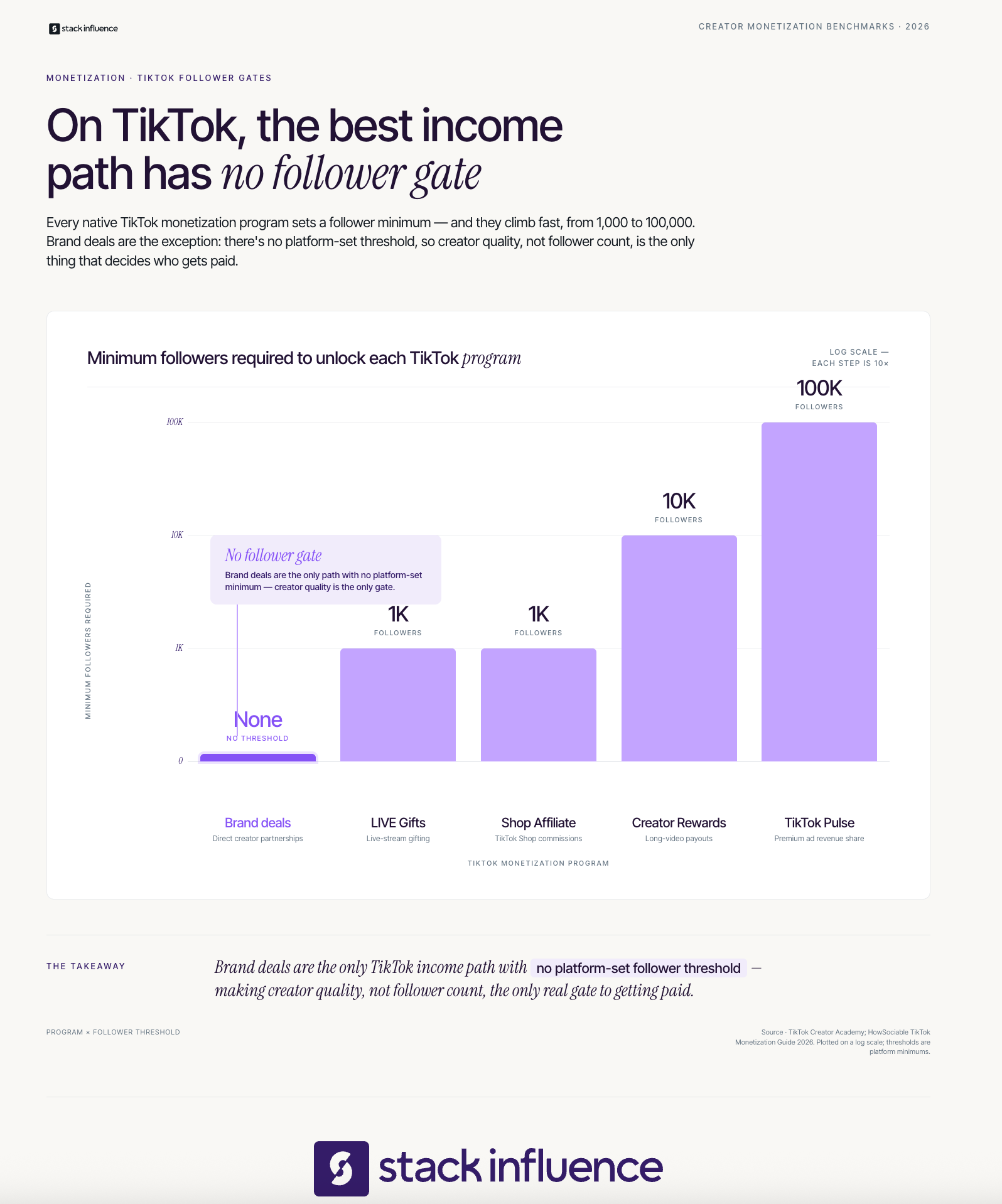
TikTok monetization refers to the collection of programs that allow content creators to earn income directly from TikTok or through the brands and advertisers who operate on the platform. It is not a single payout pool. Each program has its own application process, eligibility gate, and earning model. The question of how many followers on TikTok to get paid is therefore not a single number but a series of thresholds tied to which income stream you are pursuing.
The old Creator Fund, which paid $0.02 to $0.05 per 1,000 views, is being fully replaced by the Creator Rewards Program, which pays 10 to 25 times more per view. This transition changed the economic calculus for every creator and every brand that partners with them. Sellers evaluating influencer marketing platforms now need to understand the new earning landscape to set realistic expectations for creator partnerships.
The table below summarizes the five core paths:
Each path serves a different creator profile, and for eCommerce sellers evaluating creator partnerships, knowing which paths your creators can access tells you a great deal about their audience quality and content maturity.
The 5-Path TikTok Revenue Sequence is a structured way to think about TikTok creator earnings as a progression rather than a menu. Creators typically unlock these paths in order, and eCommerce sellers who understand the sequence can identify which stage a creator is at and which campaign structures make sense for that stage. The framework applies equally to sellers building their own TikTok presence and to brands evaluating creator partnerships.
Step 1: TikTok Shop and LIVE Gifts (1,000 followers)
The minimum for TikTok Shop affiliate and LIVE access is 1,000 followers. This is the most accessible entry point in the 5-Path TikTok Revenue Sequence and the most commercially relevant for eCommerce sellers. A creator at this threshold can already tag products in videos, earn commissions, and participate in product seeding campaigns. Requirements for LIVE Gifts include having at least 1,000 followers to go live. Many brands overlook these nano-level creators entirely, which is a strategic miss when product alignment is strong.
Step 2: Creator Rewards Program (10,000 followers)
According to TikTok's Creator Academy, creators need at least 10,000 followers and 100,000 video views in the last 30 days to qualify for the Creator Rewards Program. This is the program most people think of when asking how many followers on TikTok to get paid. The RPM model rewards originality, watch time, and search value rather than raw view counts. Your RPM fluctuates based on four factors: originality, how unique your content is; play duration, how long viewers watch before leaving; audience engagement, including comments, shares, saves, and interactions; and search value, whether your video answers queries people are actively searching for on TikTok.
Step 3: Brand Deals and Sponsored Content (no platform threshold)
Brand deals are not gated by TikTok's algorithms at all. They are negotiated between creators and brands or facilitated through an influencer marketing agency or influencer marketing platform. Brand deals are often the highest-earning monetization channel for TikTok creators, surpassing ad revenue from Creator Rewards at most follower levels. For eCommerce sellers building creator partnerships, this is where most of the commercial opportunity lives.
Step 4: TikTok Shop Brand Partnerships and UGC
Brands that work with creators through TikTok Shop can structure deals that combine product seeding with affiliate commissions, reducing upfront cost while aligning creator incentives with sales performance. Influencers generated $5.4 billion in GMV through videos and live streams in the U.S. alone in 2024, accounting for 60% of total TikTok Shop GMV. UGC creators and brand ambassadors at the micro level drive a meaningful portion of this volume through consistent, niche-specific content rather than one-off viral moments.
Step 5: TikTok Pulse (100,000 followers)
TikTok Pulse is the platform's premium ad revenue-sharing program, unlike Creator Rewards which is available to mid-tier creators; Pulse targets top-performing accounts and offers a 50/50 revenue split between creator and TikTok. This is the final gate in the 5-Path TikTok Revenue Sequence and the one with the most demanding content requirement. For eCommerce sellers evaluating mega-influencers or established content creators, Pulse eligibility is a useful signal that a creator's content consistently ranks in the platform's top tier.
From Stack Influence's experience running product seeding campaigns across eCommerce categories, brands that activate creators at Steps 1 and 2 of the 5-Path TikTok Revenue Sequence before scaling to macro tiers see stronger per-unit cost efficiency because nano and micro creators at those stages are more responsive to campaign briefs and generate UGC with higher reuse rates in paid amplification.
The 5-Path TikTok Revenue Sequence matters to eCommerce sellers not just as creator guidance but as a campaign planning tool. Knowing where a creator sits in the sequence tells you their content maturity, their audience trust level, and the commercial structures they are most likely to accept.
Payout rates across the five paths vary substantially, and follower count is only one variable. For sellers evaluating influencer campaigns, realistic earnings benchmarks help set appropriate partnership expectations and negotiate fair rates.
For the Creator Rewards Program, the range is wide. In 2026, most creators report RPMs between $0.40 and $1.00 per 1,000 qualifying views. High-quality, long-form, high-completion content occasionally cracks $2.00 RPM in the U.S. A creator with 50,000 followers producing search-optimized long-form content in a commercial niche can earn significantly more than a creator with 200,000 followers posting generic short clips.
Here is a realistic earnings snapshot by tier within the Creator Rewards Program:
For brand deals and sponsorships, the ceiling is far higher. The 2025 Influencer Marketing Report indicates that half of influencers charge between $250 and $1,000 per post, but 71% offer discounts for longer-term partnerships. For eCommerce sellers, this means structuring brand ambassador programs rather than one-off brand sponsorships delivers more content volume at a lower effective CPM. According to Lumanu payment data, the average TikTok creator payment was $2,049 in early 2025, a 23% increase from the previous year.
Stack Influence's internal campaign data shows that for eCommerce brands running TikTok creator partnerships across the nano and micro tiers, campaigns structured around product seeding plus commission rather than flat fees generate 35 to 45% more content pieces per dollar of campaign budget compared to flat-fee-only contracts, because creators at these tiers are motivated by product alignment over payout size.
The Creator Monetization Readiness Checklist is the secondary framework in this guide. It is designed for eCommerce sellers vetting potential creator partners before committing campaign budget. Run every prospective creator through these seven checkpoints before approving them for influencer campaigns, brand deals, or product seeding activations.
Run this Creator Monetization Readiness Checklist at the beginning of every influencer outreach process. It applies whether you are sourcing creators through a micro influencer agency, a self-serve influencer marketing platform, or direct outreach.
The checklist works alongside the 5-Path TikTok Revenue Sequence because it tells you not just which paths are open to a creator but whether that creator is operating at the standard required to deliver results on your campaign. A creator at Step 2 of the sequence who fails three items on the checklist is a worse partner than a creator at Step 1 who passes all seven.

This is where most guides about how many followers on TikTok to get paid go wrong, and it costs eCommerce sellers budget they cannot recover. The common mistake is treating follower count as a proxy for commercial value. It is not. Follower count measures historical reach accumulation. It tells you almost nothing about current content distribution, audience trust, or conversion potential.
The first mistake is filtering out creators below 10,000 followers entirely. As shown in the 5-Path TikTok Revenue Sequence, TikTok Shop affiliate access begins at 1,000 followers. A creator with 5,000 highly engaged followers in the beauty or personal care niche who produces original product review content can drive measurable TikTok Shop commission revenue without ever qualifying for the Creator Rewards Program. The influencer seeding model is specifically designed to activate creators at this tier.
According to Sprout Social's 2025 Influencer Marketing Report, 86% of consumers make at least one influencer-inspired purchase per year. That purchasing behavior is distributed across the entire creator ecosystem, not concentrated in mega influencer accounts. A nano creator with authentic product enthusiasm often converts at a higher rate than a macro creator with a diluted audience and generic endorsement style.
The second mistake is using follower count to negotiate creator rates without accounting for average video views. A creator with 80,000 followers who averages 500,000 views per video is reaching a mostly non-follower audience every time they post. Pricing that creator based on follower count produces a systematically wrong number. Pricing based on 90-day average views produces the right number. For sellers running influencer campaigns, CPV-based pricing is the more accurate model.
The third mistake is conflating the Creator Rewards Program with brand deal income. Many successful creators combine multiple streams of income, including brand deals, affiliate marketing, live gifts, and merchandise sales, instead of relying solely on TikTok payouts. For eCommerce sellers looking for brands that work with micro influencers, this means the most commercially effective creators are rarely the ones maximizing CRP earnings. They are the ones building diverse income stacks where brand sponsorships, TikTok Shop affiliate commissions, and UGC deals all contribute.
Here is what to track instead of follower count when evaluating creator partners:
Data from Stack Influence's micro influencer campaigns suggests that eCommerce brands filtering creator rosters by 90-day average video views rather than follower count see a 25 to 40% improvement in campaign engagement rates, because view-based filtering naturally surfaces creators whose content is currently in active algorithmic distribution rather than those coasting on an older audience base.
The creator economy is no longer a peripheral channel for DTC brands. The global influencer marketing industry is expected to reach $32.55 billion by the end of 2025, up from $24 billion in 2024 and just $1.4 billion in 2014. That trajectory reflects a structural shift in how consumers discover and purchase products, and TikTok is at the center of it.
For eCommerce sellers, the actionable implication of this growth is that the creator partnerships you build today create compound value. A creator you activate through automated product seeding at 3,000 followers may reach 30,000 followers within eighteen months, at which point their CRP eligibility, their brand deal rates, and their TikTok Shop affiliate conversion data all become more valuable. Brands that build long-term creator partnerships rather than transactional one-off campaigns benefit from this compounding directly.
Research shows that in 2025, 39% of brands chose nano-influencers as their most likely partners. That preference for nano and micro influencers reflects a broader understanding among sophisticated DTC brands that authentic product integration in a niche audience outperforms broad reach in a diluted one. The creator economy, in other words, is moving toward depth over scale, and TikTok's algorithm rewards that same quality-first orientation.
Across campaigns managed on the Stack Influence platform, brands in the health, beauty, and home goods categories that activate both TikTok Shop affiliate structures and UGC content agreements simultaneously see 50% higher content output per campaign and stronger post-campaign attribution through promo code tracking compared to brands using either structure in isolation.
For sellers new to influencer marketing for CPG and consumer goods, TikTok offers a uniquely accessible entry point because the platform's algorithm surfaces content based on relevance rather than follower authority. A well-briefed creator with 2,000 followers and genuine product enthusiasm can generate more qualified traffic to a TikTok seller page than a macro influencer with a disengaged audience posting generic unboxing content.
Tracking the right metrics separates eCommerce sellers who grow through creator partnerships from those who cycle through campaigns without learning. The TikTok Commerce Metric Stack is a named four-component measurement model designed specifically for sellers running creator campaigns on TikTok in 2026.
Component 1: Qualified View Rate (QVR)
The percentage of total video views that meet TikTok's monetization criteria, meaning at least five seconds of watch time from a real, non-bot account. A high QVR signals that a creator's audience is genuinely engaged and that the content is holding attention rather than generating passive scrolling impressions. This metric also predicts CRP earnings potential more accurately than total views.
Component 2: Affiliate Conversion Rate (ACR)
For TikTok Shop-linked content, the ACR is the ratio of product page visits to completed purchases. Conversion rates within TikTok Shop range from 3 to 8%, significantly exceeding link-in-bio conversion rates on Instagram which average 0.5 to 2%. An eCommerce seller benchmarking creator performance should use 3% as the floor for TikTok Shop-linked campaigns and investigate any creator delivering below that threshold.
Component 3: Earned Media Value per Post (EMVP)
The estimated media value generated by a creator's post compared to the cost of producing or commissioning it. This metric contextualizes brand deal spend against organic reach outcomes and helps sellers compare creator partnerships against paid alternatives like TikTok Spark Ads. Spark Ads, where a brand amplifies a creator's organic post as a paid in-feed ad while preserving the creator's handle, comments, and social proof signals, consistently outperform standard in-feed ads with 20 to 40% higher view completion rates and 30 to 60% higher click-through rates.
Component 4: Cost Per Acquired Customer from Creator Channel (CPACC)
The total campaign cost divided by the number of new customers directly attributed to creator content during the campaign window. This is the most commercially direct metric in the TikTok Commerce Metric Stack and the one DTC brands should use as their primary optimization signal. Using UTM parameters, TikTok Shop affiliate tracking, and promo code redemption data together provides a reliable attribution picture.
Reference the TikTok Commerce Metric Stack at every campaign review cycle. If QVR is high but ACR is low, the creator is generating interest but the product page or offer is failing the conversion. If EMVP is strong but CPACC is high, the campaign is generating brand awareness but not efficiently converting it to revenue. The model gives sellers a diagnostic lens, not just a performance scorecard.
The question of how many followers on TikTok to get paid has a more useful answer in 2026 than it ever has before. The platform's five monetization paths create a structured progression from 1,000-follower TikTok Shop access all the way to Pulse-level ad revenue sharing at 100,000 followers and above. For eCommerce sellers, the real opportunity is not in the follower numbers themselves but in the commercial structures those thresholds unlock. A 2,000-follower creator with genuine niche authority and TikTok Shop affiliate access can drive more revenue for a DTC brand than a 200,000-follower creator with a fragmented audience and no product fit. Use the 5-Path TikTok Revenue Sequence to map creator potential, apply the Creator Monetization Readiness Checklist before committing campaign budget, and track performance through the TikTok Commerce Metric Stack. The brands building durable creator programs in 2026 are the ones treating influencer marketing as a compounding channel, not a one-time activation.