
The latest info on influencer marketing trends, micro influencer news, and the world of social media

Since 2020, the work-from-home trend has exploded in popularity as people seek the freedom and flexibility of remote work.
This newfound freedom has given rise to a new breed of professionals known as travel influencers, who are able to combine work and travel seamlessly.
In this article, we will explore the top 5 travel influencers of the year (so far) and how their content is shaping the world of globetrotting today.
Since 2020, the work-from-home trend has exploded in popularity as people seek the freedom and flexibility of remote work.
This newfound freedom has given rise to a new breed of professionals known as travel influencers, who are able to combine work and travel seamlessly.
In this article, we will explore the top 5 travel influencer of the year (so far) and how their content is shaping the world of globetrotting today.
View this post on Instagram
Shared post on Time
Instagram embed code generator
Followers: 900k on Instagram, 1.4 M on TikTok
Nicki Sunderland, a 40-year-old Irish and Scottish traveler with an incurable wanderlust, has been passionate about exploring the world since a young age.
Starting at 18, she took seasonal jobs around the United States and visited all 50 states.
For the last 10-11 years, she has focused on luxury travel, food, and photography, experiencing the best hotels worldwide and sharing her adventures on social media and her blog to inspire others to travel.
View this post on Instagram
A post shared by Drew Binsky (@drewbinsky)
Followers: 700k on Instagram, 3.94 M on TikTok
Drew Binsky has famously has visited every nation on Earth and amassed a following of over 3.94 million followers in the process.
Throughout his travels, Drew has had the opportunity to meet a diverse array of fascinating individuals, each with their own unique stories and perspectives. His goal is to not only share his adventures but also to educate his viewers about the rich tapestry of cultures and communities that exist across the globe.
Drew seeks to inspire a greater understanding and appreciation for the world's diversity, encouraging others to embark on their own journey of exploration and discovery.
View this post on Instagram
A post shared by Courtnie & Nate (@courtandnate)
Followers: 541k on Instagram, 2.5 M on TikTok
Courtnie and Nate live and travel through multiple countries with their dog Tonkins on a custom built van.
Through their adventures, they offer viewers a glimpse into the realities of life on the road when your home is on wheels. Their journey not only showcases the beauty of different landscapes and cultures, but also highlights the challenges and rewards of living a nomadic lifestyle.
As they navigate through new places and experiences, Courtnie and Nate provide valuable insights and inspiration for those who share their love for travel and exploration.
View this post on Instagram
A post shared by Alex Ojeda (@alexojeda)
Followers: 660k on Instagram, 3.94 M on TikTok
Alex Ojeda is TikTok’s favorite travel blogger, retaining the top spot he claimed in our previous studies. Alex is often seen exploring thrilling waterparks, ziplines, and waterslides, making for an adventure-filled TikTok page.
Alex’s content continues to push the boundaries of creativity and thrills around the world.
View this post on Instagram
A post shared by Salah Brooks (@salah.brooks)
Followers: 316k on Instagram, 3.94 M on TikTok
Salah Brooks is a seasoned traveler who once gained popularity for living in a school bus.
She also shares her adventures travling the world, tips on how to do it inexpensively. Salah candidly discusses the many hurdles and challenges that come with living life as a female solo traveler in hopes that it reaches to other women who share similar struggles.
Through her experiences and insights, she provides a wealth of knowledge and inspiration for others looking to embark on their own journeys of discovery and adventure.
These top influencers of 2026 have captivated audiences with their vulnerability, sharing tips, stunning views, and exhilarating adventures.
Through their content, they offer a window into worlds that many may not have the opportunity to experience firsthand.
Their creativity and passion for travel inspires others to dream of their own globetrotting adventures in the future, showing that with determination and creativity, the world can be explored in countless ways
So, you might be wondering, what exactly is this thing called a creative brief that everyone in the creative industry seems to talk about? Well, let's break it down in simple terms.
A creative brief is like a roadmap for any creative project.
It's a document that outlines all the important stuff like goals, objectives, and requirements for the project. Think of it as a guiding light that keeps everyone on the same page and helps bring those wild and wonderful creative ideas to life.
Now, let's dive into some interesting stats to show you the importance of a creative brief.
According to a study by the Content Marketing Institute, 63% of marketers found that having a clear, concise creative brief directly contributed to the success of a project.
This just goes to show that a well-crafted creative brief can make all the difference in achieving your project goals.
From a designer's perspective, a creative brief provides them with essential information to create designs that resonate with the target audience.
It helps them understand the project's objectives and requirements, allowing them to channel their creativity in the right direction.
For copywriters, a creative brief serves as a foundation for crafting compelling and strategic messaging that aligns with the overall project goals.
Having a detailed brief helps them tailor their language and tone to effectively communicate with the target audience.
In essence, a creative brief acts as a communication tool that brings together all the key players in a project.
It ensures that everyone is on the same page, working towards a common goal, and ultimately delivering a successful creative outcome.
So, next time you embark on a creative project, remember the power of a well-crafted creative brief to set the stage for creativity and collaboration.
Before you create a creative brief, it's essential to identify the purpose of the project.
A clearly defined project purpose will help you structure the creative brief more effectively and set realistic goals.
For instance, if you're launching a new product, the purpose of the project would be to create an effective marketing campaign that brings attention to the product.
On the other hand, if you're revamping your company's branding, the project purpose would be to refresh and modernize your brand image.
Identifying the purpose of the project forms the foundation of your creative brief and helps you craft messaging that aligns with your overall objectives.
Let's look at some interesting stats for understanding the significance of setting project goals.
According to research by the Standish Group, only 29% of all projects are successful. The primary reason for this is poor planning and misaligned project goals.
Therefore, it's crucial to set clear goals and objectives for projects to increase a project's chances of success.
An effective creative brief should reflect these goals and objectives and provide all stakeholders with a clear understanding of what the project's purpose is.
From a marketer's perspective, setting clear goals upfront allows you to measure the success of a marketing campaign.
It also helps you budget more effectively, knowing what the project requires and how much it will cost.
Designers have an easier time when the project's purpose is defined since it helps them focus their creativity and deliver designs that are aligned with the project's goals.
In summary, identifying the project's purpose is critical for creating a meaningful and effective creative brief.
It places everyone involved on the same page and ensures that the final creative output achieves the goals and objectives of the project.
To create a comprehensive and effective creative brief, it's vital to gather information from all stakeholders involved in the project.
This ensures that everyone's perspectives and insights are considered, leading to a more well-rounded and successful creative outcome.
Start by involving your marketing team—they play a key role in understanding the project's objectives, target audience, and overall strategy.
They can provide insights into market trends, competitor analysis, and customer preferences.
Additionally, designers and creatives should be involved in gathering information because their expertise in visual communication is valuable for creating impactful designs.
They can provide input on the aesthetic aspects, such as color schemes, typography, and graphical elements.
Don't forget to engage copywriters in the process as well. They have a knack for crafting compelling messaging and can contribute to developing key messages that resonate with the target audience.
It's essential to involve all necessary stakeholders to collect their unique perspectives and insights.
By doing so, you create an inclusive and collaborative environment that fosters innovation and produces more effective creative solutions.
The information you gather should answer critical questions such as:
Demographics like age, gender, and location, as well as psychographics like interests and preferences, should be considered.
Clearly define what the project aims to achieve, whether it's increasing brand awareness, generating leads, or driving sales.
Identify the core messages the creative work needs to convey to the target audience.
Determine the technical aspects of the project, such as the format, size, color scheme, and any other specific requirements.By gathering comprehensive and diverse input from all stakeholders, you ensure that your creative brief is well-informed and aligned with the project's goals.
Creating a well-crafted creative brief is a crucial step in ensuring that the project's objectives are clearly communicated to the team and that the creative work meets those goals.
In this step, we will discuss how to create a comprehensive and effective creative brief.
Studies have shown the impact of a well-defined brief on project success.
According to a survey by Workfront, 66% of marketers reported that a lack of clear goals and objectives in a creative brief often led to project delays and inefficient work.
Therefore, taking the time to create a detailed creative brief is essential for project success.
Start with a concise overview of the project. Provide background information, context, and a summary of the project's purpose and goals.
This sets the stage and ensures that everyone is on the same page from the beginning.
Next, define the target audience. Consider their demographics, interests, and preferences.
Understanding your audience is key to creating designs and messaging that resonate with them.
Outline the key messages that need to be conveyed. These messages should align with the project objectives and cater to the target audience.
A study by Nielsen Norman Group found that users only read about 20% of the text on a page, so clearly defining the key messages ensures that the most important information is communicated effectively.
Include any technical specifications that are relevant to the project.
This can include design elements, color schemes, font choices, image guidelines, and any other specific requirements. Having these details available in the creative brief helps the team understand the project's scope and deliver work that meets expectations.
Collaboration is vital when creating a creative brief.
Involve all stakeholders, including marketers, designers, copywriters, and other key team members, to gather their input and insights.
A study by McKinsey found that companies with diverse teams were 35% more likely to have financial returns above the industry median. Integrating diverse perspectives leads to more innovative and inclusive creative work.
Finally, make sure to set clear deadlines and include a timeline for the project. This helps manage expectations and keeps the team accountable for their deliverables.
By following these steps and creating a comprehensive creative brief, you set the project up for success. It provides a clear roadmap for the team and ensures that everyone understands the project goals and requirements.
After creating a comprehensive and well-defined creative brief, it's time to put it to use. In this step, we'll discuss how to apply the creative brief to the project and ensure that the final outcome meets expectations.
A study by Deloitte found that when there is a clear understanding of the project objectives and goals, teams are 62% more likely to deliver high-quality work.
Therefore, it's essential to use the creative brief throughout the project's lifecycle to ensure that the team stays aligned with the project's goals and objectives.
One way to utilize the creative brief is to reference it throughout the creative development process.
Whether it's during brainstorming sessions or design reviews, constantly referring to the brief ensures that the team remains focused on the project's objectives and goals.
Another way to utilize the creative brief is to ensure that all work produced aligns with the brief's requirements and specifications. This can include design elements, color schemes, messaging, or other technical requirements outlined in the brief.
Failing to meet these requirements can result in the final product not meeting expectations and may require additional time and resources to correct.
It's also crucial to ensure that the project stays on track and meets its timeline milestones.
Delays in the project can cause disalignment with the project's overall strategy and goals and can result in decreasing the project's effectiveness.
For instance, a study by PwC found that 30% of projects fail due to lack of prioritization and budgeting. Therefore, project managers must manage time efficiently when using the creative brief.
Moreover, it's essential to encourage collaboration and open communication among the team throughout the project's development. Encouraging critical feedback sessions and taking feedback constructively can lead to innovation and improvements in the overall quality of the project's outcomes.
A study by MIT found that teams that communicate effectively were 15% more productive than their peers.
In summary, using the creative brief throughout the project's lifecycle is essential to ensure that the project aligns with the goals defined in the brief.
Utilizing the brief can lead to high-quality outcomes, increased productivity, and more efficient use of time and resources.
Once the creative brief is in use, it's important to periodically review and update it to ensure that it remains relevant and aligned with the project's goals.
In this step, we'll discuss the importance of reviewing and updating the creative brief and how it can contribute to the success of the project.
A study by Capterra found that 37% of projects fail due to a lack of defined objectives.
This highlights the significance of regularly reviewing and updating the creative brief to ensure that objectives and goals are clearly defined and remain consistent throughout the project.
One reason to review the creative brief is to assess its effectiveness in guiding the project. By evaluating the brief's impact, team members can identify any gaps, ambiguities, or areas that need improvement.
This review process allows for adjustments to be made to better align the creative brief with the project's objectives.
Moreover, seeking feedback from stakeholders is crucial when reviewing the creative brief.
By actively involving diverse perspectives—from marketers, designers, copywriters, and other stakeholders—you can gain valuable insights that may lead to a more inclusive, innovative, and effective creative brief.
Additionally, when updating the creative brief, consider incorporating new data or insights that have emerged since its creation. This includes any changes in the target audience's preferences, industry trends, or technological advancements. By integrating the latest information, the creative brief remains relevant, ensuring the project's success.
During the review and update process, it's also important to evaluate whether the project is still aligned with the organization's overall goals and strategies.
In summary, reviewing and updating the creative brief is a vital step in project management. By continuously assessing its effectiveness, seeking diverse perspectives, incorporating new data, and evaluating alignment with organizational goals, you ensure that the creative brief remains a valuable tool throughout the project's lifecycle.
In the fast-paced world of ecommerce, CPG brands have a unique opportunity to leverage this platform for success.
Understanding the importance of ecommerce and its impact on consumer behavior is crucial. By developing a comprehensive ecommerce strategy, implementing effective digital marketing tactics, optimizing the customer experience, and leveraging data analytics, CPG brands can navigate the competitive landscape and drive growth.
This introductory guide aims to provide CPG brands with a roadmap for success, emphasizing the significance of ecommerce in 2024.
In today's digital age, ecommerce has become an essential channel for Consumer Packaged Goods (CPG) brands to reach consumers and drive growth.
With the rise of online shopping and the increasing dependence on technology, CPG brands need to adapt their strategies to stay competitive in the market.
One of the key reasons why ecommerce is important for CPG brands is the opportunity for increased reach and accessibility. Unlike traditional brick-and-mortar stores, ecommerce allows brands to reach a global audience, breaking geographical boundaries.
According to Statista, global ecommerce sales reached $3.53 trillion in 2019 and are projected to reach $6.54 trillion by 2023. This vast market potential should not be overlooked by CPG brands.
Moreover, ecommerce provides convenience to consumers, allowing them to shop for their favorite CPG products from the comfort of their homes.
This convenience factor has become increasingly important, especially in light of the COVID-19 pandemic which has accelerated the shift towards online shopping. According to a study by Nielsen, online CPG sales grew by 90% in 2020. This trend is expected to continue as consumers prioritize safety and convenience in their shopping experiences.
Another aspect to consider is the direct consumer engagement that ecommerce enables for CPG brands.
By having an online presence, brands can directly interact with consumers, gather feedback, and build brand loyalty. Social media platforms provide a valuable avenue for engagement, with consumers sharing their experiences and recommendations. CPG brands can leverage social media to showcase product offerings, educate consumers, and build relationships.
According to eMarketer, 78% of Americans discover new CPG products through social media platforms. By actively engaging with consumers, brands can not only increase brand awareness but also adapt their offerings to meet consumer needs.
It's important to note that while traditional retail still dominates the overall CPG market, ecommerce is quickly gaining ground.
According to McKinsey & Company, ecommerce penetration in the CPG sector has doubled in the past three years. This trend is driven by factors such as the proliferation of smartphones, increasing internet penetration, and the growth of online marketplaces.
In conclusion, ecommerce offers immense opportunities for CPG brands to expand their reach, enhance consumer engagement, and drive growth.
With the convenience and accessibility it offers, along with the increasing consumer preference for online shopping, brands cannot afford to ignore the importance of ecommerce in their overall business strategies.
To effectively leverage ecommerce for your CPG brand, it's crucial to understand your target market and their online consumer behavior.
By gaining insights into your audience's preferences, habits, and purchasing patterns, you can tailor your ecommerce strategy to meet their needs.
Start by defining your target market, which is a specific group of consumers that your CPG products cater to. Consider demographic factors such as age, gender, location, and income level. Additionally, psychographic factors like interests, values, and lifestyle choices should also be taken into account.
By having a clear understanding of your target market, you can create marketing messages and design your ecommerce platform to resonate with them.
Once you have defined your target market, it's important to delve into their online consumer behavior. The first step is to analyze their online shopping habits.
According to a survey conducted by BigCommerce, 96% of Americans have made an online purchase in their lifetime, and 51% prefer to shop online. This statistic underscores the growing popularity of online shopping and the need for your CPG brand to have a strong ecommerce presence.
Next, consider the platforms and devices your target market uses for online shopping.
Are they primarily using desktop computers, smartphones, or tablets? This information will help you optimize the user experience on your ecommerce website and ensure it is compatible with their preferred devices.
According to Statista, mobile devices accounted for 58.6% of global website traffic in 2023. Therefore, mobile optimization is crucial to capture the attention of your target market.
Understanding the online purchasing patterns of your target market is equally important.
Research shows that consumers often conduct thorough product research before making a purchase.
According to Google, 82% of smartphone users consult their phones while in a store deciding which products to buy. This highlights the importance of providing detailed product information, reviews, and ratings on your ecommerce platform.
Additionally, offering a seamless and secure checkout process can help reduce cart abandonment rates.
Consumer behavior on social media platforms also plays a significant role in ecommerce success.
54% of social media users research products on social media platforms. By leveraging social media, you can engage with your target market, showcase your products, and drive traffic to your ecommerce website.
Lastly, consider the role of online reviews and recommendations in the decision-making process.
According to a study by BrightLocal, 87% of consumers read online reviews for local businesses, and 90% of consumers read less than 10 reviews before forming an opinion about a business.
Encourage satisfied customers to leave reviews and actively manage your online reputation to build trust and credibility with your target market.
By identifying your target market and understanding their online consumer behavior, you can customize your ecommerce strategy to effectively reach and engage with them. Remember to regularly monitor and adapt to changes in consumer behavior to stay ahead in the competitive ecommerce landscape.
Now that you understand the importance of ecommerce for CPG brands and have identified your target market's online behavior, it's time to develop a comprehensive ecommerce strategy.
Start by identifying your ecommerce goals.
What do you want to achieve through your online presence? This could include increasing sales, expanding market reach, building brand awareness, or enhancing customer loyalty.
Clearly defining your goals will help you prioritize your efforts and allocate resources effectively.
Invest in an optimized ecommerce website that provides a seamless user experience.
According to Statista, 88% of online shoppers are less likely to return to a website after a bad experience. Ensure your website is visually appealing, user-friendly, and mobile-responsive to cater to the preferences of your target market.
Search Engine Optimization (SEO) plays a crucial role in driving organic traffic and improving your website's visibility in search engine results.
Conduct keyword research to understand the search terms your target market is using, and optimize your website's content accordingly.
According to Moz, 65% of overall organic clicks go to the top five organic search results on Google.
Utilize various digital marketing channels to promote your ecommerce platform.
Paid advertising, such as Google Ads or social media ads, can help increase brand visibility and drive traffic.
Additionally, content marketing through blogs, videos, and social media posts can engage your target market and showcase your CPG products.
Given the increasing reliance on smartphones for online shopping, it's critical to optimize your ecommerce platform for mobile devices.
Mobile accounted for 42% of total online shopping revenue in the 2020 holiday season.
Ensure your website is mobile-responsive, easy to navigate, and offers a seamless checkout experience on mobile devices.
With fierce competition in the ecommerce space, providing an exceptional customer experience is key.
Focus on personalized recommendations, convenient payment options, and responsive customer support.
According to Salesforce, 88% of consumers say the experience a company provides is as important as its products.
Leverage data analytics to gain insights into consumer behavior, sales trends, and marketing effectiveness.
Analyzing data can help you make informed decisions, improve conversion rates, and identify areas for optimization.
According to McKinsey, organizations that leverage customer behavioral insights outperform peers by 85% in sales growth.
Regularly monitor your ecommerce performance and stay updated with industry trends.
Continuously seek feedback from your target market and adapt your strategy accordingly. The ecommerce landscape is constantly evolving, and staying ahead of the curve is crucial for success.
By developing a comprehensive ecommerce strategy that aligns with your goals and engages your target market, you can drive growth for your CPG brand and stay competitive in the digital era.
To maximize the reach and impact of your ecommerce strategy for your CPG brand, it's crucial to implement effective digital marketing and promotional tactics.
Social media platforms have become powerful marketing tools for CPG brands.
Identify the platforms where your target market is most active and create a strong presence there. Engage with your audience through compelling content, visually appealing imagery, and interactive features.
According to studies, 54% of social media users research products on social media platforms.
Partnering with influencers can help amplify your reach and credibility.
Collaborate with influencers in your industry who have a strong presence and a dedicated following. They can create sponsored content, product reviews, or even host giveaways to promote your CPG brand.
Build and nurture a reliable email subscriber list to engage with your target market directly.
Send personalized emails with exclusive offers, product updates, and relevant content.
For every $1 spent on email marketing, the average return on investment is $42.
Create valuable and informative content that educates, entertains, and resonates with your target market.
This can include blog posts, videos, infographics, or podcasts. By providing useful content, you can position your brand as a trusted resource in your industry.
One statistic shows that content marketing generates 3 times as many leads as traditional outbound marketing strategies.
Consider investing in paid advertising to increase your online visibility and drive targeted traffic to your ecommerce platform.
Google Ads, social media ads, and display ads can help you reach your target market effectively.
Offer special discounts, limited-time promotions, or loyalty programs to incentivize online purchases.
Create a sense of urgency and exclusivity to encourage immediate action.
According to RetailMeNot, 80% of shoppers say they are more likely to make a purchase if they find a discount or promotion.
Encourage customers to share their experiences with your products on social media or through reviews and testimonials on your ecommerce platform.
User-generated content builds trust and credibility with your target market.
Some studies have shown that up to 84% of millennials say that user-generated content has some influence on what they buy.
Implement remarketing strategies to target users who have shown interest in your products but haven't made a purchase.
By displaying targeted ads to these users, you can remind them of your brand and encourage them to convert.
According to WordStream, the average click-through rate for Google Ads remarketing campaigns is 0.7%.
By implementing these digital marketing and promotional tactics, you can boost your online visibility, engage your target market, and drive sales for your CPG brand in the ecommerce landscape.
Creating a positive customer experience and optimizing your conversion rate are essential elements of a successful ecommerce strategy for your CPG brand.
Optimize your ecommerce platform to provide a seamless and intuitive user experience.
According to a study by Baymard Institute, the average cart abandonment rate is a staggering 69.57%. To combat this, ensure your website's navigation is user-friendly, offer a one-click checkout process, and optimize your site speed for fast loading pages.
Make the checkout process as quick and straightforward as possible to reduce cart abandonment.
Allow guest checkouts without mandatory account creation and minimize the number of form fields required.
According to Statista, 28% of shoppers abandon their carts due to a complicated checkout process.
Provide a variety of payment options to cater to different customer preferences. Credit cards, digital wallets like PayPal or Apple Pay, and Buy Now, Pay Later (BNPL) services can improve conversion rates.
According to a study by Baymard Institute, 6% of US shoppers abandon carts due to a lack of preferred payment options.
Clear and comprehensive product information is crucial to help customers make informed purchasing decisions. Include detailed descriptions, high-quality images, and customer reviews.
Studies show that 87% of shoppers rate product content as extremely important when deciding what to buy.
Implement personalization techniques to create tailored shopping experiences for your customers.
Use purchase history, browsing behavior, and demographics to provide personalized product recommendations or targeted promotions.
According to Accenture, 91% of consumers are more likely to shop with brands that provide relevant offers and recommendations.
Offer responsive and reliable customer support channels such as live chat, email, or phone.
Promptly address customer inquiries, complaints, or issues to build trust and loyalty.
According to researchers, 82% of consumers expect a fast response from brands when they have a question or issue.
With the rising trend of mobile shopping, ensure your ecommerce platform is mobile-responsive and optimized for mobile devices.
Mobile devices accounted for 54.68% of website traffic worldwide in Q4 2020. A mobile-friendly experience is critical for providing a smooth and convenient shopping journey.
Encourage customers to leave reviews and ratings for your products. User-generated reviews build trust and influence purchase decisions.
Nearly 90% of consumers read online reviews for local businesses.
By prioritizing the customer experience and constantly optimizing your conversion rate, you can create a customer-centric ecommerce platform that drives more sales and fosters customer loyalty for your CPG brand.
Utilizing data analytics and gaining valuable insights is crucial in measuring the performance of your ecommerce strategy for your CPG brand.
Identify and track key performance indicators (KPIs) that align with your business goals.
Metrics such as website traffic, conversion rate, average order value, and customer acquisition cost will provide valuable insights into the effectiveness of your ecommerce strategy.
According to Adobe, the average ecommerce conversion rate across industries is approximately 2.58%.
Utilize web analytics tools like Google Analytics to track and analyze user behavior on your ecommerce platform.
This data will help you understand customer preferences, identify conversion bottlenecks, and optimize your site accordingly.
Google Analytics is used by approximately 85% of all websites.
Gain a comprehensive understanding of the customer journey by analyzing data at each touchpoint. Track customer interactions from initial awareness to purchase and beyond.
This will enable you to identify key moments of influence and optimize customer experiences.
According to Deloitte, companies with a customer-centric focus are 60% more profitable than those without.
Implement A/B testing to compare different variations of your ecommerce platform, such as landing pages, checkout processes, or promotional schemes.
This method allows you to identify the most effective strategies for optimizing conversion rates.
According to research, A/B testing can generate on average a 16% increase in conversion rates.
Utilize predictive analytics to forecast future customer behavior and identify potential trends.
This data-driven approach can help you make informed decisions, refine marketing strategies, and optimize inventory management.
Companies that leverage data analytics for decision-making are 23 times more likely to outperform their competitors.
Utilize predictive analytics to forecast future customer behavior and identify potential trends.
This data-driven approach can help you make informed decisions, refine marketing strategies, and optimize inventory management.
Utilize social media monitoring and listening tools to track brand mentions, sentiment analysis, and customer feedback.
This will help you understand customer preferences, address concerns, and identify opportunities for improvement.
Numerous studies have shown that consumers are more likely to recommend a brand after a positive social media experience.
Ensure you comply with data privacy regulations and prioritize customer data protection.
Transparency and responsible handling of customer data are key to building trust and maintaining a positive brand image.
According to a survey by Pew Research Center, 79% of US adults are concerned about the way their personal data is being used by companies.
By leveraging data analytics and gaining insights, you can measure the effectiveness of your ecommerce strategy, optimize user experiences, and make informed decisions that drive sustainable growth for your CPG brand.
Embracing innovation and continuously striving for improvement are vital for staying competitive in the ever-evolving landscape of ecommerce for your CPG brand.
Encourage a mindset of innovation throughout your organization.
Create an environment that values creativity, experimentation, and an entrepreneurial spirit.
According to a McKinsey survey, 84% of executives believe that innovation is critical to their organization's growth strategy.
Stay informed about industry trends, emerging technologies, and changing consumer behaviors.
Regularly monitor market research reports, attend industry conferences, and engage in conversations with peers to identify opportunities for innovation.
According to Shopify, global ecommerce sales are projected to reach $6.38 trillion by 2024.
Explore and adopt emerging technologies, such as artificial intelligence (AI), machine learning, and virtual reality (VR), to enhance the customer experience and streamline operations.
These technologies can improve personalization, recommendation engines, inventory management, and logistics optimization.
76% of retail and consumer packaged goods (CPG) executives consider AI as a key topic on their business agenda.
Embrace automation and robotics to streamline operations, enhance efficiency, and reduce costs. From warehouse automation to chatbots for customer support, implementing these technologies can lead to significant improvements in productivity and customer satisfaction.
According to one article, 67% of supply chain executives mentioned that automation in the supply chain is important for their business.
Experiment with new marketing strategies and channels to reach and engage your target audience.
Explore influencer marketing, social media advertising, content marketing, or augmented reality (AR) experiences to stay ahead of the competition.
According to eMarketer, worldwide digital ad spending is projected to surpass $455 billion in 2022.
Actively seek feedback from your customers and use it to drive product improvements and enhance the customer experience.
Consider implementing a feedback loop that allows you to iterate and refine your offerings based on customer insights.
According to HelpScout, 80% of companies that act on customer feedback saw an increase in customer satisfaction.
Invest in the development of your employees' skills and knowledge to foster a culture of continuous learning and improvement.
Encourage them to explore new ideas, attend workshops or seminars, and share their expertise.
According to a study by LinkedIn, 94% of employees would stay at a company longer if it invested in their career development.
Keep a close eye on your competitors and their innovations. Monitor their strategies, product launches, and customer experiences to identify gaps or opportunities within your market.
According to a report, 77% of executives believe that their industry is experiencing disruption, and 86% expect their organizations to be disrupted in the next few years.
By embracing innovation and continuously seeking ways to improve, you can stay ahead of the competition, meet changing consumer demands, and drive long-term success for your CPG brand.
Building strong partnerships and collaborations is essential for the success of your CPG brand in the ecommerce space.
By forming strategic alliances, you can tap into new markets, leverage complementary expertise, and strengthen your competitive advantage.
Identify potential partners whose goals align with yours and who can contribute value to your ecommerce strategy.
Look for companies that offer complementary products or services, have a similar target audience, or possess unique expertise.
According to Harvard Business Review, 85% of the companies who have partner collaboration achieve a competitive advantage.
Collaborate with partners who have established distribution networks to expand your market reach.
By leveraging their existing channels, you can accelerate your product's accessibility to a wider customer base.
According to McKinsey, 40% of executives report that partnerships have helped them enter new markets.
Form partnerships that allow you to share resources and cost burdens. By pooling your resources, you can access economies of scale, reduce expenses, and invest in joint marketing efforts.
According to a study by PwC, 82% of executives believe that partnerships can help effectively manage costs.
Collaborate with partners to foster innovation and co-create new products or services.
By combining expertise, knowledge, and resources, you can develop innovative solutions that provide unique value to your customers.
According to one research paper, 59% of organizations prioritize co-innovation with external partners.
Partner with companies that can enhance the customer experience. This could include integrating complementary services, sharing customer data insights, or delivering a seamless omnichannel experience.
According to Salesforce, 80% of customers say that the experience a company provides is as important as its products or services.
Develop strong relationships with your partners based on trust and transparency.
Clearly define roles, responsibilities, and expectations from the outset to foster smooth collaborations.
According to Edelman's Trust Barometer, 81% of consumers say that trust in a brand is a deciding factor in their purchase decision.
Seek partnerships that promote diversity and inclusion.
Collaborating with diverse partners can bring fresh perspectives and insights, leading to innovation and better problem-solving.
According to McKinsey, companies with diverse executive teams are 33% more likely to outperform their competitors.
Explore partnerships with influencers or industry experts to amplify your brand's visibility and reach. Influencers can help you connect with your target audience authentically and generate valuable social proof.
According to a report by Influencer Marketing Hub, the influencer marketing industry is expected to reach $13.8 billion in 2021.
By building strong partnerships and collaborations, you can tap into new markets, foster innovation, enhance the customer experience, and create a competitive advantage for your CPG brand in the ecommerce space.
In the competitive world of ecommerce for your CPG brand, it is crucial to stay ahead of the competition by closely monitoring their activities, understanding market trends, and continuously innovating.
This step will guide you on how to effectively monitor your competition and take proactive measures to stay ahead.
Begin by identifying your direct and indirect competitors.
Direct competitors offer similar products or services to the same target market, while indirect competitors may have different offerings but still compete for customer attention and spending. Conduct thorough market research and competitor analysis to gain insights into their strengths, weaknesses, and strategies.
Keep a close eye on your competitors' digital footprint. Analyze their websites, social media presence, online reviews, and customer feedback.
Look for areas where they excel and areas where they may be falling short. Tools like SEMrush, SimilarWeb, and social media monitoring platforms can help you gather valuable data.
Stay updated on your competitors' pricing strategies and promotional activities. Regularly track their pricing changes, discounts, offers, and special promotions.
This information can help you adjust your own pricing strategy and stay competitive. Pricing intelligence tools like Price2Spy or Incompetitor can assist you in tracking and monitoring your competitors' pricing.
Compare your brand's performance metrics with those of your competitors to assess your market position.
Key metrics to monitor include sales revenue, market share, customer acquisition costs, and customer satisfaction. Conduct regular performance analysis and benchmarking to identify areas for improvement and set realistic goals.
Pay attention to customer reviews and feedback about your competitors' products or services.
Analyze common pain points and identify opportunities to differentiate your offerings. Use review platforms, social media listening tools, and customer feedback surveys to gather insights and gain a competitive edge.
Keep a finger on the pulse of market trends and industry developments.
Stay informed about new product launches, emerging technologies, changes in consumer behavior, and evolving customer expectations.
This information can help you make informed decisions and adapt your strategies accordingly. Industry reports, market research firms, and industry publications can be valuable sources of trend analysis.
Maintain a culture of innovation within your organization to stay ahead of the competition.
Encourage employees to share ideas, experiment with new approaches, and explore emerging technologies. Foster a continuous learning mindset and invest in research and development to drive innovation.
Focus on delivering exceptional customer experiences to differentiate your brand from the competition.
Regularly collect customer feedback, measure customer satisfaction, and identify opportunities for improvement.
According to PwC, 73% of consumers say that customer experience plays a crucial role in their purchasing decisions.
In the dynamic ecommerce landscape, agility is key.
Monitor the competitive landscape and be willing to adapt your strategies, products, and services quickly. Keep an eye on emerging trends and disruptive innovations that could impact your industry and be prepared to pivot accordingly.
By closely monitoring your competition, analyzing market trends, fostering a culture of innovation, and continuously improving the customer experience, you can stay ahead of the competition and drive success for your CPG brand in the ecommerce space.
Ensuring compliance with regulations and protecting consumer data is not only crucial for the success of your CPG brand in the ecommerce space but also for maintaining trust with your customers.
Stay up-to-date with relevant regulations governing the ecommerce industry and the protection of consumer data.
Depending on your geographical location, these regulations may include the General Data Protection Regulation (GDPR) in the European Union, the California Consumer Privacy Act (CCPA) in the United States, or other regional or industry-specific regulations. Understand the requirements and obligations imposed by these regulations to ensure compliance.
Implement robust data security measures and adopt data security posture management practices to protect consumer data.
This includes encryption, secure storage, regular data backups, access controls, and network monitoring. By investing in data security, you can safeguard customer information and mitigate the risk of data breaches.
According to a report by IBM, the average cost of a data breach reached $3.86 million in 2020, emphasizing the importance of data protection.
Before collecting and processing consumer data, ensure that you obtain informed consent.
Clearly communicate to your customers how their data will be used, who will have access to it, and their rights regarding their personal information. Implement user-friendly consent mechanisms and make it easy for customers to withdraw consent if they choose to do so.
Develop and maintain transparent privacy policies that clearly outline how you handle consumer data.
Ensure that your policies are easily accessible on your website and contain all the necessary information required by regulations. Clearly explain the types of data you collect, how you use it, and how customers can exercise their data rights.
Educate and train your employees on data protection best practices.
Make sure they understand their roles and responsibilities in safeguarding consumer data and complying with regulations. Regularly review and update training materials to keep employees informed about emerging threats and regulatory changes.
Regularly conduct compliance audits to ensure that your data protection practices align with regulations.
Assess your systems, processes, and documentation to identify any potential areas of non-compliance or vulnerabilities. Address any gaps or issues promptly to mitigate risks.
Implement secure payment processing mechanisms to protect customer payment information.
Use reliable payment gateways and encryption technologies to ensure that sensitive financial data is transmitted and stored securely. Compliance with the Payment Card Industry Data Security Standard (PCI DSS) is essential in this regard.
If you rely on third-party service providers for data processing or storage, ensure that they adhere to the same data protection and compliance standards.
Conduct due diligence when selecting partners and regularly assess their compliance posture to minimize potential risks.
Despite preventive measures, data breaches can still occur.
Have a clear incident response plan in place to respond quickly and effectively in the event of a breach. Notify affected customers promptly, work on containment and remediation efforts, and engage with appropriate authorities as necessary.
Regulations surrounding data protection and privacy are continuously evolving.
Stay informed about changes and updates in the regulatory landscape to ensure ongoing compliance. Regularly review your data protection practices and policies to align with any new requirements.
By staying compliant with regulations and implementing robust data protection measures, you can not only protect consumer data but also build trust and loyalty with your customers in the ecommerce space.
In conclusion, staying compliant with regulations and protecting consumer data is essential for maintaining trust, ensuring the success of your CPG brand, and thriving in the ecommerce industry.
By familiarizing yourself with relevant regulations, implementing robust data security measures, obtaining informed consent, and maintaining transparent privacy policies, you can safeguard consumer data and mitigate the risk of data breaches.
Additionally, training employees, conducting regular compliance audits, and taking responsible action in the event of a breach are crucial for maintaining compliance and building customer trust.
By prioritizing compliance and data protection, you can set your brand apart, foster customer loyalty, and thrive in the competitive ecommerce landscape.
Direct to Consumer (DTC) ecommerce is a business model that allows brands to sell their products or services directly to consumers, bypassing intermediaries.
With the rapid growth of global retail ecommerce sales and changing consumer preferences, DTC ecommerce has gained significant traction. This direct-to-consumer approach offers benefits such as increased profit margins, enhanced customer relationships, and data-driven insights.
By leveraging technology and engaging directly with customers, brands can disrupt traditional industries and provide more personalized experiences.

Direct to Consumer (DTC) ecommerce offers numerous benefits for both brands and consumers. Let's explore some of the key advantages of this business model and how it has reshaped the ecommerce landscape.
One of the primary benefits of DTC ecommerce is the ability for brands to capture a larger share of the profits.
By bypassing intermediaries and traditional retail channels, brands can retain more revenue from each sale. According to a study by consulting firm McKinsey, DTC brands typically enjoy 10-20% higher profit margins compared to those relying on traditional retail channels.
This increased profitability provides businesses with the resources to invest in product innovation, marketing campaigns, and customer support, ultimately enhancing the overall customer experience.
DTC ecommerce enables brands to establish direct connections with their customers, fostering deeper and more meaningful relationships.
By engaging directly with consumers, brands can gather valuable feedback, understand their needs, and personalize their offerings accordingly. This direct feedback loop allows DTC brands to continually improve their products and services, resulting in increased customer satisfaction and loyalty.
According to a study conducted by Forrester Research, DTC brands achieved 1.7 times higher customer retention rates compared to traditional retailers.
This strong bond with customers contributes to long-term success and a dedicated customer base.
With DTC ecommerce, brands have the flexibility to customize their products or services to meet individual customer preferences.
This level of personalization allows brands to create unique and tailored experiences, catering to the diverse needs of their customers. By utilizing data-driven insights and utilizing advanced technologies, DTC brands can deliver personalized recommendations, targeted offers, and relevant content that resonates with their customers.
A survey by Epsilon found that 80% of consumers are more likely to make a purchase when brands offer personalized experiences.
This ability to provide customized offerings distinguishes DTC brands from their competitors and strengthens their position in the market.
DTC ecommerce provides brands with valuable data insights that can be used to drive smarter decision-making.
With each direct customer interaction, brands gather data on preferences, purchase patterns, and customer demographics. This wealth of information can be analyzed to extract actionable insights and inform strategic business decisions.
By leveraging data analytics tools, brands can optimize marketing strategies, identify new target segments, and discover opportunities for growth.
Access to real-time data enables DTC brands to stay agile and quickly adapt to changing consumer trends and preferences.
DTC ecommerce has disrupted traditional industries by challenging established players and introducing innovative business models.
This disruption has led to increased competition and greater consumer choice. DTC brands, with their direct relationship with consumers, have been able to offer unique products, competitive pricing, and exceptional customer experiences. This has forced traditional retailers to rethink their strategies and adapt to the changing landscape.
For instance, the eyewear industry witnessed a transformation with DTC brands like Warby Parker, offering affordable and stylish prescription glasses directly to consumers, bypassing traditional optical stores.
These benefits of DTC ecommerce have contributed to its widespread adoption and popularity among both established brands and startups.
By embracing the direct-to-consumer approach, brands can tap into new revenue streams, build stronger customer relationships, drive innovation, and gain a competitive edge in the ever-evolving ecommerce marketplace.
Implementing a successful Direct to Consumer (DTC) strategy requires careful consideration of several key components. In this section, we'll explore these components and their significance in building a thriving DTC business.
A robust and user-friendly ecommerce platform is critical for DTC brands.
It serves as the foundation for online sales, customer interactions, and brand experience. The platform should offer a smooth and seamless purchasing process, excellent product presentation, and secure payment options to instill trust in customers.
According to Statista, the global ecommerce market is expected to reach $6.54 trillion in 2022, highlighting the significance of a well-designed and agile ecommerce platform
DTC brands should prioritize crafting a compelling brand narrative that resonates with their target audience.
Successful DTC brands understand the importance of connecting with customers on an emotional level, and storytelling is a powerful tool for achieving this. By sharing authentic stories and highlighting the brand's mission or values, DTC brands can forge an emotional connection with customers and stand out in a crowded marketplace.
According to a survey by Sprout Social, 91% of consumers are more likely to engage with brands that share authentic stories.
Digital marketing plays a crucial role in the success of DTC brands. With increasing competition, it's essential to leverage various digital channels to promote brand awareness and drive customer acquisition.
Successful DTC brands utilize a combination of strategies like search engine optimization (SEO), social media marketing, content marketing, and influencer collaborations to reach their target audience.
According to a report by eMarketer, digital advertising spend is projected to reach $389 billion worldwide in 2021, emphasizing the importance of an effective digital marketing strategy.
A customer-centric approach is at the heart of a successful DTC strategy.
DTC brands prioritize understanding their customers' needs, preferences, and pain points. By gathering customer feedback through direct interactions and data analysis, brands can tailor their products, services, and marketing efforts to meet customer expectations.
A study by Accenture found that 91% of consumers are more likely to shop with a brand that recognizes, remembers, and provides relevant offers and recommendations.
Efficient supply chain management is crucial for DTC brands to ensure timely delivery and customer satisfaction.
Brands must establish partnerships with reliable logistics providers and optimize their inventory management. With the rise in same-day or next-day delivery expectations, effectively managing the supply chain is more important than ever.
A survey by Temando revealed that 80% of consumers expect same-day shipping, while 61% are likely to abandon their purchase if their preferred delivery option is not available.
Data is a valuable asset for DTC brands.
By analyzing customer data, brands can gain actionable insights, make informed decisions, and drive continuous improvement. Data-driven decision making allows DTC brands to identify trends, optimize marketing strategies, personalize customer experiences, and measure their business performance.
According to a study by Forbes, companies that adopt data-driven marketing strategies are six times more likely to be profitable year-over-year.
By incorporating these key components, DTC brands can establish a solid foundation for success in the highly competitive ecommerce landscape.
A seamless ecommerce platform, compelling brand storytelling, effective digital marketing, a customer-centric approach, strong supply chain management, and data-driven decision making are essential pillars for building a sustainable and thriving DTC business.

Direct-to-Consumer (DTC) brands have revolutionized the retail industry by eliminating the need for intermediaries and establishing a direct connection with customers. In this section, we'll explore different DTC business models, each offering unique advantages and catering to diverse consumer needs.
The vertical integration model involves DTC brands owning and controlling the entire supply chain, from manufacturing to distribution.
By cutting out middlemen, these brands can maintain control over product quality, pricing, and customer experience. Companies like Warby Parker and Dollar Shave Club have successfully adopted this model, enabling them to offer high-quality products at more affordable prices.
According to Digital Commerce 360, vertical integration can lead to increased profitability, with DTC brands achieving gross margins of up to 75%.
Subscription-based DTC models have gained significant popularity in recent years.
These businesses offer curated product boxes or regular deliveries of specific items to their subscribers. By providing a personalized experience and convenience, subscription services appeal to customers seeking discovery and convenience. Industry leaders like Birchbox and Stitch Fix have embraced this model, benefiting from recurring revenue streams and higher customer loyalty.
According to McKinsey, the subscription e-commerce market has seen substantial growth, with sales increasing by more than 100% annually over the past five years.
DTC brands can leverage online marketplaces like Amazon, eBay, and Etsy to reach a wider audience and gain exposure.
Selling through these platforms provides access to a vast customer base and takes advantage of the marketplace's established infrastructure. However, the challenge lies in differentiating the brand and competing against other sellers. While marketplaces can offer substantial sales growth opportunities, it's essential for DTC brands to build a strong brand identity and deliver exceptional customer experiences to stand out.
According to Marketplace Pulse, Amazon's third-party sellers accounted for 58% of gross merchandise sales on the platform in 2020.
The brick-and-click model integrates traditional brick-and-mortar retail with an online presence. This hybrid approach allows DTC brands to provide customers with the convenience of online shopping while offering the in-person experience of physical stores.
Brands like Glossier and Nike have transformed their online success into brick-and-mortar ventures, recognizing the importance of offline engagement in building brand loyalty.
Research by Harvard Business Review found that omnichannel customers spend an average of 4% more on every shopping occasion in-store and 10% more online compared to single-channel customers.
Social media platforms are increasingly becoming a hub for DTC brands to engage with customers and drive sales.
The social commerce model capitalizes on the vast user bases and advanced targeting capabilities of platforms like Instagram, Facebook, and TikTok. By showcasing products directly on these platforms and leveraging influencer partnerships, DTC brands can reach highly relevant audiences and create a seamless shopping experience.
According to eMarketer, social commerce sales in the United States are projected to reach $36.62 billion in 2021.
Each DTC business model offers its own advantages and considerations.
When choosing a model, a brand should consider factors such as the product type, target audience, operational capabilities, and growth objectives.
By aligning the chosen business model with these factors, DTC brands can maximize their potential for success in a rapidly evolving retail landscape.
Direct-to-Consumer (DTC) brands have disrupted traditional retail models and achieved remarkable success in a relatively short period. In this section, we'll analyze case studies of DTC brands that have flourished by leveraging innovative strategies and customer-centric approaches.
Casper, a mattress-in-a-box company, revolutionized the sleep industry by offering a hassle-free purchasing experience and high-quality products.
With a strong DTC model, Casper disrupted the traditional mattress industry dominated by brick-and-mortar stores. By offering a 100-night trial, free shipping, and hassle-free returns, Casper gave customers the confidence to purchase their mattresses online.
According to Inc., Casper's revenue skyrocketed from $1 million in 2014 to $250 million in 2016. Their success was fueled by a strong emphasis on customer satisfaction and creating a differentiated brand experience.
Glossier, a beauty and skincare brand, gained immense popularity by building a community-driven brand through social media and customer engagement.
By leveraging user-generated content and feedback, Glossier created a sense of inclusivity and authenticity that resonated with their target audience. Glossier's innovative approach to marketing and product development allowed them to connect intimately with customers and build a loyal following.
According to CNBC, Glossier reached a valuation of $1.2 billion in 2019. Their success showcases the power of community-building and user-generated content in driving DTC growth.
Allbirds, a sustainable footwear brand, prioritizes environmental sustainability and material innovation.
By using renewable materials like merino wool and eucalyptus tree fiber, Allbirds gained a competitive advantage in the market. Their commitment to producing comfortable, eco-friendly shoes struck a chord with consumers seeking sustainable alternatives.
Allbirds achieved rapid growth, with CNBC reporting their revenue exceeding $100 million in 2018. Their success demonstrates the potential of combining sustainability with a customer-centric approach in the DTC space.
Dollar Shave Club disrupted the razor industry by offering affordable, high-quality razors delivered directly to customers' doorsteps on a subscription basis.
Their witty marketing campaigns and emphasis on convenience resonated with a broad audience. Dollar Shave Club's innovative subscription model propelled their growth, and they were able to gain a significant market share.
According to The New York Times, Unilever acquired Dollar Shave Club for $1 billion in 2016. Their success illustrates the power of subscription-based models and disruptive marketing strategies.
Warby Parker revolutionized the eyewear industry by offering fashionable, affordable glasses online.
By cutting out the middlemen and designing their products in-house, Warby Parker was able to offer high-quality eyewear at lower prices compared to traditional retailers. Additionally, their philanthropic mission of donating a pair of glasses for every purchase resonated with socially conscious consumers. Warby Parker's success was remarkable, as Forbes reported reaching a valuation of $1.75 billion in 2018. Their story showcases how a customer-centric approach, coupled with a social mission, can drive success in the DTC space.
These case studies highlight the diverse strategies that led to the success of these DTC brands.
From prioritizing customer satisfaction to embracing sustainability and leveraging social media, each brand achieved significant growth by offering unique value propositions and connecting deeply with their target audiences.
The rise of Direct-to-Consumer (DTC) brands has revolutionized ecommerce by enabling businesses to connect directly with customers, offering them a unique and personalized shopping experience.
This shift empowers brands to cultivate closer customer relationships, control their brand narrative, and make data-driven decisions. DTC brands benefit from having complete control over every aspect of their branding, from website design to customer service, ensuring a consistent brand experience and the flexibility to quickly adapt to market changes.
Additionally, direct access to customer data allows for optimized marketing efforts and an enhanced understanding of consumer behaviors. This agility in innovation and responsiveness to trends gives DTC brands a significant advantage in the market.
As consumer preferences continue to evolve towards valuing convenience, personalization, and authenticity, embracing the DTC model can provide a sustainable competitive edge, fostering growth and deepening customer loyalty.
Ambassador marketing is a strategy that focuses on identifying and nurturing brand ambassadors who passionately promote your products or services.
According to Nielsen, 92% of consumers trust recommendations from people they know, ambassador marketing offers a powerful alternative to traditional advertising methods.
It is cost-effective and takes advantage of the influence of social media platforms. In this guide, we'll explore how to find ambassadors and create successful ambassador marketing campaigns.
Successfully launching an ambassador marketing program begins with understanding your audience. Precisely identifying your ideal customer profile is key to choosing brand ambassadors who can genuinely represent your brand's values and connect with your audience. Follow these steps to lay the groundwork for an impactful strategy:
Before launching an ambassador marketing campaign, it's essential to define your objectives. Clearly outlining your goals will help you stay focused and measure the success of your efforts. Let's explore some common objectives and how they relate to ambassador marketing.
One of the primary goals of ambassador marketing is to expand brand awareness.
By leveraging the networks of your ambassadors, you can reach a wider audience and expose more people to your brand. According to a report by HubSpot, increasing brand awareness is a top priority for most marketers.
Ambassador marketing provides an opportunity to tap into trusted personal networks and increase the visibility of your brand.
Ambassador marketing can also be an effective way to drive sales and conversions.
When ambassadors share their positive experiences and recommendations, it can lead to increased credibility and trust among their followers.
According to a study by Nielsen, 77% of consumers are more likely to trust a brand recommended by a friend or family member.
By focusing on conversion-oriented objectives and providing ambassadors with unique promo codes or affiliate links, you can track and measure the impact of ambassador marketing on your sales.
Another valuable objective is to build and nurture customer loyalty. Research shows that acquiring a new customer can be up to five times more expensive than retaining an existing one. Ambassador marketing allows you to reward and engage your most loyal customers, turning them into brand advocates who continue to spread positive word-of-mouth. By providing personalized experiences, exclusive benefits, and ongoing communication with your ambassadors, you can strengthen customer loyalty and create a community around your brand.
User-generated content (UGC) has become a powerful marketing tool.
It not only provides social proof but also allows you to showcase real-life experiences with your brand. Ambassador marketing can be an effective way to encourage and collect UGC.
According to a survey by Stackla, 79% of consumers say UGC highly impacts their purchasing decisions. By defining objectives around UGC creation, you can motivate your ambassadors to share their experiences and create a library of authentic content.
When defining your objectives, it's important to consider the diverse perspectives of your target audience and ambassadors.Ensure that your goals align with their needs and desires, as well as with your brand values. This alignment will result in a more effective and impactful ambassador marketing campaign.In summary, defining your objectives is a crucial step in ambassador marketing.Whether it's increasing brand awareness, driving sales, building loyalty, or gathering user-generated content, setting clear goals will guide your strategy and help measure the success of your campaign.
Once you have defined your objectives, it's time to recruit ambassadors who will act as advocates for your brand. Finding the right ambassadors who align with your values and resonate with your target audience is crucial for the success of your ambassador marketing campaign. Let's explore some strategies for recruiting ambassadors.
Start by identifying your most loyal and satisfied customers.
These individuals already have a positive relationship with your brand and can be excellent ambassadors. Reach out to them and express your appreciation for their support, and explain your ambassador program.
Many brands choose their ambassadors from their existing customer base. By leveraging the loyalty of your current customers, you can find passionate brand advocates who are eager to spread the word.
Influencer marketing has gained significant traction in recent years.
Collaborating with influencers who have a substantial following and align with your brand values can provide access to their engaged audience.
According to a survey by Mediakix, 89% of marketers found influencer marketing to have a successful ROI. When selecting influencers as ambassadors, look beyond the number of followers and consider factors such as engagement rate, authenticity, and relevance to your target audience.
Your own employees can be powerful brand ambassadors.
According to one study, employees are trusted twice as much as a CEO, and their social media posts reach 561% further than the brand's social media channels.
Encourage your employees to promote the brand on their personal social media accounts and provide them with the necessary resources and guidelines. By empowering your employees, you can tap into their networks and reach an audience that values their recommendations.
When recruiting ambassadors, it's crucial to embrace diversity and inclusivity.
Ensure that your ambassadors reflect the diversity of your target audience.
According to McKinsey & Company, companies in the top quartile for ethnic and cultural diversity are 36% more likely to have above-average profitability.
By including ambassadors from different backgrounds and perspectives, you can connect with a broader audience and foster a sense of authenticity and relatability.
Consider running ambassador programs where you invite individuals to apply for ambassadorship.
This approach allows you to attract individuals who are genuinely passionate about your brand and have the dedication to represent it effectively. Establish clear criteria for the program and create an application process that evaluates the alignment between the ambassadors and your brand values.
In conclusion, recruiting ambassadors is a crucial step in ambassador marketing.By tapping into existing customers, leveraging influencer networks, embracing employee advocacy, embracing diversity, and running ambassador programs, you can find passionate individuals who will authentically represent and promote your brand.
Once you have recruited ambassadors for your brand, it's essential to nurture and maintain a strong relationship with them. By providing ongoing support, recognition, and incentives, you can keep your ambassadors engaged and motivated to promote your brand. Let's explore some strategies for nurturing your ambassadors.
Maintain regular communication with your ambassadors to keep them informed about your brand updates, new products or services, and any changes in your ambassador program.
This will help them stay up-to-date and provide accurate information to their networks. Employees believe that effective communication is the key to successful collaboration.
Ensure that the communication channels are open and encourage ambassadors to share their feedback and ideas.
Show appreciation for your ambassadors by providing them with exclusive benefits and perks.
This can include early access to new products, special discounts, or invitations to exclusive events.
According to a study by SHRM, 60% of employees say that benefits and incentives play a significant role in their decision to stay with a company. By offering unique rewards, you can motivate your ambassadors to continue promoting your brand and strengthen their loyalty. In larger ambassador programs, coordinating these perks and managing availability can also require structured planning, and tools such as Agendrix’s scheduling software can help streamline shift planning and attendance management, particularly in restaurants and other shift-based environments, reducing administrative workload, improving operational efficiency, and supporting better work-life balance.
Publicly recognize and highlight the efforts of your ambassadors to make them feel appreciated and valued. Feature them on your social media channels, website, or blog, and share their success stories.
According to research, organizations with a strong recognition program have a 31% lower voluntary turnover rate. By shining the spotlight on your ambassadors, you not only increase their motivation but also inspire others to become ambassadors for your brand.
Create a sense of community among your ambassadors by fostering connections and facilitating interaction between them.
This can be done through dedicated online forums or social media groups where ambassadors can share their experiences, ask questions, and learn from each other. By building a community, you encourage collaboration and create a support system for your ambassadors.
Equip your ambassadors with the necessary resources and tools to effectively promote your brand.
This can include branded content, guidelines for creating social media posts, or educational materials.
According to a study by Slack, 76% of employees said they want better technology for communication and collaboration. By providing resources, you streamline the process for your ambassadors and enable them to represent your brand accurately and consistently.
In conclusion, nurturing your ambassadors is vital for a successful ambassador marketing campaign. By providing clear communication, exclusive benefits, recognition, fostering a community, and continuously providing resources, you can maintain an engaged and motivated group of ambassadors who will authentically promote your brand.
To maximize the impact of your ambassador marketing campaign, it's crucial to empower your ambassadors with the resources, autonomy, and support they need to effectively represent your brand.By empowering your ambassadors, you not only build their confidence but also foster a sense of ownership and authenticity in their advocacy efforts. Let's explore some strategies to empower your ambassadors.
Offer comprehensive training and education resources to your ambassadors so that they have a solid understanding of your brand, products, and messaging.
This will enable them to accurately communicate your brand values and benefits to their networks.
According to LinkedIn, companies that invest in employee training have 37% higher productivity levels. By empowering your ambassadors with knowledge, you equip them to confidently represent your brand and handle customer inquiries effectively.
Allow your ambassadors to bring their unique perspectives and creativity to their advocacy efforts.
Give them the freedom to develop their own content and share their own experiences with your brand.
Most ambassadors believe that creativity is crucial for driving economic growth. By encouraging your ambassadors to express themselves authentically, you create a more engaging and relatable brand presence.
Offer your ambassadors access to exclusive content, such as behind-the-scenes updates, sneak peeks, or industry insights.
This not only makes them feel privileged but also equips them with valuable information they can share with their networks.
According to a report by Demand Metric, personalized content can result in a 20% increase in sales opportunities. By providing exclusive content, you empower your ambassadors with unique and compelling content to captivate their audience.
Recognize and reward the efforts of your ambassadors to show appreciation for their contributions.
This can include incentives such as commission on sales generated through their referrals, exclusive gifts, or even ambassador of the month/year recognition.
According to a study by SHRM, 68% of employees say that recognition improves their job satisfaction. By rewarding your ambassadors, you motivate them to continue their advocacy efforts and inspire others to join as well.
Regularly seek feedback from your ambassadors to understand their needs, challenges, and ideas for improvement.
Act on their feedback and make necessary adjustments to your ambassador program.
According to a survey by Qualtrics, 63% of employees who feel their feedback is acted upon are more engaged. By valuing their input and making changes based on their feedback, you strengthen the relationship with your ambassadors and create a collaborative environment.
In conclusion, empowering your ambassadors is essential for a successful ambassador marketing campaign.By providing training and education, encouraging creativity, providing access to exclusive content, rewarding and recognizing success, and soliciting and acting on feedback, you empower your ambassadors to confidently represent your brand and amplify your message.
To truly understand the impact of your ambassador marketing campaign, it's essential to measure and analyze your results.By collecting data and analyzing key metrics, you can gain insights into the effectiveness of your program, identify areas for improvement, and make informed decisions to optimize your ambassador marketing strategy. Let's explore some strategies for measuring and analyzing your results.
Before you start measuring your results, establish clear objectives for your ambassador marketing campaign.These objectives can include increasing brand awareness, driving website traffic, generating leads, or boosting sales. By defining specific and measurable goals, you can easily track your progress and determine the success of your campaign.
Identify the key performance indicators (KPIs) that align with your objectives.
These can include metrics such as reach, engagement, referral traffic, conversion rates, or sales attributed to your ambassadors.
According to one report, 80% of marketers use engagement as a primary metric to measure social media success. By tracking relevant KPIs, you can gauge the impact of your ambassador program on your overall marketing efforts.
Take advantage of analytics tools to track and analyze your results.
Platforms like Google Analytics, social media analytics, or ambassador management software can provide valuable insights into your ambassador program's performance. These tools can help you track website traffic, monitor social media engagement, measure referral sources, and more.
According to a survey by Gartner, 79% of brands are expected to increase their use of analytics tools in the coming years. By leveraging analytics tools, you can gain a deeper understanding of your ambassadors' impact on your brand.
In addition to tracking quantitative data, gather qualitative feedback from your ambassadors through surveys or interviews.
This can provide valuable insights into their experiences, challenges, and suggestions for improvement.
According to a report by Econsultancy, 89% of marketers say that customer feedback is the most effective method for improving customer experience. By listening to your ambassadors and acting on their feedback, you can enhance your ambassador program and strengthen your relationship with them.
Experiment with different strategies or content variations to see what resonates best with your audience and achieves the desired outcomes.
Conduct A/B tests on different messaging, visuals, or promotional tactics to identify the most effective approaches.
According to Optimizely, companies that embrace a culture of experimentation are more likely to exceed their goals. By continuously testing and optimizing your ambassador program, you can improve its performance and drive better results.
In conclusion, measuring and analyzing your results is crucial for evaluating the effectiveness of your ambassador marketing campaign.
By setting clear objectives, tracking key performance indicators, utilizing analytics tools, conducting surveys and feedback, and conducting A/B testing, you can gain valuable insights and make data-driven decisions to optimize your ambassador program.
In conclusion, implementing an ambassador marketing campaign can be a powerful strategy to amplify your brand message, build trust, and drive customer engagement.By leveraging the passion and influence of brand advocates, you can tap into new networks and reach a broader audience. Throughout this guide, we've explored various key elements to consider when executing an ambassador marketing campaign. Let's recap the main takeaways:
Carefully select ambassadors who align with your brand values and have a genuine passion for your products or services. Their authenticity and credibility will be key to their success as advocates.
Invest in building a strong relationship with your ambassadors. Regular communication, support, and recognition will motivate them and enhance their commitment to your brand.
Offer incentives that align with your ambassadors' needs and motivations. Whether it's financial rewards, exclusive perks, or opportunities for personal growth, make sure to provide value in return for their advocacy efforts.
Empower your ambassadors with training, creative freedom, exclusive access, and recognition. By investing in their success, you create a sense of ownership and authenticity that will amplify their impact.
Ambassador marketing is not a one-size-fits-all approach, and it can vary greatly depending on the industry, target audience, and goals of your brand.
It's important to continuously iterate and improve your ambassador program based on insights and feedback.
Remember, ambassador marketing is a long-term strategy. Building strong relationships with your ambassadors takes time, but the rewards can be substantial.
By collaborating with your brand advocates, you can create a community that drives awareness, fosters loyalty, and ultimately contributes to the growth of your business.
So, start harnessing the power of your brand advocates to extend your reach, build trust, and connect with your audience on a deeper level. Good luck!
Sponsored posts have become an essential component of the digital landscape, offering creators a unique opportunity to monetize their content and establish profitable partnerships with brands and companies.
In this step-by-step guide, we will explore the world of sponsored posts and delve into strategies for creator success.
But first, what exactly are sponsored posts? Simply put, sponsored posts are pieces of content that are created in collaboration with a brand or sponsor, with the intention of promoting their products, services, or message.
Why should creators consider incorporating sponsored posts into their content strategy? The answer lies in the potential for financial gain and the ability to establish fruitful relationships with brands.
In fact, according to a survey, 71% of influencers reported that sponsored posts were their most lucrative revenue stream.
Moreover, 78% of marketers plan to use influencer marketing as part of their marketing strategies in the next year.
It is important to note that sponsored posts should always be approached with transparency and ethics.
Maintaining the trust of your audience is crucial, and clearly disclosing any sponsored collaborations ensures an open and honest relationship.
So, whether you are a blogger, vlogger, podcaster, or social media content creator, get ready to unlock the potential of sponsored posts and propel your career to new heights.
One of the most critical steps to success in sponsored posts is knowing your niche and target audience.
Defining your area of expertise and understanding who your content will resonate with will help you align with the right sponsors and develop content that engages and converts.
To determine your niche, consider your passions, interests, and unique perspective. Maybe you're a vegan food blogger or a travel vlogger specializing in sustainable tourism.
Whatever your niche is, make sure it's something you're passionate about and knowledgeable in.
Once you've identified your niche, the next step is to define your target audience.
Who are you speaking to, and what are their interests and needs? Are you targeting a specific demographic, such as millennials or parents?
Understanding your audience's desires and pain points is crucial to creating content that resonates and encourages action.
But don't take our word for it – statistics support the importance of niche and target audience in content creation.
According to a 2020 study by HubSpot, creators who have a specific niche receive 22 times more engagement and have 77% more earning potential than those without. Additionally, data from Google Marketing Platform shows that 65% of shopping enthusiasts feel more connected to brands that share their passions and interests.
So, take some time to define your niche and audience, maybe even conduct some audience research using social media analytics and surveys.
The more you know about your audience, the more successful your sponsored post collaborations will be.
Now that you've defined your niche and target audience, it's time to start exploring potential sponsors.
Identifying sponsors that align with your values and content will make for more authentic and relatable sponsored posts.
But where do you start? Begin by looking at brands and companies in your specific niche or industry. For example, if you're a fitness influencer, look for health and wellness companies that offer products that fit your brand and audience.
Check out their websites and social media channels to get a sense of their branding, values, and target audience.
Another way to find potential sponsors is to use influencer marketing platforms. These online tools connect creators with brands and simplify the collaboration process.
Some popular platforms to explore include AspireIQ, Stack Influence, and Upfluence.
It's also essential to consider the demographic makeup of your audience when selecting potential sponsors.
According to a report, 70% of teens trust influencers more than traditional celebrities when making purchasing decisions. With that in mind, be selective and intentional about the brands you work with, and always prioritize authenticity.
Why is it important to identify potential sponsors that align with your content and values?
Well, for starters, studies show that brand alignment can lead to better engagement and conversions.
In fact, a 2021 study found that 71% of consumers are more likely to make a purchase if the influencer is aligned with the brand.
Remember, building long-term relationships with sponsors is often more fruitful in the long run than one-off collaborations.
Take the time to get to know potential sponsors and identify how you can collaborate to create compelling content that advances your brand and the sponsor's goals.
Building a strong online presence is key to attracting sponsors and growing your audience. Your online presence is a reflection of your brand and credibility as a creator, and it's essential to invest time and effort into developing it. Here are some steps to help you build a robust online presence:
Consistently produce high-quality content that aligns with your niche and engages your target audience. Whether you're creating blog articles, videos, or social media posts, focus on delivering value and establishing yourself as an expert in your field.
Implementing search engine optimization (SEO) strategies can help improve the visibility and discoverability of your content. Research keywords relevant to your niche, optimize your website structure and meta tags, and create informative and engaging content that search engines and users will love.
Social media platforms are powerful tools for growing your online presence and connecting with your audience. Choose the platforms that resonate most with your target audience and create engaging and consistent content. Interact with your audience, participate in conversations, and use relevant hashtags to expand your reach.
Building a strong and engaged community is crucial. Respond to comments, messages, and emails from your audience. Show appreciation for their support and actively engage with them through live streams, Q&A sessions, or polls. This two-way interaction builds trust and loyalty.
Collaborating with other creators can help you tap into new audiences and expand your reach.
Identify creators in your niche with a similar target audience and explore opportunities for collaboration, such as guest blogging, co-hosting live streams, or participating in joint projects. This mutually beneficial partnership can lead to exposure and growth for both parties.
Statistics highlight the importance of building a strong online presence.
According to a survey by Sprout Social, 79% of consumers are more likely to engage with a brand that shows a genuine interest in its customers. Additionally, influencer marketing delivers 11 times higher return on investment (ROI) compared to traditional marketing methods.
Remember, building an online presence takes time and consistency. It's a continuous process of learning, adapting, and improving. Stay authentic, stay focused, and watch your online presence grow.
As a creator and influencer, establishing credibility and expertise is critical for gaining the trust of your audience and potential sponsors. This trust is built through consistent, high-quality content, active engagement with your community, and a strong online presence. Here are some ways to establish credibility and expertise:
Building expertise in your niche means staying up-to-date with trends, attending relevant events, and continually learning and strengthening your knowledge. You can develop expertise by reading reputable sources, attending conferences, or participating in industry webinars.
Consistently publishing high-quality content helps build your reputation as an authority in your niche.
Focus on creating content that provides value to your audience, teaches them something new, or helps solve a problem. Research shows that 91% of consumers prefer quality content over ads when making purchasing decisions.
Building authentic relationships with your audience is crucial in establishing yourself as a credible source of information. Respond to comments, participate in Q&As, and engage in conversations with your followers. Authenticity and transparency go a long way in building trust, so be honest, open, and genuine.
Sharing your accomplishments with your audience and potential sponsors helps establish your expertise and credibility. Highlight any awards, publications, or speaking engagements relevant to your niche on your website and social media channels.
Networking with industry leaders and influencers in your niche can open up new opportunities for collaboration and exposure.
Attend industry events, join online communities, and participate in social media conversations relevant to your niche.
Influencer marketing can increase brand awareness, improve brand reputation, and drive sales.
Earning that trust and establishing yourself as a credible authority in your industry can lead to new sponsorship opportunities, collaborations, and partnerships.
Remember that establishing credibility and expertise takes time and consistency. Continue to learn, innovate, and create value for your audience.
Once you have built a strong online presence and established credibility and expertise in your niche, it's time to reach out to potential sponsors.Collaborating with sponsors can not only provide financial support but also opens doors to new opportunities, helps you reach a wider audience, and further strengthens your brand. Here are some steps to help you reach out to potential sponsors:
Start by identifying brands that align with your niche and target audience. Look for companies whose products or services are a natural fit with your content. Consider both big and small brands, as smaller companies may be more willing to engage in collaborations with creators.
Once you have identified potential sponsors, research each brand thoroughly. Familiarize yourself with their values, target audience, existing marketing campaigns, and any previous sponsorships they have done. This research will help you tailor your pitch and demonstrate your understanding of their brand.
Personalization is key when reaching out to potential sponsors. Customize each pitch to show that you've done your research and that you believe in their brand's alignment with your content. Clearly explain the value you can provide to their brand through your audience engagement, reach, and expertise.
When contacting potential sponsors, highlight your audience reach and engagement metrics. Provide relevant statistics such as your social media follower count, website traffic, and average engagement rates on your content. This data will help demonstrate the value of partnering with you.
4ebsiteBe creative and offer unique collaboration ideas to potential sponsors.
Think beyond traditional sponsored content and propose custom campaigns, events, or product launches that capitalize on your creativity and expertise. This demonstrates your commitment to creating value for both your audience and the sponsor.
According to a report by influencer marketing website Influencer Marketing Hub, 60% of marketers plan to increase their influencer marketing budgets in 2024.
Furthermore, a study by Nielsen found that 92% of consumers trust recommendations from individuals over brands. This shows the growing importance of influencer marketing and the potential benefits you can offer to potential sponsors.
Remember that reaching out to potential sponsors requires persistence and resilience.
Don't be discouraged by initial rejections or non-responses. Keep refining your approach, building relationships, and showcasing the unique value you bring to the table.
Influencer marketing has been a highly effective marketing strategy for many brands. However, it is important to consider the ethical implications of working with Key Opinion Leaders (KOLs). Let's explore some key ethical considerations for influencer marketing campaigns, along with relevant statistics and diverse perspectives on this topic.
Before entering into negotiations, understand the value you bring to the table. Familiarize yourself with industry standards for influencer compensation and consider factors such as your audience size, engagement rates, and content quality. This knowledge will give you confidence when discussing terms with potential sponsors.
During negotiations, provide sponsors with key metrics that demonstrate your influence and reach. These can include your social media follower count, website traffic, engagement rates, or any other relevant data. Statistics like these can help justify your rates and emphasize your ability to deliver results.
Think beyond monetary compensation. Consider alternative forms of compensation such as free products, exclusive experiences, or affiliate partnerships. These forms of compensation can be mutually beneficial and provide additional value to your audience.
Clearly define the deliverables you will provide as part of the collaboration. This includes the number and type of posts, the content format (e.g., blog post, social media post, video), and any additional promotional efforts you will undertake. A clear understanding of expectations helps avoid misunderstandings and sets the foundation for a successful partnership.
Authenticity is crucial in influencer marketing.
Negotiate for creative control and the ability to maintain your unique voice and style throughout the sponsored content. Authenticity resonates with audiences and helps build stronger connections and trust with your followers.
According to a survey by Influencer Marketing Hub, 71% of influencers found that sponsored content trended better than unpaid content when it came to audience engagement. This highlights the value that sponsored posts can bring in terms of audience reach and engagement.
Remember, negotiation is a collaborative process.
Be professional, maintain open communication, and strive for a win-win outcome that benefits both you and the sponsor. Building strong relationships with sponsors can lead to long-term collaborations and increased opportunities for growth.
Creating engaging sponsored content is critical to maintaining credibility with your audience while delivering value to your sponsor. Sponsored content should be seamlessly integrated into your regular content and align with your brand's values and voice. Here are some essential tips for creating engaging sponsored content:
The quality of your content is essential when it comes to engagement. Focus on creating visually appealing posts with high-quality images and videos. Ensure that the content is well-written, informative, and adds value to your audience. High-quality content resonates well with audiences and drives higher engagement rates.
Authenticity is key when it comes to influencer marketing. Keep your sponsored content authentic by staying true to your voice and style while still fulfilling the sponsor's expectations. Your approach should remain consistent with your established persona to engage your audience and reinforce your authenticity while still satisfying contractual obligations.
Fitting the product naturally into your content flow can improve engagement and make it less disruptive to your audience's experience. Implement the product in a way that is natural and blends seamlessly with your regular content and does not look like an abrupt promotional message.
Adding value to your audience should be the primary goal of your content marketing efforts. Sponsored content must provide useful information or solutions to problems that resonates with your audience. By delivering value through sponsored content, add relevance to the sponsored promotion while enhancing engagement with your audience.
Focus on your niche when creating sponsored posts; keep them authentic and unique.
Talk about your experiences with the product and how you think it adds to the community in your niche. This approach can significantly increase engagement levels by appealing to an audience that already has an interest in the subject.
Influencer marketing campaigns can achieve a 6.5x return on investment (ROI) – higher than email marketing and paid search campaigns.
This highlights the effectiveness of influencer marketing campaigns and their potential to deliver real value to brands.
Remember, creating engaging sponsored content takes time and effort.
Make sure to carefully consider your sponsor's expectations while keeping your audience in mind. An effective strategy combines authenticity, quality, and valuable content that resonates with your audience.
Disclosure and ethical responsibility are crucial when it comes to sponsored content. Transparently conveying the commercial nature of a post not only builds credibility with your audience but also complies with regulations and industry guidelines. Here are some key considerations for disclosure and ethical responsibility in sponsored content:
Transparency is vital in influencer marketing. Clearly disclose your sponsorship relationship by prominently indicating that the content is sponsored or in collaboration with a specific brand. This can be done through hashtags like #ad, #sponsored, or by explicitly mentioning the partnership in your caption or video. Clear disclosure ensures that your audience is aware of the commercial nature of the content and maintains transparency in your relationship with sponsors.
Different countries have different laws and regulations regarding influencer marketing and disclosure. Familiarize yourself with the guidelines set by local authorities, such as the Federal Trade Commission (FTC) in the United States or the Advertising Standards Authority (ASA) in the United Kingdom. Following these guidelines ensures compliance with the law and helps maintain trust with your audience.
When creating sponsored content, provide honest and transparent feedback about the product or service you are promoting. Share your genuine experiences, highlighting what you liked and any limitations you encountered. Authentic reviews and opinions contribute to building trust with your audience and help them make informed decisions.
Consider how your sponsored content might impact your audience's perception and decision-making. Be mindful of the potential influence you have as an influencer and the effect your recommendations can have on your followers. Ensure that the sponsored products or services align with your audience's interests and needs to maintain their trust in your recommendations.
Select your partnerships carefully.
Before collaborating with a brand, assess whether their values and products align with your own. Authenticity is crucial in influencer marketing, and promoting products or services that you genuinely believe in can help establish and maintain trust with your audience.
According to a survey, 71% of consumers stated that they are more likely to trust influencers who disclose sponsored content.
This statistic highlights the importance of transparency and ethical responsibility in influencer marketing.
Remember, disclosure and ethical responsibility are not just legal obligations but also ethical considerations that impact your long-term reputation and credibility.
By following disclosure guidelines and maintaining transparency, you can foster a genuine connection with your audience.
Analyzing metrics and results is a crucial step in evaluating the success of your sponsored content campaigns. By understanding the performance data, you can gain valuable insights into audience engagement, brand reach, and overall campaign effectiveness. Here are some key considerations for analyzing metrics and results:
Identify the key performance indicators that align with your campaign goals. These could include metrics like reach, engagement rate, click-through rate (CTR), conversion rate, or sales attributed to the campaign. Tracking these KPIs provides valuable insights into the impact and effectiveness of your sponsored content.
Engagement metrics provide insights into how your audience interacts with your content.Track metrics like likes, comments, shares, saves, and video view duration to understand the level of engagement your content generates. Assessing the sentiment of comments and direct messages can also provide valuable qualitative data about audience perception and feedback.
Reach and impression data indicate how many people have seen your sponsored content. These metrics help evaluate brand exposure and content distribution. Analyzing reach across different platforms and comparing it to your organic reach can provide insights into the effectiveness of the sponsored content in expanding your audience.
If your sponsored content aims to drive conversions or sales, carefully monitor the associated metrics. Track click-through rates to measure how many users move from your content to the brand's website. Additionally, leverage tracking codes or affiliate links to attribute sales or conversions directly to your campaign. These metrics allow you to assess the ROI of your sponsored content efforts.
Understand your audience demographics and preferences to tailor your content effectively.
Use analytics tools available on different platforms to gain insights into your audience's age, gender, location, and interests.
Analyzing this data can help you refine your content strategy and create sponsored content that resonates with your target audience.
According to a study, 51% of marketers believe that engagement is the most important metric for measuring influencer marketing success. This statistic emphasizes the significance of assessing audience engagement as a key performance indicator in sponsored content campaigns.
By analyzing metrics and results, you can identify what aspects of your sponsored content are working well and optimize your future campaigns.
Regularly reviewing and adjusting your strategy based on data-driven insights will lead to more impactful and successful sponsored content in the long run.
In the ever-evolving landscape of influencer marketing, it is crucial to adapt to changing trends and strategies to stay relevant and maximize your success as an influencer. As new platforms emerge, algorithms change, and audience preferences shift, it's important to be flexible and proactive in adjusting your approach. Here are some strategies for adapting to changing trends and strategies in influencer marketing:
Continuous monitoring of emerging platforms allows you to identify new opportunities. Keep an eye on platforms such as TikTok, Clubhouse, or Twitch that are gaining popularity and attracting audiences. Experiment with these platforms, explore their features, and assess their potential for your niche and target audience. Being an early adopter can give you a competitive advantage and help you reach a new and engaged audience.
Video content continues to dominate the digital landscape, with platforms like YouTube and Instagram Reels experiencing significant growth. Consider incorporating video content, such as tutorials, vlogs, or product reviews, into your strategy. Additionally, explore live streaming options, as they provide an interactive and authentic way to engage with your audience in real-time. By embracing video and live stream formats, you can keep up with the preferences of modern audiences.
Authenticity is increasingly valued by audiences, according to Forbes, 86% of consumers stating that authenticity is an important factor when considering brands to support.
Incorporate authentic storytelling into your sponsored content by sharing personal experiences, genuine opinions, and behind-the-scenes moments. This approach helps build trust and connection with your audience, making your content more compelling and relatable.
Social media algorithms are constantly evolving, affecting the visibility of your content. Keep yourself informed about algorithm updates on platforms like Instagram, TikTok, or Facebook. Understand how these changes impact content reach and engagement. By adapting your content strategy to align with algorithm changes and best practices, you can maintain visibility and maximize audience engagement.
Engage with fellow influencers and industry professionals to stay informed about new trends and strategies.
Attend conferences, participate in online communities, and join influencer networks to expand your knowledge and stay ahead of the curve. Building relationships with peers can provide valuable insights and opportunities for collaboration, leading to exposure to new audiences and increased credibility.
According to a study, 60% of marketers intend to increase their influencer marketing budgets in 2024.
This statistic highlights the growing importance and investment in influencer marketing, emphasizing the need to adapt and evolve to meet the changing demands of brands and audiences.
By staying aware of emerging platforms, embracing video content, prioritizing authenticity, keeping up with algorithm updates, and networking with peers, you can adapt to changing trends and strategies in influencer marketing.
Being proactive in your approach will help you maintain your relevance, connect with your audience, and achieve long-term success as an influencer.
Influencer marketing continues to be a powerful and impactful strategy for both influencers and brands alike.
As an influencer, building strong relationships with sponsors, adapting to changing trends and strategies, and staying informed about industry best practices are the keys to long-term success.
By implementing these strategies, you can elevate your influence, establish credibility, and create mutually rewarding partnerships.
Building long-term relationships with sponsors is essential for sustainable success in influencer marketing.
By consistently delivering high-quality content, being proactive in your communication, providing data and analytics, offering value beyond the campaign, and seeking feedback and collaboration, you can foster trust and secure ongoing partnerships.
89% of marketers believe long-term influencer collaborations are the most successful strategy. By focusing on building trust and providing outstanding results, you can create enduring relationships that benefit both you as an influencer and the brands you work with.
Adapting to changing trends and strategies is crucial in influencer marketing.
Staying aware of emerging platforms, embracing video and live stream content, incorporating authentic storytelling, staying on top of algorithm updates, and collaborating with peers are key strategies to remain relevant and engage with your audience effectively.
By staying adaptable and proactive, you can navigate the dynamic landscape of influencer marketing and continue to deliver content that resonates with your audience.
It's important to note that the success of influencer marketing extends beyond the numbers. While statistical insights and data play a significant role in evaluating the reach and impact of campaigns, the relationships you build with your audience and sponsors are equally vital. Understanding and connecting with your followers on a personal level can lead to higher engagement and stronger brand loyalty.
By staying informed about industry trends, learning from diverse perspectives, and adapting your strategies accordingly, you can position yourself as an influential voice and continue to thrive in this dynamic industry.
Remember, building long-term relationships with sponsors, adapting to changing trends and strategies, and prioritizing authenticity and engagement are the pillars of success in influencer marketing.
With dedication, creativity, and a commitment to delivering value, you can create a lasting impact as an influencer.
When it comes to building a successful brand, one key factor that cannot be overlooked is the role of brand ambassadors.
But what exactly is a brand ambassador and why are they so important in today's marketing landscape?
A brand ambassador is an individual, typically a consumer or influential figure, who promotes a brand and its products or services.
They act as a bridge between businesses and consumers, serving as advocates who embody the values and identity of the brand. These individuals can be celebrities, social media influencers, industry experts, or even loyal customers who have a genuine passion for the brand.
Brand ambassadors play a crucial role in creating brand awareness and increasing credibility.
According to a survey conducted by Nielsen, 84% of consumers trust recommendations from friends, family, and influencers they follow online more than any other form of advertising. This shows the power of word-of-mouth promotion, which brand ambassadors excel at.
Their personal connection and belief in the brand they represent make their recommendations more authentic and impactful.
In addition to trust, brand ambassadors also help to build a positive brand image.
By embodying the brand values and engaging with their audience, they create a strong emotional connection and loyalty. This is particularly essential in an era where consumers seek authenticity and transparency from the brands they support. A study revealed that 94% of consumers are likely to be loyal to a brand that demonstrates transparency and authenticity.
Brand ambassadors also have a significant influence on consumer purchasing decisions.
In fact, 80% of marketers believe influencers and brand ambassadors are among the most effective tactics for driving sales. Their ability to reach and connect with their target audience through social media platforms and other channels can result in increased brand visibility and, ultimately, higher conversion rates.
To leverage these benefits, it is crucial to carefully select brand ambassadors who align with the brand's values and image.
These individuals should possess traits such as passion for the brand, authenticity, strong communication skills, and a relatable persona. When brand ambassadors resonate with their audience, their endorsements are more likely to drive engagement and generate positive brand sentiment.
In conclusion, brand ambassadors play a vital role in today's marketing landscape by building brand awareness, increasing credibility and trust, and creating a positive brand image. Their ability to connect with consumers and influence purchasing decisions sets them apart as valuable assets for businesses. By leveraging the power of authentic advocacy, brands can establish long-lasting relationships with their target audience and thrive in a competitive market.
Brand ambassadors are not just individuals who promote a brand or its products; they play a multifaceted role in shaping a brand's success.
Let's dive deeper into their key responsibilities and contributions.
One of the primary roles of a brand ambassador is to build brand awareness.
Through their influence and advocacy, they bring attention to a brand and its offerings. It's noted that 74% of consumers rely on social media to guide their purchasing decisions. Brand ambassadors leverage their social media platforms, such as Instagram, YouTube, or TikTok, to create content that showcases the brand and engages their followers. This increased exposure helps in reaching new audiences and expanding the brand's footprint.
In addition to creating awareness, brand ambassadors also play a crucial role in increasing brand credibility and trust.
Most people would trust brands more if the information about the brand comes from a third-party source. Brand ambassadors, as trusted and influential figures, provide social proof and validate the brand's claims.
Their personal experiences and recommendations create a sense of trust and reliability among their followers, fostering a positive perception of the brand.
Furthermore, brand ambassadors contribute to generating valuable word-of-mouth promotion.
According to a report by McKinsey, word-of-mouth marketing generates more than twice the sales of paid advertising. Brand ambassadors excel at creating authentic conversations about the brand, sparking interest and curiosity among their audience. Their genuine enthusiasm and belief in the brand's value proposition make their endorsements influential.
When their followers see them using and enjoying the brand's products or services, they are more likely to trust and consider the brand for their own needs.
A positive brand image is crucial for long-term success, and brand ambassadors play a vital role in shaping that image.
Through their advocacy efforts, they personify the brand's values, mission, and personality. They actively engage with their audience, responding to questions and feedback, and showcasing their passion for the brand.
This creates a strong emotional connection that goes beyond mere advertising and fosters loyalty and support from their followers.
It is important to note that brand ambassadors are not limited to celebrities or influencers with large followings.
Everyday customers who genuinely love a brand can also become powerful brand ambassadors. Their authentic testimonials and recommendations have a unique resonance.
Consumers actively seek out real-life stories and experiences before making a purchase decision.
In conclusion, brand ambassadors are not just endorsers; they are influential partners in brand building.
They contribute to brand awareness, credibility, word-of-mouth promotion, and the overall brand image. Their authentic connections with their followers create a ripple effect, influencing purchasing decisions and fostering brand loyalty.
By leveraging brand ambassadorship, brands can tap into the power of personal recommendations and build a strong and engaged community of supporters.
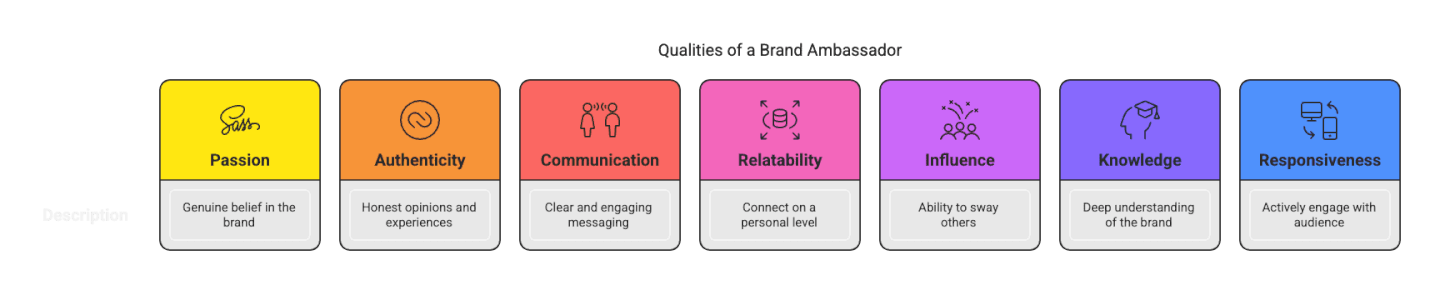
Being a brand ambassador is more than just promoting a brand. It requires a combination of skills, traits, and qualities that contribute to their effectiveness.
Let's explore some of the key qualities that make a successful brand ambassador.
One of the most crucial qualities of a brand ambassador is a genuine passion for the brand they represent.
They should have a deep connection and belief in the brand's values, products, or services. When ambassadors are truly passionate, their enthusiasm shines through their content and interactions, making their endorsements more authentic and compelling.
Authenticity is paramount for brand ambassadors.
In a study conducted by Stackla, 86% of consumers said that authenticity is an important factor when deciding which brands to support. Successful ambassadors stay true to themselves while representing the brand. They share their honest opinions, experiences, and stories, building trust and credibility with their audience.
Effective communication is essential for brand ambassadors. They need to be able to convey their messages clearly and engage with their audience. Ambassadors with excellent communication skills can effectively articulate the brand's value proposition, answer questions, and address concerns. They know how to connect with their audience and inspire action through their content.
Successful brand ambassadors are relatable figures that their audience can identify with.
They understand their target demographic and can connect with them on a personal level. According to a survey by Social Media Today, 60% of respondents believe that content from real people is the most influential in shaping their purchasing decisions.
Ambassadors who are relatable make the brand more accessible and appealing to their followers.
Brand ambassadors are chosen for their ability to influence others.
They have a significant following and reach on social media platforms or other channels. According to a report, influencer marketing has the potential to generate up to $18 in earned media value for every dollar spent.
Ambassadors with a strong online presence can effectively promote the brand, increasing its visibility and expanding its reach.
While not all brand ambassador roles require subject matter expertise, having a deep understanding of the brand and its industry can be a valuable asset.
Knowledgeable ambassadors can provide detailed information about the brand's products or services, share insights, and educate their audience. This expertise adds credibility to their endorsements and helps build trust among their followers.
Successful brand ambassadors actively engage with their audience.
They respond to comments, messages, and inquiries, fostering a sense of community and connection. According to a study, 40% of consumers expect brands to respond within one hour.
Ambassadors who are responsive and engaged build stronger relationships with their audience, leading to increased loyalty and support for the brand they represent.
In conclusion, successful brand ambassadors possess a combination of crucial qualities that make them effective advocates for a brand.
Their passion, authenticity, communication skills, relatability, influence, knowledge, and engagement contribute to their ability to connect with their audience and drive brand awareness and loyalty.
When it comes to finding and selecting brand ambassadors, there are several considerations and steps to ensure the right individuals represent the brand effectively.
Let's delve into the process of finding and selecting brand ambassadors.
The first step in selecting brand ambassadors is to identify individuals whose values align with the brand.
It is important to find ambassadors who genuinely believe in and connect with the brand's mission and values. According to Harvard Business Review, 64% of consumers say shared values are the main reason for their relationship with a brand. Finding ambassadors with a natural affinity for the brand ensures authenticity in their representation.
Assessing the reach and influence of potential brand ambassadors is crucial.
Look at their social media following, engagement rates, and reach on relevant platforms. According to a report, 90% of consumers trust recommendations from individuals, even if they don't know them personally.
Ambassadors with a substantial and engaged following have the potential to amplify the brand's message and generate significant impact.
Assess the quality and relevance of the potential ambassadors' content.
Look for individuals who consistently create high-quality and engaging content that aligns with the brand's image and tone.
Their content should demonstrate their creative skills, storytelling abilities, and their ability to capture their audience's attention. Quality content contributes to the overall perception of the brand and ensures a cohesive representation.
Take a close look at how potential ambassadors interact with their audience.
Are they actively responding to comments and messages? Do they foster meaningful discussions? The level of engagement indicates their ability to connect with their followers and build a loyal community.
49% of consumers expect influencers to respond to comments within 24 hours. Ambassadors who effectively engage with their audience can drive more meaningful conversations about the brand.
By following these steps, brands can find and select ambassadors who align with their values, have a significant reach and influence, offer diverse perspectives, create high-quality content, engage with their audience, and maintain a professional reputation.
A thoughtful and strategic selection process can lead to successful brand partnerships and effective brand ambassador programs.
Once brand ambassadors have been selected, it is important to have a structured onboarding and training process to ensure they are well-equipped to represent the brand effectively.
Let's explore the steps involved in onboarding and training brand ambassadors.
Start by sharing the brand's mission, values, and guidelines with the ambassadors.
This helps them understand the brand's identity and the message it wants to communicate.
According to a study, 50% of consumers say they share their positive experiences with others, and 33% of them do it through social media. Clear and consistent brand values and guidelines ensure that ambassadors accurately represent the brand and its values.
Depending on the nature of the brand, it is important to provide ambassadors with in-depth knowledge about the products or services they will be promoting.
They should understand the features, benefits, and unique selling propositions of the brand's offerings.
Equipping ambassadors with product knowledge enhances their credibility and enables them to effectively communicate the brand's offerings.
Brand ambassadors should be trained on effective communication and engagement strategies.
They should know how to engage with their audience in a way that aligns with the brand's voice and values. Training on active listening, responding to comments or messages, and fostering meaningful discussions helps ambassadors build strong connections with their audience.
Engaged customers are likely to spend 40% more with a brand. Effective communication and engagement can lead to increased customer loyalty and advocacy.
Since brand ambassadors often promote brands on social media, it is important to provide them with social media tips and content creation guidance.
This can include best practices for creating engaging posts, utilizing hashtags or keywords, and understanding social media algorithms.
According to a report, 71% of consumers are more likely to make a purchase based on social media referrals. Equipping ambassadors with social media and content creation skills helps them create compelling posts that drive brand visibility and engagement.
By following a comprehensive onboarding and training process, brands can ensure that brand ambassadors are well-prepared to represent the brand effectively.
Sharing brand values and guidelines, providing product knowledge, offering communication and engagement training, guiding social media and content creation, fostering a sense of community, and providing ongoing feedback are critical steps to maximize the impact of brand ambassador programs.
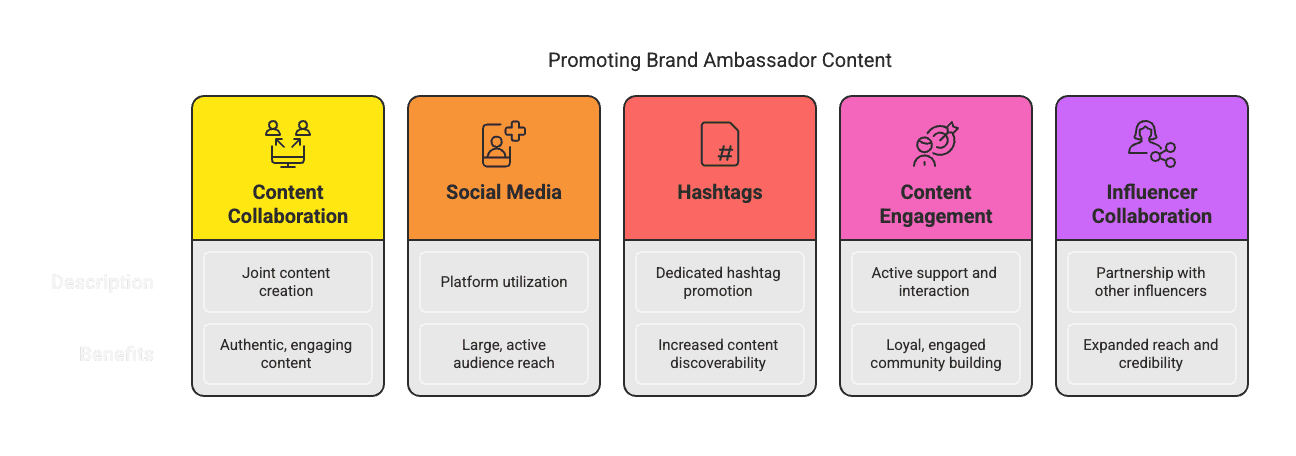
Once brand ambassadors create compelling content, it's time to amplify their efforts by promoting their content effectively.
By promoting brand ambassador content, brands can maximize the reach and impact of their ambassador programs.
Let's explore some strategies for promoting brand ambassador content.
Foster collaboration between the brand and the ambassadors on content creation.
Encourage ambassadors to create content that aligns with their own unique style and brand guidelines. Collaborative content creation ensures that ambassadors feel a sense of ownership and creativity in their representation of the brand.
The vast majority of brands rank ambassador collaboration as a critical factor in a successful influencer campaign. This collaboration can lead to more authentic and engaging content.
Utilize social media platforms to promote brand ambassador content.
Share their posts on the brand's official social media accounts and tag the ambassadors. This exposes the ambassadors' content to the brand's existing audience, increasing visibility and engagement.
Social media users spend an average of 2.5 hours per day on social networks and messaging. Leveraging social media platforms ensures that brand ambassador content reaches a large and active audience.
Create and promote dedicated hashtags for your brand ambassador program.
Encourage ambassadors and followers to use these hashtags when sharing content related to the brand. Hashtags help categorize and organize content, making it easier for users to discover brand ambassador posts.
Data suggests that posts with at least one hashtag average 12.6% more engagement than those without. Utilizing hashtags increases the discoverability and reach of brand ambassador content.
Show active engagement and support for brand ambassador content by liking, commenting, and sharing their posts.
This demonstrates the brand's appreciation for the ambassadors' efforts, encourages their continued promotion of the brand, and strengthens the relationship between the brand and the ambassadors.
According to a report, 53% of customers expect brands to respond to their comments on social media within an hour. Active engagement with ambassador content helps build a loyal and engaged community.
Collaborate with other influencers or brand ambassadors in complementary industries or niches to create mutually beneficial content.
Cross-promotion exposes brand ambassador content to a new audience and can generate increased engagement and follower growth.
Most people trust paid recommendations from influencers. Collaborating with other influencers expands the brand's reach and credibility.
By implementing these strategies for promoting brand ambassador content, brands can maximize the impact of their ambassador programs.
Encouraging collaborative content creation, leveraging social media platforms, utilizing hashtags, actively engaging with ambassador content, repurposing content across channels, and seeking collaborations with other influencers contribute to the success of brand ambassador initiatives.
Ensuring the success of a brand ambassador program is critical to maximizing its impact and achieving marketing objectives.
Effective ambassador programs require careful planning, strong communication, and consistent support.
Let's explore some strategies for ensuring the success of a brand ambassador program.
Define clear goals and expectations for the brand ambassador program.
This includes establishing specific objectives such as increasing product sales, building brand awareness, or driving online engagement. Clear goals help ambassadors understand their expected deliverables and guide the development of meaningful activities and initiatives.
Setting clear goals is crucial for success.
Provide ambassadors with the necessary resources and support to effectively represent the brand.
This includes access to product samples, exclusive content, and marketing materials. Providing resources and support helps to inspire ambassadors' creativity, productivity, and production of high-quality content.
According to a study by Accenture, 91% of consumers are more likely to shop from brands that provide personalized recommendations. Providing personalized resources and support enhances the ambassadors' effectiveness in promoting the brand.
Offer incentives and rewards to motivate ambassadors to achieve their goals and objectives.
Incentives can include exclusive discounts, free products, and cash rewards. Offering incentives and rewards helps to create a sense of value and satisfaction among ambassadors, which can drive loyalty and inspire continued participation in the program.
According to a report by HBR, motivation, and loyalty are the most significant factors that drive ambassador engagement. Providing incentives and rewards is a proven method for success.
Regularly monitor and evaluate the effectiveness of the brand ambassador program.
This includes analyzing engagement metrics, tracking sales data, and gathering feedback from ambassadors and customers. Monitoring and evaluating the program helps to identify areas for improvement, measure ROI, and determine overall success.
According to a study by Influencer Marketing Hub, 67% of marketers have reported an increase in their budget allocation for influencer marketing. Regularly monitoring and evaluating the program ensures the brand ambassador program remains relevant and impactful.
Measuring the impact of brand ambassadors is crucial for understanding the effectiveness of ambassador programs and optimizing their performance.
By tracking key metrics and analyzing the outcomes of brand ambassador initiatives, brands can gain valuable insights into the program's impact on sales, brand awareness, and customer engagement.
Let's explore some strategies for measuring the impact of brand ambassadors.
Start by defining the key performance indicators that align with the brand's marketing goals.
These KPIs can include metrics such as sales revenue, website traffic, social media engagement, brand mentions, or customer referrals. By establishing clear KPIs, brands can track and measure the impact of brand ambassador activities and campaigns accurately.
According to a study by Nielsen, 84% of marketers believe return on investment (ROI) is an essential metric for measuring influencer marketing success. Defining KPIs is crucial for assessing the impact of brand ambassadors.
Monitor and track engagement metrics to understand how brand ambassador content resonates with the audience.
Metrics such as likes, comments, shares, and click-through rates provide insights into the level of audience engagement and the effectiveness of ambassador initiatives. By analyzing these metrics, brands can identify the type of content that generates the most engagement and adjust their strategies accordingly.
According to a report by MSL Group, content shared by employees gets 8 times more engagement than content shared by brand channels.
Tracking engagement metrics helps measure the impact and reach of brand ambassador initiatives.
Gather feedback from customers and ambassadors through surveys and interviews to understand their perceptions and experiences.
Surveys can provide valuable insights into the impact of brand ambassadors on brand awareness, purchase decisions, or overall customer satisfaction. Encouraging open-ended feedback allows for diverse perspectives and helps identify areas for improvement.
Sometimes up to 80% of customers are willing to provide feedback if asked. Collecting feedback enables brands to measure the impact of brand ambassadors from the customer's point of view.
Track sales data and conversions to measure the impact of brand ambassadors on purchase decisions.
By analyzing the correlation between ambassador activities and sales metrics, brands can determine the program's effectiveness in driving revenue. Utilizing trackable referral codes or affiliate links assigned to ambassadors can help attribute sales to their efforts accurately.
30% of companies consider sales revenue as the most important metric to measure influencer marketing success. Monitoring sales and conversions provides tangible evidence of the impact of brand ambassadors.
Establish control groups to compare the impact of brand ambassador activities to the absence of such initiatives.
By comparing customer behavior, engagement, and sales between the control group and the group exposed to brand ambassador activities, brands can quantify the impact and effectiveness of their ambassador programs. Control groups provide a benchmark for measuring performance and determining the true impact of brand ambassadors.
According to a study by MIT Sloan Management Review, controlled experiments are the most accurate method for measuring the effect of marketing initiatives. Comparing against control groups ensures accurate measurement of brand ambassador impact.
By implementing these strategies, brands can effectively measure the impact of their brand ambassador programs.
Defining KPIs, tracking engagement metrics, gathering feedback, monitoring sales and conversions, evaluating brand sentiment, and comparing against control groups provide brands with a comprehensive understanding of the impact brand ambassadors have on their marketing objectives.
Brand ambassadors play a crucial role in driving brand awareness, customer engagement, and ultimately, sales growth.
By leveraging the power of passionate advocates, brands can harness their influence and expertise to reach new audiences and build trust with consumers. Throughout this guide, we have explored strategies for launching, managing, and measuring the success of a brand ambassador program.
From a customer's perspective, brand ambassadors serve as trusted sources of information and recommendations.
Consumers appreciate the authenticity and relatability of ambassadors, leading to increased trust in the brand. Additionally, brand ambassadors often provide unique insights and perspectives that resonate with specific target audiences, creating a sense of inclusivity and diversity.
From a brand perspective, brand ambassadors are valuable assets who can help boost brand reputation, increase customer loyalty, and drive customer acquisition.
Ambassadors provide a cost-effective way to reach a larger audience and build brand affinity. Furthermore, by utilizing ambassadors from diverse backgrounds and perspectives, brands can ensure representation and resonate with a broader range of customers.
In conclusion, brand ambassador programs can be a powerful marketing tool when implemented and managed effectively.
By fostering authentic relationships, leveraging ambassadors' influence, and measuring the impact of their efforts, brands can create a successful ambassador program that drives brand awareness, customer engagement, and ultimately, business growth.
In today's digital age, User Generated Content (UGC) has become a powerful force that shapes the online landscape.
At the heart of UGC are individuals known as UGC Creators, who actively create and share content on various platforms. From social media influencers to bloggers and vloggers, UGC Creators have gained traction for their ability to captivate audiences with authentic and relatable content.
In this step-by-step guide, we will explore what it means to be a UGC Creator, the different types of UGC Creators, their motivations, and the significance of their role in influencing consumer behavior.
So, let's dive into the world of UGC Creators and uncover the key aspects of this influential digital phenomenon.
As social media and digital connectivity have grown, UGC has become essential in the online space.
UGC encompasses any content—text, images, videos, or reviews—created and shared by users instead of traditional media outlets, making it more authentic, relatable, and influential on consumer behavior and brand perceptions.
With over 3.96 billion active social media users worldwide, platforms like Instagram, YouTube, TikTok, and Twitter have become breeding grounds for creative expression. UGC Creators, from ordinary individuals to influencers, bloggers, and vloggers, drive this wave of user-generated content.
Through audience engagement and the establishment of loyal followings, UGC Creators have become key players in the digital landscape.
As mentioned above, UGC refers to any form of content - such as text, images, videos, reviews, and testimonials - that is created and shared by users rather than traditional media outlets. This content is driven by individuals known as UGC Creators, who actively contribute their unique perspectives, experiences, and talents to the digital realm.
The rise of UGC is evident in the numbers. According to a survey by BrightLocal, 82% of consumers say that online reviews are a significant influence on their purchasing decisions.
Additionally, 70% of consumers place equal trust in peer recommendations and professional content. These statistics showcase the power and impact of UGC on consumer behavior, cementing its relevance and importance in the digital landscape.
UGC Creators come in various forms, bringing diverse talents and expertise to the table.
Social media influencers have gained significant prominence in recent years. With their substantial following and authentic content, influencers have become influential figures in shaping trends and consumer choices.
Bloggers, on the other hand, utilize written content to share their knowledge, insights, and personal experiences with a dedicated audience. Vloggers have taken advantage of the video medium, creating engaging and informative content via platforms like YouTube. Reviewers play a crucial role in providing honest and unbiased opinions about products, services, and experiences, helping consumers make informed decisions.
What sets UGC Creators apart is their passion and commitment to creating content that resonates with their audience.
They bring a personal touch to their work, providing authentic and relatable perspectives that traditional media may lack. UGC Creators often have a deep understanding of their niche and develop a loyal following due to their unique voice and expertise.
UGC Creators are not confined to a specific demographic or background.
They can be individuals from all walks of life, representing various cultures, interests, and experiences. This diversity adds richness and depth to the content landscape, allowing audiences to connect with a wide array of viewpoints and narratives.
While UGC Creators have gained significant popularity and influence, it is important to recognize the challenges they face.
Algorithm changes on social media platforms can impact their reach and visibility, leading to a need for consistent adaptation and innovation. Additionally, UGC Creators must navigate a competitive landscape, where standing out amidst a sea of content creators requires creativity and consistency. Furthermore, ethical considerations, such as transparency and respect for copyright, are vital for UGC Creators to maintain their credibility and build trust with their audience.
In conclusion, UGC Creators play a pivotal role in shaping the digital landscape. Their ability to provide authentic, relatable, and diverse content has revolutionized how consumers engage with online platforms. With their unique perspectives and talents, UGC Creators have solidified themselves as influential figures, shaping consumer behavior and challenging traditional media models.
UGC Creators come in various forms, each bringing their unique talents and expertise to the digital realm. Let's explore some of the most common types of UGC Creators and their impact on the online landscape.
A post shared by ELENA VASILENKA (@elenavasilenka)
Social media influencers have become a force to be reckoned with in recent years.
These individuals have carefully curated social media profiles with a substantial following, often numbering in the thousands or even millions. They share their experiences, opinions, and recommendations through visually compelling content and captions.
Brands recognize the influence of these UGC Creators and often collaborate with them to promote products and services. According to a survey by Influencer Marketing Hub, 84.8% of marketers believe influencer marketing is effective in building brand awareness.
Social media influencers have the power to shape trends, introduce new products, and sway consumer decisions through their authentic and relatable content.
Bloggers have been at the forefront of UGC for quite some time.
These UGC Creators use written content to share their knowledge, insights, and experiences on niche topics. From travel bloggers documenting their adventures to food bloggers sharing their culinary expertise, bloggers have developed dedicated communities of readers who trust their opinions and seek their recommendations.
According to Statista, there were an estimated 31.7 million bloggers in the United States alone in 2020. The vast reach and influence of bloggers epitomize their significance as UGC Creators.
Vlogging, or video blogging, has gained significant popularity over the years.
Vloggers share their experiences and expertise through videos, often documenting their daily lives, providing tutorials, or reviewing products and services. YouTube has become a prominent platform for vloggers, attracting millions of viewers and subscribers. These UGC Creators engage their audience through visual storytelling, adding a personal touch to their content.
According to a survey by the Pew Research Center, 81% of Americans aged 18-29 years use YouTube. This highlights the significance of vloggers in shaping digital content consumption habits.
Reviews have become an integral part of consumer decision-making.
As UGC Creators, reviewers offer honest and unbiased opinions about products, services, and experiences. Their insights play a crucial role in helping potential buyers evaluate and choose the right options.
READ MORE - Guide to Product Seeding
According to a survey by Emplifi, 90% of buyers say that positive online reviews influence their purchasing decisions. Reviewers can be found on various platforms, including dedicated review sites, e-commerce websites, and social media platforms.
Their perspectives and recommendations hold substantial weight in the eyes of consumers.
From social media influencers to bloggers, vloggers, and reviewers, the world of UGC Creators encompasses a diverse range of talents and expertise. These individuals have gained significant influence over consumer behavior and have transformed the way brands connect with their target audience.
User Generated Content (UGC) Creators have a multitude of motivations that drive them to create and share their content with the world. Let's explore some of the common motivations that fuel their passion and dedication.
For many UGC Creators, the primary motivation is the desire for creative expression. They use various mediums such as writing, photography, videography, or art to showcase their unique perspectives, talents, and ideas. Creating content allows them to channel their creativity, share their passions, and connect with like-minded individuals. The online platform provides them with a space to freely express themselves and indulge in their artistic pursuits.
UGC Creators who are knowledgeable in specific fields may be motivated by the opportunity to share their expertise with others. These individuals have a deep understanding of a particular topic or niche and use their content to educate, inform, and inspire their audience. Whether it's sharing DIY tutorials, cooking recipes, fitness tips, or academic insights, their goal is to empower and help others by sharing their knowledge and experiences.
Many UGC Creators are driven by the desire to build a community around their content. They create content that resonates with a specific audience, fostering a sense of belonging and connection. By consistently engaging with their community through comments, direct messages, and social media interactions, UGC Creators cultivate a loyal following. This community can provide support, feedback, and encouragement, creating a symbiotic relationship between the UGC Creator and their audience.
UGC Creators often aspire to influence and inspire others through their content. They aim to make a positive impact on their audience's lives, whether by sharing personal stories, promoting social causes, or showcasing inspirational journeys. UGC Creators recognize the power they hold to shape perspectives, challenge existing norms, and spark change through storytelling and relatable experiences.
While not the sole motivation, the potential for monetization and business opportunities also drives many UGC Creators.
Platforms like YouTube, Instagram, and TikTok provide UGC Creators with avenues to earn income through brand collaborations, sponsored content, advertisements, and affiliate marketing.
According to a report by Statista, global influencer marketing spending is projected to reach $22.2 billion by 2025. This financial potential gives creative individuals an incentive to turn their passion into a viable career option.
UGC Creators are fueled by a blend of personal motivations, aspirations, and opportunities. They find fulfillment in the creative process, the impact their content can have, the sense of community they build, and the potential for professional growth.

User Generated Content (UGC) Creators have become a driving force in the modern digital landscape, with their content and influence playing a significant role in shaping consumer behavior, brand perception, and online communities. Let's explore the importance of UGC Creators and the impact they make.
UGC Creators bring an authentic and relatable voice to the digital space.
Unlike traditional advertising, which often feels polished and scripted, UGC Creators offer genuine opinions, experiences, and recommendations. This authenticity resonates with audiences who are increasingly seeking transparent and trustworthy content.
According to a survey by Stackla, 86% of consumers believe that authenticity is an essential factor when deciding which brands they like and support. UGC Creators have the ability to establish a genuine connection with their audience, making their content more influential and persuasive.
UGC Creators have a significant impact on consumer behavior, with their recommendations and reviews influencing purchasing decisions.
According to a survey by BrightLocal, 82% of consumers read online reviews for local businesses, and 90% of consumers say that positive reviews influence their purchasing decisions. UGC Creators provide real-world insights and first-hand experiences that consumers rely on to make informed choices.
Their opinions carry weight, shaping trends, generating buzz, and driving brand awareness.
UGC Creators empower users by giving them a voice and platform to share their own content.
Through comments, shares, and collaborations, UGC Creators actively engage with their audience, creating a two-way conversation. This level of engagement fosters a sense of community, encourages user participation, and strengthens the bond between UGC Creators and their followers.
User-generated videos get 10 times more views and are shared 11 times more compared to brand-generated videos. UGC Creators inspire and motivate others to create, contribute, and actively participate in the online ecosystem.
UGC Creators have become powerful brand advocates and essential components of marketing strategies.Brands recognize the impact UGC Creators have on their target audience and often collaborate with them to promote their products and services.According to a study by digital marketing agency Linqia, 86% of marketers have used influencer marketing as part of their overall marketing strategy.UGC Creators can generate organic word-of-mouth marketing, boost brand awareness, and drive customer engagement through their authentic and relatable content.UGC Creators play a crucial role in shaping digital culture, consumer behavior, and brand perception. Their authentic, relatable content, diverse perspectives, and direct engagement with their audience make them indispensable in today's digital landscape.
User Generated Content (UGC) Creators provide a diverse and influential voice in the digital space, but they also face unique challenges and considerations. Let's explore some key challenges and considerations UGC Creators encounter.
UGC Creators rely on their authenticity and integrity to establish trust and credibility with their audience.
However, in an era of fake news and misinformation, UGC Creators face the challenge of maintaining these values. Misrepresenting facts or promoting dishonest content can damage their reputation and credibility. UGC Creators must be vigilant and ensure that the content they produce aligns with their values and mission.
According to a survey by Edelman Trust Barometer, 63% of respondents said that they can't differentiate between what's true and false in today's digital age.
UGC Creators must also navigate legal and copyright issues.
Creating content that infringes on copyrighted material or violates intellectual property laws can lead to legal repercussions, financial damages, and loss of credibility. UGC Creators must understand the legal implications and ensure that their content complies with copyright regulations.
According to one survey, 57% of content creators worry about copyright infringement and 52% feel that protecting their copyright is becoming more critical.
UGC Creators often share personal details and experiences in their content, making privacy and safety a significant concern.
Online harassment, stalking, and doxxing can put UGC Creators in vulnerable positions. They must be aware of their digital footprint, protect their personal information, and take necessary precautions to ensure their safety.
According to a survey by Broadband Search, 40% of online harassment victims experience long-term mental health effects.
The growth of social media platforms has led to an explosion of UGC Creators vying for attention and engagement.
The competition for audience attention and platform visibility has intensified, making it harder for UGC Creators to stand out.
Additionally, algorithm changes by social media platforms can significantly impact UGC Creators' reach and engagement. UGC Creators must stay updated with these changes and adapt their strategies accordingly.
According to a report by Microsoft, the average human attention span has decreased from 12 seconds to eight seconds since 2000.
While the potential for monetization has helped many UGC Creators turn their passion into a career, it also presents a challenge to balance creative expression with financial goals.
Pursuing monetization opportunities may lead to a compromise in the authenticity, integrity, or creative freedom of UGC Creators. They must find a balance between financial goals, creative expression, and ethical values.
According to a report by Stackla, 90% of marketers believe that authenticity is essential when choosing which creators to work with.
UGC Creators face unique challenges and considerations, from maintaining authenticity to navigating legal issues, privacy concerns, competition, and balancing financial goals and creative expression. UGC Creators must be aware of these challenges and find ways to overcome them, while staying true to their values and mission.
User Generated Content (UGC) Creators have become a powerful force in the digital landscape, bringing authenticity, relatability, and diverse perspectives to the forefront. They play a crucial role in shaping consumer behavior, brand perception, and digital culture. Let’s recap the key points discussed and their significance.
However, UGC Creators also face unique challenges and considerations.They must navigate issues such as maintaining authenticity and integrity, legal and copyright concerns, privacy and safety risks, rising competition, and balancing creativity with monetization goals. These challenges require UGC Creators to be vigilant, adaptable, and true to their values.
In conclusion, UGC Creators have revolutionized the digital landscape by providing authentic, relatable content, influencing consumer behavior, amplifying diverse perspectives, empowering users, and driving brand advocacy. They have become influential voices in shaping our digital culture and deserve recognition for their valuable contributions.
Hey there, so you don’t know what Amazon’s Vine Program is?It’s an exclusive initiative that provides honest and unbiased product reviews to help shoppers make informed purchasing decisions.
For sellers, it enhances product visibility, generates customer engagement, and provides valuable insights. Selected sellers have their products distributed to Vine reviewers, who are encouraged to provide honest and unbiased feedback. When a seller’s product is enrolled in the program, sales can increase by 30% on average.
On the other hand, reviewers have access to free products in exchange for reliable feedback. Amazon ensures the authenticity of reviews through strict guidelines and monitoring systems.
However, bear in mind that acceptance into the program is not guaranteed, and reviews can vary among Vine reviewers. If you’re not accepted, you can look into using social media influencers or forming strategic partnerships.
Overall, the Vine Program is a reliable source of feedback that benefits both sellers and customers alike, so let’s dive into more about the program.
To participate in Amazon's Vine Program, sellers must meet specific eligibility criteria.
These criteria are designed to ensure that the products enrolled in the program meet the standards and quality expected by Amazon's customers.
One of the primary requirements for sellers is maintaining a high level of customer satisfaction.
Amazon tracks sellers' performance through metrics such as the percentage of orders that are fulfilled on time, the number of cancelled orders, and customer feedback ratings. Consistently maintaining high standards in these areas raises the likelihood of being eligible for Amazon's Vine Program.
Another requirement for eligibility is offering quality products. Amazon is stringent in its selection process, choosing products that are new or have recently experienced a surge in customer interest.
Products should also meet specific criteria such as availability, pricing, and competitive positioning.
Amazon aims to ensure that products enrolled in the program have a wide appeal and offer a compelling value proposition to consumers.
The Vine Program is invitation-only, so once a product is deemed eligible, Amazon will invite the seller to join the program.
Amazon's selection process is based on a variety of factors, and not all products will be selected. Therefore, sellers may need to continue optimizing their products by meeting eligibility requirements and improving customer satisfaction metrics to increase their chances of being invited to the program.
One of the key benefits of the Vine Program is that Vine reviews carry more weight with potential customers than regular reviews.
According to a study conducted by Amazon, products with Vine reviews outsell those without Vine reviews by an average of 30%.
This statistic highlights the importance of participation in the program for sellers. With the potential for increased product visibility, sales, and customer engagement, joining the Vine Program is an attractive opportunity for many sellers on Amazon.
In addition, Amazon places significant emphasis on the integrity and authenticity of the reviews generated by the Vine Program.
To ensure the reviews are unbiased and honest, Amazon limits the product selection process to ensure a balanced perspective from the reviewers. They also closely monitor for any potential manipulation or biased feedback.
It is important to note that participation in the Vine Program does not guarantee a positive review rating or favorable feedback.
Vine reviewers have the freedom to provide honest opinions, which may vary from seller expectations. As such, managing expectations regarding review ratings and feedback is essential for sellers participating in the program.
In conclusion, Amazon's Vine Program is an exclusive but attractive opportunity for sellers to gain exposure and increase sales.
However, meeting eligibility criteria and maintaining high standards in customer satisfaction is crucial. By doing so, sellers may be invited to participate in the program, ultimately leading to increased visibility and valuable customer engagement.
Amazon's Vine Program works in a straightforward manner, connecting sellers with a selected community of Vine reviewers to provide honest and unbiased product feedback. Let's take a closer look at how this program operates.
First and foremost, the Vine Program is invitation-only, making it an exclusive opportunity for sellers on Amazon.
Once a seller's product is selected and enrolled in the program, Amazon takes charge of distributing the product to Vine reviewers. This ensures a fair and controlled process of gathering feedback from a diverse group of reviewers.
Vine reviewers are individuals who have been selected by Amazon to participate in the program.
They are often seasoned reviewers with a strong reputation for providing thorough and unbiased feedback. These reviewers receive the product free of charge and are encouraged to share their experiences and thoughts within a specified timeframe.
Upon receiving the product, Vine reviewers are under no obligation to provide a positive review.
The program is designed to emphasize authenticity and unbiased feedback. This means that the reviews generated by Vine reviewers may vary, offering a range of perspectives on the product.
Sellers should keep this in mind when participating in the program and managing their expectations regarding review ratings and feedback.
To illustrate the impact of Vine reviews, a study conducted by Amazon found that products with Vine reviews outsell those without Vine reviews by an average of 30%.
This statistic highlights the significance of Vine reviews in terms of customer engagement and the potential sales boost for participating sellers. By leveraging the Vine Program, sellers have the opportunity to increase their product's visibility and credibility on the Amazon platform.To ensure the integrity of reviews, Amazon has put in place strict guidelines and monitoring systems. These measures aim to prevent any manipulation or biased feedback. By closely monitoring the program and the reviews generated, Amazon maintains the reliability and trustworthiness of the Vine Program. This commitment to authenticity benefits both sellers and customers, as it fosters trust in the feedback provided by Vine reviewers.It's also important to note that while the Vine Program offers numerous benefits, it does have some limitations. One challenge is the limited number of Vine reviewers available and the limited number of slots for products. This means that not all products or sellers will be accepted into the program. However, sellers can improve their chances of acceptance by consistently meeting Amazon's eligibility criteria and delivering excellent customer service.In conclusion, Amazon's Vine Program is an exclusive opportunity for sellers to connect with a select group of Vine reviewers and obtain honest and unbiased feedback on their products. By participating in this program, sellers have the potential to enhance their product's visibility, engage with customers, and boost sales on the Amazon platform.
Participating in Amazon's Vine Program can bring several benefits to sellers, ranging from increased sales and product visibility to increased customer engagement. Let's explore the advantages that sellers can enjoy by joining the program.
By enrolling in the Vine Program, sellers can significantly increase their product's visibility on the Amazon platform.
Vine reviews carry more weight with potential customers than regular reviews, making them a powerful tool for grabbing attention and piquing interest.
According to a study conducted by Amazon, products with Vine reviews outsell those without Vine reviews by an average of 30%. This statistic underscores the value and impact of participating in the program.
Vine reviews provide an additional layer of credibility and trust to a product listing.Verified purchases and well-regarded Vine reviewers lend authenticity to the feedback, helping potential buyers make informed decisions. The unbiased nature of Vine reviews also contributes to building trust in the product and brand, ultimately leading to increased sales and customer loyalty.
Through the Vine Program, sellers gain access to detailed and valuable customer feedback. This feedback can provide insights into product features, strengths, weaknesses, and potential improvements. Understanding customer perspectives helps sellers refine their marketing strategies, make informed business decisions, and develop better products in the future.
Vine reviews can serve as valuable marketing content that sellers can leverage across various channels. As with all user generated content (UGC), positive Vine reviews can be showcased on product listings, social media platforms, and marketing materials, establishing social proof and encouraging potential customers to make a purchase.
Participating in the Vine Program sets sellers apart from competitors, especially those who are not part of the program. The visibility and credibility gained through Vine reviews give sellers a competitive edge, helping them stand out in a crowded marketplace and potentially attracting more customers to their products.
Amazon's selection process for the Vine Program focuses on new or recently popular products. This means that being part of the program allows sellers to gain early recognition and exposure for their latest offerings. Launching a new product with the support of Vine reviewers increases the chance of generating initial sales and traction in the marketplace.It's important to note that while there are significant benefits to participating in the Vine Program, it does not guarantee positive review ratings or favorable feedback.Vine reviewers maintain their independence to provide honest opinions, which may vary from seller expectations. However, even critical feedback can be valuable for continuous improvement and addressing customer concerns.In conclusion, Amazon's Vine Program offers various benefits for sellers, including enhanced visibility, increased credibility, valuable customer insights, marketing content, competitive advantage, and early product recognition.By leveraging the power of Vine reviews, sellers can effectively engage with customers, boost sales, and strengthen their brand presence on the Amazon platform.
Participating in Amazon's Vine Program as a reviewer offers several benefits, which include access to a wide range of products, building a reputation as a trusted reviewer, and the opportunity to influence purchasing decisions. Let's explore the advantages that Vine reviewers can enjoy by being part of the program.
Vine reviewers have the opportunity to try out a diverse range of products across different categories, ranging from electronics and household items to books and beauty products. This provides them with the chance to explore new and innovative offerings that they may not have otherwise discovered. The program allows reviewers to widen their horizons and develop a deeper understanding of different product types.
Becoming a Vine reviewer comes with a certain level of prestige and recognition within the Amazon community. Consistently providing thorough, honest, and unbiased reviews can help reviewers establish themselves as trusted authorities in their respective niches. This reputation can lead to increased credibility among fellow customers, potentially attracting more followers and influencing purchasing decisions.
Vine reviewers often have the opportunity to receive products before they are widely available to the public.
This exclusive early access allows reviewers to get a first look and share their insights with their audience. Being the first to provide feedback and insights on new products can increase a reviewer's visibility and establish them as a go-to source for information on the latest releases.
Vine reviewers have the opportunity to engage with a community of like-minded individuals who share their passion for reviewing products. This community can provide support, feedback, and advice, creating a network of reviewers who can learn from one another and collaborate on projects or initiatives. The sense of belonging to a community can enhance the overall experience of being a Vine reviewer.
Vine reviewers play a crucial role in helping sellers improve their products and enhance the overall customer experience. By providing detailed feedback and highlighting both the strengths and weaknesses of a product, Vine reviewers contribute to the continuous improvement of products on the Amazon platform. This review feedback loop benefits both sellers and customers, ensuring that product offerings meet the evolving needs and expectations of consumers.
Amazon recognizes the contributions of Vine reviewers and rewards them with various perks and benefits. These can include exclusive invitations to events, access to special promotions, and the opportunity to be part of Amazon's trusted reviewer program. These rewards not only acknowledge the effort and dedication of Vine reviewers but also provide additional incentives to continue participating in the program.In conclusion, Amazon's Vine Program offers numerous benefits for Vine reviewers, including access to a wide range of products, building a reputation as a trusted reviewer, exclusive early access, building an engaged community, providing valuable feedback to sellers, and recognition and rewards from Amazon.By being part of this program, Vine reviewers can enjoy a fulfilling reviewing experience and have a meaningful impact on the Amazon community.
Authentic reviews on Amazon are crucial to both sellers and customers, as they provide valuable insights, build trust, and help guide purchasing decisions. Let's explore the importance of authentic reviews from diverse perspectives and understand why they play a vital role in the Amazon ecosystem.
Authentic reviews give customers the opportunity to make well-informed purchase decisions.
When customers see genuine feedback from fellow buyers, they gain insights into the product's quality, performance, and suitability for their needs.
According to a study,, products with authentic and trustworthy reviews tend to have higher ratings and attract more sales. The information shared in these reviews helps customers evaluate products and choose the one that best matches their requirements.
Authentic reviews play a crucial role in building trust and credibility on the Amazon platform.
Customers are more likely to trust a product and seller when they see genuine feedback from other buyers.
In fact, 84% of consumers trust online reviews as much as personal recommendations. By providing honest and detailed reviews, customers can shape the reputation of sellers and products, helping build a trustworthy environment where buyers can shop with confidence.
Authentic reviews offer valuable insights into a product's strengths and limitations. Customers can learn about the features, benefits, and potential drawbacks before making a purchase. This feedback helps sellers understand the aspects that resonate with customers and areas where improvements can be made. By listening to customer concerns and suggestions, sellers can enhance their products and provide a better shopping experience.
Customer reviews act as a feedback mechanism for sellers to identify and address any quality or performance issues with their products.
This feedback loop allows sellers to continuously improve their offerings, ensuring that they meet customer expectations and deliver a high level of satisfaction.
According to a BrightLocal survey, 78% of consumers say that seeing a response from a business to their review makes them believe that the business cares more about them. By actively responding to customer feedback, sellers can showcase their commitment to customer satisfaction and foster a positive reputation.
Authentic reviews are essential in combating the issue of fake reviews that can mislead customers. Amazon employs advanced algorithms and human moderation to detect and remove fraudulent reviews. By relying on honest and genuine feedback, customers can make purchasing decisions based on reliable information. Furthermore, customers who provide authentic reviews contribute to maintaining the integrity and reliability of the review platform.It is important to note that while authentic reviews are highly valuable, it's natural for opinions to vary. Each customer may have different expectations and experiences with a product. By considering a diverse range of reviews, customers can gain a comprehensive understanding of the product and make an informed decision based on their own needs and preferences.In conclusion, authentic reviews are of utmost importance in the Amazon ecosystem. Genuine feedback helps customers make informed decisions, builds trust and credibility, identifies product strengths and limitations, improves product quality, and combats fake reviews. By participating in the review process, customers contribute to a reliable and trustworthy environment where buying and selling on Amazon is transparent and beneficial for all.
While customer reviews on Amazon offer valuable insights, there are also potential challenges and limitations to consider. It's important to be aware of these factors to make informed decisions as both a reviewer and a customer. Let's explore some of the potential challenges and limitations of customer reviews on Amazon, considering diverse perspectives.
Reviews are inherently subjective, as they reflect personal opinions and experiences. While one customer may have a positive experience with a product, another may have a completely different perspective. It's important to consider these variations and read multiple reviews to get a more comprehensive understanding. Additionally, individuals may be influenced by their personal biases, which can influence their review. Recognizing and considering these biases can help provide a more balanced view of the product.
Despite Amazon's efforts to combat fake reviews, they can still exist.
Some sellers may employ tactics to manipulate the review system, such as incentivizing customers for positive reviews or leaving fake negative reviews on competitors' products.
According to a BrightLocal survey, 82% of consumers have read a fake review in the last year. Being aware of this possibility and looking for warning signs, such as suspiciously positive or negative reviews without detailed explanations, can help customers identify potential fake or manipulated reviews.
Different customers may have varying experiences with the same product. Factors like personal preferences, individual usage patterns, and expectations can influence how a product performs or meets a customer's needs. It's important to consider this variability while reading reviews and identify aspects that align with one's own requirements. Looking for trends and patterns across multiple reviews can help minimize the impact of individual variations and provide a more well-rounded view of the product.
Customer reviews typically provide limited context and may not address specific use cases or scenarios. A reviewer's expertise and knowledge about the product, especially in technical or specialized areas, can also vary. Customers should be aware of these limitations and seek additional information or expert opinions if necessary. Additionally, customers with limited experience or expertise in a particular field may not be able to provide in-depth analysis or evaluation of certain products.
While customer reviews are useful, it's essential to avoid overreliance on them as the sole basis for decision-making. Depending solely on reviews may not take into account one's own individual needs, preferences, and unique circumstances. It's beneficial to consider reviews alongside other factors, such as product descriptions, specifications, and additional research, to make a well-informed decision.
Just as sellers can manipulate reviews, reviewers themselves may also have biases or personal agendas that can affect the credibility and objectivity of their feedback. Some reviewers may receive products for free or at a discount in exchange for a review, which can potentially influence their opinions. Understanding these dynamics and considering the reviewer's credibility and motivations can help customers interpret reviews more effectively.By being aware of these potential challenges and limitations, both reviewers and customers can approach Amazon's customer reviews with a critical mindset. Reading multiple reviews, looking for patterns, considering biases, and seeking additional information when needed can help mitigate these challenges and make more informed decisions.
Amazon's Vine Program is an invitation-only program that allows trusted reviewers to receive free or discounted products in exchange for unbiased and honest reviews. If you're interested in joining the program, here are some steps to consider.
Building a strong track record of genuine and high-quality reviews is crucial to gaining visibility as a trusted reviewer. Start by consistently writing detailed and honest reviews for products you have personally used or purchased. Engage with the Amazon community, interact with other reviewers, and provide valuable feedback. This will help establish your credibility and increase your chances of being noticed by Amazon.
Amazon recognizes its top reviewers based on their reviewing activity, helpfulness votes, and the overall quality of their reviews. Strive to achieve the Top Reviewer status to demonstrate your commitment to providing valuable insights and trustworthy feedback. The Top Reviewer status can increase your visibility and enhance your chances of receiving an invitation to the Vine Program.
To be eligible for the Amazon Vine Program, ensure that you have enabled "Vine Voices" in your account settings. This feature allows Amazon to consider your account for inclusion in the program. Go to your Amazon account settings, navigate to the "Community Profile" section, and make sure the "Vine Voices" box is checked.
Producing high-quality reviews is crucial to gaining recognition from Amazon. Amazon's algorithms and moderators value factors such as the depth of analysis, thoroughness, and helpfulness of your reviews. Strive to provide detailed and unbiased feedback that offers valuable insights to other customers. Focus on delivering authentic and well-written reviews that genuinely reflect your experiences with the products.
It's essential to familiarize yourself with Amazon's review guidelines and adhere to them consistently.
Violating these guidelines can result in the removal of your reviews or even suspension from the program. Some key guidelines to keep in mind include avoiding biased or paid reviews, disclosing any relationships or incentives, and writing reviews that are constructive and helpful to other customers.
Joining the Vine Program is a selective process, and not all top reviewers may receive an invitation. It's important to be patient and continue producing high-quality reviews while actively engaging with the Amazon community. Respond to questions or comments on your reviews and demonstrate your willingness to engage in meaningful conversations. This helps build a reputation as an engaged and reliable reviewer.Remember that participation in the Vine Program is at the discretion of Amazon, and invitation criteria may vary over time. Keep your profile updated, maintain your reviewing activity, and consistently provide valuable feedback to increase your chances of receiving an invitation.
While Amazon's Vine Program offers an opportunity for reviewers to receive free or discounted products, it is an invitation-only program. If you're looking for alternative ways to receive products for review, there are several options available. Let's explore some alternatives to the Vine Program.
There are various websites and platforms that connect reviewers with brands looking for product feedback.
These platforms allow reviewers to sign up and receive product samples in exchange for honest reviews. Some popular product testing websites include Influenster, Stack Influence and Smiley360.
These platforms often offer a wide range of products across different categories, allowing reviewers to explore and provide feedback on a variety of items.
Many brands have their own ambassador or influencer programs, where individuals can apply or be selected to represent and promote the brand's products. As a brand ambassador, you may receive free products or exclusive discounts in exchange for creating content, sharing your experiences, and writing reviews. These programs often require a strong social media presence or a dedicated platform where you can showcase your reviews and engage with your audience.
Engaging with brands and participating in social media conversations can also lead to opportunities for product reviews. Follow brands that align with your interests and actively engage with their social media posts. Commenting on their posts, sharing your experiences with their products, and providing valuable insights can attract their attention and potentially lead to collaborations or review opportunities.
There are online communities and forums dedicated to product reviews where members can exchange opinions and receive products to review.
These communities allow members to connect with brands or sellers looking for authentic feedback. Examples of review communities include Tomoson, Influenster, and AMZDiscover.
Joining these communities can provide access to a wide range of products available for review.
Another approach is to directly contact brands or sellers whose products you are interested in reviewing. Many companies welcome reviews and feedback from individuals who are passionate about their products. Research the brands you're interested in and reach out to them via their website, social media channels, or contact information. Be professional in your approach, explain your reviewing experience, and express your interest in providing honest feedback.It’s important to keep in mind that while these alternative methods provide opportunities for product reviews, they may not always guarantee receiving free products. Additionally, it's crucial to maintain transparency and follow ethical guidelines when reviewing products, ensuring that your reviews remain unbiased and honest.
Product reviews play a crucial role in the online buying process, and companies and brands are keen to solicit feedback from consumers.
Amazon's Vine Program is one such avenue for generating reviews and feedback for their products, but it is not the only option.
As we've explored, there are several alternatives to the Vine Program, including product testing websites, brand ambassador programs, social media engagement, review communities, and direct brand outreach.
Each of these options offers its unique advantages and drawbacks, and it's important to consider which approach aligns best with your reviewing goals and ethical standards.
Regardless of the method used, the utmost importance must be given to providing honest and unbiased reviews. By doing so, we can ensure that consumers have access to high-quality information that guides them towards smart purchase choices.
Negative reviews can have an impact too, as 86% of customers say they hesitate to purchase from businesses that have negative online reviews.
In conclusion, the reviewing process has become a critical component of the e-commerce ecosystem, and reviewers play an essential role in sharing opinions and feedback with consumers and brands alike.
By staying authentic and transparent in our reviewing practices, we can help foster trust between buyers and sellers and contribute to a more informed and empowered shopping experience.
Direct to Consumer (DTC) is a business model where companies sell products or services directly to consumers, bypassing intermediaries or traditional retailers.
This approach has gained traction due to technological advancements and evolving consumer behaviors, giving companies greater control over the entire customer experience.
Several factors contribute to the rise of DTC. The growth of e-commerce platforms and internet users presents opportunities for businesses to connect directly with their target audience. The global e-commerce market is projected to reach $6.54 trillion by 2022 according to Statista. Consumers nowadays seek personalized and authentic experiences, valuing transparency, quality, and convenience.
Adopting a DTC approach allows companies to build direct relationships with customers, gaining trust and loyalty through tailored products and enhanced customer service.
DTC also offers valuable insights and feedback.
Companies can gather data on consumer preferences, buying patterns, and satisfaction levels through direct interactions. This information drives product improvements, informs marketing strategies, and better meets customer needs.
Studies by Epsilon show that 80% of consumers are more likely to become repeat customers when offered personalized experiences.
Furthermore, DTC proves to be financially viable.
By eliminating distribution channel costs, companies can improve profit margins. It also allows greater control over pricing strategies and brand image, distinguishing companies from competitors and creating a unique value proposition.
Implementing a successful DTC strategy comes with challenges.
Investing in technology, logistics, and customer support infrastructure is necessary for a seamless experience. Competition from established retailers and acquiring/retaining customers in a crowded online marketplace can be daunting.
However, with careful planning and execution, businesses can overcome these obstacles and reap the rewards of the DTC model.
In conclusion, DTC has become a powerful tool for businesses to establish direct connections with consumers. By leveraging technology, personalized experiences, and data-driven insights, companies can drive growth, adapt to evolving consumer demands, and create stronger customer relationships.
Embracing DTC is essential for companies looking to thrive in the dynamic and competitive e-commerce market.
Direct to Consumer (DTC) is a business model that involves selling products or services directly to consumers, eliminating the need for intermediaries such as retailers or wholesalers.
This approach has gained popularity in recent years, driven by technological advancements and changing consumer preferences.
The DTC model offers several key characteristics and benefits.
Firstly, it allows companies to have greater control over their brand and product offerings. By cutting out middlemen, businesses can maintain full control over the entire customer experience, from product design and development to marketing and sales strategies.
This level of control enables companies to create a unique brand identity and deliver products that align closely with consumer needs and preferences.
Additionally, DTC provides companies with valuable data and insights about their customers.
Through direct interactions, businesses can gather information on consumer behavior, preferences, and purchasing patterns. This data can be analyzed to identify trends, tailor marketing campaigns, and drive product development.
According to a study by Accenture, 75% of consumers are more likely to make a purchase when brands provide personalized recommendations based on their previous interactions. DTC allows businesses to deliver personalized experiences, increasing the likelihood of customer loyalty and repeat purchases.
Moreover, DTC can offer cost advantages for companies.
By bypassing traditional distribution channels, businesses can reduce costs associated with wholesale markups and retailer margins. This cost efficiency enables companies to offer competitive prices to consumers while maintaining healthy profit margins.
According to a report by Digital Commerce 360, DTC brands experienced higher gross margins compared to traditional retail brands. Additionally, a survey by McKinsey found that DTC brands grew their revenue at a rate five times faster than traditional retailers.
From a consumer's perspective, DTC offers convenience, transparency, and a personalized shopping experience. It allows consumers to have direct access to the brands they prefer, providing a seamless purchasing journey.
With the rise of e-commerce platforms and social media, consumers can easily discover and engage with DTC brands, enabling a direct line of communication. This direct relationship fosters trust and loyalty, as consumers feel more connected and valued by the brands they support.
However, it is important to note that DTC is not suitable for all businesses.
Certain industries and products may still rely on traditional distribution channels due to factors such as complex supply chains or the need for physical stores. Additionally, DTC requires businesses to invest in technology, logistics, and customer support infrastructure to ensure a smooth customer experience.
Companies must carefully evaluate their products, target audience, and market dynamics before deciding to adopt a DTC approach.
In conclusion, the DTC model is a powerful and transformative force in today's business landscape.
It allows companies to establish direct relationships with consumers, provide personalized experiences, and gain valuable insights. DTC enables businesses to differentiate themselves, reduce costs, and adapt quickly to changing market trends.
By embracing the DTC model, companies can position themselves for growth and success in the digital era.
The Direct to Consumer (DTC) model has gained significant traction in recent years, and for good reason. By selling products or services directly to consumers, companies can unlock a range of benefits that can drive growth and success. Let’s explore some of the key advantages of the DTC approach.
One of the major benefits of DTC is that companies have complete control over their brand and product offerings. By eliminating intermediaries, such as retailers or wholesalers, businesses can shape their brand identity, set their pricing strategies, and have direct ownership of the entire customer experience. This control allows companies to create unique and differentiated products that resonate with their target audience.
DTC enables companies to build direct relationships with their customers, fostering trust and loyalty.
Through direct interactions, businesses can gather valuable insights, understand customer needs and preferences, and tailor their offerings accordingly.
According to a study by Accenture, 91% of consumers are more likely to shop with brands that recognize, remember, and provide relevant offers and recommendations. By providing personalized experiences, DTC brands can strengthen customer relationships and drive repeat purchases.
Another advantage of DTC is the access to valuable customer data and insights. Through direct sales and interactions, companies can gather data on consumer behavior, preferences, and consumption patterns. This data can be analyzed to uncover trends, make informed business decisions, and develop targeted marketing strategies. For instance, DTC brands can leverage data analytics to personalize marketing campaigns, resulting in better customer engagement and improved ROI.
By bypassing traditional distribution channels, DTC brands can eliminate the costs associated with wholesalers and retailers. This cost efficiency allows for greater flexibility in pricing, enabling companies to provide competitive prices to consumers while maintaining healthy profit margins. Additionally, DTC offers the possibility of reducing overhead costs related to inventory management and store operations. This financial advantage can be a significant boost for startups and small businesses.
The DTC model provides companies with increased agility and adaptability. By having direct control over their products and operations, businesses can quickly respond to market trends, consumer demands, and feedback. DTC brands can launch new products, test different strategies, and make rapid adjustments based on real-time customer insights. This ability to iterate and evolve at a faster pace can give DTC businesses a competitive edge in dynamic markets.
Consumers increasingly value authenticity and transparency in their interactions with brands.DTC allows companies to directly communicate their values, story, and mission to consumers. By cutting out intermediaries, businesses can share their brand narrative and build a genuine connection with consumers. This authenticity can translate into higher brand loyalty and advocacy.It's important to note that while DTC offers numerous advantages, it may not be suitable for every business or industry. Some industries, such as those with intricate supply chains or highly regulated products, may still require the involvement of intermediaries. Additionally, establishing a DTC presence requires careful planning, investment in technology, and building a robust infrastructure to ensure a seamless customer experience.In conclusion, the DTC model empowers companies to take control of their brand, build authentic relationships with customers, and gain valuable insights that can drive growth. By embracing DTC, businesses can create unique product offerings, leverage data analytics for informed decision-making, and adapt quickly to market changes. As consumer preferences and shopping behaviors continue to evolve, DTC provides a viable and forward-thinking strategy for companies looking to thrive in the modern business landscape.
The Direct to Consumer (DTC) model has revolutionized the way businesses connect with customers, bypassing traditional intermediaries and selling products or services directly to consumers. This approach has become increasingly popular in various industries, providing both established brands and emerging startups with unique opportunities. Let's take a closer look at how DTC works and the advantages it brings to the table.
In a traditional retail model, products usually go through a series of distribution channels before they reach the consumer. This can include wholesalers, retailers, and other intermediaries, each taking a cut of the profit along the way. However, with DTC, brands eliminate these intermediaries and sell directly to their customers. By doing so, businesses can retain more control over their brand, pricing, and customer experience.
A strong online presence is a key component of a successful DTC strategy. Companies typically set up their own e-commerce platforms to showcase and sell their products directly to consumers. This allows businesses to have complete control over the shopping experience, from product presentation and content creation to payment processing and customer support. Establishing an effective online presence is crucial for capturing the attention and trust of consumers in the digital age.
In the era of social media, brands have found immense value in leveraging platforms like Instagram, Facebook, and YouTube to promote their products directly to consumers.
DTC brands often utilize influencer marketing, collaborating with content creators who have a significant following and influence in their target audience.
According to a study by HypeAuditor, 48% of Instagram influencers have collaborated with DTC brands. This form of marketing not only expands brand awareness but also helps build credibility and trust among potential customers.
Data is at the heart of many successful DTC brands.
By collecting and analyzing customer data, businesses can gain valuable insights into consumer preferences, behaviors, and demographics. This information allows brands to personalize their marketing efforts and tailor their products or messaging to meet specific customer needs.
This personalized approach can enhance customer engagement, loyalty, and ultimately drive sales.
A seamless customer experience is vital for DTC brands.
With direct control over the entire customer journey, businesses can focus on delivering exceptional service and ensuring customer satisfaction. From easy-to-use websites and hassle-free checkout processes to efficient shipping and responsive customer support, these brands prioritize customer convenience.
A study by Forbes found that 70% of consumers are more likely to recommend a brand that has a good loyalty program. Building loyalty through an exceptional customer experience is a key driver of growth for DTC brands.
It's important to note that although DTC offers significant advantages, it also presents challenges. Building brand awareness, ensuring customer acquisition, and competing with established retailers are some hurdles that DTC brands may face.
However, the benefits, including increased control, direct customer relationships, and data-driven decision-making, make the DTC model highly attractive for many businesses.
In conclusion, the DTC model empowers brands to establish a direct connection with customers, bypassing intermediaries and leveraging digital platforms.
By utilizing an online presence, social media marketing, personalized strategies, and a seamless customer experience, DTC brands can thrive in today's competitive landscape.
The Direct to Consumer (DTC) model has empowered numerous brands to thrive in the digital era. By bypassing traditional distribution channels and establishing a direct connection with consumers, these companies have been able to drive growth, build loyal customer bases, and disrupt industries. Let's explore some notable examples of successful DTC businesses and the strategies that have contributed to their success.
Warby Parker, an eyewear company founded in 2010, disrupted the eyewear industry with its DTC approach.
By selling prescription glasses and sunglasses online, Warby Parker eliminated high markups typically associated with traditional retailers. The company also introduced a home try-on program, allowing customers to choose and try up to five frames at home before making a purchase. This unique strategy combined with a strong online presence and word-of-mouth marketing contributed to their rapid growth.
As of 2020, Warby Parker's valuation reached $3 billion according to.
Cosmetics and skincare brand Glossier has garnered a massive following since its launch in 2014.
With a strong emphasis on customer engagement and feedback, Glossier has successfully created a community-driven brand. The company actively involves customers in product development, seeking their input and incorporating their preferences. This approach has not only fostered brand loyalty but also generated a sense of ownership among customers.
Glossier's success is evident in its valuation, which exceeded $1 billion in 2019.
Dollar Shave Club disrupted the shaving industry by offering affordable and convenient razors through a subscription-based model.
By directly shipping razors to customers' doors, Dollar Shave Club eliminated the need for consumers to buy expensive razors from retail stores. The company's humorous and viral marketing campaigns, like their famous "Our Blades Are F***ing Great" video, helped them gain widespread attention and customer acquisition.
In 2016, Dollar Shave Club was acquired by Unilever for $1 billion.
Casper, a mattress and bedding company, is a prime example of a DTC business that disrupted a traditional industry.
By selling mattresses online and offering a risk-free trial period, Casper revolutionized the mattress buying experience. The company focused on creating high-quality, affordable mattresses and providing exceptional customer service.
Casper's success in capturing the market is evident from its initial valuation of $1.1 billion after just two years of operation.
Allbirds, a footwear brand, prioritizes sustainability and comfort.
The company gained traction by creating stylish sneakers made from eco-friendly materials like merino wool and eucalyptus fiber. Allbirds' commitment to sustainability resonated with consumers, leading to a loyal customer base.
The brand's success was recognized when it reached a valuation of $1.7 billion in 2018. Allbirds has since expanded its product line and maintained its commitment to sustainability and ethical production.
These examples demonstrate that successful DTC brands often share common characteristics, such as a focus on customer experience, strong online presence, unique product offerings, and disruptive marketing strategies.
By embracing the DTC model, these companies have been able to differentiate themselves, build authentic connections with consumers, and thrive in their respective industries.
It's important to note that while these companies have experienced remarkable success, not all DTC ventures achieve the same level of growth. Factors such as market competition, product-market fit, and effective execution of DTC strategies play a crucial role in determining success.
In conclusion, these examples highlight the immense potential of the DTC model in driving success and disrupting traditional industries. By leveraging digital platforms, prioritizing customer experience, and offering unique and personalized products, DTC brands can carve out their own space in the market and build lasting customer relationships.
While the DTC model has proven to be successful for many companies, it comes with its own set of challenges and considerations. Let's take a closer look at some of these challenges and what companies need to consider before adopting the DTC model.
One of the biggest challenges of the DTC model is the initial investment required to build an online platform, establish marketing channels, and manage shipping and logistics.
For small businesses with limited resources, this can be a significant barrier to entry. In fact, a study by Deloitte found that 53% of small businesses cited cost as a major challenge in implementing a DTC strategy. It's important for companies to carefully consider the financial implications and necessary resources before making the switch to DTC.
The rise of DTC has led to a more crowded and competitive marketplace.
With numerous brands vying for attention and market share, it can be challenging for companies to stand out and establish a strong brand identity.
A study conducted by Salesforce found that 48% of DTC brands reported facing increased competition. Companies must have a unique value proposition and effective marketing strategies to successfully compete in this space.
Directly engaging with customers means that companies bear the responsibility of acquiring and retaining customers. This requires a deep understanding of customer behavior, preferences and expectations, and ongoing efforts to provide exceptional customer experience.
A study found that DTC brands are facing tougher customer acquisition challenges, with cost per acquisition increasing by 50% over the last five years.
Companies must be prepared to invest time and resources into building and maintaining strong customer relationships.
DTC companies have the added responsibility of managing their supply chain, including sourcing materials and products, inventory management, packaging, and shipping.
The complexity of these operations can be overwhelming for companies that are not equipped with the necessary resources and infrastructure.
38% of consumers encountered issues with delivery from DTC companies due to poor communication with carriers. Companies must ensure that their supply chain is robust and efficient to provide a seamless customer experience.
The success of the DTC model is heavily dependent on logistics and fulfillment operations.
Timely and accurate delivery is critical to maintaining customer satisfaction and loyalty. However, managing and executing these operations can be challenging, especially for small businesses.
A report by 3Gtms found that 47% of small to mid-sized retailers cited logistics as their biggest challenge in achieving omnichannel success. Companies must invest in technology and infrastructure to optimize logistics and fulfillment operations.
In conclusion, while the DTC model offers numerous benefits, companies must also consider the challenges and implications of adopting this approach. The financial investment, competition, customer acquisition and retention, supply chain management, and logistics and fulfillment are all critical considerations for companies looking to succeed in the DTC space.
Implementing a successful DTC strategy requires careful planning and execution. Here are some tips to consider when adopting a DTC approach for your business, along with relevant statistics and insights.
Establishing a robust online presence is crucial for DTC success.
Invest in creating a user-friendly website, optimize it for mobile devices, and utilize effective search engine optimization (SEO) techniques to improve organic visibility.
According to an article by RetailDive, 87% of shoppers begin their product searches online. Also, ensure that your website provides detailed product information, high-quality visuals, and customer reviews to build trust and confidence.
DTC brands can differentiate themselves by offering personalized experiences and actively engaging with customers.
Utilize customer data to personalize product recommendations, offers, and messages.
71% of consumers prefer personalized experiences, and 44% are likely to become repeat buyers after a personalized shopping experience. Engage with customers through social media, email marketing, and chatbots to build relationships and gather feedback.
Providing an exceptional customer experience is essential for DTC success.
According to a survey by PwC, over 73% of consumers consider customer experience an important factor in their purchasing decisions. Offer fast, convenient, and reliable shipping options, provide clear and transparent communication throughout the buying process, and offer hassle-free returns and exchanges. Promptly address customer inquiries and complaints to build trust and loyalty.
Harness the power of social media to increase brand visibility and reach.
Create engaging content, share customer stories, and actively participate in relevant conversations.
According to a study by GlobalWebIndex, 54% of social media users research products on social platforms. Collaborate with influencers and brand ambassadors to amplify your message and tap into their engaged audiences.
According to one survey, 63% of consumers trust influencer messages more than brand messages.
Utilize data analytics to monitor and optimize your DTC strategy.
Analyze customer behavior, conversion rates, and key performance indicators to identify areas for improvement.
According to a study by McKinsey, companies that make data-driven decisions have 126% higher profits. Leverage tools and technologies such as Google Analytics, customer relationship management (CRM) systems, and artificial intelligence (AI) to gather insights and make informed decisions.
Acquiring and retaining customers is vital for DTC success.
Implement targeted marketing campaigns to reach your desired audience. Leverage digital advertising, content marketing, and email marketing to attract and convert customers.
According to a survey by eMarketer, digital ad spending in the United States is expected to reach $395 billion in 2027. Implement loyalty programs, referral incentives, and personalized offers to encourage repeat purchases and foster customer loyalty.
By following these tips and adapting them to your specific industry and target audience, you can enhance your chances of implementing a successful DTC strategy.
Implementing a direct-to-consumer (DTC) strategy can offer numerous advantages for businesses looking to establish a closer connection with their customers and take control of their brand experience. However, it's important to be aware of the challenges and consider various factors before transitioning to a DTC model.
The DTC model comes with its own set of challenges, including cost, competition, customer acquisition and retention, supply chain management, and logistics and fulfillment.
53% of small businesses cited cost as a major challenge in implementing a DTC strategy. Rising competition is also a concern, with 48% of DTC brands reporting increased competition according to Salesforce. Companies must carefully consider these challenges and be prepared to invest time, resources, and effort to overcome them.
However, by implementing the following tips, businesses can increase their chances of success with a DTC strategy:
Key Opinion Leaders (KOLs) are highly influential individuals who shape opinions and drive consumer behavior. They have gained expertise and credibility in specific industries, making them trusted sources of information. With the rise of social media, KOLs can be found on platforms like Instagram and YouTube, providing valuable content in areas such as fashion, beauty, and travel.
Collaborating with KOLs can greatly impact brand awareness, reputation, and sales, as 92% of consumers trust their recommendations. However, finding the right KOLs requires extensive research and building relationships.
Measurement of KOL campaigns is essential to determine effectiveness. Ethical considerations, such as transparency and disclosure of partnerships, must be maintained.
By understanding the benefits and considerations associated with KOLs, businesses can tap into their vast audience reach and build strong connections with consumers.
In the age of social media, Key Opinion Leaders (KOLs) have emerged as influential figures in various industries.
KOLs are individuals who have established themselves as experts and authorities in their respective fields. They have built a loyal and engaged following on platforms like Instagram, YouTube, and TikTok, where they create content centered around their expertise.
A key distinction between KOLs and traditional influencers or celebrities lies in their domain knowledge.
KOLs have deep insights and understanding of their industry and audience, which lends credibility to their opinions and recommendations. They have earned the trust of their followers through consistent and valuable content.
According to a survey by Edelman, 63% of consumers trust KOLs more than brands. This highlights the impact that KOLs have in shaping consumer behavior.
KOLs cater to a diverse range of industries, from beauty and fashion to technology, health, and finance. For instance, a fitness KOL may provide workout routines, nutrition tips, and product recommendations, while a gaming KOL may offer reviews, tutorials, and industry insights. They continuously educate and engage their audience through their expertise and experiences, becoming go-to sources for information and recommendations within their niche.
Brands have recognized the potential of collaborating with KOLs to tap into their established communities and the trust they have built with their followers.
Research indicates that 49% of consumers rely on influencer recommendations for their purchase decisions.
By partnering with the right KOL, brands can reach a highly targeted audience and benefit from the KOL's influence and reputation. These collaborations can help increase brand awareness and trust, leading to improved customer loyalty and sales.
Selecting the appropriate KOL for a brand requires careful consideration.
Factors such as the KOL's industry fit, target audience, engagement metrics, and authenticity should all be evaluated. Brands must align their values and objectives with those of the KOL to ensure a successful partnership.
Additionally, understanding the KOLs' audience demographics is crucial to ensure that it aligns with the brand's target market.
Measuring the impact of a KOL campaign is essential in determining its success and ROI.
Metrics such as engagement rate, click-through rate, and conversion rate can provide insights into the effectiveness of the collaboration.
According to one study, 92% of marketers believe influencer marketing is effective in achieving their goals. By tracking these metrics and analyzing consumer feedback, brands can adjust their strategies and optimize future collaborations.
Ethical considerations are also important when working with KOLs.
Transparency in sponsored content is key to maintaining the trust of their audience. A survey found that 93% of consumers believe it is important for influencers to disclose brand partnerships.
Both brands and KOLs should communicate openly about their collaborations to ensure transparency and maintain authenticity.
In conclusion, KOLs have become influential figures in the digital era, impacting consumer behavior and brand perception. Their domain knowledge, coupled with their engaged and trusting followers, make them valuable partners for brands.
By collaborating with the right KOL and establishing transparent and authentic relationships, brands can leverage their expertise to build awareness, credibility, and achieve marketing success.
Key Opinion Leaders (KOLs) have gained popularity and influence in the digital age. These individuals have certain characteristics and qualities that set them apart and make them successful in their respective fields. Let's explore some of these traits and why they matter.
One of the most critical qualities of a KOL is their deep understanding and expertise in their industry. Whether it's beauty, fashion, tech, or any other field, KOLs have the knowledge and insights that make them reliable sources of information. They stay up-to-date with the latest trends, products, and developments, which they share with their followers. This expertise adds credibility to their opinions and recommendations.
KOLs have built a loyal and engaged community of followers who value their content and insights.
These followers trust the KOLs and often seek their advice and opinions when making purchasing decisions.
Once again, 63% of consumers trust KOLs more than brands. This strong following indicates the influential role that KOLs play in shaping consumer behavior.
Authenticity is crucial in the world of KOLs.
Their audience appreciates genuine content and interactions. When KOLs share their passions, experiences, and opinions, it helps build trust and connection with their followers. Transparency is also key, especially when it comes to sponsored content.
KOLs who are transparent about their relationships with brands maintain the trust of their audience.
KOLs excel in communicating with their followers. They know how to craft compelling content that resonates with their audience and sparks engagement. They are skilled at sparking discussions, responding to comments and messages, and building a sense of community around their content. This engagement helps foster trust and loyalty among their followers.
Successful KOLs have a well-defined personal brand that aligns with their niche and resonates with their audience. They know their strengths, unique selling points, and how to differentiate themselves from others in their field. By staying true to their brand values and consistently delivering valuable content, they maintain their credibility and attract a loyal following.To select the right KOL for a brand collaboration, it's important to consider these characteristics. The KOL should have a strong understanding of the industry, an engaged following, and a reputation for authenticity and transparency. Additionally, looking at their communication and engagement skills, as well as their personal brand alignment, can help ensure a successful partnership.While the above qualities are essential, it's also crucial to note that the definition of a KOL can vary across different cultures and markets. In some regions, influencers may have more influence and importance compared to celebrities or traditional experts. Brands must carefully consider the preferences and expectations of their target audience and adapt their approach accordingly.In conclusion, Key Opinion Leaders (KOLs) possess unique characteristics and qualities that make them influential figures in their industries. Their domain knowledge, engaged following, authenticity, and communication skills contribute to their success. By collaborating with the right KOL, brands can tap into their expertise and build trust among their target audience, ultimately driving brand awareness and loyalty.
In the world of social media and digital influence, Key Opinion Leaders (KOLs) come in various types, each catering to a specific niche or industry. Let's explore some of the common types of KOLs and the unique value they bring to their followers.
Lifestyle KOLs focus on providing content and insights into various aspects of everyday life. They may cover topics like fashion, travel, food, and wellness. Lifestyle KOLs often share their personal experiences, recommendations, and tips, offering inspiration and guidance to their followers. Their relatable approach and ability to curate content that resonates with the audience make them popular choices for brands seeking to promote products or services to a broad consumer base.
Beauty and fashion KOLs dominate the influencer landscape, especially on platforms like Instagram and YouTube.
They share their expertise in skincare, makeup, haircare, and styling tips, often demonstrating the use of specific products and techniques. Their engaging and visually appealing content, combined with their industry insights, makes them influential figures in the beauty and fashion community.
According to a report, 52% of beauty and fashion shoppers are influenced by influencers.
With an increased emphasis on health and well-being, fitness and wellness KOLs have gained significant popularity.
These KOLs share workout routines, healthy recipes, lifestyle tips, and motivational content to inspire their followers to lead healthier lives. They often collaborate with brands to promote fitness equipment, sportswear, and wellness products.
A study by Linqia found that 86% of marketers have included influencer marketing in their fitness campaigns.
Technology and gaming KOLs are experts in their respective fields, providing valuable insights, reviews, and tutorials to their audience.
With the rapid advancements in technology and the growing gaming industry, these KOLs play a crucial role in educating and guiding tech enthusiasts and gamers. They partner with brands to promote gadgets, software, and gaming products.
According to a survey by Morning Consult, 52% of consumers trust tech influencers for product recommendations.
Finance and business KOLs are sought-after experts who share knowledge and advice related to personal finance, investments, entrepreneurship, and career development. Many specialize in topics like debt consolidation loans, helping individuals streamline repayments and improve financial health. Their insights empower audiences to make informed decisions about money management and growth strategies.
Their audience looks to them for insights, tips, and strategies to achieve financial success. These KOLs collaborate with financial institutions, fintech companies, and business services to promote their offerings.
According to a study by eMarketer, 38% of people have made a financial decision based on a recommendation from a finance KOL.
It's important to note that there are numerous other types of KOLs, including travel KOLs, parenting KOLs, and more. The key is to identify the KOLs whose expertise aligns with the brand's target audience and goals.Collaborating with the right type of KOL is crucial for brands to effectively reach their target market. By partnering with a KOL who specializes in a relevant industry or niche, brands can tap into the KOL's established community and credibility. This not only increases brand visibility but also builds trust among the KOL's followers, leading to higher engagement and conversions.In conclusion, Key Opinion Leaders (KOLs) come in various types, each serving a unique niche or industry. Lifestyle, beauty and fashion, fitness and wellness, tech and gaming, and finance and business KOLs are some of the popular categories. By identifying and collaborating with the right type of KOL, brands can leverage their expertise and influence to connect with their target audience and drive marketing success.
Key Opinion Leaders (KOLs) play a significant role in today's digital landscape, impacting brand awareness, consumer behavior, and marketing strategies. Let's explore why KOLs are important and the benefits they offer to brands and consumers alike.
Collaborating with KOLs can significantly boost brand awareness.
KOLs have a loyal and engaged following, which allows brands to reach a wider audience.
69% of marketers consider raising brand awareness as the primary goal of their influencer marketing campaigns.
When KOLs endorse a product or service, their followers become aware of the brand, leading to increased visibility and exposure.
One of the key advantages of working with KOLs is the trust and credibility they bring to a brand.
KOLs often have established themselves as experts in their industries, and their opinions and recommendations carry weight among their followers. A survey conducted by Twitter found that 49% of consumers seek the opinion of influencers on social media before making a purchase.
By associating with reputable KOLs, brands can leverage their credibility to build trust with their target audience.
KOLs are known for their authenticity and genuine connections with their followers.
They share personal experiences, stories, and insights that resonate with their audience.
According to a report by BazaarVoice, 83% of consumers believe that influencers are effective at creating authentic content. When KOLs endorse a brand or product, it feels more like a personal recommendation rather than overt advertising.
This authenticity helps form a strong bond between the KOL, brand, and consumers.
KOLs excel at engaging their followers and fostering two-way communication.
They actively respond to comments, messages, and participate in discussions. This high level of engagement helps brands establish direct connections with their target audience.
According to a study, influencer marketing campaigns generate 16 times more engagement compared to traditional advertising methods.
By partnering with KOLs, brands can create meaningful interactions with consumers, gathering valuable feedback and insights.
Numerous studies have shown that working with KOLs can lead to higher conversion rates.
KOLs have the power to influence purchase decisions, with their followers often relying on their recommendations.
80% of marketers believe influencer marketing is effective for driving sales.. When KOLs endorse a product or service, their followers are more likely to consider and purchase it, resulting in increased conversions and revenue for the brand.
In conclusion, Key Opinion Leaders (KOLs) bring significant benefits to brands and consumers. Their ability to enhance brand awareness, build trust and credibility, create authentic connections, foster engagement, and drive conversions make them indispensable in today's marketing landscape. By collaborating with the right KOLs, brands can leverage their influence to reach their target audience effectively and achieve marketing success.
Discovering and partnering with the right Key Opinion Leaders (KOLs) is essential for brands looking to leverage the power of influencer marketing. Let's explore some strategies for finding and collaborating with KOLs, along with key considerations to ensure successful partnerships.
Before searching for KOLs, it's important to clearly define your target audience. Understand their demographics, interests, and preferences. This will help you narrow down your search for KOLs who align with your brand and resonate with your target audience.
According to a report by Influencer Marketing Hub, 67% of marketers believe that relevancy is the most important factor in choosing KOLs.
Once you have identified your target audience, conduct comprehensive research to find KOLs who cater to that specific niche or industry. Look for KOLs who have a substantial following, engage with their audience, and align with your brand values. Explore their content, engagement rates, and demographics of their followers. Tools like Social Blade, HypeAuditor, and Klear can provide insights into KOLs' performance and authenticity.
Influencer marketing platforms can be valuable resources for discovering and connecting with KOLs. These platforms provide databases of influencers from various niches, allowing you to search based on specific criteria. Influencer marketing platforms also streamline the collaboration process, managing campaigns, tracking performance, and ensuring transparency. Some popular platforms include AspireIQ, Upfluence, and Traackr.
Once you have identified potential KOLs, it's crucial to engage in meaningful outreach.
Personalize your approach and clearly communicate why you believe the collaboration would be beneficial. Demonstrate your knowledge of their content and express genuine interest in working with them.
According to a survey by Hubspot, 63% of marketers agree that personalized influencer outreach is more effective. Building a genuine connection with KOLs increases the likelihood of building long-term collaborations.
Successful collaborations with KOLs are built on mutually beneficial partnerships.
Clearly define your goals and expectations, while also understanding the needs and objectives of the KOL. Customize your collaboration to fit their style and expertise, allowing them to create content that resonates with their audience authentically.
The majority of influencers prefer long-term partnerships with brands. Building lasting relationships with KOLs can generate consistent brand advocacy and trust.
It's important to track and evaluate the performance of your collaboration with KOLs. Set specific key performance indicators (KPIs) aligned with your goals, such as engagement rate, reach, conversions, or brand mentions. Use tracking tools and analytics provided by social media platforms or influencer marketing platforms to measure the success of your campaigns. Data-driven insights will help you optimize future collaborations and make informed decisions.In conclusion, finding and collaborating with Key Opinion Leaders (KOLs) requires strategic planning and thorough research. By identifying your target audience, conducting comprehensive research, utilizing influencer marketing platforms, engaging in meaningful outreach, building mutually beneficial partnerships, and tracking performance, brands can establish successful collaborations with KOLs that effectively reach their target audience and achieve marketing objectives.
Measuring the effectiveness of Key Opinion Leaders (KOLs) is crucial for brands to evaluate the success of their influencer marketing campaigns and optimize future collaborations. Let's explore some key metrics and methods for measuring KOL effectiveness, along with relevant statistics and diverse perspectives on this topic.
Engagement metrics highlight the level of interaction and interest generated by KOLs' content.
Key metrics to consider include likes, comments, shares, and saves on social media platforms. These metrics indicate audience involvement and the effectiveness of KOLs in capturing attention and driving conversations.
Influencer marketing campaigns generate an average engagement rate of 5.7%, compared to 2.2% for traditional media. High engagement rates suggest that the KOLs are resonating with their audience and effectively promoting the brand.
Measuring the reach and impressions of KOLs' content provides insights into the number of people exposed to the brand messages.
Reach refers to the total number of unique users who have seen the content, while impressions represent the total number of times the content has been viewed. These metrics help evaluate the potential impact and visibility of the influencer campaign.
Over half of marketers believe that measuring reach and impressions is important in influencer marketing. Higher reach and impressions suggest a broader brand exposure and increased visibility among target audiences.
The ultimate goal of influencer marketing is to drive conversions and sales.
Measuring the impact of KOLs on sales helps determine the effectiveness of their promotional efforts. Provide unique discount codes, track referral links, or leverage affiliate marketing platforms to attribute sales directly to KOLs' influence.
Higher conversion rates and increased sales indicate that KOLs are effectively persuading their audience to take action and make purchases.
Monitoring brand mentions and sentiment analysis helps gauge the impact of KOLs on brand perception.
Keep track of conversations surrounding the brand and analyze sentiment (positive, negative, or neutral) in user-generated content. Social listening tools like Brandwatch, Talkwalker, or Mention can assist in tracking brand mentions and sentiment analysis.
Positive sentiment and increased brand mentions indicate a favorable perception of the brand among the target audience.
Utilize surveys and gather feedback directly from your target audience to measure the effectiveness of KOLs. Ask questions about brand awareness, purchase intent, or brand perception to assess the impact of influencer collaborations. Collect qualitative insights on consumers' experiences and opinions to gain a deeper understanding of the audience's response to KOLs' content. Combining quantitative data with qualitative feedback helps create a comprehensive evaluation of KOL effectiveness.In conclusion, measuring the effectiveness of Key Opinion Leaders (KOLs) is crucial for brands to assess the impact of their influencer marketing campaigns. By analyzing engagement metrics, reach and impressions, conversions and sales, brand mentions and sentiment analysis, and gathering feedback from the audience, brands can gain valuable insights into the success of their collaborations with KOLs. These insights enable brands to optimize future partnerships, improve campaign strategies, and achieve their marketing goals.
Influencer marketing has been a highly effective marketing strategy for many brands. However, it is important to consider the ethical implications of working with Key Opinion Leaders (KOLs). Let's explore some key ethical considerations for influencer marketing campaigns, along with relevant statistics and diverse perspectives on this topic.
Disclosure is crucial in influencer marketing to ensure transparency and honesty between the KOLs and the audience.
KOLs should clearly disclose their relationship with the brand and the compensation they receive for promoting the products or services.
According to a survey by the Federal Trade Commission (FTC), 71% of consumers are persuaded by endorsements when they are aware of sponsorship. Therefore, transparent disclosure is essential for maintaining trust among the audience and complying with FTC guidelines.
Authenticity is crucial for building a genuine connection between the KOLs and their audience.
Brands should choose KOLs who align with their values and aesthetics, promoting the brand authentically and organically. KOLs should also disclose if they have been gifted products or received any incentives for creating the content.
According to a survey by Edelman, 63% of consumers say they trust influencers less if their posts feel inauthentic. Focusing on authenticity ensures that KOLs promote brands they genuinely believe in and build long-term relationships with their audience.
Brands should consider diversity and representation when working with KOLs.
Choosing KOLs from various backgrounds and identities ensures that the brand's marketing message is inclusive and appeals to a wider range of audiences. Brands should also avoid tokenism and ensure that their partnerships with KOLs are based on genuine values and vision.
According to a study by Kantar, advertisements with inclusive and diverse representation are 25% more effective in driving sales than those without. Therefore, promoting diversity and representation through KOLs can increase the effectiveness of the campaign and create a positive impact on society.
Brands should ensure that the content created by KOLs is of high quality and accuracy.
KOLs should not make false claims or misleading statements about products or services. Brands can provide clear guidelines and standards for content creation, ensuring that their messaging is consistent and accurate.
Recent research shows that 61% of consumers believe that inaccurate information is the biggest problem with influencer marketing. Ensuring the quality and accuracy of content promotes trust among the audience and enhances the effectiveness of the campaign.
Brands should promote environmental and social responsibility in their influencer marketing campaigns.
Brands can choose KOLs who actively promote sustainable and ethical practices in their content. Additionally, brands can donate a portion of their sales to social or environmental causes.
According to a study by Nielsen, 81% of consumers feel strongly that companies should help improve the environment. Promoting environmental and social responsibility through influencer marketing can create a positive impact on society and increase the brand's credibility.
In conclusion, ethical considerations are crucial for the success of influencer marketing campaigns. By ensuring transparency and honesty through disclosure, promoting authenticity through genuine partnerships, focusing on diversity and representation in their KOL choices, ensuring the quality and accuracy of content, and promoting environmental and social responsibility, brands can create meaningful and impactful campaigns without compromising ethical values.
Influencer marketing has become an integral part of many brands' marketing strategies. By partnering with Key Opinion Leaders (KOLs), brands can reach a wider audience, build credibility, and promote their products or services effectively. As we have discussed, measuring KOL effectiveness and considering ethical implications are crucial for the success and sustainability of influencer marketing campaigns.
By measuring engagement metrics, reach and impressions, conversions and sales, brand mentions, and gathering feedback from the audience, brands can gain valuable insights into the effectiveness of their collaborations with KOLs.
These insights enable brands to optimize future partnerships and improve campaign strategies, ultimately leading to a higher return on investment.
Ethical considerations are equally important. By ensuring transparent disclosure, promoting authenticity, diversity and representation, ensuring the quality and accuracy of content, and promoting environmental and social responsibility, brands can establish trust, credibility, and a positive impact on society.
It is also important to consider the perspectives of KOLs and their audience when designing and implementing influencer campaigns.
Building genuine and long-term partnerships with KOLs based on shared values and vision can yield better results than one-off collaborations based on financial incentives only. Additionally, considering the audience's preferences, demographics, and values can inform the selection of KOLs and create a more impactful marketing message.
In conclusion, influencer marketing can be a highly effective marketing strategy if approached strategically, ethically, and with a focus on sustainability and impact.
By measuring KOL effectiveness, considering ethical implications, building genuine partnerships, and catering to the audience's preferences and values, brands can create meaningful and impactful influencer campaigns that resonate with the target audience
Amazon's colossal presence in the e-commerce world is well-known. It's what makes advertisers flock to Amazon for the unparalleled exposure it offers.
Amazon is one of the world's biggest online advertising businesses. The company’s online advertising unit raked in over $10 billion in the second quarter of 2023. The question now is, how do businesses harness the full potential of their advertising and marketing endeavors within the Amazon ecosystem?
This leads us to the intriguing realm of Amazon Attribution. Whether you're a seasoned Amazon seller or just starting, this comprehensive guide will shed light on the power of Amazon Attribution. Dive in to understand how it works, who can leverage it, and why it's a game-changer for boosting sales.
Amazon Attribution is a powerful analytical tool offered by the tech giant. It allows advertisers to track and measure the effectiveness of their marketing campaigns outside Amazon. That means you can finally gain the visibility you need to assess the impact of your investments without solely relying on Amazon's internal data.
During the second quarter of 2023, third-party sellers on Amazon accounted for an impressive 60% of paid units sold. This highlights the sheer volume of sellers vying for visibility and success on the platform.
To thrive in this competitive landscape, businesses need more than just advertising; they need to understand how their ads perform. Amazon Attribution serves this need by empowering sellers to track their ad performance comprehensively.
Amazon Attribution's functionality centers on creating distinctive tracking links, providing advertisers with a powerful tool to enhance their external marketing campaigns. These tracking links seamlessly intertwine with your promotional efforts to meticulously monitor user behavior throughout the customer journey.
The links act as vigilant observers from the initial click on your advertisement to subsequent interactions with your Amazon listings. They collect all relevant data that serves as a goldmine of invaluable information. This data delves deep into the intricate details of customer engagement, offering insights instrumental to refining your marketing strategy.
By understanding what works and what doesn't, you gain the ability to make precise data-driven adjustments. This data-backed approach empowers you to optimize your advertising strategy for exceptional results. Amazon Attribution ensures that every marketing dollar is wisely invested, and every campaign is meticulously fine-tuned for success.
Amazon Attribution's allure is rooted in its inclusivity, which makes it an invaluable asset accessible to advertisers. It extends its benefits to a broad spectrum of businesses, accommodating the needs of corporate giants, small enterprises, and aspiring entrepreneurs equally well.The universal applicability of Amazon Attribution underscores its commitment to democratizing the advertising landscape. It acknowledges that businesses of all sizes and industries can harness its power to supercharge their marketing efforts on the Amazon platform.
Let’s now understand the key benefits of Amazon Attribution in some detail.
Amazon Attribution provides advertisers with detailed insights into customer behavior. These in-depth insights of the customer journey empower you to make well-informed, data-driven decisions.
By meticulously analyzing the performance of your external marketing campaigns, Amazon Attribution enables you to allocate your budget more effectively. The result? A heightened return on investment that can significantly impact your bottom line.
With Amazon Attribution, you can refine your advertising strategy based on real-world data. This data-led approach paves the way for higher conversion rates, increasing sales, and profitability.
Gain a new level of transparency and independence from Amazon's internal data reporting. With Amazon Attribution, you're assured of receiving the credit you genuinely deserve for your role in driving sales.
Amazon Attribution links are designed to work harmoniously with external marketing endeavors, such as Stack Influence campaigns. This unique integration presents a golden opportunity for you to track Amazon sales more effectively.
Advertisers can harness the power of Amazon Attribution by incorporating unique tracking links into their external marketing campaigns. These specialized links closely monitor user interactions, from the first click on an ad to subsequent activities on Amazon product listings. Advertisers can gain a granular view of customer behavior, determine what works best, and optimize their advertising strategy accordingly. This data-driven approach empowers advertisers to allocate budgets more efficiently, enhance return on investment, and boost their overall sales performance.
If you’re already harnessing the power of Stack Influence to connect with social media micro-influencers, you’re undoubtedly on the right path to boosting your brand’s visibility. What’s all the more exciting is that Amazon Attribution links align perfectly with Stack Influence campaigns. This creates a powerful fusion of data-driven advertising and influencer marketing that allows you to track Amazon sales with precision and recognize the full impact of your marketing efforts.
By teaming up with Stack Influence, you can experience a double win. Not only do you enjoy the benefits of Amazon Attribution, but you also leverage the extraordinary power of influencer marketing. This collaboration enables you to accurately track your Amazon sales, helping you make more strategic decisions and, in the process, save money on marketing campaigns.
The potential for growth and success is tremendous with this combination: It’s a game-changer you just can’t afford to miss. It opens up exciting opportunities for businesses of all sizes, driving success in the ever-competitive world of e-commerce.