
The latest info on influencer marketing trends, micro influencer news, and the world of social media

Amazon sellers do not usually lose money because they chose the wrong daily budget. They lose money because they answer the wrong question. How much are Amazon ads sounds like a CPC question, but the real answer also includes conversion rate, margin, review strength, and the demand you create outside Amazon.
For eCommerce sellers, Amazon FBA brands, and DTC teams that also sell on Shopify, that distinction matters. A cheap click on a weak listing is expensive, while a pricier click on a high-intent term can be profitable. This guide explains what Amazon ads really cost, how to budget by growth stage, and how to reduce true acquisition cost with better measurement, storefront strategy, and creator-driven demand.
Amazon makes the surface answer look simple. In its guide to ad products, the company says sponsored ads are cost-per-click, have no minimum spend requirement, and can start as low as $10 a day. That means almost any seller can enter the auction, but it does not mean almost any seller can buy profitable growth.
The real cost shows up in layers that PPC dashboards rarely show on one screen. If you bid on a term that sends traffic to a weak listing, your CPC may look manageable while your cost per order keeps climbing. If you use Sponsored Brands or display formats, the creative bar and the strategic bar usually rise with it.
Competition is getting heavier too. In Amazon’s Q4 2025 earnings release, advertising services revenue reached $21.3 billion, up 23% year over year, which is a useful reminder that more sellers and brands are competing for the same shopper attention. That does not make Amazon ads unworkable. It means sellers need a sharper system than “set a bid and hope.”

The most useful way to budget Amazon ads is with a tiered model, not a universal benchmark. The Amazon Ad Cost Ladder separates spend into three stages: Launch, Efficiency, and Compounding. Once you know your tier, the question shifts from “What do clicks cost?” to “What should this dollar do right now?”
At the Launch tier, focus beats complexity. One product, a small set of intent-rich terms, and a conversion-ready listing usually outperform a bloated campaign tree. If the page lacks proof or the price is unstable, more budget only makes the leak bigger.
At the Efficiency tier, premium formats should be earned. Pacvue’s Q1 2025 retail media benchmark reported that on Amazon EU, Sponsored Products CPC stayed flat year over year while Sponsored Brands CPC rose 8.3%, and advertisers shifted spend toward Sponsored Products. That is a strong signal that broader visibility matters most after the core page economics are stable.
At the Compounding tier, the Amazon Ad Cost Ladder becomes a demand system. You protect high-intent terms on Amazon, then use off-platform traffic, repeat purchase channels, and reusable UGC to make future clicks more productive. That is where Amazon ads stop being a cost center and start acting like an integrated growth channel.
Most CPC inflation comes from fit problems, not platform unfairness. Sellers pay more when they chase crowded categories, bid on weak intent, or force traffic into listings that do not convert well enough to support the auction. Triple Whale’s 2026 benchmark update found Amazon CPM up 47.46% year over year to $7.82, showing that audience access itself is getting more expensive.
That macro trend affects everyone, but not equally. A niche replacement-part brand and a supplement seller do not face the same auction. A page with stronger imagery, better review density, and a tighter price-to-value story can often afford higher bids because it converts more of the traffic it buys.
The Signal Check is a better pre-scale tool than a CPC benchmark.
In practice, that means fixing the page before forcing the bid. If your team needs a workflow for that side of the equation, Stack Influence’s guide on how to build Amazon PPC strategy in 2026 is useful because it treats PPC, page quality, and demand creation as one system.
A good Amazon budget is sized to the rate at which you can learn profitably. New sellers often under-budget learning, while experienced sellers over-budget scale before the next layer of demand is ready. The right number is less about a universal percent of revenue and more about what your margin can support at your current conversion rate.
A simple reverse-math example keeps this grounded. If a $30 product can tolerate a $9 total acquisition cost and the listing converts 10% of clicks into orders, the click target is about $0.90 before coupons, returns, or production costs. If conversion doubles, the same business can afford much more auction pressure without breaking margin.
Mixed-channel sellers gain one extra option. Brands running both Amazon and Shopify can push discovery through creators, social, or email while using Amazon as the conversion and fulfillment layer for selected campaigns. Stack Influence’s 2026 guide to Shopify Amazon integration is useful here because it frames the two channels as complements instead of opponents.
Storefronts can also lower friction for creator-led traffic. Amazon’s storefront guide explains that an Amazon Influencer storefront is a customizable page where creators recommend products, while a Brand Store is a branded destination for a seller’s own catalog. If you want to build around that behavior, Stack Influence’s posts on how to get an Amazon storefront and how to find Amazon influencers and their storefronts are helpful companions.
If you only watch spend, sales, and ACoS, you will misread what is working. The better model is a layered scorecard, because Amazon growth now comes from both on-platform auctions and off-platform traffic. I use a simple measurement model called the Four Lens ROI Stack.
Amazon Attribution is central to this stack. Amazon describes it as a free measurement solution for non-Amazon campaigns, and its reporting includes a 14-day attribution window with clicks, detail page views, add-to-carts, purchases, units sold, product sales, and new-to-brand metrics. That makes it essential for sellers who use creators, paid social, search, display, video, or email to drive traffic.
Brand Referral Bonus changes the payoff profile too. Amazon says eligible brands can earn credits averaging 10% of qualifying off-Amazon sales, with category-specific estimated rates that offset future referral fees. In plain English, that means an external click can be more valuable than it first appears if it is measured correctly and the bonus is modeled into margin.
By design, Attribution reports tagged traffic and Amazon conversion metrics, so sellers still need a blended scorecard for halo effects like branded search lift, retail rank improvement, and the long-tail value of UGC that keeps converting after the original creator post ends. That is why the Four Lens ROI Stack works better than a single dashboard metric.
Content quality also changes cost. PowerReviews found that 91% of consumers are more likely to buy a product that has reviews with photos and videos in addition to text. That is one reason Stack Influence’s Amazon Attribution Guide and automated product seeding workflow matter to sellers trying to lower real ad cost, not just reported CPC.

Most guides treat Amazon ad cost like an auction problem with a keyword answer. That misses the bigger failure mode. Sellers usually get hurt when they buy traffic before they have conviction in retail readiness, before they can track off-platform impact, or before they have enough proof on the page to convert cold traffic efficiently.
The channel mix is also changing faster than older Amazon PPC playbooks admit. Tinuiti’s Q2 2025 benchmark reported that same-store Amazon advertisers increased Amazon DSP spend 33% year over year, with impressions up 48% and CPM down 10%. That does not mean every seller should move into DSP tomorrow. It does mean the cheapest next customer may come from a different format or channel than the cheapest last one.
The other blind spot is proof building. If a listing lacks visual credibility, every click has to do more persuasion work. Product seeding, creator content, storefront curation, and post-purchase review strategy are not side quests. They are part of the cost structure because they change how efficiently paid traffic converts.
Stack Influence becomes relevant when Amazon ads are good at harvesting intent but too expensive for discovery. On its automated product seeding page, the company says creators buy the product and brands pay only after social posts go live, which is designed to reduce inventory loss and ghosting while still producing social content and UGC. That makes it most useful for brands that need repeatable creator volume, not one-off celebrity placements.
The pricing model also matters. On its pricing page, Stack Influence says it charges $30 on average per completed creator post and lists a network of 340,000 vetted creators. That structure is notable for Amazon sellers who want to test product seeding, Amazon storefront traffic, and creator-sourced proof without rebuilding their workflow around high monthly software fees.
The strategic value is not “replace Amazon ads.” It is “improve the economics around Amazon ads.” Stack Influence’s Amazon solutions page and its guide on how to build a brand seeding strategy for Amazon in 2026 both point to the same idea: use creators to build proof, route measurable traffic, and create assets you can reuse across Amazon, social, and DTC channels.
That direction is getting more important. Influencer Marketing Hub estimated the influencer marketing industry at $32.55 billion in 2025, which means access to creators is no longer the differentiator by itself. The differentiator is having a system that turns creator output into attributable traffic, reusable UGC, and lower effective acquisition cost.
How much are Amazon ads? For most sellers, they are as cheap or as expensive as the system around them. The visible bid is only the entry fee. The real cost is set by your tier on the Amazon Ad Cost Ladder, your ability to measure incremental revenue, and the proof assets that help each click convert.
That is why the best next move for eCommerce sellers is rarely “spend more.” It is to tighten retail readiness, install Amazon Attribution, model Brand Referral Bonus into margin, and decide where creator-driven demand can lower the cost of the next sale. When you do that, Amazon ads stop feeling unpredictable and start behaving like a controllable growth channel.

In practice, amazon marketing services now means the operating layer that helps sellers win discovery, conversion, and measurement inside Amazon. Amazon’s current self-service stack includes Sponsored Products, Sponsored Brands, display ads, and Brand Stores, and it can be extended with Amazon Attribution when a seller wants to measure off-Amazon traffic.
That wider definition matters because the term survives in seller language even as the work gets broader. IAB’s creator economy report says U.S. creator ad spend is projected to reach $37 billion in 2025, which means influencer marketing now sits close enough to commerce that Amazon sellers, DTC brands, and creators need a shared operating model.
Before you scale, define the four jobs the system has to do.
For sellers, the practical question is not whether to choose Amazon Ads or creator partnerships. It is how to make each one do a different job. If you are rebuilding your media structure, Stack Influence’s guide on How to Build Amazon PPC Strategy in 2026 is a useful companion because it treats PPC, page quality, and external demand as one system, not three disconnected tasks.
For influencers, the system matters because Amazon now supports native recommendation surfaces. The official Amazon Influencer Program gives creators a customizable Amazon presence and a vanity URL, which makes storefront-style recommendations easier to share and measure.
Too many execution plans start with channel shopping. They ask whether to spend more on Sponsored Brands, influencer marketing platforms, or video content before the listing is ready to absorb demand.
A better approach is to follow the Marketplace Lift Sequence. The sequence forces amazon marketing services into an order that improves both performance and diagnosis, so bad results are easier to trace back to the real problem.
Step three is where many Amazon sellers miss leverage. Amazon says Brand Stores are free, can be used as landing pages for Sponsored Brands or display campaigns, and expose metrics like visits, sales, and traffic sources. Amazon also reports that shoppers who visit a Brand Store purchase 53.9% more frequently and show a 52.1% higher add-to-cart rate than shoppers who do not visit one. Brand Stores deserve to sit in the middle of the Marketplace Lift Sequence, not as a cosmetic add-on.
Step four turns creator demand into a compounding asset instead of a one-time spike. When off-Amazon traffic is tagged, the same creator campaign can drive immediate sales, inform future briefs, and leave behind content you can reuse on PDPs, Store pages, and ads. For a seller that needs examples, Stack Influence’s articles on How to Drive Traffic to Your Amazon Listing in 2026 and How to Build an Amazon Brand in 2026 both show how that system thinking translates into execution.
Not every Amazon asset moves the same lever. The highest-performing accounts separate intent-capture assets from trust-building assets, then decide where to send cold, warm, and creator-driven traffic.
That matters for both Amazon sellers and influencers. Many brands working with an Amazon PPC agency use this approach to drive better conversions for bundles, product families, and replenishment products. A hero ASIN can close quickly on a PDP, but a product family, bundle story, or routine replenishment offer often needs a richer destination and better proof before the click.
Use each asset for a narrow, specific job.
Amazon’s sponsored ads guide describes Sponsored Products as cost-per-click ads that appear in shopping results and product detail pages, while Sponsored Brands can feature a headline, logo, and multiple products. Sponsored search works best when a shopper already knows what problem they need to solve and you are competing to be the cleanest answer.
Because they answer the unspoken objection before the PDP has to do it. Bazaarvoice’s 2025 video commerce findings say more than 65% of shoppers consider videos from other consumers critical in the shopping experience, and Sprout Social’s influencer statistics say genuine reviews are the most effective influencer content type for many consumers. For Amazon sellers, that means UGC video is not just social filler. It is conversion support.
Creators also give Amazon-native destinations more range. The Amazon Influencer Program gives influencers a storefront-style vanity URL, which is useful when a creator recommends multiple products or curates themed lists. If you want a practical starting point, Stack Influence’s guide on How to Find Amazon Influencers and Their Storefronts maps the discovery side of that workflow.
Measurement is where most seller teams either build conviction or lose it. A post with views is not proof. A sale without margin context is not a win.
The cleaner model is to stack retail signals in order of commercial value. I call this the Retail Signal Stack. It keeps the team from overreacting to vanity metrics while still giving enough leading indicators to diagnose creative and traffic quality quickly.
Track performance in layers, not in one blended dashboard.
The first three layers are easiest to instrument with Amazon Attribution, which Amazon describes as a free solution for eligible sellers, vendors, and brand owners across search, social, display, video, email, and affiliate or influencer campaigns. Amazon’s guide to Amazon Attribution also matters because it spells out the mechanics that skew reporting, including a 14-day last-touch attribution model and a Brand Referral Bonus that averages 10% of product sales driven by measured non-Amazon traffic.
Use one dashboard for leading indicators and one for economic truth. Leading indicators can update daily, while economic truth should include FBA fees, discounts, and content costs that a media dashboard will never see. Stack Influence’s Amazon Attribution Guide is a useful internal refresher if your team needs the setup basics.
This is also why retail media context matters. EMARKETER’s 2026 retail media FAQ says U.S. retail media spend reaches $71.09 billion in 2026, which means the auction keeps getting more expensive. If off-Amazon creator traffic earns the average Brand Referral Bonus and lifts conversion with better proof, it can improve economics even when headline CPCs do not fall.
The hard part is halo effects. Amazon Attribution will not perfectly capture every branded-search lift, future repeat order, or creator comment that nudges a shopper days later. That is why the Retail Signal Stack should be used as a decision model, not as a promise that every off-platform touchpoint can be traced with laboratory precision.

Most amazon marketing services guides fail for a simple reason. They explain ad formats, but they do not explain failure modes.
The hidden issues usually sit outside the ad console. Weak review volume, poor landing choices, missing rights for UGC reuse, and untagged creator links can make a good channel look broken.
Before you scale any ad budget or creator program, use this checklist.
Skipping this checklist creates expensive false negatives. A seller can conclude that influencer marketing does not work when the real problem is that traffic was sent to a weak PDP, a stock-out ASIN, or an untagged destination. In a market where IAB says nearly half of ad spenders now treat creators as a must-buy channel, operational sloppiness is often a bigger drag than channel choice.
Authenticity is the other hidden failure mode. Bazaarvoice’s research on authenticity and UGC found that 65% of shoppers consider UGC important and 6 in 10 are likely to make a purchase based on it, which is why detached, over-scripted creator content tends to underperform. Stack Influence’s roundup of Influencer Product Seeding Strategies is directionally useful because it treats product seeding like a process, not a gamble.
Stack Influence fits this topic because the platform is built around the operational bottlenecks that stall Amazon creator programs. The main Stack Influence platform positions itself around everyday creators, UGC, and Amazon growth, while the Amazon solutions page centers on external traffic, listing visibility, and ongoing affiliate-style creator programs.
That is a different fit from a broad influencer marketing agency built around a handful of bespoke partnerships. If your constraint is volume, product seeding, and repeatable creator operations, managed workflow matters more than celebrity access.
Here is where the fit is strongest.
Stack Influence’s automated product seeding page says creators buy products and brands pay after verified social posts go live. For Amazon sellers, that model is attractive because it is designed to reduce inventory loss, missed follow-up, and the time sink of chasing content one creator at a time.
It also pairs well with Amazon-native programs. The Amazon Influencer Program gives creators storefronts and compensates them for qualifying purchases, while Sprout Social’s influencer research shows 86% of consumers make at least one purchase inspired by an influencer each year. The combination matters most when a seller wants creator partnerships that generate traffic now and compound into a longer-tail affiliate layer later.
Amazon marketing services stops being confusing once you treat it as a system. The winners are not the sellers who turn on the most ad types. They are the teams that sequence retail readiness, Amazon ads, creator demand, and measurement in the right order.
Use these next moves to put the system into practice.
If you are an eCommerce seller or creator building the next stage of growth, start small, measure honestly, and scale only what improves both proof and profit. That is how amazon marketing services becomes a compounding lever instead of another channel to babysit.
Most influencers do not fail because they lack talent. They fail because they confuse posting with building a creator business. If you want to learn how to become a content creator in 2026, you need more than ideas and editing apps. You need positioning, repeatable formats, proof of value, and a monetization path that works before you have a massive audience.
This guide shows influencers how to build that system. You will learn how to choose the right platform, create content that brands can buy, measure progress like an operator, and turn early traction into paid UGC, creator partnerships, and sustainable influencer campaigns.

A content creator is someone who publishes repeatable media for a defined audience and a defined outcome. For influencers, that outcome might be attention, trust, product discovery, email signups, or direct sales.
That is why it helps to separate three roles early. A content creator builds the content engine, a UGC creator builds reusable brand assets, and an influencer combines content skill with distribution and audience trust. If you are still sorting out where you fit, Stack Influence guides on UGC vs. content creators and types of content creators can help you choose the lane that matches your strengths.
For newer creators, the smartest starting point is usually narrower than it feels. Micro influencers often win because they are relatable and responsive, while nano influencers gain momentum when consistency and trust are obvious from the first few posts.
The business upside is real. Goldman Sachs estimates the creator economy could reach $480 billion by 2027 while also noting that only about 4% of creators currently earn more than $100,000 a year, which means the gap between hobby posting and professional content creation is mostly about systems, not access.
The fastest route I see for influencers is not volume. It is progression. The Creator Momentum Ladder turns a vague goal into four clear stages so you know what to fix next.
Most creators stall because they try to skip rungs. They want brand deals before they have proof, or they want scale before they have a format. The Creator Momentum Ladder keeps you focused on the next useful upgrade, not the loudest tactic on your feed.
Starter is where you choose one niche, one audience problem, and one content promise. The goal is clarity, not reach.
Signal is where you publish enough content for patterns to show up. HubSpot reports that short-form video is the highest ROI content format for marketers, which is why a simple repeatable short-form series is usually the fastest way to see what resonates.
System is where you package your value so a stranger can buy it. This is the stage for a portfolio, rate card, inquiry form, media kit, usage terms, and a small library of finished examples.
Scale is where you add leverage. That can mean retainers, affiliate revenue, memberships, digital products, reusable UGC, or long-term creator partnerships that compound instead of resetting every month.
If you are stuck, diagnose the rung. Creators in Starter need sharper positioning. Creators in Signal need more consistent publishing. Creators in System need better proof and a cleaner offer. Creators in Scale need stronger tracking, smarter deal selection, and better time management.
New influencers usually do best with one primary platform and one support platform. The primary platform earns discovery, and the support platform holds proof, links, highlights, or long-form context.
If you are new, do not spread the same asset everywhere and call it strategy. HubSpot reports that channel-specific content outperforms simple copy-paste distribution, so the better move is to adapt one idea into platform-native versions rather than duplicate it word for word.
A content system beats inspiration because brands hire creators who can repeat a result. Start with three content pillars, two recurring series, and one conversion asset such as a portfolio page, creator brief form, or email capture.
Use product content as your training ground even if you are not a full-time UGC creator yet. Stack Influence examples of top user-generated content types are useful here because they show how reviews, demos, testimonials, and everyday lifestyle clips become commercial assets. The buying logic behind that is strong: PowerReviews found that 99.9% of consumers seek out customer photos and videos before buying, and 91% are more likely to buy when reviews include photos and videos alongside text.
Most creators overinvest in the post and underinvest in the relationship. YouTube recommends comments, posts, live streams, and memberships as practical ways to turn casual viewers into loyal fans, and that principle applies across platforms. Between uploads, your job is to keep the conversation warm.
Before you pitch, run your profile through the Brand-Ready Checklist. This is the fastest way to stop looking like a hobby account and start looking like a reliable creative partner.
You do not need all of this to look corporate. You need it to lower buying friction. A simple understanding of influencer compensation models also helps you price your work without guessing in every negotiation.
Early money comes from usefulness, not fame. If you can help a brand get authentic UGC, clicks, or conversions, you can monetize before you have a huge following.
If you want concrete examples of what those briefs look like, browse Stack Influence creator opportunities and study how influencer discount codes are structured. The performance case is already there: Sprout Social reports that 49% of consumers make daily, weekly, or monthly purchases because of influencer posts, 64% engage most with genuine and unbiased reviews, and 55% are more likely to seek influencer content when it includes discount or promo codes.
Platform programs can supplement that stack, but they should not be your only plan. TikTok's Creator Rewards Program favors original videos over a minute long, while YouTube memberships give eligible creators a recurring monthly option tied to exclusive posts, Shorts, and live content. Treat platform payouts as a bonus layer, not your base income.

Use the Four-Layer Creator ROI Stack to measure progress without getting trapped by vanity metrics. This model works for influencers, UGC creators, and anyone building creator partnerships with brands.
The point of the stack is sequence. Output creates attention. Attention creates intent. Intent creates revenue. Once you reach the System tier on the Creator Momentum Ladder, you should be able to show evidence at each layer, not just follower growth.
Tracking mechanics matter more than most creators think. Stack Influence's article on how influencer marketing for startups works in 2026 gets this right because it frames creator content as an operating system, not a one-off post. The broader market supports that view too: Sprout Social's research shows influencer content already shapes purchase behavior, and Stack Influence's platform overview emphasizes live links, asset downloads, exportable reports, and tracking winners into ads or affiliate programs. Clean attribution beats fancy dashboards with bad inputs.
Most advice on how to become a content creator gets one thing wrong. It assumes more exposure is the goal. It is not. The real goal is becoming easier to remember, easier to trust, and easier to hire.
The contrarian move is to become more buyable, not more famous. That matters because competition is brutal: YouTube says more than 20 million videos are uploaded daily on average, and Goldman Sachs says only a small share of creators become professional high earners. In crowded markets, clarity and repeatability beat raw ambition.
Stack Influence is most useful for emerging creators who want a cleaner entry point into product seeding, UGC creation, and micro-influencer campaigns. Its creator login states that applicants need a public Instagram profile with at least 200 followers, which makes it accessible to influencers who are beyond day one but not yet large enough to command premium sponsorship rates.
For creators, the practical value is repetition. If you want to make the workflow concrete, the Stack Influence UGC page shows how brands think about reusable photos, videos, and testimonials, while the pricing page shows what brands prioritize operationally. Stack Influence says brands can access 340,000 vetted creators, save 175 hours per month, and pay about $30 per creator post on average, which tells you a lot about the current market for scalable, rights-ready content.
The tradeoff is that this path fits creators who are comfortable with structured deliverables and product-based collaborations. If your goal is only large upfront cash deals, use Stack Influence as a portfolio builder inside the System tier of the Creator Momentum Ladder, not as your entire business model.
If you want to know how to become a content creator in 2026, the answer is simple but not easy. Pick a problem, publish a repeatable format, build proof, and monetize the proof in layers.
For influencers, the win is not just more views. It is more leverage, better creator partnerships, and a business that compounds each time you publish. Start with one platform, one series, and one offer, then climb from Starter to Scale with intent.
Amazon sellers do not lose margin because they lack adjectives. They lose it because most optimization workflows stop at copy, while shoppers still need clearer proof, better visuals, tighter keyword coverage, and cleaner measurement. If you are evaluating an amazon listing optimization tool in 2026, the winning choice is usually the platform that improves your full listing system, not just your title field.
This guide shows eCommerce sellers how to choose the right software, avoid the most common optimization traps, and build a workflow that turns better listings into measurable revenue. You will also see where creator content, UGC, and off-Amazon traffic fit, which matters more now that listing quality, social proof, and attribution increasingly work together.
An amazon listing optimization tool is software that helps sellers improve the discoverability and conversion quality of a product detail page. In practice, some tools focus on keyword banks and copy generation, while others improve competitor analysis, content inputs, campaign feedback, or off-platform traffic measurement.
That distinction matters because shopper behavior is moving toward proof-rich content. Sprout Social reports that 64% of consumers say genuine reviews are the most effective influencer content type, while Bazaarvoice found that 74% of consumers trust shopper content more than brand-provided content on a product page. A good tool should help you publish clearer claims and stronger evidence at the same time.
Seller Central is enough when you have a small catalog, stable rankings, and a founder who still knows every keyword, image gap, and conversion objection by memory. Once you are managing multiple ASINs, refreshing bullets across marketplaces, testing A+ modules, or trying to connect creator traffic back to Amazon, a specialized system starts paying for itself.
Use the secondary decision tool in this guide, the Proof-Ready Checklist, before you buy anything.
If you can check four or five boxes, a stronger tool stack usually pays back faster than another round of manual spreadsheet edits.
The primary framework for this article is the 5-Step Listing Lift Sequence. Use it to choose, deploy, and score any amazon listing optimization tool without getting distracted by AI demos or feature bloat.
The Proof-Ready Checklist works best inside step three of the Listing Lift Sequence. Before you rewrite a title or bullet set, confirm that you have one strong visual hook, one repeated review theme, one differentiating use case, one measurable keyword target, and one channel where the asset can be reused after the listing update.
Sellers who skip this step usually get polished copy with weak staying power. Sellers who complete it build listings that also feed Amazon Store content, Sponsored Brands creative, Shopify influencer marketing landing pages, and Amazon storefront refreshes.
One-click AI is fast, but speed without constraints usually creates generic claims. The Listing Lift Sequence forces every draft to start with search intent and end with measurement, which is why it is more durable than a prompt-only workflow.
It also scales better across teams because everyone can see what changed, why it changed, and how success will be judged.
The tools below are best for sellers whose first job is improving listing structure, keyword placement, and production speed. They all touch Amazon SEO, but they do not solve the same problem.
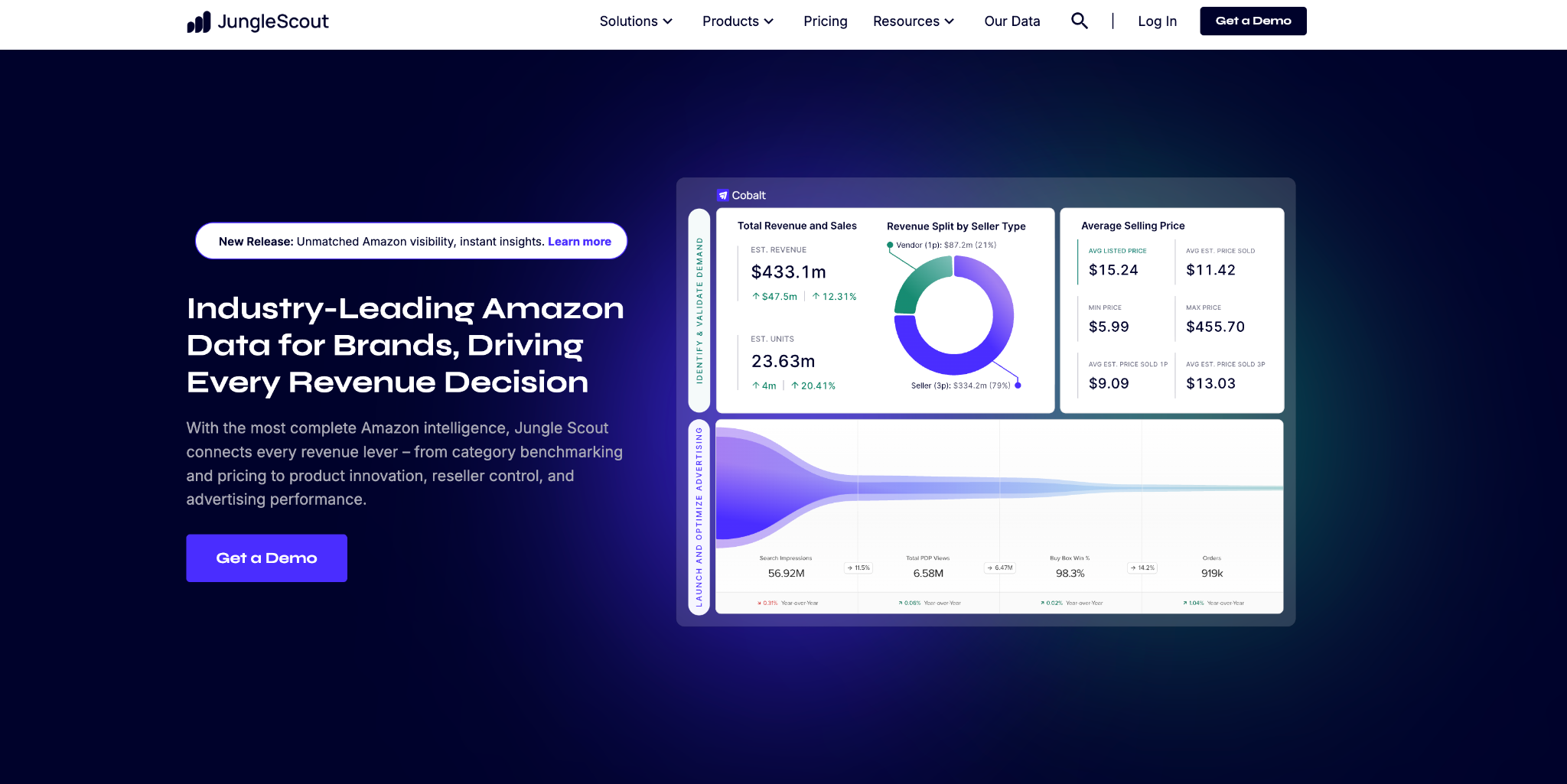
Jungle Scout is an Amazon seller platform whose Listing Builder is designed to help sellers assemble data-backed product copy from a keyword bank and push it into a cleaner optimization workflow. Its clearest differentiator is the Listing Optimization Score, a live grading layer that updates as you edit the title, bullets, description, backend search terms, and images, while AI Assist can generate titles, features, and descriptions from the keyword bank.
Choose Jungle Scout when your team needs a guided writing environment with a visible scorecard and Seller Central syncing, especially for launch-stage or mid-market Amazon sellers who want structure more than maximal customization. Its tradeoff is that it is strongest at drafting and scoring the listing itself, so sellers who need deeper market mapping or larger content supply inputs may still need neighboring tools.
Helium 10 is a broad Amazon operating stack, and its Listing Builder sits inside a much larger ecosystem that covers keyword research, profitability, operations, and ad support. Its differentiator is workflow breadth: Helium 10 says Listing Builder can sync live listings, place extra terms in the Subject Matter backend field, and connect directly to a wider tool stack, while the platform overall spans more than 30 tools.
Choose Helium 10 when your listing work is inseparable from the rest of your Amazon operations and you want one system for research, writing, account monitoring, and team access. The limitation is complexity and cost discipline, because a seller who only needs a lightweight listing environment may pay for far more platform than they actually use.
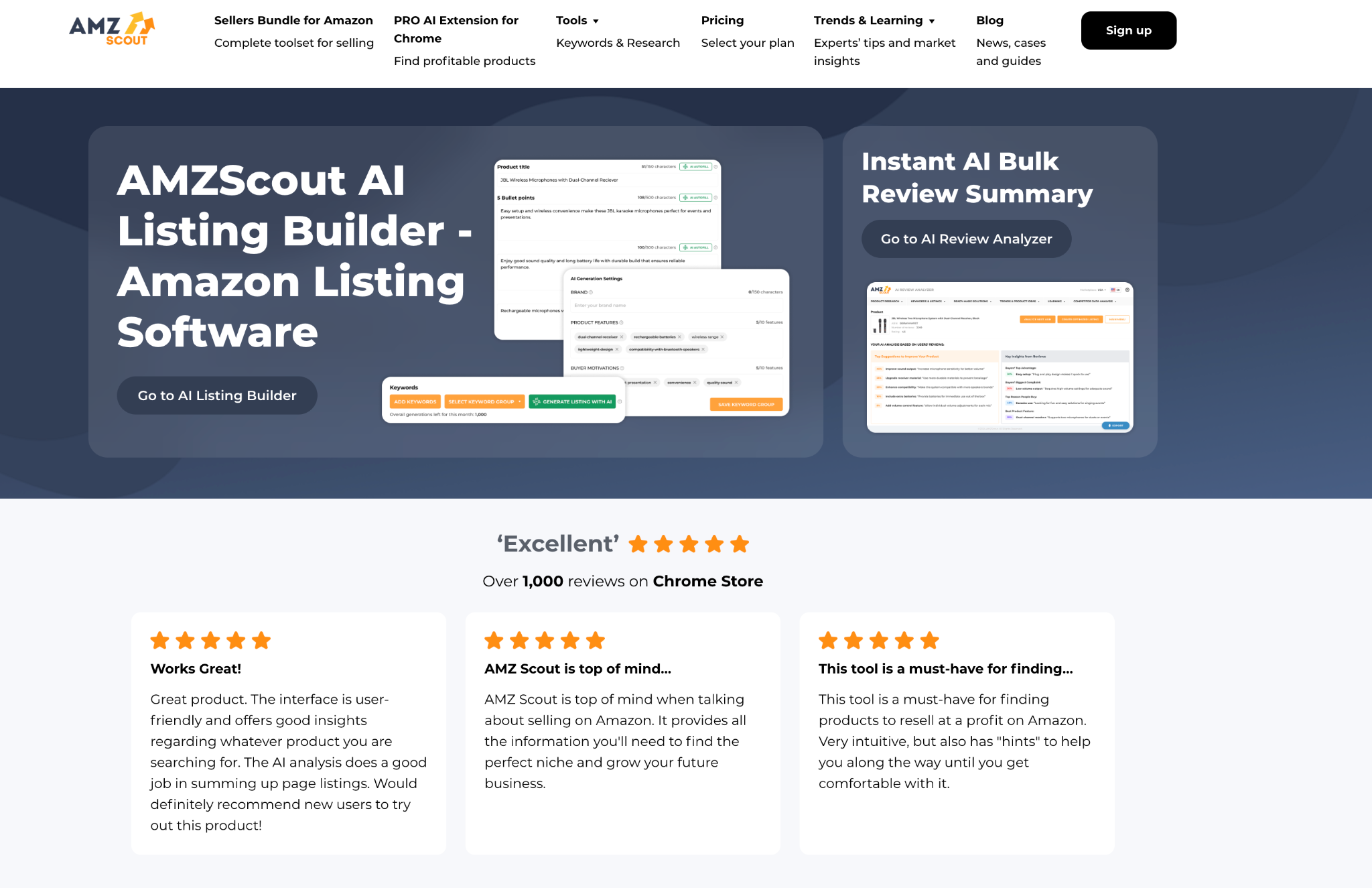
AMZScout is an Amazon-focused platform with an AI Listing Builder and AI Review Analyzer aimed at sellers who want quick, guided listing production. Its differentiator is simplicity at the lower end of the market: the AI listing package starts at $19.99 for one month, and the review analyzer is positioned as a paired input that mines customer feedback for strengths, weaknesses, and objections before you draft.
Choose AMZScout when you are a newer private label seller, reseller, or small brand that wants faster listing output without hiring a dedicated copywriter. The tradeoff is depth, because AMZScout is strongest as a practical drafting layer and less compelling if you need richer cross-channel measurement, big-team collaboration, or enterprise reporting.
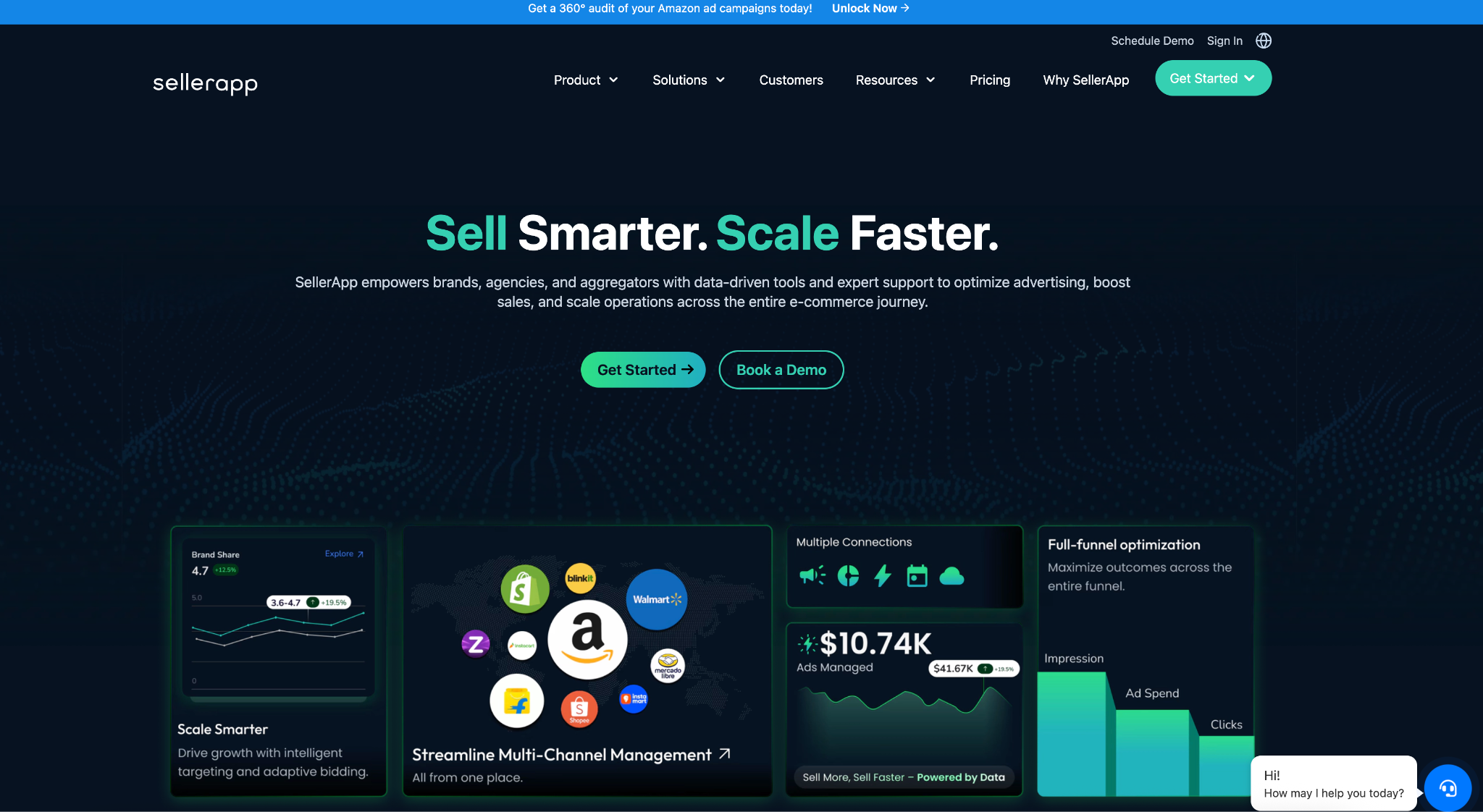
SellerApp is an all-in-one Amazon growth platform that combines listing optimization with keyword analysis, ad automation, monitoring, and managed services. Its differentiator is operating range: the company highlights listing optimization, supports a freemium entry point, covers a long list of Amazon marketplaces, and ties self-serve tools to optional managed services and agency workflows.
Choose SellerApp when your listing updates need to connect closely to PPC management or business alerts. The limitation is that it can feel more like a performance suite than a focused writing studio.
Many sellers buy a writer when they really need better inputs. The next group matters because rankings improve faster when your copy is informed by category structure, daily marketplace diagnostics, or scalable creator content.
SmartScout is an Amazon intelligence platform built around brand, seller, and product databases rather than around copy creation alone. Its strongest differentiator is top-down category and brand mapping combined with a low Basic entry point of $25 per month annually for two user seats, which makes it unusually useful for wholesale, online arbitrage, and seller discovery workflows.
Choose SmartScout when your issue is not writing the bullets but deciding what the market is actually doing, who owns the demand, and where the competitive pressure is moving. The tradeoff is that SmartScout does not replace a dedicated drafting environment, so most teams use it to sharpen strategy before they write somewhere else.
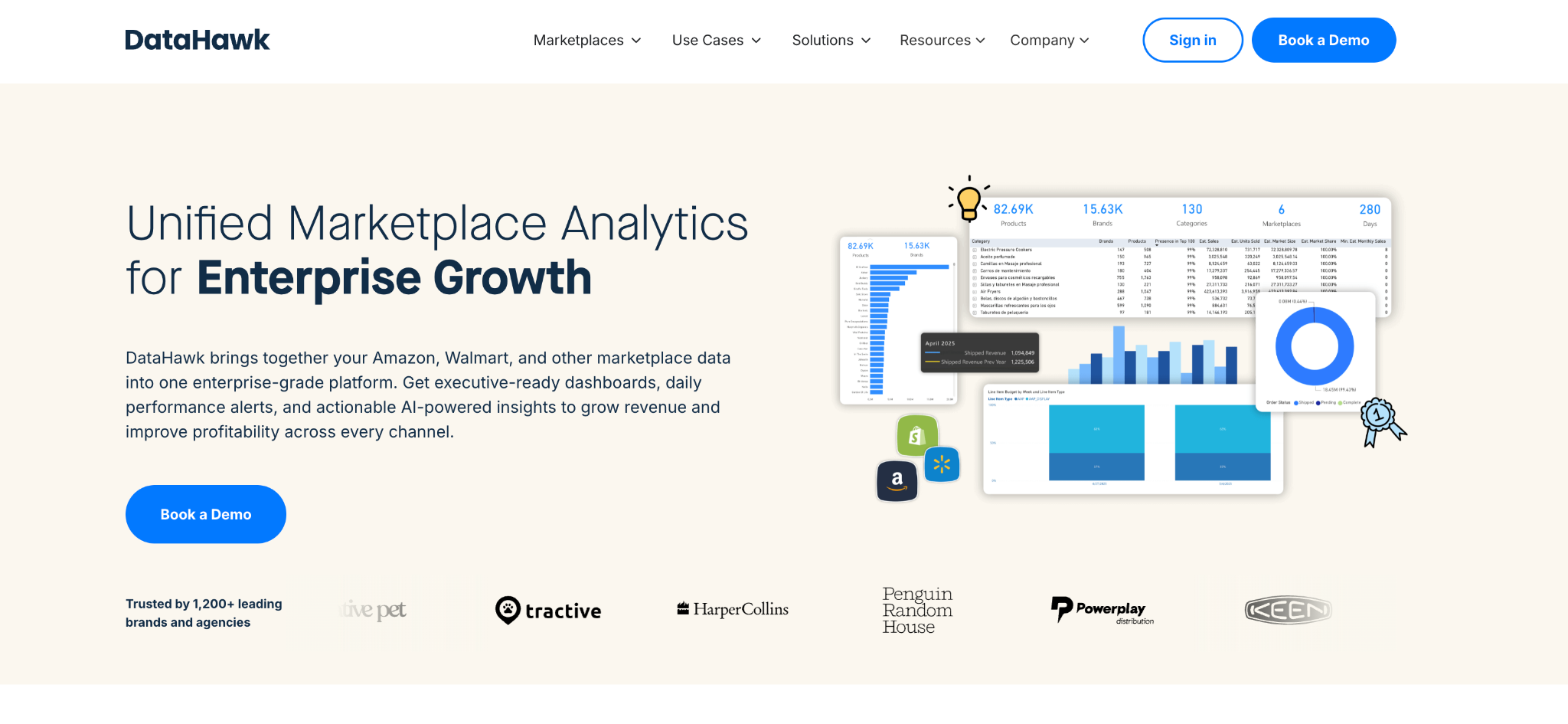
DataHawk is a marketplace analytics platform that unifies Amazon, Walmart, and other marketplace data into dashboards, alerts, and AI-guided insights. Its differentiator is diagnostic depth: DataHawk emphasizes daily SKU-level analytics, ad metrics, profitability signals, and official Amazon partner integrations, which makes it valuable when listing performance needs to be read alongside inventory, ads, and margin.
Choose DataHawk when a listing rewrite is only one part of a bigger retail execution problem and leadership wants executive-ready reporting instead of isolated content opinions. The limitation is pricing transparency and solo-seller fit, because custom annual plans make more sense for serious brands and agencies than for smaller operators testing a handful of ASINs.

Stack Influence is a micro influencer and UGC platform that improves Amazon listings indirectly by creating reusable proof assets and off-platform demand. Its differentiator is operational model: the automated product seeding workflow says creators buy the product and brands pay only after social posts go live, while the creator community page lists 340,837 creators, $14.2 million paid to influencers, and 1.1 billion total social reach.
Choose Stack Influence when your bottleneck is proof, not prose, especially if you need micro influencers, nano influencers, or UGC creators producing fresh demonstrations you can reuse across Amazon listings and broader Amazon influencer marketing solutions. The tradeoff is that Stack Influence is not a keyword drafting tool, so it works best as the content-supply layer inside the Listing Lift Sequence, not as the complete stack on its own.
Its user-generated content workflow and content syndication workflow are built around turning creator photos, videos, and testimonials into a library that can move into marketplace listings, social ads, email, and on-site experiences. The Blueland case study on Stack Influence reports 372% sales growth, a 6.3x rank gain, 247,000 impressions, and 927 new keywords during the campaign.
Here is the comparative summary for quick selection.
Most guides assume ranking problems start with writing. In reality, many listing problems begin with weak proof, stale images, poor review mining, or a total lack of off-Amazon demand signals.
Better copy fails when it makes sharper promises but shows no stronger evidence. Bazaarvoice reports that 78% of consumers feel more confident in a purchase when they view content from other shoppers, and Sprout Social found that genuine reviews and discount codes are the two influencer content qualities most likely to push a customer toward a purchase.
That is why seller teams that run creator partnerships, influencer campaigns, or product seeding often improve their listings faster than teams that only rewrite bullets. They are feeding the page with richer demonstrations, not just cleaner nouns, which is also why Stack Influence keeps tying proof assets to listing, ad, and content reuse workflows.
Fix the input system before the sentence system. If your current workflow cannot surface review themes, collect UGC video creator assets, compare competitor positioning, and reuse winning assets across channels, your next rewrite will still be built on thin evidence.
Prioritize these fixes first.
That is the same logic behind How to Build an Amazon Brand in 2026, How to Build a Brand Seeding Strategy for Amazon in 2026, and How to Use Amazon Sponsored Products in 2026. The same creator content that lifts a product page can also support Amazon storefront modules and off-platform paid traffic.
Measurement is where most listing programs become guesswork. The right model is not one KPI, but a stack that separates content lift, traffic quality, and profit impact.
Use the Three-Layer Attribution Stack as your measurement model. It keeps your amazon listing optimization tool connected to business outcomes and helps mixed teams speak the same language.
It lets you separate whether a win came from better page quality, better traffic, or better economics.
Amazon Attribution is the measurement spine for off-platform traffic because Amazon describes it as a free solution that tracks the on-Amazon impact of search, social, display, video, email, and influencer campaigns. The platform reports clicks, detail page views, add-to-cart actions, purchases, units sold, product sales, and new-to-brand metrics, and Amazon says reporting uses a 14-day attribution window.
Brand Referral Bonus matters because it changes the economics of sending qualified traffic into Amazon. Amazon says the program gives brands an average bonus of about 10% of sales driven from eligible non-Amazon marketing and keeps credit on additional purchases from the brand for up to 14 days after the click, which means influencer traffic, Amazon influencers, affiliates, and creator deals can look better on a true net basis than they do in a basic ad manager export.
Off-platform conversion paths are still messy because a creator post may drive tagged traffic, delayed brand search, or halo sales on related ASINs. That is another reason the Listing Lift Sequence ends with profit measurement instead of stopping at a higher optimization score.
The right amazon listing optimization tool does more than help you write faster. It helps you connect keywords, proof, publishing, and profit so every listing update strengthens the rest of your growth system.
If you are an eCommerce seller choosing between faster copy, better intelligence, and scalable UGC, start with the Listing Lift Sequence and buy for your actual bottleneck. Teams that combine sharper keyword workflows with creator-made proof assets usually build stronger Amazon pages, stronger ads, and a stronger margin story at the same time.
You can pick a product that sells every day on Amazon and still lose money by the second reorder. For eCommerce sellers, the hard part is not demand. It is finding demand that survives fees, returns, copycats, and rising acquisition costs.
That is why the most profitable items to sell on Amazon are rarely the loudest winners on social media. They usually sit where stable reorder behavior meets healthy gross margin, low shipping friction, and strong proof on the listing. This guide shows you how to pressure-test those products, how to sort them with the Profitability vs. Volatility Matrix, and how to scale them with better attribution and smarter creator traffic.

Amazon says the five most shopped categories from US sellers in 2023 were Health and Personal Care, Beauty, Home, Grocery, and Apparel. Amazon also says US independent sellers averaged more than $290,000 in annual sales in 2024. That tells sellers two things: the marketplace is still large, and the biggest opportunities sit in high-frequency categories with broad everyday demand. In those lanes, profitability often comes from repeat behavior and disciplined operations, not just a spike in searches. Sell on Amazon FAQ
Profitability starts with unit economics before it starts with volume. Amazon’s Professional plan costs $39.99 per month, referral fees vary by category, and Amazon’s 2026 update says FBA fees will rise by an average of $0.08 per unit sold. That is why serious sellers model economics at the ASIN level, then review the full fee stack before they buy deeper inventory. Update to U.S. Referral and Fulfillment by Amazon fees for 2026 and Stack Influence’s explainer on how much it costs to sell on Amazon in 2026 are useful starting points.
Use four tests before you call any product profitable.
A product with moderate search demand can outperform a viral bestseller if buyers come back on their own. Deloitte found that 4 in 10 American consumers surveyed were value-seekers in 2025, and those shoppers are shifting more of their budgets toward essentials while cutting back on many discretionary categories. That behavior favors products tied to routines, utility, and reliable outcomes. Deloitte’s value-seeking consumer research
Jungle Scout’s 2025 seller study adds the operational reason. It found that 38% of businesses cited higher shipping costs as a top challenge, 34% pointed to rising cost of goods, and 32% said growing advertising expenses were a concern. When those pressures rise together, novelty products get squeezed first because they need constant new demand and constant creative refreshes. State of the Amazon Seller 2025
Use the secondary tool in this guide, the Margin-Ready Checklist, before you approve inventory.
Search volume gets attention, but proof closes the sale. Bazaarvoice reports that more than 65% of shoppers consider videos from other consumers critical in their shopping experience, and its trust study found that 75% of shoppers are concerned about fake reviews. A profitable product needs enough evidence on the page and around the page to convert skeptical buyers quickly. Video Commerce 2025 and Bazaarvoice’s fake review trust study make that clear.
That matters even more for Amazon sellers using off-platform traffic. Every click from paid social, search, or creators lands on a page where the shopper decides whether the product feels real, useful, and worth the price. Weak proof increases bounce and lowers purchase rate, which means the same traffic becomes more expensive.
Treat proof as part of the product economics.
The primary framework in this article is a decision matrix because sellers do not just need ideas. They need a way to sort ideas by economic quality. The Profitability vs. Volatility Matrix uses two axes: margin strength on one side, and demand stability on the other.
Read the Profitability vs. Volatility Matrix before you source, before you bid, and before you send creator traffic. If a product does not hold up inside the matrix, no amount of PPC or UGC is likely to rescue it for long.
Describe the four zones like this.
The Margin-Ready Checklist helps you reject weak ideas early. The Profitability vs. Volatility Matrix helps you prioritize the survivors.
The product classes that win on Amazon tend to win for the same reasons. They create repeat demand, carry manageable fulfillment costs, and lend themselves to social proof. The products below are not random trend picks. They are the types most likely to stay in the strong zones of the Profitability vs. Volatility Matrix.
Beauty is one of the clearest examples of profitability through habit. Amazon includes Beauty among its most-shopped categories, and McKinsey expects online channels to account for nearly one-third of global beauty sales by 2030, with eCommerce marketplaces becoming a go-to destination for shopping and replenishment. That combination makes pimple patches, serums, shave-care refills, oral-care replacements, and specialty grooming items especially attractive when margins hold. McKinsey’s state of beauty research
This cluster works best for sellers who can explain a visible benefit fast. It also works for DTC brands that already understand creative testing, because beauty often lives or dies on proof and positioning. The tradeoff is crowding. Weak branding, vague claims, or generic packaging get punished quickly, which is why how to build an Amazon brand in 2026 matters so much in this lane.
Household essentials and pet products often look ordinary, which is exactly why they can be attractive. Amazon’s most-shopped categories include Home and Grocery, and NielsenIQ says the pet care market is at $86 billion, online sales are up 12%, and 82% of spend comes from omni-shoppers. That supports practical items like grooming wipes, litter accessories, odor control products, food storage refills, and feeding add-ons. NIQ’s Pet Retail 2025
These products fit Amazon sellers who want steadier reorder economics and lower creative pressure than beauty or fashion. They also fit Shopify brands that already see consistent repeat purchase behavior on their own store and want to extend that demand into Amazon FBA. The limitation is moat. If the product feels generic and every listing image looks the same, price compression becomes brutal. Sellers need a real angle, not just a cheaper vendor.
Light utility items win because they solve small frustrations every day. Think cable organizers, drawer dividers, travel bottles, desk accessories, kitchen organization add-ons, and low-breakage storage helpers. These products usually benefit from simple before-and-after creative, low shipping complexity, and bundle potential, which gives sellers more room to protect margin.
This category works best for Amazon sellers who can merchandize better than the market, not just source the same commodity. The tradeoff is ticket size. A cheap but stable item belongs in your catalog only if it feeds a stronger bundle, a starter set, or a multi-pack. Otherwise it can become a traffic trap with good conversion and weak profit.
Hobby and craft markets can be quietly profitable because buyers often know exactly what they need and reorder inside a narrow preference set. Sewing accessories, specialty paper goods, model-building supplies, baking decorating consumables, and organizer kits can all work when the audience is motivated and the search intent is specific. That specificity lowers waste and raises the value of good merchandising.
This lane is best for sellers who understand the customer deeply enough to speak the language of the niche, whether they sell on Amazon, Shopify, or both. The main limitation is ceiling. A niche can be very profitable without becoming very large, so the operating model should prioritize exact-query ranking, smart bundles, and proof that helps the shopper choose quickly.
If you already sell through Shopify, use your first-party data before you expand deeper on Amazon. Shopify cannot measure Amazon conversion directly, but it can tell you whether the offer already behaves like a real winner with repeat purchase timing, bundle attachment, and low refund friction. That bridge between owned-channel learning and marketplace execution is one reason how to build an Amazon brand in 2026 treats DTC evidence and Amazon readiness as one system.
Pull a simple validation set from your DTC business before you scale the ASIN.

Most Amazon sellers stop at revenue, TACoS, and review count. That is not enough if your goal is true margin. Use a named metric stack instead: the Traffic-to-Margin Stack. It connects traffic quality, conversion behavior, fee recovery, and contribution margin in one view.
Start with off-platform measurement. Amazon says Amazon Attribution is free, supports channels like search, social, display, video, email, and affiliate or influencer campaigns, and reports a 14-day attribution window with metrics including clicks, detail page views, add-to-cart, purchases, units sold, and product sales. That gives sellers a cleaner way to compare creator traffic, paid social, and email without guessing from vanity metrics.
Then account for fee recovery. Amazon’s Brand Referral Bonus says enrolled brands can earn a bonus averaging 10% of qualifying sales driven by non-Amazon traffic, with credits applied against future referral fees. That means a creator campaign should be evaluated on gross sales, bonus recovery, content assets produced, and contribution margin after fees, not just raw attributed revenue. Stack Influence’s guide on how to budget influencer marketing for Amazon brands in 2026 is helpful because it treats creator spend as a retail math problem, not just a media line item.
Build the Traffic-to-Margin Stack with these layers.
Most guides confuse fast sales with durable profit. They pull product ideas from bestseller lists or trend dashboards, then skip the annoying part: weak gross margin, fragile packaging, return risk, and the cost of keeping the listing competitive. Jungle Scout’s seller data shows how much rising shipping, goods, and advertising costs already pressure operators, so the old playbook of “find demand and figure out margin later” is much less forgiving now.
The second mistake is underestimating trust. Bazaarvoice reports that 75% of shoppers are concerned about fake reviews, and more than 65% say videos from other consumers are critical in the shopping journey. In other words, a product can have strong search demand and still underperform if it lacks convincing proof on the listing or across external traffic sources.
Here are the failure modes that deserve more attention.
Once a product survives the Margin-Ready Checklist and holds its place in the Profitability vs. Volatility Matrix, the next problem is traffic and proof at scale. This is where Stack Influence fits naturally for Amazon sellers. Its Amazon solutions page positions the platform around external traffic, listing visibility, Amazon affiliate community building, and creator-driven conversion support for marketplace brands.
The operational angle matters more than the pitch. Stack Influence’s automated product seeding page says creators buy the product and brands pay after social posts go live, which is designed to reduce inventory loss and ghosting risk compared with unmanaged gifting. For sellers running repeated launches or replenishment pushes, that workflow is more useful than one-off sponsorships because it turns creator outreach into a system. How to build a brand seeding strategy for Amazon in 2026 and how to drive traffic to your Amazon listing in 2026 show how that system can connect seeding, traffic, and asset collection over time.
A practical workflow looks like this.
If you want creator traffic that also compounds inside Amazon, pair seeding with Amazon’s Influencer Program, where creators can recommend products through a curated Amazon storefront and earn from qualifying purchases. Stack Influence’s article on how to find Amazon influencers and their storefronts is helpful when you want to map the creator layer to a specific catalog strategy. The limitation is readiness. Influencer traffic to a weak listing usually just creates expensive evidence that the offer was not ready.
The most profitable items to sell on Amazon in 2026 are the ones that keep working after the initial burst of attention fades. They live in repeatable need states, carry sane fee economics, and convert clearly enough that every new piece of traffic improves the business instead of exposing its weaknesses.
For eCommerce sellers, the real win is not finding one magic SKU. It is building a portfolio of products that pass the Margin-Ready Checklist, stay in the strong zones of the Profitability vs. Volatility Matrix, and can be measured from first click to net margin. If you want to turn those winners into scalable external demand, Stack Influence can help you connect product seeding, creator traffic, and listing proof into a repeatable growth loop.
Most influencer discount codes fail for a simple reason. Brands treat them like a coupon blast instead of a conversion system, and creators get handed generic offers that do little for trust, attribution, or repeat revenue.
For eCommerce sellers and influencers, influencer discount codes work best when the offer, the audience, and the tracking setup all match. This guide explains when to use them, how to structure them, how to measure them, and what separates a profitable code program from a margin leak.

Influencer discount codes are creator-linked offer codes that give an audience a purchase incentive while helping the brand attribute conversions to a specific partner, campaign, or audience segment. The code is not just a savings mechanic. When set up correctly, it is also a signal of audience fit, purchase intent, and creator quality.
That matters because code-driven creator content works at the intersection of trust and value. Research from Sprout Social found that in its influencer marketing research, 55% of consumers are more likely to seek out influencer content when discount or promo codes are involved, while Bazaarvoice reports in its Shopper Preference Report 2025 that 37% of shoppers are actively using coupons and discount codes as they shop.
A useful way to think about the format is this:
That last point is why codes fit especially well in micro and nano creator programs. If you sell on Amazon, this guide to influencer basics for marketplace sellers and this micro-versus-nano breakdown are useful primers for understanding why smaller communities often convert with less incentive pressure.
Influencer discount codes work when the creator is already close to the buying moment. If the audience trusts the recommendation, understands the product category, and can redeem the offer with low friction, the code becomes a nudge instead of a rescue lever.
That pattern aligns with current creator-program behavior. Later found in its 2025 State of Influencer Marketing report that 70% of leaders have turned creator relationships into ongoing partnerships, and 22% of brands cited UGC and affiliate programs as top-performing tactics. In parallel, Awin reported in its affiliate survey that 52% of surveyed marketers see personalization as a top digital objective affiliates can support.
You see the strongest code performance in a few recurring scenarios:
Codes usually underperform when the product requires too much education, the offer stacks badly with existing promotions, or the creator is too far from the purchase moment. They also struggle when brands expect the discount to compensate for weak creative, weak product-market fit, or weak landing pages.
If your workflow starts with product sampling, this product seeding guide is a useful companion read because codes tend to convert better after the creator has real product experience instead of a cold brief.
The 4 Laws of High-Intent Codes are a simple way to decide whether a code deserves to exist, scale, or expire. Instead of asking whether a creator can post a code, ask whether the code meets all four laws.
The 4 Laws of High-Intent Codes help sellers avoid a common mistake, which is evaluating codes only at the checkout layer. In practice, the creator, the offer, the asset quality, and the post-click path all shape the result. That is why code performance often improves when the campaign brief and the landing experience improve together.
The same framework protects creators too. When influencers apply the 4 Laws of High-Intent Codes to brand deals, they can push for cleaner deliverables, better-fit products, and renewal terms that reflect actual commerce value instead of one-off posting fees.
A code is especially powerful when it keeps working after the first post. That is where an asset library matters, and content syndication for creator UGC becomes relevant because strong creator assets can keep influencing conversion long after the code's first traffic spike.
Code structure determines whether you learn anything from the campaign. A messy setup creates false winners, hidden margin loss, and confused creators who cannot tell which CTA actually matters.
For DTC stores, this is partly an operations question. According to Shopify and its discount code documentation, merchants can control date windows, usage counts, minimum order amounts, eligible products, and reporting through the Sales by discount report, while its discount combinations guide explains which discount classes can combine.
Use this structure guide before launch:
The 4 Laws of High-Intent Codes still apply here. If a brand uses one generic public code everywhere, it may create sales, but it destroys the insight needed to decide which creators deserve more product, more budget, or a move into an affiliate program.
Brands also need to watch stacking risk. Shopify notes that discount combinations depend on discount class settings, and its draft-order documentation warns that letting both staff and customers apply discounts can lead to larger-than-expected markdowns. That sounds tactical, but it is really a margin rule. If you do not define combination logic before creators publish, your campaign economics can drift fast.
When the goal is long-term creator revenue rather than a one-week push, ambassador and affiliate programs are the cleaner next step because winning codes should graduate into repeatable partnerships instead of staying trapped in one-off campaigns.
Code redemptions are useful, but they are only one layer of performance. As creator programs mature, brands need a measurement system that captures intent, transactions, and compounding value.
That shift shows up clearly in the data. In the State of Creator Marketing 2025-2026 report, CreatorIQ notes that no single metric tells the full story and that marketers are moving toward a layered approach to measurement, while affiliate links or promo codes remain among the measurement methods brands find effective.
A practical way to apply that is the Revenue Signal Stack:
This becomes even more important for Amazon sellers because Amazon usually is not a Shopify-style code redemption environment. In Amazon's Brand Referral Bonus guide, the company says qualifying off-Amazon traffic can earn brand credits averaging 10% of qualifying sales when tracked with Amazon Attribution, and Amazon's Brand Registry overview lists both Amazon Attribution and Brand Referral Bonus as tools for enrolled brands.
That means Amazon creators should usually be measured with tagged links, storefront traffic, and post-click sales signals rather than a DTC-style checkout code alone. In an oral care case study, Amazon details a campaign that used Brand Referral Bonus and Amazon Attribution across social, email, SMS, and podcasts, then reported $2.1 million in one Deal of the Day, including $1 million attributed through those tools.
The hard part of off-platform conversion tracking is delayed behavior. A shopper may see a creator on social, search for the product later, then convert through Amazon search, a retargeting ad, or a direct brand visit. That is why this campaign measurement guide is a useful reference for building a reporting model that combines code data, link data, content output, and downstream marketplace behavior.

Most guides treat the code as the strategy. In reality, the code is only the commercial wrapper around creator trust, product fit, and landing-page readiness.
That distinction matters because shoppers are more skeptical than many brands assume. In Bazaarvoice's 2025 shopper research, 52% of shoppers said they distrust creator content that feels overly promotional, and 43% said authenticity comes from creators who acknowledge a product's pros and cons. A code can increase action, but it cannot rescue credibility.
The most common failure modes are easy to spot:
The 4 Laws of High-Intent Codes reduce these problems because they force the offer to stay attached to audience fit, contribution economics, and content reuse. If one of those pieces is missing, the code is probably doing less work than the spreadsheet suggests.
A final blind spot is rights and reuse. If code campaigns generate strong creator content, teams should know exactly how they can store, repurpose, and redistribute it. That is why this UGC licensing rights guide matters for sellers who want creator posts to support paid social, email, PDPs, and marketplace listings after the original promotion ends.
Stack Influence fits best when a brand's challenge is operating creator volume, not deciding whether creator marketing matters. If you are running repeated micro or nano creator batches, need product seeding, want reusable UGC, and plan to move top performers into ongoing partnerships, the platform can help connect those pieces into one workflow.
That fit becomes clearer across the platform's core pages. Automated product seeding shows how brands can reduce manual logistics, marketplace growth solutions focus on marketplace growth, and content syndication for creator UGC maps how creator assets can extend into listings, ads, email, and social after the original post.
The strongest use cases look like this:
It is not the best fit for every brand. If you want one celebrity partnership, already have a mature creator CRM and affiliate stack, or only need occasional sponsored posts, a lighter workflow may be enough. But for sellers who want code programs to compound into UGC, brand partnerships, and repeat creator campaigns, Stack Influence is a practical operating layer rather than just another discovery tool.
Influencer discount codes work best when they are treated as part of a full-funnel creator system. The offer should match the audience, the code should match the channel, and the measurement plan should match the business model.
For eCommerce sellers, that means building influencer discount codes around profitable customer acquisition, clean attribution, and reusable content. For influencers, it means choosing brand deals with a believable offer, a real audience fit, and a path toward repeat partnerships instead of one-time coupon drops.
Clicks are easy to buy and hard to turn into durable profit. For eCommerce sellers, amazon sponsored products can either accelerate ranking and revenue or quietly tax every weak product page, generic keyword, and untracked traffic source.
The winners in 2026 do not treat Sponsored Products like a standalone PPC toggle. They build a system that connects retail readiness, creator demand, measurement, and reusable UGC so each click does more work.

According to Amazon Ads' getting started guide, Sponsored Products are cost-per-click ads for individual listings that appear in shopping results and product detail pages, and Amazon recommends them as the starting point for new advertisers.
That recommendation is useful, but incomplete. As the Amazon PPC strategy guide explains, Sponsored Products works best when it sits inside a broader operating system that protects margin, ranking, and retail readiness instead of acting like a standalone bidding tactic.
Before you scale, lock in the basics:
The strongest accounts also protect continuity between the query and the page. If the ad promises one use case but the hero image, bullets, or price communicate another, the click becomes a bounce disguised as traffic.
The practical takeaway is simple. If your listing cannot convert cold traffic, Sponsored Products will only make the weakness more expensive.
Waste usually starts before the click. Tinuiti found in its Q3 2025 benchmark report that Amazon Sponsored Products clicks jumped 31% year over year in Q3 2025 while spend rose 15% and CPC fell 12%, while Pacvue saw in the Q1 2025 Retail Media Benchmark Report that Amazon EU Sponsored Products CPC stayed flat year over year while spend rose 6% as advertisers leaned toward the lower-bidding-intensity format over Sponsored Brands.
Those benchmarks matter because they show the auction is still active and attractive. Cheaper or flatter CPC does not mean easier profit if the listing, keyword mix, and post-click experience are weak.
The most common failure modes look like this:
In practice, the biggest leak is not your bid. It is a listing that lacks proof, a hero image that does not explain the product fast enough, or a review profile too thin to justify the click. That is why social proof on Amazon product pages belongs in the same conversation as bids and negatives.
Sellers also underestimate how much branded demand changes the auction. If shoppers already know your name from creator partnerships, your clicks arrive warmer, your product detail page has context, and generic search terms stop carrying all the burden. That same principle sits underneath How to Build an Amazon Brand in 2026.
The Sponsored Lift Sequence is a five-step process for turning Sponsored Products from a traffic source into a compounding growth channel. It works in order because skipping an earlier step usually makes every later step more expensive.
The Sponsored Lift Sequence also explains why more sellers graduate from manual outreach into influencer marketing platforms and UGC platforms. Once creator marketing becomes a workflow, not a side project, you can brief faster, collect more assets, and learn which voices actually move Amazon shoppers. What Is an Influencer? 2026 Guide for Amazon Sellers is a useful primer if your team is still defining the roles of micro influencers, UGC creators, and Amazon influencers.
If you need a sourcing starting point, finding Amazon influencers and their storefronts maps a practical path across hashtags, storefront clues, and creator bios. That matters because the best Sponsored Products strategy in 2026 is not only about auction math. It is about building enough branded and creator-led demand that search intent arrives warmer in the first place.
ACoS is too narrow to explain whether Sponsored Products is actually making the business stronger. A better model is the Retail Media Proof Stack, a four-tier scorecard that keeps ad metrics connected to traffic quality, conversion, and profit.
Use the Retail Media Proof Stack in this order:
Amazon Attribution is free and built to measure how non-Amazon campaigns influence discovery, consideration, and purchase on Amazon. Amazon says it can track paid and organic non-Amazon channels that drive to product pages and Stores, including search, social, display, video, email, and affiliate or influencer campaigns. For Amazon sellers leaning into creator partnerships, that makes the Retail Media Proof Stack far more useful than a one-metric dashboard.
Measurement still gets messy once shoppers move across devices and channels. A shopper can see a creator demo on social, click a retargeting ad later, and finally buy through Amazon search, which means last-click ROAS should be treated as one layer of the answer, not the whole answer.
To close that gap, tag every creator link, keep campaign names consistent by SKU and channel, and compare attributed revenue with content reuse, branded search lift, and repeat purchase behavior. Brand Referral Bonus can return an average 10% credit on qualifying sales from external traffic you drive back to Amazon, which changes the real economics of influencer campaigns.
This is also where many teams undercount halo value. A single creator video can influence the first click, improve the product page, and later become paid creative, which means the asset is doing more than one job even when only one conversion path gets logged.
Most guides treat amazon sponsored products as a bidding game. That misses the cheaper lever: proof. Research from PowerReviews in its user-generated visual content study found 91% of consumers are more likely to buy a product with review photos and videos, and 23% will not buy if there is no customer imagery at all.
Trust keeps shifting toward peer evidence as well. Bazaarvoice's shopper trust analysis says 47% of consumers trust customer testimonials and peer reviews when shopping on social media, and 39% say purchase confidence rises with review volume.
That leads to a very different optimization mindset:
That is why UGC creators, micro influencers, and future brand ambassadors deserve a seat in what looks like a pure PPC meeting. If your category depends on demonstration, comparison, or social validation, real customer footage can do more to lower wasted spend than another round of bid inflation.
In other words, the job of Sponsored Products is not to create belief from zero. It is to catch intent at the moment belief is already building from reviews, storefront exposure, creator demos, and category familiarity. That contrarian framing is what separates a spend-heavy account from a compounding one.

For sellers that already know their hero SKU, Amazon Influencer Marketing Solutions positions Stack Influence around micro influencers, content creators, and managed creator workflows built for Amazon growth. The fit is strongest when a team needs repeated creator volume more than a single celebrity placement or one-off brand sponsorship.
Its Automated Product Seeding page frames the workflow around product-first creator activation, reusable UGC, and faster campaign operations, while the Customer Success Stories hub says Stack Influence has 340k vetted creators and claims average time savings of 175 hours per month. Those are company-reported figures rather than independent benchmarks, but they clarify the operating model.
For lean teams, the operational difference is often the deciding factor. A marketplace seller may not need another spreadsheet of creators. It may need a repeatable way to source, brief, verify, and repurpose creator output without building a larger internal ops function.
Here is where that fit becomes clearest:
If you want proof of how that workflow can look in practice, Stack Influence highlights brand-reported outcomes such as Aunt Fannie's scaling to 8x Amazon sales in 90 days and other marketplace growth stories built around creator volume. That makes Stack Influence less like a generic influencer marketing agency and closer to an operating layer for product seeding and creator partnerships.
The key is to slot Stack Influence after the fundamentals, not before them. When Sponsored Products already has a defensible hero SKU, creator traffic and UGC can raise conversion, strengthen your Amazon storefront ecosystem, and give the Sponsored Lift Sequence more fuel.
The real power of amazon sponsored products shows up when it is treated as the point of capture, not the whole growth engine. The sellers who win build the listing, split intent, seed demand, prove conversion, and measure blended profit.
For eCommerce sellers, that means following the Sponsored Lift Sequence until every click improves rank, proof, and profit at the same time. If you want more efficient growth, start with one hero SKU, tag every off-platform campaign, and build a creator plan that gives your ads warmer traffic and better assets to convert it.
Amazon still rewards disciplined operators, but it punishes vague economics. For eCommerce sellers, learning how to become an Amazon seller in 2026 is less about opening an account and more about building a channel that can survive fees, fulfillment choices, compliance gates, and rising acquisition costs.
This guide shows you how to enter the marketplace with margin in mind. You will learn how to evaluate fit, choose the right selling setup, build a listing that can convert, and create a growth loop that blends Amazon FBA, Amazon Attribution, Brand Referral Bonus, Amazon storefront traffic, and creator content into one measurable system.

An Amazon seller is a business or individual that lists products in Amazon’s marketplace and fulfills orders either through its own operation or through Amazon’s fulfillment network. In Amazon’s 2024 Small Business Empowerment Report, Amazon says independent sellers now account for more than 60% of sales in the store, U.S.-based independent sellers averaged more than $290,000 in annual sales in 2024, and more than 55,000 sellers topped $1 million.
That definition matters because “seller” is not one business model. On Amazon, you can operate as a private label brand, a reseller, a wholesale operator, a handmade maker, or a multichannel brand using the marketplace as one conversion engine inside a broader Shopify or DTC stack.
Before you launch, separate the label from the operating model.
For many eCommerce teams, Amazon should be treated as a deliberate channel, not a side project. Amazon’s report also says Multi-Channel Fulfillment helped more than 300,000 sellers worldwide serve orders beyond Amazon’s store over the past year, which shows the marketplace is increasingly built for operators who sell in more than one place.
The best way to think about market entry is through the Marketplace Readiness Ladder. It is a four-tier model that forces you to graduate from access to efficiency, then from efficiency to defensibility, and finally from defensibility to measurable demand.
Use the Marketplace Readiness Ladder to assess whether you are actually ready to sell.
If you skip the second tier of the Marketplace Readiness Ladder, you can confuse revenue with profit very quickly. On Amazon’s pricing page, Amazon lists an Individual plan at $0.99 per item sold and a Professional plan at $39.99 per month, while referral fees vary by category, so the wrong setup can hurt margin before your first review appears.
The third tier is where serious sellers separate from casual ones. Amazon’s New Seller Guide says sellers who use the guide during their first 90 days generate approximately 6x more first-year sales on average, and enrolled brands can unlock incentives like 10% back on the first $50,000 in branded sales and 5% back through the first year until $1 million.
The practical answer starts before Seller Central. Use the Seller-Ready Checklist before you register, because the fastest way to waste time on Amazon is to create a listing for a product that cannot absorb fees, cannot win approval, or cannot earn trust once it appears.
Run this Seller-Ready Checklist before you sign up.
Your business model should follow defensibility, not trend chasing. If you want long-term brand equity, how to start Amazon private label in 2026 is the more durable route, while wholesale or resale can get you live faster but often creates more exposure to gating, price compression, and Buy Box pressure.
The plan you choose should match how you will operate after launch. The Professional plan usually makes more sense once you need advertising, bulk listing tools, and brand features, while casual sellers moving a few units can start simpler and upgrade when the business case is real.
The first 90 days are where sequencing matters most. If you treat that window as a sprint to activate the New Seller Guide, tighten your economics, and clarify your brand path, you are building the first three levels of the Marketplace Readiness Ladder in the right order instead of improvising later.
FBA versus FBM is really a margin and control decision. The question is not which model sounds more sophisticated, but which one better supports your cash flow, customer expectation, and product shape.
Choose fulfillment based on SKU reality, not seller folklore.
Fulfillment by Amazon can create real leverage when the SKU profile fits. Amazon says shipping with FBA costs 70% less per unit than comparable premium options offered by other major U.S. carriers, which is meaningful when logistics are the difference between viable and break-even.
That does not mean FBA is universally better. If your catalog includes oversized items, low velocity products, or bundles that change often, FBM may protect profit better and reduce storage risk, and if you are still pressure-testing costs, Stack Influence’s guide on what it costs to sell on Amazon in 2026 can help you model real contribution instead of surface revenue.
For sellers that already run Shopify or another DTC channel, hybrid often beats platform loyalty. Amazon’s own multichannel tools and off-platform measurement products suggest that using Amazon for high-intent conversion while keeping owned channels for bundles, subscriptions, and first-party retention is a normal operating pattern, not a compromise.

Most beginner content treats Amazon as a setup project. Realistically, the hard part is not registration, it is entering a high-intent marketplace without enough margin, enough proof, or enough differentiation to survive your first few months.
Here is what most guides miss.
That last mistake gets more expensive every year because costs are climbing across the board. Jungle Scout’s State of the Amazon Seller 2025 says 38% of brands cite higher shipping costs as a top challenge, 34% struggle with rising cost of goods, and 32% say growing ad expenses are a concern, which is a reminder that sloppy launches get punished faster in 2026.
The better move is to build proof before scale. Bazaarvoice research says 85% of consumers turn to visual UGC over branded content when making purchasing decisions, so sellers who pair clear listings with believable content usually give paid traffic a better chance to convert.
That is why it makes sense to connect listing work, how to build an Amazon brand in 2026, and how to build Amazon PPC strategy in 2026 instead of handling them as separate checklists. The strongest launches look coordinated to the shopper, even if the backend work spans ops, content, paid media, and creator partnerships.
Revenue is too late and ACOS is too narrow. A better system is the Amazon Signal Stack, a four-layer measurement model that connects awareness, shopping behavior, source-level attribution, and profit reality.
Use the Amazon Signal Stack to keep the business honest.
Amazon says Amazon Attribution is free and measures the on-Amazon impact of search, social, display, video, email, and affiliate or influencer campaigns. Amazon also says Brand Referral Bonus returns an average bonus of 10% of qualifying sales from non-Amazon marketing, which means better tracking can directly improve margin.
There are still blind spots, so use the Amazon Signal Stack honestly. Amazon support documentation says Amazon Attribution uses a 14-day, last-touch attribution model, which makes it strong for tagged conversion analysis but weaker for upper-funnel influence, delayed repeat purchase behavior, and brand lift that appears outside the attribution window.
That limitation matters because external demand is now a meaningful commerce layer, not a side tactic. In Amazon’s Honest Paws case study, the brand says 75% to 80% of its external marketing traffic goes to Amazon and that conversion rates were 3 to 4 times better, and in some cases 10 times better, when the shopper clicked the Amazon link.
Creator-led commerce is also getting too large to treat casually. IAB’s 2025 Creator Economy Ad Spend & Strategy Report says U.S. creator ad spend reached $37 billion in 2025, and Sprout Social’s 2024 influencer research says 49% of consumers make daily, weekly, or monthly purchases because of influencer posts.
For brands that sell on both Amazon and Shopify, the operating goal is not to crown one winner forever. The smarter move is to compare contribution paths, use Amazon Attribution for marketplace conversion, use your owned-site analytics for pre-click and retention behavior, and document which path creates the best blended margin, and if you need a tactical walkthrough, Stack Influence’s Amazon Attribution guide is a strong starting point.
Stack Influence fits after you already have a product worth scaling. It is most useful when an eCommerce seller needs creator volume, reusable UGC, and off-platform demand without building a large manual outreach operation from scratch.
Workflow design is the differentiator. On Stack Influence’s automated product seeding page, the company describes a model where creators buy the product and the brand pays only after social posts go live, which makes the platform most relevant for Amazon sellers that want creator output tied to a repeatable operational process rather than one-off sponsorships.
Here is where Stack Influence tends to fit best.
This is also where the brand side and creator side split. Amazon says the Amazon Influencer Program gives creators their own Amazon presence with a vanity URL and curated recommendations, which is useful for storefront-led traffic, while Stack Influence helps the brand side source, brief, and manage creator activity at scale.
If you want the operating playbook behind that approach, Stack Influence’s guides on how influencer seeding works for eCommerce in 2026 and how to drive traffic to your Amazon listing in 2026 show how Amazon sellers and DTC brands can connect creator content, external traffic, and measurable marketplace growth.
If you want the simplest answer to how to become an Amazon seller, it is this: start with a product that can survive the math, a listing that can earn trust, and a channel role that makes sense inside your broader business. Then move up the Marketplace Readiness Ladder one layer at a time.
eCommerce sellers who win on Amazon usually do not win because they opened an account faster. They win because they chose the right fulfillment path, measured the right signals, built proof before heavy spend, and turned external traffic into attributable revenue, so audit your margin, choose your first proof engine, and build the channel like an operator.
eCommerce sellers are being pushed in two directions at once. U.S. creator ad spend is projected to reach $37 billion in 2025, and social platforms are increasingly functioning like product-search engines for shoppers. That means discovery often starts with creator content, reviews, and social posts long before a customer lands on Amazon or a DTC checkout.
Amazon multi channel fulfillment matters because it can remove shipping drag from that discovery path, but logistics alone do not create profitable growth. The brands that win usually connect fulfillment, attribution, and creator-led proof into one operating system instead of treating shipping as an isolated department. This guide shows eCommerce sellers where MCF fits, how to measure it, and how to use it without quietly leaking margin.

Amazon multi channel fulfillment is Amazon’s 3PL service for orders placed outside the Amazon marketplace. In Amazon’s own guide from Amazon, MCF uses the fulfillment network many sellers already know from Amazon FBA, but serves off-Amazon orders while the seller still owns customer service for those non-Amazon transactions. That makes MCF a powerful operational layer, but not a substitute for channel strategy.
The appeal is simple. Sellers can create orders one by one, in bulk, or through integrations, and Amazon positions MCF around standard and expedited shipping options that help merchants serve websites and social commerce channels without standing up a second fulfillment system. The commercial question starts when you compare those benefits against real fee structure, channel promises, and contribution margin.
Before you decide whether MCF belongs in your stack, focus on the operating changes it actually creates:
It feels bigger because fulfillment now affects marketing economics. McKinsey’s delivery research shows shoppers care deeply about shipping cost, reliability, and flexibility, not just raw speed, so the fulfillment choice changes your CAC tolerance and your conversion ceiling.
That is why MCF should sit inside a broader commerce plan. If your listing quality, offer architecture, and external demand engine are weak, MCF just helps you ship under-optimized demand faster, which is why many sellers pair it with a broader Amazon brand playbook before they scale new channels.
The Five-Step Channel Sync Sequence is a practical process for deciding whether MCF should support a SKU, a channel, or only a short-term expansion test. Its purpose is simple: do not make a fulfillment decision before you have a margin model and a traffic model.
Use the Five-Step Channel Sync Sequence in order. The brands that skip steps usually end up with one of two bad outcomes: great shipping mechanics with weak demand, or strong demand with invisible fulfillment drag.
Start by modeling MCF fees, landed margin, unit weight, and destination risk by SKU. Amazon’s MCF pricing makes clear that economics change with size tier, shipping weight, delivery speed, and region, so MCF should be evaluated product by product, not as a blanket channel decision.
Decide whether the channel needs a more controlled post-purchase experience than Amazon can support. Premium DTC brands, subscription products, and bundle-heavy assortments often need more than fast shipping, so the right answer can be a hybrid model instead of a full migration.
Use shared inventory where pooled stock truly improves performance. Amazon says U.S. sellers using both MCF and FBA reduced out-of-stock rates by 19% on average and improved inventory turnover by 12%, but those gains only matter when the same units can serve both channels without distorting margin.
Instrument demand before the first creator post, ad, or email goes live. A seller-friendly Amazon Attribution walkthrough on your side paired with Amazon Attribution tags on the platform side makes it far easier to compare influencers, affiliates, paid social, and brand ambassadors without collapsing them into one traffic bucket.
Increase volume only after the channel has proven both delivery reliability and profitable retail response. If your expansion plan also depends on a stronger Amazon traffic planning guide or a sharper Shopify influencer marketing playbook, validate the fulfillment promise before you widen the media budget.
Most sellers do not need every SKU on MCF. The Five-Step Channel Sync Sequence usually reveals a smaller launch group that is easier to forecast, easier to tag, and far less likely to surprise finance later.
That is especially useful for DTC brands that want to test new channels without building a second warehouse model on day one. Instead of asking whether MCF is good or bad, ask whether a specific SKU and a specific path to purchase earn the right to use shared inventory.

Amazon multi channel fulfillment makes the most sense when operational simplicity is worth more than full-stack customization. That usually describes Amazon-first sellers, lean eCommerce teams, and brands expanding into Shopify, TikTok Shop, or other channels that need fast, credible shipping before they need a deeply customized warehouse playbook.
The strongest use cases tend to share the same pattern. The catalog is tight, the team is lean, and the brand wants to move faster than a full 3PL transition would allow. That is why MCF often works best as a speed-to-market layer rather than a forever answer for every product.
Use this filter before you deploy MCF broadly:
The more your business depends on customer experience as a differentiator, the more selective you should be. Many brands keep fast-moving replenishment items on MCF while protecting bespoke bundles, fragile launches, or premium unboxing moments on a separate path.
MCF should be measured like a growth system, not just a warehouse expense. If you only track speed and fee per unit, you will miss the bigger question of whether off-Amazon traffic is becoming more profitable because fulfillment, merchandising, and proof are working together.
A stronger model is the Profit Signal Stack, a four-layer measurement framework that connects operations, traffic quality, retail response, and recovered margin. It is especially useful for Amazon sellers running influencer campaigns, affiliate links, creator partnerships, and external media into Amazon product pages.
Track the Profit Signal Stack in this order:
Amazon Attribution is essential, but it is not a complete answer to incrementality. Amazon’s own guide explains that it measures tagged non-Amazon campaigns into Amazon destinations, which means organic halo, saved content, untagged shares, and delayed lift can all influence demand without being perfectly credited back to the original creator touchpoint. This is a limitation of measurement design, not proof that creator traffic failed.
That is why sellers should compare campaign-level tags with account-level behavior. If tagged traffic looks break-even while branded search, conversion rate, or repeat purchase behavior improves, you may still be creating value that last-touch logic cannot fully capture, which is also why a companion ROI checklist for influencer programs helps keep reporting grounded.
Most guides get MCF wrong by treating it like a universal upgrade. In reality, it is a very good answer to a narrow problem: how to fulfill more channels from one network without building a full warehouse operation of your own.
The real failure modes are commercial, not technical. Sellers lose profit when they move every SKU into shared inventory, let logistics decisions outpace proof on the retail page, or assume faster shipping can compensate for a weak listing and weak social validation.
Watch for these mistakes first:
Shared inventory can create a false sense of security. Teams see fewer stockouts and cleaner operations, then miss the fact that one channel is absorbing the highest fee burden while another is consuming the best units, which is why inventory efficiency should trigger deeper analysis, not end it.
Channel rules can also change what good fulfillment looks like. Amazon’s AFTN guidance for TikTok Shop says the tracking number can be generated within minutes of order creation to help sellers meet TikTok Shop fulfillment SLAs, which is a useful reminder that each sales surface can define success differently.
MCF lowers shipping friction, but it does not create demand. That job belongs to retail merchandising and creator-led traffic, which is one reason the IAB’s creator report and Sprout Social’s research matter so much here: creators are now a real commerce channel, and social content is increasingly influencing product discovery and purchase.
For Amazon sellers, the smartest creator workflow is usually simple. Use product seeding to create proof, push tagged traffic to Amazon, and convert the creators who outperform into ongoing brand ambassadors rather than repeating disconnected brand sponsorships or one-off brand deals that never compound.
If you want a practical operating pattern, start here:
The answer depends on shopper intent. High-intent traffic from creators already familiar with your niche often works well with product pages, while colder traffic may need a curated destination such as an Amazon storefront or the discovery path common in the Amazon Influencer Program, which gives creators a custom Amazon presence and vanity URL.
If you are still figuring out who should send traffic where, this resource on finding Amazon influencers and storefronts is a practical place to start. It is especially useful when your team is sorting creator roles across Amazon storefront traffic, off-platform social, and marketplace conversion paths.
This is where Stack Influence fits naturally for brands that work with micro influencers at volume. Stack Influence’s automated product seeding workflow says creators buy the product and brands pay after posts go live, its UGC workflow for eCommerce focuses on reusable content assets, and its pricing page advertises an average of $30 per creator post, while the creator page says the network includes more than 340,000 creators. That makes it useful when coordination is the bottleneck, although it still cannot rescue weak listing economics or vague attribution goals.
If your question is where creator operations should live, the answer is usually near fulfillment, not far from it. That is the gap described across Stack Influence’s Amazon creator campaign solutions and its brand case studies, where sourcing, seeding, content collection, and repeat influencer campaigns become part of one repeatable system.
The right amazon multi channel fulfillment strategy is not about routing every order through Amazon. It is about choosing the SKUs that benefit from shared inventory, measuring external demand correctly, and using creator proof to make each click more likely to convert.
If you want the simplest next move, do these three things first:
That sequence helps Amazon sellers turn off-Amazon discovery into profitable growth instead of operational noise. For eCommerce sellers, that is the real advantage: cleaner logistics, better measurement, and a stronger path from creator discovery to repeat revenue.
For eCommerce sellers and influencers, the content bottleneck is no longer making one good asset. It is turning every strong review, demo, unboxing, or founder post into a repeatable stream of traffic and sales before attention expires. IAB says U.S. creator ad spend reached $37 billion in 2025 and grew about four times faster than the broader media industry, which means the brands that win are the ones that reuse creator proof across channels instead of letting it die on one feed.
Content syndication is the operating system for that reuse. This guide explains what content syndication means for eCommerce, how to build a five-step workflow, how to measure it on Amazon and DTC, and where Stack Influence fits when you need fresh UGC from micro influencers at scale.

For eCommerce, content syndication is the structured reuse of one asset across owned, social, retail, and marketplace touchpoints, with the original source, rights, and measurement path kept intact.
That definition is broader than classic publisher syndication. A creator video clipped into a PDP gallery, an Amazon traffic-driving Reel reused in email, and a review snippet pushed to retailer pages all count, as long as the message stays consistent and the destination matches shopper intent.
Used well, content syndication lets the same proof travel through the buying journey without feeling repetitive. A shopper might first see a creator mention on social, then encounter the same product in an ad, then land on a product page where the proof is tightened into a demo, testimonial, or objection-handling clip.
The reason this matters is trust. As Bazaarvoice found, one in five shoppers defines a quality review as one with photos or video, and younger digital shoppers place outsized value on visual UGC. That makes syndication less about volume and more about moving proof to the exact place where hesitation shows up.
Search mechanics also matter. If you republish long-form content on partner sites, Google's canonical guidance recommends explicitly identifying the preferred URL, and Google has also said in SEO office hours that syndicated versions may still appear unless the republished page is noindexed when you do not want it surfaced in Search. For sellers, that means educational content can be widely reused, but the source page still needs technical protection.
A working content syndication strategy needs order, not enthusiasm. The 5-Step Syndication Lift Sequence keeps teams from publishing the same asset everywhere and instead turns each creator deliverable into a controlled chain of versions.
The sequence starts upstream with source quality. If the original creator brief is vague, the asset will be hard to reuse across PDPs, ads, and retailer pages later, which is why the best inputs usually come from specific demos, objections, comparisons, and before-and-after moments instead of generic praise. Stack Influence's resources on how influencer seeding works for eCommerce and types of content creators show why reuse should be planned before the first post goes live.
The payoff is real because creator content changes buying behavior. As Sprout Social reports, 49% of consumers make daily, weekly, or monthly purchases because of influencer posts, so every good asset should be treated like a reusable sales input, not a one-time social event. When the Syndication Lift Sequence is followed, one creator post can become a listing proof point, an ad variant, an email module, and a retargeting hook without starting from zero each time.
Most brands over-syndicate weak assets and under-syndicate winning ones. Your first destinations should be the places where shoppers either validate trust or move closest to checkout.
If you sell on multiple channels, think in terms of purchase proximity. The closer a surface is to checkout, the more your version should emphasize proof, objections, and product use, while upper-funnel placements can carry a broader story or founder angle. That is why the Syndication Lift Sequence works best when the asset gets more specific as it moves down the funnel.
Owned channels usually deserve priority because they preserve more control. Before you chase third-party reach, make sure your product pages, retention emails, and ad accounts already contain your best creator proof. Teams that are also refining how to do eCommerce social media marketing and how to budget influencer marketing for Amazon brands usually get more leverage from this sequencing than from adding another syndication target too early.
Consumers increasingly reward brands that extend creator partnerships beyond a single post. As Sprout Social found, 80% of consumers are more likely to buy from brands that work with influencers on projects beyond social media content, including multichannel campaigns. For eCommerce sellers, the smartest first move is not more creators. It is better channel placement for the proof you already have.
Measurement is where most content syndication programs get demoted to brand awareness. The fix is to track syndication in layers so you can see what asset earned attention, what channel created shopper action, and what touchpoint actually produced revenue.
The Syndication ROI Stack solves that by separating your reporting into layers that answer different questions. One layer tells you whether the asset was noticed. Another tells you whether the shopper moved deeper into consideration. The final layers show whether the content produced revenue and whether the asset kept paying you back after its first post.
For Amazon sellers, Amazon Attribution is the anchor. Amazon says the tool can show detail page views, add-to-carts, sales, and new-to-brand metrics from non-Amazon marketing, which gives you a cleaner bridge between creator posts and on-Amazon outcomes. Use unique tags by creator, by asset angle, and by placement so you can separate a high-performing message from a merely high-performing person.
The second layer is economics. Amazon's Brand Referral Bonus program says eligible brands can earn an average 10% bonus on qualifying sales from traffic they drive to Amazon, so content syndication ROI should be calculated after you account for that credit rather than before it. A creator campaign that looks break-even on the surface can turn profitable once referral bonuses are included.
The hardest part is off-platform leakage. Shoppers may see a creator video on one channel, search your product later, and buy through a different click path, which means last-click reporting will understate influence. In those cases, pair attribution tags with cohort windows, branded search lift, review velocity, and SKU-level sales changes, then compare those patterns against a non-syndicated control period.
This is also where seller teams need discipline. If a creator asset is reused in ads, retail, email, and marketplace traffic at once, you need naming conventions and time stamps that preserve the path from source asset to downstream performance. Stack Influence's guide on how to measure influencer campaigns is a helpful model for building that operational habit before the reporting gets messy.

The biggest mistake in content syndication is assuming distribution creates value by itself. It does not. If the republished asset is detached from the right channel, landing page, rights terms, or source URL, you are just multiplying confusion.
As Google has warned about spammy links in large-scale article campaigns, syndication can become an SEO liability if it turns into link manipulation, and Google's spam policies also flag republishing other sites' content without original value as abusive scraping. That is why the safest form of content syndication is never blind duplication. It is controlled reuse with attribution, technical guardrails, and a real audience fit.
The contrarian view is that smaller, rights-ready libraries often outperform giant creator dumps. A few specific clips that answer sizing, setup, ingredients, durability, or comparison questions will compound faster than dozens of generic lifestyle posts. If you are running micro influencers, prioritize editability and placement range over vanity reach.
Stack Influence fits content syndication best when the problem is upstream supply, not just downstream placement. On its eCommerce growth pages, Stack Influence says it works with 340,000 vetted creators, saves brands 175 hours per month, and helps drive 4x ad conversions, which is useful when a seller needs a steady flow of UGC that can move from organic posts into PDPs, paid media, and marketplace testing.
The operational reason matters more than the headline numbers. Content syndication only compounds when briefs, asset collection, proof of post, and reuse rights are organized early, and Stack Influence's resources on how brands manage UGC licensing rights, its Amazon influencer marketing page, and the workflow behind creator seeding all point toward that more structured operating model.
The case studies show why that matters. The Lenny & Larry's case study reports 11x monthly sales growth, 1,560 creator promotions, and 2.3 million impressions, while the Blueland case study reports 372% sales growth in two months and 927 new ranking keywords. Those numbers do not prove every brand will see the same outcome, but they do show how syndication works when content creation, distribution, and measurement are linked.
Content syndication becomes a growth system when you treat creator content like reusable commerce inventory. For eCommerce sellers and influencers, the winning move is to build a source asset once, adapt it by channel, protect the original, and measure the chain all the way to revenue.
If you want more content syndication output without turning your team into a spreadsheet department, start with a smaller batch of rights-ready UGC, run the Syndication Lift Sequence for 30 days, and expand only after you know which proofs convert. That is how content creators, micro influencers, and seller teams turn attention into repeatable sales.
Amazon sellers rarely lose margin because of one obvious fee. They lose it because plan fees, referral fees, fulfillment, ads, returns, and weak listing conversion stack on top of each other until a product that looked healthy on paper starts behaving like a break-even SKU.
If you are an eCommerce seller trying to answer how much does it cost to sell on Amazon, the useful answer is not one number. It is a cost model. This guide breaks that model into clear layers, shows when each expense becomes material, and gives you a clearer way to decide what Amazon growth should actually cost.

The cleanest way to answer the cost question is to separate access costs from performance costs. Amazon's standard selling fees page separates selling plan fees from referral fees, while the State of the Amazon Seller report shows that shipping, cost of goods, and advertising all press on margins at the same time.
That distinction matters because most margin leaks happen outside the headline fee schedule. Marketplace Pulse's 2026 Seller Index analysis found that 49% of active Amazon sellers named marketplace fees as their primary margin concern and 46% named advertising spend, which is a strong signal that the real issue is total commercial efficiency, not one isolated line item.
Before you decide whether Amazon is expensive, model these four layers:
Once you put those layers together, Amazon looks less like one marketplace fee and more like a ladder of commitments. That is why a low-volume reseller, a private-label launch, and a mature brand can all sell on Amazon while carrying very different cost structures.
To make that math usable, I like to frame it as the Amazon Cost Clarity Ladder. It is a four-tier model that maps your cost structure to operating maturity, not only to revenue.
The point of the ladder is simple. Do not buy complexity before you can use it. Every move up the ladder should unlock a new capability, a new margin advantage, or a better measurement system.
Here is how the Amazon Cost Clarity Ladder works:
The Amazon Cost Clarity Ladder keeps planning honest because it turns cost decisions into stage decisions. It also prevents a common mistake: paying for a scale setup while still operating like a test seller.
At the bottom of the ladder, the Individual plan can be rational for true low-volume selling. On pure fee math, though, the Professional plan overtakes it at roughly 41 units a month because Amazon lists the Individual plan at $0.99 per item sold and the Professional plan at $39.99 per month.
The next layer is referral fees, and this is where lazy assumptions get expensive. Amazon's fee schedule is not one flat percentage across the catalog. Search snippets for Amazon's current seller fee schedule show examples like 8% to 15% structures in several common categories, while price-banded categories such as clothing and grocery can change economics when a SKU crosses a threshold.
Use this stage-by-stage lens when you build your forecast:
The same product can move through all four versions of that math over its lifecycle. That is why the Amazon Cost Clarity Ladder is more useful than any single average-fee estimate. It keeps you focused on stage-specific costs that are justified now, not later.
Most guides treat conversion and returns as marketing problems when they are really cost problems. If your listing does not persuade shoppers cleanly, every click gets more expensive. If your listing overpromises and the product disappoints, post-purchase cost rises too.
This is where weak content becomes a hidden Amazon fee. Salsify's 2025 Consumer Research says 54% of shoppers have abandoned a sale because product content was inconsistent across channels and 71% have made a return because the product did not match the online listing. At the same time, Bazaarvoice's Shopper Preference Report release says 52% of shoppers cite real customer reviews as the biggest factor in final purchase decisions, and PowerReviews' ratings and reviews guide says 85% of shoppers are less likely to buy a product with no ratings or reviews.
The secondary tool that helps here is the Margin Guard Checklist. Run it before you spend harder on traffic:
The Margin Guard Checklist matters because Amazon rarely punishes sellers all at once. It punishes them in layers. First conversion softens. Then ad efficiency slips. Then inventory lingers. Then returns become visible. By that point, the original mistake is hard to isolate.
If you plan to bring creators into the mix, Stack Influence's Amazon Influencers glossary is a useful refresher on why creator-led commerce can shorten the path from discovery to purchase. The common thread is context: shoppers want believable proof, and Bazaarvoice's research shows they are skeptical of content that feels overly promotional.

Amazon measurement breaks when sellers jump straight from a creator post or a social ad to last-click sales. A better approach is the Traffic to Margin Stack. It reads performance in layers so you can see whether traffic is qualified, whether the listing converts, and whether the economics still work after Amazon takes its share.
Amazon Attribution is the backbone of that stack for eligible sellers. On the Amazon Attribution product page, Amazon describes it as a free measurement solution for non-Amazon channels and says it reports metrics such as clicks, detailed page views, add-to-cart actions, purchases, units sold, product sales, and new-to-brand outcomes.
Use the Traffic to Margin Stack in this order:
Even this stack has limits, and good sellers respect them. In Amazon's complete guide to Amazon Attribution, the company says Attribution uses a 14-day last-touch model and that eligible U.S. seller brand owners can earn a Brand Referral Bonus averaging 10% of product sales driven by measured non-Amazon traffic, with a two-month processing delay before the bonus is received.
If you need a simpler implementation workflow, Stack Influence's guides on how to track influencer marketing, how to budget influencer marketing for Amazon brands, and a brand seeding strategy for Amazon are useful complements because they turn attribution from a dashboard feature into an operating routine.
Stack Influence fits when your margin problem is not only traffic cost. It fits when you also need more conversion proof, more creator volume, and less manual campaign work. The company's Amazon influencer marketing solutions and Amazon influencer marketing page position the workflow around automated product seeding, reusable UGC, external traffic generation, listing visibility, and stronger conversion support rather than one-off celebrity-style placements.
The economics are part of the appeal. The Stack Influence pricing page says brands pay about $30 per creator post on average, while its micro influencer cost benchmarks page highlights roughly 340,000 vetted creators, 175 hours saved per month, and a 4x ad conversion benchmark. That positioning suggests a workflow built for throughput instead of slow, manual outreach.
The best-fit scenarios are usually straightforward:
That fit shows up in Stack Influence's own published proof points. Its pricing page highlights stories such as Aunt Fannie's scaling to 8x Amazon sales in 90 days and Naked Sunday reaching 10x Amazon sales in four months, while the Amazon growth page also features customer examples tied to revenue and rank lifts.
There is a real tradeoff, and it is worth stating clearly. Stack Influence is strongest when you want repeated micro-creator output tied to eCommerce workflows. It is less useful if your plan depends on one celebrity partnership, extremely bespoke talent vetting, or a brand team that wants total control over every asset.
The strongest reason to consider Stack Influence is not that it replaces Amazon fees. It does not. The stronger reason is that it can make future traffic more efficient by improving the two levers many sellers underfund: believable content and trackable outside demand.
So how much does it cost to sell on Amazon? For most eCommerce sellers, the answer starts with plan fees and referral fees but ends with a broader equation that includes fulfillment, ads, returns, content quality, and measurement discipline.
If you need a simple next move, start here:
Use the Amazon Cost Clarity Ladder to decide which layer of expense you have actually earned. Run the Margin Guard Checklist before you buy more traffic. Then measure outside demand with the Traffic to Margin Stack so growth channels are judged on profit, not hope.
If you want Amazon growth that gets smarter as it scales, build for reusable proof, not just short-term clicks. That is the shift that can turn how much does it cost to sell on Amazon from a stressful question into a strategic advantage.
If you are an eCommerce seller or influencer trying to grow Amazon revenue, the real problem is not traffic. It is paying for clicks that never turn into durable profit. Retail media ad spend grew 33% year over year in Q4 2025, which means more brands are walking into the Amazon auction with bigger budgets and less patience for sloppy structures.
A strong Amazon PPC strategy in 2026 has to do more than lower ACoS. It has to protect margin, improve listing conversion, and connect paid search with the demand you create outside Amazon. This guide shows you how to build that system, how to measure the parts that ad dashboards miss, and where creator-driven traffic can make PPC work harder instead of just cost more.

Amazon PPC strategy is the operating system behind how a seller buys visibility, captures demand, and turns ad learnings into broader account growth. It is not just a bidding tactic. It is the coordinated use of Sponsored Products, Sponsored Brands, Sponsored Display, listing readiness, and measurement rules to decide which traffic deserves more budget and which traffic should be filtered out.
That wider view matters because Salsify’s 2025 Consumer Research Report found that marketplaces like Amazon are now the primary product discovery source for 57% of shoppers. When discovery happens on the marketplace, every listing weakness gets amplified by paid traffic instead of hidden by it.
Before you touch campaign settings, lock in the role each ad type should play.
Most guides talk about PPC as if the campaign itself is the hero. In practice, the listing does half the work. Salsify found that 54% of shoppers abandoned a purchase because product information was inconsistent, and 53% abandoned when titles or descriptions were incomplete or poorly written. If the detail page cannot close, the ad campaign becomes a very efficient way to buy waste.
That is why an Amazon PPC strategy should be built next to merchandising and content, not after it. Pages with customer proof are stronger conversion environments, and PowerReviews found that 23% of shoppers will not buy if there are no photos or videos from a prior customer. Before you buy more traffic, fix the retail basics that Amazon SEO services are supposed to strengthen.
Most Amazon PPC plans stall out because sellers optimize the dashboard instead of the business. A campaign can report an acceptable ACoS while still losing money after referral fees, coupons, storage, and creator costs. The opposite can also be true, especially when paid search helps branded search, repeat purchase, and organic rank.
That is the strategic gap many competitor pieces still leave hanging. They explain campaign mechanics, but they stop short of showing how PPC interacts with external traffic, content reuse, or blended contribution margin. Amazon itself recommends a layered approach by match type, consistent negative keyword use, and manual campaigns that supplement auto campaigns, which only works when each campaign has a clearly defined job.
When performance stalls, one of these breakdowns is usually the cause.
A better question is not “How do I lower ACoS this week?” It is “Which clicks create repeatable value, and which clicks only rent attention?” That shift changes how you read performance. It also changes how you budget across content, SEO, creator seeding, and PPC.
This is where contrarian discipline helps. Sometimes the right move is to hold bids steady and improve images, reviews, or creative first. Bazaarvoice’s Shopper Preference Report found that 60% of U.S. consumers have purchased after watching a social video or influencer highlight, which means better proof can lift the conversion side of the equation before you touch a single keyword bid.
The Bid-to-Brand Sequence is a five-step process for building Amazon PPC around compounding account health instead of daily bid tinkering. It works because each step solves a different job in order. If you skip the order, the later steps magnify the weaknesses of the earlier ones.
Use the Bid-to-Brand Sequence when you want a structure that explains what to do next, not just which metric looks bad right now. The sequence is especially useful for eCommerce teams that also work with creators, because it creates a clean handoff between conversion harvesting on Amazon and demand generation off Amazon.
The Bid-to-Brand Sequence also solves a hidden budgeting problem. Discovery campaigns deserve a looser efficiency target than brand defense or exact-match harvest campaigns. When all traffic types share one efficiency target, the normal outcome is underinvestment in growth.
The sequence becomes even stronger when you pair it with a brand seeding strategy for Amazon. External demand does not replace PPC. It improves the quality of branded searches, remarketing audiences, and conversion signals that your Amazon campaigns can then capture more efficiently.
Campaign structure is where strategy becomes observable. If campaigns are not organized by intent, then reporting cannot teach you much. You end up comparing branded clicks, competitor clicks, broad discovery clicks, and repeat-purchase traffic as if they belonged to the same economic model.
Amazon’s own targeting guidance is clear that manual and automatic targeting serve different purposes, and that broad, phrase, and exact match each provide a different balance of reach and control. A healthy structure therefore mirrors intent instead of collapsing everything into one campaign per product. Amazon’s guide to targeting with Sponsored Products is useful here because it lays out how each match type should shape exposure and control.
A strong build usually includes these campaign lanes.
That campaign-by-job approach matters more as competition rises. Tinuiti’s Q2 2025 Digital Ads Benchmark Report found that Sponsored Brands CPC rose 18% year over year while clicks fell 20%. Amazon’s own best-practices guide still recommends an always-on posture and manual campaigns that supplement automated discovery, which means structure is now operating hygiene, not an advanced trick.
Creative quality belongs in this section too, because campaign type and creative format should match the buying stage. If the shopper is still uncertain, proof assets matter. PowerReviews found that 99.5% of consumers seek out photos and videos from people like them before purchase, which is why many sellers now treat UGC for eCommerce as a conversion input, not just a social media output.
The Revenue-Proof Measurement Stack is a four-level model for reading Amazon PPC like a business instead of a dashboard. It gives each metric a place. That matters because the wrong measurement layer creates the wrong optimization habit.
At the base of the Revenue-Proof Measurement Stack are auction metrics like CPC, CTR, conversion rate, and ACoS. Those numbers tell you whether the ad unit is competitive. They do not tell you whether the entire account is becoming healthier, or whether off-Amazon traffic is improving the quality of searches that later convert inside Amazon.
Read the stack from bottom to top.
Level Three is where many Amazon strategies finally become measurable. Amazon describes Amazon Attribution as a free measurement product that tracks the on-Amazon impact of non-Amazon campaigns across search, social, display, video, email, affiliate, and influencer channels. That means external traffic no longer needs to be judged as a vague awareness play. It can be read as a traffic source that either creates profitable marketplace sales or needs to be cut.
Brand Referral Bonus changes the economics even further. Amazon says the program credits brands an average of 10% of qualifying sales from traffic they drive to Amazon, and its guide notes the bonus can also apply to additional products purchased from the same brand within 14 days after the click. If you run creators, affiliates, or paid social without counting that credit, your margin picture is incomplete. Brand Referral Bonus should sit inside the same spreadsheet as spend, revenue, and contribution margin.
The hard part is the tracking gap. Amazon Attribution relies on tagged destination URLs, while the Amazon Influencer Program also allows creators to drive traffic through storefronts and vanity URLs. The practical inference is that some lift from creator mentions, branded searches, repeat visits, or word of mouth will help the account without showing up neatly in a tagged-click report, so sellers need both direct attribution and a blended account reading.
That is why the Revenue-Proof Measurement Stack matters. It prevents you from over-crediting last-click PPC and under-crediting the upstream work that turns cold demand into warmer, cheaper clicks later. It also keeps you from excusing poor PPC performance with vague brand-awareness language when the lower layers are clearly failing.

Stack Influence strengthens Amazon PPC strategy when the bottleneck is not bid automation but proof, content volume, and external demand. The platform positions itself around Amazon solutions that drive external traffic, improve listing visibility, build affiliate communities, and strengthen conversion with creator content. That is useful because many Amazon sellers do not need another dashboard first. They need better inputs feeding the dashboard they already have.
The platform can also reduce the operational drag that often keeps creator programs from ever supporting PPC. According to Stack Influence’s platform overview and automated product seeding pages, brands can automate creator sourcing, campaign management, and product seeding while only paying after posts go live. For teams trying to support marketplace growth without adding a large in-house creator ops function, that is a practical fit.
Here is where Stack Influence fits best inside the larger system.
The strategic advantage is not magical traffic. It is cleaner economics. Bazaarvoice found that 60% of U.S. consumers have bought after watching social video or influencer content, while PowerReviews continues to show the importance of real shopper imagery and video in the purchase process. If creator programs build proof that lifts conversion, then PPC can harvest demand at a lower effective cost than it could on a weak page with stale creative.
That also explains why Stack Influence belongs inside the same planning conversation as influencer marketing budgets for Amazon brands and Amazon brand building. Amazon PPC does not live in isolation anymore. The accounts that scale usually connect marketplace ads, external traffic, conversion content, and repeatable creator workflows into one system.
The sellers and influencers who win with Amazon PPC strategy are not the ones making the most bid changes. They are the ones building the cleanest system. They know where discovery happens, where conversion breaks, which campaigns are learning, which campaigns are harvesting, and which external channels deserve to feed the machine.
If you want an Amazon PPC strategy that compounds instead of resetting every month, start with listing readiness, run the Bid-to-Brand Sequence, and measure performance with the Revenue-Proof Measurement Stack. Then add external traffic and creator content where it improves the click, the conversion, and the proof at the same time. That is how eCommerce brands turn PPC from a cost center into a scalable growth loop.