




Most lists of ideas for online store success stop at inspiration and never reach economics. For eCommerce sellers, that is the dangerous part, because a store idea only works when it can attract demand, earn trust, and convert profitably across the channels you actually sell on.
This guide shows how to choose a niche that fits modern shopper behavior, how to validate it before inventory gets expensive, and how to measure whether the concept can support DTC growth, Amazon storefront traffic, or both. If you sell on Shopify, Amazon, or a hybrid stack, the goal is not more ideas. It is fewer bad bets.
Key Takeaways
- A strong store idea is not just a product category. It is a repeatable problem to solve, with enough content potential, review potential, and margin room to scale.
- The best-performing niches are proof-friendly. They are easy to demonstrate in short-form content, easy to explain on product pages, and easy to support with fresh reviews.
- Cross-channel fit matters early. The same idea should make sense on a Shopify PDP, in creator content, and on an Amazon storefront or product detail page.
- Measurement should shape the launch, not follow it. Sellers who define attribution, creative tags, and margin recovery before content goes live make better expansion decisions.
What Is a Good Idea for an Online Store Right Now?

A good online store idea in the current market is one that matches how shoppers already research and buy. The Quarterly Retail E-Commerce Sales report shows U.S. ecommerce sales reached $1.2337 trillion in 2025 and accounted for 16.4% of total retail sales, while Salsify's 2025 consumer research shows shoppers now move fluidly across search, marketplaces, stores, and mobile moments instead of following a clean linear funnel.
That matters because discovery is no longer confined to Google or a marketplace search box. HubSpot's 2025 Social Trends Report found that 84% of marketers believe consumers will search for brands on social media this year, and 25% of consumers say they bought products directly from social media in the past three months.
A good store idea usually has four traits:
- Clear Utility: The shopper can understand the problem and payoff in a few seconds.
- Visible Proof: The product works well in images, video, reviews, or side-by-side demonstrations.
- Repeatable Demand: The customer has a reason to return, reorder, or buy adjacent items.
- Flexible Channel Fit: The offer makes sense on a DTC site, in creator content, and on a marketplace listing.
In practice, that means you are not choosing a hobby or a trend label. You are choosing a proof system. The stronger the idea, the easier it is to create trust across channels, which matters even more when Salsify's 2025 consumer research reports that 87% of shoppers will pay more for a product from a brand they trust.
How Should eCommerce Sellers Judge Demand Before Launch?
Before you commit to a category, judge whether the idea can survive the channels you plan to use. A serious how to become an Amazon seller plan looks different from a Shopify influencer marketing workflow, but both depend on products that creators can explain quickly and shoppers can verify fast.
This is where operational testing becomes more valuable than brainstorming. The Stack Influence platform and its automated product seeding workflow are built around creator matching, creator purchases, post verification, and reusable UGC, which makes them useful when you need to test whether a niche can reliably generate authentic demos without turning your team into a manual outreach department.
Use this quick validation screen before you buy deeper inventory:
- Demand Test: Can you explain the search intent in one sentence without using trend language?
- Proof Test: Can a real customer or creator show the value in a short video or photo set?
- Margin Test: Can the category support content costs, discounts, and fulfillment without collapsing contribution margin?
- Expansion Test: Can the first winning SKU lead naturally to bundles, refills, or related accessories?
If you sell on Amazon, route early traffic to a focused PDP or an Amazon storefront only when the offer is tight enough to convert. Amazon's free advertising guide notes that brands can create a Store on Amazon for free, while a structured Amazon creator campaign workflow gives sellers a way to pressure-test whether a category can win with external traffic before doubling down on Amazon FBA volume.
If you sell DTC, the same logic applies. A playbook for influencer seeding for eCommerce is less about chasing impressions and more about forcing a product idea through real buyer behavior, real content creation, and real landing-page friction while the stakes are still low.
The Four Rules of Viable Store Ideas
The Four Rules of Viable Store Ideas are a better filter than any trend roundup because they account for how discovery and proof now work. That filter is more relevant every year, since IAB's Creator Economy Ad Spend & Strategy Report says U.S. creator ad spend is projected to reach $37 billion in 2025, up 26% year over year, and 48% of creator ad buyers now consider creators a must-buy channel.
- Rule One, Sell A Frequent Friction: Choose products tied to a recurring annoyance or routine, not a one-time novelty.
- Rule Two, Design For Demonstration: Prioritize products that can be shown, compared, unboxed, or explained quickly.
- Rule Three, Protect Margin Before Scale: Leave room for content, discounts, referral fees, and fulfillment, not just manufacturing cost.
- Rule Four, Build For Cross-Channel Conversion: The idea should translate cleanly across PDPs, creator content, email, social, and marketplaces.
Rule Two is easier to underestimate than Rule One. Data from Stack Influence's micro influencer campaigns suggests that category-specific creator cohorts clear content approval at roughly 72%, versus about 54% for broad lifestyle cohorts, which is why niche fit usually beats broad trend appeal when you want reliable content production.
Rule Three and Rule Four determine whether demand can compound instead of reset. PowerReviews' guide to ratings and reviews reports that 74% of consumers want at least 25 reviews before feeling comfortable buying, while Bazaarvoice's Video Commerce 2025 says 84% of consumers are convinced to buy after watching a brand video. A viable store idea is one that can keep producing fresh reviews and fresh demonstrations without custom production every week.
Where Are the Strongest Ideas for Online Store Growth?
When the Four Rules of Viable Store Ideas point in the same direction, your short list gets much smaller. The strongest categories are not always the flashiest. They are the ones that align with multi-channel shopping, creator-led discovery, and the need for visible proof across product pages, video, and customer reviews.
A practical short list for eCommerce sellers looks like this:
- Refill Home Care Systems: Refillable cleaners, laundry boosters, and odor-control products work because the value is easy to show and reorders are natural.
- Functional Beauty Tools: Products like scalp massagers, LED accessories, or grooming tools perform well when creators can show a routine and the shopper can see results.
- Pet Cleanup And Wellness Essentials: These products often combine emotional appeal, repeat purchase behavior, and straightforward demonstrations for Amazon sellers and DTC brands.
- Storage And Organization Kits: Small-space solutions, pantry systems, and desk kits convert when the offer is sold as a system instead of a single item.
- Hobby Upgrade Accessories: Niche add-ons for baking, gaming setups, gardening, or art supplies work well because shoppers already understand the category language.
- Travel And Commute Problem Solvers: Packing accessories, cable organizers, and portable comfort products fit ambient shopping moments and giftable buying behavior.
- Kids Learning And Sensory Kits: Parents and gift buyers respond well to products that can be explained through outcomes, routines, and short demonstrations.
What ties these ideas together is content reuse. Across campaigns managed on the Stack Influence platform, creator content reused across ads and commerce surfaces can drive up to 4x ad conversions, which is why ideas with strong demo potential tend to outperform categories that rely on static aesthetics or abstract branding.
That reuse matters on both sides of the business. DTC brands can place creator assets on Shopify PDPs and collections, while Amazon sellers can carry the same learning into Store modules, product detail page creative, and off-platform traffic campaigns once the content is rights-cleared and consistent with the offer.
Stop Chasing Novelty, Start Chasing Repeatable Proof
Most guides imply the best ideas for online store launches are the most original ideas in the room. That is usually backwards. PowerReviews' guide to ratings and reviews shows 88% of consumers regularly consider how recent reviews are, and 77% ideally want reviews from within the previous three months, which means the winner is often the category that can keep generating proof, not the one that sounds most surprising on launch day.
That makes one-hit novelty expensive. Products with weak repeat use cases and little demonstration value force you to buy attention again and again, while products tied to routines, maintenance, comparison, or replenishment can keep earning social proof in the same way shoppers now browse and buy across search, social, and ambient mobile moments.
If you want a quicker way to avoid the wrong niche, stop doing these things:
- Stop Choosing Categories That Need A Long Lecture: Start with products whose value can be understood in a few seconds.
- Stop Launching Single-SKU Curiosities: Start with an offer that can lead to bundles, accessories, or reorders.
- Stop Treating UGC As A Bonus: Start with the assumption that content is part of the product economics.
- Stop Waiting For Perfect Branding: Start collecting proof on a lean offer page as soon as the core claim is clear.
The contrarian truth is that the best store ideas are often a little boring in the best possible way. They win because they are easy to explain, easy to trust, and easy to restock, which is exactly what modern shoppers reward when they compare products across content, reviews, and channels.
Which Metrics Actually Prove a Store Idea Can Scale?
Measurement is what turns a store concept into an investment decision. Amazon Attribution is a free measurement solution for eligible sellers that tracks how non-Amazon channels such as search, social, video, email, and affiliate or influencer campaigns drive on-Amazon behavior, and the Brand Referral Bonus program lets U.S. seller brand owners earn a bonus averaging 10% on qualifying sales driven by measured non-Amazon marketing.
To keep reporting honest, use a four-tier model called the Proof-to-Profit Stack. If your team needs setup help, Stack Influence's Amazon Attribution guide and Amazon marketing services guide are useful operational references because they connect creative, tagging, channel mix, and margin thinking before launch.
The Proof-to-Profit Stack looks like this:
- Tier One, Discovery Signals: Track reach, saves, profile visits, Store visits, traffic quality, and landing behavior.
- Tier Two, Consideration Signals: Track detail page views, add-to-cart activity, email captures, and coupon or creator-link engagement.
- Tier Three, Purchase Signals: Track purchases, units sold, product sales, and new-to-brand or first-order behavior where available.
- Tier Four, Margin Recovery Signals: Track contribution margin after creator cost, discounts, fulfillment, and any Amazon Brand Referral Bonus credit.
Amazon's complete guide to Amazon Attribution says sellers should create one ad group per strategy, tactic, or creative, and it uses a 14-day last-touch attribution model. That matters because a product idea cannot be evaluated properly if every creator, angle, and landing path gets collapsed into one messy tag.
From Stack Influence's experience running attribution-ready seeding campaigns, Amazon brands that assign Attribution tags before creators publish capture about 82% clean click-to-content mapping, compared with roughly 69% when tags are added after content goes live. In simple terms, measurement is not cleanup work. It is launch work.
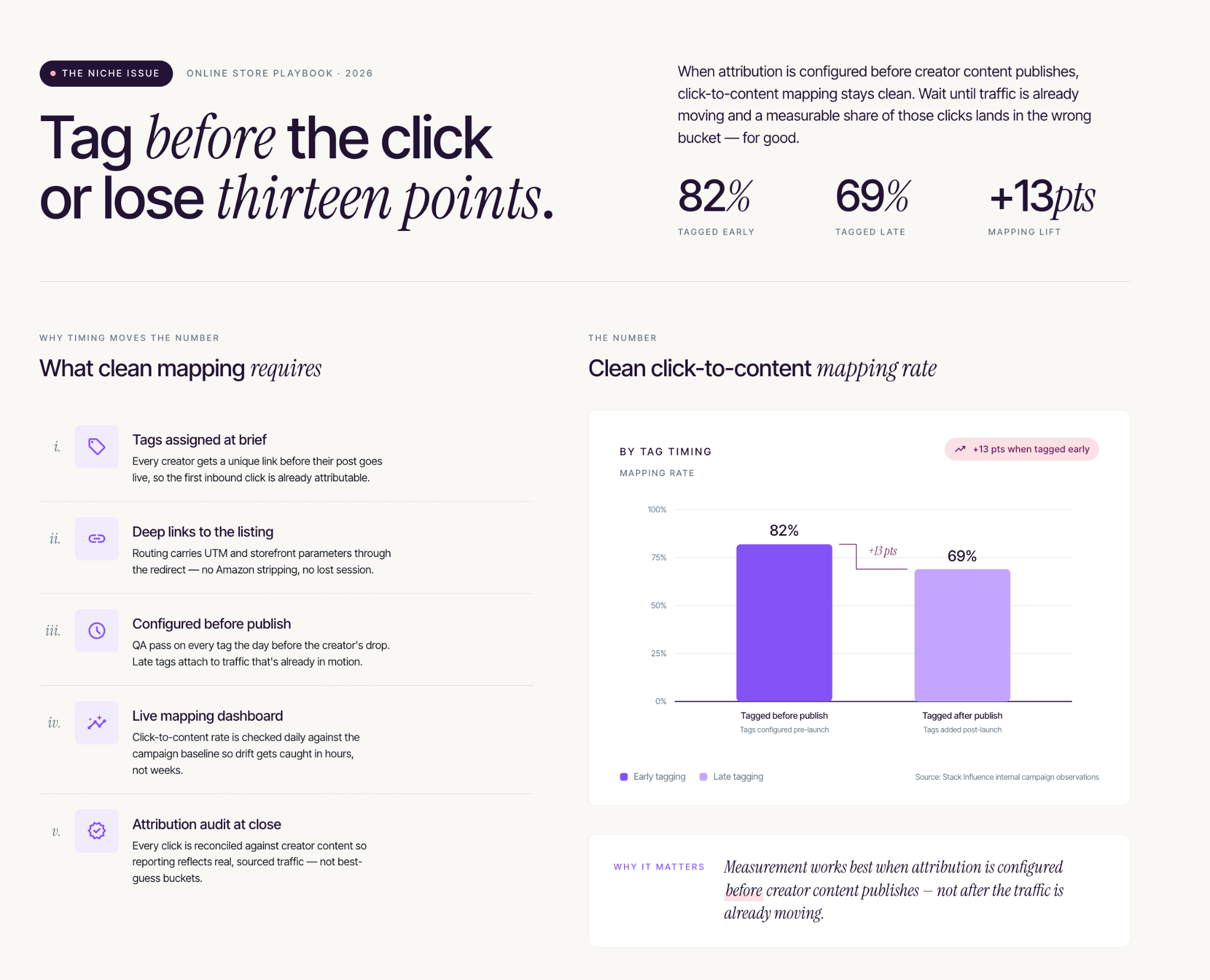
Once the signal is clean, judge the idea with economic discipline. A category that drives clicks but cannot recover creator cost, discount pressure, Amazon referral fee pressure, and fulfillment cost is not a winning idea for an online store. It is just an interesting source of traffic.
Build the Store Around Proof, Not Guesswork
Most articles about ideas for online store planning help you brainstorm. Serious eCommerce sellers need a stricter outcome than inspiration. They need a category that can earn trust repeatedly, survive cross-channel measurement, and give the business room to scale without rebuilding the offer every quarter.
Use the Four Rules of Viable Store Ideas to narrow the field, pressure-test the winner with the Proof-to-Profit Stack, and move faster only when the niche shows repeat demand, content fit, and clean economics. That approach gives DTC brands and Amazon sellers a better path to stronger launches, smarter inventory decisions, and store growth that compounds.