




Luxury brands are spending more on creator partnerships than ever before, yet most influencers approach these deals the wrong way. They chase follower counts, negotiate a flat fee, and post a single polished photo, and then they wonder why the brand never calls back. Luxury brand marketing operates on a completely different logic than mass-market campaigns, and understanding that logic is what separates creators who land one deal from creators who become long-term brand ambassadors. This guide will walk you through exactly how luxury influencer marketing works, what brands are actually looking for, and how to build a strategy that turns a single campaign into an ongoing creative partnership.
Key Takeaways
- Luxury brand marketing prioritizes exclusivity, narrative quality, and audience alignment over raw reach, making micro influencers and nano influencers powerful partners for premium campaigns.
- The Creator Alignment Matrix helps you evaluate whether a brand opportunity fits your positioning before you pitch or accept a deal.
- UGC and product seeding are two of the most underutilized entry points for creators looking to break into luxury brand deals without a massive following.
- Measuring success in luxury influencer campaigns requires a named metric model that goes beyond likes and impressions to include brand-lift indicators and content reuse rates.
- Long-term brand ambassador relationships deliver significantly higher ROI for both creators and brands than one-off sponsored posts.
How to Position Yourself for Luxury Brand Marketing Deals
Most creators assume that luxury brands only work with mega-influencers or celebrities. The reality in 2026 is far more nuanced. Micro influencers with 10,000 to 100,000 followers deliver some of the highest engagement rates and strongest ROI across industries, and in luxury marketing specifically, they outperform larger creators because their audiences perceive them as genuine and relatable yet aspirational. That perception gap is exactly what luxury brands are trying to close.
Positioning yourself for luxury brand marketing starts before you pitch any brand. Your content aesthetic, caption voice, and even the way you frame everyday objects should signal an appreciation for quality, craft, and detail. Luxury houses study a creator's entire content library before reaching out, not just their last 12 posts. Consistency in visual identity and storytelling depth carries more weight than a one-time viral video.
Here are the core positioning signals luxury brands look for in a creator partner:
- Aesthetic coherence: A consistent visual style across platforms that aligns with premium product categories, whether that is fashion, beauty, travel, or lifestyle.
- Narrative depth: Captions and video scripts that go beyond "this product is amazing" to discuss craft, origin, or personal meaning.
- Audience quality: A following where comments are substantive and engagement reflects genuine interest in the niche, not passive scrolling.
- Platform presence: Active on at least two platforms, with a primary focus on Instagram or TikTok and a secondary presence on YouTube or a newsletter.
- Prior brand history: Past collaborations that show you can produce brand-aligned content without losing your authentic voice.
Creators who build niche micro influencer audiences around specific lifestyle verticals are particularly well-positioned for luxury partnerships. A creator focused on slow travel, artisan food, or heritage menswear has an audience that luxury brands recognize as their own target customer. That specificity is worth more than a larger but diffuse following in a general lifestyle category.
What Is Luxury Brand Marketing?
Luxury brand marketing is the strategic practice of building and sustaining perceived exclusivity, cultural relevance, and emotional desire for high-end products or services through carefully curated storytelling and partnerships. Unlike mainstream consumer marketing, which often focuses on volume and conversion speed, luxury marketing prioritizes brand equity, aspiration, and a sense of belonging to a select community. The goal is not simply to sell a product but to sell a world that the buyer wants to inhabit.
Across generations, spending patterns in luxury remained relatively stable in 2025, with Millennials accounting for about 46% of total luxury spending. Gen Z is more critical and tends to be more open but less loyal, prioritizing individual identity over community and evaluating brands on cultural relevance, not status. That shift toward values-driven purchasing is exactly why creator partnerships have become central to luxury marketing strategy.
Ninety-two percent of consumers trust user-generated content more than traditional promotional messages, and posts featuring UGC receive 6.9 times higher engagement than brand-generated content. For luxury brands, this statistic reframes the entire value of a creator relationship. A well-crafted UGC post from a credible micro influencer can outperform a six-figure brand campaign on click-through and conversion efficiency.
Understanding the luxury marketing landscape means grasping three defining principles:
- Scarcity signaling: Luxury brands deliberately limit access, whether that is to products, events, or creator collaborations, to preserve perceived value.
- Storytelling over selling: The most effective luxury brand partnerships focus on narrative first and product second, allowing the item to appear as a natural extension of the creator's world.
- Halo effect attribution: A creator's credibility and lifestyle associations transfer to the brand through repeated, authentic integration, not one-off mentions.
For creators who want to break into influencer marketing campaigns with luxury brands, internalizing these principles changes how you pitch, what content you create, and how you negotiate content rights and usage terms.
The Creator Alignment Matrix
The Creator Alignment Matrix is a decision framework that helps creators and brand partnerships teams evaluate whether a luxury collaboration is strategically sound before any contract is signed. It operates on two variables: Brand World Fit and Audience Desire Alignment. Both variables must score highly for a luxury partnership to deliver long-term value. The matrix identifies four quadrants that predict collaboration outcomes.
Use the Creator Alignment Matrix before accepting any luxury brand opportunity by scoring each variable:
- High Brand World Fit + High Audience Desire Alignment: The ideal quadrant. The creator's aesthetic and values mirror the brand's identity, and their audience actively aspires to the brand's category. Pursue long-term ambassador terms here.
- High Brand World Fit + Low Audience Desire Alignment: The creator looks like the brand but their audience is not the buyer. Good for brand awareness campaigns but low conversion efficiency. Negotiate for content licensing rather than sales-linked performance.
- Low Brand World Fit + High Audience Desire Alignment: The creator's audience is the right buyer, but the creator does not embody the brand's world. High-risk collaboration. The post may feel forced and damage both parties.
- Low Brand World Fit + Low Audience Desire Alignment: Do not accept this deal. The mismatch will produce low engagement, dilute your creator credibility, and deliver poor ROI for the brand.
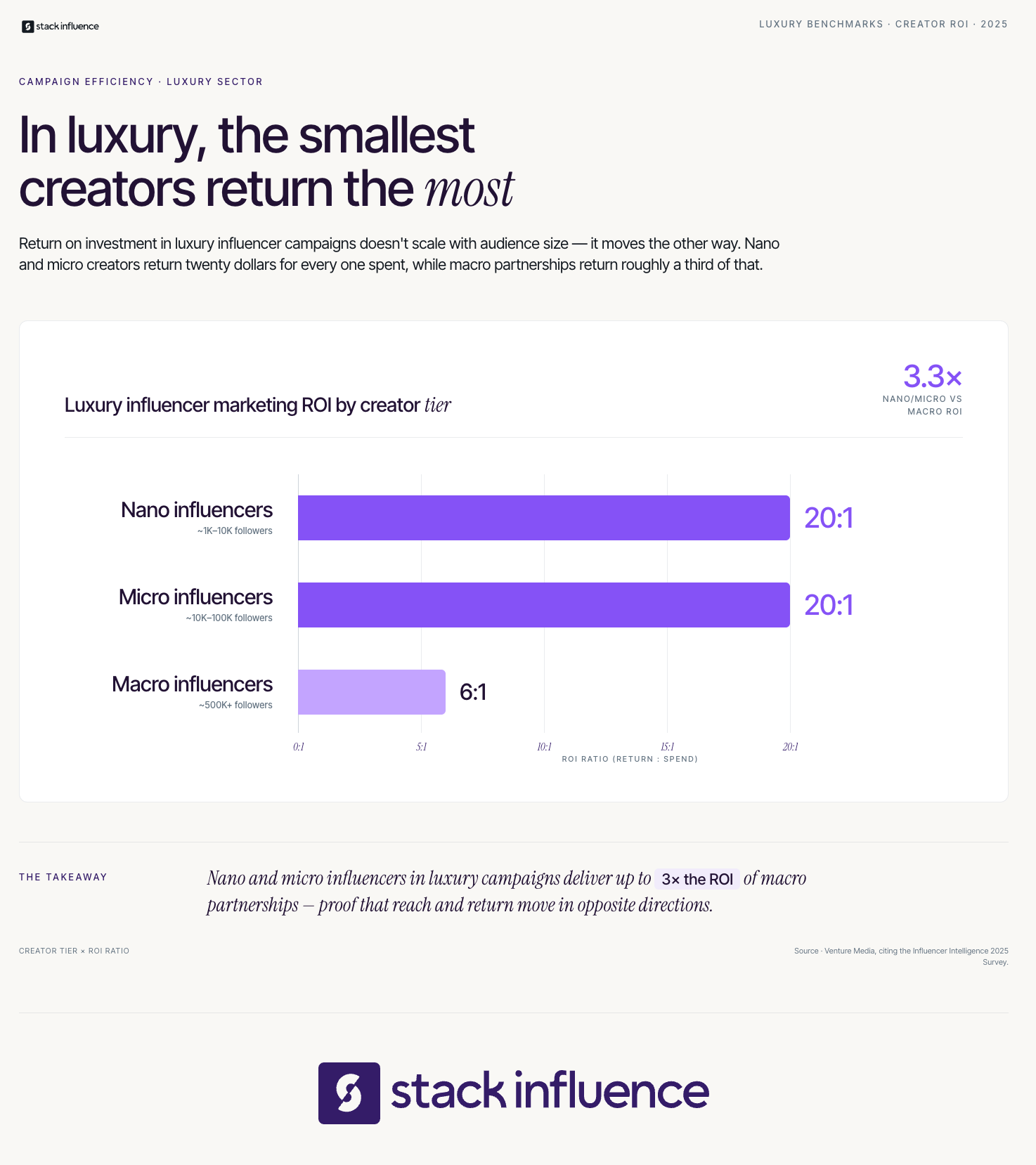
A 2025 survey from Influencer Intelligence found that campaigns driven by micro influencers in luxury marketing achieved ROI as high as 20:1, compared to 6:1 when using macro influencers. That six-to-one gap exists largely because macro influencers often score high on reach but low on Audience Desire Alignment for the specific luxury category they are promoting.
Stack Influence's internal campaign data shows that in the luxury and premium beauty categories, creators who scored in the top quadrant of the Creator Alignment Matrix were three times more likely to be invited into paid retainer partnerships after an initial product seeding collaboration, compared to creators who accepted deals outside their content world.
Always run the Creator Alignment Matrix before accepting an inbound brand inquiry. A deal that looks attractive on paper can quietly damage your credibility if the brand's world does not match the aspirational space you have built for your audience. The framework also functions as a negotiation tool. When you can demonstrate high alignment using concrete content examples, you have the leverage to negotiate better usage rights and higher compensation.
What Does "Authentic Luxury" Actually Mean for Creators?
The phrase "authentic luxury" sounds like a contradiction, but it is the central tension that defines modern luxury brand marketing. Luxury is inherently constructed and aspirational, while authenticity implies spontaneity and transparency. The brands winning in 2026 are the ones who have figured out how to make the constructed feel genuine, and they are doing it through creators who genuinely love the product category.
The BoF-McKinsey State of Fashion 2024 Consumer Survey found that 68% of respondents were unhappy about the high volume of sponsored content on social media platforms, and 65% were turning less to fashion influencers than a few years ago. This is the tension creators must navigate. Audiences are fatigued by obvious promotional content, but they are still deeply influenced by creators they trust. The solution is not less sponsored content. It is more deeply integrated, values-aligned content.
The global fashion influencer marketing market was valued at $6.82 billion in 2024 and is projected to reach $39.72 billion by 2030, growing at a CAGR of 33.8% from 2025 to 2030. That growth is not being driven by celebrity partnerships. It is being driven by the long tail of niche creators who have built genuine authority in specific categories that luxury brands want to reach.
Here is what authentic luxury content actually requires from creators:
- Product immersion before posting: Use the product for at least one to two weeks before creating any content. Real usage details, personal observations, and honest opinions are what separate credible luxury content from obvious advertorial posts.
- Context over catalog: Photograph or film the product in your actual environment, not a staged set. The brand's item should look like it belongs in your world, not like it was placed there for a shoot.
- Opinion without script: Share a genuine perspective, even if it includes a caveat or a preference. Audiences respond to specificity. Saying "the texture of this serum is heavier than I expected but it is perfect for dry winter skin" is more trustworthy than generic praise.
- Disclosure done right: Clear, prominent disclosure of paid partnerships or gifted products protects both your audience's trust and your legal standing. Transparency paradoxically increases credibility in luxury content.
From Stack Influence's experience running product seeding campaigns across beauty and lifestyle categories, creators who integrated gifted luxury products into existing content series rather than producing standalone sponsored posts saw an average of 2.4x higher engagement rates and significantly higher content reuse rates from brand partners.
The influencer seeding workflow for eCommerce brands follows the same logic at scale. The most effective product seeding campaigns for luxury-adjacent brands succeed not because creators are required to post, but because the product experience is compelling enough that they post organically. That organic quality is what separates content that converts from content that merely fills a feed.
The Prestige Creator Checklist
The Prestige Creator Checklist is a secondary framework designed to be used alongside the Creator Alignment Matrix. Where the matrix evaluates strategic fit, the checklist audits your operational readiness before you pitch a luxury brand or accept a deal. Run through all eight items before entering any luxury creator partnership.
According to data from the Sprout Social 2025 Influencer Marketing Report, 65% of influencers prefer joining strategy development conversations with brands early on rather than following a rigid brief. The Prestige Creator Checklist helps you show up to those conversations prepared.
The Prestige Creator Checklist includes:
- Media kit updated within the last 90 days: Includes current audience demographics, engagement rate by platform, top-performing content examples, and past brand collaborations with category relevance.
- Content library screenshot-ready: At least 20 posts in your primary category that demonstrate consistent aesthetic, caption depth, and audience interaction quality.
- Usage rights policy defined: Know before the conversation whether you will grant the brand paid usage rights for their own advertising, and at what price tier.
- FTC disclosure practice documented: A clear, practiced disclosure format for every platform you use, because luxury brands have legal teams that will review your posts.
- Partnership preference stated: Know whether you want a one-time collaboration, a product seeding relationship, or a long-term brand ambassador agreement before you walk into the negotiation.
- Niche authority positioned: Identify the one to two content pillars that position you as a credible authority in the brand's world, and lead with those in your pitch.
- Production capacity confirmed: Luxury brands have timelines and quality standards. Know your turnaround speed and what you can realistically deliver before committing to deliverables.
- Rate card benchmarked: Research current creator economy pricing for your follower tier and engagement level before the first call. Brands looking for influencers in the luxury space often have higher budgets than you might expect for micro influencer work.
Across campaigns managed on the Stack Influence platform, creators in the fashion and beauty categories who entered luxury brand conversations with all eight checklist items ready were significantly more likely to convert an initial inquiry into a paid retainer deal within the first 30 days of contact, compared to those who prepared only a basic media kit.
The Prestige Creator Checklist also functions as a self-assessment tool. If you cannot check off six or more of these items, you are not yet ready to pitch luxury brands. Use the gap as a 60-day roadmap to get there, and revisit influencer marketing platform resources to benchmark your content against other creators in your vertical.
Measuring What Actually Matters: The Luxury Signal Stack

Most guides to influencer marketing metrics focus on engagement rate, reach, and impressions. Those numbers matter, but for luxury brand marketing specifically, they are not the metrics that brands use to decide whether to renew a partnership. The Luxury Signal Stack is a named metric model built for creators and brands navigating premium partnerships.
The Luxury Signal Stack has four components:
- Brand-Lift Indicator (BLI): Tracks whether mentions of the brand in the creator's comment section increase over time, how many followers ask where to buy the featured product, and whether the creator's audience begins associating their channel with the brand's category. This is measured through comment audits and social listening tools.
- Content Reuse Rate (CRR): Measures how many pieces of creator-produced content the brand repurposes in their own paid advertising, organic channels, or retail displays. A high CRR signals that the brand finds the content commercially valuable and is an indicator of deeper partnership potential.
- Conversion Attribution Score (CAS): Calculated using unique discount codes, affiliate links, or UTM parameters embedded in stories and bio links. For luxury brands with longer purchase consideration cycles, this metric should be tracked over a 30 to 60-day attribution window, not just the 24-hour post window.
- Audience Aspiration Index (AAI): A qualitative measure of whether the creator's audience aspires to the brand's price point and lifestyle. Gathered through audience polling, DM analysis, and comment sentiment. Luxury brands use this to validate that a creator's audience is an actual future buyer, not just an admirer.
UGC generates 6.9x more engagement than brand content, and on average, UGC posts achieve 28% higher engagement rates than brand-created alternatives, reflecting algorithmic preferences for authentic, user-centric content. These numbers explain why Content Reuse Rate has become a critical negotiation metric in luxury partnerships. Brands know that creator UGC outperforms their own content, and they are willing to pay a premium for usage rights.
For DTC brands and Amazon sellers running luxury-positioned products, the Luxury Signal Stack connects naturally to Amazon Attribution tracking links, which allow brands to measure exactly which creator touchpoints drive traffic and sales on the marketplace. Amazon sellers using the Amazon Brand Referral Bonus program can also offset a portion of influencer campaign costs through traffic-driven bonus earnings, making the economics of creator partnerships measurably stronger.
Reference the Luxury Signal Stack in your creator media kit by listing which of the four metrics you actively track and can report to brand partners. Most creators only offer engagement rate data. Showing up with CRR and BLI data demonstrates a level of professional sophistication that luxury brands respond to immediately.
Should You Accept a Luxury Brand Deal Without Upfront Payment?
The most common mistake new creators make in luxury brand marketing is confusing brand prestige for compensation. Being offered a collaboration with a heritage fashion house or a premium skincare brand feels validating, but product-only deals without creative compensation can undermine your business and your credibility over time.
The 2025 Influencer Marketing Report indicates that half of influencers charge between $250 and $1,000 per post, but 71% offer discounts for longer-term partnerships and 25% would consider doing so in the future. That pricing data confirms that most creators in the mid-tier are leaving money on the table with luxury brands that have budget to invest in creator partnerships.
Product seeding without upfront payment makes strategic sense in one specific situation: when the brand is in the top quadrant of your Creator Alignment Matrix and the goal is to build a relationship that can convert into a paid ambassador program. In that scenario, the gifted product is not compensation. It is a first-chapter introduction. Everything after that first post should carry a creative fee.
Here is when to accept versus negotiate luxury brand deal structures:
- Accept product-only: When the brand is a genuine aspirational fit, the product has a retail value that reflects meaningful compensation, and your primary goal is brand association and content creation for your own portfolio.
- Negotiate for usage rights fees: When the brand explicitly plans to repurpose your content in paid advertising or retail channels. Usage rights are separate from the creative fee and should be priced accordingly.
- Require a flat creative fee: When you have demonstrated creator authority in the brand's category and the brand is asking for multiple deliverables, specific usage permissions, or exclusivity in a product category.
- Walk away: When the brand's terms include non-negotiable exclusivity clauses that prevent you from working with competitors but offer no financial compensation for that restriction.
The creator economy has matured enough in 2026 that luxury brands working with micro influencers understand that professional creators have professional rate expectations. Creators who approach brand deals with the brand ambassador mindset and a clear value proposition consistently secure better terms than those who treat brand inquiries as personal validation rather than business opportunities.
Conclusion
Luxury brand marketing rewards creators who understand its logic: exclusivity, narrative depth, and long-term relationship building over transactional posts. The Creator Alignment Matrix and the Prestige Creator Checklist give you two concrete frameworks to evaluate every opportunity before you say yes. The Luxury Signal Stack gives you the measurement language that luxury brands actually use internally, and speaking that language puts you on equal footing in every partnership negotiation.
The creator economy is shifting toward quality over quantity in every category, and luxury is leading that shift. Creators who invest in their content craft, build authority in specific niches, and show up to brand conversations with professional preparation are the ones landing the most meaningful brand partnerships in 2026. Use this guide as your operating system for every luxury brand marketing opportunity that comes your way.